The strangest fact about Audioslave's debut is that the album already existed, in rough form, six months before anyone was supposed to hear it. On 17 May 2002, thirteen unfinished tracks credited to "Civilian" leaked across peer-to-peer networks under the heading "The Civilian Project". Tom Morello publicly blamed an intern at Bad Animals Studios in Seattle. Whoever it was had pirated a record by a band that, at that exact moment, was not entirely sure it still existed: Chris Cornell had walked out two months earlier and the four musicians were not on speaking terms. The album would eventually arrive on 18 November 2002, sell 162,000 copies in its first US week, debut at seven on the Billboard 200, and end the decade triple platinum. It would also, somehow, get a 1.7 out of 10 from Pitchfork and an A-minus from Entertainment Weekly in the same fortnight.
That contradiction is the entire story of Audioslave. A supergroup that nearly fell apart twice before its first single, made by four players whose previous bands had defined two distinct strains of 1990s rock, produced by Rick Rubin, leaked from inside a studio, named after a band the four of them had to pay 30,000 dollars to use, and packaged inside a Storm Thorgerson cover photographed on a volcanic island. Everything about the record is more complicated than the songs themselves let on. The songs themselves, as it turned out, were direct, melodic, riff-driven hard rock, the kind both Soundgarden and Rage Against the Machine had hinted at without ever fully writing. They were good enough to sell three million copies in America even after the press largely dismissed them.
Album Facts
| Field | Detail |
|---|---|
| Artist | Audioslave |
| Album | Audioslave |
| Release Date | 18 November 2002 (UK), 19 November 2002 (US) |
| Label | Epic, Interscope |
| Producers | Rick Rubin and Audioslave |
| Studios | Cello Studios (Hollywood), Royaltone (Burbank), Litho and Studio X (Seattle), Akademie Mathematique of Philosophical Sound Research (Los Angeles) |
| Genre / Subgenre | Hard rock, alternative rock |
| Track Count | 14 |
| Total Runtime | 65:26 |
| Billboard 200 Peak | 7 (162,000 first-week sales) |
| UK Albums Chart Peak | 19 (Number 2 on the UK Rock and Metal Albums chart) |
| Other Notable Chart Peaks | New Zealand 4, Norway 5, Canada 6, Australia 8, Sweden 14, Finland 28 |
| Certifications | RIAA 3x Platinum, ARIA 3x Platinum, RMNZ 3x Platinum, Music Canada 2x Platinum, BPI Platinum, BVMI Gold, IFPI Norway Gold, FIMI Gold, Pro-Musica Brasil Gold, Musiikkituottajat Gold |
| Estimated Sales | Over 3 million in the US alone; over 4 million worldwide; Audioslave's best-selling album by a wide margin |
| Key Singles | Cochise, Like a Stone, Show Me How to Live, I Am the Highway |
Cultural Context
November 2002 was a strange month to release a supergroup record. The Strokes had reset what a guitar band was supposed to look like with Is This It the year before. The White Stripes' White Blood Cells was midway through its slow burn. Nu-metal had peaked, gone mainstream, and started to feel old: Linkin Park's Hybrid Theory was approaching diamond, Korn had just released Untouchables, and Limp Bizkit were touring without a guitarist. Queens of the Stone Age had put out Songs for the Deaf, Pearl Jam had Riot Act, Red Hot Chili Peppers had By the Way, and System of a Down had Steal This Album! reissuing leaked material. Pitchfork, by 2002, had become a cultural force; its review economy ran on hostility to anything that smelled like corporate rock.
Into that environment landed a record produced by the man who had made the Beastie Boys, Run-DMC, Slayer, the Red Hot Chili Peppers, Johnny Cash, and Rage Against the Machine themselves. The album cost a small fortune to make, came packaged with a Storm Thorgerson sleeve that openly referenced his Pink Floyd work, and contained a song with a Tom Morello solo that imitated a helicopter rotor. Either Audioslave was going to be the moment alternative rock returned to its 1970s heavy-rock roots, or it was going to be a relic of an older industrial process the moment it shipped. The press argued furiously over which it was. The buyers had less doubt.
The Band's Story Up to This Point
Two careers ended to make Audioslave possible. Soundgarden had fallen apart in April 1997 after the Down on the Upside tour. Rage Against the Machine had imploded on 18 October 2000 when Zack de la Rocha announced he was leaving, citing decision-making frustrations. Chris Cornell had spent the years since 1997 making one solo album, Euphoria Morning, which had under-performed, and had begun writing what was going to be its follow-up. Tom Morello, Tim Commerford and Brad Wilk had spent the months since de la Rocha's departure auditioning vocalists.
It was Rick Rubin, friend and producer to all three of the Rage instrumentalists, who suggested they call Cornell. Rubin played them Slaves and Bulldozers from Badmotorfinger as the audition reel. Cornell, despite being well into his second solo record, agreed to come down. The first jam produced an instant chemistry, Morello told MTV that what came out of the speakers was not "good" or "great" but "transcendent". The four wrote 21 songs in 19 days of rehearsal. They started recording at the end of May 2001.
"He stepped to the microphone and sang the song and I couldn't believe it. It didn't just sound good. It didn't sound great. It sounded transcendent. And when there is an irreplaceable chemistry from the first moment, you can't deny it."
Tom Morello, MTV News, 22 November 2002
Pre-production and Demos
The rehearsal phase produced more material than the band could ever release. The 21 songs cut in those 19 days were the bones of the album, plus several tracks that would later resurface on Out of Exile and Revelations. Cornell wrote all the lyrics himself, in keeping with his Soundgarden practice; the band shared music credits four ways on every song. The chemistry was friction-free in the writing room and instantly toxic outside it. Management conflicts reached a head on 22 March 2002, three days after the band had announced their participation in the seventh Ozzfest tour. Cornell quit. The Ozzfest dates were cancelled. The band sat in limbo for six weeks before Cornell came back, with new management in place.
The leak nearly finished them off a second time. On 17 May 2002, thirteen rough mixes credited to "Civilian" or "The Civilian Project" appeared on Napster successors and message boards. Some had different lyrics, different solos, different vocal takes. Morello fingered an intern at Bad Animals Studios in Seattle in a Metal Sludge interview that July; whoever it was had walked tapes out of the building. The band could either rush an early release to compete with the leak or push through to a finished record. They chose to keep recording. The leak, in retrospect, became part of the album's promotion: half the rock internet had heard a worse version of the songs by the time the real version came out.
- 21 songs written in 19 days of pre-production rehearsal at the start of the project.
- Cornell quit on 22 March 2002 and rejoined the band six weeks later after a management overhaul.
- 13 unfinished demos leaked online on 17 May 2002 as "The Civilian Project".
- Cornell entered rehab in late 2002 for a two-month stay during the album's release cycle.
- The band paid 30,000 US dollars to a Liverpool group called Audioslave for the right to use the name.
Creating the Album
Recording began in late May 2001 and finished in June 2002, an unusually long thirteen-month tracking window broken by Cornell's six-week walkout and the leak. Five studios were used: Cello in Hollywood (the old Western and United complex on Sunset, with Neve 8078 desks and a long history with Frank Sinatra and the Beach Boys), Royaltone in Burbank, Litho and Studio X in Seattle (Cornell's home turf), and a private room called the Akademie Mathematique of Philosophical Sound Research in Los Angeles, which is a Rick Rubin facility. Rubin produced with the band credited as co-producers. Rich Costey mixed. David Schiffman and Andrew Scheps recorded, with John Burton, Floyd Reitsma and Thom Russo on additional engineering and Greg Fidelman on digital editing. Vlado Meller mastered.
Sonically the album leans hard on Morello's Telecaster-through-Marshall signature setup and his usual battery of effects: the DigiTech Whammy, kill switch, Cry Baby wah, and on Cochise's intro a deliberate helicopter rotor effect built from rapid arm-swings on the volume control. Tim Commerford's bass, fed through Ampeg SVT and a parallel distorted DI, gave songs like Cochise and What You Are their lower-mid grind. Brad Wilk's drums were tracked dry and big in the room, often with the kit positioned in Cello's main live space. Cornell's vocals were largely cut at Studio X in Seattle, on a Neumann U87, and were notable for taking fewer takes than Rubin had expected, at least until Cornell's drinking caught up with him in late 2002 and he checked into rehab for two months, conducting a Metal Hammer interview from a clinic payphone.
"It was a horrible personal crisis. But I was writing some of the best music of my life. I always like to look at periods of greatest darkness and pain, and they always coincide with making music or writing music."
Chris Cornell, San Diego CityBeat, 2005
Rubin's decision-making during the sessions was characteristically minimalist. Where producers like Bob Rock would have layered guitars eight deep, Rubin kept things to one or two main parts and pushed the band toward arrangements that resembled live takes. Critics later attacked him for it; Pitchfork called the result "a synthesized rock-like product that emits no heat" and Stylus Magazine awarded the record an F. Audiences disagreed. The album later got a DualDisc audiophile release with a 48 kHz DVD side that has been used as reference material for high-end home cinema systems.
Personnel and Credits
| Role | Player | Notes |
|---|---|---|
| Core band | ||
| Lead vocals, lyrics | Chris Cornell | All lyrics on every track; tracked at Studio X, Seattle. Entered rehab during release cycle. |
| Guitars | Tom Morello | Helicopter-effect intro on Cochise; Whammy, kill switch, Marshall JCM800. |
| Bass, backing vocals | Tim Commerford | Parallel-distorted DI plus Ampeg SVT; provided the album's lower-mid weight. |
| Drums | Brad Wilk | Big-room sound; minimal close-mic processing. |
| Production and engineering | ||
| Producer | Rick Rubin and Audioslave | Rubin's first project with this lineup after producing two Rage Against the Machine albums. |
| Mixing | Rich Costey | Mixed during a 2002 run that also included Muse and Mastodon. |
| Recording engineers | David Schiffman, Andrew Scheps | Both went on to lengthy mainstream rock careers; Scheps later mixed Adele's 21. |
| Additional engineering | John Burton, Floyd Reitsma, Thom Russo, Andrew Scheps | Cross-studio coverage; Reitsma's Litho is Stone Gossard's Seattle facility. |
| Assistant engineers | Chris Holmes, Darron Mora | Cello Studios assistants. |
| Digital editing | Greg Fidelman, Thom Russo, Andrew Scheps | Fidelman went on to produce Metallica's Hardwired. |
| Mastering | Vlado Meller | Sony Mastering, New York. |
| Production coordinator | Lindsay Chase | Credited as the album's "wrangler". |
| Artwork and packaging | ||
| Album cover and art direction | Storm Thorgerson, Peter Curzon | Hipgnosis principal; veteran of Pink Floyd, Led Zeppelin, Genesis sleeves. |
| Flame logo | Peter Curzon | Created the band's enduring visual signature. |
| Cover photography | Rupert Truman | Shot on the volcanic island of Lanzarote. |
| Band photography | Danny Clinch | Long-time rock photographer; later directed the band's documentary Live in Cuba. |
| Sculpture | Hothouse | Built the physical metal flame sculpture used in the cover photograph. |
| Art direction assistance | Dan Abbott, Finlay Cowan | Cowan is a long-time Hipgnosis collaborator and Roger Waters illustrator. |
The Songs
For all the supergroup-era expectations, Audioslave is structurally a straightforward hard-rock record. Fourteen tracks, no instrumentals, no skits, no guests. Cornell wrote every lyric. The four band members shared every music credit four ways. The album opens with three of its strongest songs in sequence, Cochise, Show Me How to Live, Gasoline, then drops a slow-burn ballad in What You Are, then drops the album's biggest single in Like a Stone at track five, then proceeds through ten more songs that get progressively more textural and less radio-shaped. The pacing front-loads the singles in a way that has not aged well; the back half (Hypnotize, Bring Em Back Alive, Light My Way, Getaway Car, The Last Remaining Light) is where the band's experimental side actually lives, and where most of the album's defenders point when they argue it has been under-rated.
| # | Title | Length | Single? | Notes |
|---|---|---|---|---|
| 1 | Cochise | 3:42 | Yes (Sept 2002) | Helicopter-effect intro; lyric is Cornell yelling at a mirror. |
| 2 | Show Me How to Live | 4:38 | Yes (June 2003) | Existential plea framed in Frankenstein imagery. |
| 3 | Gasoline | 4:39 | Pure riff workout; live staple. | |
| 4 | What You Are | 4:09 | Yes | Reached top 10 on Mainstream Rock; underrated middle single. |
| 5 | Like a Stone | 4:54 | Yes (April 2003) | Number 1 on both Modern Rock and Mainstream Rock; Grammy nominated. |
| 6 | Set It Off | 4:23 | Tom Morello's most overt Soundgarden-esque riff. | |
| 7 | Shadow on the Sun | 5:43 | Used in Collateral (2004); slow-burn ballad. | |
| 8 | I Am the Highway | 5:35 | Yes (Sept 2003) | Acoustic-led; band's first proper crossover ballad. |
| 9 | Exploder | 3:26 | Funkiest groove on the record; Commerford's moment. | |
| 10 | Hypnotize | 3:27 | One of the leaked Civilian tracks; lyric was rewritten before release. | |
| 11 | Bring Em Back Alive | 5:29 | Dropped tunings; the album's heaviest moment. | |
| 12 | Light My Way | 5:03 | Cornell's most overtly spiritual lyric. | |
| 13 | Getaway Car | 4:59 | Late-album highlight, often cited by fans as a missed single. | |
| 14 | The Last Remaining Light | 5:17 | Slow-fade closer; Cornell falsetto over arpeggiated guitar. |
Two songs deserve their own paragraph. Cochise opens the record with the most recognisable Tom Morello recording of the post-Rage era, a guitar tone that imitates a helicopter rotor approaching from a distance, achieved by rapid swings on the volume knob and a long delay tail. The lyric, despite the title, has nothing to do with the Apache leader; Cornell told Gavin Edwards it is "me yelling at me, looking in the mirror". Like a Stone is the album's commercial centrepiece. It is the only track on which the band's combined chemistry produced something neither Soundgarden nor Rage Against the Machine could have made alone: a slow-burn meditation on mortality and longing, in 6/8, that reached number one on both the Billboard Modern Rock and Mainstream Rock charts and earned a Grammy nomination for Best Hard Rock Performance.
B-sides, Outtakes and Lost Songs
The 21-songs-in-19-days writing burst left a sizeable surplus. The material that did not make the album fell into three categories: the leaked Civilian tracks (most of which were rewritten for the released album rather than dropped entirely), genuine B-sides used for single releases, and material that was reworked and saved for Out of Exile (2005) and Revelations (2006). A bonus track called Give was released for a limited time through the album's ConnecteD CD-ROM portal and has never been issued on any official compilation since. The Cornell-helmed cover of Bob Marley's Redemption Song later cut on the band's 2005 trip to Cuba is sometimes catalogued with the debut, but actually post-dates it.
- Give, ConnecteD-only bonus track, accessed via CD-ROM at launch.
- The Civilian Project demos, 13 leaked rough mixes from May 2002, most rewritten for the released album.
- Sleeping in the Fire, recorded for the album, deemed not strong enough, never officially released.
- Stay, a Cornell-led ballad reworked and held back for Out of Exile.
- Doesn't Remind Me (early version), written during the debut sessions, finished and released on Out of Exile.
The deluxe-edition treatment that would normally compile this kind of material has, twenty years later, never appeared. Sony has reissued the album on coloured vinyl multiple times but has never put out a 20th-anniversary expanded edition with the Civilian demos officially licensed. Fans have asked, repeatedly, for the leak to be tidied up and released as the Civilian Project EP. So far the label has declined.
Album Artwork and Packaging
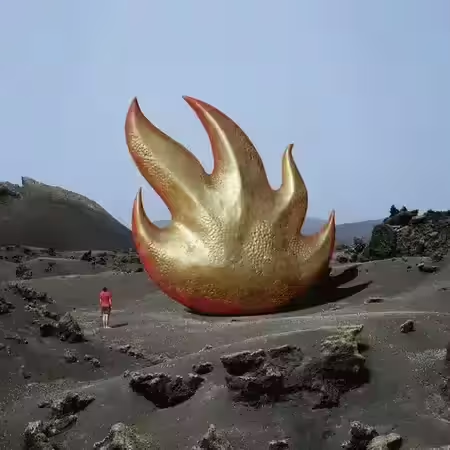
Storm Thorgerson got the cover commission through Rick Rubin, who had worked with him on the cover of System of a Down's Toxicity the previous year. Thorgerson, working with Peter Curzon and the photographer Rupert Truman, flew to the Spanish island of Lanzarote in the Canaries, a volcanic landscape that had been used decades earlier for parts of One Million Years B.C. A physical metal flame sculpture, built by the British prop firm Hothouse, was positioned against the black volcanic rock and photographed at golden hour. Curzon's stylised flame logo became the band's permanent visual signature.
Thorgerson described the music as "brooding and sultry, carrying a sense of threat as if about to burst asunder or erupt in fury, much like a volcano". The flame, in his explanation, was an "eternal flame", a memorial to the two extinct bands inside the new one. Pilgrims and "slaves of sound" were "duty-bound to visit and pay homage with their beater". An alternate cover, with a naked man standing before the flame, was photographed at the same Lanzarote shoot but was rejected. Thorgerson said later that the band came close to using it but were "not entirely sure of the nude figure". The image survives in the 2010 Classic Rock magazine calendar.
"The music of Audioslave struck us as brooding and sultry, carrying a sense of threat as if about to burst asunder or erupt in fury, much like a volcano. The flame is the eternal flame, embodying the memory of two previous incarnations: namely Soundgarden and Rage Against the Machine."
Storm Thorgerson, Classic Rock magazine, March 2009
Release and Reception
The album debuted at number seven on the Billboard 200 with first-week US sales of 162,000 copies. It hit number 19 on the UK Albums Chart, number two on the UK Rock and Metal Chart, top ten in Australia, Canada, New Zealand and Norway, and was certified gold by the RIAA less than a month after release. By 2006 it was triple platinum. It is, twenty-three years on, comfortably the band's best-selling album. Like a Stone became their biggest single, reaching number one on both the Billboard Modern Rock and Mainstream Rock charts and earning a Grammy nomination for Best Hard Rock Performance.
Critically the response split harder than the chart numbers suggest. Pitchfork's Chris Dahlen and Ryan Schreiber gave it 1.7 out of 10, calling it "the worst kind of studio rock album, rigorously controlled, even undercut, by studio gimmickry" and Cornell's lyrics "complete gibberish". Jon Monks at Stylus Magazine awarded it an F and called Rubin's production "over-produced, overlong and over-indulgent". Entertainment Weekly's David Browne went the other way and gave it an A-minus. Q magazine gave it four and a half stars, Spin gave it four, Rolling Stone three, AllMusic three, NME a startlingly low four out of ten. Metacritic landed on 62 out of 100. Rock Hard's 2005 book The 500 Greatest Rock and Metal Albums of All Time ranked the album at 281.
| Publication | Score | Reviewer |
|---|---|---|
| Metacritic | 62/100 | Aggregate |
| Pitchfork | 1.7/10 | Chris Dahlen and Ryan Schreiber |
| Stylus Magazine | F | Jon Monks |
| NME | 4/10 | Uncredited |
| AllMusic | 3/5 | Stephen Thomas Erlewine |
| Rolling Stone | 3/5 | Pat Blashill |
| Entertainment Weekly | A- | David Browne |
| Q magazine | 4.5/5 | February 2003 issue |
| Spin | 4/5 | Chuck Klosterman |
| Dotmusic | 8/10 | Chris Heath |
| Rock Hard book | Number 281 in 500 Greatest Rock and Metal Albums | 2005 reader poll |
Singles and Music Videos
Four singles were officially worked, with What You Are and Show Me How to Live also charting strongly off the back of rock-radio play. The lead single Cochise arrived in September 2002, ahead of the album. Its video, directed by Mark Romanek, featured a fireworks display so elaborate that local Los Angeles residents called the police believing they were witnessing a terrorist attack. Like a Stone followed in April 2003 with a black-and-white video shot in a single dimly lit room. Show Me How to Live arrived in June 2003 with a Tony Scott-style high-speed car-chase video. I Am the Highway rounded out the single run in September 2003.
| Single | Released | US Modern Rock | US Mainstream Rock | UK | Other |
|---|---|---|---|---|---|
| Cochise | September 2002 | 4 | 5 | 53 | AUS 80 |
| Like a Stone | April 2003 | 1 | 1 | 33 | NZ 22, Grammy nominated |
| Show Me How to Live | June 2003 | 5 | 1 | 76 | |
| What You Are | 2003 | 14 | 9 | Mainstream Rock top 10 | |
| I Am the Highway | September 2003 | 1 | 2 | Grammy nominated |
Touring and Live
The band's debut television performance is one of the most-cited in Late Show history. On 20 November 2002, the day after the album's US release, Audioslave became the first band ever to play on the marquee of the Ed Sullivan Theater in New York. They performed Cochise from a hastily reinforced platform two storeys above 53rd and Broadway. David Letterman watched from the street. The band's first paying concert came a month later at KROQ's Almost Acoustic Christmas in December 2002.
2003 was the band's road year: 87 concerts, two world tours, festival headliners across the European summer. They played Download Festival at Donington Park, Pinkpop in the Netherlands, Rock am Ring in Germany, Fuji Rock in Japan, and a long US run that included Madison Square Garden. Setlists drew almost exclusively from the debut, with occasional surprises: Cornell would sometimes play a Soundgarden track, Morello would slip in a Rage Against the Machine riff, but the four of them were strict about not playing each other's old material outright until much later in the band's life. They appeared on The Tonight Show with Jay Leno and Saturday Night Live in early 2003. Cornell was sober for most of the touring; he had finished his rehab stay at the end of the previous year.
- Letterman marquee debut, 20 November 2002, first band to play above the Ed Sullivan Theater.
- KROQ Almost Acoustic Christmas, December 2002, first paying concert.
- Lollapalooza 2003 (cancelled, replaced with their own headline tour).
- Download Festival, Donington, June 2003, main-stage headline slot.
- Madison Square Garden, May 2003.
- Saturday Night Live appearance, March 2003.
- Live in Cuba broadcast, May 2005, first American rock band to play a free outdoor concert in Havana.
In TV, Film and Media
The album's afterlife in screens has been almost as commercially significant as its first-week sales. Cochise opens Talladega Nights: The Ballad of Ricky Bobby (2006), soundtracks Friday Night Lights' pilot episode (2007), and most enduringly opens the second act of Iron Man (2008), the cue that scores Tony Stark's first flight in the prototype suit, and which arguably introduced Audioslave to a generation of cinemagoers who had not been listening to rock radio in 2002. Shadow on the Sun appeared in Michael Mann's Collateral (2004) over Tom Cruise's nightclub sequence. I Am the Highway closed an episode of One Tree Hill in 2006. Show Me How to Live opened a 2009 episode of CSI: NY. The British Top Gear used Exploder in 2012 and Bring Em Back Alive in 2007.
Controversy, Censorship and Lawsuits
The Liverpool-band naming dispute is the cleanest piece of Audioslave trivia. There was already a band called Audioslave on Merseyside when the supergroup announced its name. Rather than fight, the band simply paid the existing rights holders 30,000 US dollars to keep using it. The original Liverpool band has been quoted in the British music press several times in subsequent years on the wisdom of accepting the cheque.
The Civilian Project leak was discussed by the band as a "violation" but never produced a public lawsuit; Bad Animals Studios in Seattle, where the leak was alleged to have originated, never confirmed or denied any internal investigation. The Cochise music video's pyrotechnics, photographed in a vacant industrial lot in Los Angeles in late August 2002, generated complaints from neighbouring businesses and triggered an LAPD response, but no charges were filed. Some pressings of the album, in Saudi Arabia and a handful of other markets, were issued without the lyric sheet because of references to alcohol on Light My Way and Set It Off. There are no known territorial cover changes.
Covers, Samples and Tributes
Audioslave is not an album that has been heavily covered, partly because Cornell's vocal range is unusually difficult and partly because the band's reputation as a transitional supergroup has discouraged tribute records. Shinedown's Brent Smith has cited Like a Stone as a cornerstone influence on Shinedown's ballad style. Alter Bridge's Myles Kennedy has performed acoustic versions of Like a Stone in tribute sets after Cornell's death in 2017. Lzzy Hale of Halestorm has covered Like a Stone on multiple acoustic radio sessions. Royal Blood's Mike Kerr has cited the album as a key bass-and-drums-only blueprint, despite the band having a guitarist; the Audioslave production approach, where the bass often carries the chord changes, was an explicit reference for Royal Blood's debut.
The album itself contains no obvious samples or interpolations. Cornell's lyrics on Show Me How to Live reference Frankenstein imagery (the chorus is sung from the monster's perspective addressing Victor); on Cochise, the title is a Tom Morello suggestion adopted because the music sounded "warlike", not because the song has anything to do with Cochise the historical Apache war chief.
Reissues, Remasters and Anniversaries
The album had a brief but interesting first afterlife in higher-resolution audio. In 2004 it was issued as a DualDisc in test markets in Boston and Seattle, with the standard CD on one side and a 48 kHz DVD-Audio side on the other. The DVD-Audio side has been used by reviewers as audiophile demonstration material. A ConnecteD-enabled CD-ROM portal at launch gave buyers temporary access to a bonus track called Give and a handful of behind-the-scenes videos; that portal has long since gone offline. There has been no proper deluxe-edition reissue. Sony released coloured-vinyl pressings in 2018 and 2022 but neither carried bonus material. The 20th anniversary in 2022 came and went without a remastered edition. Audiophile pressings on Mobile Fidelity Sound Lab vinyl have been rumoured but, as of 2026, not announced.
Legacy and Influence
Audioslave's biggest legacy may be the simple proof of concept that two splintered alternative-rock dynasties could merge without producing either a watered-down compromise or a self-destructing ego project. The band would record two more albums: Out of Exile in 2005, which debuted at number one on the Billboard 200, and Revelations in 2006, which moved into funk and soul territory under more distributed song-writing. Cornell left in February 2007, citing "irresolvable personality conflicts and musical differences". Morello, Commerford and Wilk reunited with Zack de la Rocha for the Rage Against the Machine reunion run that started in April 2007. Cornell pursued a solo career through Carry On, Scream, Higher Truth and a Christmas EP before his death by suicide in May 2017. The band briefly reunited at the Anti-Inaugural Ball on 20 January 2017, four months before Cornell's death; that was their last performance.
"There is a wider scope than Rage. We could do slower, more melodic songs. There is more space in this music than there ever was before, and we use it. Chris is the only singer alive who could lead this band, and we are the only band he could front."
Tom Morello, Entertainment Weekly, 18 November 2002
The album's critical reputation has slowly improved since Cornell's death, partly because of the elegiac quality his solo material took on in retrospect and partly because the supergroup-era backlash has fallen away. Pitchfork has not retracted the 1.7 out of 10. AllMusic's Stephen Thomas Erlewine has not raised his three stars. But Rock Hard, Classic Rock, Mojo and Loudwire have all published 20th-anniversary reappraisals reframing the album as a transitional masterpiece rather than a corporate misstep, and streaming numbers tell the same story: Like a Stone alone passed one billion Spotify streams in 2023.
Things You Might Not Know
| Fact | Detail |
|---|---|
| 21 songs in 19 days | The first writing session, before any studio work began, produced 21 complete songs in nineteen days of rehearsal. Most of the band's first three albums grew from that burst. |
| Cornell's six-week walkout | Cornell quit the band on 22 March 2002 over management conflicts that scratched their planned Ozzfest dates, and rejoined six weeks later after a management overhaul. |
| The Civilian Project leak | 13 unfinished tracks credited to "Civilian" leaked online on 17 May 2002 from a Bad Animals Studios intern in Seattle, six months before the official release. |
| 30,000 dollars for the name | An existing Liverpool band already held the Audioslave name; the supergroup paid them 30,000 US dollars to use it. |
| The Slaves and Bulldozers audition | Rick Rubin played the Rage instrumentalists Soundgarden's Slaves and Bulldozers from Badmotorfinger as the audition tape that convinced them to call Cornell. |
| The helicopter intro | The opening sound on Cochise is Tom Morello swinging the volume knob on his guitar to imitate a distant helicopter rotor, fed through a long delay. |
| Cornell's clinic interview | Cornell entered rehab in late 2002 and conducted his Metal Hammer cover interview from a clinic payphone, the only major-magazine cover of the album cycle in which his location was hidden. |
| The Letterman marquee debut | Audioslave became the first band ever to play on the marquee of the Ed Sullivan Theater on 20 November 2002, the day after their US release. |
| The Cochise pyrotechnics | Mark Romanek's video for Cochise used such elaborate fireworks that local Los Angeles residents called the police believing they were witnessing a terrorist attack. |
| Storm Thorgerson on Lanzarote | The cover photograph was shot on the Spanish volcanic island of Lanzarote, with a metal flame sculpture built by the British prop firm Hothouse and photographed by Rupert Truman. |
| The naked alternate cover | A second cover, with a naked man standing before the flame, was shot at the same Lanzarote session and rejected. It survives in the 2010 Classic Rock magazine calendar. |
| The Pitchfork 1.7 | The album received a 1.7 out of 10 from Pitchfork in November 2002 and an A-minus from Entertainment Weekly in the same fortnight. |
| The Iron Man cue | Cochise is the song that scores Tony Stark's first flight in the prototype suit in Iron Man (2008), and is arguably how a generation of cinemagoers first heard the band. |
| The Like a Stone billion | Like a Stone passed one billion Spotify streams in 2023, the band's first track to do so. |
| The Anti-Inaugural Ball | The band's last performance was at the Anti-Inaugural Ball in Los Angeles on 20 January 2017, four months before Cornell's death. |
Listen to the Riffology Podcast
Riffology covers Audioslave in full on its dedicated episode, embedded above this article. The conversation digs into the Civilian leak, the Letterman marquee debut, the Pitchfork 1.7, the Storm Thorgerson cover shoot on Lanzarote, and how a band that nearly fell apart twice before its first single managed to outsell every other supergroup of its era. The Riffology podcast is available on Apple Podcasts, Spotify, Pocket Casts, Overcast and every major platform; the dedicated Audioslave episode runs seventy-six minutes and is the next stop after this article.
Comments