Halfway through the recording of their fourth album, the president of Slash Records flew up from Burbank to Coast Recorders, listened to a playback, and warned the band he hoped none of them had bought houses. Roddy Bottum has said the room got "really scared"; Jim Martin remembered the line about houses landing like a slap. The record they were halfway through making was the one they would call Angel Dust, after a really beautiful name for a really hideous drug, and the label was right to worry. It would be the last album to feature the original Faith No More guitarist, the first to feel like a Mike Patton record from end to end, and a commercial gamble that worked everywhere except the country that mattered most to the people paying for it.
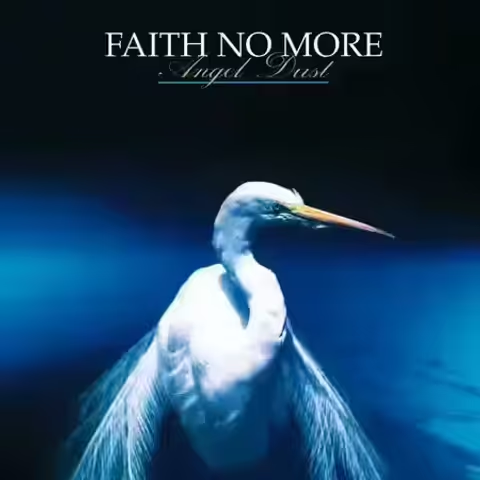
What landed on 8 June 1992 was a Trojan horse. The cover was a serene white egret. The first single sampled Simon and Garfunkel and the Beastie Boys before kicking into a chorus about a man losing his mind. Inside the gatefold were songs about kindergarten as the high point of life, a Brazilian airport announcer reading a list of plane crashes, fellatio dressed up as a sports chant, and an industrial-metal closer called Jizzlobber. Slash thought their alt-MTV breakthrough band was about to torch every demographic the last record had bought them. They were not entirely wrong; they were also entirely wrong.
Album Facts
| Field | Detail |
|---|---|
| Artist | Faith No More |
| Album | Angel Dust |
| Release Date | 8 June 1992 (UK) / 16 June 1992 (US CD) |
| Label | Slash / Reprise / London |
| Producers | Matt Wallace and Faith No More |
| Studios | Coast Recorders and Brilliant Studios, San Francisco (late 1991) |
| Genre / Subgenre | Alternative metal, experimental metal, avant-garde metal |
| Track Count | 13 (standard edition) |
| Total Runtime | 58:47 |
| Billboard 200 Peak | 10 (the band's only US Top 10 album) |
| UK Albums Chart Peak | 2 |
| Other Notable Chart Peaks | Australia 4, Austria 4, Germany 8, New Zealand 6, Norway 7, Switzerland 9, Canada 12 |
| Certifications | RIAA Gold (US), BPI Gold (UK), ARIA Platinum for the Easy single (Australia) |
| Estimated Sales | Best-selling Faith No More album worldwide; Gold in the US (500,000+) on lower domestic sales than its predecessor |
| Key Singles | Midlife Crisis, A Small Victory, Everything's Ruined, Easy |
Cultural Context
The summer of 1992 was already crowded. Nevermind had been at number one in January and was still selling truckloads. The Black Album was three quarters of the way through its slow march to Diamond. Pearl Jam's Ten was finally breaking out, the Red Hot Chili Peppers were touring Blood Sugar Sex Magik on a Lollapalooza victory lap, and Soundgarden were about to release Badmotorfinger's grimmer cousin. The mainstream was finally learning to call all of this "alternative". A band whose breakthrough single had been a piano-led rap-rock crossover was, on paper, perfectly positioned.
Faith No More refused that position with both hands. Where Nirvana had collapsed metal and punk into one sound, Angel Dust tried to fit lounge, easy listening, hardcore, soundtrack-funk, French chanson, country pastiche and German electronic music onto the same record without choosing between them. The album dropped in the same six-month window as Bone Machine, Automatic for the People, Dirt and Rage Against the Machine's self-titled debut. It looks at home next to those records now. At the time it looked like four people having a public argument with their own audience.
The Band's Story Up to This Point
Faith No More had spent six years getting Epic on MTV. The Real Thing, released in June 1989, sat for over a year before "Epic" went Top 10 in the US and the band turned, almost overnight, into the radio-friendly face of crossover. They toured for eighteen straight months on the back of it. Mike Patton joined as a 21-year-old replacement for Chuck Mosley two weeks before the album was finished, sang words he hadn't written, and spent the touring cycle pretending the songs were his while writing his second Mr Bungle record on bus rides. The first album he could call his own would be the one he had to live in.
By the time the band came off that tour, the cracks were public. Bottum and bassist Billy Gould wanted to push further into what they had hinted at on The Real Thing's weirder corners. Patton had spent the tour growing actively contemptuous of the chord changes he had inherited. Mike Bordin's drumming had hardened into something closer to industrial. Only guitarist Jim Martin seemed comfortable with the post-Epic identity, and even Martin was distracted; his father had died shortly before sessions began.
"Just before making Angel Dust, Jim Martin's dad died. That was a pretty big thing, obviously, and I think it's part of why he was a little checked out. There was a noticeable lack of enthusiasm."
Matt Wallace, Diffuser.fm, 2015
Pre-production and Demos
The pre-production for Angel Dust happened in stages. Patton, Gould and Bottum brought in skeleton ideas one at a time and the band built around them in rehearsal rooms in San Francisco. Most of the songs cycled through working titles before they had lyrics. Midlife Crisis was "Madonna" because Patton was reading interviews with her. RV was "Country Western Song" or "Macaroni and Cheese". Be Aggressive was "I Swallow". Crack Hitler was "Action Adventure". Caffeine was "Triplet". The World Is Yours, eventually a B-side, was "The Sample Song".
Patton ran a sleep-deprivation experiment on himself for several days during writing, partly to write Land of Sunshine and Caffeine from inside the symptom. He stitched Land of Sunshine's lyrics together from Scientology's Oxford Capacity Analysis questionnaire and a fortune cookie. Be Aggressive's lyric, written by Bottum about fellatio, was given to Patton to sing as a flat-out joke, the singer obliged. The songs the band considered too obvious for the album, including a long ballad and a country pastiche fully called "Country Western Song", were demoed and shelved.
- Patton wrote most of the lyrics during the sessions, often in the studio at night.
- Bottum wrote Be Aggressive and co-wrote Kindergarten; Gould co-wrote Everything's Ruined.
- Martin contributed riffs to Jizzlobber, Caffeine and parts of Malpractice, then increasingly worked alone.
- Demos for several B-sides (The World Is Yours, Das Schützenfest) were tracked alongside the album.
- An early version of "Easy" already existed as a goof, intended for nobody in particular.
Creating the Album
Sessions began at Coast Recorders, San Francisco, in late summer 1991, moved to Brilliant Studios for overdubs and stretched into late autumn. Matt Wallace, who had produced everything they had ever released, returned. Adam Munoz, Craig Doubet, Gibbs Chapman, Lindsay Valentine and Nikki Tafrallin engineered. David Bryson and Wallace mixed. John Golden mastered. Nineteen songs were tracked in total. Thirteen made the standard album. The leftovers became B-sides and bonus tracks.
The recording was not happy. Patton had grown used to writing alone and presented finished demos. Martin, who had previously played a structural role, was sent his guitar parts on cassette and recorded them in isolation in a separate room. The two barely spoke. Wallace shuttled between them. Bottum's keyboards, previously a colour, became a structural element; on Land of Sunshine they're more important than the guitar. Patton brought in a sampler and used it as a writing tool. Bordin's drums were tracked dry and aggressive, often without the room sound that had cushioned The Real Thing.
"This whole funk metal thing is really disgusting. The last thing I ever want to be is a funk metal band. We're gonna try to be anything except that."
Billy Gould, 1992
The samples are the part of the record that scared the label most. The drum break on Midlife Crisis is lifted from Simon and Garfunkel's Cecilia; the song also samples the Beastie Boys' Car Thief. Malpractice uses a four-second extract of the Kronos Quartet's recording of Shostakovich's String Quartet No. 8. Crack Hitler opens with a 1980s Brazilian airport announcement read by Iris Lettieri at Rio's Galeão; she later sued. Smaller and Smaller uses Native American chant. The B-side The World Is Yours samples the broadcast of the 1987 on-camera suicide of Pennsylvania politician R. Budd Dwyer. Be Aggressive's cheerleader chants were performed by four girls aged between 15 and 17, recorded specifically for the song. The samples were licensed where possible, ignored where not, and one of them ended up in court.
Slash's reaction was famous. The label president visited mid-sessions, listened, and made his comment about house deposits. The band kept going.
"There had never been any question of my staying in the band. The first record was theirs. This one was going to be ours."
Mike Patton, quoted in Steffan Chirazi's Faith No More: The Real Story, 1994
Personnel and Credits
| Role | Player | Notes |
|---|---|---|
| Core band | ||
| Lead vocals, samples, lyrics | Mike Patton | First Faith No More album he wrote on; built most lyrics in the studio. |
| Guitar | Jim Martin | Tracked separately from the rest of the band; his last studio album with the group. |
| Bass | Billy Gould | Co-wrote Everything's Ruined; effectively the band's musical director on this record. |
| Keyboards, backing vocals | Roddy Bottum | Wrote Be Aggressive, picked the album title; keys promoted from colour to structure. |
| Drums | Mike Bordin | Dry, hard-tracked drums; the post-Real Thing shift toward industrial weight. |
| Production and engineering | ||
| Producer | Matt Wallace and Faith No More | Wallace's fifth and final album with the band. |
| Mixing | Matt Wallace, David Bryson | Bryson is best known as Counting Crows' guitarist. |
| Mastering | John Golden | K-Disc, Hollywood. |
| Engineer | Adam Munoz, Craig Doubet | Coast Recorders staff. |
| Assistant engineers | Gibbs Chapman, Lindsay Valentine, Nikki Tafrallin | Brilliant Studios overdubs. |
| Guest performers | ||
| Cheerleader vocals | Four uncredited teenagers | Performed the chants on Be Aggressive. |
| Sampled voice | Iris Lettieri | Brazilian airport announcer whose recording opens Crack Hitler; she later sued. |
| Artwork and packaging | ||
| Front cover photograph | Werner Krutein | Airbrushed great egret photograph. |
| Back cover photograph | Mark Burnstein | Cow on a meat hook in a slaughterhouse. |
| Band photography | Ross Halfin | Long-time metal photographer; previously The Real Thing's sleeve. |
| Art direction | Kim Champagne | Reprise in-house designer. |
The Songs
The standard Angel Dust tracklist runs thirteen songs, fifty-eight minutes, no clear single until track five. The opening triptych, Land of Sunshine, Caffeine, Midlife Crisis, is essentially a thesis statement: cult-recruitment lyrics, sleep-deprivation grind, and a single about a celebrity having a breakdown set to a hip-hop drum loop. RV, in slot four, is a country-flavoured monologue by a fat alcoholic father in a recreational vehicle; it lasts almost four minutes and contains no chorus. By the time Smaller and Smaller arrives, halfway through the album, the listener is meant to be lost.
| # | Title | Writer(s) | Length | Single? | Notes |
|---|---|---|---|---|---|
| 1 | Land of Sunshine | Patton / Gould / Bottum / Bordin / Martin | 3:43 | Working title "The Funk Song"; lyrics from Scientology test and a fortune cookie. | |
| 2 | Caffeine | Patton / Gould / Bottum / Bordin / Martin | 4:31 | Working title "Triplet"; Patton wrote it during a sleep-deprivation experiment. | |
| 3 | Midlife Crisis | Patton / Gould / Bottum / Bordin / Martin | 4:22 | Yes | Working title "Madonna"; samples Simon and Garfunkel and the Beastie Boys. |
| 4 | RV | Patton / Gould / Bottum / Bordin / Martin | 3:43 | Working title "Country Western Song"; first-person trailer-park monologue. | |
| 5 | Smaller and Smaller | Patton / Gould / Bottum / Bordin / Martin | 5:10 | Working title "Arabian Song"; samples Native American chanting. | |
| 6 | Everything's Ruined | Patton / Gould | 4:31 | Yes | Working title "The Carpenters Song"; nearly a straight ballad. |
| 7 | Malpractice | Patton / Gould / Bottum / Bordin / Martin | 4:01 | Samples Shostakovich's String Quartet No. 8 via the Kronos Quartet. | |
| 8 | Kindergarten | Patton / Bottum | 4:31 | Working title "F Sharp"; nostalgia as despair. | |
| 9 | Be Aggressive | Bottum (lyrics) / Patton / Gould / Bordin / Martin | 3:42 | Working title "I Swallow"; cheerleader chant performed by four teenagers. | |
| 10 | A Small Victory | Patton / Gould / Bottum / Bordin / Martin | 4:53 | Yes | Working title "Japanese"; Frank Zappa-style siren intro. |
| 11 | Crack Hitler | Patton / Gould / Bottum / Bordin / Martin | 4:50 | Working title "Action Adventure"; opens with the sampled airport announcement. | |
| 12 | Jizzlobber | Martin / Patton | 6:38 | Industrial-metal closer; one of Martin's biggest contributions. | |
| 13 | Midnight Cowboy | John Barry | 4:13 | Cover of the 1969 film theme; instrumental closer. |
Two songs deserve their own paragraph. Midlife Crisis is the moment the album earns its mainstream slot: a Madonna-baiting lyric about narcissism set to a borrowed drum loop, sung by a man who had been told for two years he wasn't a real frontman. It's also the moment the band tipped their hand to anyone listening. Within ninety seconds it shifts time signature, drops the chorus and brings it back at half speed under a vocal loop. Jizzlobber, in penultimate slot, is its inverse: Martin's last great riff for the band, a six-minute industrial slog that ends with church organ. Bookending the record's most accessible song with its least is not an accident.
B-sides, Outtakes and Lost Songs
Six tracks recorded during the Angel Dust sessions did not make the standard album. They are collectively the strongest set of B-sides Faith No More ever released and account for a lot of why the era still rewards reissue buyers.
- The World Is Yours, B-side of Midlife Crisis; samples R. Budd Dwyer's televised suicide.
- Easy, Commodores cover, originally tracked as a goof, later released as the fourth single and the band's biggest UK hit.
- As the Worm Turns, re-recorded version of an early Chuck Mosley-era song.
- Das Schützenfest, German oompah-style party track sung in German.
- Let's Lynch the Landlord, Dead Kennedys cover.
- Midnight Cowboy (radio edit), shorter version of the album closer.
Most of these surfaced as 12" and CD-single B-sides in 1992 and 1993, were collected on the 1994 stop-gap Songs to Make Love To EP, and were finally rounded up properly on the 2015 deluxe reissue. Easy's journey from joke offcut to international hit single is the catalogue's clearest example of a B-side mentality outperforming the A-side machine.
Album Artwork and Packaging
Bottum picked the title. He had been carrying it around for months, partly because it was a beautiful name for an ugly drug, phencyclidine, sold on the street as PCP, and partly because it summed up the contradiction the band was reaching for. They had briefly considered calling it Crack Hitler, after the ninth track, before deciding the song could carry the joke alone.
The cover photograph is Werner Krutein's airbrushed image of a great egret. The back cover, from the same booklet, is Mark Burnstein's photograph of a cow strung up on a meat hook in a slaughterhouse. Inside the booklet, Krutein's stock photographs of Soviet soldiers in Red Square have been doctored to put the four band members' heads on the soldiers. Ross Halfin shot the new band photography. Reprise's Kim Champagne directed.
The pairing of the egret and the slaughterhouse cow is the cover's joke and its instruction manual. The album was meant to be heard as the same gesture: a serene front, a rotting back, both equally true.
Release and Reception
The album entered the UK chart at number two, behind Lionel Richie's greatest-hits compilation. In the US it peaked at ten on the Billboard 200, the band's only Top 10 album to this day. It went Gold by the BPI and the RIAA, and the Easy single went Platinum in Australia.
Press response was split exactly along the line the label had feared. Rolling Stone, Pitchfork in retrospect (8.8 of 10), NME (8 of 10), Q, Record Collector and AllMusic ("a bizarro masterpiece") loved it. Entertainment Weekly filed a lukewarm B. Kerrang!, of all magazines, gave it three out of five at release. Eleven years later, in 2003, the same magazine named Angel Dust the most influential album of all time. Year-end critics' lists in 1992 placed it at number one in Germany's Musik Express Sounds, eight in Raw, ten in Vox, seventeen in The Face and twenty-six in the Village Voice's Pazz and Jop.
"That was the record that made me think, 'This is one of the sickest bands.' The first album had a couple of good songs, but Angel Dust sounded savage to me. It sounded way more like a Mike Patton record. I feel like he had a lot more influence on it."
Chino Moreno, Artistdirect, 2010
Singles and Music Videos
| Single | Released | UK Peak | US Peak | Other | B-sides |
|---|---|---|---|---|---|
| Midlife Crisis | 25 May 1992 | 10 | Modern Rock 1; Mainstream Rock 13 | AUS 19, GER 33, NZ 13 | Jizzlobber, The World Is Yours, Easy |
| A Small Victory | 3 August 1992 | 29 | Modern Rock 24 | AUS 50 | Das Schützenfest, Let's Lynch the Landlord, Midnight Cowboy edit |
| Everything's Ruined | 9 November 1992 | 28 | Modern Rock 23 | As the Worm Turns, Easy, Midnight Cowboy | |
| Easy | 29 December 1992 | 3 | Adult Contemporary 30 | AUS 1 (Platinum), NZ 6, IRE 4 | Be Aggressive, Midnight Cowboy |
The Midlife Crisis video, directed by Kevin Kerslake, is the one most people remember: Patton in funeral black under harsh fluorescent lighting, dripped into a frame full of coffin imagery and slow zooms. A Small Victory, directed by Marcus Nispel, looks more like a perfume advert and was deliberately chosen to wrong-foot the metal audience. Everything's Ruined, also Nispel, took the joke further: surrealist green-screen of the band as a 1950s family. Easy, directed by Kerslake, is the one that played MTV and the morning shows for months.
Touring and Live
The Angel Dust tour is the part of the story that rewards the podcast hosts most, because it produced more incident per capita than almost any cycle in the band's career. The album was previewed at Bill Graham's Day on the Green festival on 12 October 1991 in Oakland, where Faith No More played alongside Metallica and Queensrÿche on a bill that MTV broadcast. They debuted The World Is Yours, RV and Caffeine from the new record.
That festival also got them the support slot of a lifetime, or its opposite, depending on who you ask. They were added to Guns N' Roses and Metallica's joint stadium run for summer 1992. The tour started well and ended in fire. On 8 August 1992, at Olympic Stadium in Montreal, James Hetfield burned his arm in a pyrotechnic accident; Guns N' Roses cut their set short, the crowd rioted, the stadium was evacuated. Faith No More watched from the side of the stage. Within a month they were the joint show's open enemies.
The Citrus Bowl in Orlando on 2 September 1992 was the public turning point. After a confrontation between Slash and Axl Rose's camp and the Faith No More dressing room, Patton retaliated. He urinated in Axl Rose's onstage teleprompter. He left a bowel movement in a banquet cake meant for the band's after-show. They were quietly off the tour by mid-September. Helmet replaced them in the US; L7 picked up the European leg. Faith No More headlined their own clubs instead and arguably had a better tour.
- Three-night residency at Brixton Academy, London, 25-27 November 1992.
- Cambridge Corn Exchange, 23 November 1992.
- Four nights at Barrowland Ballroom, Glasgow, 1-4 December 1992.
- The Tonight Show with Jay Leno, 13 January 1993, performance of Easy.
- Final show with Jim Martin: 17 July 1993, Stratford Upon Avon, set ended with Epic.
In TV, Film and Media
The album's afterlife in screens and games is broader than the chart positions suggest. Beavis and Butt-Head reviewed the Easy video in the 1994 episode "Rabies Scare", the kind of pop-culture acceptance no Faith No More A&R ever planned for. Smallville used Be Aggressive in the 2002 episode "Redux". Tony Hawk's Underground 2 (2004) put Land of Sunshine on its soundtrack. Grand Theft Auto: San Andreas (2004) put Midlife Crisis on its alternative-rock station, Radio X. Rock Band 3 (2010) added Midlife Crisis as downloadable content. None of these are obscure cult placements; they are mainstream-media confirmation of an album that the mainstream media of 1992 was, by and large, not ready for.
Controversy, Censorship and Lawsuits
The Iris Lettieri lawsuit is the cleanest piece of Angel Dust trivia. The Brazilian announcer's voice opens Crack Hitler, and the band had not licensed it. Lettieri sued. Reprise settled out of court. Her voice stayed on the album.
The R. Budd Dwyer sample on The World Is Yours, by contrast, never became a legal problem but did become a censorship one; some pressings of the single were quietly issued without the audio. Be Aggressive's lyric was banned from a number of US morning radio playlists once programmers worked out what it was about. Kerrang!'s 1992 three-out-of-five review is treated by the band as the funniest controversy of the lot, given the same magazine declared it the most influential album of all time eleven years later. The Guns N' Roses tour incident, the act of rebellion most fans associate with the era, was never a legal matter, Axl Rose's camp considered pressing charges over the cake and the teleprompter, then declined.
Covers, Samples and Tributes
The album's afterlife as covered material has been steady rather than flashy. Disturbed recorded Midlife Crisis for the 2009 charity compilation Covered: A Revolution in Sound and re-released it on their 2011 odds-and-ends collection The Lost Children. Machine Head covered Jizzlobber in 2003. Between the Buried and Me covered Malpractice on their 2006 covers album The Anatomy Of. Norwegian gothic-metal band Trail of Tears covered Caffeine in 2002. A planned 2001 tribute album featuring Disturbed, Fear Factory, Papa Roach and Taproot was cancelled before release; an underground compilation, Tribute of the Year, came out in 2002 and was one of the year's better-regarded fan-made tribute records.
What Angel Dust has been sampled by, more than what has been sampled on it, is harder to track because Patton's own use of samples set a precedent the band's imitators absorbed structurally rather than literally.
Reissues, Remasters and Anniversaries
The first significant reissue came from Mobile Fidelity Sound Lab in 2008, remastered by Rob LoVerde for both Ultradisc II Gold CD (UDCD 787) and 180-gram vinyl. The MFSL versions are still the audiophile reference. A two-disc deluxe edition appeared in 2015 with the era's B-sides, alternate mixes and a second disc of demos. Reprise have not issued a 30th-anniversary edition, an oversight the fanbase complained about loudly in 2022 and again in 2023. The album is otherwise widely available digitally, on streaming, and on multiple coloured vinyl pressings.
Legacy and Influence
Where The Real Thing placed Faith No More on the genre map, Angel Dust redrew the map. Rolling Stone ranked it 65th on its 2017 list of the 100 Greatest Metal Albums of All Time and ranked Caffeine 55th on its March 2023 list of the 100 Greatest Heavy Metal Songs of All Time. Kerrang!'s 2003 list put it at one. The album has been cited by Serj Tankian of System of a Down as Faith No More's best record and as the gateway that took him to Metallica and Slayer; by Chino Moreno of Deftones as his favourite Faith No More album; by Trey Spruance of Mr Bungle as "a glorious record"; by Killswitch Engage's Jesse Leach as the album that changed his life; by Hoobastank's Doug Robb as one of ten records that changed his life; and by Mike Vennart of Oceansize as a working blueprint.
Within the band, Angel Dust is the album that broke Jim Martin's tenure. He privately referred to it as "Gay Disco". His last show was 17 July 1993 in Stratford Upon Avon, ending with Epic. He was sacked by fax shortly afterwards. Mr Bungle's Disco Volante (1995) and Faith No More's own King for a Day (1995) and Album of the Year (1997) are recognisably the work of a band that learned Angel Dust's lesson, that the only direction worth committing to is the one nobody asked you to pick.
"We didn't expect to be Whitesnake or Bon Jovi. We expected to be a band that made the records we wanted to make, on a major label, for as long as they would let us. Angel Dust was the test of that."
Billy Gould, Mushroom Music interview, 2022
Things You Might Not Know
| Fact | Detail |
|---|---|
| The label warning | Slash's president visited Coast Recorders mid-sessions, listened to the playback and warned the band he hoped none of them had bought houses; Bottum has said the room got "really scared". |
| Madonna as a working title | Midlife Crisis was called "Madonna" in pre-production because Patton had been reading interviews with her and the lyric sketches were originally about narcissistic celebrity behaviour. |
| The Brazilian airport announcer sued | Iris Lettieri's recorded list of plane departures, used to open Crack Hitler, was lifted unlicensed from Rio's Galeão airport. She sued and Reprise settled. |
| Cheerleaders aged 15 to 17 | The chant on Be Aggressive was performed by four girls aged 15 to 17, recorded specifically for the album over a Bottum lyric about fellatio. |
| The fortune-cookie lyric | The opening lines of Land of Sunshine are stitched together from Scientology's Oxford Capacity Analysis personality test and a fortune cookie. |
| Sleep deprivation as method | Patton ran a sleep-deprivation experiment on himself for several days while writing, and used the symptoms as the lyrical core of Caffeine and Land of Sunshine. |
| The Budd Dwyer B-side | The B-side The World Is Yours samples the broadcast of Pennsylvania politician R. Budd Dwyer's 1987 on-camera suicide; some pressings of the Midlife Crisis single quietly removed the sample. |
| Kronos Quartet contraband | Malpractice contains a four-second sample of the Kronos Quartet's recording of Shostakovich's String Quartet No. 8. |
| Easy as a joke | The Commodores cover that became the album's biggest UK single was tracked as an offcut, intended as a goof rather than as a release. |
| Almost called Crack Hitler | Before Bottum settled on Angel Dust, the band briefly considered naming the album after its ninth track. |
| Bottum wrote Be Aggressive | The keyboardist wrote the lyric, about fellatio, and gave it to Patton to sing as a deliberate prank that became one of the era's signature songs. |
| Jim Martin recorded alone | Martin tracked his guitar parts in a separate room in Brilliant Studios, often from cassettes the rest of the band had cut without him. |
| Kerrang's about-face | Kerrang! reviewed the album three out of five at release, then named it the most influential album of all time in 2003. |
| The teleprompter incident | During the Guns N' Roses and Metallica stadium tour in 1992, Patton urinated in Axl Rose's onstage teleprompter; Faith No More were off the tour within weeks. |
| Best-seller worldwide | It sold less than The Real Thing in the US, Gold rather than Platinum, but more than The Real Thing everywhere else, making it the band's best-selling album internationally. |
Listen to the Riffology Podcast
Riffology covers Angel Dust in full on its dedicated Faith No More episode, embedded above this article. The conversation digs into the working titles, the sample lawsuits, the Guns N' Roses tour, and why an album reviewed three out of five at release ended up at the top of Kerrang!'s most-influential list eleven years later. The Riffology podcast is available on Apple Podcasts, Spotify, Pocket Casts, Overcast and every major platform; the dedicated Angel Dust episode runs eighty-two minutes and is the longest single-album episode in the show's run to date. If you have made it this far, the podcast is the next stop.
Comments