The day after Metallica wrapped the North American leg of the Poor Re-Touring Me Tour in San Diego in late summer 1998, the band did not go home. They drove north to Sausalito and walked straight into The Plant Studios with a list of other people's songs, a tribute band on retainer, and a mandate to make the loosest record of their career. Three weeks later they had the eleven new tracks that would form one half of Garage Inc., a double album whose other half was a paper-trail of every cover they had bolted onto the back of a single since 1984. It was the first Metallica album that nobody felt they had to sweat, the only one bookended by a Killing Joke cover and a Motorhead live recording, and the only one that opens with a Discharge song.

Released on 24 November 1998, Garage Inc. is not a studio album. It is a compilation, an archive and a confession of taste. Disc one is the new cover sessions from autumn 1998, with Bob Rock behind the desk and the band working at a speed that would have been unthinkable two years earlier. Disc two reaches back across fourteen years of B-sides, EP tracks and assorted oddities, including the long out-of-print 1987 EP The $5.98 E.P. - Garage Days Re-Revisited, which Elektra had quietly stopped pressing in 1989. Twenty-seven tracks. Two hours and sixteen minutes. Five times platinum in the United States. And, by the band's own description, the easiest record they had ever made.

FieldDetail
ArtistMetallica
AlbumGarage Inc.
Release date24 November 1998
LabelElektra (US) / Vertigo (UK)
Producer(s)James Hetfield, Lars Ulrich, Bob Rock, Mark Whitaker (and others, by track)
StudiosThe Plant, Sausalito (disc 1); A&M and Conway, Los Angeles (1987 EP); various, 1984 to 1996 (disc 2)
GenreHeavy metal, hard rock, thrash metal, hardcore punk
Track count27 (11 on disc one, 16 on disc two)
Total runtime136:38
Billboard 200 peak2 (held off number one by Garth Brooks's Double Live)
UK Albums Chart peak29
Other notable peaks1 in Finland, Germany, Norway and Switzerland; 2 in Australia; 3 in Canada and New Zealand
Certifications5x Platinum (RIAA, USA); Platinum (Germany, Greece, Poland, Sweden, NZ); Platinum (IFPI Europe); 3x Platinum (Australia)
Estimated US sales3.35 million
Singles"Turn the Page", "Whiskey in the Jar", "Die, Die My Darling"

Why a Covers Album, and Why Now

By the summer of 1998 Metallica had spent seven straight years being a Bob Rock band. The five-and-a-half-million-selling 1991 self-titled record (universally known as the Black Album) had finished touring in 1993. Load followed in 1996 and ReLoad in 1997, both produced by Rock, both records of long, slow, brooding rock songs that had taken the better part of three years to assemble. The Poor Re-Touring Me Tour wound through North America, Europe, Asia and back through the United States, finishing in California with a band that had not made anything quick since 1987.

Lars Ulrich, talking to Billboard in November 1998, framed the covers project as a deliberate reset after that long stretch of seriousness.

"We had three pretty serious albums in a row, starting with the Black album and then Load and ReLoad. Doing covers, you can put your blinkers on, get into the studio and bash it out. There is a tradition in this band of taking other people's songs and turning them into something very Metallica, different from what the original artist did."

Lars Ulrich, Billboard, November 1998

There was also a back-catalogue problem to solve. Metallica had spent fifteen years stuffing covers onto B-sides, single CD bonus discs and Japan-only tracklists. Diamond Head's "Am I Evil?" and Blitzkrieg's "Blitzkrieg" had been the B-sides of "Creeping Death" in 1984 and bonus tracks on the Elektra reissue of Kill 'Em All. Budgie's "Breadfan" and Diamond Head's "The Prince" had appeared as B-sides to "Harvester of Sorrow" in 1988. A Queen cover of "Stone Cold Crazy" had surfaced on Elektra's Rubaiyat 40th anniversary compilation in 1990. Anti-Nowhere League's "So What" and Sweet Savage's "Killing Time" were on the back of "The Unforgiven" in 1991. By the late 1990s, even committed fans were giving up on tracking them all down. Ulrich called it putting them all "in a nice little packaging for easy listening".

The deeper reason was the 1987 EP itself. The $5.98 E.P. - Garage Days Re-Revisited had gone out of print in 1989 and had become a collector item priced into territory that the band, as ex-tape-traders, found offensive. Bringing the EP back, alongside the scattered B-sides, in one Elektra-blessed package was as much a piece of fan service as it was a creative act. The new 1998 covers were, in a sense, the price of admission for the archive.

Recording Disc One: Three Weeks at The Plant

The new sessions ran from 14 September to 1 October 1998 at The Plant Studios in Sausalito, the same room in which the band had cut Load and ReLoad. Bob Rock produced with James Hetfield and Lars Ulrich; Randy Staub engineered, with Brian Dobbs as additional engineer and Kent Matcke, Leff Lefferts and Chris Manning as assistants. Paul DeCarli and Mike Gillies handled the digital editing. Staub mixed the disc with Mike Fraser; George Marino mastered.

The contrast with the previous two records was the point of the exercise. Load had run to 78 minutes and well over a year of work; ReLoad had drawn the unused songs from those same sessions through another half-year of overdubs. The eleven covers were nailed down in roughly three weeks, with arrangements blocked out the day before tracking and tempo decisions sometimes made between takes. Bob Rock, who had spent the better part of a decade chasing tones with Metallica, found himself producing the band as the band that they had been on the 1987 EP rather than the band that had made the Black Album.

The selection was made democratically, with all four members bringing songs to the table. Ulrich pushed for the British new wave of heavy metal material that he had grown up with: Diamond Head's "It's Electric", Mercyful Fate's medley, Holocaust adjacent picks. Hetfield brought the Discharge tracks ("Free Speech for the Dumb" and "The More I See") and the Misfits' "Die, Die My Darling". Hammett pressed for Blue Oyster Cult's "Astronomy", a deep cut from Secret Treaties that the band had been listening to in soundchecks. Newsted, who shared lead vocals on the Lynyrd Skynyrd cover, brought the southern-rock sensibility to the table. The one curveball was Nick Cave's "Loverman", an unlikely choice from the Let Love In album that had been a Hetfield favourite.

Of the eleven tracks credited to disc one, only ten were actually recorded in the autumn 1998 sessions. The version of Lynyrd Skynyrd's "Tuesday's Gone" that closes the album's first hour had been cut almost a year earlier, on 18 December 1997, at The Plant during a live broadcast for the local San Francisco radio station KSJO called "Don't Call Us, We'll Call You". Metallica played the song with a small army of guests: Pepper Keenan of Corrosion of Conformity on co-lead vocals, Jerry Cantrell of Alice in Chains on guitar, Sean Kinney of Alice in Chains on additional percussion, Faith No More's Jim Martin on guitar, John Popper of Blues Traveler on harmonica, Gary Rossington of Lynyrd Skynyrd himself on additional guitar and Les Claypool of Primus on banjo. The performance had been broadcast as part of a station promotion; producer Mark Whitaker, Metallica's old front-of-house engineer who had also produced the original 1987 EP, was on hand to ensure the multitrack was clean enough to release if the band ever wanted it.

The decision to put it on Garage Inc. was made late in the sequencing. Including it locked in the album's loose, friends-and-favourites tone: the country-rock outlier on a record otherwise built from European thrash, hardcore punk and 1970s arena rock.

The Songs: Disc One

Disc one runs to 65 minutes and 42 seconds across eleven tracks. It does not flow like a Metallica studio album. There is no opening barrage, no mid-album acoustic breather and no closing instrumental. It runs in the order in which the band wanted to argue for the songs.

"Free Speech for the Dumb" and "The More I See"

Discharge bookend the record. The Stoke-on-Trent hardcore band's 1980s output, with its punk fury and military-march drumming, had been cited by Hetfield since 1986 as a foundational Metallica influence. "Free Speech for the Dumb" opens the album in 2:36 of bludgeoning rhythm guitar with almost no melodic information, a deliberate flag planted at the start of a record that could otherwise have drifted into novelty. "The More I See" closes disc one and contains a hidden track: after a stretch of silence at 3:23, a fragment of Robin Trower's "Bridge of Sighs" appears, a small further nod to Hetfield's late-night listening.

"It's Electric"

Diamond Head's "It's Electric" was, with "Am I Evil?" and "The Prince", one of the three Diamond Head songs Metallica had been playing at soundcheck for half their career. Sean Harris and Brian Tatler had written the song in 1980 for what would become the Lightning to the Nations album. Hetfield and Ulrich's reading is faithful to a degree that occasionally veers into homage rather than reinterpretation, which was a charge the band were willing to wear.

"Sabbra Cadabra"

The Black Sabbath cover from Sabbath Bloody Sabbath (1973) is one of two tracks on disc one to bleed into a second song without a separate index. The closing minutes drop into a section of "A National Acrobat" from the same Black Sabbath album, an Easter egg that fans clocked instantly and that no other Metallica covers project had attempted. The performance is also one of the only places on the record where Kirk Hammett's lead guitar work is allowed to mimic the original; Hammett's tone is overtly Iommi-flavoured, with a fattened bridge pickup and the wah pulled back.

"Turn the Page"

Bob Seger's 1973 song, originally on the live album Live Bullet and on his earlier Back in '72 studio record, became the album's lead single. Hetfield had been singing it on tour buses since the 1980s; the lyric ("Here I am, on the road again") is so close to a band member's actual life that the cover plays as a kind of confession. The arrangement is a slow build from clean guitar to a saxophone substitute in the form of Hetfield's most exposed mid-range vocal performance, with Hammett delivering a long, melodic solo that owes more to David Gilmour than to anything in his usual vocabulary.

"Die, Die My Darling"

The Misfits' 1981 single (released on the Earth A.D. sessions but not on that album) is the second single from Garage Inc. and a complete formal opposite to "Turn the Page": 2:29 of horror-punk that includes, unusually, backing vocals from Ulrich, Hammett and Newsted. Lars Ulrich rarely sang on Metallica records. The presence of three other Metallicas on the chorus is partly a knowing nod to the Misfits' own Glenn Danzig-era three-part harmonies and partly an in-joke about how few times in their career the band had bothered.

"Loverman"

Nick Cave and the Bad Seeds had recorded "Loverman" in 1994 for Let Love In. At 7:53, Metallica's reading is the album's most genuinely transformed cover: where Cave's original is a sinister murmur over a single repeated bass figure, Hetfield's version is a slow-burn arena rock dirge that gradually opens into outright distortion in the last two minutes. It has never been performed live.

"Mercyful Fate"

The 11:11 medley, one of the longest tracks Metallica had ever released, stitches together five Mercyful Fate songs: "Satan's Fall", "Curse of the Pharaohs", "A Corpse Without Soul", "Into the Coven" and "Evil". Hetfield had named Mercyful Fate as a key songwriting influence on early Metallica, particularly the way King Diamond and Hank Shermann constructed multi-part suites; the medley is a deliberate compression of that idea, with the band acting as a kind of NWOBHM-thrash tribute act for a single eleven-minute stretch.

"Astronomy"

Hammett's pick. The Blue Oyster Cult song from 1974's Secret Treaties sits inside a strange architecture, with verse-and-chorus melodies that turn into instrumental sections that turn into different verse-and-chorus melodies. The Metallica reading lands close to the original arrangement but plays the second-half guitar duels harder than Donald Roeser had done in 1974.

"Whiskey in the Jar"

The most commercially successful track on the album, the one that won the Grammy and the one that, twenty-eight years later, soundtracks every St Patrick's Day playlist between Boston and Belfast. The song is a traditional Irish folk number arranged in 1972 by Eric Bell, Brian Downey and Phil Lynott of Thin Lizzy; Metallica's version is, in essence, a cover of Thin Lizzy's cover, with Hetfield singing in a voice that is closer to Lynott than to anything he had attempted before.

"Tuesday's Gone"

The Skynyrd cover, recorded almost a year before the rest of the disc, sits at track ten. Pepper Keenan trades verses with Hetfield; Jerry Cantrell, Jim Martin and Gary Rossington layer guitars; John Popper plays harmonica; Les Claypool plays banjo. It is, by some distance, the most populated recording on any Metallica album and the only one that approaches a country-rock arrangement.

Disc Two: The Archive

Disc two runs to 70 minutes and 51 seconds. It is not chronological. It is sequenced in three loose blocks: the 1987 EP first, then the 1984 to 1991 B-sides, then the 1995 live Motorhead tribute set.

  • Tracks 1 to 5 are The $5.98 E.P. - Garage Days Re-Revisited in its original 1987 sequence: "Helpless" (Diamond Head), "The Small Hours" (Holocaust), "The Wait" (Killing Joke), "Crash Course in Brain Surgery" (Budgie) and "Last Caress / Green Hell" (the Misfits medley). Engineer Csaba Petocz, who had recorded the EP at A&M and Conway in Los Angeles in July 1987, is credited; the production is famously listed as "not very produced by Metallica".
  • Tracks 6 and 7 are the 1984 Diamond Head and Blitzkrieg covers ("Am I Evil?" and "Blitzkrieg") cut at Music Grinder in Los Angeles for the "Creeping Death" 12-inch single. Mark Whitaker is credited as co-producer; these are the only two tracks on either disc to feature the late Cliff Burton on bass.
  • Tracks 8 and 9, "Breadfan" and "The Prince", come from the September 1988 "Harvester of Sorrow" sessions, with Mike Clink and Toby Wright engineering. Flemming Rasmussen, who had produced Ride the Lightning, Master of Puppets and ...And Justice for All, is credited with rough mixing.
  • Track 10, the 1990 Queen cover of "Stone Cold Crazy", was originally recorded for Elektra's Rubaiyat compilation. The credit is "kind of produced by Metallica".
  • Tracks 11 and 12, "So What" (Anti-Nowhere League) and "Killing Time" (Sweet Savage), come from the 1991 Black Album single sessions and were "roughly produced by Bob Rock with Hetfield and Ulrich".
  • Tracks 13 to 16 are the four-song Motorhead medley recorded live at The Plant in December 1995 for Lemmy Kilmister's 50th birthday party at the Whisky a Go Go in Los Angeles. The band performed under the alias The Lemmys, in wigs and fake moustaches, and the covers ("Overkill", "Damage Case", "Stone Dead Forever", "Too Late Too Late") were "not produced", with Randy Staub mixing and George Marino remastering.

The disc's running joke, recurring through the production credits in the liner notes, is that nothing on it was produced in any meaningful sense. The credits read, in turn: "not very produced", "kind of produced", "roughly produced" and "not produced". David Fricke wrote the liner notes; Andie Airfix designed the album; Anton Corbijn shot the front cover; Ross Halfin shot the back. Mark Leialoha contributed additional photography.

One detail in the original CD pressing has dogged collectors for nearly thirty years. At 2:01 in "Green Hell" on disc two, the left channel glitches and falls a fraction of a second out of sync with the right channel. The error does not exist on the 1987 EP master and was introduced when the EP was re-mastered for inclusion on Garage Inc. Subsequent pressings have not fully corrected it on every territory.

Personnel and Credits

Disc one is straightforwardly the four-piece. Disc two contains the only two Metallica recordings that feature both Cliff Burton (on the 1984 Creeping Death B-sides) and Jason Newsted (on everything else from 1987 onwards), making it, by a technicality, the only release on which both bassists appear.

RolePlayerNotes
Core band
Vocals, rhythm guitarJames HetfieldAll tracks except where noted
DrumsLars UlrichAll tracks; backing vocals on "Die, Die My Darling"
Lead guitarKirk HammettAll tracks; backing vocals on "Die, Die My Darling"
BassJason NewstedAll tracks except disc 2 "Am I Evil?" and "Blitzkrieg"; backing vocals on "Die, Die My Darling"; co-lead vocal on "Tuesday's Gone"
BassCliff BurtonDisc 2 only: "Am I Evil?" and "Blitzkrieg" (recorded October 1984)
Guests on "Tuesday's Gone" (KSJO broadcast, 18 December 1997)
Co-lead vocalsPepper KeenanCorrosion of Conformity, Down
GuitarJerry CantrellAlice in Chains
Additional percussionSean KinneyAlice in Chains
GuitarJim MartinFaith No More
HarmonicaJohn PopperBlues Traveler
Additional guitarGary RossingtonLynyrd Skynyrd
BanjoLes ClaypoolPrimus
Production and engineering, disc 1
ProducersBob Rock, James Hetfield, Lars UlrichThe Plant, Sausalito, September to October 1998
EngineerRandy StaubAlso co-mixer
Additional engineeringBrian Dobbs
Assistant engineersKent Matcke, Leff Lefferts, Chris Manning
Digital editingPaul DeCarli, Mike Gillies
MixingRandy Staub, Mike Fraser
MasteringGeorge MarinoSterling Sound, New York
Production and engineering, disc 2 (selected)
Engineer (1987 EP)Csaba Petocz"Not very produced by Metallica"
Co-producer (Creeping Death B-sides)Mark WhitakerOctober 1984, Music Grinder, Los Angeles
Engineers (Harvester of Sorrow B-sides)Mike Clink, Toby WrightRough mix by Flemming Rasmussen
Engineer (Black Album B-sides)Randy Staub"Roughly produced" by Bob Rock with Hetfield and Ulrich
Mixing (Motorheadache 1995)Randy StaubLive at The Plant, December 1995
Artwork and packaging
Album design and 32-page bookletAndie Airfix (Satori)Allowed access to Ulrich's personal Metallica archive in San Francisco
Front cover photographyAnton CorbijnBand dressed as garage mechanics
Back cover photographyRoss HalfinPastiche of the 1987 EP cover with 1998 band photos taped over the original faces
Additional photographyMark Leialoha
Liner notesDavid FrickeSenior writer, Rolling Stone

Artwork, Packaging and the 32-page Booklet

The art direction is the part of Garage Inc. that most rewards close attention. Andie Airfix, the British designer (working under the studio name Satori) who had handled the Black Album's deluxe packaging and almost every Metallica visual since, was given a brief by the band that amounted to: archive everything. Airfix flew to Lars Ulrich's house in San Francisco and was let into the storage unit in which Ulrich had kept Metallica memorabilia since the early 1980s. The result was a 32-page booklet stuffed with old flyers, press clippings, demo cassette inlays, photo strips and the original handwritten track-listing for the 1987 EP.

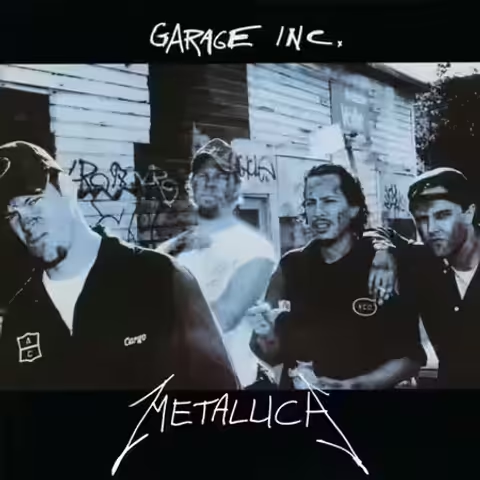
The front cover photograph, by Dutch portrait specialist Anton Corbijn, frames the four band members in a monochrome blue-black wash, dressed in mechanic's overalls. The connection to the album title is unsubtle by design: Metallica are running the garage that the song "Damage, Inc." opens the doors on. The back cover, shot by Ross Halfin, reproduces the front of the 1987 EP, with new 1998 headshots of the four members taped over the original faces and the words "Garage Inc." stuck across the original "Garage Days Re-Revisited" using tracing paper. Andie Airfix later wrote on her studio blog that the band wanted the booklet to function as "a detailed account of the contents of the project", which is what the credits to "kind of produced" and "not produced" eventually became.

Release and Reception

Elektra issued Garage Inc. on 24 November 1998. It sold 426,500 copies in its first week in the United States, the band's fourth consecutive album to debut over 400,000. It would have entered the Billboard 200 at number one almost any other week of the decade. It was held off the top by Garth Brooks's Double Live, the only album in the 1998 Christmas trading window to clear a million copies in seven days. Ben Ratliff reviewed the album in Rolling Stone on 17 November 1998, three days after release, and gave it four stars out of five.

"Gloriously hard as the album is, you can't miss Metallica's good natured side coming through."

Ben Ratliff, Rolling Stone, November 1998

Tom Sinclair, writing in Entertainment Weekly on 18 December 1998, was warmer than the B-minus rating implied.

"We'll have to wait until Metallica's next 'proper' album to find out if this trip to the garage recharges their batteries. Still, all things considered, Garage Inc. is an intermittently exhilarating joyride."

Tom Sinclair, Entertainment Weekly, December 1998

AllMusic's Stephen Thomas Erlewine awarded four stars; Q magazine three; the Encyclopedia of Popular Music three; the Collector's Guide to Heavy Metal 8 out of 10. NME, who had been hostile since at least 1991, gave it 5 out of 10. The German magazine Rock Hard placed the album at number 500 in their 2005 book of the 500 greatest rock and metal albums of all time, the only Metallica covers project to make any equivalent list.

Internationally the album behaved like a regular Metallica studio release, hitting number one in Finland, Germany, Norway and Switzerland, number two in Australia, number three in Canada and New Zealand, number four in Portugal, and the top ten in France, the Netherlands and Sweden. The UK reception was the outlier: Garage Inc. peaked at number 29 on the OCC chart, by some distance Metallica's worst UK chart placement of the 1990s, in part because the singles "Whiskey in the Jar" and "Die, Die My Darling" were not given the same priority by Vertigo as they were by Elektra.

The certifications eventually arrived everywhere: 5x Platinum in the United States (3.35 million units, per the RIAA), Platinum in Germany (500,000), Greece, New Zealand, Poland and Sweden, 3x Platinum in Australia, Gold in the United Kingdom, Argentina, Austria, Norway, Spain and Switzerland, and a 1-million IFPI Platinum Europe Award in 1999. Simon Young of Metal Hammer, looking back at the band's US sales in March 2023, summarised it briskly.

"Released in late 1998, Garage Inc. was a fun, stop-gap double-album which saw the band pay tribute to their heroes, with classics by Diamond Head, Black Sabbath, Mercyful Fate, Lynyrd Skynyrd and Thin Lizzy all given the 'Tallica treatment."

Simon Young, Metal Hammer, March 2023

Singles and Music Videos

Three singles were issued from Garage Inc., all from disc one. The lead single, "Turn the Page", was issued on 16 November 1998, eight days before the album, and reached number one on the Billboard Mainstream Rock Tracks chart. It later cross-pollinated to number 39 on the Modern Rock Tracks chart in 1999. "Whiskey in the Jar" followed on 1 February 1999 and peaked at number 4 on Mainstream Rock. "Die, Die My Darling" came out on 7 June 1999 and made number 26 on Mainstream Rock.

SingleReleasedUS Mainstream Rock peakNotes
"Turn the Page"16 November 19981Originally Bob Seger, 1973. Modern Rock Tracks peak 39 (1999). Music video directed by Jonas Akerlund, follows a single mother working as a stripper, censored in some markets for its depiction of domestic abuse.
"Whiskey in the Jar"1 February 19994Traditional Irish, arranged by Thin Lizzy in 1972. Won the 1999 Grammy for Best Hard Rock Performance. Music video directed by Jonas Akerlund and shot at the Whisky a Go Go in Los Angeles, depicts a destroyed apartment in reverse.
"Die, Die My Darling"7 June 199926Originally the Misfits, 1981. Music video directed by Jonas Akerlund, an animated horror short in the spirit of the Misfits' own iconography.

The "Turn the Page" video was the most discussed of the three, both for the subject matter and because the song had not been a single in 1973. Akerlund framed the song's road-weariness through the eyes of a single mother working as an exotic dancer, with her daughter waiting in motel rooms; sequences depicting domestic violence led to MTV airing a censored cut at certain dayparts. The video later appeared on Metallica's home-video compilations.

The Garage Barrage Tour

To promote the album Metallica played five shows in November 1998, billed as the Garage Barrage Tour. The premise was a deliberate inversion of the previous decade's stadium business: the band would play only cover songs, with their own material played by their support act, a Metallica tribute band called Battery. The shows were short, the venues were small, and the door price was deliberately well below market.

The dates ran through small theatres and ballrooms in the United States and Canada. Battery, the tribute act, opened each night with a 45-minute set drawn from Kill 'Em All, Ride the Lightning and Master of Puppets. Metallica then took the stage and played covers, including "Sabbra Cadabra", "Whiskey in the Jar", "Turn the Page", "Die, Die My Darling", "Astronomy", "Mercyful Fate", "Helpless", "The Wait", "Crash Course in Brain Surgery" and the Motorhead medley from disc two.

Several of the covers were played for the only time in Metallica's career on these shows. Per setlist.fm, the following disc-one tracks have never been performed live by the band since:

  • "Free Speech for the Dumb" (Discharge)
  • "Loverman" (Nick Cave and the Bad Seeds)
  • "Astronomy" (Blue Oyster Cult)
  • "The More I See" (Discharge)

The Garage Barrage Tour was the first Metallica run since the 1980s to be staged at this scale. It would also be one of the last small-room outings the band did before the legal and commercial fallout of the Napster lawsuit reshaped their public profile in 2000.

The Grammy and Other Recognitions

"Whiskey in the Jar" won the Grammy Award for Best Hard Rock Performance at the 41st annual ceremony in February 1999. It was Metallica's fourth Grammy in that category in nine years, after "Stone Cold Crazy" (1990), "Enter Sandman" (1991) and "Better Than You" from ReLoad (1998). The 1999 win is the only occasion on which the category has gone to a cover song that explicitly itself covered another act's cover of an Irish folk song; the lineage from Phil Lynott and Eric Bell's 1972 arrangement back to a sixteenth-century broadside ballad is still the longest historical chain attached to any Grammy-winning rock performance.

The song's Grammy win was, by a margin, the most commercially significant outcome of the project. It pushed the album back into the US top 30 in spring 1999, and it gave the band a soundtrack hit they have played at every Metallica tour since.

Legacy and Influence

For the bands Metallica covered, Garage Inc. functioned as a windfall. Diamond Head, who had broken up by 1985, signed a new record deal in 1999 and have toured continuously since; Brian Tatler has cited the Metallica royalties for "It's Electric", "Helpless" and "The Prince" as the financial backbone of the reformed band. Discharge, Holocaust, Budgie and Sweet Savage all saw catalogue sales tick up. Mercyful Fate's Melissa and Don't Break the Oath were reissued by Roadrunner in 1999 with new liner notes that referenced the Metallica medley.

For Metallica themselves, the album closed an era. The Plant Studios sessions of September and October 1998 were the last sustained studio work the four-piece would do as a four-piece. Jason Newsted left the band in January 2001, and the next time Bob Rock walked into a Metallica session, in April 2001 at HQ in San Rafael, he would do so as the band's interim bass player on what became St. Anger. Garage Inc. is, by that timeline, the last record on which Hetfield, Ulrich, Hammett and Newsted appear together as a working studio band.

The album's other afterlife is the way it has functioned as a gateway record. A generation of metal fans who were too young for thrash in 1986 first encountered Discharge, Killing Joke, Mercyful Fate and Holocaust through the disc two notes by David Fricke. Avenged Sevenfold, Trivium, Bullet for My Valentine and Machine Head all cite individual Garage Inc. tracks as introductions to bands that became their own influences. Lars Ulrich's instinct, in late 1998, that an album of covers would also work as a syllabus, turned out to be largely correct.

Reissues, Remasters and the 1987 EP Returns

The 1987 EP, which had been the keystone of Garage Inc.'s archival half, did not stay merged into the compilation forever. In April 2018, Metallica reissued The $5.98 E.P. - Garage Days Re-Revisited as a stand-alone release on their own label Blackened Recordings, in CD, vinyl and digital formats, for the first time since 1989. The reissue used the original mastering, fixing the channel-glitch in "Green Hell" that had been on the Garage Inc. version, and entered the Billboard 200 at number 18, exactly ten places higher than the EP's 1987 peak.

Garage Inc. itself has not, at the time of writing, received an anniversary deluxe edition; unlike Master of Puppets, ...And Justice for All and the Black Album, all of which have been issued in box-set form by Blackened Recordings since 2017, the 1998 compilation remains in print only in its original 1998 sequence and packaging.

Things You Might Not Know

FactDetail
The title's hidden second meaning"Garage Inc." is a portmanteau of "Garage Days Re-Revisited" and "Damage, Inc.", the closing thrash track from the 1986 album Master of Puppets. The art-direction nod is reinforced by the cover photograph of the band as mechanics.
The Garth Brooks problemGarage Inc. would have been Metallica's fifth straight US number one if it had not been released the same week as Garth Brooks's Double Live, which sold over a million copies in its first week and pinned the band at number two.
The only release with both bassistsDisc two's "Am I Evil?" and "Blitzkrieg" feature Cliff Burton on bass; the rest of disc two and all of disc one feature Jason Newsted. Garage Inc. is therefore the only Metallica release on which both men play.
The LemmysThe four Motorhead covers on disc two were recorded at Lemmy Kilmister's 50th birthday party at the Whisky a Go Go on 14 December 1995, with Metallica performing in wigs and fake moustaches under the alias The Lemmys.
The hidden Robin Trower"The More I See" ends at 3:23. After a stretch of silence, a fragment of Robin Trower's 1974 song "Bridge of Sighs" appears as a hidden track. It is the only acknowledged hidden track in Metallica's discography.
The Iron Maiden feud"Last Caress / Green Hell", on the 1987 EP, ends with a deliberately off-key parody of Iron Maiden's "Run to the Hills". Maiden replied with their own B-side cover of Montrose's "Space Station No. 5", which used a parody of "Damage, Inc." in the outro.
The mastering glitchThe original 1998 CD pressing of "Green Hell" contains an audible left-channel sync glitch at 2:01, introduced when the 1987 EP master was rebuilt for inclusion on disc two. The 2018 stand-alone Blackened reissue of the EP fixed it.
"Loverman" has never been played livePer setlist.fm, four disc-one tracks have never been performed live by Metallica: "Free Speech for the Dumb", "Loverman", "Astronomy" and "The More I See", along with the hidden "Bridge of Sighs" outro.
The longest single Metallica track at the time of releaseThe "Mercyful Fate" medley, at 11:11, was the longest piece of music Metallica had released in their career to that point, eclipsing "...And Justice for All" (9:46) and "Orion" (8:27).
Mark Whitaker's double roleMark Whitaker is credited as a producer of Garage Inc. He was Metallica's road manager and front-of-house engineer in the early 1980s, co-produced the 1987 EP, and is the only non-band, non-Bob Rock figure with a producer credit on a Metallica album of the 1990s.
The Anton Corbijn lineageAnton Corbijn, who shot the Garage Inc. front cover, is best known for his black-and-white work with U2 and Depeche Mode. Garage Inc. is the only Metallica album cover Corbijn has shot.
The Tuesday's Gone broadcastThe Lynyrd Skynyrd cover that closes disc one's first hour is the only track on Garage Inc. recorded for live radio. The 18 December 1997 KSJO broadcast was archived with multitrack audio so that, if the band ever wanted, the recording could be released; almost a year later, they did.