
Adam Duritz wrote the song that would save his second album in two hours, between four and six in the morning, in the bedroom of a rented house at the top of a Hollywood hill, having walked out of the studio at 2am after another long day visiting a friend in intensive care. The song was "A Long December". The friend was Jennifer, who had been hit by a car earlier that month and spent most of January 1996 in hospital. Counting Crows had just begun recording the follow-up to August and Everything After, an album that had gone seven times platinum in the United States and put Duritz on the cover of Rolling Stone with the headline "The Biggest New Band In America". The pressure was enormous. The singer was, by his own account, in pieces.
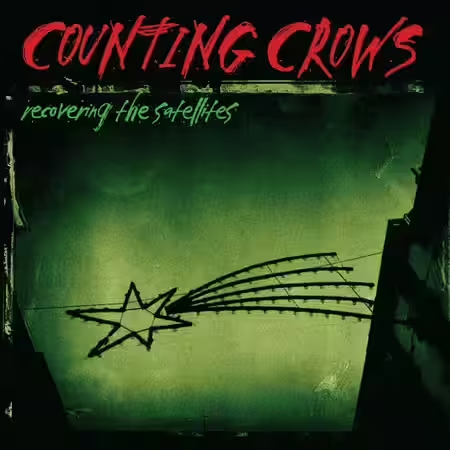
Recovering the Satellites is the record he and his band made out of that pressure. Released by DGC/Geffen on 15 October 1996 and produced by the English studio veteran Gil Norton, it is louder, angrier and lonelier than the debut, an album about the cost of getting what you asked for. It debuted at number one on the Billboard 200, sold two million copies in the United States alone, and produced in "A Long December" the band's biggest international hit. It also ended the easy mythology that Counting Crows were a sunny roots-rock revival act in the manner of Van Morrison or The Band. By the time the credits rolled on its cover photograph, a green-tinted snapshot of a child's drawing of a star, the group had a different reputation, one that would carry them through the rest of the decade.
| Field | Detail |
|---|---|
| Artist | Counting Crows |
| Album | Recovering the Satellites |
| Release date | 15 October 1996 |
| Label | DGC / Geffen |
| Producer | Gil Norton (track 8 produced by Marvin Etzioni) |
| Studios | Rented house in the Hollywood Hills; The Sound Factory, Hollywood; further sessions in San Francisco |
| Recording dates | January to March 1996 |
| Genre | Alternative rock, roots rock |
| Track count | 14 |
| Total runtime | 59:28 |
| Billboard 200 peak | 1 (debut) |
| UK Albums Chart peak | 4 |
| Other chart peaks | Australia 7, New Zealand 4, Scotland 6, Sweden 6, Norway 20, Switzerland 22 |
| Certifications | 2x Platinum (RIAA, Music Canada); Gold (UK BPI, ARIA, RMNZ) |
| Estimated US sales | 2,000,000+ (RIAA shipments) |
| Singles | "Angels of the Silences", "A Long December", "Daylight Fading" |
Cultural Context: A Difficult Year to Be a Sensitive Rock Band
The autumn of 1996 was a strange place to release a moody, piano-led, second album. The American charts were still working through the long tail of grunge and the early swell of pop-punk; Alanis Morissette's Jagged Little Pill remained inescapable a full year after its release; Beck's Odelay had won the kind of critical adoration the Crows had been awarded only two years earlier. Hip-hop was rising fast, with the Fugees' The Score and 2Pac's All Eyez on Me dominating cultural conversation. The week Recovering the Satellites debuted at number one, it knocked Tracy Chapman's New Beginning off the top after eight non-consecutive weeks and held off Toni Braxton's Secrets and a fresh release from R.E.M.
The world the album walked into was also, briefly, a place where a guitar band could still go straight to number one. The Smashing Pumpkins' Mellon Collie and the Infinite Sadness was a year old and still selling; the Wallflowers' Bringing Down the Horse was about to become unavoidable; Pearl Jam's No Code arrived a few weeks earlier as a deliberately difficult successor to Vitalogy. Counting Crows' decision to follow a feel-good debut with a darker, harder record fit the broader mood: nineties guitar acts, having got everything they asked for, were increasingly suspicious of it.
The records jostling for shelf space the week Recovering the Satellites arrived give a sense of the climate the album walked into:
- Tracy Chapman, New Beginning, the album it knocked off the top of the Billboard 200.
- R.E.M., New Adventures in Hi-Fi, released a month earlier and still in heavy rotation.
- Tori Amos, Boys for Pele, the year's other piano-led confessional centerpiece.
- Beck, Odelay, the indie-rock record holding most of the critical real estate.
- Pearl Jam, No Code, the deliberately knottier follow-up by another band running from a debut.
- Toni Braxton, Secrets, the radio juggernaut Recovering the Satellites had to compete with for adult listeners.
The Band, After Mr. Jones
Counting Crows had formed in Berkeley, California in 1991 around Duritz, a former Himalayans frontman, and producer-guitarist David Bryson. By the time they were signed to Geffen by Gary Gersh in 1992 the deal was so generous the music press nicknamed them Accounting Crows. August and Everything After arrived in September 1993, produced by T-Bone Burnett, and was carried first by "Mr. Jones" and then by "Round Here" into a level of success the band had not expected and were not prepared for. They filled in for Van Morrison at the Rock and Roll Hall of Fame in January 1993, played Saturday Night Live a year later, opened for the Rolling Stones, the Cranberries, Bob Dylan and Midnight Oil, and watched the debut sell more than seven million copies in the United States alone. The Chicago Sun-Times later observed that, at the time, it was the fastest-selling record since Nirvana's Nevermind.
It also broke their singer. Duritz had a widely reported nervous breakdown in 1994. Drummer Steve Bowman was fired towards the end of that year and replaced by Ben Mize. The touring band added a second guitarist in Dan Vickrey. By the time everyone got off the road in 1994, the lineup that would record the second album was new in two key positions and exhausted in every other.
"A concept album of sorts about trying to pick up the pieces of a family, a social life and a psyche shattered by fame."
Neil Strauss, The New York Times, October 1996, summarising the album's stated subject matter.
Duritz spent most of 1995 not on tour, an unusual luxury at the height of an album cycle and a deliberate one. The band played only two shows the entire year. The intention was to give the singer time to write, and he did, in hotel rooms during the previous tour and then more seriously at home. The songs that emerged were drawn directly from the experience of becoming famous: lines such as "These days I feel like I'm fading away / Like sometimes when I hear myself on the radio" from "Have You Seen Me Lately?", and a title track that openly weighed the idea of starting again from scratch.
Pre-Production and Songwriting
Duritz wrote the bulk of the album alone at the piano, with several of the more aggressive tracks built up by the full band in the room. Two songs that he later said he simply could not figure out how to sequence into the running order were cut: "Chelsea" and "Good Luck", both of which featured horns played by friends from New Orleans' Soul Rebels Brass Band. "Chelsea" eventually surfaced as a bonus track on the 1998 live album Across a Wire: Live in New York City. "Good Luck" was thought lost for years and was assumed destroyed in the 2008 Universal Studios fire, before turning up in the early 2020s when Geffen dug through its vault for the HBO documentary on the band.
Working titles for tracks have largely vanished from the public record, but the early shape of the record was clearly heavier than what had come before. Where August and Everything After had been built around acoustic guitar, mandolin and Hammond organ, the demos for the second album were full-band rock arrangements. The band wanted to capture what they sounded like on stage, not what they could orchestrate in a studio.
Bringing In Gil Norton
The choice of Gil Norton as producer was deliberate and slightly counter-intuitive. Norton had built his reputation working with the Pixies on Doolittle, Bossanova and Trompe le Monde, with Echo and the Bunnymen, and with Throwing Muses. He was an indie-rock producer with an ear for dynamic detonations and a taste for what the music press at the time still called "alternative" guitar tones. He was an unusual choice for a band whose first album had been steered by T-Bone Burnett towards roots-rock warmth.
His approach to Recovering the Satellites would later become a kind of template for him; within a year he had taken the same sensibility to Foo Fighters' The Colour and the Shape. He and the band rented a large house, the same approach the debut had taken under Burnett, and used its acoustics for the more intimate tracks. Heavier sessions ran at The Sound Factory in Hollywood and at studios in San Francisco. Marvin Etzioni, formerly of Lone Justice, was brought in to produce "Miller's Angels" and to play mandolin on "Mercury".
"A self-consciously challenging response" to the debut, with songs that were "slightly more somber" but "more affecting".
Stephen Thomas Erlewine, AllMusic, in his retrospective four-star review.
Recording the Album: January to March 1996
Sessions began in January 1996 and ran until March. They started in difficult circumstances. Duritz's close friend Jennifer had been hit by a car in mid-December 1995 and was hospitalised for most of January and February. The singer was spending mornings and early afternoons at her bedside and arriving at the studio in the late afternoon, working until two or three in the morning, going home, and starting again the next day. He has said in multiple interviews, including a long account during the band's VH1 Storytellers taping, that the smell of hospitals soaked into the record.
Live tracking dominated. The band wanted to capture takes whole rather than build them piece by piece, and Norton accommodated. "Catapult", the opener, is a full-band performance with Mize's drums set hard against the wall of the rented house. "Angels of the Silences" was tracked at full volume, the closest thing on the record to a contemporary alternative-rock single, with Vickrey's guitars compressed flat and Mize's tom rolls pushed forward in the mix. "Have You Seen Me Lately?" was built around Duritz's piano, with Charlie Gillingham layering Wurlitzer and Mellotron over the top.
The signature production decisions were almost all about restraint. Where T-Bone Burnett had built the debut's roots-rock palette out of acoustic instruments, Norton mostly let the band play loud and then pulled the room sound up into the mix. Paul Buckmaster, who had arranged strings on Elton John's early albums and on David Bowie's Space Oddity, was brought in to conduct an orchestra on three tracks: "Daylight Fading", "I'm Not Sleeping" and "Another Horsedreamer's Blues", with arrangements by Gillingham. David Immerglück, who had been a session player on the debut and would not officially join the band until 1999, played pedal steel and octave mandolin on "Miller's Angels".
The session also dealt with deaths and crises beyond the studio. Duritz spent extended hours visiting his friend in hospital. The band were, simultaneously, integrating their two new members. Mize had been in for a year by the time tracking began but had not yet recorded a full album with the band. Vickrey's only studio work for them had been guesting on "A Murder of One" on the debut. Norton's job was partly to make this new lineup sound like one band rather than the previous lineup with two hires.
Personnel and Credits
| Role | Player | Notes |
|---|---|---|
| Counting Crows | ||
| Lead vocals, piano, Wurlitzer, tambourine | Adam Duritz | Sole writer of nine of the fourteen tracks; co-writer of the remaining five. |
| Guitars, Dobro, tambourine, vocals | David Bryson | Co-founder; rhythm guitar role formalised after Vickrey joined. |
| Hammond B-3, piano, Mellotron, Wurlitzer, accordion, harmonica, vocals | Charlie Gillingham | Wrote string arrangements for three tracks under Buckmaster's baton. |
| Electric bass, double bass, vocals | Matt Malley | Founding bassist; would leave the band in 2005. |
| Drums, percussion, light bulbs, Zippo lighter, vocals | Ben Mize | First full studio album with the band; the percussion credit is real, taken from the album's own sleeve. |
| Lead guitar, vocals | Dan Vickrey | His first Counting Crows studio album as a full member. |
| Additional musicians | ||
| Pedal steel, octave mandolin | David Immerglück | Long-time sideman; would join as a full member for This Desert Life. |
| Mandolin on "Mercury" | Marvin Etzioni | Formerly of Lone Justice; also produced "Miller's Angels". |
| Orchestra conductor | Paul Buckmaster | "Daylight Fading", "I'm Not Sleeping", "Another Horsedreamer's Blues". |
| String arrangements | Charlie Gillingham | Same three tracks. |
| Horns (recorded but cut) | Members of the Soul Rebels Brass Band | Played on "Chelsea" and "Good Luck"; both songs were left off the album. |
| Production | ||
| Producer | Gil Norton | Twelve of the fourteen tracks. |
| Producer, "Miller's Angels" | Marvin Etzioni | The album's only outside production credit. |
| Engineering | Brad Cook (assist) | Duritz has referred to "Brad our engineer" in his Storytellers account of cutting "A Long December". |
Worth noting in passing: the percussion credits on the original sleeve do, genuinely, list "light bulbs" and "Zippo lighter" alongside Mize's name. The band have never quite explained which track those appear on, and reports vary. The sleeve's playfulness is otherwise restrained.
The Songs
The fourteen-track sequence is unusually well shaped for a long second album. It opens with three rock songs, settles into mid-tempo introspection through its middle, picks up again, and closes with the album's two best-known performances back-to-back, "A Long December" into "Walkaways". The record is sequenced like a difficult conversation that ends quietly.
| # | Title | Writer(s) | Length | Single? | Notes |
|---|---|---|---|---|---|
| 1 | "Catapult" | Duritz, Bryson, Gillingham, Malley, Vickrey, Mize | 3:34 | Full-band opener; the only track credited to all six members. | |
| 2 | "Angels of the Silences" | Duritz, Gillingham | 3:39 | Yes (Sept 1996) | Lead single; #3 Modern Rock Tracks; MTV Best Group Video nomination 1997. |
| 3 | "Daylight Fading" | Duritz, Vickrey, Gillingham | 3:50 | Yes (May 1997) | Third single; Buckmaster orchestra. |
| 4 | "I'm Not Sleeping" | Duritz, Bryson, Gillingham, Malley, Vickrey, Mize | 4:57 | Buckmaster orchestra; album's longest crescendo. | |
| 5 | "Goodnight Elisabeth" | Duritz | 5:20 | Setlist staple; live versions routinely run past nine minutes. | |
| 6 | "Children in Bloom" | Duritz | 5:23 | One of the more openly anti-fame lyrics on the record. | |
| 7 | "Have You Seen Me Lately?" | Duritz | 4:08 | Famous "fading away on the radio" couplet. | |
| 8 | "Miller's Angels" | Duritz, Vickrey | 6:33 | Only track produced by Marvin Etzioni; Immerglück on pedal steel. | |
| 9 | "Another Horsedreamer's Blues" | Duritz | 4:32 | Buckmaster orchestra. | |
| 10 | "Recovering the Satellites" | Duritz | 5:24 | Title track; the album's emotional centre and statement of purpose. | |
| 11 | "Monkey" | Duritz | 3:02 | One of the album's most direct rock tracks. | |
| 12 | "Mercury" | Duritz | 2:48 | Etzioni mandolin; written about, and named after, a friend's car. | |
| 13 | "A Long December" | Duritz | 4:57 | Yes (Nov 1996) | Second single; #6 US Radio Songs; #1 Canada; recorded on take six, live except harmonies. |
| 14 | "Walkaways" | Duritz, Vickrey | 1:12 | Acoustic coda; the album's quietest moment and shortest track. |
"Angels of the Silences"
The lead single is the loudest thing the band had recorded. Built on a Vickrey riff and one of Duritz's tightest melodies, it functions as the album's calling-card: a deliberate signal to listeners and radio programmers that the band who had written "Mr. Jones" were not making a sequel. It hit number 3 on the Billboard Modern Rock Tracks chart and earned the band an MTV Video Music Award nomination for Best Group Video in 1997.
"A Long December"
The album's enduring single is its loosest performance. Duritz left the studio at 2am, drove to a small house he and his friends called Hillside Manor, sat with his friends Samantha and Tracy until dawn, then went home and wrote the song between four and six. He played it for the band the next afternoon, taught it to them after dinner, and they cut it in roughly six takes. The recording is essentially live; only the vocal harmonies were overdubbed afterwards. The line "the smell of hospitals in winter" is literal. The "feeling that it's all a lot of oysters but no pearls" is, by the singer's own admission, a turning-of-the-corner: the song is, against the run of play on this album, a quietly hopeful one.
"It's a song about looking back on your life and seeing changes happening, and for once for me, looking forward and thinking, 'Ya know, things are gonna change for the better, maybe this year will be better than the last.' Like a lot of songs at the end of an album it's not about everything turning out great, but at least it is about hope, and the possibilities."
Adam Duritz, VH1 Storytellers, 1997.
"Have You Seen Me Lately?" and the Title Track
If "A Long December" is the album's hopeful close, "Have You Seen Me Lately?" is its low point: a piano-led ballad that reads as straightforwardly autobiographical. The "fading away" couplet became one of the most-quoted lines of Duritz's career and a recurring shorthand for the disorientation of fame in nineties rock criticism. The title track, "Recovering the Satellites" itself, is the album's thesis statement, an attempt to articulate what it means to try to put a life back together after it has been scattered by celebrity.
B-Sides, Outtakes and Lost Songs
Two finished tracks were left off the album because Duritz could not place them in the running order:
- "Chelsea": released as a bonus track on the 1998 live album Across a Wire: Live in New York City; played live throughout the late nineties.
- "Good Luck": presumed lost for over a decade, possibly destroyed in the 2008 Universal Studios fire, before resurfacing from Geffen's archives during research for the 2025 HBO documentary on the band.
Both featured horns from the Soul Rebels Brass Band of New Orleans, which would have given the album an entirely different texture had they made the cut. Other outtakes from the period have surfaced piecemeal on bootlegs but never on official releases.
Album Artwork and Packaging
The cover is one of the more striking sleeves of the late nineties: a green field, a child-like crude drawing of a five-pointed star in white, with the album and band names hand-scrawled at the top of the frame. The deliberate amateurishness is the point. After eighteen months of glossy magazine covers and music-video closeups, the band wanted the sleeve to look like a notebook page rather than a marketing campaign. The interior gatefold continues the hand-drawn aesthetic, with credits and lyrics laid out in handwriting and the percussion-credit jokes left intact.
Release and Reception
The album entered the Billboard 200 at number one on the chart dated 2 November 1996, with first-week sales reportedly close to half a million. It hit number 4 in the United Kingdom, number 7 in Australia, number 4 in New Zealand, number 6 in Scotland and Sweden, and the top forty across most of continental Europe. The RIAA certified it Platinum within weeks and 2x Platinum the following year; Music Canada moved equally fast. The UK BPI awarded it Gold (100,000 shipments).
| Publication | Reviewer | Score | Quote |
|---|---|---|---|
| Rolling Stone | Anthony DeCurtis | 4 / 5 | "Deeply satisfying"; the band "largely achieve their serious ambitions". |
| AllMusic | Stephen Thomas Erlewine | 4 / 5 | "A self-consciously challenging response" with songs "slightly more somber" but "more affecting". |
| MusicHound Rock | Jeff Schwager (ed.) | 4 / 5 | Singled the album out as a creative leap. |
| Q | Staff | 4 / 5 | Praised Norton's production. |
| Spin | Staff | 6 / 10 | Mixed; admiration for ambition with reservations about the lyrics. |
| Los Angeles Times | Elysa Gardner | 2.5 / 4 | Conceded "precious few of the killer pop hooks" of the debut. |
| Entertainment Weekly | Ken Tucker | C | Called the band a "pastiche of its influences"; criticised Duritz's "yowling" and "moans". |
| The Independent | Andy Gill | Negative | "Self-pitying"; "classic solipsistic soul-barer, he just won't shut up about himself". |
| The Rolling Stone Album Guide (2004) | Greg Kot | 2 / 5 | The major retrospective downgrade, against the contemporary RS rave. |
"A pastiche of its influences."
Ken Tucker, Entertainment Weekly, 25 October 1996, in his C-grade review.
The split was characteristic of the late-nineties rock press. The mid-decade had been a long argument about authenticity, and Duritz's open-vein lyricism made him an unusually inviting target for British critics in particular. Andy Gill's Independent review was scathing; Tucker's Entertainment Weekly verdict, that the band were a "pastiche of its influences", became the line most often quoted in the ensuing years. The band's North American press was largely positive, with Rolling Stone's four-star DeCurtis review the high-water mark.
Singles and Music Videos
| Single | Released | Highest charts | Director | Notes |
|---|---|---|---|---|
| "Angels of the Silences" | 24 September 1996 | US Modern Rock 3 | Mark Pellington (uncredited reports) | MTV VMA nomination, Best Group Video, 1997. |
| "A Long December" | 19 November 1996 | US Hot 100 6 (Radio Songs); Canada 1; UK 34 | Lawrence Carroll | Featured Courteney Cox; Cox and Duritz dated for a period after meeting on the shoot. |
| "Daylight Fading" | 19 May 1997 | US Modern Rock 28 | Released only after the album had been out seven months; lower-priority single. |
The "A Long December" video, directed by Lawrence Carroll, found Duritz playing a grand piano in a stretch of woodland while words were scrawled on walls behind him. Courteney Cox, then in the middle of Friends' second season, played the woman in the cutaways. She and Duritz met on set and dated briefly afterwards; he had previously dated her co-star Jennifer Aniston in 1995, a coincidence the tabloid press of the day noted at length.
Touring and Live: The Wallflowers Tour and Duritz's Voice
The album's touring cycle began at the end of 1996 and continued, more or less without break, until the autumn of 1997. The most-discussed leg was the co-headlining run with the Wallflowers that ran from 2 July 1997 to early September. Bringing Down the Horse, Jakob Dylan's breakthrough album, was tearing up American radio at the time, and the pairing was, on paper, a perfect summer-shed bill for that year's adult-rock format. Bettie Serveert, Engine 88, the Gigolo Aunts and That Dog rotated through the support slot in three-week blocks.
The tour also broke its singer. After nine months of near-constant performance, Duritz developed nodules on his vocal cords in July 1997 and the band were forced to cancel several gigs. The Rolling Stone item announcing the cancellation, on 25 July 1997, ran under the headline "Duritz Needs To Rest Voice". After several weeks of recovery, the band played the rest of 1997 lightly and closed the cycle with an MTV-broadcast performance at the Hammerstein Ballroom in New York City. That recording, paired with their VH1 Storytellers session, became the 1998 double live album Across a Wire: Live in New York City.
In TV, Film and Media
"A Long December" became one of the most-licensed Counting Crows songs of the next two decades. It has appeared in episodes of Cold Case, Scrubs, Dawson's Creek and Grey's Anatomy, among others, and is a perennial fixture of end-of-year radio packaging in the United States. "Angels of the Silences" had a smaller but durable life in skate-video and sports-broadcast soundtracking. Crucially, none of these placements ever reached the level of "Big Yellow Taxi" or "Accidentally in Love" later in the band's career; Recovering the Satellites was always a record more loved by listeners than mined by sync agents.
Legacy and Influence
For Counting Crows themselves, the album cemented a pattern that has held for thirty years: a very large debut, a darker and more inward second album that disappointed the critics who had championed the first, and a discography that the band's audience has continued to return to with a loyalty out of proportion to the album's contemporary reputation. By the time This Desert Life arrived in 1999, with the lighter, wittier "Hanginaround", the band had effectively used Recovering the Satellites to finish the conversation about Mr. Jones-era fame.
The record's longer influence is harder to track because the bands who most clearly inherited from it, including the Wallflowers themselves, Train, Matchbox Twenty, the Goo Goo Dolls' more reflective work and almost everything Dashboard Confessional ever recorded, came up alongside Counting Crows rather than after them. Norton would deliver The Colour and the Shape for Foo Fighters in 1997 using many of the same techniques he had refined here, and would later produce A Mark, A Mission, A Brand, A Scar for Dashboard Confessional in 2003. The lineage is more clearly visible in production credits than in headline influences.
The HBO Max documentary Counting Crows: Have You Seen Me Lately?, directed by Amy Scott and released on 18 December 2025 as part of the Music Box series, took its title from one of the album's most quoted songs and centred its narrative on the period between August and Everything After and Recovering the Satellites. The film features Bryson, Gillingham, Vickrey, Immerglück, former bandmate Matt Malley, and interviews with Cyndi Lauper, Coldplay's Chris Martin, Mary-Louise Parker and Jeff Ross. Three decades on, this is the album the band themselves treat as the pivot in their story.
"They largely achieve their serious ambitions"; the album was "deeply satisfying".
Anthony DeCurtis, Rolling Stone, 4 November 1996.
Things You Might Not Know
| Fact | Detail |
|---|---|
| The lost horns | Two finished tracks for the album, "Chelsea" and "Good Luck", featured horns played by friends from New Orleans' Soul Rebels Brass Band; both were cut from the running order purely because Duritz could not figure out how to sequence them. |
| Take six and out | "A Long December" was recorded on take six, live in the room except for the vocal harmonies, and never overdubbed afterwards. Duritz had taught the song to the band that same afternoon. |
| Hospital writing room | The line "the smell of hospitals in winter" is literal. Duritz spent most of January and February 1996 visiting his friend Jennifer in hospital after she was hit by a car in mid-December 1995. |
| The Pixies producer | Gil Norton's previous credits included Doolittle, Bossanova and Trompe le Monde for the Pixies. Within a year of Recovering the Satellites he had produced The Colour and the Shape for Foo Fighters using a very similar approach. |
| The Buckmaster connection | The orchestrations on "Daylight Fading", "I'm Not Sleeping" and "Another Horsedreamer's Blues" were conducted by Paul Buckmaster, who had arranged strings on Elton John's early albums and on David Bowie's Space Oddity in 1969. |
| Two new members, one studio | The album was the first studio Counting Crows record to feature drummer Ben Mize and full-time second guitarist Dan Vickrey. Steve Bowman had been fired in late 1994 and Vickrey had only ever guested on the debut. |
| Hidden percussion credits | Mize's percussion credits on the original sleeve include "light bulbs" and "Zippo lighter" alongside the standard kit. The band have never publicly identified which track those appear on. |
| Friends co-stars in the videos | Courteney Cox played the woman in the "A Long December" video and dated Duritz briefly afterwards. He had previously dated her Friends co-star Jennifer Aniston in 1995. |
| One year, two shows | To give Duritz time to write the second album, Counting Crows played only two gigs in the entire calendar year of 1995, an unusually short break for a band at the height of an album cycle. |
| The lost master, then found | "Good Luck", one of the cut horn tracks, was assumed destroyed in the 2008 Universal Studios fire. It only resurfaced when Geffen pulled material from its vault for HBO's 2025 documentary. |
| Number one out of the box | The album entered the Billboard 200 at number one, knocking Tracy Chapman's New Beginning off the top after eight non-consecutive weeks at the summit. |
| The Etzioni track | "Miller's Angels", the album's longest song at 6:33, is the only track on the record not produced by Gil Norton; Marvin Etzioni of Lone Justice produced it and also played mandolin on "Mercury". |
Listen to the Riffology Podcast
The Riffology podcast goes deeper into albums like Recovering the Satellites every week, with two hosts, a stack of records and a long memory for the era. Subscribe on Spotify, Apple Podcasts, Pocket Casts, Overcast or wherever else you listen. New episodes drop weekly, and the back catalogue covers the rest of the alternative-rock canon of the nineties, plus the records that came before and the records that came after.
Comments