
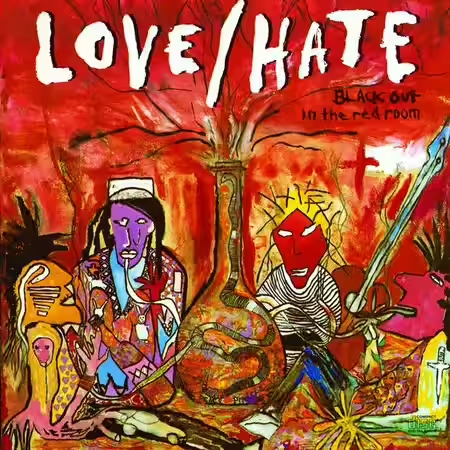
Skid Rose wrote every song on this record before Columbia Records knew the band existed. By early 1988, while every A&R man on Sunset Boulevard was still throwing chequebooks at lookalikes of Poison and Warrant, Love/Hate had been turned down so often that they had stopped chasing labels altogether and started chasing crowds, taking the free Monday-night "No Bozo Jam" slot at the Whisky a Go Go and turning it into the loudest, sweatiest, most stage-dive-prone rite on the Strip.
That is the contradiction at the heart of Blackout in the Red Room. It looks, on its 1990 sleeve, like another late-period hair-metal cash-in. It actually sounds like a band that spent three years being told no and decided to make their debut album anyway, in a four-piece room, with hooks sharp enough to cut Poison's throat and a singer who had only just stopped drinking himself into the ground. Eduardo Rivadavia of AllMusic put the divide bluntly in his retrospective review.
"On the surface, the music of Love/Hate's debut may seem no different than most any late-'80s L.A. pop-metal, but the band's performance exudes a fury and belligerence that posers such as Poison or Warrant could never even grasp; actually, they would turn on their heels and run away screaming from it."
Eduardo Rivadavia, AllMusic review of Blackout in the Red Room
Album Facts
| Field | Detail |
|---|---|
| Artist | Love/Hate |
| Album | Blackout in the Red Room |
| Release Date | 22 February 1990 |
| Label | Columbia Records |
| Producers | Tom Werman, David Kahne |
| Studios | One on One Studios, North Hollywood; Ocean Way Recording, Hollywood |
| Genre | Glam metal, hard rock |
| Track Count | 12 |
| Total Runtime | 40:44 |
| Billboard 200 Peak | 154 |
| UK Albums Chart Peak | Did not chart |
| Mainstream Rock Peak (single) | 46 ("Why Do You Think They Call It Dope?") |
| Certifications | None |
| Estimated Sales | Below gold; figures never publicly disclosed |
| Key Singles | "Blackout in the Red Room", "Why Do You Think They Call It Dope?", "She's an Angel" |
Cultural Context
February 1990 was the strangest possible window into which to drop a Sunset Strip debut. Aerosmith's Pump was still on the Billboard 200 from the previous September. Motley Crue's Dr. Feelgood had been certified platinum four times over by the time Love/Hate's record reached shops. Skid Row's self-titled debut had done the same. Bon Jovi were touring stadiums on the back of New Jersey. Hair metal looked, from the inside, indestructible.
From the outside, the cracks were already visible. Sub Pop had released Mudhoney's Mudhoney the previous October. Soundgarden were finishing Louder Than Love. Alice in Chains were eight months from Facelift. The college-rock world had spent the last year obsessing over the Pixies' Doolittle, and a Seattle three-piece called Nirvana had a Sub Pop debut called Bleach in record bins for anyone willing to look. Love/Hate were arriving at the door of a club whose lights were already being dimmed, and they did not yet know it.
What kept the Strip ecology breathing for one more year was a flood of debuts from bands who had served their time on the boards: Slaughter's Stick It to Ya, Vixen's second record, Faster Pussycat's Wake Me When It's Over, Warrant's Cherry Pie. Inside Tower Records on Sunset, Columbia's promo team racked Blackout in the Red Room alongside all of those. To the casual buyer the cover gave nothing away that distinguished Love/Hate from any of their neighbours.
The Band's Story Up to This Point
The four men who eventually made Blackout in the Red Room first started playing together in 1985, not as a glam band but as Dataclan, an electronica-influenced outfit. The vocalist who became Jizzy Pearl, real name Jim Wilkinson, joined Jon E. Love, Skid Rose and Joey Gold after Dataclan's previous singer walked out mid-tour in Japan. They moved into a Los Angeles warehouse they nicknamed SoulHouse, put out a four-track EP, and played a short tour of Mexico that, by the band's own later admission, went badly.
In 1986 they renamed themselves Love/Hate after a song from their early set called "Love and Hate", and pivoted hard. Out went the synthesisers, in came a gothic, Cult-influenced look modelled on Ian Astbury's Love-era band. By 1987 they had pivoted again, this time landing on a stripped-down rock attack. One of their songs found its way onto the soundtrack of Critters 2, and an early version of "She's an Angel" was used in A Nightmare on Elm Street 4: The Dream Master, both released in 1988. For a brief stretch they employed a guitarist called Tracy G, who later moved on to play with Dio.
None of it produced the record deal they were chasing. Around that period, a video of a drunken Love/Hate set so unsettled Jizzy Pearl that he resolved to clean himself up. Then, in early 1988, Skid Rose sat down and wrote what would become almost the entire Blackout in the Red Room tracklist in a single concentrated burst. The band stopped pitching, took the unwanted Monday slot at the Whisky a Go Go, and committed to playing the songs into shape rather than waiting for an A&R department to make up its mind.
The No Bozo Jam
The Whisky's "No Bozo Jam" was the unfashionable Monday-night slot most touring acts ignored. For Love/Hate, it became a residency. Free entry meant a young drinking crowd. A regular weekly stage meant they could test the new Skid Rose songs in front of an audience week after week, watch which arrangements connected, and rebuild any that did not.
Bassist Skid Rose's habit of opening gigs with a wild dance, brandishing a cross built out of empty Budweiser cans, started in this period and stuck for the rest of the decade. The band's reputation at the Whisky was for a frenetic atmosphere where stage-diving and crowd-surfing were standard: by the back end of 1988 their Monday nights were drawing hundreds. The eventual Columbia deal, signed in December 1988, was a direct consequence of the residency rather than a demo tape doing the rounds.
- The "No Bozo Jam" name was a gentle dig at the Whisky's higher-profile weekend tribute-band slots.
- By late 1988 the residency had drawn enough industry observers that Columbia A&R were attending in person.
- An archival album of pre-deal demos from this exact period, Before the Blackout, was eventually released in 2017 and remains the cleanest surviving record of how the songs sounded before Tom Werman got hold of them.
Pre-production and Demos
The Columbia deal was signed in December 1988. The band's own demo tape that secured it was a four-track recording engineered by Jon E. Love himself, cut in a small studio without producer supervision. That tape captured the songs with a rawness the eventual album would not entirely keep, and it is the version of Love/Hate that the Before the Blackout compilation later restored for fans curious about the unvarnished material.
For the album proper, Columbia paired the band with two producers from very different worlds. Tom Werman, by 1989, was the dominant production hand in West Coast hard rock, with Cheap Trick's Heaven Tonight, Motley Crue's Shout at the Devil and Theatre of Pain, Twisted Sister's Stay Hungry and Poison's Look What the Cat Dragged In already on his ledger. David Kahne, the second name on the credits, was a Columbia staff producer better known for new-wave and alt-rock work, who would go on to produce Sugar Ray, the Bangles' Different Light and, much later, the Strokes. Kahne also played cellos on "She's an Angel" and contributed string arrangements; the genre split written into the production credit was visible on the finished record.
Creating the Album
Recording took place across 1989 at two Los Angeles studios. The bulk of the work was tracked at One on One Studios in North Hollywood, the room Metallica had built much of ...And Justice for All in the previous year. Additional sessions and orchestration were cut at Ocean Way Recording in Hollywood, the older Sunset Sound-adjacent facility where Tom Werman had recorded much of his back catalogue. Both rooms were analogue, both were tape, and the album's sonic character (a dry, close-miked rhythm section, guitars panned hard, vocals sat well forward) is as much a Werman signature as it is a Love/Hate one.
The four-piece arrangement, with Skid Rose's bass doubling as a rhythm-guitar substitute on "Slave Girl" and a 12-string acoustic on "She's an Angel", left Jon E. Love's guitar with a great deal of room. Werman's mixing instincts pushed Love's parts forward and let Joey Gold's drums sit loud and dry rather than reverberant. Outside the core four, Greg Gottlieb cut cellos on "Why Do You Think They Call It Dope?" and "Mary Jane", David Kahne added cellos on "She's an Angel", and a session player named Paul Lewolt overdubbed bagpipes on "Why Do You Think They Call It Dope?", a detail that is one of the album's strangest production choices and a key reason that song has its eccentric, arms-length character compared to anything else on the record.
"Why Do You Think They Call It Dope?" was also where the producer team made its most overt commercial play. The track was given a funk-metal bassline and a noticeably radio-leaning mix that AllMusic's Rivadavia later flagged as the album's one obvious concession. It paid off: the song reached number 46 on the Billboard Mainstream Rock chart and became the band's MTV calling card, but in context it sits oddly against the rest of the record, which makes very few overt grabs at radio.
Personnel and Credits
| Role | Player | Notes |
|---|---|---|
| Core band | ||
| Lead vocals | Jizzy Pearl | Real name Jim Wilkinson; joined what would become Love/Hate in 1985. |
| Guitar | Jon E. Love | Engineered the band's pre-deal four-track demo personally. |
| Bass, rhythm guitar, 12-string | Skid Rose | Wrote every song on the album. Rhythm guitar on "Slave Girl"; 12-string on "She's an Angel". |
| Drums | Joey Gold | Also contributed acoustic guitar in writing sessions. |
| Guest and session musicians | ||
| Cellos | Greg Gottlieb | "Why Do You Think They Call It Dope?" and "Mary Jane". |
| Cellos | David Kahne | "She's an Angel"; doubled as co-producer. |
| Bagpipes | Paul Lewolt | "Why Do You Think They Call It Dope?". |
| Production and engineering | ||
| Producer | Tom Werman | Coming off Motley Crue, Twisted Sister, Poison and Cheap Trick. |
| Producer | David Kahne | Columbia staff producer; later Sugar Ray, the Strokes. |
| Studios | One on One Studios, Ocean Way Recording | North Hollywood and Hollywood, California, 1989. |
| Songwriting | ||
| All songs | Skid Rose | Sole credited writer on every track. |
The Songs
Twelve songs in forty minutes and forty-four seconds. Even by 1990 standards that is a lean record. There is no power ballad in the Whitesnake or Bon Jovi sense; there are no eight-minute epics; the closest thing to filler is "Slutsy Tipsy", a half-grin throwaway that runs three minutes and goes home. What follows is the full sequence as printed on Columbia's first pressing.
| # | Title | Writer(s) | Length | Single? | Notes |
|---|---|---|---|---|---|
| 1 | "Blackout in the Red Room" | Skid Rose | 2:33 | Yes (1990) | UK Singles Chart 88. Title track; the album's mission statement. |
| 2 | "Rock Queen" | Skid Rose | 2:21 | Live opener for years. | |
| 3 | "Tumbleweed" | Skid Rose | 3:31 | Showcased by AllMusic for Jon E. Love's playing. | |
| 4 | "Why Do You Think They Call It Dope?" | Skid Rose | 3:57 | Yes (1990) | Mainstream Rock 46. MTV Headbangers Ball staple. |
| 5 | "Fuel to Run" | Skid Rose | 3:18 | Side-one closer on vinyl. | |
| 6 | "One More Round" | Skid Rose | 3:22 | Side-two opener; bar-anthem template. | |
| 7 | "She's an Angel" | Skid Rose | 4:08 | Yes (1990) | UK Singles Chart 86. Skid plays 12-string; David Kahne adds cello. Earlier version on Nightmare on Elm Street 4 soundtrack. |
| 8 | "Mary Jane" | Skid Rose | 4:31 | Album's longest track; Greg Gottlieb cellos. | |
| 9 | "Straightjacket" | Skid Rose | 3:14 | Later closing-night encore staple. | |
| 10 | "Slutsy Tipsy" | Skid Rose | 3:09 | Half-time blues stomp. | |
| 11 | "Slave Girl" | Skid Rose | 3:51 | Skid plays rhythm guitar. | |
| 12 | "Hell, Ca., Pop. 4" | Skid Rose | 2:44 | Closer; the title was later reused for the band's 2022 reunion album Hell, CA. |
The title track is the album's clearest argument for itself. Two minutes and thirty-three seconds, a riff that sits somewhere between Cult-era Billy Duffy and AC/DC, and Pearl's vocal pushed into a slightly hoarse upper register. There is no chorus in the conventional sense, just a four-bar refrain and a sleeve-rolled-up swagger that announces the band's intent. By the time it ends and "Rock Queen" arrives at an even sharper tempo, the listener has had thirty seconds of pop-metal preamble and just shy of five minutes of actual music. AllMusic's Rivadavia put the album's fundamental tempo problem (in a good way) like this:
"The band literally 'plays on 11,' from the very first crunching power chord of the title track to the last cymbal crash of the frenzied 'Hell Ca., Pop. 4.' In between, they alternate the sheer power of 'Rock Queen,' 'One More Round,' and 'Straightjacket' with the haunting yet beautiful melodies of 'Mary Jane' and 'She's an Angel.'"
Eduardo Rivadavia, AllMusic
"Tumbleweed" is the song every Love/Hate fan singles out as proof that the band could write outside the bar-rocker template. It opens on a slow, almost psychedelic guitar figure from Jon E. Love before resolving into a thrumming mid-tempo verse. It is also the song Rivadavia praised by name when he wrote the AllMusic review.
"With delirious performances, such as guitarist Jon E. Love's on the massive 'Tumbleweed,' there is little here to criticize. Blackout in the Red Room is a very impressive album."
Eduardo Rivadavia, AllMusic
"Why Do You Think They Call It Dope?" is the calculated outlier. Funk bassline, anti-drug message hammered hard, Lewolt's bagpipes adding an absurd theatrical flourish over the bridge: it does not sound like the rest of the album, but it is the song Columbia took to MTV and the song that, for many viewers, was their first encounter with Love/Hate. Headbangers Ball played the video heavily through the spring of 1990. The Mainstream Rock peak of 46 was the band's only entry on that chart for the entire album cycle.
"She's an Angel" is the closest Love/Hate get to a ballad, and the song with the longest history in the band's set: an early version had been licensed to A Nightmare on Elm Street 4: The Dream Master two years before the Columbia recording. Skid Rose's 12-string and David Kahne's cello arrangement give it a darker, more Cult-influenced atmosphere than anything Werman's Crue-era productions would have suggested. "Mary Jane", on the other hand, is the album's most ambitious arrangement, with Gottlieb's cellos lending real weight to a song whose subject matter is a thinly veiled drug romance. "Straightjacket" closes side two of the cassette as the most recognisable hook on the record, and remained the band's encore for the rest of the touring decade.
B-sides, Outtakes and Lost Songs
The Columbia singles for Blackout in the Red Room were issued primarily as US promo CDs and UK 7-inch and 12-inch formats, with B-sides drawn either from album tracks or from radio edits and live cuts rather than from previously unreleased material. The UK pressings of "Blackout in the Red Room", "Why Do You Think They Call It Dope?" and "She's an Angel" are the most-collected of these today, particularly the picture-disc and limited gatefold variants of the title track issued by Columbia UK.
The largest single piece of unreleased material from the era surfaced only in 2017 with the Before the Blackout compilation, which gathered Skid Rose's pre-deal demos from 1986 and 1987. Several of those songs are recognisably the same compositions later cut for the album, but the demo tape preserved them in their unproduced four-track form, which gives a clear sense of how much Werman and Kahne shaped the finished record. A handful of compositions from that period never made the album and have only ever circulated through that release.
Album Artwork and Packaging
The cover is uncharacteristically restrained for the era: the band logo set in red on black with no photograph, no model, no airbrushed cityscape. Columbia released the record on cassette, CD and 12-inch vinyl. Inner-sleeve credits noted Tom Werman and David Kahne as co-producers and printed Skid Rose as sole writer on every track, an unusually clean publishing arrangement for a Sunset Strip debut where credits were typically dispersed across the lineup.
European and Japanese pressings carried the same artwork. The Japanese CD edition added obi-strip translations and a longer set of liner notes, and remains the most-collected international pressing today; UK first pressings of the vinyl have retained collector value because they were issued in smaller quantities than the US Columbia run.
Release and Reception
The album was released on 22 February 1990 and entered the Billboard 200 at a modest position, eventually peaking at 154. The figure understates the record's real reach: by the end of 1990 the singles cycle, the MTV rotation of the "Why Do You Think They Call It Dope?" video and the band's tour with Dio had built a steady cult following, particularly across the UK and continental Europe, where the title track had reached number 88 on the UK Singles Chart and "She's an Angel" number 86.
Contemporary reviews were broadly warm, with Kerrang! and the British rock press flagging the band as one of the year's most vivid debuts. AllMusic's later retrospective four-star review from Eduardo Rivadavia is the most cited critical piece on the record today, and consistently positions Love/Hate as the angrier, more honest cousins of Poison and Warrant rather than peers. The record sold steadily but never reached the gold-certification benchmark Columbia had quietly assumed it would, and that gap between expected and actual sales would shape the entire fate of the band's relationship with the label across 1991 and 1992.
By the time the album cycle wound down, Love/Hate had toured arenas with Dio and AC/DC, played their first UK shows, and were widely considered, inside the LA scene at least, as the next band most likely to break out at a Skid Row scale. The follow-up, Wasted in America, was already being demoed; it would arrive into a music industry transformed by Nevermind, and almost nothing about its reception would resemble the debut's.
Singles and Music Videos
Three singles were issued from the album in 1990. "Blackout in the Red Room" was the lead single in the UK, where Columbia pushed it harder than in the US, and reached number 88 on the UK Singles Chart. "Why Do You Think They Call It Dope?" was the US-focused single, with a video given heavy rotation on MTV's Headbangers Ball; the song peaked at 46 on the Billboard Mainstream Rock chart. "She's an Angel" followed as the third single and reached number 86 in the UK.
The "Why Do You Think They Call It Dope?" video, with its straight-faced anti-drug message running over a funk-metal arrangement that already sounded like it belonged to a different record, was the band's biggest piece of visual marketing. Headbangers Ball's pattern of week-after-week rotation through the spring of 1990 gave the song a cultural footprint disproportionate to its parent album's chart position. Forty-six on Mainstream Rock was the highest the band would ever climb on a US chart.
Touring and Live
The 1990 touring cycle defined Love/Hate as a live band. After a short US club run, Columbia secured them a support slot on Dio's American arena tour, the largest stages they had played to that point and the platform that put them in front of metal audiences who had never set foot on the Strip. The MTV rotation of "Why Do You Think They Call It Dope?" hit during this leg, and by the time they came off the Dio dates, the band had become a recognisable name on Mainstream Rock radio and on Headbangers Ball.
The bigger break followed almost immediately. Love/Hate were added to a leg of AC/DC's The Razors Edge tour, opening on stadium-sized stages on both sides of the Atlantic. It was their first run of UK shows, and the response was substantially warmer than the polite reception they had received as openers in the United States. That was the tour, more than the Dio leg, on which the band's UK following was actually built, and a tour that several British rock writers later cited as the moment they understood why critics in Los Angeles had been writing about Love/Hate for two years.
Skid Rose's Budweiser-cross opening dance, refined over the years on the Whisky's Monday-night stage, travelled with the band across both legs. The set leant heavily on the album's faster material, with the typical 1990 setlist running roughly as follows:
- "Blackout in the Red Room" as the opener, with Skid's Budweiser-cross dance.
- "Rock Queen" and "Straightjacket" early to lock the tempo.
- "Why Do You Think They Call It Dope?" mid-set, the MTV calling card.
- "She's an Angel" or "Mary Jane" as the lone slow gear.
- Either the title track or "Hell, Ca., Pop. 4" as the closer or encore.
The four-piece arrangement gave them a stage presence that was visibly leaner than most of their Strip peers, who at this point were touring with elaborate lighting rigs, runway extensions and pyrotechnics.
In TV, Film and Media
Beyond Headbangers Ball, the album's most prominent media footprint sits in the Wes Craven and Roger Corman B-movie ecosystem of the late 1980s. An early version of "She's an Angel" appears on the A Nightmare on Elm Street 4: The Dream Master soundtrack from 1988, two years before the Columbia recording, which marked the song's first professional release in any form. A separate Love/Hate composition was used on the soundtrack to Critters 2 the same year. Both predated the band's record deal and both, by happy accident, gave Columbia a small body of pre-existing soundtrack credits when they came to write the press kit.
Reissues and Anniversaries
Columbia did not issue a major anniversary edition of Blackout in the Red Room, but the record has been reissued in various territories on CD over the years and remains in print on the streaming services. The most significant archival release tied to the album was 2017's Before the Blackout, a compilation of 1986 and 1987 demos by what was effectively the album's writing line-up.
The most striking live tribute to the record came on 24 February 2007, when the original lineup of Pearl, Jon E. Love, Skid Rose and Joey Gold reunited for the first time in ten years at Club Vodka in Hollywood. They played Blackout in the Red Room in its entirety to a sold-out crowd of 1,500. A December 2007 European tour followed with Darren Housholder on guitar in place of Jon E. Love, again featuring the entire album in album-order followed by selections from later records. In 2020, Golden Robot Records signed Jizzy Pearl's Love/Hate and announced plans for a thirtieth-anniversary album-in-full performance series; the announcement framed the debut as the band's defining work, and the live shows that followed have repeatedly returned to the same all-album setlist template.
Controversy and Later Turmoil
The album itself attracted no significant censorship or controversy on release. The much-told turmoil that surrounds Love/Hate's history sits on the records that followed it. By the time Wasted in America arrived in 1992, Columbia and the band were fighting over which single to release ("Miss America" was the band's choice; the label vetoed it and put out "Happy Hour" instead), and the whole second-album cycle ended with Pearl mounting a Hollywood-sign cross stunt as a publicity gesture and being arrested for it. Pearl described the genesis of the idea years later.
"People were talking about Nirvana. It was a word-of-mouth thing: 'Have you heard about them? Have you heard them?' And that's how it sorta started in the wind. Guns N' Roses were still huge, they were still the kings, but shit was changing."
Jizzy Pearl, 2021 interview, via Ultimate Classic Rock, June 2022
The Hollywood-sign episode left Pearl stuck on a 60-foot cross for nearly two hours before a passing news helicopter spotted him, and Columbia, far from being grateful for the publicity, withdrew its support for a planned Love/Hate slot on a Black Sabbath tour and quietly dropped the band soon afterwards. Jon E. Love quit the lineup almost immediately. None of that catastrophic second-album cycle is the debut's fault, but it is impossible to read the legacy of Blackout in the Red Room without reading what happened to the band that made it.
Covers, Samples and Tributes
The album has been covered live by a range of LA Strip-era contemporaries and successors. Skid Row's Sebastian Bach, despite his famous backstage tangle with Pearl on the No Fucking Frills European tour in 1992, has performed snippets of "Blackout in the Red Room" at solo shows. The band's own setlists across the various Pearl-led incarnations from 2007 onward have functioned as ongoing tributes to the record; the Nottingham-based New Generation Superstars, who supported the December 2007 European tour, have repeatedly cited Skid Rose's writing as a direct influence on their early material. No major studio cover has appeared, but Pearl's 2002 European tour with Gilby Clarke regularly featured "Why Do You Think They Call It Dope?" in the encore set, played by both bands' personnel.
Legacy and Influence
The record's legacy is shaped by the music that followed it more than by the music it sat alongside. Within eighteen months of its release, the Sunset Strip ecosystem that had given Love/Hate their identity was effectively over. Nevermind arrived in September 1991. Ten shipped a month earlier. By the time Wasted in America followed Love/Hate's debut in 1992, the rock press that had championed glam metal had already pivoted, and Columbia's nervous attempt to broaden the band's sound on that second record became an indictment of how quickly the climate had changed. The label dropped them later that year.
For the bands who came after, Love/Hate's debut occupies a distinctive place: the last great Sunset Strip debut before the genre's commercial collapse. It is repeatedly cited in retrospective pieces about LA hard rock as one of the records that should have been bigger and was not, and the pre-grunge what-if quality of its career has, paradoxically, kept the album in conversation longer than many records that outsold it three to one. Metal Rules's "Top 50 Glam Metal Albums" reader poll has consistently ranked Blackout in the Red Room in its top tier; the album's entry on AllMusic carries a four-star retrospective rating; and writers such as Martin Kielty at Ultimate Classic Rock have repeatedly returned to Love/Hate as a useful test case for the question of which Strip bands aged well and which did not.
Pearl has continued to work in the same circles for more than three decades, fronting Ratt for six years from 2000 onwards, joining Quiet Riot, Adler's Appetite, and L.A. Guns at various points, and reactivating Love/Hate under his own name from 2013. Jon E. Love, Skid Rose and Joey Gold have appeared with him intermittently. The records the original four-piece made are now treated by their constituency as a small, specific canon: Blackout in the Red Room, Wasted in America, Let's Rumble. The first of the three remains the one any new listener is pointed at first, and the only one whose songs the band still play in full to celebrate.
Things You Might Not Know
| Fact | Detail |
|---|---|
| The pre-Love/Hate band | Pearl, Jon E. Love, Skid Rose and Joey Gold first played together in an electronica-influenced outfit called Dataclan, not as a glam band, in 1985. |
| The SoulHouse | The four men shared a Los Angeles warehouse rehearsal space and home they nicknamed SoulHouse for several years before the Columbia deal. |
| The brief Tracy G era | Tracy G, who later joined Dio, played guitar in the band briefly in the 1986 to 1987 transition period. |
| The film soundtrack head start | "She's an Angel" appeared, in an earlier version, on the 1988 A Nightmare on Elm Street 4: The Dream Master soundtrack two years before the Columbia album. |
| The bagpipes | Paul Lewolt overdubbed bagpipes on "Why Do You Think They Call It Dope?", an idea credited to the Werman/Kahne production team. |
| The cello players | One of the cellists on the record, on "She's an Angel", is co-producer David Kahne, who later went on to produce the Strokes. |
| The Werman roster | Tom Werman came to Love/Hate immediately after producing Motley Crue, Twisted Sister, Poison and Cheap Trick. |
| One sole songwriter | Every track on the album is credited solely to bassist Skid Rose, an unusual concentration of authorship for a four-piece Sunset Strip band. |
| The Whisky residency | The band built the songs into shape playing the unfashionable free Monday-night "No Bozo Jam" slot at the Whisky a Go Go through 1988. |
| The Budweiser cross | Skid Rose's habit of opening shows with a wild dance brandishing a cross built from empty Budweiser cans started in the Whisky residency and travelled with the band on every major tour after. |
| The 2007 reunion | The original lineup reformed for the first time in a decade on 24 February 2007 at Club Vodka in Hollywood and played the entire album to a sold-out crowd of 1,500. |
| The pre-deal demos | Columbia's deal was secured by a four-track tape engineered by Jon E. Love himself, later reissued in expanded form as 2017's Before the Blackout. |
| The closing-track reuse | The album's closing track, "Hell, Ca., Pop. 4", supplied the title for Pearl's 2022 reunion-era studio album Hell, CA. |
Listen to the Riffology Podcast
The Riffology podcast covered Blackout in the Red Room in full on episode 31, walking through the songs, the production team, the Whisky residency that made the band, and the brief window of opportunity Columbia had with one of the best Sunset Strip debuts of the era. The episode is available on every major podcast platform, including Apple Podcasts, Spotify, Amazon Music and the Riffology podcast feed. We would love to hear which side of the record you reach for first.
Comments