
Sound of White Noise is the album Anthrax made the year they stopped racing. Joey Belladonna had been fired, John Bush had been hired out of Armored Saint, thrash had been dethroned by grunge, and the producer Dave Jerden, fresh from Alice in Chains' Dirt, was the man Elektra paid to find a heavier version of Anthrax that did not depend on speed.
Released on 25 May 1993, it became the band's highest-charting US album to that point, debuted at number 7 on the Billboard 200, sold a half-million copies inside seven months, and split the fanbase straight down the middle. Three decades on it is the record both halves still argue about: the Bush camp's defining statement, the Belladonna camp's heretical detour, and by any honest account the most carefully made album in Anthrax's catalogue.
Album Facts
| Field | Detail |
|---|---|
| Artist | Anthrax |
| Album | Sound of White Noise |
| Release Date | 25 May 1993 |
| Label | Elektra Records |
| Producer | Dave Jerden |
| Studios | Henson Recording Studios, Cherokee Studios, Eldorado Recording Studios (all Hollywood) |
| Engineer | Bryan Carlstrom |
| Mastering | Eddy Schreyer |
| Genre | Alternative metal, groove metal, heavy metal |
| Track Count | 11 |
| Total Runtime | 58:56 |
| Billboard 200 Peak | No. 7 (debut) |
| UK Albums Chart Peak | No. 14 |
| Other Notable Chart Peaks | Top 40 across Germany, Australia, the Netherlands and the Nordic markets |
| Certifications | RIAA Gold (1993) |
| Estimated Sales | Over 500,000 in the US; circa 1 million worldwide |
| Key Singles | Only, Black Lodge, Room for One More, Hy Pro Glo (promo) |
Cultural Context
By May 1993 the rock landscape had been reorganised. Nirvana's In Utero would arrive in September, but the seismic work of Nevermind, Pearl Jam's Ten and Alice in Chains' Dirt had already happened. MTV was rotating Alice in Chains, Soundgarden, Tool and Stone Temple Pilots through Headbangers Ball and Buzz Bin in equal measure. The traditional thrash audience that had carried Anthrax, Metallica, Slayer and Megadeth to platinum success on the back of Among the Living, the Black Album and Reign in Blood was watching its scene reshape itself in real time.
Metallica had already pivoted with the 1991 self-titled album. Megadeth would respond in 1992 with Countdown to Extinction. Slayer was the only Big Four band still committed to the older tempo. Into that crossfire walked Anthrax with a record built around mid-tempo riffs, a new singer with a baritone instead of a tenor, and a producer best known for Jane's Addiction and Alice in Chains. The band were betting that what was perceived as compromise by the speed-metal faithful was the only way to remain on rock radio in the back half of the decade.
- Competing May–June 1993 releases included Aerosmith's Get a Grip, Tool's Undertow and Suede's debut.
- MTV's Beavis and Butt-Head was Anthrax's most powerful single-source promotional channel and would shortly skewer the Only video on air.
- The Lollapalooza touring model had institutionalised the alternative-metal crossover that Anthrax were now trying to enter.
The Band's Story Up to This Point
Anthrax had spent the late 1980s as a band whose ambition outran their lineup's patience. Among the Living in 1987, State of Euphoria in 1988 and Persistence of Time in 1990 had taken them from Bermondsey-and-Brooklyn cult heroes to a Grammy-nominated act with a back catalogue strong enough to sit alongside Metallica and Megadeth in critical conversation. The 1991 collaboration with Public Enemy on Bring the Noise had pushed Scott Ian and Chuck D into the cultural mainstream and put Anthrax on MTV in a way that no purely metal release had managed.
What it had not solved was the band's internal fault line. Joey Belladonna had a voice built for thrash's bright top end and a stage presence that the other four members increasingly felt did not match the heavier, more rhythmically anchored material Ian and Charlie Benante were writing. The breakup was confirmed in mid-1992 and the public framing was creative differences. The private framing, according to Ian in later interviews, was simpler: the band wanted a singer who could survive the mid-tempo direction the songs were already heading in.
The Elektra deal landed in 1992. Megaforce and Island had built the band; Elektra brought the cheque and the expectation. Bob Krasnow's label had Metallica's Black Album distributor money sitting in the same building and wanted an Anthrax record that could chase it.
"It was a big change for us, but it was necessary. We weren't going to keep making the same record."
Scott Ian, in retrospective interviews about the Belladonna-to-Bush transition
Pre-production and Demos
Ian and Benante began writing the bulk of the material in late 1991 and through 1992, often with no settled singer in mind. The working method was a guitar-and-drums sketch in a New York rehearsal space, taken to the rest of the band in lower fidelity than the band had been used to working in. Several of the album's heaviest riffs, including the spine of Room for One More and the chorus stop-time of Only, existed as demos before John Bush had heard a note.
Bush was Anthrax's first and only choice once Belladonna left. He had fronted four Armored Saint records between 1984 and 1991, was a friend of Charlie Benante from the New York and Los Angeles metal touring circuit, and had famously turned down the Metallica job in 1983 when James Hetfield was thinking about stepping back from vocals. The Anthrax courtship was less dramatic. Bush listened to the demos, agreed the material wanted his baritone rather than a tenor, and joined formally in summer 1992.
One song, Black Lodge, had no existing demo. The band approached Angelo Badalamenti, the composer of the Twin Peaks score, and asked whether he would co-write a piece inspired by the show's Black Lodge mythology. Badalamenti agreed and contributed the chord movement and atmospheric scaffolding that the band built the song around. It is the only outside-writer credit on the album, and the only Anthrax track in any era to share a credit with a film and television composer of Badalamenti's stature.
- Belladonna had recorded vocal demos of two early versions of what would become Only and Hy Pro Glo before his departure; those tapes circulated as bootlegs in the late 1990s.
- The working title for the album was reportedly Sound of White Noise from very early in writing; no alternative band-favoured title is documented.
- Pre-production rehearsals were held in New York before sessions relocated to Hollywood.
Creating the Album
Recording began in late 1992 and ran into early 1993, split across three Hollywood studios: Henson Recording Studios (the old A&M lot on La Brea), Cherokee Studios and Eldorado Recording Studios. The producer was Dave Jerden, whose contemporary CV included Jane's Addiction's Nothing's Shocking and Ritual de lo Habitual, Alice in Chains' Facelift and Dirt, and engineering credits stretching back to Talking Heads' Remain in Light. His engineer Bryan Carlstrom came with him, as he did on most of his early-1990s projects.
Jerden's working method, documented at length in a later Tape Op interview, ran counter to the all-night thrash sessions Anthrax had been used to in the Belladonna era. Sessions started in the morning and ended at a sensible hour. Performance capture was prioritised over the editing-board fixes that were starting to be common with the arrival of digital workstations. Guitars were recorded in mono with a single amplifier and two mics, the rhythm tracks then doubled and triple-tracked for width rather than layered with effects.
The drum sound is the most audibly Jerden-shaped element of the record. Where Persistence of Time had used a bright, large-room ambience, Sound of White Noise is closer-miked and drier, with the kick and snare given primary visibility in the mix. Jerden cited the same Sennheiser MD 421 on toms and Shure SM57 on snare that he used on Dirt, with careful phase management between the top and bottom snare mics. Charlie Benante's playing on the record is consequently the most legible of his career to that date; you can hear the individual right-hand articulations on Burst and Sodium Pentothal that earlier records had buried.
"Less is more if the performances and the gear are right. I'm not interested in making a record by editing one. I want to capture the band playing."
Dave Jerden, Tape Op interview on his early-1990s production methods
John Bush's vocals were tracked with a multi-microphone setup designed to accommodate his physical movement at the mic and his shift from spoken-grain verses to declarative choruses. Jerden double-compressed the vocal at the mix stage, a technique he had used on Layne Staley's Dirt vocals, to bed the voice into the rhythm-guitar density without losing consonants. The result is the most upfront vocal presence Anthrax had ever printed, audibly different from the slightly mid-scooped Belladonna mixes of the late 1980s.
Recording overran the original schedule and reportedly the original budget, though no public figure has been disclosed. Mastering was handled by Eddy Schreyer at Future Disc Systems in Hollywood, the same mastering engineer who had cut Dirt and would later cut Tool's Ænima.
Personnel and Credits
| Role | Player | Notes |
|---|---|---|
| Core band | ||
| Lead vocals | John Bush | Anthrax debut; ex-Armored Saint |
| Rhythm guitar, backing vocals | Scott Ian | Primary riff architect alongside Benante |
| Lead guitar, backing vocals | Dan Spitz | Last Anthrax album for Spitz before his 1995 departure |
| Bass, backing vocals | Frank Bello | Melodic counter-lines on Only and Black Lodge |
| Drums | Charlie Benante | Co-writer with Ian on the bulk of the material |
| Guest and session musicians | ||
| Co-writer, atmospheric arrangement | Angelo Badalamenti | Black Lodge; composer of the Twin Peaks score |
| Production and engineering | ||
| Producer | Dave Jerden | Jane's Addiction, Alice in Chains |
| Engineer | Bryan Carlstrom | Jerden's long-time engineering partner |
| Mixing | Dave Jerden | Mixed at Eldorado |
| Mastering | Eddy Schreyer | Future Disc Systems, Hollywood |
| Artwork | ||
| Cover art | Don Brautigam | Illustrator known for Metallica's Master of Puppets sleeve |
The Songs
Sound of White Noise is an eleven-track album of remarkable internal consistency. The pacing keeps the listener in a window of mid-tempo, mid-density heaviness for nearly the full hour, with Black Lodge as the only deliberate textural departure. The lyrical concerns, written largely by Ian with Bush refining phrasing, return repeatedly to paranoia, surveillance, conditioning and emotional exhaustion. It is the closest Anthrax have ever come to a concept record without committing to one.
| # | Title | Writer(s) | Length | Single? | Notes |
|---|---|---|---|---|---|
| 1 | Potters Field | Anthrax | 5:00 | Statement opener; a live staple of the 1993-1994 tour | |
| 2 | Only | Anthrax | 4:55 | Lead single, 1993 | Mid-tempo radio anchor; MTV rotation |
| 3 | Room for One More | Anthrax | 4:35 | 1994 single | Heaviest riff on the record |
| 4 | Packaged Rebellion | Anthrax | 6:13 | Modal lead section in the bridge | |
| 5 | Hy Pro Glo | Anthrax | 4:33 | Promo single | Percussive verse with sparse dynamic drop |
| 6 | Invincible | Anthrax | 6:09 | Anthemic mid-album lift | |
| 7 | 1000 Points of Hate | Anthrax | 5:00 | Descending figure; machine-like drum pattern | |
| 8 | C11 H17 N2 O2 S Na (Sodium Pentothal) | Anthrax | 5:39 | Staccato pattern; closest cut to the band's older speed | |
| 9 | Black Lodge | Anthrax, Angelo Badalamenti | 5:24 | 1993 single | Twin Peaks-inspired; the album's textural centre |
| 10 | Burst | Anthrax | 3:33 | Tight rhythm release | |
| 11 | This Is Not an Exit | Anthrax | 7:23 | Long-form closer; dynamic pacing throughout |
Only
The lead single is a model of how the band rebuilt themselves around John Bush. The verse is a muscular palm-muted Ian rhythm part with a chromatic descent; the pre-chorus tightens the screw with Bello's bass riding the kick pattern; the chorus resolves on a rhythmic cadence rather than a sustained melody. James Hetfield reportedly called it the perfect song. The Mark Pellington-directed video became the band's most-played MTV clip and put Bush's face in front of a rock audience that had largely missed the Armored Saint catalogue.
Black Lodge
Badalamenti's involvement is what made the song possible, but the band's interpretation is what made it Anthrax. The clean-guitar arpeggios that open the track are the closest Scott Ian had ever come to a Johnny Marr part. Bush's vocal sits half-spoken in the verse before opening up at the chorus. The lyric, written by Ian, reads as an Agent Cooper-inflected meditation on the Black Lodge as a place where time and identity unravel. The single edit ran shorter than the album cut and received both MTV and European rock-television airplay.
Room for One More
The two-chord engine is the most direct line back to the band's thrash instincts, but the tempo has been pulled back. The chorus stop-time, where the band drops out entirely for a half-bar before resuming, is the kind of arrangement decision Jerden encouraged and that earlier Anthrax records had largely avoided. It became the third single in early 1994 and a fixture of the touring set.
This Is Not an Exit
The closer is the most ambitious cut on the album, over seven minutes of dynamic build with an ambient outro that fades into white noise, a closing-circle gag the album's title obviously wants you to notice. The arrangement gives Bush more melodic room than anywhere else on the record and is the strongest case the album makes for the band's ability to write long-form without losing momentum.
B-sides, Outtakes and Lost Songs
The Sound of White Noise sessions were unusually tight for Anthrax. The band tracked very close to the album's eventual eleven songs, leaving comparatively little on the cutting room floor. The B-sides that did emerge across the singles cycle were live recordings rather than studio outtakes: Black Lodge backed itself with live versions of older material on the European 12-inch, and Only's B-sides leaned on live cuts from the early phases of the supporting tour.
The most-discussed missing piece is the rumoured Belladonna vocal takes of early Only and Hy Pro Glo demos. These have circulated as bootleg tapes since the late 1990s without any official confirmation from the band. The 2003 We've Come for You All-era Universal reissue did not include them; the album has never had a formal expanded-edition release with bonus studio material.
Album Artwork and Packaging
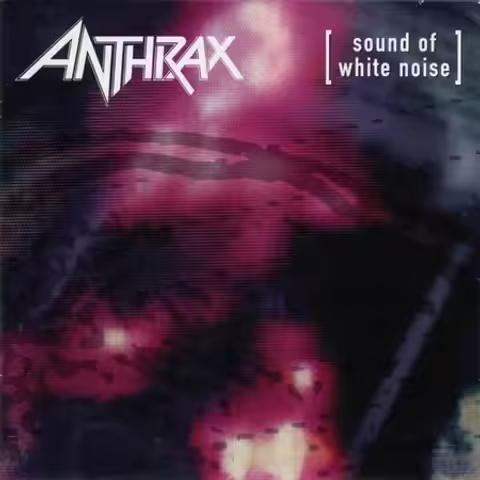
The cover was painted by Don Brautigam, the same illustrator who had created the Master of Puppets sleeve for Metallica in 1986 and the cover for Anthrax's earlier Persistence of Time. The image is a stark close-up portrait in a grey-and-blue tonal palette, with the Anthrax logo at the top and the album title set small at the lower edge. It is one of the least typographically busy sleeves in the band's catalogue and a deliberate move away from the cartoon imagery of the Belladonna-era covers.
The CD booklet contained full lyrics for every track, a credit page that gave each studio its line, and a series of paranoia-inflected interior images that picked up the album's surveillance themes. The European 12-inch vinyl, comparatively rare on first pressing, gatefolded the artwork into a tonally darker version of the same composition.
Release and Reception
Elektra released Sound of White Noise on 25 May 1993 simultaneously in the US, UK and the major European markets. The album debuted at number 7 on the Billboard 200 with first-week US sales of 62,000 copies, the strongest opening of any Anthrax album to that date. In the UK it reached number 14 on the Official Albums Chart. It charted top 40 across Germany, the Netherlands, Australia, Finland and several other secondary markets. The RIAA certified it Gold within seven months of release, reflecting US shipments of 500,000 units. Global sales are estimated at around one million.
Critical reception was largely positive and almost entirely about the Bush handover. Q described the album as a successful recalibration that proved the band could survive the singer change. Kerrang! gave it a four-K review and called Bush the right voice for the material. AllMusic's retrospective entry settled on four stars and noted the production as the strongest of the band's catalogue. The dissenting voices, mostly in the metal underground press, treated the mid-tempo direction as a concession to grunge.
| Territory | Chart | Peak |
|---|---|---|
| United States | Billboard 200 | 7 |
| United Kingdom | Official Albums Chart | 14 |
| Germany | Media Control | 16 |
| Australia | ARIA | 27 |
| Netherlands | Mega Top 50 | 32 |
| Finland | Suomen virallinen lista | 13 |
"Sound of White Noise should silence the doubters. Bush isn't a replacement Belladonna. He's a different singer in a different band, and that band is heavier than the one that made Persistence of Time."
Kerrang! review, June 1993
Singles and Music Videos
Only led the campaign in May 1993, directed by Mark Pellington, whose work for Pearl Jam on Jeremy had won him a Video of the Year Grammy three months earlier. The clip leant on Pellington's documentary-collage style, with intercut text fragments and stark band performance footage. It received heavy Headbangers Ball rotation and lighter mainstream play on MTV. Black Lodge followed in autumn 1993 with a more atmospheric video that played on the Twin Peaks association without licensing any Lynch footage; David Lynch reportedly approved of the band's interpretation in a brief later interview. Room for One More was issued as the third single in early 1994 with a more conventional performance video that was the last music-video assignment of Dan Spitz's Anthrax tenure. Hy Pro Glo was issued as a promotional radio-only single without a commercial video.
| Single | Released | Video Director | B-sides |
|---|---|---|---|
| Only | May 1993 | Mark Pellington | Live cuts from the early supporting tour |
| Black Lodge | Autumn 1993 | Not credited in surviving press | Live B-sides including older Anthrax material on the European 12-inch |
| Room for One More | Early 1994 | Not credited in surviving press | Live recordings |
| Hy Pro Glo | 1994 (promo) | No video | Radio promo only |
Touring and Live
The Sound of White Noise tour ran from June 1993 into late 1994 across the US, Europe, Japan and Australia. Headline theatre runs in the US gave way to a UK and European leg in late 1993 that included multiple sold-out shows at venues like Wolverhampton Civic Hall, Manchester Apollo and St David's Hall in Cardiff. The 9 November 1993 Cardiff set has been preserved on setlist.fm and gives a clear picture of how the new material integrated with the older catalogue: six Sound of White Noise tracks (Potters Field, Only, Room for One More, Black Lodge, Packaged Rebellion, Hy Pro Glo) sat alongside Caught in a Mosh, Indians, Keep It in the Family, Efilnikufesin (N.F.L.), the Public Enemy collaboration Bring the Noise, and the band's traditional Joe Jackson cover Got the Time.
Festival appearances included a slot on the 1993 Monsters of Rock European tour and a return to Donington Park in 1994. The Quicksand support slot on the US theatre leg paired Anthrax with one of the most respected post-hardcore bands of the era and signalled exactly where the band wanted to be positioned culturally. The tour's running visual production was the most ambitious of Anthrax's career to that point, with backline staging that mirrored the album sleeve's tonal restraint.
- Tour opening night: Roseland Ballroom, New York, 26 May 1993, the day after the album's release.
- Quicksand and Mind Funk took alternating support slots on the US theatre leg.
- The 1994 Japanese leg was filmed in part for Japanese television broadcast and has circulated as a fan bootleg.
- Bush's vocal stamina was tested for the first time on the European leg's longer sets; the band shortened a handful of older songs to accommodate his range.
In TV, Film and Media
Only became Beavis and Butt-Head fodder in late 1993, with the duo working through the video on the show in their characteristic style. The exposure, by some band accounts grudgingly welcome, pushed the single back up MTV's request charts for a fortnight. Black Lodge's Twin Peaks connection generated coverage in the mainstream music press that thrash records did not normally receive; Spin and Rolling Stone both ran short pieces on the Badalamenti co-write. The album's tracks have appeared sparingly in later sync placements, with Only the most-used cut, surfacing on rock radio retrospectives and in a handful of action-film soundtracks across the late 1990s and early 2000s.
Covers, Samples and Tributes
Direct covers of Sound of White Noise material are uncommon. Only has been performed by a small handful of bands as a live tribute, including a one-off cover by Bullet for My Valentine on a 2010 festival date. Black Lodge has been performed live by John Bush in his solo and supergroup sets after his second Anthrax tenure ended. The album itself has not been the subject of a tribute record. The 2009 covers compilation Aftershock, an Anthrax tribute issued on Big Box of Metal, included a version of Only by a US thrash band but the record was a limited release. The album has not, to date, been sampled by hip-hop or electronic producers in any prominent placement.
Reissues, Remasters and Anniversaries
Sound of White Noise has had a comparatively quiet reissue history. There has been no super-deluxe anniversary edition. The album was remastered as part of a wider catalogue refresh during Anthrax's mid-2000s reactivation and reissued without significant bonus material. Vinyl re-pressings have appeared on the European market on Music On Vinyl and similar audiophile imprints across the 2010s, in standard 180-gram form. The 30th anniversary in 2023 passed without a band-coordinated release event, although the touring setlist of that year leaned harder than usual on the album's material; both Only and Black Lodge appeared on multiple legs of the band's 2023 European dates.
Legacy and Influence
Anthrax's catalogue after Sound of White Noise tells the story of the choice the band made in 1993. Stomp 442 in 1995 doubled down on the groove direction and lost Dan Spitz mid-album. Volume 8: The Threat Is Real in 1998 fragmented the band's audience further. The Bush era ended in 2005 with Joey Belladonna's return for a series of reunion tours and eventually for 2011's Worship Music and 2016's For All Kings. Bush returned briefly in 2009 for a handful of festival dates.
The album's standing has improved with distance. Where it was treated as a controversial pivot at release, it now sits in critical retrospectives as the band's most carefully made record and as a coherent answer to the question of what a major-label thrash band did with the 1993 reset. Loudwire, MetalSucks and Decibel have all included it in retrospective ranked lists of the band's albums in the upper half. The 2023 reactivation of the touring catalogue, with Belladonna again on vocals, has not displaced Only and Black Lodge from the band's live set, suggesting both that the songs have outlived the singer change and that the audience has, three decades later, made peace with the album's place in the canon.
"It's the record I'm proudest of from that era. We tried something. It wasn't easy. We made the album we needed to make at that moment."
Charlie Benante, in retrospective interviews about the Bush-era Anthrax catalogue
Things You Might Not Know
| Fact | Detail |
|---|---|
| The Hetfield endorsement | James Hetfield reportedly told Scott Ian that Only was "the perfect song" after hearing an early mix, a quote Ian has repeated in multiple interviews across the decades. |
| The Badalamenti cold call | The band approached the Twin Peaks composer directly rather than through Elektra's A&R, with no precedent for a metal band requesting a co-write from a film scorer of his stature. |
| Bush's Metallica near-miss | John Bush had turned down the Metallica vocalist position a decade earlier; Anthrax was the only major thrash band he ever fronted. |
| The Brautigam connection | Cover artist Don Brautigam had also painted Master of Puppets and Anthrax's own Persistence of Time, making him the visual through-line between three of the most important Big Four sleeves of the late 1980s and early 1990s. |
| Dan Spitz's last record | Sound of White Noise was the final Anthrax studio album to feature lead guitarist Dan Spitz before his 1995 departure; he would not return to the band's lineup until the 2005 Belladonna reunion tour. |
| The Pellington pedigree | Only's director Mark Pellington had won the MTV Video of the Year Grammy for Pearl Jam's Jeremy three months before he shot the Anthrax clip. |
| The Beavis bump | Beavis and Butt-Head's coverage of the Only video in late 1993 added a measurable bump to MTV request-show plays for a fortnight after broadcast. |
| The Jerden double | Dave Jerden mixed Sound of White Noise within months of finishing Alice in Chains' Dirt and used many of the same mic and compression choices on both records; the two albums share a sonic family resemblance audible on the snare and the rhythm-guitar mids. |
| The Cardiff snapshot | A surviving setlist from St David's Hall on 9 November 1993 documents six Sound of White Noise songs in a seventeen-song set, the highest concentration of new material the band ever played live in support of a single record. |
| The seven-track sketch | Seven of the eleven album cuts existed as demo sketches before John Bush had heard any of the material, undercutting the persistent fan myth that the Bush handover reshaped the songwriting from the ground up. |
| The closing white noise | The final fade of This Is Not an Exit dissolves into a literal wash of white noise, a closing-circle gag that has gone uncommented on in most reviews of the album over thirty years. |
| The Hetfield-Bush parallel | Hetfield and Bush share a similar mid-baritone range and several Sound of White Noise vocal lines sit almost exactly where Metallica's Load-era material would later be written; the resemblance was noted by reviewers comparing the two records on Load's 1996 release. |
The Riffology Podcast
The Riffology podcast dug into Sound of White Noise across the Bush handover, the Jerden production, the Black Lodge co-write and the album's three decades of critical reappraisal in episode 64 of the show. The episode is available above and on Apple Podcasts, Spotify, Amazon Music and every other major podcast platform. If you enjoyed this article and have a take on where Sound of White Noise sits in the Anthrax catalogue, the Riffology hosts would love to hear it on the next episode.
Comments