Heartwork is the album whose guitarist quit before it came out, whose producer was nearly fired in pre-production, whose vocalist tracked the demos with a throat wrecked by a hash pipe at a Brutal Truth gig, and whose own fans told the band to their faces that it sucked. It is also the record that invented melodic death metal eighteen months before the Gothenburg scene got the credit for it.
By the summer of 1993, Carcass had spent five years building a reputation as the most clinically disgusting band in Britain. Three albums of medical-dictionary lyrics, microscopic close-ups of viscera on their sleeves, John Peel sessions performed under pseudonyms like J. Offalmangler and K. Grumegargler. And then they walked into Parr Street Studios in Liverpool with Colin Richardson, hung an H. R. Giger sculpture on the wall and made an album of palm-muted twin guitar harmonies, mid-paced verse-chorus songs and lyrics about religious extremism. Their American label, Columbia, hoped it might cross over. Their American fans walked out of the shows.
Album Facts
| Field | Detail |
|---|---|
| Artist | Carcass |
| Album | Heartwork |
| Release Date | 18 October 1993 (UK / Europe), 11 January 1994 (US) |
| Label | Earache Records (worldwide), Columbia Records (US distribution) |
| Producer | Colin Richardson |
| Engineer | Keith Andrews; Dave Buchanan and Andrea Wright (assistant) |
| Studio | Parr Street Studios, Liverpool (recorded in Studios Two and Three) |
| Recording Dates | 18 May to 21 June 1993 (with February 1993 demos at the same studio) |
| Genre / Subgenre | Melodic death metal, technical death metal, extreme metal |
| Track Count | 10 |
| Total Runtime | 41:55 |
| Billboard 200 Peak | Did not chart on release |
| UK Albums Chart Peak | Did not chart on release |
| Other Notable Chart Peaks | UK Indie Chart presence; later considered the band's catalogue cornerstone |
| Certifications | None awarded; long-tail catalogue seller |
| Estimated Sales | At least 81,000 units cited by Decibel as of 2013 |
| Key Singles | "Buried Dreams" (1993), "Heartwork" (1994), "No Love Lost" (1994), "Embodiment" (1994) |
Three decades on, the album sits in the Decibel Hall of Fame, on the 51st rung of Rolling Stone's 100 Greatest Metal Albums of All Time, and on the shortlist of any serious discussion about the best British extreme metal record of the 1990s. Bill Steer has said it is his favourite Carcass album. None of that was obvious at the time. As Steer put it years later, the early reception was "frosty", and the band were not at all sure they had not made a catastrophic mistake.
Cultural Context: October 1993
The month Heartwork arrived, mainstream rock was somewhere else entirely. In Utero had been out for three weeks and was crawling back up the Billboard 200. Pearl Jam's Vs. was about to set a one-week sales record. Smashing Pumpkins were a fortnight from releasing Siamese Dream's singles into the world. Tool had just released Undertow. Alice in Chains were finishing Jar of Flies. The conversation was grunge.
In extreme metal, the table was being set by Tampa rather than Liverpool. Death's Individual Thought Patterns, Cynic's Focus and Atheist's Elements had all arrived earlier in 1993 from Florida. Entombed's Wolverine Blues shipped the same month as Heartwork. Sepultura's Chaos A.D. was charting in fourteen countries. Pantera's Vulgar Display of Power was a year old and still everywhere.
Carcass's home turf was no kinder. The British music press in autumn 1993 was almost entirely consumed by Britpop's opening salvoes; Suede's debut had been out six months, Oasis were about to sign to Creation, Blur were halfway through writing Parklife. Kerrang! and Metal Hammer still had pages to fill, but the cultural wind blew everywhere except the direction Carcass were pointing.
- Same-week releases included Entombed's Wolverine Blues and Pearl Jam's Vs.; both outsold Heartwork several hundred times over in its opening months.
- Earache stable-mates Napalm Death released Fear, Emptiness, Despair the following spring, taking a different evolutionary path away from grindcore.
- The Gothenburg scene that would later be credited with inventing melodic death metal had not yet released its defining records; At The Gates' Slaughter of the Soul and In Flames' The Jester Race were still two and a half years away.
The Band's Story Up to This Point
Bill Steer was the through line. He and drummer Ken Owen had formed Carcass as schoolboys, then folded the band when Steer joined Napalm Death in time to play on side two of Scum. When Carcass reactivated in 1986 with Jeff Walker, formerly of Liverpool's Electro Hippies, on bass and a vocalist called Sanjiv on the mic, they wrote Reek of Putrefaction in four days. Walker, Steer and Owen handled vocals between them after Sanjiv left.
John Peel made Reek a Radio 1 favourite despite its production quality, which the band themselves loathed. Symphonies of Sickness in 1989 was the first record with Colin Richardson behind the desk and the first to sound like an actual album, with longer songs and identifiable death-metal architecture. Necroticism – Descanting the Insalubrious in 1991 added the Swedish guitarist Michael Amott, freshly out of Carnage, who at first contributed only one riff and most of the leads while Steer continued to handle every rhythm part. By 1992, between the Earache "Gods of Grind" package tour with Cathedral, Entombed and Confessor and the Campaign for Musical Destruction tour with Napalm Death, Carcass were a serious touring band with a serious problem: their songs were getting longer, slower and more progressive, and the gore-grind formula they had invented felt, in Walker's words, "kind of old".
Pre-production and Demos
Steer and Amott started writing Heartwork riffs on the Necroticism tour bus. The brief was to shorten everything. As Walker told Metal Hammer:
"I suppose what we were really doing was going for shorter songs. We were beginning to write songs that were less wandering. Not that we weren't capable of being complex or technical, something like 'Arbeit Macht Fleisch' proved that to be the case."
Jeff Walker, Metal Hammer, quoted in Revolver, 2018
In February 1993, the band booked Parr Street's tiny third room and demoed the entire album, top to bottom, in the same 10-track running order it would have on release, minus the title sequence. The plan was to hand Colin Richardson a finished blueprint before he walked into the proper sessions. The plan also nearly came apart at the seams because Walker, the night before tracking, had been to see Brutal Truth and Cathedral and had ended up sharing a hash pipe with someone backstage. His throat was wrecked. He liked the result.
"I had a slight vocal problem. I'd been to see Brutal Truth and Cathedral play, and had a hash pipe afterward, that caused the problem. But the demo versions of the songs were a lot rawer than the album ones, and I have to say that I prefer them."
Jeff Walker, Metal Hammer, quoted in Revolver, 2018
The full demo tapes ended up on the 2008 Dualdisc reissue, where you can hear that Walker is right. The vocal is more frayed, more present, slightly more deranged. The album versions are tidier; the demos are scarier. The same 10 songs in a marginally different order.
Two more pre-production wobbles set the tone. The first: Steer announced he was not singing on the record. He had shared vocal duties on the first three albums, but for Heartwork he wanted to focus only on guitar. The band tried to talk him out of it. Steer walked out of the studio for an hour, came back, and the matter was not raised again. The second: Carcass started seriously discussing firing Colin Richardson because they thought he was getting overexposed.
"There was a point where he was doing so much work with other bands that we thought, 'This is weak.' We were such snobs that we didn't want to work with him, because in a way, we're thinking it's getting so trendy nowadays that we don't want to get lumped in with these other bands. Me and Bill went down to meet him and we were talking to him about it. He was kind of upset about it, pissed off. And then we decided we were still going to go with him about it. If we'd gone our way, God knows what would have happened."
Jeff Walker, Carcass – The Pathologist's Report documentary, 2013
Creating the Album: Parr Street, May and June 1993
The sessions ran from 18 May to 21 June 1993. Colin Richardson produced, Keith Andrews engineered, Dave Buchanan and Andrea Wright assisted. Earache were paying. Parr Street, which would later host Coldplay's Parachutes and A Rush of Blood to the Head, Elbow's Asleep in the Back and Stereophonics' Performance and Cocktails, was a sprawling Liverpool facility with three rooms of wildly different character.
Carcass began in Studio Two, which had the best drum room. The drums went down fine. The guitars sounded, in Walker's word, like shit.
"We just couldn't get a guitar sound. For some bizarre reason, being the desk, being whatever, the sound was shit. It must have took two or three days before we realised, 'Well, let's just go upstairs and plug in and see what happens.' Within five minutes, we had this great guitar sound again, not that we did anything different."
Jeff Walker, Carcass – The Pathologist's Report, 2013
The upstairs room was Studio Three, the same tiny space they had demoed in. With Studio Three's character locked, the sessions found their rhythm. Steer double-tracked every rhythm part himself, left and right, panned wide. Amott layered the leads. Walker tracked all the vocals alone, for the first time in Carcass's recording history.
The bass got its own piece of theatre. Walker wanted natural cab tone, but the only isolated room left was a stone cellar built out of leftover Yorkshire stone, which the team christened the dungeon. The bass amp went down there, miked up, with a DI signal recorded in parallel.
Kit selection was small and stubbornly old-fashioned for an album of this importance. Bill Steer's rhythm tone was built around a Peavey 5150 and a Marshall 30th Anniversary head, with a Marshall Guv'nor pedal for extra dirt. Ken Owen's kit was tracked with AKG D12 on the kick, Beyer M380 and Shure SM57 on the snare, Neumann C414 and Sennheiser MD421s around the toms, and Bruel & Kjaer 4006 omnis as overheads. Richardson wanted natural drum sound and resisted heavy triggering; samples were used only for clarity in the mix.
The single biggest production absence was Michael Amott. He had locked his passport into an apartment in Israel earlier in the year and was struggling to get back. He had also already started Spiritual Beggars in Sweden in 1992, and was, as Walker put it, "losing interest". Six of the ten songs are credited to Amott and Steer jointly; Steer wrote four alone. On the album credits, Amott is the second guitarist. In the studio, he was a guest who flew in to put leads down and flew out again.
"We were recording Heartwork and Mike was losing interest. He was stuck in Israel at that point. He got his passport locked into an apartment and he'd gone back. The cracks were starting to show. Mike started the Spiritual Beggars back in Sweden. After doing a tour in '92, I remember where his head was at. Doing Heartwork, he basically came in just to play his lead."
Jeff Walker, Carcass – The Pathologist's Report, 2013
Personnel and Credits
| Role | Player | Notes |
|---|---|---|
| Core band | ||
| Vocals, bass, lyrics | Jeff Walker | Sole lead vocalist for the first time in Carcass history; wrote all lyrics. |
| Rhythm guitars, some leads | Bill Steer | Played every rhythm guitar part on the record, as on the previous two albums; refused to track any vocals. |
| Lead guitars | Michael Amott | Co-wrote six of the ten songs with Steer; absent from much of the recording; quit immediately after. |
| Drums | Ken Owen | His final Carcass studio album as full-time drummer; his playing on the record has been described as "curiously wobbly", a compliment. |
| Production and engineering | ||
| Producer | Colin Richardson | Third Carcass record with Richardson, after Symphonies of Sickness and Necroticism; nearly fired during pre-production. |
| Engineer | Keith Andrews | Spent days hunting Steer's guitar tone before the move from Studio Two to Studio Three resolved it in minutes. |
| Assistant engineers | Dave Buchanan, Andrea Wright | Parr Street house staff. |
| Artwork | ||
| Cover sculpture | H. R. Giger | Life Support, 1993; a recast of a late-1960s original. Same artist who designed the Alien xenomorph and Celtic Frost's To Mega Therion sleeve. |
| Photography | Jurg Kümmer | Shot the Giger sculpture for the sleeve. |
| Sleeve design | Andrew Tuohy | Long-time Earache designer. |
| Disputed / uncredited | ||
| Vocal coaching | None | Persistent fan rumour that Richardson moved Walker off Steer's harmonies; Walker has stated repeatedly that it was Steer's own decision. |
The lineup credit on Heartwork is unique in 20th-century Carcass: until 2021's Torn Arteries, this was the only Carcass album that featured the same four-piece lineup as its immediate predecessor. By the time the album hit shops in October 1993, Amott had already left to focus on Spiritual Beggars; he would later co-found Arch Enemy with Johan Liiva and recruit his brother Christopher on bass. His Carcass replacement on the touring lineup was Mike Hickey, then later Carlo Regadas.
The Songs
| # | Title | Writer(s) | Length | Single? | Notes |
|---|---|---|---|---|---|
| 1 | "Buried Dreams" | Steer (music), Walker (lyrics) | 3:58 | Lead single (1993) | Inverts the Beatles' "All You Need Is Love" lyric; partly inspired by a Tim Cahill book on John Wayne Gacy. |
| 2 | "Carnal Forge" | Steer, Amott (music), Walker (lyrics) | 3:54 | No | Lent its name to the Swedish melodic-death-metal band Carnal Forge. |
| 3 | "No Love Lost" | Steer (music), Walker (lyrics) | 3:22 | 1994 EP | The most compact, hooks-first piece of writing the band had ever done. |
| 4 | "Heartwork" | Steer, Amott (music), Walker (lyrics) | 4:33 | 1994 EP | The title track and the album's biggest video; got the Giger-sculpture concept treatment. |
| 5 | "Embodiment" | Amott, Steer (music), Walker (lyrics) | 5:36 | 1994 EP | The longest cut on the record, with the most overt twin-guitar harmonies. |
| 6 | "This Mortal Coil" | Steer, Amott (music), Walker (lyrics) | 3:49 | No | A standalone NWOBHM gallop dressed as death metal. |
| 7 | "Arbeit Macht Fleisch" | Steer (music), Walker (lyrics) | 4:21 | No | The album's most technical workout; the title plays on the inscription over the gates at Auschwitz. |
| 8 | "Blind Bleeding the Blind" | Steer (music), Walker (lyrics) | 4:57 | No | Released as a B-side on the "Heartwork" EP in some territories. |
| 9 | "Doctrinal Expletives" | Steer, Amott (music), Walker (lyrics) | 3:39 | No | Walker's most direct attack on religious extremism on the record. |
| 10 | "Death Certificate" | Amott, Steer (music), Walker (lyrics) | 3:38 | No | One of the few moments that genuinely resembles the band's old gore-grind self. |
The album opens with the song the Invisible Oranges blog later called "one of the mightiest opening tracks any record has ever had". "Buried Dreams" begins with a clean, almost classical guitar figure, drops a single bass note, and then detonates into a riff that nobody had heard from Carcass before: tight, palm-muted, dry, terrifyingly precise. Walker's lyric was a black inversion of the Beatles, written after he had read Tim Cahill's Buried Dreams: Inside the Mind of Serial Killer John Wayne Gacy.
"The song's a play on the Beatles' 'All You Need Is Love'. And that's nice. But flip the coin and it's saying, 'All you need is hate.' More people are driven by bitterness than they are by love."
Jeff Walker, Carcass – The Pathologist's Report, 2013
"Carnal Forge" is two minutes of mid-paced gallop followed by Amott unleashing a fully-formed Iron Maiden lead. The riff sits squarely on the boundary of death metal and old-school British heavy metal, and it is the song you point at when you are trying to explain to somebody why Heartwork is held responsible for the whole melodic-death-metal genre. The Swedish band Carnal Forge later named themselves after it. So, more or less, did half of Gothenburg.
"No Love Lost" is the shortest song on the record and the most disciplined. There is a riff, a verse, a chorus, a guitar solo, another chorus and an outro, in three minutes and twenty-two seconds. For a band whose previous album had songs called things like "Inpropagation" and "Forensic Clinicism / The Sanguine Article", which were essentially eight-minute progressive death-metal suites, this was an act of self-discipline bordering on penance.
"Heartwork", the title track, is the song the band built a video around. The video itself was a literal real-life rebuild of the Giger sculpture, with a human welded into the biomechanical heart. The riff is one of the most-covered Carcass parts in extreme metal, a four-bar phrase you can sing without the lyric. Bill Steer has called it the best thing he wrote for the album.
"Embodiment" is the longest song and the most patient. Five and a half minutes of twin-guitar harmony, slow build, faster middle, return to the opening figure. It is the moment on the album where the influence of Iron Maiden stops being subtle.
"Arbeit Macht Fleisch" is the one explicit technical-death-metal track, named for the German phrase "work makes flesh", a deliberate corruption of the inscription "Arbeit Macht Frei" hung over the gates at Auschwitz. Walker has never been keen to over-explain the title; the lyric, like most of his lyrics on the album, is about how casually human beings can be reduced to material.
"Blind Bleeding the Blind" rotates through three distinct riff sections in under five minutes and contains one of Ken Owen's most distinctive drum performances; the loose, lurching feel that Invisible Oranges called "curiously wobbly" is most audible here.
"Doctrinal Expletives" is the album's most direct lyrical statement and the most theatrical Amott lead break. "Death Certificate" closes the record by partly going back; the riffing is closer to Necroticism, the lyric is medical, the energy is full-blast Carcass. It is the band saying goodbye to their old self before leaving the room.
The lone embed below is "Under the Scalpel Blade", which Carcass surfaced as a digital single in late 2019 (their first new music in six years) as a deliberate callback to the medical-dictionary era that Heartwork closed the door on. It is included here because it makes the contrast explicit: this is the language Heartwork moved away from, and the language Carcass eventually circled back to a quarter of a century later.
B-sides, Outtakes and Lost Songs
The "Heartwork" EP, released by Earache in 1994 with the title track as its lead, added two non-album tracks: "This Is Your Life" and "Rot 'n' Roll". The first is the closest Carcass ever came to a rock and roll cover swagger, with Walker doing his most leering vocal performance on tape. The second is a one-and-a-half minute punk blast that sounds like the band having a private joke at the expense of every magazine that had started calling them "death and roll" after Entombed.
The most significant outtakes are the full 10-song demo set from February 1993, eventually unearthed on the 2008 Dualdisc reissue. They are not B-sides; they are a parallel version of the album, slightly rougher, with Walker's hash-pipe-damaged vocal sitting higher in the mix and the songs in a marginally different running order. Walker has gone on record saying he prefers them to the official versions.
The mythology around Heartwork includes rumours of additional Steer demo riffs that never made it past Necroticism-era practice rooms, and a persistent fan story that "Buried Dreams" was originally a slower, longer piece halved in length during the demo session. Neither has ever been confirmed by any band member, so they remain rumour.
Album Artwork and Packaging
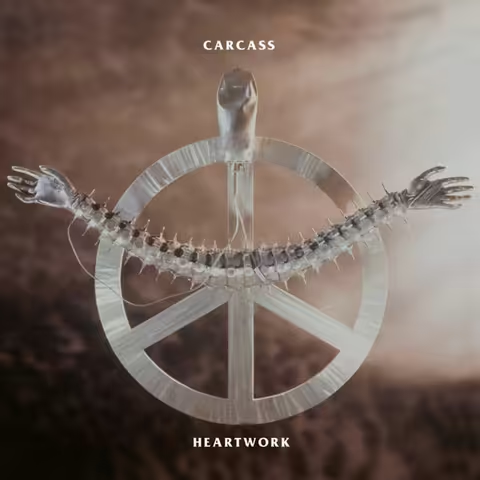
The biomechanical heart on the sleeve is H. R. Giger's Life Support, recast by the artist in 1993 from a piece he had originally made in the late 1960s. Giger had already designed the Alien xenomorph, and in metal had given Celtic Frost the sleeve of To Mega Therion in 1985. Carcass were not buying a generic piece of biomech; they were buying something he had specifically remade that year.
The chain of approval was almost comically informal:
"The art already existed. It was something he had done in the late Sixties. We approached him by a series of coincidences. I had known some woman who's a best friend of his girlfriend slash manager. And he'd actually recast the artwork. So when we approached him it was just really good timing. I think he was pretty cool about it because we didn't have a large amount of money. I think he was prepared to cut us some slack just because his girlfriend was a friend of a friend. Sometimes the stars align and all that shit and things work out."
Jeff Walker, Carcass – The Pathologist's Report, 2013
Photography of the sculpture is by Jurg Kümmer; sleeve typography and layout by long-serving Earache designer Andrew Tuohy. The earliest CD pressings showed the sculpture full-bleed in metallic copper on a black background. Later digipak and Dualdisc editions opened out into a 12-panel fold containing the full lyrics, additional Giger images and credits. The vinyl front cover crops the sculpture more tightly than the CD, which is the version most often reproduced as a tattoo.
Release and Reception
Earache released Heartwork in the UK and Europe on 18 October 1993. Columbia Records, holding the North American licence, sat on it for nearly three months before releasing it on 11 January 1994. It was the only Carcass album to ever appear on a major label.
The contemporary reviews were polite, occasionally exceptional, and frequently confused. Q gave it four stars. Rock Hard gave it 9.0 out of 10. Rolling Stone gave it three and a half. Entertainment Weekly gave it a C+ and the Los Angeles Times gave it two stars and confessed it had no idea what to do with it. The most important reviews of all, from the band's own audience, were the most negative.
"The album got quite a frosty reception, especially in the States. I remember meeting kids and they'd be saying, 'You sold out.' At our concerts people would say, 'It's good to see you, but you're not playing my favourite songs.' And as they were drifting away, they'd say, 'Actually, I think the record sucks.' I didn't meet anybody who liked it. It almost felt like we'd messed up in terms of delivery of what our audience wanted to hear."
Bill Steer, Carcass – The Pathologist's Report, 2013
Crucially, the album did not chart on either side of the Atlantic on release. It would sell quietly and steadily for thirty years instead. By 2013, Decibel cited at least 81,000 units sold; that number is almost certainly higher now, and does not include the 2008 reissue's separate sales line.
Carcass did not pick up a Grammy nomination. They were not on the cover of Rolling Stone. They were not on year-end critics' lists outside the metal press. The reception that mattered, the slow consensus that Heartwork was a defining record, took the entire 1990s to assemble. In May 2013, Decibel inducted it into their Hall of Fame as the 100th album so honoured and the second Carcass record after Necroticism. In 2017, Rolling Stone placed it at #51 on its 100 Greatest Metal Albums of All Time list. Metal Hammer, in 2020, called it "arguably the point where melodic death metal became a cohesive idea" and "the genre's defining statement".
Singles and Music Videos
| Single | Release | Format | B-sides / Extras | Video | Notes |
|---|---|---|---|---|---|
| "Buried Dreams" | 1993 | CD / 7" | Album cut only on most pressings | No official video | Lead single released alongside the album in Europe; promo-only in some territories. |
| "Heartwork" EP | 1994 | CD EP / 12" | "This Is Your Life", "Rot 'n' Roll" | Title-track video shot with a real-life rebuild of the Giger sculpture, featuring a human welded into the heart frame | The lead song of the EP and the main music-video budget go-er; got modest MTV Headbangers Ball rotation. |
| "No Love Lost" | 1994 | Promo CD | Album cut | No official video | Pushed to North American rock radio by Columbia; got nowhere. |
| "Embodiment" | 1994 | Promo CD | Album cut | No official video | Final single pulled from the record. |
The "Heartwork" video is the album's only proper music video, and the one that most often turns up in retrospectives. It was directed in the UK and shot in the same kind of vaguely industrial space that hosted dozens of early-90s extreme-metal clips, with the band performing in low light around the Giger sculpture rebuild. MTV's Headbangers Ball picked it up. It was withdrawn from the playlist not long after the album's commercial profile failed to lift in America.
"This Is Your Life", on the EP, is the closest Carcass ever got to a fast rock and roll number, the kind of thing a then-newly-rocked-out Entombed were doing on Wolverine Blues. "Rot 'n' Roll" is a 90-second sneer, structurally as close to hardcore punk as the band ever came on a studio recording. Both have aged better than most of the rest of the death-metal B-sides of their year.
Touring and Live
Carcass had already played the entire Heartwork album live before it came out. On the spring 1993 tour supporting Death and Cannibal Corpse, the rest of the band insisted on debuting the new material to audiences who had never heard a note of it. Walker thought this was a terrible idea, and said so, but lost the argument. It was the only tour on which Michael Amott would play any of the songs live.
After release, the touring schedule held together a band that was already coming apart. Headline UK and European tours through late 1993 and into 1994 were strong. North American dates with Columbia behind them in spring 1994 were less so; the rooms were smaller than expected and the new material did not yet have its modern reputation. By autumn 1994, Amott was gone and Mike Hickey had been drafted in to cover guitar. By the December 1994 UK tour, Carcass were already debuting two songs from what would become Swansong, "Edge of Darkness" and "Firmhand", with a noticeably different feel.
- Notable shows of the Heartwork cycle include the spring 1993 dates with Death and Cannibal Corpse (the first and only Amott live performances of the songs), the autumn 1993 UK headline tour, and the spring 1994 North American run with Columbia tour support.
- European festival appearances in 1994 included Dynamo Open Air; the band was rotated through several second-tier festival slots before the touring cycle was cut short by Amott's departure.
- The 2008 reunion tour, which began at Sweden Rock and included Wacken, Tuska, Hellfest and a heavily-anticipated Damnation Festival headline in Leeds (Carcass's first English show in fourteen years), made Heartwork material the spine of the set.
- The 2015 "Deathcrusher" tour with Napalm Death, Obituary and Voivod gave Heartwork's songs the venue size they had never had on first release.
In TV, Film and Media
Carcass have a strange media-cameo history that long predates Heartwork's release. Bill Steer and Jeff Walker appeared, in costume, as members of Lister's childhood band Smeg and the Heads in the 1989 Red Dwarf episode "Timeslides". A 1996 episode of Friends ("The One with the Cheap Wedding Dress") has Megan and Phoebe casually discussing Carcass playing at a wedding, a piece of writing that the band's fans still cannot quite believe is real.
Music from Heartwork itself has appeared in metal documentary soundtracks, the Carcass – The Pathologist's Report film, and a long list of skate and snowboarding video edits in the late 1990s where the title track's main riff is the de facto soundtrack for a grind down a handrail. Compared to its catalogue siblings, however, the record has had relatively few sync placements, which is part of why its reputation has had to be built slowly through musicians citing it rather than through any single mass-market exposure.
Controversy, Censorship and Lawsuits
For a Carcass record, Heartwork was unusually clean of controversy. There were no obscenity-led censorship cases of the kind that had stickered Reek of Putrefaction in certain territories, no banned-by-supermarket retail bans, no plagiarism suits. The album was the first Carcass release that you could put on the front rack of HMV without the manager rolling it under the counter.
The closest the record came to a real controversy was the title "Arbeit Macht Fleisch", a deliberate corruption of the inscription over the gates at Auschwitz. The song's lyric is not anti-Semitic and Carcass were never accused of being so, but the title generated several uncomfortable column inches in the German metal press, and Walker has answered the question about it more times than he probably wants to.
Covers, Samples and Tributes
The album has not been the subject of a dedicated tribute record, but its individual songs are some of the most-covered in modern extreme metal. Arch Enemy, the band Michael Amott formed after walking out of Carcass, have a long history of covering "Heartwork" live. The Black Dahlia Murder's Trevor Strnad cited Carcass as his single biggest vocal influence and frequently dropped Carcass riffs into the band's live show.
The Swedish melodic-death-metal band Carnal Forge are named after the song. The Gothenburg scene's full impact statement – At The Gates' Slaughter of the Soul, In Flames' The Jester Race, Dark Tranquillity's The Gallery, all 1995 and 1996 – would be impossible to imagine without Bill Steer's twin-guitar work on this album. In a 2018 Decibel feature, Cattle Decapitation's Travis Ryan named Carcass one of the five heavy albums that changed his life. Ben Weinman of Dillinger Escape Plan, Matt Nicholls of Bring Me the Horizon, Phil Bozeman of Whitechapel and Joel Stroetzel of Killswitch Engage have all named Carcass as a foundational influence.
Two more bouquets are worth noting. Death's Chuck Schuldiner, the closest thing American extreme metal had to a saint, said Bill Steer's guitar work on the album "had that magic rarely heard anymore". And Bill Steer himself, asked which Carcass album was his favourite, said it was this one.
Reissues, Remasters and Anniversaries
Earache reissued Heartwork in 2008 as a Dualdisc, with the audio album on one side and a DVD containing The Pathologist's Report Part IV: Epidemic on the other. A bonus disc contained the full February 1993 Parr Street demo, all ten songs in slightly different order. The accompanying 12-panel digipak carried the full lyrics, expanded credits and additional Giger imagery.
Subsequent reissue editions have moved the DVD onto its own physical disc, taking the package to three. The album has also seen multiple coloured-vinyl pressings on the band's reunion-era touring runs, including a half-speed master cut. There is, to date, no official Atmos / spatial-audio release.
2018 marked the album's 25th anniversary; Decibel ran an extensive "Hall of Fame Countdown" oral history pegged to it, which is the source of much of the recording detail the band has ever publicly discussed. 2023's 30th anniversary passed more quietly, with Carcass deep in touring for Torn Arteries. A 35th-anniversary deluxe edition is widely rumoured for late 2028 but has not been confirmed by either Earache or the band.
Legacy and Influence
The standard story of melodic death metal puts Gothenburg at the centre. At The Gates' Slaughter of the Soul, October 1995. In Flames' The Jester Race, February 1996. Dark Tranquillity's The Gallery, November 1995. These are the records that crystallised the sound that became one of the most commercially successful sub-genres of 1990s metal. The Gothenburg bands themselves, asked who they were listening to in 1993 and 1994, name Carcass. Heartwork is the album they were listening to.
It is not the only ancestor (Iron Maiden, Mercyful Fate and Bay Area thrash are equally important), but it is the most direct one. The twin-guitar harmonies on "Carnal Forge" and "Embodiment", the verse-chorus-verse architecture on "No Love Lost", the marriage of a death-metal vocal to recognisably classic-rock guitar shapes, all of it is on the Gothenburg records two years later. The Swedish bands made the formula more melodic, smoothed out the rough edges and turned it into hooks; Carcass, in Liverpool, had drawn the map.
The album also marks the end of one band and the beginning of several others. Michael Amott left to start Spiritual Beggars and later founded Arch Enemy, who would themselves become one of the genre's biggest acts. Bill Steer eventually formed Firebird, a Clapton-esque blues-rock outfit that has nothing to do with metal. Ken Owen's drumming on this record was his final full-length Carcass studio performance; the cerebral haemorrhage he suffered in 1999 ended his playing career, though he has appeared on stage and on record in the band's reunion years.
For Carcass themselves, the album is the line that separates the two halves of their career. Before Heartwork, they were the most clinically gross band in Britain. After it, they were the most influential extreme-metal band of their generation. Bill Steer was right when he said it sounded like sell-out at the time. He was also right when he said, with thirty years of hindsight, that it is his favourite Carcass record.
Things You Might Not Know
| Fact | Detail |
|---|---|
| The hash-pipe demo | Walker tracked the February 1993 demos with a vocal cord wrecked by a hash pipe shared backstage at a Brutal Truth and Cathedral show the night before. He has gone on record saying he prefers the demo vocals to the album versions. |
| The Beatles inversion | "Buried Dreams" is a deliberate dark inversion of "All You Need Is Love"; Walker wrote it after reading Tim Cahill's John Wayne Gacy book of the same name. |
| The fired-then-unfired producer | Walker and Steer drove down to Colin Richardson's place to fire him in pre-production, talked it through with him, watched him get upset, then changed their minds at the meeting. |
| Steer would not sing | Steer had shared vocals on every previous Carcass album. He told the band he was not singing on this one, walked out of the studio for an hour when they pushed back, and that was the end of it. |
| The locked passport | Michael Amott was stuck in Israel for part of the sessions after locking his passport in an apartment; he flew back in only long enough to track his leads. |
| The dungeon bass | Walker's bass cab was set up in a stone cellar at Parr Street made of leftover Yorkshire stone, christened the dungeon by the team. |
| The five-minute guitar tone | The sessions burned two to three days hunting Steer's guitar tone in Parr Street's best room before the team moved upstairs to the tiny Studio Three, where the tone clicked inside five minutes with the same gear. |
| The Giger discount | Walker negotiated H. R. Giger's Life Support sculpture for the sleeve through a friend-of-a-friend connection to Giger's partner, securing a financial concession the band could afford. |
| The album played live before release | Carcass played the entire album live on a spring 1993 tour with Death and Cannibal Corpse before any of it had come out, against Walker's wishes; it was the only tour Amott ever played the songs on. |
| The frosty US reception | Steer has said the album was met with hostility on its first North American tour; fans walked up to the band, said they had sold out, then said the album sucked. |
| The Gothenburg paradox | The melodic-death-metal genre is universally credited to Sweden, but the canonical Gothenburg records were released two to two and a half years after Heartwork; the Swedish bands all cite Carcass as an influence. |
| The Carnal Forge namesake | The Swedish melodic-death-metal band Carnal Forge took their name directly from track two of this album. |
| The Friends cameo | The album existed in popular culture's peripheral vision in the mid-1990s; the band were name-dropped in the 1996 Friends episode "The One with the Cheap Wedding Dress", which still bewilders fans. |
| The major-label one-off | Heartwork is the only Carcass studio album that ever appeared on a major label in any territory; Columbia signed Carcass for the follow-up Swansong and effectively paid them twice for the same album before the band moved back to Earache. |
| Steer's pick | Asked in the band's official documentary which Carcass album is his favourite, Bill Steer named this one. |
Riffology Podcast
If this article has tempted you back to Heartwork, the Riffology podcast spends a full episode pulling the record apart track by track and discussing exactly what makes a Liverpool extreme-metal album from 1993 still feel this current three decades later. The Carcass episode is RIFF058, embedded above the article on this post, and the show is also available on Apple Podcasts, Spotify, Pocket Casts, Overcast and anywhere else podcasts are listened to.
Comments