By the time Rage Against the Machine walked into Cole Rehearsal Studios in November 1995, the band had been trying and failing to make a second record for over a year. The first attempt with Brendan O'Brien, started in November 1994, produced twenty-three tracks and a series of arguments severe enough that an MTV News source described the band as having briefly broken up. They reconvened for a single show at the KROQ Weenie Roast in June 1995, then disappeared again. What eventually emerged as Evil Empire, released on 16 April 1996 by Epic, was the sound of a four-piece negotiating peace by leaning harder into the differences that had nearly killed them: more hip-hop, more dissonance, less of the chant-along punk that had made the debut a million-seller.
It debuted at number one on the Billboard 200 with first-week sales of 249,000 copies, the band's first chart-topper. It went on to triple-platinum certification in the United States, gold or platinum in nine other territories, and a 1997 Grammy for Best Metal Performance for the album's shortest, angriest track. It also marked the moment Rage Against the Machine stopped being a buzz band and became a fixture: the kind of group that could shut down Saturday Night Live in protest of its own guest host and then open the next year for U2 on a stadium tour.
Album Facts
| Field | Detail |
|---|---|
| Artist | Rage Against the Machine |
| Album | Evil Empire |
| Release Date | 16 April 1996 |
| Label | Epic Records |
| Producer | Brendan O'Brien; Rage Against the Machine (co-production) |
| Studios | Cole Rehearsal Studios, Los Angeles (recording); Kiss Music Recording Studios, Melbourne ("Down Rodeo" vocals); The Enterprise (mixing); Gateway Mastering Studios (mastering) |
| Genre / Subgenre | Rap metal, alternative metal, rap rock |
| Track Count | 11 |
| Total Runtime | 46:37 |
| Billboard 200 Peak | 1 (debut, week of 4 May 1996; 249,000 first-week sales) |
| UK Albums Chart Peak | 4 (UK Rock & Metal Albums: 1) |
| Other Notable Chart Peaks | Sweden 1, Australia 2, Austria 2, Germany 2, Norway 2, Belgium (Wallonia) 2, New Zealand 3, Denmark 4, Netherlands 4, Switzerland 4, Finland 5 |
| Certifications | US 3× Platinum (RIAA, May 2000); UK Gold (BPI); Canada Platinum; gold in Australia, Austria, Belgium, France, New Zealand, Spain, Sweden and Switzerland |
| Estimated Sales | 3 million+ in the United States; reports of worldwide sales vary |
| Key Singles | "Bulls on Parade" (April 1996), "People of the Sun" (August 1996), "Vietnow" (October 1997, Europe only) |
A Second Album in the Age of Crossover
Spring 1996 was the moment American rock was deciding which way to fall. Alanis Morissette's Jagged Little Pill was still the biggest-selling record in the country eight months after release. The Score by the Fugees would arrive in February. Pearl Jam's No Code, Soundgarden's Down on the Upside and Metallica's Load were all in the pipeline. Across the Atlantic, Britpop was peaking. The boundary between rock, hip-hop, electronics and pop was lower than it had been at any point since the late 1960s, and Epic was sitting on a band who had spent three and a half years pretending they didn't care whether they ever made a second record.
The pressure on Rage Against the Machine was specifically the pressure that comes after an unexpected debut hit. The 1992 self-titled album, recorded for around $50,000 with Garth Richardson and released into a chart still dominated by Nevermind, had not sold quickly. Lollapalooza '93 changed that. By the end of 1993 the debut had moved roughly 400,000 copies in the United States; by April 1996, on the eve of the new record, it had cleared a million. Epic wanted the follow-up. The band, increasingly, did not know what the follow-up should sound like. Tom Morello was open about the cost of that uncertainty.
"Different band members have their different interests that they've been pursuing. But principally, the main reason for the delay between records was trying to find the right combination of our very diverse influences that would make a record that we were all happy with and that was great. That was a long process."
Tom Morello, Kerrang!, 1996
The Broken Sessions of 1994 and 1995
The first attempt at the album began in Atlanta in November 1994. The band tracked twenty-three songs with Brendan O'Brien, whose recent work with Pearl Jam on Vs. and Vitalogy had made him the most in-demand rock producer in America. According to an MTV News source close to the band, the Atlanta sessions ended badly: the four members fell out so severely that they briefly stopped being a band at all. There was no public statement, no press conference, no announcement of a split. They simply stopped working.
What pulled them back together was a one-off booking. The KROQ Weenie Roast at the Irvine Meadows Amphitheatre on 17 June 1995 was the first Rage Against the Machine show in nine months. They played it, and discovered they still wanted to. Morello later explained the underlying disagreement as a question of direction rather than personality: the band were pulling at one another over how much hip-hop, how much riff-rock, how much overt politics and how much abstraction the second album should carry. The compromise that eventually crystallised was the one he summarised in a phrase that has followed the record ever since.
"We wanted to find a middle ground between Public Enemy and the Clash."
Tom Morello, quoted in The Deseret News, 1996
Recording resumed in November 1995 at Cole Rehearsal Studios in Los Angeles, a converted soundstage rather than a conventional studio. The choice was deliberate: O'Brien and the band wanted to track live in a large room with the lineup playing in earshot of one another, the way they had on the debut. Nick DiDia handled engineering, with Caram Costanzo and Clay Harper assisting. The sessions ran through December 1995 and were essentially complete by the new year. The Australian vocals for "Down Rodeo" were captured during a side-trip to Melbourne in January 1996 at Kiss Music Recording Studios, with Dave Rat and Paul Kosky engineering.
Mixing was handed to Andy Wallace at The Enterprise, Wallace's CV by 1996 included Nevermind, Jeff Buckley's Grace and Sepultura's Roots, and Bob Ludwig mastered at Gateway Mastering Studios in Maine. The whole production chain after Cole was deliberately top-shelf: O'Brien producing, Wallace mixing, Ludwig mastering. The record that emerged was eleven songs and forty-six minutes long, three minutes shorter than the debut and four songs leaner.
Brendan O'Brien and the Sound of Evil Empire
O'Brien's approach was the opposite of what received wisdom would have predicted for a record built around hip-hop influences. Where most rap-metal of the late 1990s would be tracked drum-machine-tight and overdubbed within an inch of its life, Evil Empire is largely a live-band record. The rhythm section was cut together. Morello's guitar overdubs were kept lean, with the exception of the effect-heavy hooks ("Bulls on Parade", "People of the Sun") where his pickup-switch and toggle-as-DJ-scratch tricks are the song's signature.
The bass position on the record is its single biggest production decision. Tim Commerford, credited as Tim Bob on the sleeve, sits unusually high in Wallace's mix, with a thick midrange tone that often carries the song's hook ("Bulls on Parade" is the obvious example, but it is true of "Vietnow" and "Wind Below" as well). Brad Wilk's drums were tracked close and dry, with the snare audibly tuned higher than on the debut. The overall sound is denser than the 1992 album but also more articulate: you can hear every chord change, every Zack de la Rocha consonant. That precision is partly what fuels the Rolling Stone complaint that the record sounded "maniacally shrill"; it is also why "Bulls on Parade" still functions as a single thirty years later.
Personnel and Credits
| Role | Player | Notes |
|---|---|---|
| Rage Against the Machine | ||
| Lead vocals | Zack de la Rocha | All lyrics written by de la Rocha; "Down Rodeo" vocals tracked in Melbourne |
| Guitars | Tom Morello | All music composed collectively as Rage Against the Machine |
| Bass | Tim Commerford | Credited on the sleeve as "Tim Bob" |
| Drums | Brad Wilk | |
| Production and engineering | ||
| Producer | Brendan O'Brien | Rage Against the Machine credited as co-producers |
| Engineer / recording | Nick DiDia | Cole Rehearsal Studios |
| Engineer | Caram Costanzo | |
| Assistant engineer | Clay Harper | |
| Recording ("Down Rodeo" vocals) | Dave Rat, Paul Kosky | Kiss Music Recording Studios, Melbourne |
| Mixing | Andy Wallace | The Enterprise |
| Mastering | Bob Ludwig | Gateway Mastering Studios |
| Artwork and design | ||
| Cover painting | Mel Ramos | Altered version of his 1960s Crimebuster painting |
| Additional artwork | Barbara Kruger | Some of which appears in the "Bulls on Parade" video |
| Art direction | Aimée Macauley; Rage Against the Machine | |
| Photography | Lisa Johnson | |
The personnel list is short and the lineup is the four band members alone, no guest vocalists, no sampled hip-hop artists, no string section, no horn arrangement. Everything on the album that sounds like a turntable, a sampler or a synthesiser is in fact Morello's Stratocaster routed through pedals or operated via the pickup selector. The producer's contribution is to have stayed out of the way of that.
The Songs
The album is sequenced for impact rather than dynamic shape. The first three tracks, "People of the Sun", "Bulls on Parade" and "Vietnow", are the three most identifiable songs on the record, fired off back-to-back-to-back. The middle of the album is denser and stranger, with "Revolver" and "Snakecharmer" working in slow-burn dynamics and "Tire Me" providing a three-minute thrash burst that won the band their first Grammy. The closing run, "Without a Face" through "Year of tha Boomerang", is closer to the band's debut in tempo and aggression.
| # | Title | Writer(s) | Length | Single? | Notes |
|---|---|---|---|---|---|
| 1 | "People of the Sun" | de la Rocha / Rage Against the Machine | 2:30 | Yes (Aug 1996) | Addresses the Zapatista uprising in Chiapas; Grammy nomination for Best Hard Rock Performance, 1998 |
| 2 | "Bulls on Parade" | de la Rocha / RATM | 3:49 | Yes (April 1996) | US Alternative Airplay peak 11; Grammy nomination for Best Hard Rock Performance, 1997; Morello's pickup-toggle solo |
| 3 | "Vietnow" | de la Rocha / RATM | 4:39 | Yes (Oct 1997, Europe) | Title fuses Vietnam-era paranoia with the 1990s talk-radio right |
| 4 | "Revolver" | de la Rocha / RATM | 5:30 | No | Slow, off-kilter blues-metal; the album's longest track outside the closer |
| 5 | "Snakecharmer" | de la Rocha / RATM | 3:56 | No | Built around a swampy Commerford bass riff |
| 6 | "Tire Me" | de la Rocha / RATM | 3:00 | No | Won the 1997 Grammy for Best Metal Performance; the album's shortest and fastest |
| 7 | "Down Rodeo" | de la Rocha / RATM | 5:20 | No | Vocals tracked in Melbourne in January 1996 |
| 8 | "Without a Face" | de la Rocha / RATM | 3:36 | No | Written about deaths on the US-Mexico border; de la Rocha cited 1,500 bodies found since 1986 |
| 9 | "Wind Below" | de la Rocha / RATM | 5:50 | No | Slowest track on the record; foreshadows the dynamics of The Battle of Los Angeles |
| 10 | "Roll Right" | de la Rocha / RATM | 4:22 | No | |
| 11 | "Year of tha Boomerang" | de la Rocha / RATM | 4:02 | No | Earlier version had appeared on the 1995 Higher Learning soundtrack as "Year of the Boomerang" |
"People of the Sun" opens the record on a manifesto. De la Rocha had been involved with the Zapatista Front for National Liberation since their January 1994 uprising in Chiapas, and the song reads as direct address: a two-and-a-half-minute compression of the politics that would dominate his solo and side-project work for the next twenty years. Morello's main riff is one of the cleanest single-note hooks he ever wrote.
"Bulls on Parade" is the song most people mean when they refer to Evil Empire. Built on a Commerford bass figure that walks the line between funk and hip-hop, it carries Morello's most famous solo: a toggle-switch and pickup-selector performance that mimics a hip-hop DJ scratching without the use of any actual turntable. The line "weapons, not food, not homes, not shoes" became, along with "rally round the family with a pocket full of shells", the chant that would carry Rage Against the Machine setlists for the next thirty years.
"Vietnow", its title a Vietnam-meets-talk-radio portmanteau, takes Rush Limbaugh-era right-wing radio as its target, building from a feedback-driven Morello intro into one of the album's heaviest grooves. "Revolver" sits at the album's centre and is its most unusual track: a slow, almost sludge-tempo riff with de la Rocha's vocal pitched down and back in the mix, addressing domestic violence. "Tire Me", three minutes of fast thrash-metal aggression that the Recording Academy would single out for the Grammy, was nobody's choice for a single but is the song that the album's heavy-music constituency loved most.
Embedded below is the official "Bulls on Parade" video, directed during the album campaign and the song the band would also use to detonate their April 1996 SNL appearance.
"Without a Face" is the most explicit border-politics song on the record. De la Rocha framed it in a stage introduction the following year, captured on the band's 1998 Live & Rare album.
"It seems as if soon as the wall in Germany fell, that the US government was busy building another one on the border between the US and Mexico. Since 1986, as a result of a lot of the hate talk and hysteria that the government of the United States has been speaking, 1,500 bodies have been found on the border. We wrote this song in response to it."
Zack de la Rocha, introducing "Without a Face" live, 27 May 1996
"Wind Below" is the closest the record comes to a ballad, in the strictly relative sense the term can apply to this band; it foreshadows the slow-burn dynamics that would dominate The Battle of Los Angeles three years later. The closing "Year of tha Boomerang", in a slightly different arrangement, had already appeared on the soundtrack to John Singleton's 1995 film Higher Learning; the album version is faster and the mix is denser.
B-sides, Promos and the Mumia 7-inch
The album campaign was bookended by two pieces of vinyl that almost nobody outside the band's existing fan club saw. In 1995, ahead of the record, the band sent every member of the fan-club mailing list a 7-inch single in a plain cardboard fold-out sleeve. The A-side was a BBC Evening Session recording of "Bombtrack" first broadcast on 7 June 1993; the B-side was a then-unreleased live cover of N.W.A's "Fuck tha Police", captured at a benefit concert for Mumia Abu-Jamal at the Capitol Ballroom in Washington, D.C. on 13 August 1995. The sleeve's back cover was a UPC barcode scribbled out with marker, the band's running joke about being signed to a Sony subsidiary.
- A 7-inch promo of "Bombtrack" (BBC live) backed with "Fuck tha Police" (live, Washington DC, 1995), sent free to fan-club members.
- The Mumia Abu-Jamal benefit recording, later compiled on Live & Rare in 1998.
- European-only single releases of "Vietnow" in October 1997, by which point the band were already a year into rehearsing songs for what would become The Battle of Los Angeles.
Crimebuster, Mel Ramos and the Booklet's Reading List
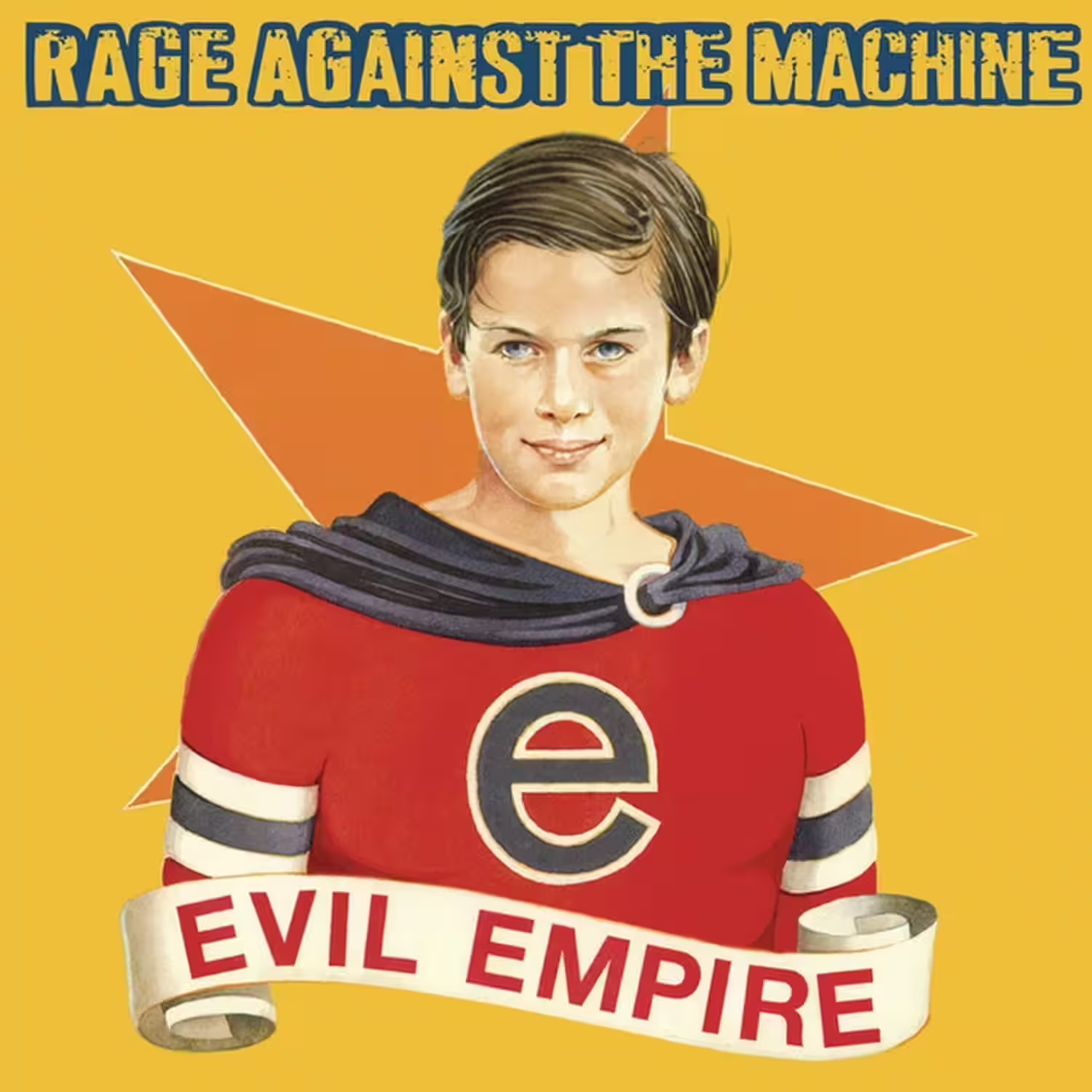
The cover is the most photographed Rage Against the Machine artwork after the burning-monk image on the debut. The painting is an altered version of a Mel Ramos canvas of the 1940s and 50s comic-book hero Crimebuster, a young boy in a striped, star-emblazoned superhero costume. For the album, the "c" on the boy's chest was changed to a lowercase "e", the caption that read "Crime Buster" was replaced with the album title, and the colour of the star behind him was changed. The original painting was a birthday present from Ramos to the eleven-year-old Ari Meisel, the boy in the picture, who later became an author and businessman and gave interviews about the cover to Kerrang! decades later. Additional artwork came from the conceptual artist Barbara Kruger, some of which appears in the "Bulls on Parade" video.
De la Rocha was specific about why he wanted Crimebuster on the cover.
"The image of the second record was a little more ironic. Considering if you look very closely at the boy's face, he symbolizes the power structure in the US, and if you look at him, he's smiling as if he's in control. But if you look deeper into his face, you see that he's afraid, because he knows what's coming. He knows that poor people in the US are not going to suffer in the way that they are suffering without taking action."
Zack de la Rocha, MTV News, 1996
The CD booklet doubled as a reading list. Inside the gatefold is a photograph of a stack of books, identified in interviews and on the band's official website at the time. The list is its own statement of intent.
- A People's History of the United States by Howard Zinn
- Capital, Volume I by Karl Marx
- A Portrait of the Artist as a Young Man by James Joyce
- The Anarchist Cookbook by William Powell
- Guerrilla Warfare by Che Guevara
- Revolutionary Suicide by Huey P. Newton
- Soul on Ice by Eldridge Cleaver
- The Wretched of the Earth by Frantz Fanon
- Darkness at Noon by Arthur Koestler
- Manufacturing Consent by Edward S. Herman and Noam Chomsky
- Live from Death Row by Mumia Abu-Jamal
- Johnny Got His Gun by Dalton Trumbo
- The Grapes of Wrath by John Steinbeck
- Rules for Radicals by Saul D. Alinsky
- Soledad Brother by George Jackson
- Walden and Resistance to Civil Government by Henry David Thoreau
- Invisible Man by Ralph Ellison
- Another Country by James Baldwin
The list reads less like a fan-service Easter egg than like a syllabus. Booksellers across the United States reported sales spikes for several titles on it through the back half of 1996, with Howard Zinn's A People's History and the Cleaver, Newton and Fanon titles in particular benefiting from inclusion. The reading list remains, three decades later, the single most-cited piece of Rage Against the Machine ephemera.
Release and Reception
The album entered the Billboard 200 at number one on the chart dated 4 May 1996, with first-week sales of 249,000 copies. It was the band's first chart-topper and Epic's biggest opening of the spring. International charts followed: number one in Sweden, number two in Australia, Austria, Germany, Norway and Belgium's Wallonia region, number three in New Zealand, number four in the United Kingdom (and number one on the UK Rock & Metal Albums chart).
Critical opinion was sharply divided in a way that is now hard to recover. Rolling Stone's Jon Wiederhorn gave the album three stars and produced one of the most-quoted pans of the band's catalogue.
"This music isn't supposed to be fun. Rage Against the Machine have jacked up the sociopolitical siege mentality in their metallic hip-hop to such a dogmatic degree, and honed their sound to such maniacally shrill perfection, that the band and the roaring joys of its harangue 'n' roll seem virtually sexless."
Jon Wiederhorn, Rolling Stone, 18 April 1996
AllMusic's Stephen Thomas Erlewine called the record "lacking the dexterity to fully execute their metal/hip-hop fusion" and concluded that it "succeeds only on the level of a sonic assault". The NME's Johnny Cigarettes gave it 5/10. Pitchfork's Ryan Schreiber, then writing for a magazine that nobody had heard of, gave it 6.1/10. On the other side of the ledger, Tom Sinclair at Entertainment Weekly awarded it A-, Spin's Jonathan Gold gave it 8/10, the Village Voice's Robert Christgau gave it A-, and the Houston Chronicle's Steffan Chirazi gave it four stars out of four. Critics' year-end lists were similarly mixed.
The Grammy voters were less ambivalent. "Tire Me" won Best Metal Performance at the 39th Annual Grammy Awards in February 1997, with "Bulls on Parade" nominated for Best Hard Rock Performance the same year and "People of the Sun" nominated for the same award the following year. The album was retrospectively named the best hard-rock release of 1996 by Loudwire in 2024.
Singles, Videos and the SNL Stunt
"Bulls on Parade" was released as the first single on 1 April 1996. It peaked at number 11 on the US Alternative Airplay chart and at number 8 on the UK Singles Chart, and remains the band's most-played track at radio. "People of the Sun" followed in August 1996. "Vietnow" was released as a single only in Europe, in October 1997, late enough that it functioned more as a tour-promotion piece than a true single push.
The SNL appearance on 13 April 1996 has long since outgrown the record itself in popular memory. The band were booked to play two songs in support of the album's release. The week's guest host was Steve Forbes, then a Republican candidate for president on a flat-tax platform. The band's planned protest was to drape inverted American flags ("a sign of distress or great danger") over their amplifier stacks. According to MTV's reconstruction of the event, the flags were removed by stage crew immediately before the live broadcast began. The band played "Bulls on Parade" anyway, were told by the show's producers their second song was cancelled, and were escorted from the building within minutes of leaving the stage. SNL has, in the decades since, declined to invite them back.
The "Bulls on Parade" video, the album's primary visual statement, incorporates the Barbara Kruger artwork from the album's interior packaging and intercuts performance footage with stock images of military hardware. The "People of the Sun" video was filmed largely outdoors in Mexico City, with on-the-street footage that the band insisted should not be staged.
| Single | Release | Chart peaks | Notes |
|---|---|---|---|
| "Bulls on Parade" | 1 April 1996 | US Alternative 11; UK 8 | 1997 Grammy nomination, Best Hard Rock Performance |
| "People of the Sun" | 26 August 1996 | UK 26 | 1998 Grammy nomination, Best Hard Rock Performance; video shot in Mexico City |
| "Vietnow" | October 1997 | UK 31 | European release only; promoted the upcoming UK and European tour leg |
Touring, U2 and the Wu-Tang Bust
The Evil Empire touring cycle was long and incident-strewn even by the band's standards. They headlined arenas across North America through the back half of 1996 and into 1997, including a high-visibility headline slot at the 1996 Reading Festival in the UK. In 1997 they were the support act on U2's PopMart Tour, taking their politics onto the largest stages American rock had to offer; the band donated their tour profits from that run to the Union of Needletrades, Industrial and Textile Employees, Women Alive and the Zapatista Front for National Liberation.
The 1997 co-headline arena run with the Wu-Tang Clan was supposed to be the album campaign's culmination. Police in several jurisdictions tried unsuccessfully to have the concerts cancelled, citing what one filing called the band's "violent and anti-law enforcement philosophies". Wu-Tang then failed to appear during a show at the Riverport Amphitheatre in Missouri; the tour dropped them from the bill and replaced them with the Roots. Sony released Live & Rare, a compilation of B-sides and live tracks from this touring period (including the Mumia benefit "Fuck tha Police"), as a Japan-only album in June 1998, and a live concert video as Rage Against the Machine later the same year.
- 1996: North American headline tour; Reading Festival headline slot in the UK; first European arena run.
- 1997: PopMart Tour support to U2; aborted co-headline with the Wu-Tang Clan; the Roots subbed in.
- 1998: Final touring activity for the album, including the recording of Live & Rare sources.
In TV, Film and Media
"Year of tha Boomerang", in earlier form, had already been placed on John Singleton's Higher Learning in late 1995, ahead of the album. "People of the Sun" was used in the 1996 trailer for The Crow: City of Angels. "Bulls on Parade" has had the longest sync afterlife of any track on the record, appearing in feature films, video games (the song became a fixture of the Tony Hawk's series and the Guitar Hero franchise) and as a sports-arena entrance theme on several continents. The album as a whole has been mined repeatedly for placements in late-1990s and 2000s prestige television, where its specific cocktail of riff and message has proved a durable shorthand for anti-establishment energy.
Controversy, the SNL Ban and the Forbes Set
The single most-cited piece of controversy attaching to the album is the SNL appearance described above. Beyond that, the album cycle saw the band's videos and singles censored intermittently on MTV, regional radio refusals across talk-radio markets, and ongoing legal harassment of the 1997 tour. The Wu-Tang co-headline run was the subject of unsuccessful police-led venue cancellations. None of this slowed the record. The triple-platinum certification from the RIAA in May 2000 came at a point when the band had already followed the album with The Battle of Los Angeles and were about to dissolve for the first time.
Covers, Samples and Tributes
"Bulls on Parade" has had the heaviest cover life of any track on the record, with versions surfacing across the punk, metal and hip-hop worlds; the song's riff has been interpolated and quoted on countless tribute releases. Among nu-metal's first-wave bands, Korn, Limp Bizkit, Linkin Park, the album is routinely cited as a direct influence, even where, as in Korn's case, the act predates Rage's recorded output. Annie Zaleski summarised the lineage in a 2017 Spin essay: "Rage predate the explosion of nu-metal, but there's no denying that the L.A. band's sound was co-opted by plenty of nu-metalheads, who mimicked RATM's aggressive hip-hop/metal hybrids."
Reissues, Remasters and the Long Tail
Unlike the band's self-titled debut, which received a full 20th-anniversary "XX" box set in 2012 including the original demo cassette, alternate mixes and Finsbury Park live footage, Evil Empire has not yet been the subject of a major-anniversary deluxe edition. The album has been continuously in print since release on CD, cassette and vinyl, with a half-speed-mastered vinyl reissue in the mid-2010s. The band's 2010 archival live album Live at Finsbury Park, recorded after the surprise UK Christmas number one of "Killing in the Name" in December 2009, captures live versions of "People of the Sun", "Bulls on Parade" and "Know Your Enemy". A definitive expanded edition of the album remains an outstanding item on the Sony catalogue calendar.
Legacy and Influence
By any commercial measure Evil Empire is the most successful album Rage Against the Machine ever made. It was the first to debut at number one, the first to chart at gold or higher in nine territories, and the source of the band's first Grammy. Critically it has been the most disputed entry in the catalogue: enthusiasts argue it is the band's most musically adventurous record, sceptics that it is their most overworked. The 2024 Loudwire ranking of it as the best hard-rock album of 1996 indicates the long-term direction of travel.
Its structural influence on the next decade of American rock is now uncontested. Nu-metal, Korn's Follow the Leader in 1998, Limp Bizkit's Significant Other in 1999, Linkin Park's Hybrid Theory in 2000, owes much of its rhythmic vocabulary to Evil Empire's arrangements, even where the politics are stripped out. The album's specific contribution to the toolkit of guitar-driven heavy music is Morello's catalogue of pickup-toggle and effect-pedal tricks, which became required reading for every aspiring rock guitarist of the late 1990s. Three Rage Against the Machine albums sit on the band's CV; this is the one that turned them into a fixture.
By 2020, in the wake of the murder of George Floyd and the worldwide protests that followed, every Rage Against the Machine album had re-entered the upper reaches of Apple Music's Rock Albums chart, and the self-titled debut had re-entered the Billboard 200 at number 174. Evil Empire's songs have been quoted in protest footage from Beirut to Minneapolis, and the album's title, Reagan's phrase turned inside-out, has shown no sign of feeling dated, which the band's surviving members have remarked on with some weariness in interview after interview.
Things You Might Not Know
| Fact | Detail |
|---|---|
| The shelved first sessions | The band tracked 23 songs in Atlanta with Brendan O'Brien starting in November 1994, then briefly broke up before regrouping for the KROQ Weenie Roast in June 1995. |
| The Australian vocal | The vocal for "Down Rodeo" was recorded at Kiss Music Recording Studios in Melbourne in January 1996, with Dave Rat and Paul Kosky engineering. |
| The cover boy | The child on the cover is author and businessman Ari Meisel, painted at age 11 by Mel Ramos; the canvas was a birthday present from Ramos to Meisel. |
| Crimebuster's "c" to "e" | Ramos's original painting depicts the 1940s comic-book hero Crimebuster; the album cover changes the "c" on his costume to a lowercase "e" and the caption "Crime Buster" to "Evil Empire". |
| The Mumia 7-inch | The B-side of the 1995 fan-club promo 7-inch was an unreleased live cover of N.W.A's "Fuck tha Police", recorded at a Mumia Abu-Jamal benefit show in Washington DC on 13 August 1995. |
| Tim Bob, not Tim Commerford | The bassist is credited on the sleeve as "Tim Bob", a nickname that appears nowhere else in the band's discography. |
| The reading list inside the booklet | The CD booklet includes a photograph of a stack of nineteen named books, including Zinn's A People's History of the United States, Chomsky and Herman's Manufacturing Consent and Cleaver's Soul on Ice; several saw measurable sales spikes after the album's release. |
| The SNL flag stunt | The band's planned protest of guest host Steve Forbes on the 13 April 1996 SNL broadcast involved inverted American flags draped over their amplifiers; the flags were removed by crew, the second song was cut, and the band were escorted from the building. |
| Sony's Japan-only live album | Live & Rare, the 1998 compilation of B-sides and live tracks from the Evil Empire touring cycle, was released only in Japan; it became one of the most-traded American import CDs of the late 1990s. |
| The first Grammy was the shortest song | "Tire Me", the album's shortest track at exactly three minutes, won the 1997 Grammy for Best Metal Performance; the band were not present at the ceremony. |
| The Wu-Tang substitution | The 1997 co-headline tour with the Wu-Tang Clan was abandoned after Wu-Tang failed to appear at a Riverport Amphitheatre show; the Roots were drafted in as replacements within days. |
| Andy Wallace mixed it | The album was mixed by Andy Wallace at The Enterprise, the same engineer who had mixed Nevermind five years earlier and would mix Jeff Buckley's Grace in between. |
| Barbara Kruger on the videos | The conceptual artist Barbara Kruger provided additional artwork for the album packaging; some of her images are reused in the official "Bulls on Parade" video. |
| The Higher Learning rewrite | "Year of tha Boomerang" had appeared in a slightly different arrangement on the 1995 Higher Learning soundtrack as "Year of the Boomerang"; the album version is faster and the mix is denser. |
Listen on the Riffology Podcast
If you want to hear the deep-dive companion to this piece, the Riffology podcast covers Evil Empire as part of its ongoing series on the defining records of 1990s American rock. Episodes are available on Apple Podcasts, Spotify, Pocket Casts, Overcast and every other major platform, with full show notes, source lists and follow-on reading at podkit.riffology.co.
Comments