When Megadeth scored their highest-charting American single in the summer of 1997, the man at the production desk was a Nashville session guitarist who had never produced a record in his life. Cryptic Writings was Dann Huff's debut behind the board, and Dave Mustaine had handed him a thrash band that wanted to compete with the rock songs on car-radio drive-time. The result was a number ten debut on the Billboard 200, four top-twenty Mainstream Rock hits and a Grammy nomination for the lead single Trust, which climbed to number five on a chart Megadeth had never previously cracked.
It was also the last time Mustaine, Marty Friedman, Dave Ellefson and Nick Menza would all be in a studio together. Within a year of the album's release Menza was off the bus with a tumour in his knee, Mustaine had fired him by phone, and the next record, Risk, would push the radio experiment so far that Friedman walked out before it was finished. Cryptic Writings sits at the exact point where the classic Rust in Peace lineup ended and the wilderness years began, and it remains the most consciously commercial record the band ever made.
Album Facts
| Field | Detail |
|---|---|
| Artist | Megadeth |
| Album | Cryptic Writings |
| Release Date | 17 June 1997 |
| Label | Capitol Records |
| Producer | Dann Huff (Dave Mustaine, co-producer) |
| Recording engineer and mixer | Jeff Balding |
| Mastering | Bob Ludwig (Gateway Mastering) |
| Studios | The Tracking Room, Nashville; The Castle, Franklin, Tennessee |
| Recorded | September 1996 |
| Genre | Heavy metal, alternative metal, hard rock |
| Track Count | 12 (original 1997 issue); 16 on 2004 remix and remaster |
| Total Runtime | 46:44 |
| Billboard 200 Peak | 10 |
| UK Albums Chart Peak | 38 (UK Rock and Metal Albums: 3) |
| Other Notable Chart Peaks | Finland 2, Greece 1, Portugal 5, Japan 7, France 14, Sweden 15, Italy 16, Canada 17, Germany 22, Australia 43 |
| Certifications | RIAA Gold (October 1997); Music Canada Gold; RIAJ Gold; CAPIF Gold; KMCA Gold |
| Estimated Sales | Approximately 850,000 in the United States by 2004 per Billboard |
| Key Singles | Trust, Almost Honest, Use the Man, A Secret Place, She-Wolf (rock-radio promo) |
The 1997 Metal Landscape
By the time Cryptic Writings landed in June 1997 the bottom had fallen out of the thrash market that Megadeth had helped build. Metallica had released Load the previous summer, a record that cut the hair, lost the riffs and divided their audience in two. The Reload follow-up was already in the can and would arrive five months after Cryptic Writings. Anthrax were between deals and preparing Volume 8 for a small independent. Slayer would put out Diabolus in Musica the following year, leaning into a downtuned, almost nu-metal feel. Pantera had released The Great Southern Trendkill in 1996 and were the last big band who could still call themselves a metal act without rolling their eyes.
The chart pages told the same story. Korn's [Life Is Peachy](/posts/the-making-of-life-is-peachy-by-korn/) was platinum. Limp Bizkit's debut was weeks away. The Prodigy's Fat of the Land would knock Radiohead's [OK Computer](/posts/radiohead-ok-computer/) off the top spot. Grunge had collapsed in on itself after Kurt Cobain's death and the Smashing Pumpkins were now a synth-pop act. Mainstream rock radio in 1997 was a strange compromise between alt-rock holdovers, post-grunge balladry and the first stirrings of rap metal, and metal bands of Megadeth's generation had to decide whether to chase it or be left behind.
- Metallica, Load and Reload sessions, ReLoad due November 1997
- Anthrax, Volume 8: The Threat Is Real, label uncertainty
- Pantera, on the road behind The Great Southern Trendkill
- Korn, Life Is Peachy on its way to double platinum
- Radiohead, OK Computer released the same month as Cryptic Writings
- Tool, Aenima still selling, the band who would beat Trust to the 1998 Grammy
The Band Up to This Point
Megadeth had been together fourteen years and on the same lineup since 1990. Rust in Peace, recorded with Friedman and Menza newly installed, had landed in 1990 as the technical pinnacle of American thrash. [Countdown to Extinction](/posts/the-making-of-countdown-to-extinction-by-megadeth/) in 1992 had taken the gloves off the radio ambition, shortened the songs, sold double platinum in the United States and given the band their highest Billboard 200 entry to date at number two. Youthanasia in 1994 had carried the same lineup and the same producer, Max Norman, to a third straight platinum certification, with A Tout le Monde becoming a permanent fixture in the live set.
That stability mattered. Megadeth had been a chaotic band in the 1980s, with Mustaine sacking and rehiring members at speed and a drug problem that nearly ended the project entirely. By 1996 the four had been together longer than any previous lineup and were, briefly, a functioning machine. The Hidden Treasures EP in 1995 had tied off the Capitol contract with B-sides and one-offs, and the band were free to make their seventh studio album on their own terms.
Why Dann Huff Replaced Max Norman
Max Norman had produced Countdown to Extinction and Youthanasia and was an obvious choice for a third. Mustaine wanted somebody else. The official story was that Norman had imposed a strict tempo rule for any song that hoped to get on the radio, and that Mustaine had grown tired of being told what to do by a man whose Megadeth records had already happened.
"Max came up with this bullshit formula that every song had to be 120 beats per minute to get on the radio. When people make drastic decisions to do things like that and it backfires, it usually ends up, in one way or another, costing them their jobs."
Dave Mustaine, quoted in the 2004 Cryptic Writings reissue liner notes
Dann Huff was an unlikely successor. He was the guitarist in the late-80s melodic-rock band Giant, a first-call Nashville session player who had worked on records by Whitney Houston, Michael Jackson and Celine Dion, and a born-again Christian who lived a long way from the Megadeth world view. He had also never produced an album. Mustaine's manager at the time, Bud Prager, had decided that Megadeth needed somebody who understood radio from the inside rather than another rock producer, and Huff fitted the brief. Mustaine wrote later that he agreed because he wanted the kind of intangible number-one record he had never quite landed.
Pre-production and Songwriting
Friedman has said that the writing took the band a full year, from the first sketches to the final mix. Material accumulated during the Youthanasia tour, on the bus and in soundchecks, and was then refined at home demos. There was no label-imposed deadline, which Friedman cited as one of the reasons the songs felt natural rather than forced.
"It took us about a year to do this record from note one to mixing. A lot of the material we wrote on the road, some of it afterwards. Because we weren't rushed, the songs came together naturally."
Marty Friedman, Rocknotes Webzine, January 1998
Trust was the oldest piece on the record. It had begun as an instrumental called Absolution, demoed during the Youthanasia sessions in 1994 and shelved. By the time Mustaine returned to it for Cryptic Writings the basic riff and structure were already mapped and only the vocal melody and lyric needed to be added. Sin was an outlier, the only song with a writing credit for Menza, while I'll Get Even carried a co-write for Brian Howe, the former Bad Company singer with whom Mustaine had been writing in the off period. The remaining tracks were split between Mustaine on his own and Mustaine and Friedman together.
Recording in Nashville
The basic tracks were cut in September 1996 at The Tracking Room in Nashville, a former movie studio on Music Row that Huff knew well. Overdubs and additional work moved a few miles south to The Castle in Franklin, Tennessee, a converted late-19th-century stone manor house with a control room in the cellar. Both rooms were a long way, geographically and culturally, from the Los Angeles studios where Megadeth had made every previous record.
The choice of Nashville was deliberate. It put the band in Huff's home town, away from the LA distractions and inside the country and pop infrastructure that Huff had spent twenty years operating in. The Nashville Symphony Orchestra was within driving distance and ended up playing the string section on the bridge of Trust. Local engineer Jeff Balding handled the recording and mixing, with Mark Hagen assisting. The mastering was farmed out to Bob Ludwig at Gateway in Portland, Maine, who was already the default choice for any rock record that wanted to compete on volume and clarity.
Dann Huff and the Production Style
Huff's approach was the opposite of Norman's. He encouraged the band to layer guitar parts more thickly, to use acoustic textures, to record cleaner solos and to spend longer on vocal production than the band were used to. Ellefson said before the sessions that the brief was simple, the seventh album should not sound like any of the previous six. The crunchy riffs and the speedy guitar solos were still there, but the arrangements were tighter, the hooks bigger and the choruses more clearly structured.
Lyrically, Mustaine took a knife to anything that he felt might keep the songs off the radio. He has said in interviews and in the 2004 reissue notes that many lyrics were rewritten at Prager's request to be, in his phrase, less about dying and evil. Use the Man, originally a drug-addiction song with a snippet of the Searchers' Needles and Pins as an intro, was softened. Have Cool, Will Travel ended up touching on school shootings with what would later, in the 2004 remix, be paired with an unsettling Wheels on the Bus quote.
Jeff Balding, the Mix and the Master
Jeff Balding was not a metal engineer. He was a Nashville lifer who had worked with Faith Hill, Trisha Yearwood and Vince Gill, and Huff brought him in because he trusted his ears on guitar tones and vocals. The Cryptic Writings mix is noticeably wider and brighter than Youthanasia, with a vocal sat higher in the mix and a snare drum that snaps rather than thuds. Ludwig's master pushed everything close to the level ceiling that 1997 CD culture was already chasing.
The fingerprint of the production is most obvious on Almost Honest, where the guitar solo is double-tracked, the vocal is multi-stacked on the chorus and there is a clear pop-rock sheen on what is, structurally, still a Megadeth song. Billboard's reviewer Chuck Taylor called it "somewhere between Def Leppard and Bon Jovi", which Mustaine would not have disputed.
Personnel and Credits
| Role | Player | Notes |
|---|---|---|
| Megadeth | ||
| Lead vocals, guitars | Dave Mustaine | Sole or co-writer on every track |
| Bass, backing vocals | David Ellefson | Co-writer on I'll Get Even, Sin and FFF |
| Lead guitars, acoustic guitar, backing vocals | Marty Friedman | Plays sitar on A Secret Place; co-writer on most tracks |
| Drums, backing vocals | Nick Menza | Co-writer on Sin and FFF; his last Megadeth studio record |
| Guest musicians | ||
| Strings | Nashville Symphony Orchestra | Bridge of Trust, arranged by Huff and Balding |
| Additional guitar, songwriting | Brian Howe | Co-writer on I'll Get Even, ex-Bad Company vocalist |
| Production and engineering | ||
| Producer | Dann Huff | Producing debut, Nashville session guitarist and Giant frontman |
| Co-producer | Dave Mustaine | |
| Recording and mixing | Jeff Balding | Nashville engineer, country and rock specialist |
| Assistant engineer | Mark Hagen | Recording and mixing assistant |
| Mastering | Bob Ludwig | Gateway Mastering, Portland, Maine |
| Artwork | ||
| Album artwork | Hugh Syme | Long-time Rush sleeve designer; works repeatedly with Megadeth |
| Photography | Dimo Safari | Band shots inside the booklet |
| 2004 remix and remaster | ||
| Producer of remix | Dave Mustaine | Capitol back-catalogue reissue programme |
| Mixing | Ralph Patlan and Dave Mustaine | Adds four bonus tracks and re-edits several songs |
| Mastering | Tom Baker | Precision Mastering, Hollywood |
The Songs
The original twelve-track sequence runs forty-six minutes and forty-four seconds and is split between four fast thrash workouts, four singles aimed at rock radio and four mid-paced album cuts. Mustaine has said that exactly a third of the record was deliberately built around tempo and aggression, with the rest given the room to breathe.
| # | Title | Writer(s) | Length | Single? | Notes |
|---|---|---|---|---|---|
| 1 | Trust | Mustaine, Friedman | 5:11 | Yes, lead | Reworked from a Youthanasia-era instrumental called Absolution |
| 2 | Almost Honest | Mustaine, Friedman | 4:02 | Yes, second | Hooky midtempo, video by Scott Richter |
| 3 | Use the Man | Mustaine, Friedman | 4:35 | Yes, third | Originally opens with a Needles and Pins snippet |
| 4 | Mastermind | Mustaine | 3:48 | Mustaine has called it a song about "the computerization of the world" | |
| 5 | The Disintegrators | Mustaine | 2:50 | Pure thrash workout, one of four "fast, hard and crunchy" cuts | |
| 6 | I'll Get Even | Mustaine, Ellefson, Friedman, Brian Howe | 4:23 | Only track with a co-write from the ex-Bad Company singer | |
| 7 | Sin | Mustaine, Menza, Ellefson | 3:06 | Menza's only writing credit on the album | |
| 8 | A Secret Place | Mustaine | 5:29 | Yes, fourth | Friedman plays sitar; lyric about losing touch with reality |
| 9 | Have Cool, Will Travel | Mustaine | 3:28 | Lyric about school shootings, written before Columbine | |
| 10 | She-Wolf | Mustaine | 3:36 | Rock-radio promo | Cited by the Chicago Tribune as the album's "melodic thrash" peak |
| 11 | Vortex | Mustaine | 3:38 | Metal Forces highlighted it for the album's best guitar work | |
| 12 | FFF | Mustaine, Friedman, Ellefson, Menza | 2:38 | Whole-band co-write, the fastest song on the record |
Trust
Trust is the song that did the heavy lifting. Released to American radio on 8 May 1997, six weeks ahead of the album, it announced an immediate change of weather. The drum intro is essentially a single tom-and-snare phrase repeated, the bass line follows, and the main riff arrives almost as an afterthought. The verses build slowly, the bridge drops into a six-bar Nashville Symphony Orchestra string passage, and the song ends on a quiet acoustic outro. None of that is how Megadeth had started a Megadeth single before.
It went to number five on the Mainstream Rock Tracks chart, the highest position any Megadeth song has reached on that listing. It picked up a Grammy nomination for Best Metal Performance at the 1998 ceremony, losing on the night to Tool's Aenema. A Spanish-language version, sung phonetically by Mustaine, was recorded for the Latin American market and added as a bonus track on the Japanese edition. The video, directed by Liz Friedlander, was Megadeth's most expensive to date and one of MTV's most-played metal clips of the year.
Almost Honest
Almost Honest was issued as the second single in November 1997 and reached number eight on Mainstream Rock, giving the band two consecutive top-ten singles for the first time. Lyrically Mustaine described it as a song about how hard it is for people to be honest with one another. Musically it is the most overt radio play on the record, with a hook that lands inside thirty seconds and a chorus pitched, in Chuck Taylor's Billboard line, somewhere between Def Leppard and Bon Jovi.
The video was directed by Scott Richter and intercut footage of the band performing on a soundstage with clips of extreme-sports stunts, an editorial decision that dated almost instantly but kept the song on MTV's rotation for most of the winter. It remains a fixture of Megadeth setlists in shortened form and was performed by the band at Woodstock 99 in front of an audience that, by that point, mostly belonged to Korn and Limp Bizkit.
Use the Man
Use the Man is the album's most personal song. Originally framed as a straight account of addiction and recovery, the lyric was softened during the Nashville sessions and the opening borrowed a few seconds of the Searchers' 1964 hit Needles and Pins as scene-setting. The Searchers' sample was removed from the 2004 remix on rights grounds, leaving the song to open cold. It was issued as the third single in December 1997 and reached the lower end of the Mainstream Rock chart.
The arrangement is the closest the album gets to a ballad, with acoustic guitars carrying the verses and a long Friedman solo that sounds, deliberately or not, like a Nashville session-man's idea of a metal solo. It is the song the Cryptic Writings era is most often defended on by fans who otherwise resent the album's commercial sheen, and it remained in occasional Megadeth setlists for the rest of the Capitol period.
Mastermind and The Disintegrators
Mastermind sits at track four and is Mustaine's commentary, in his own phrase, on the computerization of the world. Coming from a man who had just learnt to use the internet to argue with his fan base on the early Megadeth.com forums, the song reads now as a snapshot of late-90s tech anxiety. Musically it is a midpaced track with a vocal melody that wraps closely around the riff and a chorus that sits low in the mix rather than reaching for radio.
The Disintegrators is the first of the four songs Mustaine has described as the album's "fast, hard and crunchy" core. It is under three minutes long, runs at thrash tempo from the first beat to the last and was sequenced immediately after Mastermind to remind anyone reaching for the skip button that the band who made Rust in Peace was still in the building. MTV's P.R. Flack singled it out, alongside FFF, as the most aggressive moment on the record.
A Secret Place, Have Cool Will Travel and She-Wolf
A Secret Place is the album's strangest single. The middle eight is built around a sitar part played by Friedman, who had been an open student of Eastern modes since his J-rock period, and the lyric describes losing touch with reality. It was issued as the fourth and final commercial single in February 1998 and entered the lower reaches of the Mainstream Rock chart. The video was filmed in a Los Angeles warehouse with the band shot through coloured gels.
Have Cool, Will Travel is Mustaine's school-shooting song. It pre-dates Columbine by two years and was treated at the time as a straightforward piece of social commentary. In the 2004 reissue the band added a child's recording of The Wheels on the Bus to the introduction, a decision that turned a routine album track into one of the most uncomfortable thirty seconds in the band's catalogue. She-Wolf was promoted to rock radio in 1998, picked up airplay in Mexico without ever being issued as a commercial single, and is the one cut from the album that still appears in Megadeth setlists in the 2020s.
FFF, Vortex and the Thrash Survivors
FFF, written by all four members together, is the closing track on the original sequence and the fastest. Mustaine reused the riff on the alternative version Bullprick, included as a bonus on the Japanese edition. Vortex sits two slots earlier and was singled out by Neil Arnold of Metal Forces as the home of the album's best guitar work, with a Friedman lead line that gives away how far his playing had moved from the Cacophony era. The Disintegrators completes the quartet of full-tempo cuts and serves as a deliberate counterweight to the radio songs.
Sin is the curiosity. It is Menza's only writing credit on a Megadeth album, three minutes of midtempo riffing with a punky vocal phrasing. The 2004 remix included an alternative version of the same song under its original title Evil That's Within, with different lyrics and a tougher mix. The remaster also restored Bullprick alongside FFF, allowing the four band members' joint composition to exist in two versions at once.
B-Sides, Japanese Bonus Tracks and the Live EPs
The Japanese pressing of Cryptic Writings carried a thirteenth track called One Thing, a Mustaine solo composition that did not make the international cut. The European pressing added nothing. A separate Japanese bonus disc paired Cryptic Writings with material that would later become the live EPs Live Trax and Live Trax II, the first released on 30 June 1998 and the second the year after.
A third companion release, the studio EP Cryptic Sounds, gathered instrumental versions of five album tracks and was issued only in Japan as a label-loyalty pressing. Two of the four 2004 remix bonus tracks, the alternative versions of Vortex and FFF, are essentially first-pass mixes of the songs that ended up on the album. The other two, the Spanish Trust and the renamed Sin variant Evil That's Within, are the closest the band came to releasing outtakes from the Nashville sessions.
Artwork, the Veve Symbol and the Missing Logo
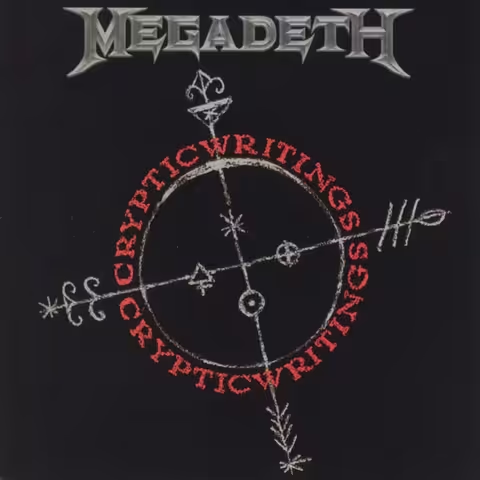
The cover symbol is a veve, a Haitian Vodou sigil traditionally drawn on the floor of a peristyle in cornmeal to invite a particular loa to a ceremony. Hugh Syme, who had drawn most of Rush's sleeves since [Permanent Waves](/posts/the-making-of-permanent-waves-by-rush/) and was already a Megadeth regular, kept the design clean and put it dead centre on a metallic silver background for the first 500,000 American copies. Later pressings, and every later reissue, replaced the silver with black, and the band logo, missing from the first issue, was restored above the title.
According to Ellefson the original cover concept had been very different. Menza later said the album had nearly been called Needles and Pins, with a cover showing a young girl stabbing a Kewpie doll in the chest with a syringe. The image was rejected at the last minute and the title was reused as a snippet in Use the Man. The first 500,000 American copies also shipped with a Vic Rattlehead collectible card promoting The Cryptic Writings of Megadeth, a short-lived Chaos Comics tie-in.
Release and Chart Reception
| Territory | Chart | Peak position |
|---|---|---|
| United States | Billboard 200 | 10 |
| United States | Year-end Billboard 200 (1997) | 177 |
| United Kingdom | Official Albums Chart | 38 |
| United Kingdom | UK Rock and Metal Albums | 3 |
| Finland | Suomen virallinen lista | 2 |
| Greece | IFPI Greece | 1 |
| Portugal | AFP | 5 |
| Japan | Oricon | 7 |
| France | SNEP | 14 |
| Sweden | Sverigetopplistan | 15 |
| Italy | Musica e Dischi | 16 |
| Canada | RPM Top Albums | 17 |
| European Top 100 Albums | Music and Media | 19 |
| Germany | Offizielle Top 100 | 22 |
| Australia | ARIA | 43 |
Cryptic Writings sold around 75,000 copies in its first week in the United States. The RIAA certified it gold for half a million shipments four months later, in October 1997, and Billboard reported sales of around 850,000 in the United States by the time the 2004 reissue arrived. International chart performance was uneven, with the unexpected highlight a number-one finish on the Greek IFPI chart and a number-two run in Finland that lasted eleven weeks. The UK Albums Chart entry of 38 was lower than Youthanasia but the corresponding number three placing on the UK Rock and Metal Albums chart was the band's highest to date.
Critical Response in 1997
Reviews were split, predictably, between writers who heard a thrash band selling out and writers who heard a thrash band growing up. Jon Wiederhorn at Rolling Stone landed on the latter side and gave the album three and a half stars, framing it as the record disappointed Metallica fans had not got from Load. Stephen Thomas Erlewine at AllMusic was less convinced, calling the songwriting unambitious and arguing that the band still sounded better playing thrash. Rock Hard in Germany gave it eight out of ten as a balanced mix of typical Megadeth rockers and experimental songs. Uncut, then a new magazine in only its second issue, dismissed it in a single star.
"Cryptic Writings should thrill Metallica fans who felt screwed by that band's thrashless 1996 album, Load."
Jon Wiederhorn, Rolling Stone, 10 July 1997
The most quoted retrospective line came from Decibel writer Shane Mehling, who in 2015 grouped Cryptic Writings with Metallica's Load and Reload as the trio of nearly thrashless 1997 records that left the metal community trying to pick up the pieces. Loudwire's retrospective coverage has been kinder, treating the album as the cleanest expression of the Mustaine and Friedman writing partnership before its collapse.
Singles and Music Videos
| Single | Release | Director | Mainstream Rock peak | Notes |
|---|---|---|---|---|
| Trust | 8 May 1997 | Liz Friedlander | 5 | Highest-charting Megadeth single on this chart; Grammy nominated |
| Almost Honest | 26 November 1997 | Scott Richter | 8 | Performance footage cut with extreme-sports clips |
| Use the Man | December 1997 | Scott Richter | Charted | Needles and Pins intro removed in 2004 remix |
| A Secret Place | February 1998 | Not confirmed | Charted | Sitar-led, Friedman's most overt Eastern moment |
| She-Wolf | 1998 | Performance clip only | Rock-radio promo | Mexican Top 40 airplay, no commercial single |
Liz Friedlander was an unusual choice for Trust. She had directed clips for Alanis Morissette and Celine Dion and would later go on to work with Ashlee Simpson, and the brief was to make Megadeth look like a contemporary rock band rather than a thrash band. The Almost Honest and Use the Man videos, both directed by Scott Richter, leant on extreme-sports cutaways and high-contrast lighting in a clear effort to match the visual grammar of post-grunge MTV. None of the four was banned, none was particularly censored, and none picked up a Video Music Award nomination.
Touring and the End of Nick Menza
The world tour began in the summer of 1997 with the Misfits opening on most American dates. One of the South American legs included Megadeth's first all-acoustic show, played in Argentina to a seated audience. The set leant on Cryptic Writings, Countdown to Extinction and Rust in Peace in roughly equal measure, with Trust and Almost Honest opening and closing the radio block in the middle of the night.
In summer 1998 Megadeth signed up for Ozzfest, which by then was Sharon Osbourne's annual showcase for both classic-era metal and the new nu-metal arrivals. The shows were the last Menza ever played with the band. He had been complaining of knee pain for months and was eventually diagnosed with a tumour on the bone. The tumour turned out to be benign, but Menza needed surgery and a recovery window the tour could not absorb.
"Two days after my knee surgery Dave Mustaine called me and told me that my services were no longer needed."
Nick Menza, Metal Sludge interview, March 2002
Mustaine has maintained, both at the time and in his 2010 autobiography, that he believed Menza had exaggerated the injury. Jimmy DeGrasso, then in Suicidal Tendencies and Alice Cooper's band, was brought in as a temporary replacement and stayed for the next two studio records, Risk in 1999 and The World Needs a Hero in 2001. Menza's first studio album with Megadeth had been Rust in Peace; Cryptic Writings was his fourth and last.
Awards and the Grammy Nomination
Trust's Best Metal Performance nomination at the 1998 Grammy Awards was Megadeth's sixth in the category. They had been nominated annually since 1991, when Hangar 18 lost to Metallica's One, and would extend the streak through Risk before falling out of contention as the metal field shifted. Tool's Aenema took the 1998 award, with Megadeth, Pantera, Rob Zombie and Marilyn Manson making up the remaining nominees. The band attended the ceremony and Mustaine has subsequently said in interviews that he did not expect to win.
Cryptic Writings was not nominated for an album-level Grammy, although Trust did appear on a handful of year-end critics' lists in 1997 and 1998. The Loudwire and Metal Hammer retrospective lists of the 2010s and 2020s have treated the song more favourably than the album, often singling it out as the last truly successful piece of Megadeth radio writing before Risk.
Reissues and the 2004 Remaster
Capitol reissued Cryptic Writings in 2004 as part of a back-catalogue programme that also covered Countdown to Extinction, Youthanasia and most of the band's early-90s output. The reissue was remixed and remastered by Dave Mustaine and Ralph Patlan, mastered by Tom Baker rather than Bob Ludwig, and added four bonus tracks, the Spanish-language Trust, an alternative version of Sin called Evil That's Within, an alternative Vortex and the FFF variant Bullprick. Several album tracks were edited down by a few seconds, and Use the Man lost its Needles and Pins sample on rights grounds.
- Spanish-language version of Trust, originally a Latin American bonus
- Evil That's Within, an alternative version of Sin with rewritten lyrics
- Vortex, alternative mix and edit
- Bullprick, alternative version of FFF with the original working lyrics
The remaster also restored the Megadeth band logo to the front cover, which the original 1997 sleeve had quietly dropped. It is the version most listeners encountered first on streaming services, and it is the cover used as the hero image on this page. There has been no twenty-fifth-anniversary super-deluxe edition. A 2026 thirtieth-anniversary release has been rumoured in fan circles but, as of this writing, not announced by Capitol or by the band.
Legacy and the Road to Risk
The straight commercial line through the Capitol years runs Rust in Peace, Countdown to Extinction, Youthanasia, Cryptic Writings and Risk. The first two are nailed-on classics of American metal. The middle two are the records where the band tried, increasingly hard, to make the metal sit on the radio. Risk pushed the experiment past the point Friedman was willing to follow and he left during the sessions. He has said since that the direction the band wanted was closer to U2 than to Megadeth and that he could no longer pretend to enjoy it.
"I really liked Dishwalla. I wanted to make a record that worked next to that on the radio. By the time we got to Risk we had pushed it as far as we could."
Marty Friedman, paraphrased in Dave Mustaine's autobiography Mustaine: A Heavy Metal Memoir, 2010
For a long time Cryptic Writings was lumped in with Risk as part of the band's wilderness period and quietly avoided by setlist compilers. That has softened. Mustaine returned to the album for the 2024 and 2025 tours in support of the band's later record cycle, regularly opening with Trust and including Almost Honest, She-Wolf or A Secret Place. The lineup that recorded it was reunited briefly in 2009 when Menza came back into the touring band, although he did not play on a studio album before his death in 2016.
The wider critical reappraisal has been kinder than the 1997 reviews suggested it would be. Decibel still uses the album as the cautionary example of mid-90s metal trying to dress for radio, but Loudwire, Metal Hammer, Guitar World and most of the more recent Megadeth long-form writing has come around to treating Cryptic Writings as a smartly made record that happens to fall in the gap between the band's two undisputed peaks. It sits in roughly the same position in the Megadeth catalogue as the self-titled Black Album does in Metallica's, which is the comparison that the 1997 marketing department had wanted all along.
Things You Might Not Know
| Fact | Detail |
|---|---|
| The original album title | The record was nearly called Needles and Pins, with a cover showing a young girl stabbing a Kewpie doll in the chest with a syringe. Capitol rejected the cover and the title was reused as a Use the Man intro. |
| The producer's day job | Dann Huff had never produced an album before Cryptic Writings. He was a first-call Nashville session guitarist whose previous credits included work with Whitney Houston, Michael Jackson and Celine Dion. |
| Trust as an outtake | The song that became Trust started life as an instrumental called Absolution, demoed during the Youthanasia sessions in 1994 and shelved for two years. |
| Strings on a thrash single | The six-bar bridge of Trust was played by members of the Nashville Symphony Orchestra, arranged by Huff and Jeff Balding in the city of Tennessee state. |
| The veve cover | The cover symbol is a veve, a Haitian Vodou sigil drawn in cornmeal during ceremonies to invite a specific loa. Hugh Syme placed it dead centre on a metallic silver background for the first 500,000 American copies. |
| The missing band logo | Cryptic Writings is the first Megadeth album not to carry the Vic Rattlehead band logo on the front cover. The logo was restored on the 2004 remix. |
| The Chaos Comics tie-in | First-pressing American copies came with a Vic Rattlehead collectible card promoting a short-lived Chaos Comics title called The Cryptic Writings of Megadeth. |
| Friedman on sitar | The middle eight of A Secret Place is built around a sitar part played by Marty Friedman, who had been a public student of Eastern modes since his J-rock period. |
| The Spanish Trust | Mustaine recorded a Spanish-language vocal of Trust for the Latin American market, sung phonetically. It later appeared as a bonus on the 2004 remix. |
| The Brian Howe co-write | I'll Get Even carries a writing credit for ex-Bad Company singer Brian Howe, with whom Mustaine had been collaborating in the off period. |
| The Wheels on the Bus sample | The 2004 reissue added a child's recording of The Wheels on the Bus to the introduction of Have Cool, Will Travel, a school-shooting song written before Columbine. |
| The Grammy night | Trust lost the Best Metal Performance Grammy in 1998 to Tool's Aenema. The other nominees were Pantera, Rob Zombie and Marilyn Manson. |
| The first all-acoustic show | One of the Cryptic Writings tour stops in Argentina became Megadeth's first all-acoustic concert, played to a seated audience. |
| The Nashville engineer | Jeff Balding, who engineered and mixed the album, was a Nashville lifer best known for country work with Faith Hill, Trisha Yearwood and Vince Gill. |
| The Greek number one | Cryptic Writings is the only Megadeth album to reach number one on the IFPI Greek chart, where it outsold both Reload and Diabolus in Musica. |
Listen to the Podcast
If you would rather hear the Cryptic Writings story than read it, the Riffology podcast covers the album in long form alongside the rest of the Megadeth catalogue, the 1997 metal landscape and the road from Rust in Peace to Risk. Riffology is available on Apple Podcasts, Spotify, Amazon Music, Pocket Casts and every other major podcast platform. New episodes drop on a rolling schedule and the back catalogue covers most of the records mentioned on this page.
Comments