No EP had ever debuted at No 1 on the Billboard 200 before Jar of Flies. None has done it on its own since either. The week of 12 February 1994, Alice In Chains pushed Counting Crows off the top of the American album chart with a seven-track acoustic record that had been written and tracked from scratch inside a single week the previous September, by four musicians who walked into a Seattle studio with no songs ready and a bassist who had been in the band for less than a year.
The whole project was an accident. The band had been booked at London Bridge Studio to see whether their new lineup could sit in a room together. They came out with a finished record, a Grammy-nominated sleeve, a US No 1, a UK Top 5, an Australian No 1 in tandem with Sap, and a future that, in retrospect, looked nothing like the past. Jar of Flies is the quiet centre of the Alice In Chains catalogue, the moment the band stopped being the heaviest thing on MTV and became, for thirty short minutes, the saddest.
An EP That Broke the Rule
Until January 1994 the Billboard 200 had a simple unwritten rule about extended-play records. EPs did not top the chart. They were thrown out as stop-gaps between albums, sold cheap, slotted into back catalogue bins. A record made of seven tracks, totalling thirty minutes and forty-nine seconds, had no business at the same chart position as records that took eighteen months and a million dollars to make. Jar of Flies ignored that rule. It sold more than 141,000 copies in its opening week in the United States alone, entered at No 1, and stayed on the Billboard 200 for over two years.
The achievement was not matched for a decade. Only Jay-Z and Linkin Park's Collision Course repeated the trick in November 2004, and Eminem and Royce da 5 9"s Bad Meets Evil EP Hell: The Sequel in 2011. For the entire Clinton presidency, Alice In Chains held the line alone. They did it with brushes on drum heads, harmonised vocals tracked in two takes, a string quartet wheeled into a Seattle live room and a song about being unable to leave the house.
Album Facts
| Field | Detail |
|---|---|
| Artist | Alice in Chains |
| Album | Jar of Flies |
| Release date | 25 January 1994 |
| Label | Columbia Records |
| Producer | Alice in Chains (self-produced) |
| Engineer and mixer | Toby Wright |
| Studio | London Bridge Studio, Seattle (tracking, 7 to 14 September 1993); Scream Studios, Los Angeles (mixing, 17 to 22 September 1993) |
| Genre | Acoustic rock, grunge, hard rock |
| Track count | 7 |
| Total runtime | 30:49 |
| US Billboard 200 peak | 1 (first EP ever to debut at No 1) |
| UK Albums Chart peak | 4 (packaged with Sap) |
| Other notable peaks | New Zealand 1; Australia 2 (with Sap); Finland 3; Canada 5; Sweden 6; Norway 7 |
| Certifications | US 4x Platinum (RIAA, 2022); Canada 2x Platinum; UK Silver; New Zealand Platinum |
| Estimated sales | Over 2 million in its first year in the US alone; 4 million-plus US units to date |
| Key singles | No Excuses, I Stay Away, Don't Follow |
The Week in 1993 Pop Music
The Alice In Chains who walked into London Bridge Studio in the first week of September 1993 were stepping out of the most chaotic year of their professional lives, into one of the strangest weeks American rock had yet produced. In Utero by Nirvana arrived a fortnight later, on 21 September. Pearl Jam's Vs. followed on 19 October and set its own debut record by selling 950,000 copies in a week. Smashing Pumpkins were halfway through tracking [*Siamese Dream*](/posts/the-making-of-siamese-dream-by-the-smashing-pumpkins/). Soundgarden were rehearsing what would become [*Superunknown*](/posts/the-making-of-superunknown-by-soundgarden/). Cobain was alive. Layne Staley was deteriorating but still working.
Grunge as a commercial proposition was at its absolute zenith and already starting to look like a marketing category rather than a movement. Within months, four of its biggest figureheads would release records that defined the form and, simultaneously, signalled its impending collapse. Jar of Flies sat oddly inside that field. It was the only one of these records made on purpose without amplifiers, the only one that came out as an EP, the only one made by accident, and the only one that no living member of the band would ever properly tour.
Where the Band Was in 1993
1992's Dirt had been the breakthrough record, a four-times-platinum study in addiction and dread that pushed the band into arenas. The tour that followed lasted thirteen months, took the band twice through Europe, twice through North America, into Australia and Japan, and ended with a slot on the 1993 Lollapalooza package alongside Primus, Tool, [Rage Against the Machine](/posts/the-making-of-rage-against-the-machine-by-rage-against-the-machine/), Babes in Toyland, Front 242, Arrested Development and Dinosaur Jr.
It was on that tour that the wheels began to come off. Layne Staley's addiction, public enough by 1993 to be discussed in print, was no longer something the band could entirely manage. Sean Kinney later described coming off the road as a recovery period in which the last thing anyone wanted was to hear a guitar plugged into anything. The band returned to Seattle in late August 1993, with two new things in their pockets: a relationship with a different bassist, and no fixed address.
Mike Starr Out, Mike Inez In
Mike Starr, the band's bassist since their founding as Alice N Chains in 1987, did not finish the Dirt tour. He was fired in January 1993 during the touring schedule, his drug use openly cited as the cause. His replacement came from an unexpected pool. Mike Inez had spent the previous four years as Ozzy Osbourne's touring bassist, including the No More Tears cycle, and was free to join Alice In Chains almost immediately. He was on stage with the band by mid-1993 and through the Lollapalooza run; by September he was in a Seattle studio with them, recording his first Alice In Chains material.
That timeline matters. The whole conception of Jar of Flies was, in the band's own framing, a test. Cantrell told Guitar World in 1999 that the sessions were partly an experiment to find out whether the new four-piece had chemistry on tape. The fact that the chemistry was tested by writing the entire record from nothing in a few days, rather than by rehearsing existing material, made the test brutal and the result undeniable.
"After playing loud music for a year, we'd come home and the last thing we wanted to do was crank up the amps right away. That stuff was written on buses and whenever we had downtime. We did Jar of Flies to see how it was to record with Mike Inez. We just went into the studio with no songs written, to check out the chemistry. It all fell into place."
Sean Kinney, quoted in Guitar World, 1999
Sap as Acoustic Dry Run
None of this would have been possible without Sap. The 1992 five-track EP, recorded in four or five days in November 1991 with Rick Parashar at London Bridge, had been Alice In Chains's first experiment in acoustic mode. It was the record on which Jerry Cantrell first sang lead with the band, on Brother, and on which Sean Kinney told Cantrell about a dream he had had about an EP called Sap. They followed the dream because, in Kinney's later phrase, they decided "not to mess with fate".
Sap had also already mapped the studio, the room, the engineer culture and the loose, harmony-driven, country-tinged Cantrell mode that Jar of Flies would expand. It even shared a sleeve photographer, Rocky Schenck, and it shared guest vocalists from Heart and Soundgarden, although none would return for the second EP. Without Sap teaching the band that they could fly an entire short-form record on acoustic guitars and intimate harmonies, the Jar of Flies session would have had no template.
From Eviction to London Bridge
The path from the end of Lollapalooza to the start of the sessions was less than dignified. The band returned to Seattle to discover that their shared rental property had been emptied by the landlord; they had failed to keep up with the rent during the months on the road. Effectively homeless for a stretch, they moved their possessions into London Bridge Studio in the Shoreline area of Seattle and started living there.
The studio was already part of their professional family. Soundgarden's Louder Than Love, Mother Love Bone's Apple, Pearl Jam's Ten and Alice In Chains's own Sap had all been tracked there. Co-owner Rick Parashar was the studio's producer-in-residence. For these particular ten days, Cantrell wanted a different ear. During the Lollapalooza run he had phoned the Los Angeles engineer Toby Wright with a pitch to make new music together. Wright agreed and booked the room.
Pre-production That Wasn't
By Cantrell's own admission to Wright, there was nothing prepared. He arrived with a clutch of sketches written in the back of tour buses, in dressing rooms, in hotels; Layne Staley would write almost all of the lyrics inside the studio itself, sitting on the floor with a notebook while the music took shape around him. Cantrell handled the music; Staley took on the words and the vocal arrangements; Inez immediately pushed his way onto the writing credits, picking up co-writes on four of the seven tracks; Sean Kinney took co-writes on two.
It was the most democratic Alice In Chains writing process to date. Where Facelift and Dirt had been overwhelmingly Cantrell records with Staley as principal vocal collaborator, Jar of Flies was a four-person session where the new bassist was instantly inside the songwriting room. That is what Cantrell and Kinney later meant when they said the chemistry "fell into place".
The September Sessions
The first day of recording was 7 September 1993. The last was 14 September. Inside that week the band tracked seven complete songs, most of them in one or two takes, while working fourteen to eighteen hour days. Wright then drove the tapes south to Scream Studios in Los Angeles and mixed the whole record between 17 and 22 September. From walking into London Bridge to walking out of Scream with a finished master, the entire Jar of Flies project took fifteen working days.
The schedule was punishing but the room was relaxed. Jon Plum, the assistant engineer, would later describe the sessions as exhaustive rather than fraught. There were no arguments on record. There was no second producer brought in to fix anything. The label was not present. Columbia had no idea, going in, that anything they were about to receive would even be released; the band's contractual sense of it, at the time, was a low-key in-house exercise.
Toby Wright and the Sound of the Room
Toby Wright would go on to engineer Korn, Sevendust, Slayer and the next Alice In Chains album in 1995. Jar of Flies was his first major calling card with the band. He recorded the entire EP to tape, on the studio's Neve 80-68 console, and Staley specifically forbade him from using Pro Tools at any stage. The condition was musical, not nostalgic.
"Layne absolutely had a working knowledge of his sonic preferences in the studio, and felt analog sounded better for the band's sound."
Toby Wright, quoted in Jake Brown's Alice in Chains: In the Studio, 2010
The mic cabinet selections were chosen to keep the acoustic guitars feeling like acoustic guitars, not amplified ones. When Cantrell played live off the floor with the band, Wright would mostly take the pickup signal from inside the guitar; when overdubbing, he would mic the body of the instrument too. The trick was to keep the room sounding small and intimate even with strings and harmonies stacked on top. Among the recording gear logged for the session were these signature items:
- Neve 80-68 mixing console at London Bridge, the studio's flagship desk
- AKG 414 microphones as drum overheads
- AKG D-12 on the floor and rack toms
- Sennheiser MD 421 on the kick drum
- AKG 451 and Shure SM57 on the top of the snare, with an AKG 441 underneath
- Neumann M 49 valve microphone on Staley's lead vocals
- Ovation acoustic guitars throughout for Cantrell's parts
- Brushes, bongos and small hand percussion in place of Kinney's usual sticks
The syncopated, side-stick groove that opens No Excuses was an accidental result of Kinney messing about with that quieter kit. Wright was not initially convinced by the side-stick approach and the pair eventually layered bongos and small drums over the hi-hat to give the pattern more body. That detail, more than any other, gives the record its instantly recognisable thumbprint.
Personnel and Credits
| Role | Player | Notes |
|---|---|---|
| Core band | ||
| Lead vocals | Layne Staley | All lyrics except No Excuses and Don't Follow |
| Guitars, backing and lead vocals | Jerry Cantrell | Lead vocal on No Excuses and Don't Follow; all music writing or co-writing |
| Bass, additional vocals | Mike Inez | First Alice In Chains studio record; co-writes on Rotten Apple, Nutshell, I Stay Away and Swing On This |
| Drums, percussion | Sean Kinney | Brushes and bongos on multiple tracks; co-writes on Nutshell and Swing On This |
| Guest and session musicians | ||
| Viola | April Acevez | String quartet voicings, most prominent on Rotten Apple, I Stay Away and Whale and Wasp |
| Violin | Rebecca Clemons-Smith | String quartet |
| Violin | Matthew Weiss | String quartet |
| Violoncello | Justine Foy | String quartet |
| Harmonica | David Atkinson | Don't Follow |
| Additional vocals | Randy Biro | Background harmonies |
| Additional vocals | Darrel Peters | Background harmonies |
| Production and engineering | ||
| Producer | Alice in Chains | Self-produced |
| Engineer and mixer | Toby Wright | Recorded at London Bridge; mixed at Scream Studios, Los Angeles |
| Assistant engineers | Liz Sroka and Jon Plum | London Bridge house staff |
| Artwork | ||
| Art direction | Mary Maurer | |
| Cover photography | Rocky Schenck | Shot in Schenck's own dining room, 8 September 1993 |
| Band photography | Pete Cronin | |
| Electron microscope photography | Alicia K. Thompson | Inner-booklet imagery |
Seven songs. Thirty minutes and forty-nine seconds. Three radio singles. One Cantrell lead vocal that became a Grammy nomination. One instrumental that runs to two minutes and thirty-seven seconds and changes the air pressure in any room it plays in. Below is the full tracklist; the prose sections that follow walk through each in turn.
| # | Title | Writer(s) | Length | Single? | Notes |
|---|---|---|---|---|---|
| 1 | Rotten Apple | Music: Cantrell, Inez; lyrics: Staley | 6:58 | Opens the EP with a wah bass line and string quartet | |
| 2 | Nutshell | Music: Cantrell, Inez, Kinney; lyrics: Staley | 4:19 | Staley solo vocal; became the band's signature ballad | |
| 3 | I Stay Away | Music: Cantrell, Inez; lyrics: Staley | 4:14 | Yes | Grammy nominated, Best Hard Rock Performance, 1995 |
| 4 | No Excuses | Cantrell | 4:15 | Yes | First AIC No 1 on the Billboard Mainstream Rock Tracks chart |
| 5 | Whale and Wasp | Cantrell | 2:37 | Instrumental; lap steel and string quartet | |
| 6 | Don't Follow | Cantrell | 4:22 | Yes | Cantrell lead vocal; harmonica by David Atkinson |
| 7 | Swing On This | Music: Cantrell, Inez, Kinney; lyrics: Staley | 4:04 | Closing blues-shuffle, the loosest moment on the record |
Rotten Apple
The longest track on the EP and one of only two pieces here to push past five minutes. Inez's wah-pedalled bass intro is the first sound on the record, a deliberate gesture that places the new bassist front and centre from second one. Cantrell layers slide guitar over the top; the strings (Acevez, Clemons-Smith, Weiss and Foy) bring a slow, swaying counter-melody under Staley's lyric about lies and the people who tell them. It is one of the few openers in the grunge canon that resists every loud-quiet impulse and simply stays in its trance. Live, the band almost never played it; on the record, it sets the temperature for everything that follows.
Nutshell
If Jar of Flies has a sacred text, it is Nutshell. Staley delivers it solo, no vocal harmony from Cantrell at all, only acoustic guitar and a small, sympathetic Inez bassline. The lyric, with its image of chasing misprinted lies and fighting the battle alone, has been read since the day the record came out as a self-portrait. The song became the moment that broke the room three years later on the MTV Unplugged set, with Staley in obvious physical decline, and it has been a near-religious touchstone for the audience ever since. Cantrell still plays it in his solo shows, often holding the vocal section open for the crowd to sing.
I Stay Away
The second single. Staley's vocal sits on top of one of Cantrell's prettiest acoustic chord cycles, while the string quartet swells the choruses into something that wants to be a hymn. The song earned Alice In Chains a 1995 Grammy nomination for Best Hard Rock Performance, an unusual category for what is, in every meaningful sense, an acoustic ballad. The video was directed by Rocky Schenck (who also shot the cover photograph), heavy on stop-motion creatures, low-light grotesques and a circus tent.
No Excuses
The first single, and the song that did the heaviest commercial lifting in the EP's chart story. Kinney's syncopated, side-stick groove is what every listener remembers first; underneath it, Cantrell plays the most upbeat chord sequence on the entire record, and the song sits in a major key for almost its entire duration. He takes lead vocal too, with Staley on the harmony, an inversion of the band's usual hierarchy. The song became Alice In Chains's first No 1 on Billboard's Mainstream Rock Tracks chart and went into heavy MTV Buzz Bin rotation throughout the spring of 1994.
Whale and Wasp
The instrumental. Two minutes and thirty-seven seconds of lap-steel guitar over an arpeggiated acoustic chord pattern, with the string quartet returning to drift in and out of the changes. It is the most musically delicate track Cantrell has ever recorded with the band and one of only a tiny handful of full-band instrumentals in their entire studio catalogue. Placed in the middle of the running order, it functions as a deliberate breath, a place for the album to exhale.
Don't Follow
The third single, and the only song on the record with a true two-part vocal lead. Cantrell opens it; Staley enters on the second half. David Atkinson's harmonica gives the song a campfire quality. The lyric, written by Cantrell, has been widely interpreted as a goodbye letter, to fans, to friends in trouble, to a previous version of the band, and in retrospect its placement late in the record reads like a curtain coming down. Don't Follow has been a fixture of Alice In Chains live sets in both Staley and DuVall eras, often used as the encore.
Swing On This
The closing track, and the loosest. A blues shuffle in feel, mostly bass and drums driven, with Cantrell sliding through a half-improvised guitar part and Staley delivering one of the rare playful vocals in the AIC discography. Tom Sinclair in Entertainment Weekly called it "postmodern boogie-woogie" on release. It is the only track on the EP that sounds remotely like a band having fun, and that may be exactly why it is the closer.
B-sides, Outtakes and Lost Songs
Because the entire record was written and tracked in the same week, the cutting-room floor is unusually empty. No outtakes from these September 1993 sessions have ever surfaced on a deluxe edition, a box set or a bootleg. The session tapes appear to have produced exactly the seven songs released. What does exist in the wider ecosystem is the live, acoustic furniture this material became three years later on the MTV Unplugged set, where five of the seven (Nutshell, No Excuses, Don't Follow, Rotten Apple and Frogs sat alongside older songs reworked in this mode) reappeared in new arrangements.
The B-side situation also reflects the EP format. The 1994 No Excuses CD single carried an alternate or live version on certain territories rather than a previously unheard studio cut. The 1995 reissue of Sap in the United Kingdom, packaging both EPs together as a double CD, became the closest thing to a deluxe edition Jar of Flies received for almost three decades.
Rocky Schenck and the Jar on the Table
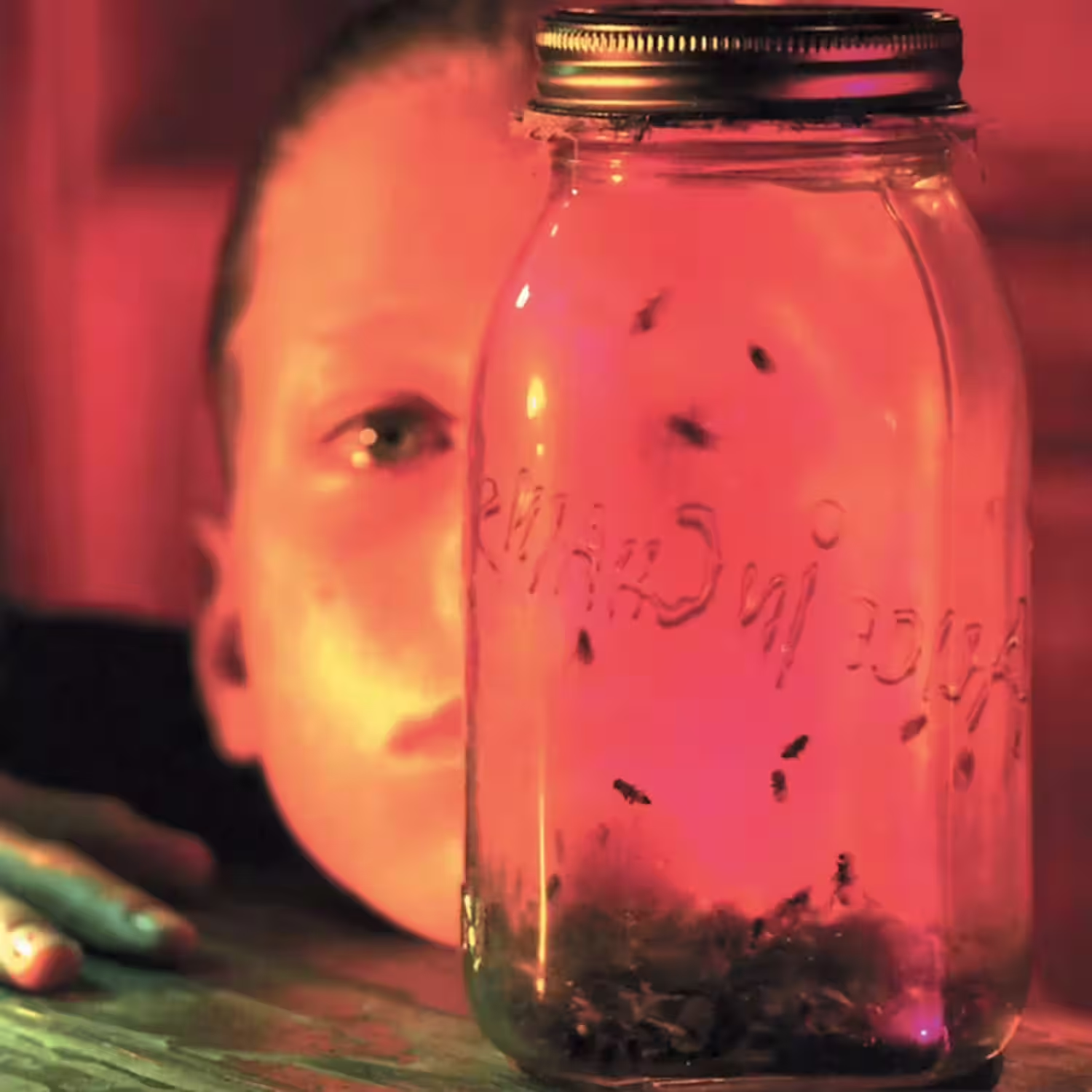
The cover photograph was shot in a single afternoon, on 8 September 1993, in the dining room of Los Angeles photographer Rocky Schenck. Schenck had already shot Sap; the band asked him back. Their brief was straightforward: a young boy peering into a glass jar filled with flies, lit with "crazy colours". Schenck used coloured theatrical gels over his lights to get the slightly hallucinatory blue-orange-pink palette of the final image. His assistant drove to a nearby horse stable with a butterfly net and caught hundreds of live flies for the prop.
"The band had come up with the idea for the title and wanted the cover to be a young boy looking into a jar filled with flies. I remember they asked me to use crazy colors in the shot, so I utilized lots of different gels over the lights to achieve the final look."
Rocky Schenck, recounted in David de Sola's Alice in Chains: The Untold Story, 2015
The title itself came from a science experiment Jerry Cantrell had carried out in third grade. He kept two jars of flies, overfed one and underfed the other; the overfed flies bred faster but died from overcrowding, and the underfed ones survived. The first commercial pressing of the compact disc shipped with a row of small plastic flies stuck inside the clear plastic spine, a packaging detail expensive enough to draw a Grammy nomination for Best Recording Package, which the band lost the following year to Buddy Jackson's design for a Bob Wills tribute album.
Release Day and a Historic Debut
Columbia released Jar of Flies on 25 January 1994. Two weeks later, the chart entered new territory. The EP debuted at No 1 on the Billboard 200 with first-week sales of 141,000 copies, the first extended play in the chart's history to enter at the top. It would remain the only solo holder of that distinction until Collision Course in 2004 and Bad Meets Evil's Hell: The Sequel in 2011. It sold 2,037,853 copies in the United States during its first year, was certified triple platinum in 1995, and was promoted to quadruple platinum by the RIAA in 2022.
The international story was almost as good. The EP went to No 1 in New Zealand, No 4 in the United Kingdom in a double-CD package with Sap, No 2 in Australia in the same configuration, No 3 in Finland, No 5 in Canada and inside the Top 10 in Sweden and Norway. Contemporary reviews were near-unanimously warm. Paul Evans wrote in Rolling Stone that the EP was "darkly gorgeous". The lone outlier was a 4 out of 10 mauling from NME in mid-January 1994. Steve Huey would later sum up the retrospective consensus.
"Jar of Flies is a low-key stunner, achingly gorgeous and harrowingly sorrowful all at once."
Steve Huey, AllMusic, 2008
The EP picked up two Grammy nominations for the 37th ceremony in 1995, for Best Recording Package and Best Hard Rock Performance (for I Stay Away). It won neither, but the nominations confirmed how seriously the record was being taken. Guitar World ranked it No 4 on its top ten guitar albums of 1994. Rolling Stone in April 2014 placed it at No 12 on its list of "1994: The 40 Best Records From Mainstream Alternative's Greatest Year", and in 2019 at No 42 in its "50 Greatest Grunge Albums" rundown.
Singles and Music Videos
| Single | Released | Director | Chart notes |
|---|---|---|---|
| No Excuses | January 1994 | Matt Mahurin | No 1 Billboard Mainstream Rock Tracks; MTV Buzz Bin rotation spring 1994 |
| I Stay Away | 1994 | Rocky Schenck | Top 10 Mainstream Rock; stop-motion video featuring circus imagery; 1995 Grammy nomination, Best Hard Rock Performance |
| Don't Follow | 1994 | No commissioned video | Promo-only US single; entered Mainstream Rock Top 25; widely played live |
The visual identity of the EP was Schenck's, end to end. He shot the cover, directed the second video, set the colour palette. The first video, for No Excuses, was directed by Matt Mahurin, the photographer-filmmaker who had also shot videos for U2 (One), Tracy Chapman, Metallica (The Unforgiven) and R.E.M.; he gave the song a black-and-white treatment full of slow tracking shots of the band in a darkened room and on-set landscapes. MTV played both videos heavily through the spring and summer of 1994, with No Excuses earning Buzz Bin status alongside contemporaries like Beck's Loser and Soundgarden's Black Hole Sun.
Why There Was No Tour
The most obvious thing missing from the Jar of Flies story is the support tour. Bands normally answer a No 1 record with three to six legs of arena dates; Alice In Chains played essentially no shows behind Jar of Flies. A planned 1994 spring tour with Suicidal Tendencies was cancelled outright; rehearsals fell apart in Atlanta when Staley refused to continue, and the band issued the most public possible statement about his condition by stopping. The next major Alice In Chains live activity, a few short festival appearances aside, would not happen until the 1996 MTV Unplugged taping in New York, more than two and a half years after the EP came out.
The cancellation cost the band a fortune and the audience a generation of live memories. It also gave the EP a particular kind of mythological weight. Jar of Flies exists in the discography as a record made and then left alone, finished, released, certified platinum and stranded. Listeners came to it through MTV, through radio rotation and through word of mouth, not through a tour cycle. That isolation is part of why the record feels the way it does even thirty years on.
From Jar of Flies to MTV Unplugged 1996
When Alice In Chains finally taped a full live performance again, on 10 April 1996 at Brooklyn Academy of Music for MTV Unplugged, the format was the one that Jar of Flies had inadvertently rehearsed. The band sat on stools; Scott Olson joined as a second acoustic guitarist; Inez played acoustic bass. Five of the seven Jar of Flies tracks were performed, alongside older Cantrell songs from Dirt and Facelift rearranged in the same hushed key. The resulting album, released on 30 July 1996, debuted at No 3 on the Billboard 200 and remains one of the most-watched Unplugged tapings in MTV's history.
Most audiences experienced the Jar of Flies material through that Unplugged set rather than through the studio EP. Nutshell in particular has been associated almost entirely with the BAM performance since 1996, with Staley visibly thinner and slower than he had been in 1993, the band protective and intent around him, the room dead silent through the verses. It was the last full Alice In Chains performance of Staley's life; the band played four shows with Kiss in July 1996 and then went on a hiatus from which Staley never returned.
Covers, Syncs and the Quiet-Mode Template
Compared with Dirt, the Jar of Flies material has been used sparingly in film and television, partly because the songs themselves resist easy ironic placement. Nutshell is the most-licensed of the seven, having appeared in episodes of Cold Case and various sports highlight packages, and is frequently chosen for memorial sequences in fan-made and broadcast tributes. No Excuses has surfaced in skate and surf videos and in cable drama soundtrack stings throughout the 2000s. I Stay Away has been used in trailer reels and a handful of cable drama episodes. The instrumental Whale and Wasp has been a quiet workhorse for documentary score temp use across the years.
Nutshell, again, is the song the EP has handed to the rest of music. Covered live by Mark Lanegan, Cantrell himself solo, members of Staind and Stone Sour, and by a procession of acoustic-guitar YouTube tributes since 2002, it has become the de facto Alice In Chains ballad. Don't Follow has been covered by country and folk-adjacent artists, including a striking solo-vocal version released as a 2021 tribute. I Stay Away and No Excuses have been less covered, perhaps because the harmony arrangements are intricate enough that they resist easy transposition.
More importantly than the cover history, Jar of Flies set the template for what later Alice In Chains and Cantrell solo records would do in their quieter modes. The acoustic-with-strings palette of Black Gives Way to Blue's title track, of long stretches of The Devil Put Dinosaurs Here and Rainier Fog, and of the slower songs across Cantrell's Boggy Depot, Degradation Trip, Brighten and [*I Want Blood*](/posts/i-want-blood-by-jerry-cantrell-album-review/) records, all live in territory Jar of Flies opened up. Sap had pointed the way; Jar of Flies built the road.
30th Anniversary and the Vinyl Full of Flies
On 22 March 2024, two months after the EP's actual thirtieth birthday, Legacy Recordings issued a multi-format anniversary reissue. The standard offering was an audiophile vinyl pressing on translucent green wax. Above that sat a tri-coloured variant in a deluxe gatefold. Above that sat a logo-embossed jar package containing the record, a 60-page hardcover book of session photography and a printed lyric sheet. And above all of those, in a release that became the subject of NME and Decibel news stories from the moment it was announced in January 2024, sat a 100-copy limited edition with the carcasses of real, dried flies pressed into the vinyl itself.
The "real flies in the wax" run was made in collaboration with Furnace Record Pressing in Virginia, on clear vinyl, with the insects suspended in the playable surface. It was not a gimmick that could ever be repeated at scale and was sold by lottery. Whether it added anything to the listening experience is a question best left to the lucky 100; whether it confirmed Jar of Flies's status as a still-mythologised record three decades on is not in doubt. The reissue also pushed the EP back onto charts that, frankly, it had no business returning to, with new Top 40 placings in Croatia, Hungary, Iceland and Portugal in week 13 of 2024.
Things You Might Not Know
| Fact | Detail |
|---|---|
| Real flies in the spine | The first CD pressing in January 1994 had small plastic flies stuck inside the clear plastic spine of the jewel case. The 2024 vinyl with carcasses of real dead flies was a 30th-anniversary call-back to that first pressing. |
| Cantrell's third-grade experiment | The title comes from a science experiment Jerry Cantrell ran in third grade, with overfed flies that died and underfed flies that survived. |
| Inez was on stage with Ozzy weeks earlier | Mike Inez was still touring with Ozzy Osbourne in early 1993; he joined Alice In Chains in January, toured Lollapalooza with them that summer, and went straight into the September sessions. |
| The eviction story | The band returned from Lollapalooza in late August 1993 to find their rented Seattle house emptied for unpaid rent. They moved into London Bridge Studio with their possessions. |
| Pro Tools forbidden | Layne Staley personally banned Pro Tools from the sessions. The entire record was tracked to analog tape on the studio's Neve 80-68 console. |
| The side-stick happened by accident | The instantly recognisable groove on No Excuses came from Sean Kinney messing about with side-stick drumming. Toby Wright was initially against it and bolted on bongos to give it weight. |
| Cantrell sings lead on two tracks | Jerry Cantrell takes lead vocal on No Excuses and Don't Follow, with Staley on harmonies, an inversion of the band's usual configuration. |
| The string section was a quartet | April Acevez (viola), Rebecca Clemons-Smith and Matthew Weiss (violins) and Justine Foy (violoncello) form the string quartet heard across Rotten Apple, I Stay Away and Whale and Wasp. |
| 15 days from first note to mastered tape | Tracking ran from 7 to 14 September 1993 at London Bridge in Seattle, then mixing from 17 to 22 September at Scream Studios in Los Angeles. The whole project occupied fifteen working days. |
| The Suicidal Tendencies tour that never happened | A planned spring 1994 US co-headline tour with Suicidal Tendencies was cancelled during Atlanta rehearsals when Staley pulled out, leaving the EP without a support cycle. |
| Held the EP-at-No 1 record alone for ten years | From January 1994 until December 2004, when Jay-Z and Linkin Park's Collision Course matched it, Jar of Flies was the only EP in Billboard 200 history to debut at the top. |
| Sap and Jar of Flies were sold as a single record in the UK | The UK release packaged both EPs together as a double CD, since Sap had not previously been issued there. The combined release peaked at No 4 on the UK Albums Chart. |
| The cover photograph was shot in a dining room | Rocky Schenck photographed the sleeve in his own Los Angeles dining room on 8 September 1993, with coloured gels over the lights and real flies caught at a nearby horse stable. |
| Two Grammy nominations, no wins | The EP was nominated at the 37th Grammys in 1995 for Best Recording Package and Best Hard Rock Performance (I Stay Away). It lost both. |
| Nutshell became a memorial standard | After Staley's death in 2002, Nutshell entered the wider rock-funeral repertoire and has been covered live by Mark Lanegan, Stone Sour, Staind members and Jerry Cantrell himself, often as an audience sing-along. |
The Riffology Podcast
If you want to hear two grown men try to talk their way through Nutshell without losing it, the Riffology podcast goes deep on records like Jar of Flies every fortnight. We cover albums you grew up with, albums you missed and albums that, like this one, were never supposed to exist at all. You can find Riffology on Spotify, Apple Podcasts, Amazon Music, Pocket Casts and every other major platform, and at riffology.co. Subscribe, drop us a rating if it moves you, and join the conversation about Jar of Flies and the records around it.
Comments