Mike Clink is credited as producer of Rust in Peace, but by Dave Mustaine's account the record was really made by his engineer, his mixer and himself, after a black Labrador puppy ate a hole through the studio wall and Clink's other client, Guns N' Roses, kept pulling him away. Marty Friedman remembers Clink coaching his solos, and the sources do not even agree on how much of the sessions Mustaine attended.
What survives the dispute is nine songs in 40 minutes and 44 seconds, the first Megadeth album with Friedman on guitar and Nick Menza on drums, released by Capitol on 24 September 1990. It reached number 8 in the UK and number 23 in the US, and in 2020 Kerrang! ranked it the best album of 1990, ahead of Slayer's Seasons in the Abyss. This is how it got made, who played what, and where the accounts clash.
Album Facts
| Field | Detail |
|---|---|
| Artist | Megadeth |
| Album | Rust in Peace |
| Release Date | 24 September 1990 |
| Label | Capitol Records |
| Producer(s) | Dave Mustaine and Mike Clink; mixed by Max Norman |
| Studio(s) | Rumbo Recorders, Canoga Park, California |
| Genre / Subgenre | Technical thrash metal, thrash metal |
| Track Count | 9 |
| Total Runtime | 40:44 |
| Billboard 200 Peak | 23 |
| UK Albums Chart Peak | 8 |
| Other Notable Chart Peaks | Ireland 18, Finland 19, Germany 21, Japan 29 |
| Certifications | US Platinum (1994), Canada Platinum, UK Gold (2018) |
| Estimated Sales | Not found |
| Key Singles | "Holy Wars... The Punishment Due", "Hangar 18" |
Cultural Context
Thrash had a crowded 1990. Pantera's Cowboys from Hell arrived on 24 July, Anthrax's Persistence of Time on 21 August, and Slayer's Seasons in the Abyss and Testament's Souls of Black both on 9 October, a fortnight after Megadeth. Judas Priest's Painkiller and Suicidal Tendencies' Lights...Camera...Revolution! would join Rust in Peace on the Grammy shortlist.
The subject matter was the news. Mustaine said the Cold War was still a live issue, with Reagan in the White House while the album was written and George Bush senior by the time it came out, so "everything about the record was very politically charged".
The Band's Story Up to Rust in Peace
Megadeth began as retaliation for Mustaine's ejection from Metallica. Their debut, Killing Is My Business... and Business Is Good!, came out on Combat in 1985 and So Far, So Good... So What! in January 1988. By then Louder reports that Mustaine, bassist David Ellefson, guitarist Jeff Young and drummer Chuck Behler were in the midst of a collective addiction to heroin. A European trip that took in shows with Iron Maiden and Donington's Monsters of Rock on 20 August 1988 ended with the band abandoning the rest of the tour. "That was the beginning of the end for Jeff and Chuck," Mustaine said.
He fired both. Menza, Behler's drum tech, took over the stool in 1989. The guitar job took longer. During the March 1989 auditions Mustaine crashed into a parked car with an off-duty police officer inside, was found guilty of DUI and drug possession, and was sentenced to rehabilitation. Slash jammed with Mustaine and Ellefson. Dimebag Darrell of Pantera was offered the job but would only come if his brother Vinnie Paul did too, and Mustaine had already hired Menza. Jeff Waters of Annihilator was also considered.
Friedman arrived by tape. A copy of his solo album Dragon's Kiss sat in the management office until Mustaine, who first thought "What a clown!", finally played it and thought "Wow, he wants to play with us?" Seeing Friedman play live, Mustaine said, "I self-destructed. I just thought, 'Oh my God, this guy is good and I'm so terrible!'"
Pre-production & Demos
Ellefson says he and Mustaine began writing songs to demo in November 1988, with Behler still on drums. Behler rehearsed "Holy Wars" and "Polaris" with them in 1989. Later demos were cut at EMI Studio with Chris Poland, Megadeth's original lead guitarist, on lead. Poland played leads on demos of seven songs, and says he was "99 percent going to join" before his manager talked him out of it. Mustaine's version is blunter: "There was no way I was ever going to ask Chris Poland to rejoin Megadeth." He put three of the demos on the 2004 remaster so people could see that Friedman "was actually inspired by what Chris did on the demos".
Several songs were old. Mustaine says "Polaris" began as "Child Saint" in Panic, his pre-Metallica band, and that "Hangar 18" dates from the same period. "Poison Was the Cure" dated from the Peace Sells era. Mustaine's position was that "we'd already written all of Rust In Peace". Friedman remembers more of it coming together in rehearsal: "Even if Dave was the ringleader and arranger, he was arranging many parts that the rest of us came up with together." Management found the album slightly short, so "Dawn Patrol" was added last. Friedman recalls an original version with a heavy, dissonant guitar riff so strange he couldn't believe they planned to record it; the song took shape in the studio, with no guitar at all.
"It was the repetition, going over every song over and over again. We'd gone from having the luminescence of a candle to being a photon beam."
Dave Mustaine, Louder (Metal Hammer), 2020
Creating Rust in Peace
Sessions began in March 1990 at Rumbo Recorders in Canoga Park, a studio owned by Captain and Tennille. Mustaine asked Clink to produce because he was a big UFO fan and "expected him to constantly get me Michael Schenker tones". Clink had also produced Guns N' Roses' Appetite for Destruction and albums for Heart and Jefferson Starship, and warned Mustaine he would have to leave if Axl Rose called.
"Mike Clink is listed as the producer on Rust in Peace, but we really didn't make the record with him. Mike was there intermittently because he was working with Guns N' Roses at the same time."
Dave Mustaine, Guitar World, 2010
Mustaine added that Clink's puppy ate through the soundproofing and knocked over his guitar, and told Louder "we fired him in the middle of the project". The other accounts do not line up neatly:
- Wikipedia, citing Ellefson's memoir and Mustaine's 2020 book, has Clink handling bass, drums and Friedman's guitar while Mustaine was in rehab for the first half, then leaving for Use Your Illusion, with engineer Micajah Ryan finishing guitars and vocals.
- Distorted Sound says Mustaine relapsed once recording started and was sent to rehab after the scratch tracks were cut, with Ellefson acting as musical director. Friedman and Ellefson put Mustaine at around half the sessions, and he returned about a month in.
- Distorted Sound has Clink called away by Axl Rose about four-fifths of the way through. uDiscover says he oversaw the entire recording, the first time Megadeth had not changed producer mid-album.
Friedman's own account puts Clink in the room. His first take of the second "Holy Wars" solo was a warm-up before he had tuned, and Clink liked it. Friedman wore Clink down until he was allowed to re-cut it. He remembers wading through "miles of 2 inch tape" on the floor, with no ProTools or quantising to rescue anyone. He was also hiding nerve damage in his right arm, Distorted Sound reports, playing economically with no warm-ups and as few takes as possible.
Mustaine says he plays most of the rhythm guitar on every Megadeth record. His gear was a Jackson King V through mostly Marshall JCM800s, with every knob "dimed" for leads. For the final mixes he brought in Max Norman, the man behind Ozzy Osbourne's first two solo albums.
"I was saying, 'Y'know what? I want something a little like this [makes whooshing noise]' and Max said, 'Like this?' and there it was! Job done."
Dave Mustaine on the backwards-reverb cymbal before "Polaris", Louder (Metal Hammer), 2020
The band liked the mix enough that Norman produced Countdown to Extinction next. Distorted Sound quotes Mustaine reflecting: "Even as much as I want to take credit for my part in it, I know that it was a cast of players."
Personnel & Credits
| Role | Player | Notes |
|---|---|---|
| Core band | ||
| Vocals, guitars | Dave Mustaine | Co-producer; cover concept |
| Guitars | Marty Friedman | First Megadeth album |
| Bass, backing vocals | David Ellefson | Music credit on "Dawn Patrol" |
| Drums, backing vocals | Nick Menza | First Megadeth album; former drum tech |
| Guest & session musicians (credited) | ||
| Laugh on "Lucretia" | Sandra Rabin | |
| Lead guitar, demos only | Chris Poland | Not on the final album |
| Production & engineering | ||
| Producer | Mike Clink | Role disputed, see above |
| Recording and engineering | Micajah Ryan, Mike Clink | Ryan finished guitars and vocals |
| Assistant engineer | Andy Udoff | |
| Mixing | Max Norman | Produced Ozzy Osbourne's Blizzard of Ozz |
| Mastering | Greg Fulginiti | |
| Technician | Tom Mayhue | |
| Artwork | ||
| Cover illustration | Ed Repka | Mustaine supplied the concept |
| Photography | Gene Kirkland, Wendi Schaeffer | Schaeffer assisted |
The 2004 remix and remaster was credited to Ralph Patlan and Mustaine as mixers, with Tom Baker mastering. Poland's leads survive only on the demos, three of which reached the 2004 remaster.
The Songs
| # | Title | Writer(s) | Length | Single? | Notes |
|---|---|---|---|---|---|
| 1 | Holy Wars... The Punishment Due | Mustaine | 6:36 | Yes (1990) | Sparked by an Antrim riot; Friedman's acoustic bridge hits at 2:26 |
| 2 | Hangar 18 | Mustaine | 5:14 | Yes (1991) | Panic-era song, finished late; Menza pushed the UFO angle |
| 3 | Take No Prisoners | Mustaine | 3:28 | No | Stop-start breaks gave Friedman trouble; recorded before ProTools |
| 4 | Five Magics | Mustaine | 5:42 | No | Inspired by Lyndon Hardy's fantasy novel Master of the Five Magics |
| 5 | Poison Was the Cure | Mustaine | 2:58 | No | Dates to the Peace Sells era; lyrics reflect heroin dependence |
| 6 | Lucretia | Mustaine (lyrics); Mustaine, Ellefson (music) | 3:58 | B-side | Laugh by Sandra Rabin; B-side of the Holy Wars 7-inch |
| 7 | Tornado of Souls | Mustaine (music); Mustaine, Ellefson (lyrics) | 5:22 | No | Friedman's solo earned a silent handshake from Mustaine |
| 8 | Dawn Patrol | Mustaine (lyrics); Ellefson (music) | 1:50 | No | Added last because management thought the album too short |
| 9 | Rust in Peace... Polaris | Mustaine | 5:36 | No | Started as Child Saint in Panic; 5:44 on the 2004 remaster |
"Holy Wars" came from a gig in Antrim in 1988. Mustaine learned someone was selling bootleg Megadeth shirts for "the Cause", was told it meant equality between Protestants and Catholics, and, "pretty inebriated" by the end of the set, announced "This one's for the Cause! Give Ireland back to the Irish!" The crowd split in two and the band left town in a bulletproof bus. Louder notes the Cause is the IRA, and that the song's middle section, "The Punishment Due", salutes Marvel's Punisher. Mustaine started writing the next day.
"Hangar 18" is about the hangar near Dayton, Ohio, said by conspiracy theorists to hold the wreckage of the 1947 Roswell crash. Mustaine told MTV in 1991 that Menza "is way into this stuff. Maybe he's just a little bit more gullible than I am!" In the long instrumental section Mustaine says his solos were off the cuff and thinks Friedman's were written out. Friedman says Clink told him the song was about aliens, so he should "play something that sounds like you are coming from outer space".
"Tornado of Souls" is about the end of Mustaine's relationship with his ex-fiancee Diana. It was never a single, yet the band have played it live over 1,000 times.
"When I finished the solo to this one, Mustaine came into the studio, listened to it down once, turned around and without saying a word, shook my hand."
Marty Friedman, MartyFriedman.com, 2002
Mustaine says he wrote the "Lucretia" lyrics while driving round the Griffith Park Observatory trying to score drugs. The popular tale of a ghost in his attic he dismissed in 2008: "Lucretia was a story I made up", with the name taken from Lucrezia Borgia. "Five Magics" darts from full speed to a psychedelic groove, and the lyrics of "Poison Was the Cure" reflect Mustaine's heroin addiction. "Dawn Patrol" is Mustaine speaking over Ellefson's bass, a breather before the title track, whose name came from a bumper sticker reading "May all your nuclear weapons rust in peace".
B-sides, Outtakes & Lost Songs
- "Lucretia" was the B-side of the "Holy Wars" 7-inch and sat on the CD single. The 12-inch carried a Mustaine interview.
- The "Hangar 18" singles added live versions of "The Conjuring" and "Hook in Mouth", recorded at Wembley Arena, London, on 14 October 1990.
- "My Creation" (1:36, Mustaine and Menza) was added to the 2004 remaster, alongside demos of "Polaris", "Holy Wars" and "Take No Prisoners".
- "Breakpoint" (3:29) was a bonus track on a Korean edition.
Album Artwork & Packaging
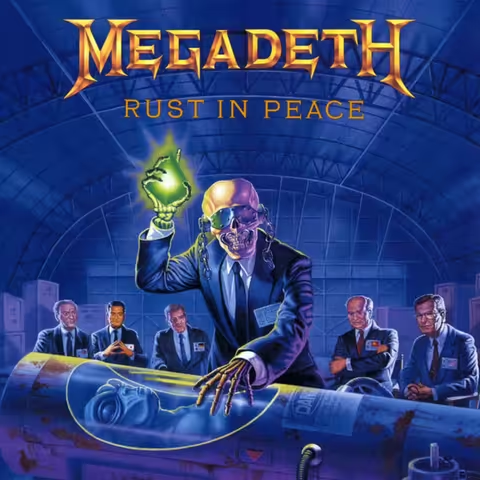
The cover is a blue-washed aircraft hangar under an arched roof, with MEGADETH in gold letters across the top. The skull-faced mascot Vic Rattlehead stands in a dark suit and tie with a name badge, his eyes covered by a metal band with chains hanging from it. One hand raises a glowing green crystal, the other rests on a rusted cylindrical chamber containing a reclining alien figure. Five men in suits, each wearing a badge, sit watching behind it.
Ed Repka created it, as he had the Peace Sells cover in 1986, and also supplied artwork for both singles. Mustaine is credited with the concept. Megadeth's own website names the seated men as Mikhail Gorbachev, George H. W. Bush, Richard von Weizsäcker, Toshiki Kaifu and, it says, John Major, five "superpowers". Wikipedia disputes the Major identification, noting that Margaret Thatcher was still prime minister in 1990, and lists the British figure as unidentified. Asked about the green crystal, Mustaine joked it was "a McDonald's cheeseburger from 1961" then said it was supposed to be like Kryptonite.
Release & Reception
The UK chart run was brief: in at number 8 on 6 October 1990, then 22, 43 and 55 before dropping out after four weeks. It later made the Official Rock & Metal Albums Chart in 2018 and 2020, peaking at 35. In the US it reached number 23, going gold in January 1991 and platinum in December 1994.
| Territory | Peak |
|---|---|
| United States (Billboard 200) | 23 |
| United Kingdom | 8 |
| Ireland | 18 |
| Finland | 19 |
| Germany | 21 |
| Japan | 29 |
| Switzerland | 29 |
| Sweden | 34 |
| New Zealand | 35 |
| Australia | 47 |
| Canada | 70 |
Critics were generous. Greg Kot gave it four stars in the Chicago Tribune and called it "the quartet's most accomplished album". Entertainment Weekly's Jim Farber graded it B+, praising its "sheer velocity, combined with dexterity". Rolling Stone's Robert Palmer gave four stars and heard "nasty speed thrash with an almost jazzlike intricacy and drive".
"Many speed-metal bands are formulaic and boring; nobody can level those charges against Megadeth now that Rust in Peace has hit the street."
Robert Palmer, Rolling Stone, 1990
- Grammy nomination for Best Metal Performance at the 33rd Grammys (1991), alongside Anthrax, Judas Priest and Suicidal Tendencies. Metallica's "Stone Cold Crazy" won.
- Foundations Forum 1991: Top Radio Album, with "Hangar 18" named Top Radio Cut.
- Rolling Stone's 100 Greatest Metal Albums (2017): number 19. Loudwire's top thrash albums (2023): number 2.
- Kerrang!'s best albums of 1990 (2020): number 1, "the epitome of all-killer-no-filler heavy metal".
Singles & Music Videos
| Single | Release | UK peak | Other peaks | Extras |
|---|---|---|---|---|
| Holy Wars... The Punishment Due | 23 September 1990 | 24 | Ireland 12, Finland 10, Australia 138 | "Lucretia" (7-inch); Mustaine interview (12-inch) |
| Hangar 18 | 4 February 1991 | 26 | Ireland 25, Finland 29 | Live "The Conjuring" and "Hook in Mouth" |
"Holy Wars" spent three weeks on the UK chart from 29 September 1990, while "Hangar 18" entered on 16 March 1991 and lasted four. Wikipedia says the "Holy Wars" video was filmed in August 1990 and cut news footage of armed conflicts together with the band playing. The "Hangar 18" video, directed by Paul Boyington, shows aliens being tortured and the band in freezing chambers. "Hangar 18" was also nominated for Best Metal Performance in 1992. A 1991 home video, Rusted Pieces, documented the recording and gathered six videos and an interview.
Touring & Live
- Clash of the Titans, from 22 September 1990: a three-week European leg with Slayer, Testament and Suicidal Tendencies.
- Late 1990: North America with Testament, supporting Judas Priest's Painkiller tour, then Rock in Rio in January 1991.
- May to July 1991: Clash of the Titans in America, with Megadeth, Slayer and Anthrax sharing the top and Alice in Chains opening.
- 2010: a 22-show North American 20th Anniversary tour with Testament and Exodus, playing the whole album every night, then the same on the American Carnage dates with Slayer.
The Hollywood Palladium show on 31 March 2010 became Rust in Peace Live, released on 7 September 2010 on Blu-ray, DVD and CD. It entered the Billboard 200 at number 161 and the DVD chart at number two, and was the first Megadeth release since 2002 to feature Ellefson. Mustaine said he had never expected to play the album through: beyond "Holy Wars" and "Hangar 18", songs such as "Five Magics" were "just part of the record".
In TV, Film & Media
- "Hangar 18" appeared in Guitar Hero II (2006) and as downloadable content for Guitar Hero 5; "Holy Wars" was in Guitar Hero: Warriors of Rock.
- "Tornado of Souls" featured in Brutal Legend (2009).
- The whole album became Rock Band downloadable content on 9 February 2010.
- In 2015 The Onion ran the headline "Humanity Still Producing New Art As Though Megadeth's Rust In Peace Doesn't Already Exist".
Reissues, Remasters & Anniversaries
The Capitol-era Megadeth catalogue was remixed and remastered in 2004, with Rust in Peace gaining four bonus tracks (see the B-sides above). Mustaine and Ralph Patlan mixed it, and "Polaris" grew from 5:36 to 5:44. The 2010 live set marked the 20th anniversary. In 2020 Mustaine and Joel Selvin published Rust in Peace: The Inside Story of the Megadeth Masterpiece, an oral history with Ellefson and Friedman and a track-by-track from Mustaine.
Legacy & Influence
The follow-up, Countdown to Extinction, was recorded from January 1992 at Enterprise Studios in Burbank. Friedman and Menza both left in the late Nineties. Decibel called Rust in Peace a "genre-defining work", Kerrang! said it "set a new standard for heavy metal in the 90s", and IGN ranked it the fourth most influential metal album. Louder's Dom Lawson hears its precision in Lamb of God, Arch Enemy and Dream Theater. Friedman re-recorded "Tornado of Souls" for his solo album Future Addict, and Steve Ouimette covered "Holy Wars" for Rock Revolution. "Hangar 18" later got a sequel, "Return to Hangar", on The World Needs a Hero.
"A lot of people have said that over the years and I used to think, 'What are you talking about?' but when I listen to it now I totally get it. Listen to the odd time signatures in Five Magics."
Dave Mustaine on the album fuelling prog metal, Louder (Metal Hammer), 2020
Things You Might Not Know
| Fact | Detail |
|---|---|
| Slash's pick | Friedman struggled with the fast pedalling part in "Five Magics" until Clink handed him one of Slash's guitar picks lying around, and he nailed it in one take. |
| Hangar 18 was longer | Friedman says the song was originally much longer and got seriously edited before it reached the album's 5:14. |
| The aircraft carrier | Mustaine said he had been aboard the USS George Washington, and the thought of 18-to-20-year-olds driving $100 million vessels fed "Take No Prisoners". |
| Annihilator's claim | In 2024 Jeff Waters said Ellefson and Menza told him they listened to his band's music "for a whole year" on the way to the sessions. |
| The laugh | The laugh at the start of "Lucretia" is Sandra Rabin, who Megadeth.com's answerer thought was a secretary at Laffitte Entertainment. |
| Wrong tabs | In 2017 Mustaine posted the correct "Holy Wars" riff after saying most online tabs transcribed it wrongly. |
| Menza's pedigree | Rolling Stone noted Menza was the son of jazz saxophonist Don Menza, and said his restraint made the band swing. |
| Ellefson's verdict | Ellefson thought Mustaine's "Holy Wars" vocal sounded thin and tentative, yet felt that rawness captured exactly where the band were. |
Listen to the Riffology Podcast
The Riffology podcast is on all major platforms. If you have a view on who really made Rust in Peace, Mustaine or Clink, tell us.
Comments