The Review in Brief
Saviors is the fourteenth Green Day studio album, released on 19 January 2024 through Reprise Records. Rob Cavallo produces a Green Day record for the first time in fifteen years. The band tracked it across two cities and three years, between RAK Studios in London and United Recordings in Los Angeles, with Chris Lord-Alge mixing and Ted Jensen mastering. The result is fifteen songs in forty-five minutes, no song longer than four, every chorus designed to be sung back in an arena. Critically it landed at 73 on Metacritic, which made it the best-reviewed Green Day record since 21st Century Breakdown in 2009. Commercially it debuted at number one in the UK and at number four in the United States, and earned the band their first Grammy nominations in over a decade. None of that quite explains why a band whose last album was widely written off as a misfire suddenly sounded like themselves again.
The short answer is the producer. The longer answer is the songs. The longest answer is the world the songs are aimed at, which by January 2024 had circled back to feeling a great deal like the world Green Day were writing into when American Idiot landed in 2004. Saviors is not a sequel to that record. It is something closer to a re-statement: a reminder that this band still know exactly which buttons to press, and which ones not to.
A Punk Trio Returning Home
Billie Joe Armstrong, Mike Dirnt and Tre Cool have been the only three members of Green Day since 1990. Across that span they have made fourteen studio albums, sold more than seventy-five million records, opened a Broadway musical and headlined every stadium worth headlining on three continents. They have also drifted, more than once, into the territory where a long career goes to die: a triple-album campaign with diminishing returns in 2012, a Trump-era misfire in 2020 with Father of All Motherfuckers that everyone outside the band seemed to regard as a curiosity at best. The arc that lands at Saviors is not the arc of a young band trying to break through. It is the arc of a veteran band trying to figure out what they are still good for, and answering the question.
The answer Saviors lands on is a familiar one. The band that recorded [Dookie](/posts/green-day-dookie/) in 1993 in three weeks for sixty thousand dollars was a power trio that could write a three-minute punk song about almost any subject. Three decades on, the band that recorded Saviors is still a power trio, the songs are still under four minutes, and the subjects have shifted from suburban boredom to civic decline. The mechanics are intact. What had been missing, until now, was the producer who knew how to capture them.
Album Facts
| Field | Detail |
|---|---|
| Artist | Green Day |
| Album | Saviors |
| Release date | 19 January 2024 |
| Label | Reprise Records (Warner Music internationally) |
| Producers | Rob Cavallo and Green Day |
| Studios | RAK Studios, London; United Recordings, Los Angeles |
| Recording dates | 2021 to 2023 |
| Engineer | Chris Dugan |
| Mixer | Chris Lord-Alge |
| Mastering | Ted Jensen at Sterling Sound |
| Genres | Pop punk, punk rock, power pop, alternative rock |
| Track count | 15 |
| Running time | 45 minutes 55 seconds |
| US Billboard 200 peak | 4 (49,000 album-equivalent units week one) |
| UK Albums Chart peak | 1 (31,361 units week one) |
| Other peaks | Australia 2, Austria 2, Germany 2, Switzerland 3, Scotland 1, Ireland 2, New Zealand 6, US Top Alternative Albums 1, US Top Rock Albums 1, UK Rock and Metal 1 |
| Certifications | United Kingdom Silver (BPI, December 2024) |
| Estimated sales | 108,000 album-equivalent units in the United States by April 2024; close to 200,000 worldwide that month |
| Singles | The American Dream Is Killing Me, Look Ma No Brains, Dilemma, One Eyed Bastard, Bobby Sox |
| Grammy nominations | Best Rock Album, Best Rock Song (Dilemma), Best Rock Performance (The American Dream Is Killing Me) |
| Riffology Score | 73 out of 100 |
The American Dream, Three Decades In
The opening line of the lead single is a thesis statement: "Hands up, who wants to be the loser?" It is followed by an image of a man on the street, "unemployed and obsolete", and then by a chorus that repeats the album's central premise like a chant. Armstrong has said the song was the first thing written for the record, and the first thing tracked once Cavallo came aboard. They sat on it for months because they knew the moment they released it the campaign would be locked in. The campaign is shaped around the idea that the country the band wrote American Idiot about in 2004 is the country they are writing about again in 2024, only worse, and that the rage and ridicule and exasperation that powered the earlier record have a fresh political cycle to direct themselves at.
That is a high bar to clear. American Idiot was not just a hit album: it was a generational document, sixteen million copies sold worldwide, two Grammy wins, a Broadway musical, the record that defined what a politically engaged rock band could still look like in the George W. Bush era. Trying to repeat that trick in the post-truth, post-Spotify, post-everything 2020s, with the band members in their early fifties, is the kind of move that has buried other veteran rock acts. Saviors does not repeat the trick. It does the only sensible thing instead, which is to write fifteen short songs that sound like Green Day and let the times do the rest of the work.
Why Rob Cavallo Came Back
Cavallo is the producer who signed Green Day to Reprise in 1993 on the back of the Lookout Records EP Kerplunk, the producer who made [Dookie](/posts/green-day-dookie/), [Insomniac](/posts/the-making-of-insomniac-by-green-day/), [Nimrod](/posts/the-making-of-nimrod-by-green-day/), Warning, American Idiot and 21st Century Breakdown, and then quietly drifted out of the picture for the trilogy years and the Revolution Radio cycle. The break was never explained as a falling-out. It was more that Cavallo had become an executive at Warner Bros Records, then chairman of the entire label, and a working producer relationship with one of the bands he had signed was no longer the obvious arrangement. By the time of Father of All Motherfuckers in 2020 the band was working with Butch Walker and self-producing. The reviews were mixed. Sales fell off a cliff.
Armstrong has talked in interviews around the Saviors campaign about the moment he realised the band wanted Cavallo back. They had assembled around fifteen songs that had not made it onto Father of All Motherfuckers, and there was an obvious decision to be made about who could turn that pile of material into a record. Cavallo was available and the band were old enough to know who they sounded best with. The seven leftover songs grew into fifteen new ones; Cavallo flew between London and Los Angeles to track them; and the sessions, by all accounts, were the most relaxed Green Day had been in a studio for a decade.
The Father of All Reset
Saviors only makes full sense once you have the previous album in your head. Father of All Motherfuckers came out in February 2020, ran twenty-six minutes across ten tracks, leaned heavily on glam and soul samples, and was produced by Butch Walker with the band. It did poorly with fans, poorly with critics, and almost immediately got swallowed by the pandemic that landed three weeks after release. The accompanying Hella Mega Tour with Fall Out Boy and Weezer was postponed and reshuffled. By the time the world came back online the band had quietly stopped talking about Father of All Motherfuckers altogether.
The replacement strategy was a string of standalone tracks. Here Comes the Shock dropped in February 2021 as part of a deal with the NHL. Pollyanna arrived in May 2021 to support the rescheduled Hella Mega run. Holy Toledo followed in November 2021 for the film Mark Mary and Some Other People. None of them appeared on a Green Day album. They were prelude. The actual record being built behind the scenes, in London with Cavallo, started life under a different working title and a different shape entirely.
From 1972 to Saviors
Early in the campaign the band teased an album called 1972, a reference to the year all three members were born. Social-media posts in December 2021 hinted at it, vinyl mockups were rumoured, and for the best part of two years the working title stuck. Somewhere in the back half of the sessions the record acquired its real name. Saviors is a more loaded word than 1972, and a more useful one for a band whose songs have always asked who exactly is coming to rescue whom. The title track, buried second from the end of the sequence, is the album in microcosm: a power-pop anthem that asks for help and immediately concedes that none is coming.
The 1972 idea did not vanish entirely. The track 1981 survived from that era of the project and appears as track six on the finished album, a minute and a half longer than its title would suggest and built around a riff that nods directly to The Clash in Sandinista mode. The song was debuted live at Festival d'ete de Quebec on 16 July 2023, more than three months before the album was even announced, which gave eagle-eyed Green Day fans the first solid hint that something concrete was on the way.
Inside RAK and United Recordings
RAK Studios is the converted St Johns Wood schoolhouse that Mickie Most opened in 1976, a four-room facility that has hosted everything from Pink Floyd overdubs to Adele vocal sessions to half the British rock canon. Green Day tracked the bulk of Saviors there in a series of blocks across 2022 and 2023, with Cavallo flying in from Los Angeles and Chris Dugan engineering. The choice of room is unusual for a band who have made most of their records in California: the band have said in interviews that the change of scenery was deliberate, both to keep the sessions feeling fresh and to push Armstrong out of the cycle of home demos that had dominated the pandemic period.
United Recordings on Sunset Boulevard is the building previously known as Ocean Way, a room with one of the great American recording histories: Frank Sinatra cut at Western there, the Beach Boys tracked Pet Sounds in the same complex, Tom Waits made Closing Time on the same boards. The Los Angeles half of the Saviors sessions was about overdubs, additional production, string and horn dates with David Campbell, and the kind of late-stage tinkering that Cavallo has always favoured on Green Day records. Chris Lord-Alge took the multitracks into his Mix LA room in Burbank and applied his trademark loud, mid-forward sound. Ted Jensen mastered at Sterling Sound in Edgewater, New Jersey.
Personnel and Credits
| Role | Player | Notes |
|---|---|---|
| Core band | ||
| Lead vocals, guitars | Billie Joe Armstrong | All fifteen tracks. Sole lyricist on every song. |
| Bass, backing vocals | Mike Dirnt | Co-production credit on every track. |
| Drums, percussion | Tre Cool | Co-production credit on every track. |
| Guest and session musicians | ||
| Additional guitar and piano | Rob Cavallo | Additional guitar on Suzie Chapstick and Saviors; additional piano on Suzie Chapstick. |
| Acoustic guitar | Butch Walker | On Goodnight Adeline. |
| String and horn arrangements | David Campbell | Arranger and conductor on The American Dream Is Killing Me and Father to a Son. Father of Beck. |
| Production and engineering | ||
| Producer | Rob Cavallo | All fifteen tracks. |
| Engineering | Chris Dugan | Longstanding Green Day engineer since 21st Century Breakdown. Also mixed the Japanese bonus track Fever. |
| Additional engineering | Butch Walker | All tracks. Also producer on Fever. |
| Additional engineering | Mark Aguilar | |
| Mixing | Chris Lord-Alge | At Mix LA, Burbank. |
| Mixing assistance | Brian Judd | |
| Editing | Greyson Smith | |
| Mastering | Ted Jensen | At Sterling Sound, Edgewater, New Jersey. |
| Drum technician | Nathaniel Mela | |
| Guitar technician | Andrew Hans Buscher | |
| Artwork | ||
| Cover photograph | Chris Steele-Perkins | 1978 Magnum image taken on Falls Road in Belfast during the Troubles. Modified for the sleeve. |
| Photography | Emma America, Alice Baxley | Sleeve and band imagery. |
| Graphic design | Ryan Baxley, Brendan Walter, Alex Tenta | |
What is unusual about the lineup is what is missing. There is no second touring guitarist Jason White on the record, no keyboard player smuggled in to thicken things up, no co-writer outside the three band members. Saviors is, by Green Day standards of the last two decades, a remarkably stripped-back personnel sheet. Cavallo plays on two tracks, Walker plays acoustic on one, Campbell arranges on two. Everything else is the three of them.
The Singles Campaign
The singles run from late 2023 into release week was the tightest Green Day had executed in years. Five singles in just under three months, each timed to a specific moment, each backed with a video, each shifting the focus a couple of degrees so that by release day the album had a complete public personality before most listeners had heard the deep cuts.
| Single | Release date | Notes |
|---|---|---|
| The American Dream Is Killing Me | 24 October 2023 | Lead single. Album announcement single. Official video directed by Brendan Walter and Ryan Baxley. |
| Look Ma, No Brains! | 2 November 2023 | Played for the first time at the When We Were Young festival in Las Vegas the previous weekend. |
| Dilemma | 7 December 2023 | A Christmas-themed video. Performed on Dick Clarks New Years Rockin Eve on 31 December. |
| One Eyed Bastard | 5 January 2024 | Released with an animated video by Rob Fidel. A live-action version followed in May 2025. |
| Bobby Sox | 19 January 2024 | Released on album day with a 1990s house-party video Billboard called queer-affirming. |
| Corvette Summer (promotional) | 23 July 2024 | Post-release single. Music video starred Mark Hamill. |
The American Dream Is Killing Me
The lead single is the album in three minutes and six seconds. A descending riff in the verse, a major-key chorus that lifts the chant, a David Campbell string and horn arrangement that swells underneath the second half. Armstrong has said it was the first song they wrote and the first they tracked, and that they then deliberately held it back for months rather than rushing it out as a stand-alone. By the time it dropped on 24 October 2023, alongside the album announcement, the band had a promo website at theamericandreamiskillingme.com posting lyric snippets, video clips and conspiracy-coded imagery for weeks.
The video, shot in Los Angeles and directed by Brendan Walter and Ryan Baxley, is built around a slow zombie procession of suburban Americans walking through landscape that swings between American Dream signifiers and post-apocalyptic decay. The band watch from a bandstand. It is not subtle. It does not need to be: the song was nominated for Best Rock Performance at the 67th Annual Grammy Awards a year later, the band's first Grammy nomination in any category since 2014.
Look Ma, No Brains!
Two minutes and three seconds long. Two chords for the verse, two more for the chorus, a Tre Cool drum part that does not let go of the back end of the beat. Armstrong has said in interviews around the album campaign that he considers Look Ma No Brains one of the best straight punk songs he has ever written, which is the kind of claim that a frontman thirty years into a career is allowed to make exactly once a decade and only when the song earns it. This one earns it. It is the song that the singles campaign needed to put alongside The American Dream Is Killing Me to demonstrate that the album could do both registers: the big-tent anthem and the headlong sprint. The first live outing was at the When We Were Young festival in Las Vegas in late October 2023, before the song had even been released.
Dilemma
The third single is the most surprising one. Built around a chiming Armstrong rhythm guitar and a chorus that lifts into a higher register than Green Day usually attempt, Dilemma is a song about addiction and relapse: "I was sober, now I am drunk again, I am in trouble and in love again." Armstrong has been open across the album cycle about his sobriety and the lengths he has had to go to maintain it. The song is not metaphorical. The Christmas-themed video, shot in a snow-dusted suburban setting, sharpens rather than softens the lyric, and by the time the band performed it on Dick Clarks New Years Rockin Eve on 31 December 2023 it was already the song the campaign was building its critical reception around. It would be nominated for Best Rock Song at the 67th Grammys eleven months later.
One Eyed Bastard
Released on 5 January 2024 with an animated video by Rob Fidel, One Eyed Bastard is the closest the album comes to the Father of All Motherfuckers register. A swung, brass-coloured riff. A vocal that leans toward sneer rather than shout. A chorus that is built around the title and not much else. The animated video, in lurid comic-book primaries, leans into the cartoon quality of the song. A live-action video filmed in Amsterdam followed in May 2025 as part of the deluxe-edition rollout. It is the track on the standard album that polarises long-time Green Day fans most reliably: critics broadly liked it, message-board purists thought it sounded like a bonus track, and live audiences sang along anyway.
Bobby Sox
The fifth and final single from the standard edition is also the only one not released ahead of the album. Bobby Sox arrived on release day, 19 January 2024, with a 1990s house-party video that Billboard described as queer-affirming. The song itself is built on a major-key palm-muted pop-punk riff that owes a clear debt to the band's own back catalogue: it is the closest the album comes to Nimrod or Warning territory. The lyrical conceit, a bisexual love song framed around a high-school dating fantasy, is a register Green Day have not often visited on record before, and the choice to release it on album day rather than during the build-up campaign was a deliberate one. It was the song the band wanted listeners to discover with the rest of the record sitting around it.
The Album Tracklist
| # | Title | Length | Single? | Notes |
|---|---|---|---|---|
| 1 | The American Dream Is Killing Me | 3:06 | Lead single | Strings and horns arranged and conducted by David Campbell. |
| 2 | Look Ma, No Brains! | 2:03 | Second single | Shortest song on the record. |
| 3 | Bobby Sox | 3:44 | Fifth single (album day) | Released with a 1990s house-party video. |
| 4 | One Eyed Bastard | 2:52 | Fourth single | Animated video by Rob Fidel. |
| 5 | Dilemma | 3:18 | Third single | Grammy nominated for Best Rock Song. |
| 6 | 1981 | 2:09 | Debuted live in July 2023 in Quebec. | |
| 7 | Goodnight Adeline | 2:56 | Butch Walker plays acoustic guitar. | |
| 8 | Coma City | 3:28 | Dystopian civic-decline lyric in the American Idiot lineage. | |
| 9 | Corvette Summer | 3:02 | Post-release video | Video starred Mark Hamill, released July 2024. |
| 10 | Suzie Chapstick | 3:16 | Rob Cavallo plays additional guitar and piano. | |
| 11 | Strange Days Are Here to Stay | 3:05 | ||
| 12 | Living in the 20s | 2:06 | Second-shortest song. | |
| 13 | Father to a Son | 3:54 | Campbell string and horn arrangement. Album ballad. | |
| 14 | Saviors | 2:55 | Title track. Cavallo plays additional guitar. | |
| 15 | Fancy Sauce | 4:01 | Longest song on the record. Closing track. | |
| Total | 45:55 | Japanese edition adds Fever (2:23), produced by Butch Walker, mixed by Chris Dugan. |
Deep Cuts: 1981, Coma City and Corvette Summer
The middle of the album is where the case for Saviors as a real return to form actually has to be made. 1981 is a propulsive minor-key thrash that does not so much resemble The Clash as plug into the same socket: a hammered eighth-note bassline from Dirnt, Cool playing four-on-the-floor with a tambourine in the chorus, Armstrong singing about Cold War paranoia bleeding into 21st-century anxiety. Coma City is the song that owes the most direct debt to American Idiot: built around a long-form rock riff and a lyric that scans an unnamed American city decaying in real time. It is the closest the album comes to its predecessor in any structural sense, and it is sequenced so that you hit it just as the singles ration runs out.
Corvette Summer is a different animal. A bright, sun-bleached pop-punk track that lifts its title from the 1978 Mark Hamill film and uses it as a frame for a vignette about a friendship across decades. Hamill himself appears in the music video, released in July 2024, six months after the album. The song would have been an obvious single in 1995; in 2024 it is a deep cut that nonetheless ends up doing some of the heaviest melodic work on the record.
The Ballads: Father to a Son and Suzie Chapstick
Two slower songs anchor the back half. Father to a Son, sequenced second from last, is the album's emotional centre: a David Campbell string and horn arrangement, an Armstrong vocal that pulls back from the volume he has used everywhere else, a lyric that addresses a father and a son in alternating verses without saying which is which. Suzie Chapstick, four tracks earlier, is the more open-hearted ballad. Cavallo plays additional guitar and piano, the chorus lifts into the sort of major-key power-pop that Green Day have always been able to find when they want to. Both songs reach back to the territory that Good Riddance Time of Your Life staked out in 1997 and that Wake Me Up When September Ends developed in 2004. They are not new ground for the band. They are the proof that Green Day can still write songs in the slow registers they invented for themselves, and that age has not blunted either Armstrong's melodic instincts or his willingness to be earnest on record.
The Title Track and Fancy Sauce
Saviors the song sits at track fourteen, two minutes and fifty-five seconds, Cavallo doubling Armstrong's rhythm guitar in the chorus. Its lyrical hook is the line that names the album, a power-pop chant that frames the saviors of the title in air quotes: a generation looking for help and being told repeatedly that they will not be receiving any. The album closes with Fancy Sauce, four minutes and one second, the longest song on the record. It is the closing argument: a slower, more reflective acoustic-driven track that pulls together the album's themes about decline, mortality and the failure of every grown-up institution to deliver on its promises, and finishes on a deliberately understated outro. Where 21st Century Breakdown closed on the operatic See the Light and Father of All Motherfuckers closed on the slight Graffitia, Saviors closes on a song that sounds like an actual ending.
The Cover Art and the Belfast Boy
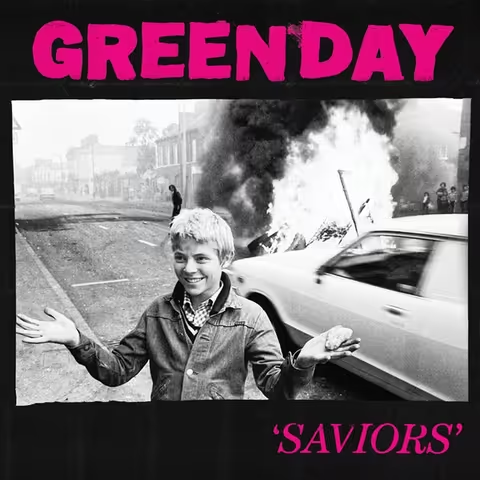
The cover is the album's most-discussed visual choice and one of the year's most debated sleeves. The image is a digitally modified version of a black-and-white photograph taken in 1978 by the British Magnum photographer Chris Steele-Perkins, on Falls Road in West Belfast, during a riot at the height of the Troubles. The original frame shows a teenager named Paul Kennedy holding a stone and shrugging, a moving car visible in the background, a pile of burning rubbish behind him. Steele-Perkins captured it in a single frame and it became one of the more circulated images from his Northern Irish work.
For the Saviors sleeve, the band's design team altered the boy's face so that he appears to be smiling rather than scowling. The change made the image more inviting and, depending on who was reading the change, either more cynical or more accurate as a metaphor for the album's lyrical posture. The Belfast Telegraph ran a story on the day of the album announcement asking whether the band had cleared the photograph and the alteration with anyone in Belfast; subsequent coverage in Belfast Live tracked down Paul Kennedy himself, by then a grown man, who gave the project his blessing. Steele-Perkins is credited on the sleeve. It is a more sophisticated piece of visual reference than the album's reputation as a populist punk record initially suggested, and it sets up the artwork inside the gatefold, where Emma America and Alice Baxley photographed the band in similarly grainy black-and-white in homage.
Release Day and Chart Performance
The release-week machine was built around two events. Six days before street date, on 13 January 2024, the band ran simultaneous in-store listening parties at independent record shops in the United States, the UK, Europe and Australia, the kind of pre-release manoeuvre that broke down the Sub Pop and Matador release campaigns of the early nineties and that very few major-label artists still bother with. Three days later, on 16 January, the band staged a surprise gig in the 47th to 50th Streets-Rockefeller Center subway station in New York, with the late-night host Jimmy Fallon joining them on tambourine. They played Basket Case, American Idiot and Look Ma No Brains to a commuter crowd that had not been told they were coming. By the time the album arrived on 19 January, the campaign had built its own headlines for three solid weeks.
The chart returns were the band's strongest in over a decade. Saviors entered the UK Albums Chart at number one with 31,361 album-equivalent units, the band's first UK number one since 21st Century Breakdown in 2009. It debuted at number four on the US Billboard 200 with 49,000 units, of which 39,000 were pure album sales, an unusually clean split in a streaming-dominated market. A further 10,390 copies were sold through independent record stores in the first week through a chain of exclusive variant pressings: those sales were not counted toward the Billboard 200, which left some industry observers arguing that the actual debut should have been higher. By April 2024 the album had passed 108,000 album-equivalent units in the United States and was approaching 200,000 worldwide. The Saviors campaign earned the album a Silver certification from the BPI in December 2024 for sales and streams equivalent to 60,000 in the UK.
Critical Reception
Metacritic settled the album at 73 out of 100 across twenty-one professional reviews, indicating generally favourable reception and making it the best-reviewed Green Day album since 21st Century Breakdown in 2009. The notable splits were predictable. NME's Andrew Trendell called it the band's best work since American Idiot, a four-star review built around the idea that Saviors is "an act of defiance met with a shrug, a band saying we are still here and we are still fucked". DIY ran a rare five-star review from Emma Swann, calling it an outstanding record that showcased an unrivalled ability to incorporate biting social commentary within perfect three-minute pop-punk songs. Kerrang gave it four out of five with Nick Ruskell writing a long appreciation of how the album returned the band to the territory that suited them. LouderSound's Paul Brannigan called it inarguably Green Day's best album in twenty years.
The standout dissenter was Pitchfork. Arielle Gordon gave the album 5.1 out of 10, a review that questioned whether the band were still capable of writing music that engaged with the present rather than the past. Uncut gave it 7 out of 10 with the curtly worded line that Green Day "unleash 15 compact, primarily pro forma bangers". Stephen Thomas Erlewine at AllMusic landed at three and a half stars and observed that the band sounded like rock and roll lifers settling into middle age, irritated by some shifts in culture but still finding sustenance in the music they have loved for decades. Loudwire ranked Saviors the tenth best rock album of 2024 in their year-end list.
Grammy Nominations
The Grammy nominations announced on 8 November 2024 were the most significant institutional recognition the band had received in over a decade. Best Rock Album for Saviors. Best Rock Song for Dilemma. Best Rock Performance for The American Dream Is Killing Me. Three nominations across the three top rock categories. Green Day had last been Grammy-nominated in any category for Cuatro in 2014, a Best Music Film nod for the documentary that accompanied the Uno Dos Tre trilogy. They had last won a Grammy in 2010, when 21st Century Breakdown took Best Rock Album. None of the three Saviors nominations converted on the night at the 67th Annual Grammy Awards on 2 February 2025; the band lost out in each category to other acts. The nominations themselves, regardless of the outcome, were the validation that the campaign had been working toward.
The Saviors Tour
The campaign that supported the record was the largest the band had ever assembled. The Saviors Tour ran from May 2024 into late 2025 across five continents, totalling 87 shows. The conceit was that Green Day would perform their fourteenth studio album in 2024 alongside two whole anniversary albums: Dookie, thirty years old that year, and American Idiot, twenty years old. Each night the band played both records in full, then closed with material from Saviors and an encore that drew on the wider catalogue. Three-and-a-half hour sets, sold-out stadiums, and the kind of programming that worked equally well for the parents-generation fans who had bought Dookie on cassette and for the teenagers who had only ever heard American Idiot in the abstract.
The North American leg, which began in July 2024, was supported by The Smashing Pumpkins, Rancid and The Linda Lindas, three acts that together spanned alternative rocks nineties peak, the band's own Lookout Records-era contemporaries and the next generation of LA punk teenagers. The European leg, which had started in May, leaned more punk: Nothing but Thieves, The Hives, The Interrupters, Donots and Maid of Ace. A second, shorter European leg followed in late 2024, and shows in Asia, Australia, and South Africa were booked into late 2024 and 2025. By the time the tour ended the band had played to roughly two million people.
The MAGA Moment on New Years Rockin Eve
On 31 December 2023, performing on Dick Clarks New Years Rockin Eve from Times Square, Green Day played American Idiot. Coming up to the second verse Armstrong changed the line "I am not a part of a redneck agenda" to "I am not a part of the MAGA agenda". It was a deliberate, scripted moment. The clip lit up social media for the first forty-eight hours of 2024 and gave the Saviors campaign a piece of political imagery that the album itself had been building toward without quite stating outright. The right-wing commentariat responded as expected. Donald Trump, by then the presumptive Republican nominee for the 2024 presidential election, did not comment publicly. Two weeks later when the band staged the surprise subway gig with Jimmy Fallon, Armstrong left a beat at the same point in American Idiot for the crowd to sing the MAGA line back at him, which they obligingly did.
The Saviors Edition de Luxe
The deluxe campaign began on 9 April 2025, with the announcement of an expanded edition titled, in French, Saviors (Edition de Luxe), trailered by a previously unreleased song called Smash It Like Belushi. A second deluxe-only single, Ballyhoo, followed on 2 May 2025. The full deluxe edition arrived on 23 May 2025, alongside an official live-action music video for One Eyed Bastard. The deluxe added seven tracks to the standard fifteen: Smash It Like Belushi, Stay Young, Fuck Off, Ballyhoo, an acoustic Suzie Chapstick, an acoustic Father to a Son, and an Underdog, taking the total runtime to 66 minutes 50 seconds. A vinyl edition added a Fidlar Alt Mix of Fuck Off; a separate live-in-Amsterdam One Eyed Bastard appears on certain formats. A Suzie Chapstick music video, capturing what Kerrang called two years of Saviors chaos, followed on 30 October 2025.
Trivia: Things You Might Not Know
| Fact | Detail |
|---|---|
| The working title | For nearly two years the album was rumoured to be titled 1972, a reference to the year all three band members were born. Teaser social-media posts dating back to December 2021 nudged at the name before Saviors was confirmed in October 2023. |
| The leftover seven | Billie Joe Armstrong has said in interviews that seven songs written for Father of All Motherfuckers did not make that album. Those seven songs became the seed for Saviors, and the project grew to fifteen finished tracks. |
| The first song written | The American Dream Is Killing Me was the first song written and recorded for the album. The band kept it in a box for months before releasing it as the lead single, knowing the moment it dropped the campaign would lock in around its political register. |
| The Belfast boy | The shrugging teenager on the album cover is Paul Kennedy, photographed by Chris Steele-Perkins during a riot on Falls Road, Belfast in 1978. His expression was digitally altered to look like a smile for the sleeve. Kennedy, now an adult, was tracked down by Belfast Live in October 2023 and gave the project his blessing. |
| Mark Hamill in a music video | The Corvette Summer music video, released six months after the album in July 2024, starred Mark Hamill, drawing the title back to his 1978 film of the same name. |
| The subway gig with Jimmy Fallon | On 16 January 2024, three days before release, Green Day played a surprise busking gig at the 47th to 50th Streets-Rockefeller Center subway station in New York. Jimmy Fallon joined them on tambourine. |
| The MAGA line on New Years Eve | Performing American Idiot on Dick Clarks New Years Rockin Eve on 31 December 2023, Armstrong changed the line "I am not a part of a redneck agenda" to "I am not a part of the MAGA agenda". The Trump campaign did not comment publicly. |
| The first Cavallo album in fifteen years | Rob Cavallo had not produced a Green Day studio album since 21st Century Breakdown in 2009. In the intervening years he had been chairman of Warner Bros Records, leaving the producer credit on Green Day records vacant for the trilogy years, Revolution Radio and Father of All Motherfuckers. |
| The Japanese bonus track | The Japanese edition added a track called Fever, produced by Butch Walker rather than Cavallo and mixed by longstanding band engineer Chris Dugan. It is the only Saviors track Cavallo did not produce. |
| The independent record store split | 10,390 copies of the album were sold through independent record shops in the first week through exclusive variant pressings. None of those sales were counted toward the US Billboard 200 chart that week. |
| The David Campbell connection | The string and horn arranger on The American Dream Is Killing Me and Father to a Son is David Campbell, the orchestrator who has arranged on records by Adele, Beyonce, Linkin Park and Carole King. He is also Becks father. |
| 1981 came out before the album was announced | The track 1981 was debuted live at Festival d'ete de Quebec on 16 July 2023, more than three months before the album was even announced. Eagle-eyed fans clipped the phone-camera footage and pieced together that a new record was in motion. |
Verdict and Riffology Score
Saviors is not the best Green Day record. It is not American Idiot or Dookie. It is unlikely to be the one anyone reaches for first in twenty years time. What it is, demonstrably, is the album that proved this band still had a definitive record left in them after a decade of evidence to the contrary. The reason it works is the same reason Green Day records work when they work at all: short songs, big melodies, no padding, a producer who knows how to capture the trio in a room, and a frontman who has remembered how to write a chorus that means something. The political register is sharper than it has been on a Green Day record since 2004, and the production is wider and louder than Father of All Motherfuckers ever managed, and the fifteen-song running order does not have a slack moment.
If there is a criticism it is the one Pitchfork made: Saviors looks back more than it looks forward. The shape of the songs, the references in the lyrics, the photographic vocabulary of the artwork, the choice to tour the record alongside the band's two most famous albums; all of it points to a project that is comfortable with its own legacy. That can read as nostalgia or as confidence. The band have made enough records by now to be allowed either reading. The reading the campaign rewards, and the reading the live shows and the chart performance and the Grammy nominations support, is that Saviors is Green Day rediscovering what they are for. The Riffology score is 73 out of 100, which is the Metacritic figure and also the number this writer would have landed on independently. It is a real record, made with care, by a band who did not need to make it and chose to anyway.
Listen to the Riffology podcast for more deep dives on the bands and the records that shaped a generation. The Riffology podcast is available on all major podcast platforms, including Apple Podcasts, Spotify and Pocket Casts.
Comments