
By the time Pearl Jam walked into a converted dairy barn in Nicasio, California in March 1993, they had been the most popular new rock band in America for fifteen months and the most uncomfortable for at least twelve. Ten had sold past five million copies, "Jeremy" had taken Best Music Video at the MTV awards, Eddie Vedder was on the cover of Time magazine refusing to be on the cover of Time magazine, and the band's response was to hire a producer they had never worked with, lock themselves in a rural studio in Marin County, agree among themselves to release no music videos at all, and provisionally title the record Five Against One. The album that came out of those sessions broke the SoundScan single-week sales record that Use Your Illusion II had set, outsold every other entry in the Billboard Top 10 combined, and stayed at No. 1 for five weeks.
The story of Vs. is the story of a band actively trying to make themselves smaller and pulling off the largest opening week the American record industry had ever measured. It is also, behind the sales figures, the story of Eddie Vedder sleeping in a sauna and a pickup truck to escape the comfort of one of the most expensive residential studios in California.
Album Facts
| Field | Detail |
|---|---|
| Artist | Pearl Jam |
| Album | Vs. |
| Original working title | Five Against One |
| Release Date | 11 October 1993 (UK), 19 October 1993 (US) |
| Recorded | February to May 1993 |
| Studios | Potatohead Studio (Seattle, rehearsals) and The Site (Nicasio, California, tracking) |
| Producer | Brendan O'Brien and Pearl Jam |
| Engineer | Nick DiDia |
| Assistant engineers | Adam Kasper, Kevin Scott |
| Mastering | Bob Ludwig |
| Label | Epic Records |
| Genre | Grunge, alternative rock, hard rock |
| Track Count | 12 |
| Total Runtime | 46:11 |
| Billboard 200 Peak | No. 1 (five weeks) |
| UK Albums Chart Peak | No. 2 (33 weeks on chart) |
| Other Notable Peaks | No. 1 Australia, Canada, Ireland, Netherlands, New Zealand, Norway, Sweden; No. 7 Austria; No. 8 Germany; No. 9 Switzerland; No. 12 France |
| First-week US sales | 950,378 in five days, a SoundScan record from 1993 to 1998 |
| Certifications | US 7x Platinum, Canada 6x Platinum, Australia 4x Platinum, New Zealand Platinum, UK Gold, Netherlands Gold, Spain Gold |
| Estimated US sales | 7,400,000 (Nielsen SoundScan, July 2013) |
| Singles | "Go" (11 Oct 1993) - "Daughter" (20 Dec 1993) - "Animal" (4 Apr 1994) - "Dissident" (16 May 1994) |
The Band Going In
The Pearl Jam that started writing Vs. in early 1993 was, in the strictest commercial sense, the biggest American rock band of the year. Ten, released in August 1991, had been a slow burn that built through the back half of 1992 into a five-times-platinum cultural juggernaut on the back of "Alive", "Even Flow", "Black" and the Mark Pellington video for "Jeremy". The band had headlined Lollapalooza 1992 in a touring lineup that included Soundgarden, Ministry, the Red Hot Chili Peppers and Ice Cube. Vedder had been on the cover of Time, despite having declined the cover shoot. Pearl Jam had become, almost against their will, the public face of grunge alongside Nirvana.
The lineup going into Vs. had one important change. Drummer Dave Krusen, who played on Ten, had been replaced by Matt Chamberlain in May 1991 and then by Dave Abbruzzese in August 1991. Abbruzzese had toured the entire Ten cycle but Vs. would be his first record with the band. He wrote the central guitar riff for what became "Go", the album's opening track and lead single, which is unusual for a drummer and was the first signal that the writing dynamic was about to change.
"The band was blown up pretty big and everything was pretty crazy."
Mike McCready, Total Guitar, November 2002
Hiring Brendan O'Brien
The producer call was the central pre-production decision of the record. Rick Parashar had produced Ten in Seattle in 1991. For the follow-up, Pearl Jam wanted somebody who would make a more direct, less reverb-soaked record, somebody who could capture the band as a live unit in a room. The choice was Brendan O'Brien, a Georgia-based producer and multi-instrumentalist who had just finished Stone Temple Pilots' Core, was about to work on the Black Crowes' The Southern Harmony and Musical Companion follow-up, and had a reputation for moving fast and writing songs in the room rather than around them.
O'Brien brought his long-time engineer Nick DiDia, who would go on to handle Pearl Jam's next four studio albums plus most of Rage Against the Machine's output. Adam Kasper, later to engineer Soundgarden and the Foo Fighters, took the assistant chair. The recording method was deliberately old-fashioned: track the band live in a room, set up much as they would on stage, then mix songs as soon as each was finished rather than waiting until the end of the sessions. O'Brien also played a small but distinctive role as a player on the record himself, contributing the keyboard part on "Elderly Woman Behind the Counter in a Small Town".
Recording the Record
Rehearsals started at Potatohead Studio in Seattle in February 1993, with the band moving down to The Site studio in Nicasio, California for the bulk of the tracking. The Site sat in a hidden valley in rural Marin County, a residential complex with bedrooms, a kitchen and a sauna attached, and counted as one of the most expensive and luxurious studio environments in the United States at the time. McCready called it "paradise". Vedder reacted very differently, telling Spin in 2001: "I fucking hate it here. I've had a hard time. How do you make a rock record here?"
The first week of sessions produced "Go", "Blood", "Rats" and "Leash" in quick succession. Then the band hit a wall. Vedder, struggling to write lyrics under the comfort of the studio compound and the unfamiliar pressure of following Ten, retreated. He drove into San Francisco and slept in the back of his pickup truck. Back at the studio, he started sleeping in the sauna. The rest of the band's response was to make things harder for him on purpose.
"Recording Vs., there was a lot more pressure on Ed. The whole follow-up. I thought we were playing so well as a band that it would take care of itself. He was having a hard time finishing up the songs; the pressure, and not being comfortable being in such a nice place. Toward the end it got fairly intense. We tried to make it as uncomfortable for him as we could."
Jeff Ament, Spin, August 2001
The strategy worked. By the time the album was finished in May 1993, Vedder had delivered the most varied and personally specific lyric sheet of his career to that point, ranging from the acoustic confession of "Elderly Woman Behind the Counter in a Small Town" to the explicit anti-police-violence narrative of "W.M.A." Looking back later, Vedder put it bluntly: "The second record, that was the one I enjoyed making the least. I just didn't feel comfortable in the place we were at because it was very comfortable. I didn't like that at all."
The Songs
| # | Title | Writer(s) | Length | Single? | Notes |
|---|---|---|---|---|---|
| 1 | Go | Lyrics Vedder; music Pearl Jam (riff Abbruzzese) | 3:12 | Yes (11 Oct 1993) | Lead single. Main riff written by drummer Dave Abbruzzese. |
| 2 | Animal | Lyrics Vedder; music Pearl Jam | 2:49 | Yes (4 Apr 1994) | Provides the "five against one" lyric that was the original album title. |
| 3 | Daughter | Lyrics Vedder; music Pearl Jam | 3:55 | Yes (20 Dec 1993) | About a child abused by parents who do not understand her learning disability. No. 1 on both Album Rock and Modern Rock charts. |
| 4 | Glorified G | Lyrics Vedder; music Pearl Jam | 3:26 | No | Sparked by Abbruzzese telling the band he had just bought two guns. |
| 5 | Dissident | Lyrics Vedder; music Pearl Jam | 3:35 | Yes (16 May 1994) | Storytelling lyric about a woman sheltering a political fugitive. |
| 6 | W.M.A. | Lyrics Vedder; music Pearl Jam | 5:59 | No | Inspired by Vedder watching police hassle a black friend outside the band's rehearsal space and ignore him. Lyric sheet quotes news coverage of Malice Green. |
| 7 | Blood | Lyrics Vedder; music Pearl Jam | 2:50 | No | Attack on the music press and on the cult-of-personality treatment of Vedder. |
| 8 | Rearviewmirror | Lyrics Vedder; music Pearl Jam | 4:44 | No | Vedder said it is about "being in a car, leaving a bad situation". McCready plays EBow. |
| 9 | Rats | Lyrics Vedder; music Pearl Jam | 4:15 | No | Gossard takes lead guitar; McCready plays rhythm. |
| 10 | Elderly Woman Behind the Counter in a Small Town | Lyrics Vedder; music Pearl Jam | 3:15 | No | Vedder plays rhythm guitar; O'Brien contributes keyboards. |
| 11 | Leash | Lyrics Vedder; music Pearl Jam | 3:09 | No | Written about the same girl as the Ten track "Why Go". |
| 12 | Indifference | Lyrics Vedder; music Pearl Jam | 5:02 | No | Slow-burn closer. Vedder: "Trying to do something to make some other peoples' lives better than they are, even if it means going through hell." |
The album opens on "Go", a 3:12 single-take riff-and-shout that arrives with no introduction and ends in under a verse-chorus-verse, then drops into "Animal" without a breath. The first nine minutes of Vs. are the loudest, fastest opening salvo of any Pearl Jam record before or since. By the time it lands on "Daughter" at track three, the listener has been deliberately battered into accepting that this is not Ten.
"Daughter" itself is the pivot. Built on an acoustic guitar figure of Gossard's, it is the song most responsible for the album's mainstream radio life, the one that hit No. 1 on both Billboard's Album Rock and Modern Rock charts and spent eight weeks at the top of the former. The narrative lyric (a child abused by parents who refuse to recognise her learning disability) is one of the most direct social-issue songs Vedder ever wrote, and the live-show outros to the song (often quotes from other writers' songs taken at the band's whim) became a defining feature of the touring band for the next thirty years.
"Glorified G", a deadpan attack on gun culture, came from a real argument inside the band. Abbruzzese had bought two guns and told the others about it; the conversation that followed became the lyric. "W.M.A." was rooted in a specific incident outside the band's rehearsal studio where a group of police hassled a black friend of Vedder's and ignored him. The lyric sheet reprinted a portion of a news report about Malice Green, the unarmed black man beaten to death by Detroit police in November 1992.
The second half of the album is the contemplative one. "Rearviewmirror" is the rolling, mid-tempo Vedder driving anthem about leaving a bad situation behind. "Elderly Woman Behind the Counter in a Small Town", title and concept both, is the storytelling song that Vedder still routinely takes up with an acoustic guitar at the front of the stage. "Leash" is a punk-leaning Abbruzzese showcase. "Indifference" closes the album in a quiet, slow-burn five-minute meditation that is almost the opposite of "Go".
Personnel and Credits
| Role | Player | Notes |
|---|---|---|
| Pearl Jam | ||
| Vocals; rhythm guitar on "Rearviewmirror" and "Elderly Woman..." | Eddie Vedder | |
| Lead guitar; rhythm guitar on "Rats"; EBow on "Rearviewmirror" | Mike McCready | |
| Rhythm guitar; lead guitar on "Rats" | Stone Gossard | |
| Bass, upright bass | Jeff Ament | Also took the cover photograph. |
| Drums, percussion | Dave Abbruzzese | First Pearl Jam studio album. Wrote the main riff for "Go". |
| Additional musician | ||
| Keyboard on "Elderly Woman Behind the Counter in a Small Town" | Brendan O'Brien | |
| Production | ||
| Producer | Brendan O'Brien | First of seven Pearl Jam studio albums he would produce. |
| Producer | Pearl Jam | Co-production credit for the band. |
| Recording engineer | Nick DiDia | O'Brien's long-time engineering partner. |
| Assistant engineers | Adam Kasper, Kevin Scott | |
| Mastering | Bob Ludwig | |
| Artwork | ||
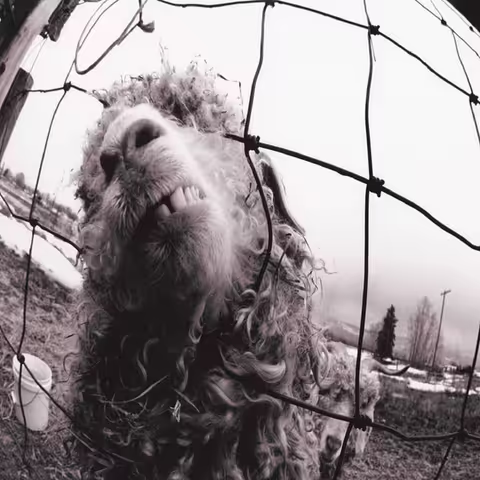
| Cover photography (black and white) | Jeff Ament (credited as "Ames") | Angora goat from Lifeline Farm, Victor, Montana. |
| Inside colour photography | Lance Mercer | |
| Art direction | Joel Zimmerman | |
Five Against One: Packaging and the Last-Minute Title
The album existed for most of its production cycle under the working title Five Against One, taken from the line in "Animal": "One, two, three, four, five against one". Gossard later explained the choice as a statement about the band's collective independence: their own band against everybody else's expectations of them. The title was changed at the last minute. The band briefly considered going self-titled, then settled on Vs., a one-word précis of the conflict theme that ran through the whole record.
The change happened so late that the first pressings of several formats are inconsistent. Some early cassette copies still carry Five Against One printed on the spine of the cassette itself. A run of cassettes and the first batch of CDs went out with no album title printed on the artwork at all. The first CD pressings shipped in an Ecopak, a cardboard variant of the standard Digipak, with no song titles printed on the back cover. The vinyl edition has never had the album title on the cover and uses a different photograph from the CD and cassette.
The cover photo itself was taken by Jeff Ament, credited as "Ames". It is a black-and-white portrait of an angora goat from Lifeline Farm in Victor, Montana. Ament has said the image was a statement about how the band felt at the time: "we were slaves". One further packaging quirk: the picture of the "elderly woman behind the counter" used inside the booklet was changed after the first pressings, allegedly because the original woman had never given permission for her photograph to be used. Later pressings carry a note under the new picture identifying her as "the new and improved woman behind the counter".
The No-Videos Decision
The single most consequential commercial decision around Vs. was the band's choice not to make a music video for any of its singles. After the "Jeremy" video had taken Best Music Video at the 1993 MTV Video Music Awards and become the song most fans associated with the band, Pearl Jam decided to pull back. No video for "Go", no video for "Daughter", no video for "Animal", no video for "Dissident". The band also scaled back interviews and television appearances, and made it a stated policy not to lip-sync.
"Ten years from now, I don't want people to remember our songs as videos."
Jeff Ament, quoted in Cameron Crowe's "Five Against the World", Rolling Stone, 28 October 1993
The decision flew directly in the face of the dominant 1993 record-industry playbook, which assumed that MTV rotation was the single biggest driver of album sales for a rock release. Vs. proceeded to disprove the assumption in the most public way available.
Release and Commercial Performance
The album was released on 11 October 1993 in the UK and 19 October in the US. Within five days SoundScan had logged 950,378 US copies sold. This broke the existing first-week sales record (held by Guns N' Roses' Use Your Illusion II from September 1991) and was the second-highest single-week album sales figure in SoundScan's history, behind only the 1.06 million copies of the Bodyguard soundtrack sold over Christmas 1992. In its opening week, Vs. outsold every other album in the Billboard Top 10 combined.
The record held its SoundScan first-week crown for five years, until Garth Brooks's Double Live shifted 1.08 million copies in November 1998. Crucially, SoundScan's methodology in 1993 only counted five days of release in the opening week; the rules changed before Double Live's tracking week. Vs. therefore retains, by one common reading, the highest five-day opening of any album in the SoundScan era.
The album spent five weeks at No. 1 on the Billboard 200, the longest stretch at the top of any Pearl Jam record. Internationally it hit No. 1 in Australia, Canada, Ireland, the Netherlands, New Zealand, Norway and Sweden, and No. 2 in the UK behind Take That's Everything Changes. As of July 2013, US sales sat at 7.4 million according to Nielsen SoundScan, and the RIAA has certified the album seven-times platinum.
Critical Reception
Critics largely came down on the side of the band. Paul Evans gave the album four-and-a-half stars in Rolling Stone, ranking it above Ten. Steve Huey gave it four stars in AllMusic. Edna Gundersen in USA Today, Jim DeRogatis in the Chicago Sun-Times, Jim Abbott in the Orlando Sentinel and Brett Thomas in The Sydney Morning Herald all sat at four stars or equivalent. Jon Pareles, writing in The New York Times, described the album as "individual misery as public catharsis".
"Few American bands have arrived more clearly talented than this one did with Ten; and Vs. tops even that debut."
Paul Evans, Rolling Stone, 23 December 1993
The dissenters were a vocal minority. David Browne gave it a B-minus in Entertainment Weekly, conceding that "Vs. is not a carbon copy of Ten" but reading the album as confirmation that "there's nothing underground or alternative about [Pearl Jam]". NME gave it 4 out of 10. Robert Christgau in The Village Voice dismissed it as a "dud". At the 1995 Grammy Awards, the album was nominated for Best Rock Album, "Daughter" for Best Rock Performance by a Duo or Group with Vocal, and "Go" for Best Hard Rock Performance. The band won none of the three; they were, by that point, well into their public withdrawal from the industry's award infrastructure.
Singles and Airplay
With no music videos in the mix, Pearl Jam relied entirely on rock and modern-rock radio for promotion. Four singles were issued from the record:
- "Go" - released alongside the album on 11 October 1993. Drove the opening-week sales spike.
- "Daughter" - released 20 December 1993. The album's biggest US radio hit, No. 1 on both the Album Rock Tracks and Modern Rock Tracks charts, with eight weeks at the top of the former.
- "Animal" - released 4 April 1994. Also placed on both Album Rock and Modern Rock charts.
- "Dissident" - released 16 May 1994. The final single from the album cycle.
"Glorified G" and "Elderly Woman Behind the Counter in a Small Town" also picked up rock-radio airplay despite never being formally promoted as singles, with both songs charting in their own right. The radio strategy made the no-videos position commercially viable: every single from Vs. reached at least the Top 5 of one of the two main US rock airplay charts.
Touring and Live
The Vs. Tour ran in two large legs: a Western United States run in the autumn of 1993, and an Eastern United States run in spring 1994. In a 1993 environment where the standard rock tour involved Ticketmaster fees, T-shirt mark-ups and arena dates, Pearl Jam set ticket prices at a deliberate cap to thwart scalpers and, when Ticketmaster added service charges to a pair of Chicago shows in March 1994, filed an antitrust complaint against the company with the US Department of Justice. The band testified before a House subcommittee on 30 June 1994. A planned 1994 summer tour was eventually cancelled as a direct result of the band's boycott of Ticketmaster-affiliated venues.
The tour was also, in retrospect, a memorial. On 5 April 1994, midway through the spring leg, Kurt Cobain's body was found in Seattle. Pearl Jam's 8 April 1994 show at the Patriot Center in Fairfax, Virginia took place three days later. Vedder addressed the crowd directly.
"I don't think any of us would be in this room tonight if it weren't for Kurt Cobain."
Eddie Vedder, Patriot Center, Fairfax, Virginia, 8 April 1994
Pearl Jam played the final two weeks of the tour with the news still raw. Vedder later told Spin that he had genuinely considered cancelling and going home, and that he came close to deciding the tour would be his last with the band. The penultimate show, at Boston's Orpheum Theater on 12 April 1994, was later released in heavily edited form on the 2011 deluxe edition of the album as the bonus disc Live at the Orpheum Theater, Boston, April 12, 1994. Material destined for the next album, Vitalogy, was already being debuted on the tour, including "Better Man", which had been recorded for Vs. and rejected by Vedder because he felt it was too accessible.
The album received one significant front-to-back live revival much later. On 16 April 2016 at the Bon Secours Wellness Arena in Greenville, South Carolina, Pearl Jam played the entirety of Vs. in album order as the opening segment of their set, the first and so far only time they have done so.
Outtakes, B-sides and the 2011 Reissue
Several songs that were recorded during the Vs. sessions did not make the final album. The most famous is "Better Man", written by Vedder before he joined Pearl Jam and recorded at The Site in 1993 but pulled from the running order. It was re-cut for Vitalogy the following year and became one of the band's signature songs. "Whipping" was also tracked during the Vs. sessions and later released on Vitalogy. "Hard to Imagine" was recorded but cut because the band already had enough mellow material; the Vs.-session version surfaced on the 2003 rarities compilation Lost Dogs, while a re-recorded Vitalogy-era version appeared on the 1998 Chicago Cab soundtrack.
The band also tracked their cover of Victoria Williams's "Crazy Mary" with Williams herself contributing backing vocals and acoustic guitar, originally for the 1993 benefit compilation Sweet Relief: A Benefit for Victoria Williams. A Pearl Jam and Cypress Hill collaboration recorded around the same time, "Real Thing", appeared on the soundtrack to the 1993 film Judgment Night.
In March 2011, Pearl Jam reissued Vs. alongside Vitalogy in three configurations: a single-disc Expanded Edition, a three-CD Deluxe Edition and a Limited Edition Collector's Boxed Set. The Expanded Edition adds three bonus tracks recorded at The Site by O'Brien during the original sessions: a previously unreleased acoustic version of "Hold On", the instrumental outtake "Cready Stomp", and the "Crazy Mary" cover. The Deluxe Edition pairs the Legacy versions of both albums with the Orpheum Theater live disc.
Legacy
The wider significance of Vs. is what it proved possible. The album showed that a rock band at the absolute peak of mainstream visibility could pull back its commercial machinery (no videos, fewer interviews, a price war with Ticketmaster) and still sell nearly a million copies in five days. It put Brendan O'Brien on the producer map permanently; he became Pearl Jam's house producer for Vitalogy, No Code, Yield, Backspacer, Lightning Bolt and beyond, while simultaneously becoming the most in-demand rock producer in America through the late 1990s and 2000s.
For the band, Vs. sits as the bridge between the still-young accidental commercial behemoth of Ten and the deliberately combative artistic curveball of Vitalogy. The Vedder lyric sheet expanded from internal autobiography into specific social commentary. The rhythm section sharpened. The willingness to make commercial decisions against industry orthodoxy was established and never reversed. Loudwire ranked the album the best hard rock album of 1993 in its 2024 year-by-year retrospective. Entertainment Weekly placed it 78th in its "100 Best Albums from 1983 to 2008" list, and Pause and Play put it 11th on its "90s Top 100 Essential Albums" list in 1999.
Things You Might Not Know
| Fact | Detail |
|---|---|
| The drummer wrote the lead single | Dave Abbruzzese, on his first Pearl Jam studio album, wrote the main guitar riff for opening track and lead single "Go". |
| Five Against One | The album was titled Five Against One for most of its production. Some early cassette pressings still carry that title on the spine. |
| The pickup truck and the sauna | Eddie Vedder slept in the back of his pickup truck and, separately, in the recording-studio sauna in order to escape the comfort of The Site. |
| 950,378 in five days | The first-week sales figure set a SoundScan record that held until Garth Brooks's Double Live sold 1.08 million in November 1998. |
| Outsold the rest of the Top 10 combined | In its opening week, Vs. sold more copies than every other album in the Billboard Top 10 put together. |
| The goat is from Montana | The angora goat on the cover was photographed by bassist Jeff Ament at Lifeline Farm in Victor, Montana. |
| No music videos | Pearl Jam released no music video for any of the four singles from the album, the first major-label rock act of the MTV era to do so consistently. |
| Brendan O'Brien plays the keyboards on "Elderly Woman" | The producer's keyboard part is the only non-band performance on the album. |
| Better Man came from these sessions | "Better Man" was recorded at The Site for Vs. and rejected by Vedder for being too accessible. It was re-cut for Vitalogy and became one of the band's biggest songs. |
| The new and improved woman | The picture of the "elderly woman" in the booklet was changed after the first pressings, allegedly because the original subject had not granted permission. Later pressings caption the replacement "the new and improved woman behind the counter". |
| The Ticketmaster lawsuit started here | The Ticketmaster antitrust complaint that defined the band's mid-1990s public profile was triggered by service-charge disputes on two 1994 Vs. Tour shows in Chicago. |
| Album played in full once, in 2016 | Pearl Jam have performed Vs. front to back live exactly once, on 16 April 2016 at the Bon Secours Wellness Arena in Greenville, South Carolina. |
Podcast
The Riffology podcast covers Vs. as a full-episode deep dive on the second Pearl Jam album. Subscribe wherever you get your podcasts, and dig further into the Pearl Jam discography across the rest of the site, from the long shadow of Ten through Vitalogy, Binaural, Ten and the band's most recent records.
Comments