The idea for one of heavy metal's greatest concept albums came out of drunk talk in Montreal and a nun dancing with a teddy bear in an Amsterdam nightclub. Geoff Tate, the operatically trained singer of Queensrÿche, had moved to Canada and fallen into friendly contact with members of the militant Quebec separatist movement, some of whom belonged to organisations that dabbled in bombing and terrorism. He listened to their loose talk, mixed it with memories of friends who had wasted away on heroin, and built from it the story of Nikki, a strung-out addict brainwashed into becoming an assassin. The result was Operation: Mindcrime, released on 3 May 1988.
It was the album that turned Queensrÿche from a high-pitched cult act with a reputation for satin cloaks and shoulder pads into what the British press swiftly dubbed "the thinking man's heavy metal band". A rock opera in fifteen parts, recorded across two years in Pennsylvania and Quebec with a Rush producer, an actor borrowed from British television, a Hollywood orchestrator and a choir billed as the Moronic Monks of Morin Heights, it proved that a metal band could be ambitious, literate and genuinely dangerous all at once. It also became, in the band's own words, a millstone as much as a milestone, the masterpiece against which fans would measure everything Queensrÿche ever did again.
| Field | Detail |
|---|---|
| Artist | Queensrÿche |
| Album | Operation: Mindcrime |
| Release Date | 3 May 1988 |
| Label | EMI Manhattan |
| Producer(s) | Peter Collins |
| Studio(s) | Kajem/Victory Studios, Gladwyne, Pennsylvania; Le Studio, Morin Heights, Quebec |
| Genre / Subgenre | Progressive metal, heavy metal, rock opera |
| Track Count | 15 |
| Total Runtime | 59:14 |
| Billboard 200 Peak | 50 |
| UK Albums Chart Peak | 58 |
| Other Notable Chart Peaks | Finland 13, Switzerland 21, Sweden 25, Netherlands 29, Germany 40, Japan 64, Canada 75 |
| Certifications | Platinum (RIAA, 1 million) |
| Estimated Sales | Over 1 million in the US |
| Key Singles | "Eyes of a Stranger", "I Don't Believe in Love", "Revolution Calling", "Breaking the Silence" |
Cultural Context
Concept albums were not a metal idea in 1988. The form belonged to the progressive-rock generation, to The Who's Tommy and Quadrophenia, to Pink Floyd's The Wall, to the kind of gatefold ambition that thrash and glam had spent the decade reacting against. Heavy metal in the late eighties was largely a singles-and-spectacle business, ruled commercially by the hairspray and choruses of the Sunset Strip and artistically by the speed and aggression of the Bay Area thrash bands. The notion of a metal band sitting down to write a fifteen-part narrative about media manipulation, political assassination and religious corruption was, on paper, commercial suicide.
Queensrÿche were not entirely alone in reaching for the form. Iron Maiden, the band's early mentors, beat them to the shops by two months with their own concept record Seventh Son of a Seventh Son, and Savatage would follow with their rock operas a couple of years later. But Operation: Mindcrime arrived as one of the first fully realised concept albums in heavy metal, and certainly the most cinematic, complete with spoken dialogue, recurring musical themes, a cast of actors and sound design borrowed from radio drama.
The timing was both early and lucky. MTV was beginning to widen its definition of what a metal band could look like, and Queensrÿche's literate, theatrical style suited the channel's appetite for narrative just as the long-form music video was becoming a viable format. The album landed at a moment when the audience was ready, even if America took a while to catch up.
The Band's Story Up to This Point
Queensrÿche had formed in Bellevue, Washington, out of a covers band called The Mob, and from the start they were an awkward fit for the metal scene they were lumped into. Geoff Tate, a singer with a multi-octave range and a background in opera, was never the headbanger the band's early image suggested. "I never was a metalhead. Personally I was always more into David Bowie and Depeche Mode," he later admitted, noting that bassist Eddie Jackson and drummer Scott Rockenfield were the Iron Maiden fans in the group. Tate recognised early that the world already had an Iron Maiden, and that copying it was a dead end.
The band's self-released, self-titled 1982 EP on their own 206 label sold around 60,000 copies and won them a deal with EMI. Their 1984 full-length debut The Warning, produced by Pink Floyd's James Guthrie, and 1986's shape-shifting Rage for Order showed a band of obvious talent searching for an identity, and not always finding it. The Rage for Order era in particular saw the band wandering into satin, shoulder pads and, in Tate's case, a Woody Woodpecker hair quiff that he would spend years living down. Chris DeGarmo later admitted the band had "teetered on the edge" of extinction in 1986. Something had to change.
"What I probably meant by that was that we'd been experimenting with a considerable amount of hairspray and various unusual accoutrements. We knew that we needed to present ourselves in a wiser way, maybe start letting the music do the talking instead of the image."
Geoff Tate, Classic Rock, 2003
The lineup that walked into the Operation: Mindcrime sessions was the classic one: Tate on vocals, DeGarmo and Michael Wilton on guitars, Eddie Jackson on bass and Scott Rockenfield on drums. They needed to recapture the street-level urgency of that first EP, and Tate's answer was the most ambitious thing the band had ever attempted.
Pre-production and Demos
The seeds of the album came to Tate quite unexpectedly while he was living in Canada and keeping company with political activists. He was not a member of their organisation, but, as he put it, "sorta guilty by association", and he found that people talked freely around a musician, especially after a few drinks. From that talk, and from his own observations of corruption, hypocrisy and economic inequality, he began sketching what he later called a thematic album about manipulation through drugs and the media.
Selling the concept to the rest of the band was a campaign in itself. Tate worked on the storyline alone first, then had to persuade his bandmates one at a time. DeGarmo was the only one to share his enthusiasm immediately; the other three had to be won over individually. "A band is always a very political entity," Tate reflected. "I had to do some wheeling and dealing to make it happen. Once I had one guy interested in my idea it kinda snowballed. And Chris really launched into it with me."
Among the first songs written were "Eyes of a Stranger" and "The Mission", while the military-flavoured opening fanfare "Anarchy-X" grew out of an idea that had been worked up for Rage for Order and then abandoned. The Sister Mary character, the former prostitute turned nun who becomes Nikki's conscience and his lover, arrived from the unlikeliest of places.
"It was a late, late, late night, and in my party-influenced stupor I happened to see this woman dressed as a nun, clutching this teddy bear and dancing to really loud, pummelling techno music. She seemed mesmerised by her own sadness. That image stuck with me, and she became our Sister Mary."
Geoff Tate on an Amsterdam nightclub, Classic Rock, 2003
Creating the Album
Pre-production began as early as the spring of 1987, and the album took almost two years to complete. The initial recordings took place at Kajem/Victory Studios in Gladwyne, Pennsylvania, before the operation moved north to the famous Le Studio in Morin Heights, Quebec, where so many Rush records had been made. The whole thing was recorded, mixed and mastered digitally on a Sony 24-track machine, unusually clean and modern for a metal album of the period.
The producer was Peter Collins, an Englishman whose eclectic CV took in Gary Moore, Billy Squier and even Tom Jones, but whose work on three Rush albums was what endeared him to Queensrÿche. Collins immersed himself in the minutiae of the sessions alongside engineers James "Jimbo" Barton and Paul Northfield, and the band's recollections of the recording are dominated not by riffs but by sound design. Crucially, the songs were not recorded in the order they appear, so the band had to engineer the segues and continuity afterwards, fitting the pieces together like a jigsaw.
"Geoff had wanted to write about the moral decay of society. It could easily have backfired on us if we'd done a sloppy job. We didn't record it in the sequence you hear it on the album, so we had to make sure the songs fitted together correctly. It was like reading a movie script."
Michael Wilton, Classic Rock, 2003
The obsessive attention to detail became the album's signature. When the nurse walks across the room at the start of the record, the band debated how big the room would have been and what the reverb should sound like, even what shoes she was wearing. For the sound of Dr X's limousine window rolling down at the start of "Suite Sister Mary", rather than buy a stock effect they pulled a real car up outside the studio in the freezing Montreal cold and stuck a microphone in front of it. A nurse's muttered "Sweet dreams... you bastard" was lifted straight from the band's favourite British sitcom, The Young Ones.
The single most cinematic moment on the record, "Suite Sister Mary", was elevated by Michael Kamen, the Hollywood orchestrator who had worked with the band on The Warning and would later score the hit "Silent Lucidity". Kamen directed the choir and the atmospheric cellos that turn the track into something resembling a Catholic requiem, and insisted on being credited as the "Archduke of Darkness". The choir itself was billed, with typical wit, as the Moronic Monks of Morin Heights. Rockenfield summed up the feeling around the sessions in a single phrase the band still quote.
"Just like everything else with Mindcrime, the moons seemed to be aligned to make it great."
Scott Rockenfield, Classic Rock, 2003
Casting the spoken roles was its own headache. Many actors auditioning for the malevolent Dr X delivered their lines in over-the-top Shakespearean tones until the band landed on Anthony Valentine, the English actor known for the television series Colditz and Callan, who gave the doctor his chilling, clipped menace. Sister Mary was voiced and sung by Pamela Moore, a popular Seattle singer DeGarmo had discovered through a local radio commercial, who would go on to perform the role live with the band for decades.
Personnel and Credits
| Role | Player | Notes |
|---|---|---|
| Core band | ||
| Lead vocals, keyboard | Geoff Tate | Also credited with "whistles and blurbs"; wrote the storyline |
| Guitars | Michael Wilton | Six-string electric, six- and twelve-string acoustic |
| Guitars, backing vocals | Chris DeGarmo | Also guitar synthesizer and lap steel; co-writer of most tracks |
| Bass, backing vocals | Eddie Jackson | |
| Drums, percussion | Scott Rockenfield | Also keyboard on "Electric Requiem" |
| Cast | ||
| Sister Mary | Pamela Moore | Seattle singer discovered via a radio commercial |
| Dr X | Anthony Valentine | English actor known for Colditz and Callan |
| The Nurse | Debbie Wheeler | |
| The Anchorman | Mike Snyder | |
| Father William | Scott Mateer | |
| Choir | The Moronic Monks of Morin Heights | |
| Production and engineering | ||
| Producer | Peter Collins | Endeared to the band by his three Rush albums |
| Orchestral arrangement, choir and cello conducting | Michael Kamen | Credited as the "Archduke of Darkness" |
| Engineering, mixing | James Barton | |
| Engineering | Paul Northfield | Responsible for much of the album's sound design |
| Mixing assistance | Ronald Prent | |
| Mastering | Bob Ludwig | |
The personnel list reads less like a metal album and more like a film production, which was precisely the point. The five band members supply the muscle, but the record's identity comes equally from its cast of voice actors and from Michael Kamen's orchestral arranging. Paul Northfield's contribution as a sound designer, recreating the acoustics of hospital rooms and church interiors, is one of the most underrated parts of the whole enterprise, and a large part of why the album still plays like a movie for the ears.
The Songs
| # | Title | Writer(s) | Length | Single? | Notes |
|---|---|---|---|---|---|
| 1 | I Remember Now | DeGarmo | 1:17 | Spoken intro; Nikki wakes in hospital | |
| 2 | Anarchy-X | DeGarmo | 1:27 | Instrumental fanfare reworked from a Rage for Order idea | |
| 3 | Revolution Calling | Tate, Wilton | 4:42 | Yes | The album's cynical mission statement |
| 4 | Operation: Mindcrime | DeGarmo, Tate, Wilton | 4:43 | The trigger word that turns Nikki into a puppet | |
| 5 | Speak | Tate, Wilton | 3:42 | Got its own one-off promo video in 1988 | |
| 6 | Spreading the Disease | Tate, Wilton | 4:07 | Introduces Sister Mary and Father William | |
| 7 | The Mission | DeGarmo | 5:45 | Among the first songs written for the album | |
| 8 | Suite Sister Mary | DeGarmo, Tate | 10:41 | The epic centrepiece, with Kamen's choir and cellos | |
| 9 | The Needle Lies | Tate, Wilton | 3:08 | Nikki confronts Dr X | |
| 10 | Electric Requiem | Rockenfield, Tate | 1:22 | Nikki discovers Mary dead | |
| 11 | Breaking the Silence | DeGarmo, Tate | 4:34 | Yes | First single and first MTV video |
| 12 | I Don't Believe in Love | DeGarmo, Tate | 4:23 | Yes | Grammy-nominated; a US chart hit |
| 13 | Waiting for 22 | DeGarmo | 1:05 | Instrumental interlude | |
| 14 | My Empty Room | Tate, Wilton | 1:25 | Nikki in the asylum | |
| 15 | Eyes of a Stranger | DeGarmo, Tate | 6:39 | Yes | The closer; reprises themes from across the album |
The story unfolds in flashback. The album opens with Nikki in a near-catatonic state in a hospital bed, his memory returning in a flood as he utters the dramatic line "I remember now". From there "Anarchy-X" and "Revolution Calling" lay out his disillusionment with a corrupt society and his recruitment into a supposed revolutionary organisation led by the demagogue Dr X. "Revolution Calling" remains one of the band's defining songs, its sneering lines about politicians, televangelists and a society for sale ringing, as one writer noted, truer with every passing decade.
The title track introduces the album's central horror: the word "mindcrime", which Dr X uses as a post-hypnotic trigger to turn Nikki into a docile assassin. As Nikki rises in the organisation his ego swells on "Speak", before "Spreading the Disease" brings in the corrupt priest Father William and the offer of Sister Mary. The slow turn of "The Mission" sees Nikki begin to doubt, and the album's centrepiece, the ten-minute "Suite Sister Mary", is where everything comes to a head. Built around Kamen's choir and cellos and a duet between Tate and Pamela Moore, it is the band's most ambitious single piece of music, opening with the sound of that real car window rolling down in the Montreal cold.
The back half is a descent. "The Needle Lies" is Nikki's confrontation with Dr X, who reminds him that the alternative to obedience is a return to addiction. "Electric Requiem" finds Mary dead, and "Breaking the Silence" sees Nikki running through the streets calling her name before the police take him. "I Don't Believe in Love", the album's most conventional and most successful song, carries his arrest and despair, and the record closes with the six-and-a-half-minute "Eyes of a Stranger", in which Nikki, back in the hospital, stares at his own reflection and fails to recognise the man he has become. The story deliberately offers no neat resolution, a choice the band always defended as truer to life than a tidy ending.
B-sides, Outtakes and Lost Songs
Because Operation: Mindcrime was built as a single continuous narrative rather than a batch of standalone songs, there were few true outtakes left on the cutting-room floor. The album's expansions came later. The 2003 remaster added two live bonus tracks, a Hammersmith Odeon "The Mission" from 1990 and an Astoria "My Empty Room" from 1994. The 2006 deluxe box set went further, pairing the remaster with a complete live performance of the album recorded at the Hammersmith Odeon on 15 November 1990 and a DVD containing the 1989 long-form Video: Mindcrime.
- "Anarchy-X" was salvaged from a discarded Rage for Order idea.
- "Eyes of a Stranger" and "The Mission" were among the first songs written.
- The 2003 remaster added two archival live recordings as bonus tracks.
- The 2006 box set bundled a full 1990 live performance of the album.
Album Artwork and Packaging
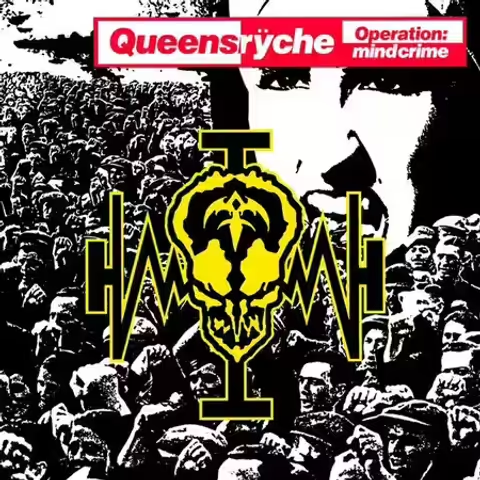
The album's visual identity matched its clinical, paranoid tone. The sleeve trades the usual metal iconography for a cold, almost corporate restraint, the title presented with the detachment of a medical chart or a classified file, suiting a record about hospitals, brainwashing and surveillance. The packaging carried the full libretto of the story, encouraging listeners to follow Nikki's descent line by line, and reinforcing the sense that this was an album to be read as much as heard.
That bookish quality was part of the appeal. At a time when metal sleeves competed to be the most lurid, Operation: Mindcrime looked like something issued by a government department, and the contrast between the sterile presentation and the violence of the story was entirely deliberate.
Release and Reception
The critics understood the album immediately, even where the public did not. In Britain, where Queensrÿche were embraced fastest, the leading rock press proclaimed that "every song is a monstrous achievement", and the "thinking man's heavy metal band" tag attached itself permanently. Kerrang!'s Derek Oliver awarded four stars, finding fault only in the open-ended storyline. Metal Forces gave it 9.5 out of 10, and its reviewer Bernard Doe made the comparison that would follow the album forever.
"Operation: Mindcrime deserves to stand alongside the likes of The Who's Quadrophenia and Pink Floyd's The Dark Side of the Moon for its conceptual brilliance."
Bernard Doe, Metal Forces, 1988
Germany's Rock Hard also gave it 9.5, praising the "clever breaks, unusual song structures and ingenious arrangements" as proof the band aimed at intelligent, demanding art rather than the taste of the masses. AllMusic's Steve Huey, in a later four-and-a-half-star retrospective, was occasionally taken aback by lyrics he found "too serious and intellectual for their own good", but concluded that it was "a testament to Queensrÿche's creativity and talent that they can pull off a project of this magnitude". The Canadian metal historian Martin Popoff admired how the heavy-handed storytelling was matched with the band's most urgent metal display since their debut EP.
Commercially, the album was a slow burn rather than an explosion. It reached number 50 on the Billboard 200, a modest peak that undersold its eventual importance, and America, in Tate's words, "definitely didn't get Mindcrime at the start", expecting the band to sound more like Mötley Crüe. But its last two singles became Queensrÿche's first charting hits in the United States, and the album was certified gold in early 1989 and platinum two years later. "I Don't Believe in Love" was nominated for a Grammy for Best Metal Performance in 1990, in the same period the category became infamous for Jethro Tull's upset win over Metallica.
Singles and Music Videos
The singles campaign was the engine of the album's slow climb, and MTV was the fuel. The band shot a video for "Breaking the Silence" on the understanding from MTV that if Queensrÿche made clips, the channel would play them. It worked almost overnight.
| Single | Released | Notes |
|---|---|---|
| Breaking the Silence | 1988 | First single and first MTV video; gold album followed within weeks |
| Revolution Calling | October 1988 | The album's cynical centrepiece as a promo single |
| Eyes of a Stranger | April 1989 | One of the band's first US chart hits |
| I Don't Believe in Love | July 1989 | Grammy-nominated; the album's biggest single |
A one-off promotional video for "Speak" had been shot in 1988 using straight performance footage, with no dramatisation of the story. The fuller visual treatment came in 1989 with Video: Mindcrime, a long-form home video that linked performance footage shot on a soundstage with actors playing out the narrative, an ambitious precursor to the live concert film that would follow.
As Rockenfield recalled, the band were "very lucky that MTV was beginning to pick up on our style of music", and the timing of the singles, the videos and the channel's growing appetite for narrative metal turned a critically admired curio into a platinum record.
Touring and Live
The album made Queensrÿche a formidable live act, helped enormously by their move to the Q Prime management stable run by Peter Mensch and Cliff Burnstein, who also looked after Metallica, AC/DC and Def Leppard. Q Prime put the band on two career-making tours: a coast-to-coast US run with Metallica, then in the middle of the ...And Justice for All juggernaut, and a support slot with Def Leppard, who were playing in the round at the height of Hysteria. Tate relished the contrast between the two crowds, joking that the Metallica audiences threw bottles while the Def Leppard ones were a rather more glamorous proposition.
By the time the band returned to the material during the Empire tour, they had performed Operation: Mindcrime live around 160 times. The full-album shows became legendary, with Pamela Moore appearing as Sister Mary and giant screens carrying movie-quality film sequences behind the band. The concert was captured for the Operation: Livecrime release, filmed across three shows in Madison, Wisconsin, by video director Wayne Isham with lighting designer Howard Ungerleider, a veteran of seventeen years with Rush. The live spectacle was not without mishap.
"One night when we played in Texas, Sister Mary was up on the screen, with her hair blowing backwards. The combination of heat in the building and our projectors not being set up correctly caused the film to melt and then burst into flames. It was pretty spectacular to see Mary on the screen burning in front of me. Not that the audience realised that anything was wrong."
Geoff Tate, Classic Rock, 2003
The band's growing fame also attracted its share of unhinged devotion. Tate once recounted an American fan who begged for a backstage pass and was jokingly told by Eddie Jackson to staple his own forehead. The fan promptly fired four staples into his head, and got the pass.
In TV, Film and Media
For an album so cinematic in conception, Operation: Mindcrime never made the leap to the screen, though not for want of trying. Tate has admitted over the years that the band held repeated talks with producers and directors about turning the story into a film, joking that the right team would be needed to avoid the fate of a beloved book ruined by a bad adaptation. The closest the project came to cinema was its own elaborate stage production and the Video: Mindcrime and Operation: Livecrime films. Livecrime sold more than 260,000 copies on its original video format before being deleted in 1998 and transferred to DVD.
Controversy and Criticism
The album's subject matter, political assassination, terrorism, drug addiction and religious corruption, was provocative by design, but it generated remarkably little censorship controversy, largely because the storytelling was too intelligent to be reduced to a tabloid headline. The chief criticism levelled at the record, then and since, was the lack of a clear conclusion. Some critics found the open ending a flaw; others, and the band themselves, defended it as deliberate. It was later revealed on the Mindcrime at the Moore DVD that Sister Mary killed herself after Dr X threatened to kill Nikki, but on the album itself the question of whether Nikki murdered her is left hanging.
The other recurring complaint was simply that the album was too clever for its own audience. America's initial indifference stemmed in part from a metal mainstream that wanted hooks and spectacle, not a fifteen-part meditation on manipulation. Time has comprehensively vindicated the band's ambition, but in 1988 the gamble was real.
Covers, Samples and Tributes
The album's influence is most visible not in cover versions but in the bands who took up its template of the metal concept album. Operation: Mindcrime has been cited as a direct influence by Avenged Sevenfold's M. Shadows and by Ben Weinman of The Dillinger Escape Plan, and its DNA runs through the wave of narrative-driven progressive metal that followed in the 1990s and 2000s. Pamela Moore's continued association with the Sister Mary role, performing it live with the band across the decades, has kept the work alive as a piece of living theatre rather than a museum exhibit.
Reissues, Remasters and Anniversaries
The album has been revisited repeatedly, and its story extended well beyond the original record.
- 2003 A remastered edition added two live bonus tracks.
- 2006 A deluxe box set paired the remaster with a full 1990 live performance and a bonus DVD of Video: Mindcrime.
- 2006 The sequel Operation: Mindcrime II arrived, with Ronnie James Dio taking the role of Dr X, and tours that performed both albums back to back.
- 2026 Geoff Tate released a third instalment retelling the original story from the perspective of the antagonist, Dr X.
The willingness to keep returning to Nikki's story, across sequels, live albums and stage productions, underlines how central this single record remains to Queensrÿche's identity, even as the band's lineup fractured and Tate eventually departed.
Legacy and Influence
In the decades since, Operation: Mindcrime has only grown in stature. Kerrang! placed it at number 34 in its 100 Greatest Heavy Metal Albums of All Time as early as 1989. LA Weekly called it the band's "magnum opus" and "a masterpiece" in 2011, the same year Decibel inducted it into its Hall of Fame. Classic Rock named it one of the ten essential progressive metal albums in 2016, Loudwire crowned it the best heavy metal album of 1988 in 2017, and that same year Rolling Stone ranked it number 67 on its list of the 100 Greatest Metal Albums of All Time.
For Queensrÿche, the album was a double-edged triumph. Its 1990 follow-up Empire, powered by the Michael Kamen-arranged hit "Silent Lucidity", outsold it by a wide margin and remains the band's commercial peak. Yet it is Operation: Mindcrime that fans return to as the benchmark, the record against which everything else is judged. The band's own ambivalence about that, the sense that their finest hour also became a weight they could never quite escape, is part of what makes the album's story so compelling.
Its wider legacy is the permission it granted. By proving that a heavy metal band could write something as conceptually ambitious as a progressive-rock opera and make it sell, Operation: Mindcrime opened a door that progressive metal has walked through ever since. Few records in the genre have aged as gracefully, or felt as prescient, as this cold, literate story about manipulation, media and the loss of self.
Things You Might Not Know
| Fact | Detail |
|---|---|
| Born from separatist talk | The story grew out of Geoff Tate's friendships with members of the militant Quebec separatist movement, some involved in bombing and terrorism, whom he met after moving to Montreal. |
| Sister Mary's origin | The character came from a woman dressed as a nun, clutching a teddy bear and dancing to techno in an Amsterdam nightclub, who Tate saw on a late night out. |
| A real car in the cold | The sound of Dr X's limo window rolling down at the start of "Suite Sister Mary" was made by pulling a real car up outside Le Studio in freezing Montreal and miking it. |
| A sitcom in-joke | The nurse's muttered "Sweet dreams... you bastard" was inspired by the British sitcom The Young Ones, which the band watched constantly. |
| Dr X was a TV actor | The voice of Dr X belongs to English actor Anthony Valentine, known for the television dramas Colditz and Callan. |
| The Archduke of Darkness | Hollywood orchestrator Michael Kamen arranged the choir and cellos on "Suite Sister Mary" and insisted on being credited as the "Archduke of Darkness". |
| The choir's joke name | The choir on the album was billed as the Moronic Monks of Morin Heights, after the Quebec town where Le Studio sat. |
| Recorded out of order | The songs were not recorded in story sequence, so the band had to engineer the segues afterwards to make the narrative flow, like assembling a movie script. |
| Maiden got there first | Iron Maiden, the band's early mentors, beat Queensrÿche to the shops by two months with their own concept album, Seventh Son of a Seventh Son. |
| The Q Prime connection | The band's breakthrough came after joining Metallica's management firm Q Prime, who put them on tours with Metallica and Def Leppard. |
| The staple-gun fan | A fan begging for a backstage pass was jokingly told to staple his forehead, and fired four staples into his own head to get one. |
| Mary's on-screen fire | At a Texas show, projector heat melted the film of Sister Mary mid-performance, making it look as though she was burning on the screen behind the band. |
| Dio played the doctor | On the 2006 sequel Operation: Mindcrime II, the role of Dr X was taken over by Ronnie James Dio. |
Listen to the Riffology Podcast
The Riffology podcast pulls apart the records that shaped rock and the people who made them, and is available on all major podcast platforms. We would love to hear where you stand on Operation: Mindcrime, and whether you think Nikki really pulled the trigger.
Comments