Mark "Barney" Greenway tracked every vocal on Harmony Corruption in a single afternoon in a Tampa control room, stoned on whatever weed Morrisound's tape op had been able to produce, while the rest of Napalm Death slept on Morbid Angel's living-room couch a few miles across town. The band were five and a half thousand miles from Birmingham, two of them had been in the line-up for less than a year, one had been in for less than three months, and the producer was a Florida technician who had never sat behind the desk for a British grindcore record in his life. By any sensible reckoning the album should have collapsed under its own logistics. Instead it became the record that turned Napalm Death from a Birmingham scene curio into a touring international death metal band, and the album their original drummer would refuse to live with.
Harmony Corruption is the moment Napalm Death stopped being the band Justin Broadrick, Nic Bullen, Lee Dorrian and Bill Steer had passed through and started being the band Shane Embury and Barney Greenway would still be running thirty-five years later. It is also the album that, by their own admission, the people who loved the first two records hated. Embury has called it the album that "turned a lot of people on to the band who I guess had never given us the time of day, but also turned old-school fans off". It is the most argued-about hour in their catalogue and, depending on which interview you read, either their bravest move or their one outright misstep. It is, in any case, the pivot on which the rest of their thirty-five-year career swings.
Album facts
| Field | Detail |
|---|---|
| Artist | Napalm Death |
| Album | Harmony Corruption |
| Release date | 30 July 1990 (UK, Earache); 7 December 1990 (US, Combat) |
| Label | Earache Records (UK and Europe); Combat Records (United States) |
| Producers | Scott Burns and Napalm Death |
| Studios | Morrisound Recording, Tampa, Florida |
| Genre | Death metal with grindcore foundations |
| Track count | 11 |
| Total runtime | 41:02 |
| UK Albums Chart peak | 67 |
| Billboard 200 peak | Did not chart |
| Other notable chart peaks | None reported in mainland Europe; underground radio play across the UK and US |
| Certifications | None |
| Estimated sales | Not publicly reported; Earache and the band have never released a figure |
| Key single | Suffer the Children (13 August 1990) |
Cultural context
The summer of 1990 was a wide-screen moment in popular music, and Harmony Corruption landed almost completely outside its frame. The UK Albums Chart that July belonged to Phil Collins, Elton John and the soundtrack to the film Ghost. Madchester was at its commercial peak. Indie radio was queueing up The Stone Roses, Happy Mondays, The La's and a young band from Manchester called James. None of this had anything to do with the place Napalm Death were headed.
The genre that mattered for Harmony Corruption was being built two thousand miles south of Earache's Nottingham office, in a single low-rise studio behind a strip mall in north Tampa. By the time Napalm Death arrived in April 1990, Morrisound Recording had already hosted Death's Leprosy (1988) and Spiritual Healing (1990), Obituary's Slowly We Rot (1989), Sepultura's Beneath the Remains (1989) and the bulk of what would become Deicide's self-titled debut. Florida death metal was the year's most virile underground scene, and Scott Burns was the producer whose desk every band wanted to record at.
What made Napalm Death's trip strange was that they were not really a death metal band. They were the British group most often credited with naming and crystallising grindcore: faster, shorter, more obviously punk than their American peers, and embedded in the anarcho-punk and hardcore network that ran out of Birmingham and Coventry. The decision to fly to Tampa was a decision to step out of that orbit and into another one. The rest of the album follows from that single logistical choice.
A few of the records Harmony Corruption shared shelves with that autumn:
- Deicide, Deicide (June 1990, Roadrunner), recorded at Morrisound with Scott Burns weeks before Napalm Death arrived.
- Obituary, Cause of Death (September 1990, Roadrunner), also Burns at Morrisound, with James Murphy on guitar.
- Entombed, Left Hand Path (June 1990, Earache), the Stockholm rejoinder to Florida, and a label-mate.
- Carcass, Symphonies of Sickness (released late 1989, but the touring record of 1990), the album that was Bill Steer's reason for leaving Napalm Death.
- Megadeth, Rust in Peace (September 1990), the mainstream metal album of the moment, and a useful reminder of how far underground Earache's roster actually was.
The band's story up to this point
Napalm Death had been a band, in some form, since 1981, when Nic Bullen and Miles Ratledge first put the name on a fanzine in the village of Meriden, between Coventry and Birmingham. The version of the band that mattered for the world's purposes did not exist until December 1985, when Mick Harris joined on drums and Justin Broadrick came in on guitar. By the time the first side of the debut album Scum was recorded at Rich Bitch studio in Birmingham in 1986, Broadrick and Bullen were close to leaving. By the time the second side was recorded in May 1987, with Lee Dorrian on vocals, Bill Steer on guitar and Shane Embury moving from the touring drum stool to permanent bass, none of the people on the first side were still in the group.
That second line-up was the one most listeners thought of as Napalm Death. They made Scum (1987), From Enslavement to Obliteration (1988) and the Mentally Murdered EP (1989). They recorded John Peel sessions. They invented, depending on whose history you trust, the blast beat. They appeared, briefly and incongruously, on an Arena BBC2 documentary about heavy metal. They toured Japan. And then, almost as soon as they got back from Japan in July 1989, Bill Steer and Lee Dorrian both left.
The reasons were different but the timing was identical. Steer wanted to give Carcass, whose Symphonies of Sickness was about to come out on Earache, his full attention. Dorrian wanted to start a doom band, and that band became Cathedral. Both of them, by all accounts, left without acrimony. Both of them, by all accounts, gutted the group anyway.
What was left was Shane Embury on bass and Mick Harris on drums. They were, between them, the only surviving members of the line-up that had cut Scum's B-side three years earlier. They had a Grindcrusher tour to play with Earache label-mates Bolt Thrower, Carcass and Morbid Angel, and they needed a vocalist and a guitarist by the time the bus left. Embury, with the calm pragmatism that has kept Napalm Death intact through every subsequent line-up storm, made phone calls.
A line-up reassembled by telephone
The first call was to Mark Greenway, known to almost everyone as Barney, then fronting fellow Midlands death metal band Benediction. Greenway had a strong, low, perfectly articulated growl and a stage presence that had already made Benediction's early demos travel. He agreed to join for the Grindcrusher tour and stayed, in one stretch or another, until the present day.
The second call went to California. Jesse Pintado was the nineteen-year-old guitarist of Terrorizer, an LA grindcore band who had been writing material for what would eventually become World Downfall and whose Lobotomizer demo Embury had on cassette. Pintado flew to England, joined the band for Grindcrusher, and that was that.
The third call came after the tour. Mitch Harris, no relation to Mick, had been running a similarly extreme group called Righteous Pigs out of Las Vegas. He had moved to England chasing the Earache scene, and Embury asked him to come in as the second guitarist for the new five-piece configuration. By the autumn of 1989 the band that would walk into Morrisound the following spring was complete: Greenway, Pintado, Mitch Harris, Embury, Mick Harris.
The Mentally Murdered EP, recorded in 1989 at Slaughterhouse Studios, had been the last gasp of the Steer and Dorrian line-up. The new five-piece had to find out who they were on the road and in rehearsal rooms before they put anything to tape. By April 1990 they had a record's worth of songs, mostly written by Embury, Greenway and Mick Harris, and Earache had booked them a flight to Florida.
Pre-production and demos
There were no plush pre-production sessions. The new line-up rehearsed in spare rooms, in Embury's flat and in shared Midlands practice spaces. The songs were demoed on cheap four-track and posted to Scott Burns in Tampa as cassette tapes. Several of the tracks that ended up on the album, including Suffer the Children and The Chains That Bind Us, had been written by Mick Harris alone on guitar before being handed to Pintado and Mitch Harris to learn. Greenway has said in interviews that he was writing lyrics in hotel rooms during the Grindcrusher tour and that several of the Harmony Corruption songs had no finished vocals until he stood in front of the Morrisound mic.
The band did not have a budget for extra studio time. They had a single block booking in Tampa, plus a borrowed sofa at the Morbid Angel house, and they had to use both for the entire spring. Mitch Harris, looking back at the period, described the work-rate plainly: "We spent five days a week for two solid months, learning, practicing the songs upside down inside out without a penny to our names, in a different country, all alone, but we had each other."
What the band did not bring with them was a producer of their own. Earache's deal was simple. The band travelled. Burns ran the room. Anything else was the band's problem.
Creating the album at Morrisound
The sessions ran across April and May 1990. Morrisound itself was, by the standards of contemporary American studios, modest: a single live room, a fairly basic control room, a Trident desk that Tom and Jim Morris had hand-tweaked over the previous decade. What the studio had was Scott Burns, his particular method of close-miking the kick and tracking guitars in pairs through Marshall heads, and the accumulated knowledge of having done exactly this job for half a dozen other death metal records in the previous eighteen months.
Mick Harris's drums went down first, as they always did. He had been the fastest drummer in extreme music for three years and had no interest in slowing down, but most of the new material was structured around mid-tempo grooves rather than blast beats. Pintado and Mitch Harris doubled the rhythm guitars across the multitrack, hard left and hard right, in the standard Florida fashion. Embury's bass was tracked into the same chain that had captured Terry Butler on Cause of Death the previous autumn.
Greenway's vocals are the most-told story from the sessions. According to the band, he tracked the entire album in a single day. He was, by his own subsequent admission, deeply stoned at the time, having spent the preceding evening with members of Deicide and Obituary on a Tampa cul-de-sac. The economy of the schedule had something to do with budget and a great deal to do with the fact that Greenway preferred to track that way. Whatever the reason, the album's vocals are entirely the product of one afternoon's work.
The other story from the sessions concerns where the band slept. Earache had not paid for a hotel. Trey Azagthoth and David Vincent of Morbid Angel put the five of them up on couches and floors at their shared rental, a few minutes from the studio. The Morbid Angel house in 1990 was already the unofficial dormitory of every Earache band passing through Tampa, and Napalm Death simply joined the rota.
The guest spot on Unfit Earth happened, by all accounts, because Glen Benton of Deicide and John Tardy of Obituary were in and out of the building every day of the session. Both bands were either tracking or mixing at Morrisound that spring. Benton and Tardy added backing vocal layers to Unfit Earth almost as a friendly walk-on, and the credit duly appears on the sleeve.
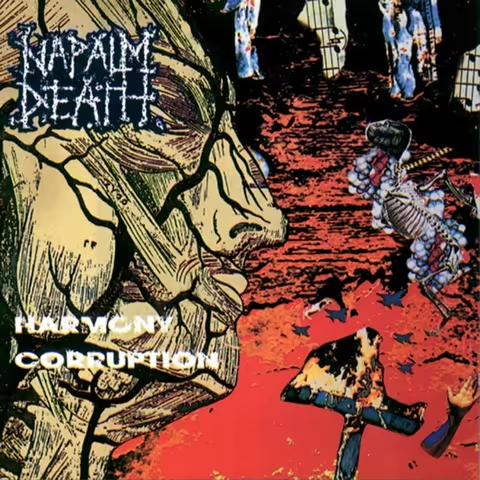
The album was mixed at Morrisound in the same block. It was mastered, back in England, by Noel Summerville, a name that recurs across the Earache catalogue. The artwork, a queasy collage of figures and faces overlaid in greens and reds, was credited to David Windmill. Cover photography came from Tim Hubbard. Mitch Harris, asked years later what he thought of the sleeve, gave the most candid answer in the album's promotional history: "medio-CORE."
"We spent five days a week for two solid months, learning, practicing the songs upside down inside out without a penny to our names, in a different country, all alone, but we had each other."
Mitch Harris, recalling the Harmony Corruption sessions, Decibel, 2020
Personnel and credits
| Role | Player | Notes |
|---|---|---|
| Core band | ||
| Lead vocals | Mark "Barney" Greenway | First studio album with Napalm Death; previously of Benediction |
| Guitars | Jesse Pintado | Previously of Terrorizer; based in Los Angeles before joining |
| Guitars | Mitch Harris | Previously of Righteous Pigs; relocated from Las Vegas |
| Bass | Shane Embury | The band's longest-serving member; on every Napalm Death studio album since 1988 |
| Drums | Mick Harris | His final studio album with Napalm Death; left the following year |
| Guest musicians (credited) | ||
| Backing vocals | Glen Benton | Deicide vocalist and bassist; appears on Unfit Earth (track 5) |
| Backing vocals | John Tardy | Obituary vocalist; appears on Unfit Earth (track 5) |
| Production and engineering | ||
| Producer | Scott Burns and Napalm Death | Burns's sixth or seventh major death metal production by this point |
| Mastering | Noel Summerville | Long-serving Earache mastering engineer |
| Artwork | ||
| Sleeve artwork | David Windmill | Cover collage in green and red tones |
| Photography | Tim Hubbard | Inner-sleeve band photography |
The number of people in the room had doubled since the previous album, and the writing credits on the sleeve reflect that. Embury and Mick Harris took the lion's share of the music credits, with Pintado writing the music for Inner Incineration and Mitch Harris writing the music for Mind Snare. Greenway wrote almost all of the lyrics, occasionally co-writing with Embury. The band were, even at this early stage, a writing collective rather than a single auteur and a backing band.
The songs
| # | Title | Writers (lyrics / music) | Length | Single? | Notes |
|---|---|---|---|---|---|
| 1 | Vision Conquest | Embury / Embury | 2:42 | Opening track; closest in feel to From Enslavement to Obliteration | |
| 2 | If the Truth Be Known | Embury and Greenway / Embury | 4:12 | Mid-tempo groove anchored by Embury's bass | |
| 3 | Inner Incineration | Embury / Pintado | 2:57 | Pintado's only solo music credit on the record | |
| 4 | Malicious Intent | Embury / Embury | 3:26 | One of the most overtly grind-leaning tracks | |
| 5 | Unfit Earth | Greenway / Mick Harris | 5:03 | Guest backing vocals from Glen Benton (Deicide) and John Tardy (Obituary) | |
| 6 | Circle of Hypocrisy | Greenway / Mick Harris | 3:15 | One of Greenway's most overtly political lyrics on the record | |
| 7 | The Chains that Bind Us | Embury and Greenway / Mick Harris | 4:08 | The track Decibel chose as the title of its thirtieth-anniversary feature | |
| 8 | Mind Snare | Greenway / Mitch Harris | 3:42 | Mitch Harris's only solo music credit on the record | |
| 9 | Extremity Retained | Greenway / Mick Harris | 2:01 | The shortest cut; a deliberate nod back to grindcore brevity | |
| 10 | Suffer the Children | Greenway / Mick Harris | 4:21 | Yes | Lead single; only Harmony Corruption song with a music video |
| 11 | Hiding Behind | Greenway / Mick Harris | 5:15 | Longest closing track in the catalogue to date |
Vision Conquest opens the record with a few seconds of feedback and then drops into the kind of mid-tempo riff Bill Steer would never have written. It is two minutes and forty-two seconds long, structured around a verse and a chorus, and has the recognisable shape of a song. For listeners coming off From Enslavement to Obliteration, that fact alone was the lightning bolt. Napalm Death had decided, openly, to write songs.
If the Truth Be Known follows it with the album's first proper groove. Embury's bass leads the riff. Greenway's vocal sits much lower in the register than Lee Dorrian's had, and the chorus is the first moment on the album where the listener understands what Napalm Death are going to sound like for the rest of their career.
Inner Incineration is the closest the new guitar partnership comes to taking centre stage. Pintado wrote the music alone, and the track has a flicker of the Terrorizer sensibility he had brought with him from Los Angeles. Malicious Intent immediately afterwards is the most grind-leaning of the album's first half, with Mick Harris allowed to lean into the kit in something resembling old-form blast.
Unfit Earth is the centrepiece. At five minutes and three seconds it is, by Napalm Death's previous standards, an extravagant runtime. The riff is mid-paced, almost doom-adjacent in places, with a second-half breakdown that the band used to give Glen Benton and John Tardy something distinctive to layer their guest vocals over. It is also, for any listener who knew what Deicide and Obituary sounded like that summer, the most explicit declaration that Napalm Death were now part of the Tampa conversation rather than the Birmingham one.
The middle of the record (Circle of Hypocrisy, The Chains That Bind Us) is where Greenway's lyrics earn the album's title. He had brought to Napalm Death a coherent ethical voice rather than the more fragmentary slogan-writing of the Bullen and Dorrian era. The songs argue, in their compressed way, that the cultural reflex to seek harmony is itself corrupt, that institutions which present themselves as orderly are usually the most violent. The blunt force of the title, paired with the album's actual sound, was the kind of joke Napalm Death had always known how to set up.
Mind Snare is Mitch Harris's writing showcase, and it is the song on the record that most obviously prefigures the more angular Napalm Death of Fear, Emptiness, Despair four years later. Extremity Retained is a two-minute reminder, dropped near the end of the record, that the band could still play their old material at their old speed if they chose to.
Suffer the Children, song ten, was the single. It is also, in retrospect, the cleanest summary of what Harmony Corruption is for. The intro is patient. The riff is a head-nodder. The chorus, when it arrives, is one of the few moments on a Napalm Death album where the word "anthemic" feels honest. The song was about institutional child abuse, a subject Greenway would return to across the rest of the catalogue, and the lyric does not flinch. Earache made it the lead single, paid for a music video, and shipped twelve-inch and seven-inch pressings in August 1990.
Hiding Behind closes the album at five and a quarter minutes. It is, by some distance, the longest song on the record, and the band end on a sustained chord rather than a stop, as if to underline that the whole thing has been one long argument about what their music was now allowed to do.
B-sides, outtakes and the title track that is not on the album
The most-asked question about Harmony Corruption from new listeners is also the easiest one to get wrong. The title track is not on the album. The song called Harmony Corruption was instead recorded for the Suffer the Children single, released on 13 August 1990, as a B-side. The other B-side on that release was Siege of Power, a track first cut for the Scum sessions in 1986 with Justin Broadrick on music. Both songs were swept up onto the 1991 compilation Death by Manipulation alongside the Mentally Murdered EP, the split with S.O.B. and live recordings.
The earliest CD pressings of Harmony Corruption itself padded the running time by tacking the Mentally Murdered EP onto the end of the album. That decision was a small Earache courtesy to fans who had never bought the 1989 EP on vinyl, and an early indicator of how loosely the band were prepared to treat the album as a fixed object. Later CD pressings, vinyl reissues and streaming editions present only the eleven canonical tracks listed above.
The 30 June 1990 show at Salisbury Arts Centre, recorded the night before the band's Florida sessions wrapped, became the bulk of Live Corruption, an Earache-released live album that emerged in 1992. Limited vinyl pressings of Harmony Corruption itself included a bonus LP with a live performance recorded at London's I.C.A. Both releases captured the new line-up before Mick Harris's departure made the period unrepeatable.
Album artwork and packaging
The sleeve, by David Windmill, is one of the album's most curious choices. Where contemporaneous Florida death metal was reaching for the kind of explicit, painted gore that Dan Seagrave was making famous, Windmill's Harmony Corruption cover is closer to a torn collage: overlapping faces, a queasy palette of bottle green and dried blood, the band logo in stark white across the top. The intent, by most readings, was to visually echo the album's title, the idea that what looks aesthetic and ordered tends to be neither.
The original 1990 CD jewel case housed a fold-out booklet with full lyrics and Tim Hubbard's monochrome band shots, the first time fans had seen the new five-piece in a fully posed studio context. Earache pressed the LP in standard black vinyl with a printed inner sleeve and, for limited European runs, a bonus live LP. The first US Combat pressing in December 1990 differed in label artwork and used a slightly altered back-cover layout but kept Windmill's front design intact.
The 2012 Earache remastered CD, packaged as a digipak with bonus tracks, retained Windmill's original art, and the 2021 coloured vinyl reissue did the same. Mitch Harris's "medio-CORE" verdict aside, no member has ever publicly suggested the sleeve be replaced.
Release and reception
Earache released Harmony Corruption in the UK on 30 July 1990. The album entered the UK Albums Chart at number 67, the band's third UK chart entry and the highest position any of their first three albums had reached. Music Week ran a brief release-week notice on 28 July 1990. The album never charted in the United States, where Combat's December release was treated as an underground extreme metal event rather than a commercial proposition.
Critical reception was, from the first week, polarised in the way it would stay. The British music press read the album generously: Select gave it four stars in their October 1990 issue under the headline "Masters of Brutality", and Kerrang!'s coverage was broadly positive. Across the Atlantic, David Browne in Entertainment Weekly issued a C grade in January 1991, dismissing the album as "death metal" of the genre's most undifferentiated kind. The Spin Alternative Record Guide later settled on 6 out of 10. The Collector's Guide to Heavy Metal eventually gave it 5 out of 10. AllMusic's Jason Birchmeier called it "a bit of a novel album for the band, though one that's not especially remarkable in the big picture".
The fan reaction was sharper. Long-time grindcore listeners, particularly in the UK and in central Europe, took Harmony Corruption as a betrayal of what Napalm Death had been since Scum. The accusation of "selling out", levelled at a band who could not have grossed more than a few thousand pounds on the album, became one of the things the band had to live with for the next eighteen months. The decision to record the more raw and aggressive Mass Appeal Madness EP at Eddie Van Dale's Violent Noise Experience Club in March 1991 was, in part, a direct response. Embury has been candid about the dynamic in retrospect.
"It turned a lot of people on to the band who I guess had never given us the time of day, but also turned old-school fans off. Being young at the time and seeing the reactions was kind of scary; as you get older, opinions matter less, but it captured the time."
Shane Embury, Decibel, 2020
Critically, the album's reputation has shifted twice since release. Through the early 1990s it was treated as the moment grindcore's most important band hopped genres. By the mid-2000s, with the Florida death metal scene itself a piece of canonised history, Harmony Corruption was being read as a key document of the British contribution to that scene rather than a desertion from grindcore. The Decibel thirtieth-anniversary feature in 2020 framed it as "a milestone in extreme music history". Phil Freeman of Stereogum, ranking the catalogue in 2015, placed Harmony Corruption at the very bottom of his list while also writing that "there are no bad Napalm Death records" and that "the primitivism of the early albums is still there, just spread across a slightly broader canvas".
Singles and music videos
| Single | Release date | Formats | B-sides | Video? |
|---|---|---|---|---|
| Suffer the Children | 13 August 1990 | 7" and CD single, Earache | Siege of Power; Harmony Corruption (title track, non-album) | Yes; promo video produced for MTV's Headbangers Ball |
The only single drawn from the album was Suffer the Children. Earache pressed it in both seven-inch and CD configurations, with the same two B-sides on each. The promotional video, the only one ever made from a Harmony Corruption track, leaned on cheaply lit performance footage and a degraded, processed colour palette. Billboard's "Eye" column in February 1991 picked it up briefly as a new metal video on rotation. There was no second single. By the time the band might have released one, attention had shifted to the in-progress Mass Appeal Madness EP and to the rolling controversy around Mick Harris's position in the band.
Touring and live
The new line-up had already been on the road since the Grindcrusher tour of late 1989, before any of Harmony Corruption was written. Once the album was out, Napalm Death's touring schedule shifted up a level. They played a long European theatre run through autumn 1990, including the 30 June 1990 Salisbury Arts Centre date that became Live Corruption, and the I.C.A. London show that contributed to limited vinyl pressings.
In 1991 the band entered a sustained partnership with Death, with Napalm Death and Death sharing North American bills under the Campaign for Musical Destruction banner. Pestilence and Dismember joined various legs. The five-piece worked harder, and travelled further, than any previous incarnation of the band. By the end of 1991 they had played more shows in the United States than the original Scum-era line-up had played in their entire existence.
A few touring touchstones from the Harmony Corruption cycle:
- April-May 1990: Morrisound recording block, Tampa, doubling as the band's last extended period off the road.
- 30 June 1990: Salisbury Arts Centre, recorded for Live Corruption (released 1992).
- August-October 1990: European touring around the UK release; first headline runs of the new five-piece.
- 1991: Campaign for Musical Destruction touring across the UK, mainland Europe and North America with Death, Pestilence and Dismember on rotating legs.
- 1992: Live Corruption released, capturing the Salisbury show; touring with Carcass, Cathedral and Brutal Truth followed.
Television appearances were limited but not absent. The promo video for Suffer the Children received MTV Headbangers Ball play in the United States. UK TV ignored the album almost entirely, with no Top of the Pops appearance and no Jools Holland slot (the Later... format did not start until 1992).
In TV, film and media
Harmony Corruption itself was rarely synced into mainstream film or television, but the song that most often appeared in licensing contexts in subsequent decades was Suffer the Children, the album's only single. Its most visible film placement came in Jeremy Saulnier's punk-band thriller Green Room (2016), where it surfaces in a club scene. The same track has appeared sporadically in extreme metal documentaries, including Greg Pratt's Decibel coverage of the album's thirtieth anniversary.
Napalm Death the band achieved more sync placements later in their career, with You Suffer (the famously one-second song from Scum) appearing in HBO's Silicon Valley and the band themselves performing on Channel 4's Skins. None of those placements drew on Harmony Corruption material.
Controversy and pushback
The album was not banned, not censored and did not generate a single lawsuit. The controversy that surrounded it was entirely intra-scene. The accusation that Napalm Death had "sold out" by recording at Morrisound with Scott Burns was loud enough, particularly in the European grindcore underground, that it shaped the band's next two years of decision-making. The Mass Appeal Madness EP recorded in March 1991, the title of which is itself a sarcastic comment on the accusation, was an explicit aesthetic course-correction. The decision to part company with Mick Harris in 1991 was, in part, a response to internal disagreements about which way the band ought to go next.
The album did, briefly, attract the standard tabloid-adjacent hand-wringing about extreme metal lyrics common to the period, but it never escalated to the point of formal censure. Earache's reputation was, by 1990, already established enough that the British press largely declined to be shocked.
Covers, samples and tributes
Suffer the Children is the most-covered song on the album. Cover versions have appeared on tribute compilations and in live sets from a range of more recent extreme metal bands; the song is now part of the standard grindcore and death metal canon for covering acts. The album's title track, despite not being on the album, is similarly covered in tribute settings on the strength of its Suffer the Children single appearance.
Harmony Corruption itself sampled nothing, in keeping with the band's general practice. Napalm Death's own subsequent record Mind of a Razor (1992) was a remix of a track by London hip hop crew Gunshot rather than a sample-based work. The album's drum sound has, however, been studied and approximated by countless subsequent extreme metal records, with Mick Harris's tracking on Vision Conquest and Extremity Retained the most-cited template.
Reissues, remasters and anniversaries
The album has been reissued repeatedly in the thirty-five years since release. The most notable editions are:
- 1990 original UK CD (Earache, MOSH 19CD) with bonus tracks appending the Mentally Murdered EP.
- 1990 US CD (Combat) with altered back-cover layout, released 7 December 1990.
- 1991 Death by Manipulation compilation, gathering Mentally Murdered, the Suffer the Children single and live tracks from the Salisbury show.
- 2012 Earache 22nd-anniversary remastered digipak CD with bonus tracks and updated liner notes.
- 2021 coloured-vinyl reissue, restoring the original eleven-track sequencing on LP.
There has not yet been a formal box-set treatment of the Harmony Corruption sessions or a deluxe edition gathering the album, the Suffer the Children single and Live Corruption into a single package, though Earache's anniversary-treatment habits on other catalogue titles suggest one is plausible. No spatial-audio or Dolby Atmos remix has been released.
Legacy and influence
What Harmony Corruption did to Napalm Death's career was permanent. It established the configuration of five musicians (Greenway, Pintado, Mitch Harris, Embury, Mick Harris) and then, by surviving Mick Harris's departure in 1991 and Danny Herrera's arrival on drums, set the template the band would refine across Utopia Banished (1992), Fear, Emptiness, Despair (1994), Diatribes (1996) and every subsequent album. Greenway and Embury are still in the band. Mitch Harris contributes from a studio capacity. The five-piece era began with Harmony Corruption and, in studio terms, never really ended.
What it did to extreme metal more broadly is harder to measure, partly because the band themselves have been ambivalent about it. The album is the bridge between British grindcore and American death metal, the most influential moment of crossover between the two scenes, and a structural blueprint for the deathgrind hybrid that bands like Brutal Truth, Pig Destroyer and Dying Fetus would refine through the rest of the 1990s and into the 2000s. Without Harmony Corruption, the very idea that a British grindcore band could front up to the Tampa establishment and be taken seriously as peers does not have a precedent.
It also defined Mick Harris's exit. He left Napalm Death in 1991, citing creative differences, after recording Painkiller's Guts of a Virgin with John Zorn and Bill Laswell. He went on to form Scorn with Nic Bullen and to pursue dub, ambient and electronic projects that have continued for thirty years. Harris has been notably reluctant, in interviews, to revisit Harmony Corruption with any warmth, and the album sits in his discography as a record he played on rather than one he claims.
The album has, more quietly, defined Shane Embury's working method. Embury became the band's primary writer and the institutional memory across line-ups. Every Napalm Death record since 1990 carries his fingerprints, and the way he organised the Tampa sessions (one trip, one producer, no pre-production budget, an immovable deadline) became the way Napalm Death have made nearly every album since.
Things you might not know
| Fact | Detail |
|---|---|
| The vocals were tracked in a day | Barney Greenway recorded every vocal on the album in a single Tampa afternoon, stoned on marijuana, while the rest of the band were elsewhere in the building or asleep. |
| The band slept on Morbid Angel's couch | Earache did not pay for a hotel; Trey Azagthoth and David Vincent put the five visiting British musicians up on couches and floors at their shared rental for the duration of the sessions. |
| The title track is not on the album | The song called Harmony Corruption was instead recorded for the Suffer the Children single (13 August 1990) as a B-side, alongside Siege of Power. |
| Mick Harris's last appearance | It is the only Napalm Death studio album on which Mick Harris drums and is, in the band's catalogue, the formal end of the founding-era line-up. |
| Two American guitarists, one British rhythm section | Jesse Pintado moved from Los Angeles and Mitch Harris from Las Vegas to join an English band; only Embury, Greenway and Mick Harris were UK-based at the time of recording. |
| The cover artist's name | The sleeve collage is the work of David Windmill, with cover photography by Tim Hubbard; Mitch Harris later described the artwork as "medio-CORE". |
| Two guest vocalists who were just hanging around | Glen Benton of Deicide and John Tardy of Obituary added backing vocals to Unfit Earth simply because both bands were in and out of Morrisound during the same recording block. |
| The mastering engineer is on every Earache record of the era | Noel Summerville mastered the album back in England, and his name recurs across the Earache catalogue from the late 1980s through the 1990s. |
| The Salisbury Arts Centre live record | The band's 30 June 1990 show at Salisbury Arts Centre became Live Corruption, released by Earache in 1992 as a near-complete live document of the new five-piece in its first year. |
| Mick Harris and the Painkiller exit | Mick Harris decided to leave Napalm Death while recording Painkiller's Guts of a Virgin with John Zorn and Bill Laswell in April 1991, the year after Harmony Corruption. |
| Mass Appeal Madness as a rebuttal | The 1991 Mass Appeal Madness EP was recorded at Eddie Van Dale's Violent Noise Experience Club partly to reassure fans the band still owned a grindcore record after the Tampa pivot. |
| The album's chart position is the band's best of its first three records | Number 67 on the UK Albums Chart was the highest any Napalm Death album had reached at the time of release. |
Listen on the Riffology Podcast
If this album is part of your personal map of the extreme music of the early 1990s, the Riffology podcast is where the hosts argue about exactly these records in exactly this much detail. Episodes are out wherever you listen to podcasts, and the back catalogue runs deep into the same Earache, Roadrunner and Morrisound corners as this post. Pick a track from Harmony Corruption, hit play, and meet us in the comments.
Comments