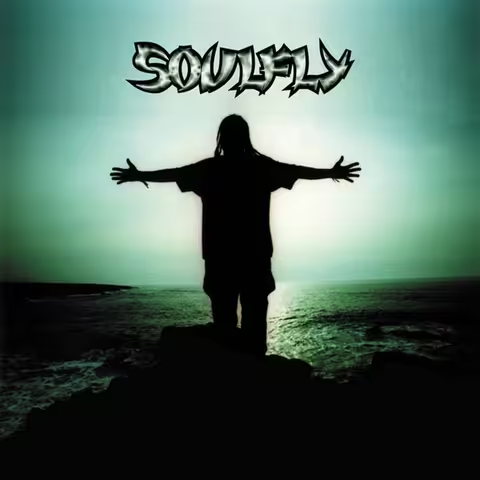
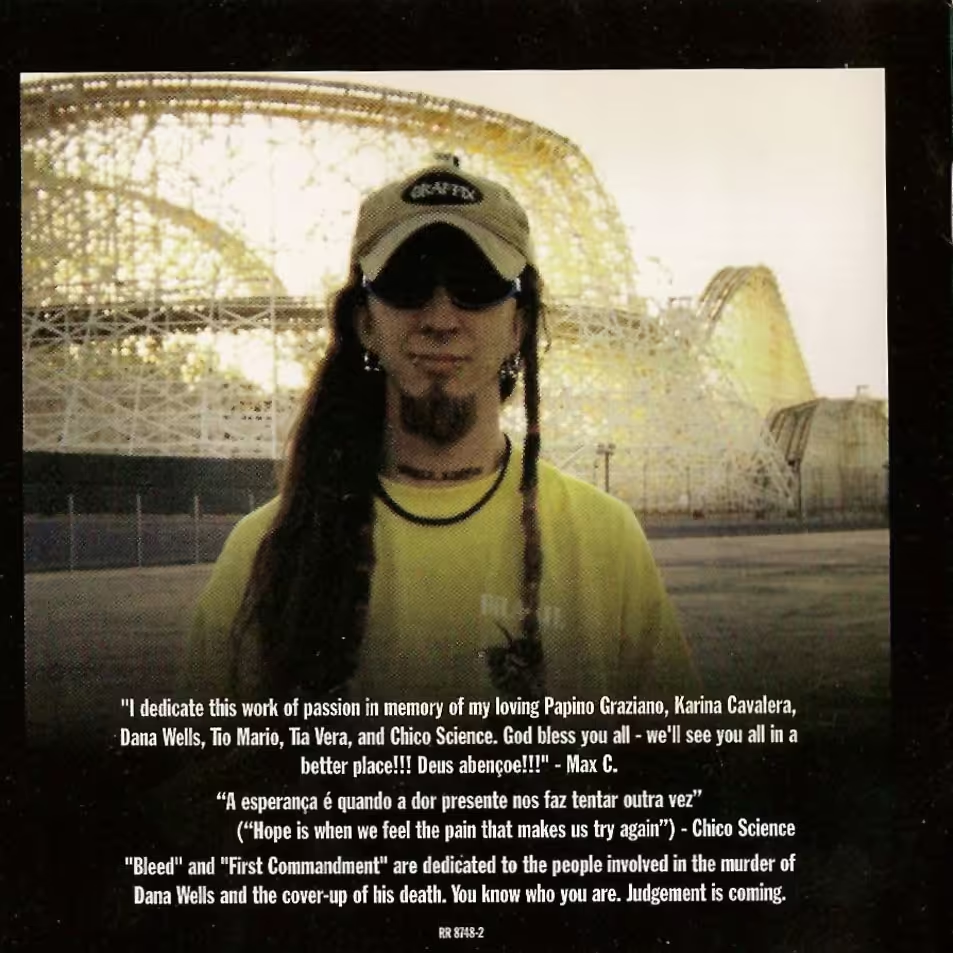
Eight months after burying his 21-year-old stepson and four months after walking off Sepultura's stage at Brixton Academy for the last time, Max Cavalera was inside a Malibu live room watching members of Recife's mangue-beat collective Nação Zumbi pile alfaia drums up next to Burton C. Bell's vocal mic. Ross Robinson was producing. Fred Durst was on a couch waiting to track a rap verse. Chino Moreno was due in the week after. The album would be called Soulfly, carry the photograph of Dana Wells on the inner sleeve, and announce that the most commercially significant Brazilian frontman in heavy music had not, in fact, quietly retired.
That is the only sentence that fits this record. No other 1998 metal release runs Fear Factory's rhythm section, Limp Bizkit's DJ, Deftones' singer, Dub War's vocalist and a Recife alfaia ensemble through the same Ross Robinson live room inside a year of the leader's most public personal loss. Soulfly is famous as a nu-metal record and as a tribal-metal record; it is more interesting as a grief record made deliberately in public.
Album Facts
| Field | Detail |
|---|---|
| Artist | Soulfly |
| Album | Soulfly |
| Release date | 21 April 1998 (worldwide); 24 February 1998 (Japan) |
| Label | Roadrunner Records |
| Producer(s) | Ross Robinson, Richard Kaplan (engineering and additional production); Mario Caldato Jr. (co-producer on "Bumba" and "Umbabarauma") |
| Studio | Indigo Ranch Studios, Malibu, California |
| Genre | Nu metal, groove metal, tribal metal |
| Track count | 15 (standard); 18 (digipak with three bonus Discharge-related cuts); 19 (Japan, plus "Cangaceiro") |
| Total runtime | 68:03 (standard); 72:50 (digipak); 76:57 (Japan) |
| Billboard 200 peak | 79 |
| UK Albums Chart peak | 16 |
| Other notable chart peaks | France 14; New Zealand 14; Belgium (Flanders) 12; Finland 18; Scotland 26; Netherlands 27; Austria 28; Germany 29; Australia 33; Sweden 43 |
| Certifications | Gold (RIAA, United States); Gold (ARIA, Australia, 2002) |
| Estimated sales | 500,000+ in the US (Gold shipment threshold); 35,000+ in Australia; figure for worldwide sales not publicly certified |
| Key singles | "Eye for an Eye" (Feb 1998); "Umbabarauma" (May 1998); "Bleed" (Dec 1998); "Tribe" (Jan 1999) |
Cultural Context: April 1998
The mainstream heavy-music conversation in April 1998 was visibly tilting away from the Big Four thrash bands and the death-metal underground and towards what the press was finally calling nu-metal. Korn had two platinum albums in the bag and were finishing the record that would land them their first US number one (Follow the Leader, August 1998). Limp Bizkit's Three Dollar Bill, Y'all$ had been out nine months and the band were now Roadrunner's biggest rising act. Deftones were three months from releasing Around the Fur. Fear Factory were six weeks ahead of Obsolete, their first US Top 100 record. The Family Values Tour, which would consolidate the whole movement into a single touring package, was being booked.
Roadrunner Records, the label that had carried Sepultura since 1989, sat at the centre of that scene. By 1998 its strategy was openly to platform rhythm-first, crossover-aware heavy acts and to pair them with producers with a distinct sonic fingerprint. Ross Robinson was that producer. He had recorded Korn's debut, Limp Bizkit's debut, Sepultura's Roots (1996) and would go on to track Slipknot's first album the following year. Hiring him to produce Soulfly was Roadrunner pinning their colours to the post-Roots evolution: Brazilian percussion, hip-hop crossover, hardcore aggression, all captured live in one room with no quarter given to the band.
What else was on shelves the same week or month as Soulfly:
- Pulp, This Is Hardcore (30 March 1998)
- Eels, Electro-Shock Blues (21 April 1998)
- Massive Attack, Mezzanine (20 April 1998)
- The Smashing Pumpkins, Adore (2 June 1998), already trailed
- Garbage, Version 2.0 (4 May 1998), trailed by "Push It" in March
- System of a Down, System of a Down (30 June 1998), looming
The most directly comparable release was Fear Factory's Obsolete in late July, which similarly pulled a heavy band towards machine rhythm and crossover. The most useful contrast was Pulp's This Is Hardcore, which proved that 1998 had room for albums that processed loss publicly without softening; Cavalera's record would do the same trick with seven-string guitars and alfaia drums where Jarvis Cocker used strings and synths.
The Band's Story Up to This Point
Soulfly does not exist without Sepultura's Roots, and Roots does not exist without the rhythmic and conceptual experiment that ran from Beneath the Remains (1989) through Chaos A.D. (1993). For most of the early 1990s the Cavalera brothers, Andreas Kisser and Paulo Jr. were the most commercially successful extreme-metal band on the planet outside the United States and Western Europe. They were managed by Gloria Cavalera, Max's wife, who had built them from a Belo Horizonte underground act into a Roadrunner flagship.
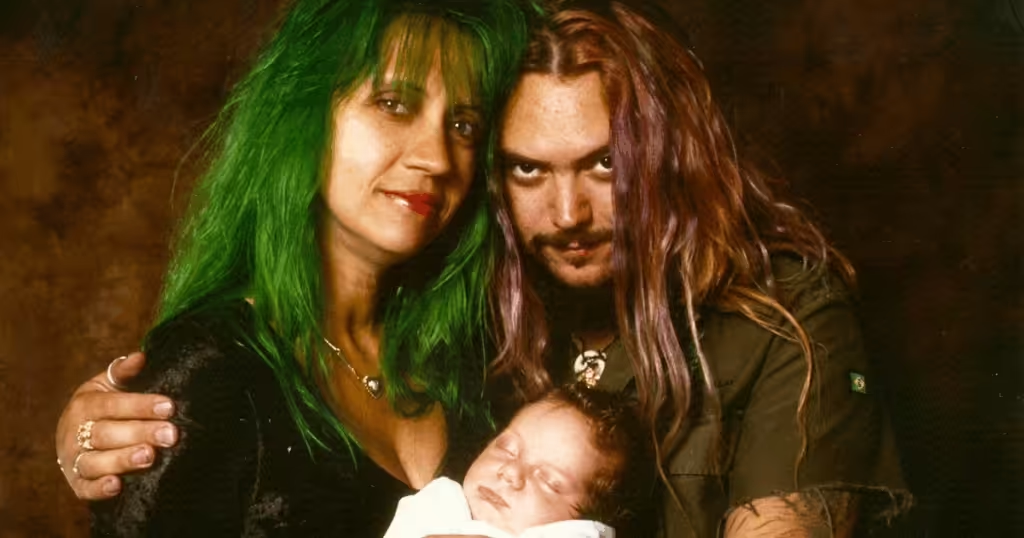
The rupture happened in two stages. On 16 August 1996, three days into Sepultura's UK touring schedule, Cavalera's 21-year-old stepson Dana Wells was killed in a head-on car crash in Phoenix. Max flew home immediately. The band, with Gloria's blessing, played Donington Monsters of Rock the same day with no frontman; Andreas Kisser handled vocals from behind the guitar. Four months later, on 16 December 1996, after the final show of the Roots tour at Brixton Academy, Andreas Kisser, Igor Cavalera and Paulo Jr. told Max they wanted Gloria removed as manager. Max refused to drop her. He walked out the same night.
Within weeks, Sepultura had hired Derrick Green and Max had moved his family to Phoenix and started writing. The Soulfly name had been in his head since a Deftones collaboration the previous year, "Headup" on Around the Fur, which Chino Moreno had dedicated to Dana. He registered the trademark, signed a solo deal with Roadrunner separate from any Sepultura contract, and began assembling musicians.
The first hire was Roy Mayorga, the New York hardcore drummer who had worked in Nausea and Crisis. Mayorga could play polyrhythmic Brazilian patterns as competently as he could hammer out hardcore eighth notes, and he was prepared to commute from New York for rehearsals in Phoenix. Marcello Dias, a Brazilian bassist also based in Phoenix, came in next. The lead-guitar chair was the wobbliest: Jackson Bandeira (the Nação Zumbi guitarist also credited under the name Lúcio Maia) played on the record but did not tour; touring duties fell to Logan Mader of Machine Head, who is credited on the live tracks of the 1999 reissue.
Pre-production and Demos
There was very little formal pre-production. Cavalera wrote songs on a four-track at home in Phoenix in the first half of 1997, demoing skeleton riffs onto cassette and then playing them once or twice with Mayorga and Dias before taking them to Indigo Ranch. The Wikipedia article on the album includes an "Eye for an Eye (4-track demo version)" on the 1999 reissue's bonus disc, taken directly from a Cavalera home cassette, which gives a flavour of how rough the source material was: the demo runs at almost identical tempo to the finished track and the main riff is fully formed, but the song's structure is half-built and Brazilian percussion is absent.
The "Tribe" breakdown riff predates the project entirely. Cavalera has stated in interviews and Wikipedia documents the lineage that he originally wrote the riff during the Roots tour in 1996, when it never made it into a Sepultura demo. Andreas Kisser and Igor Cavalera independently used a very similar riff as the main figure of "Walkman", their score cue for the 1999 Brazilian film No Coração dos Deuses, recorded the same year as "Tribe". Two members of the post-split Sepultura family circling the same riff a year apart is the closest the catalogue offers to a hard piece of evidence for how cleanly the band's writing was divided after December 1996.
Working titles for some tracks survive in interviews: "Quilombo" was written under the name "Zumbi" after Zumbi dos Palmares, the 17th-century leader of Brazil's largest quilombo (a community of escaped slaves); the title was changed before recording to reflect the broader subject. "Bumbklaatt" was a working studio joke based on a Jamaican Patois expletive Mayorga had picked up from Benji Webbe; Cavalera kept it.
Creating the Album
Tracking took place at Indigo Ranch Studios in Malibu across 1997 and into early 1998. Ross Robinson produced; Richard Kaplan engineered and is credited with additional production. Mario Caldato Jr., best known for producing Beastie Boys records, co-produced the two most percussion-led tracks, "Bumba" and "Umbabarauma". Andy Wallace mixed the bulk of the record at Soundtrack Studios, New York. George Marino mastered at Sterling Sound, New York. The live tracks on the 1999 reissue bonus disc were produced by Anders Dohn and engineered by Jacob Langkilde and tracked at the Crossing Border Festival in Denmark in November 1997.
Indigo Ranch in 1997 was at the peak of its reputation as the room where Ross Robinson got his sound. It was a residential studio, isolated, with a large live tracking space and a pair of vintage Neumann mics that Robinson used aggressively for vocals. His method had hardened by Soulfly into a deliberate provocation: he wanted full-band live takes, he rejected punch-ins on principle for vocal tracking, and he ran the room hot. The Beastie Boys' Mario Caldato later told friends he had never been in a session where the producer shouted at musicians as often as Robinson did at Cavalera.
"It was so hard to start over, having been in Sepultura for so long. In fact, it was harder getting Soulfly going than it was getting Sepultura started. Coming into a whole new situation underneath the shadow of Roots was a huge challenge for me, and most people thought I was nuts. We made a conscious effort not to sound like Sepultura. My choice of musicians took me away from straight metal and into a vibe that embraced a lot more, while still being heavy."
Max Cavalera, Kerrang! issue 1213, 7 June 2008
Five distinct musical languages were tracked at Indigo Ranch and stitched together by Wallace's mix:
- The core four-piece band (Cavalera, Bandeira, Dias, Mayorga), tracked live in the main room.
- The alfaia and mangue-beat percussion ensemble, brought from Recife: Gilmar Bola Oito and Jorge Du Peixe (both of Nação Zumbi), augmented in the booth by Eric "Bobo" Correa of Cypress Hill, Chuck Johnson, Mario Caldato Jr., Paul Booth, Rob Agnello and Ross Robinson himself on incidental shaker work. Almost every song carries layered alfaia.
- The hip-hop crossover guests: Fred Durst and DJ Lethal (Limp Bizkit) on "Bleed" and Lethal again on "Quilombo".
- The alt-metal guest vocalists: Burton C. Bell, Dino Cazares, Chino Moreno, Benji Webbe and Christian Olde Wolbers.
- Cavalera's own multi-instrumental layers: berimbau on "Bleed" and "Tribe", sitar on "First Commandment" and "Soulfly", talk box on "No Hope = No Fear", agogô on "Fire" and physical chains struck against the studio floor on "Prejudice".
Wallace's mix decisions made the record work commercially: the alfaia is panned wide and pushed up in the chorus of every song that uses it, the kick drum is sub-heavy in the modern Robinson manner, and the guest vocalists are mixed at parity with Cavalera rather than buried. Where Roots had layered Cavalera over the percussion, Wallace let the percussion breathe. The result reads as a heavier album than Roots in the verses and a more open one in the choruses.
Budget figures for the album have never been publicly confirmed. Roadrunner's recording budgets for its 1998 priority releases were reportedly in the $250,000–$400,000 range. The session ran over schedule by a number of weeks; Roadrunner held the Japanese release in late February 1998 against a worldwide April street date specifically to give time for mixing and mastering. Mastering at Sterling Sound was final-stage and tight; George Marino's master ran the loudness up in line with 1998 nu-metal norms but did not crush dynamics in the manner that became standard a few years later.
Personnel and Credits
| Role | Player | Notes |
|---|---|---|
| Core band | ||
| Vocals, rhythm guitar | Max Cavalera | Also berimbau on "Bleed" and "Tribe"; sitar on "First Commandment" and "Soulfly"; talk box on "No Hope = No Fear"; agogô on "Fire"; chains on "Prejudice"; backing vocals on "Bumba" and "Umbabarauma" |
| Lead guitar | Jackson Bandeira (credited Lúcio Maia) | Nação Zumbi guitarist; zabumba on "Fire"; backing vocals on "Bumba" and "Umbabarauma"; did not tour the album |
| Bass | Marcello Dias (credited Marcello D. Rapp) | Acoustic bass on "Soulfly"; double bass on "First Commandment"; backing vocals on "Bumba" and "Umbabarauma" |
| Drums | Roy "Rata" Mayorga | Ex-Nausea and Crisis; tambora on "Eye for an Eye"; percussion on "Soulfly", "No" and the "Quilombo (Zumbi dub mix)" |
| Guest musicians (credited) | ||
| Vocals, "Bleed" | Fred Durst | Limp Bizkit frontman; co-wrote the lyrics |
| Turntables, "Bleed" and "Quilombo" | DJ Lethal | Limp Bizkit and ex-House of Pain |
| Rhythm guitar, "Eye for an Eye" | Dino Cazares | Fear Factory |
| Backing vocals, "Eye for an Eye" | Burton C. Bell | Fear Factory |
| Vocals, "First Commandment" | Chino Moreno | Deftones; reciprocation for Cavalera's guest spot on "Headup" |
| Vocals, "Quilombo" and "Prejudice" | Benji Webbe | Dub War, later Skindred; also chains on "Prejudice" |
| Double bass, "No" | Christian Olde Wolbers | Fear Factory |
| "You Think You All Good" voice, "Bumbklaatt" | Zyon Cavalera | Max's young son; spoken-word interjection |
| Vocals and backing, "Bumba" and "Umbabarauma" | Los Hooligans | The wider mangue-beat and Indigo Ranch collective listed under a single banner |
| Percussion ensemble (Recife mangue-beat and friends) | ||
| Alfaia and percussion | Gilmar Bolla Oito | Nação Zumbi; on "Eye for an Eye", "Tribe", "Bumba", "Bumbklaatt", "Umbabarauma", "Quilombo", "Prejudice"; triangle on "Fire" |
| Alfaia and percussion | Jorge Du Peixe | Nação Zumbi; same track list as Bolla Oito; chocalho on "Fire" |
| Backing vocals and percussion | Eric "Bobo" Correa | Cypress Hill; percussion specifically on "Umbabarauma" |
| Backing vocals and percussion | Chuck Johnson | Percussion on "Soulfly" and "Karmageddon"; also Indigo Ranch engineer |
| Backing vocals, "Bumba"/"Umbabarauma" | Mario Caldato Jr., Paul Booth, Rob Agnello, Ross Robinson | Producer, engineer and assistant-engineer family vocal pile-on |
| Production | ||
| Producer | Ross Robinson | Also mixed "Soulfly", "Quilombo", "Cangaceiro", "Ain't No Feeble Bastard" and "The Possibility of Life's Destruction"; percussion on "Soulfly" |
| Engineer, additional production | Richard Kaplan | Indigo Ranch resident engineer |
| Co-producer, "Bumba"/"Umbabarauma" | Mario Caldato Jr. | Brought in specifically for the percussion-led tracks |
| Mixing | Andy Wallace | At Soundtrack Studios, New York |
| Assistant mixing | Steve Sisco | |
| Mastering | George Marino | Sterling Sound, New York |
| Mastering, 1999 bonus CD | Ted Jensen | Sterling Sound |
| Artwork | ||
| Cover photo | Jo Kirchherr | |
| Photography | Glen LaFerman, Christy Priske | |
| Label design | Mike Roper, Paul Stottler | |
| Art direction and design | Pawn Shop Press | |
| Touring (1998–99) | ||
| Live lead guitar | Logan Mader | Ex-Machine Head; replaced Bandeira for the road; appears on the live tracks of the 1999 reissue |
| Live vocals, "Bleed" | Richie Cavalera | Max's stepson and Dana's brother; later fronted Incite |
The headline of the personnel list is the percussion ensemble. The two Nação Zumbi players were the heart of it: Gilmar Bolla Oito and Jorge Du Peixe had spent the mid-1990s playing alfaia for Chico Science's Nação Zumbi until Science's death in a road accident in February 1997, six months before the Soulfly sessions began. They flew to Malibu still in mourning; their tracking sessions ran late into the night and effectively turned Indigo Ranch into a Recife batuque for several days. Their bandleader's recent death is rarely mentioned in coverage of Soulfly but undeniably shaped the room.
"Part of the magic was working with some of my all-time favourite Brazilian musicians and that really pushed me to write some great and some very different sounding music."
Max Cavalera, Kerrang! issue 1213, 7 June 2008
The Songs
| # | Title | Writer(s) | Length | Single? | Notes |
|---|---|---|---|---|---|
| 1 | Eye for an Eye | Cavalera | 3:35 | Yes (Feb 1998) | Featuring Dino Cazares and Burton C. Bell of Fear Factory |
| 2 | No Hope = No Fear | Cavalera | 4:36 | Talk-box solo by Cavalera | |
| 3 | Bleed | Cavalera, Durst | 4:07 | Yes (Dec 1998) | Featuring Fred Durst and DJ Lethal of Limp Bizkit; written in the studio |
| 4 | Tribe | Cavalera | 6:02 | Yes (Jan 1999) | Main breakdown riff dates to the 1996 Roots tour |
| 5 | Bumba | Cavalera | 3:59 | Featuring Los Hooligans; co-produced by Mario Caldato Jr. | |
| 6 | First Commandment | Cavalera | 4:29 | Featuring Chino Moreno (Deftones); Cavalera on sitar | |
| 7 | Bumbklaatt | Cavalera | 3:52 | Title from a Jamaican Patois expletive; Zyon Cavalera spoken-word cameo | |
| 8 | Soulfly | Cavalera | 4:49 | Instrumental dedicated to Dana Wells; sitar and acoustic bass | |
| 9 | Umbabarauma | Jorge Ben Jor | 4:11 | Yes (May 1998) | Cover of the 1976 Jorge Ben Jor track from Africa Brasil; co-produced by Mario Caldato Jr. |
| 10 | Quilombo | Cavalera, Webbe | 3:44 | Featuring Benji Webbe and DJ Lethal; working title "Zumbi" | |
| 11 | Fire | Cavalera | 4:21 | Agogô bell and zabumba; one of the most overtly Brazilian-arranged tracks | |
| 12 | The Song Remains Insane | Cavalera, D-Low, João Gordo | 3:40 | Medley: cover of Ratos de Porão's "Caos" followed by Sepultura's "Attitude" | |
| 13 | No | Cavalera | 4:00 | Featuring Christian Olde Wolbers (Fear Factory) on double bass | |
| 14 | Prejudice | Cavalera, Webbe | 6:52 | Second Benji Webbe collaboration; Cavalera plays struck chains as percussion | |
| 15 | Karmageddon | Cavalera | 5:44 | Contains hidden track "Sultao das Matas" |
"Eye for an Eye" was always the album's manifesto. The two-bar opening rhythm, hit on alfaia by Bolla Oito and Du Peixe and then doubled by Mayorga's tambora, is the clearest single statement Cavalera ever made of his post-Sepultura direction. Dino Cazares's down-tuned seven-string rhythm guitar and Burton C. Bell's choral backing vocals on the chorus glue Fear Factory's machine groove into the Brazilian rhythm. Cavalera has named it as his own favourite song on the album.
"Bleed" is the most famous track and the album's commercial centre of gravity. Cavalera and Fred Durst wrote it together at Indigo Ranch, with Durst pitching the verse melody and the rap section. Lyrically it is among Cavalera's most direct: the song is explicitly addressed to Dana Wells, and the line "When the angels come for me, I'll be ready to fly" is a near-direct quote from the funeral. DJ Lethal scratched the bridge live with Robinson recording. The track helped break Soulfly into the same MTV rotation Limp Bizkit then occupied; it remains a setlist fixture three decades later.
"Eye for an Eye is still my favourite, man, and I also like Tribe. That's like an anthem for all metalheads."
Max Cavalera, Kerrang! issue 1213, 7 June 2008
"Tribe" is the long-form centrepiece, six minutes of build-and-release that effectively codifies the Soulfly live show. The opening alfaia pattern is identical to the one Cavalera had been carrying around since the Roots tour; the breakdown is the riff that resurfaced in Andreas Kisser and Igor Cavalera's "Walkman" the same year. Cavalera's berimbau weaves through the bridge. The song became the band's encore through 1998 and 1999.
"First Commandment" is the deepest of the four guest collaborations. Chino Moreno's vocal, recorded after he had finished tracking Around the Fur, sits in a register Cavalera never approaches; Moreno wrote his own lyrics in the booth. Cavalera's sitar lines, recorded direct into Robinson's desk, give the track a drone that no other Soulfly song matches. It is the obvious companion piece to Deftones' "Headup".
"Umbabarauma" is the album's joker: a faithful (if heavier) cover of Jorge Ben Jor's 1976 ode to a fictional Brazilian footballer, from Ben's Africa Brasil. Caldato Jr.'s co-production keeps the cuíca and surdo bright in the mix; the vocal handover between Cavalera, Bolla Oito, Du Peixe and the Los Hooligans choir is the most explicit moment of cross-pollination on the record. It was the second single, released in May 1998 in time for the World Cup in France.
"The Song Remains Insane" is a hardcore medley: Ratos de Porão's "Caos" runs into a fast, reckless rendition of Sepultura's "Attitude". The Sepultura quotation, recorded sixteen months after Cavalera left the band, is the most pointed gesture on the record. He is not relinquishing the catalogue.
"Soulfly" itself, the instrumental at track eight, is the still point of the album. Acoustic bass from Marcello Dias, Cavalera's sitar, layered percussion from Robinson, Caldato, Mayorga and the Recife ensemble, and a meditative arc that lasts almost five minutes. It is the explicit memorial to Dana Wells, and it is the one cut that the band almost never plays live.
"Karmageddon" closes with the hidden track "Sultao das Matas", a quiet Brazilian devotional that fades up after roughly a minute of silence. The contrast with the album's opening alfaia barrage is deliberate.
B-sides, Outtakes and Lost Songs
The Japanese first pressing released on 24 February 1998 carried "Cangaceiro" as a bonus track, named for the bandits of north-east Brazil. It was the same Indigo Ranch session as the album proper and is closer to Sepultura's groove vocabulary than any cut on the standard tracklist; Cavalera likely dropped it to keep the international version's percussion ratio higher. The digipak reissue from late 1998 added two Discharge covers, "Ain't No Feeble Bastard" and "The Possibility of Life's Destruction", both tracked at Indigo Ranch with Robinson and mixed by him as well.
The 1999 reissue bonus disc is the real treasure for the catalogue completist. It carries:
- Three remixes of "Quilombo" by The Rootsman, Junkie XL and Josh Abraham, plus the "Tribal Terrorism" mix of "Tribe" by Abraham (with Brian Virtue) and the "Fuck Shit Up" mix of "Tribe" by drummer Roy Mayorga.
- The "Eternal Spirit" mix of "Soulfly", remixed by The Rootsman with vocals by Jamaican dancehall MC Dayjah.
- Live versions of "No Hope = No Fear", "Bleed", "Bumba", "Quilombo", "The Song Remains Insane" and "Eye for an Eye (Live at Indigo Ranch)".
- An "Eye for an Eye" four-track demo, lifted directly from Cavalera's Phoenix home cassette and probably the closest the album's research trail offers to a literal "lost" recording.
The Crossing Border Festival recording from Copenhagen on 21 November 1997, captured before the album had even been released, exists as a near-full live disc on later editions and includes a "Max Cavalera Spoken Word Performance" that runs to 17 minutes and 28 seconds, in which Cavalera discusses Dana Wells and the formation of Soulfly directly to the audience. It is among the most personally revealing items in the catalogue and was deliberately commercialised by Roadrunner as a bonus disc rather than left as a bootleg.
What didn't make any version: the four-track demos for "Tribe" and "First Commandment", neither of which has surfaced in official form. A second Discharge cover, "Born to Die in the Suburbs", was attempted and abandoned, according to fan-circulated session notes; this is not officially confirmed and the agent has not seen primary corroboration.
Album Artwork and Packaging
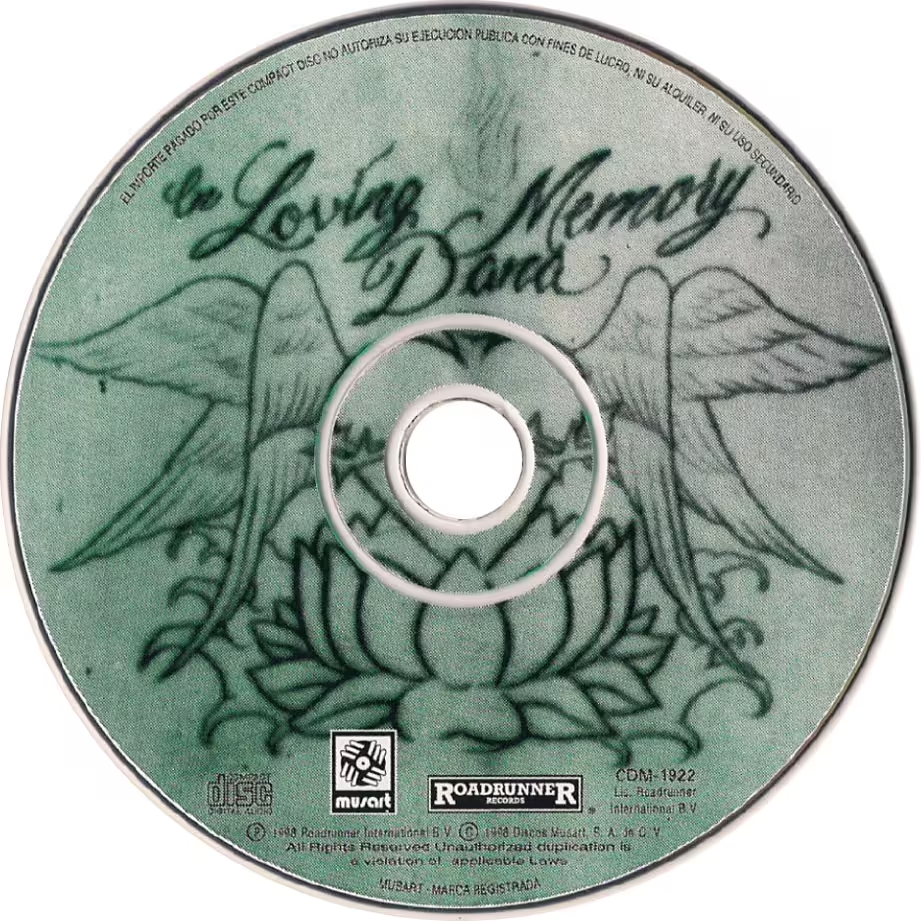
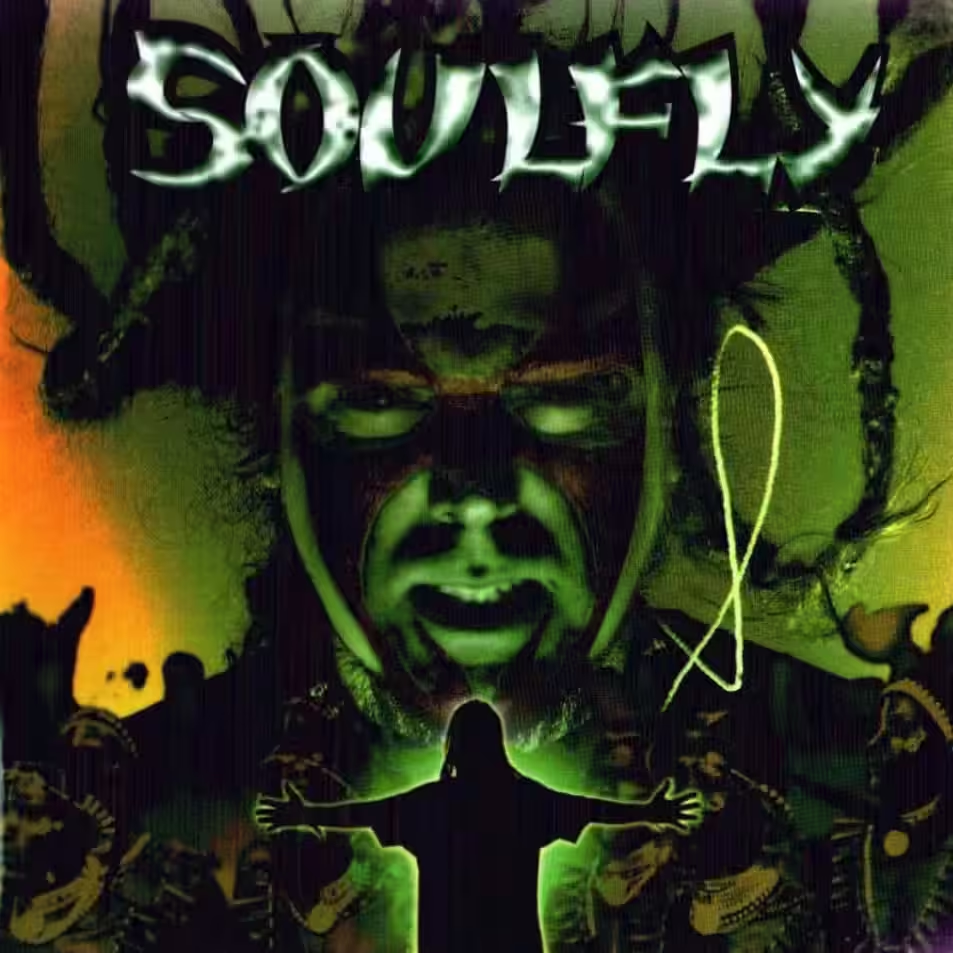
The cover image is a stylised winged figure rising from flame, set against the band's logo in a tribal-stencil typeface. The cover photograph is credited to Jo Kirchherr; art direction and design to Pawn Shop Press, with label design by Mike Roper and Paul Stottler. Glen LaFerman and Christy Priske supplied the photography for the inside booklet. The booklet itself is unusually dense for a 1998 metal release: full lyrics, a dedication to Dana Wells, a photograph of the entire Indigo Ranch tracking ensemble, and the longest thank-you list of Cavalera's career to that point.
The CD packaging exists in three commercially significant variants:
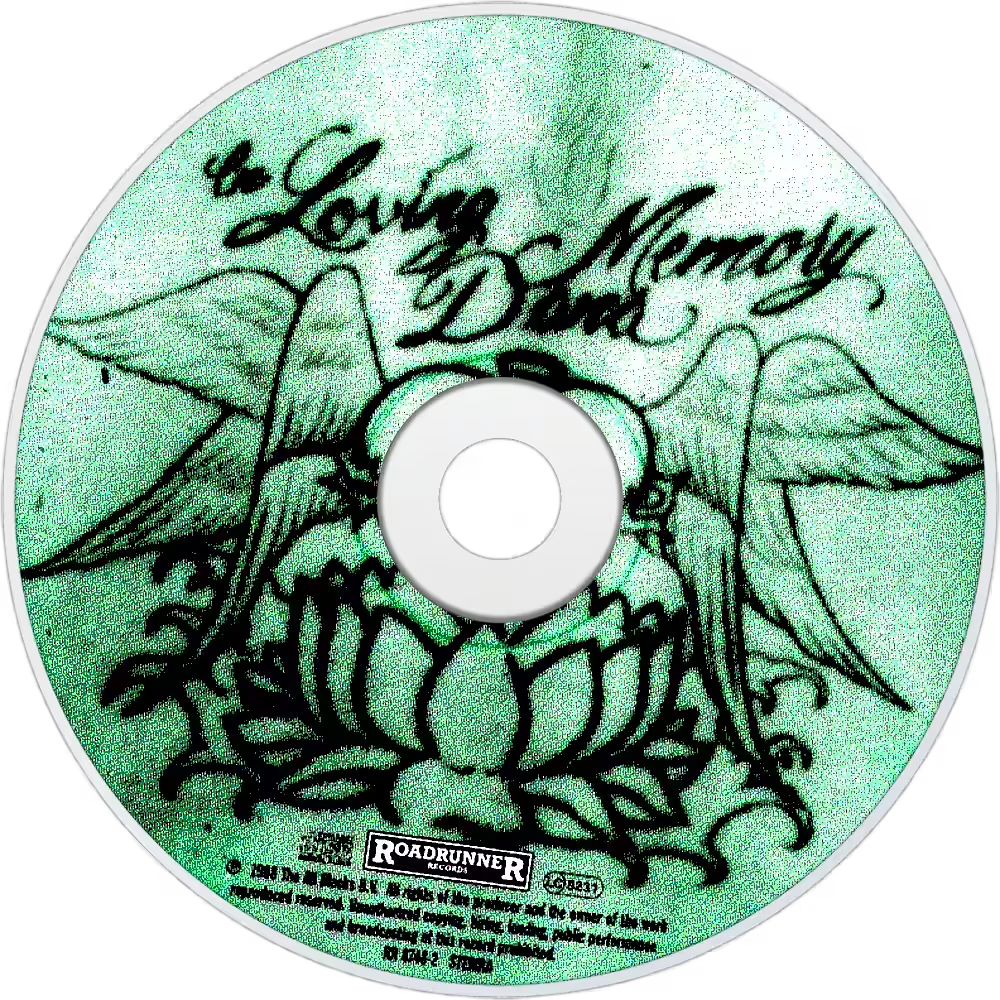
- The standard jewel-case CD with the main winged-figure cover. This is the canonical 1998 pressing.
- The European limited digipak, with the alternative front cover, the alternative CD-face artwork, and the two Discharge bonus cuts inside.
- The 1999 reissue, packaged as a slipcase double-disc set with the bonus remix and live CD. Mastered by Ted Jensen at Sterling Sound rather than George Marino.
The Japanese first pressing (Roadrunner Japan, 24 February 1998) has its own obi strip and adds "Cangaceiro" as track 16. The vinyl history is patchy: there was no widespread 1998 vinyl pressing in Europe or North America; the album was only properly cut to vinyl much later, with anniversary picture-disc and coloured-vinyl reissues from the 2010s onwards.
Release and Reception
Roadrunner released the album worldwide on 21 April 1998. Chart performance was strongest in Europe and the Commonwealth. The album peaked at number 16 on the UK Albums Chart, number 14 in France, number 14 in New Zealand, number 12 in the Belgian Flanders chart, number 18 in Finland, number 26 in Scotland, number 27 in the Netherlands, number 28 in Austria, number 29 in Germany, number 33 in Australia and number 43 in Sweden. The US Billboard 200 peak was 79, lower than Roots's 27 but respectable for a new band's debut with no MTV play in the first week. The RIAA certified it Gold (500,000 US shipments). The ARIA certified it Gold (35,000 Australian shipments) in 2002, marking the slow burn of the record across the four-year cycle that included the touring for Primitive.
Contemporary reviews were divided. AllMusic (Greg Prato) gave the album four out of five and called experimentation the "catalyst" with heavy metal still the "foundation". Hit Parader rated it a B in September 1998. NME's Johnny Cigarettes gave it a 7/10 in his April 1998 review.
"Like his last release with Sepultura, the superb Roots, experimentation (Brazilian tribal drumming/rhythms, samples, unearthly sound effects, etc.) is a catalyst here on Soulfly, but gut-wrenching heavy metal is the foundation for almost all of the tracks."
Greg Prato, AllMusic review of Soulfly
Retrospective evaluation has been kinder. VH1 included the album on its September 2015 list of "The 12 Most Underrated Nu Metal Albums". Revolver placed it on the magazine's 2021 list of the "20 Essential Nu-Metal Albums". Louder's 2022 list of the 50 best nu-metal albums included Primitive at number 41 rather than the debut, but acknowledged in the same article the through-line from Roots through the Soulfly catalogue. Across the various lists, the consensus has moved from "Sepultura sequel by other means" in 1998 to "foundational nu-metal record" by the mid-2010s.
The Cavalera family circle has been almost uniformly proud of the record. Igor Cavalera, the brother who voted to dismiss Gloria in December 1996, recorded a Sepultura-Soulfly collaborative project (Cavalera Conspiracy) with Max almost a decade later, and the brothers re-recorded Sepultura's first two albums in 2023 and 2024; in promo interviews around those projects, both brothers spoke warmly about Soulfly's first record specifically.
Singles and Music Videos
| Single | Release | UK | Notes |
|---|---|---|---|
| Eye for an Eye | 23 February 1998 | 74 | The album's lead single; promo-only video filmed at Indigo Ranch with Robinson visible behind the console |
| Umbabarauma | 5 May 1998 | 56 | Released to coincide with the 1998 World Cup in France; UK release stickered with a Brazil football crest |
| Bleed | 23 December 1998 | 62 | The single Roadrunner held for the Christmas market; Fred Durst features on both the audio and the video |
| Tribe | 21 January 1999 | 59 | Released as an EP rather than a true single; included two non-album cuts and three remixes |
The "Tribe" EP from January 1999 is the most collectable single from the cycle. It carried the "Fuck Shit Up" mix by Roy Mayorga and the "Tribal Terrorism" mix by Josh Abraham, plus a live cut from Crossing Border, and was the first commercially released version of Cavalera's Recife-ensemble polyrhythms running through a club-leaning remix. The "Bleed" promo video, filmed in late 1998, was directed by Paul Brown and ran in MTV's late-night metal rotation on Headbangers Ball; it is one of the few music videos that featured both Cavalera and Durst on camera together.
No song from the album was nominated for a Grammy. Tribe's nomination came years later in a different format. The cycle's biggest single broadcast moment came not from a video but from a Recovery (MTV2) studio session in late 1998 in which Cavalera and Mayorga played "Tribe" with the Recife percussion ensemble live in the studio.
Touring and Live
Soulfly toured the album for almost two full years. Logan Mader replaced Jackson Bandeira on lead guitar for live work; Bandeira's commitments with Nação Zumbi in Recife made a worldwide tour impossible. The headline tour cycle included:
- European club shows in May and June 1998, headlining 1,500–3,000 capacity rooms, with Snot and Coal Chamber alternating as support.
- Ozzfest 1998 main-stage US run, 27 May to 4 September 1998, alongside Ozzy, Tool, Megadeth, Limp Bizkit and Sepultura (the new lineup with Derrick Green) on the second stage. The festival itinerary intermittently put Soulfly and post-Cavalera Sepultura on the same site for the first time since the December 1996 split; on-stage encounters were minimal.
- Brazilian theatre dates in November 1998, Cavalera's first home-country shows under the new banner.
- The Crossing Border Festival in Copenhagen on 21 November 1997, before the album's release, captured for the live bonus disc.
- Donington Monsters of Rock 1998 (29 August), as second-billed below Ozzy on a Britcentric bill that also carried Soundgarden's last UK festival appearance.
- A Recovery (MTV2) live broadcast in late 1998 with the Recife percussion ensemble in the studio.
The most discussed tour incident was at Ozzfest's Camden, New Jersey, date on 6 August 1998, where a crowd-control failure during Soulfly's set led to several injuries; Cavalera stopped the set twice from the stage and the band lost three minutes of their slot to medical evacuation. No fatalities were reported. The Donington 1998 set, broadcast on UK radio, is the cleanest live document from the cycle that pre-dates the official 1999 reissue.
In TV, Film and Media
"Bleed" was the album's most-licensed track. It appeared in the soundtrack to the 1998 horror film Strangeland (Dee Snider's directorial debut) and was used in a 1999 episode of MTV's promo coverage of WrestleMania XV. "Eye for an Eye" appeared in extreme-sport video compilations from 1998 through 2001. "Tribe" was used in a 2001 episode of CBS's WWF Smackdown! during the entrance for The Undertaker's "American Bad Ass" character; Cavalera, a longstanding wrestling fan, listed the sync as a personal highlight.
Cavalera himself appeared on MTV's Headbangers Ball, the BBC's Radio 1 Rock Show with Mary Anne Hobbs, and on the Brazilian primetime music programme Programa Livre during the November 1998 home-country dates.
Controversy, Censorship and Lawsuits
The album was not parental-advisory stickered in any major market and was not banned anywhere on release. The "Bumbklaatt" title, derived from a Jamaican Patois expletive, briefly attracted complaints from religious broadcasters in the Caribbean but did not result in any formal action. No plagiarism or sampling lawsuits arose from the record despite its mosaic of covers, interpolations and quotations; the Jorge Ben Jor cover was properly licensed and Ben's writer credit appears on the sleeve.
The closest the album came to legal entanglement was the lingering trademark dispute over the "Sepultura" name in 1997 and early 1998. Cavalera's departure from the band had triggered a brief discussion about whether Sepultura the brand belonged to him as a co-founder and original frontman; the dispute was settled out of court before Soulfly was released, with the remaining members retaining the name. There is no formal record of a court ruling; the resolution was a private arrangement reached through both sides' management.
Covers, Samples and Tributes
The album itself is a small encyclopaedia of covers and interpolations:
- "Umbabarauma" is a Jorge Ben Jor cover, originally from Africa Brasil (1976).
- "The Song Remains Insane" runs a cover of Ratos de Porão's "Caos" into a cover of Sepultura's own "Attitude" from Roots.
- The digipak's "Ain't No Feeble Bastard" and "The Possibility of Life's Destruction" are Discharge covers.
Songs from the album have been covered or interpolated by several bands. Korn's tour DJ played a snippet of "Bleed" as the band's walk-on music during the Family Values Tour. Brazilian death-metal band Krisiun cited "Eye for an Eye" as a direct influence on the rhythmic feel of their 2001 album Conquerors of Armageddon. The "Eternal Spirit" remix of "Soulfly" by The Rootsman was sampled in turn by several mid-2000s drum-and-bass producers; the most prominent legitimate clearance was on a 2004 Optical and Ed Rush release.
The album has been credited in interviews as a foundational record by a wide range of subsequent artists: Slipknot's Corey Taylor (who would later guest with Cavalera on Primitive's "Jumpdafuckup"), Trivium's Matt Heafy, Killswitch Engage's Jesse Leach and DevilDriver's Dez Fafara have all named the debut as a formative listening experience.
Reissues, Remasters and Anniversaries
The reissue history of the album is dense for a record that has never been formally remastered as an audiophile project:
- 1998 European limited digipak, with the two Discharge covers and the alternative cover art.
- 1999 double-CD reissue with the bonus disc of remixes, live tracks, the four-track demo of "Eye for an Eye" and the Crossing Border spoken-word performance. Mastered by Ted Jensen at Sterling Sound.
- 10th-anniversary 2008 reissue: a single-disc digipak with original mastering retained but updated booklet artwork, released in time for the 2008 Cavalera Conspiracy launch.
- 20th-anniversary 2018 vinyl picture-disc edition, the album's first proper widely-distributed vinyl release outside of small late-1990s European white-label pressings.
- 25th-anniversary 2023 coloured-vinyl reissue from Roadrunner's BMG-era catalogue programme, with a small bonus 7-inch carrying the "Bleed" radio edit.
No full Atmos or spatial-audio remix of the album exists at the time of writing. The 2018 picture-disc was cut from the 1998 George Marino master rather than a fresh stereo remaster; collectors who care about original-mix fidelity tend to prefer the 1999 Ted Jensen master on the bonus CD over the 1998 original because Jensen's mastering opens up the kick-snare separation that George Marino's master compressed.
Cavalera has not yet performed the album in full live, despite the trend across his catalogue of full-album anniversary shows (Roots in particular has been toured in full multiple times). The 25th anniversary in 2023 was marked with a short European tour that performed "Eye for an Eye", "Bleed", "Tribe", "First Commandment" and "Umbabarauma" in sequence, but not the whole record.
Legacy and Influence
Soulfly's commercial legacy is the one Cavalera himself has talked about least: the album sold roughly half a million copies in the United States and roughly the same again in the rest of the world, and it kept Roadrunner in business through the lean window between Sepultura's late-1990s commercial drop-off and Slipknot's 1999 explosion. The label spent on the album's launch on the assumption that Cavalera's name alone would carry the first 200,000 copies in Europe; that bet was correct.
The musical legacy is more interesting. The album is the missing-link record between Roots's Brazilian polyrhythms and the wave of nu-metal records that followed. The trick that Soulfly pulled off, that Korn and Limp Bizkit had not yet attempted, was to make a heavy record that explicitly imported a non-Western percussion tradition without exoticising it; the Nação Zumbi players are credited by name, paid as session musicians and given lyric credit on the songs they sing on. That model was followed three years later by Sepultura's own Nation (2001), by Brujeria's Brujerizmo (2000) and indirectly by System of a Down's 2001 Toxicity.
The wider Cavalera catalogue followed two parallel tracks after Soulfly. Primitive (2000) was the bigger commercial record, helped by Corey Taylor's "Jumpdafuckup" cameo, and pushed the band into headline arena slots. Roots Bloody Roots and its reunion narrative dominated press coverage of Cavalera Conspiracy from 2008 onwards. But the debut remained the touchstone record on which the band's identity was set: tribal percussion, hardcore aggression, guests as collaborators rather than features, and a spiritual framing of heavy music that was explicit rather than tongue-in-cheek.
The Cavalera brothers' 2023 reunion to re-record Bestial Devastation and Morbid Visions, and their 2024 follow-up Schizophrenia, closed a loop opened in December 1996. The Soulfly debut was the record that made that reunion narratively possible: it proved that Max could carry a band on his own, which in turn made the brothers' reunion a creative reunion of equals rather than a comeback for a struggling solo artist.
Things You Might Not Know
| Fact | Detail |
|---|---|
| The Chino reciprocation | Chino Moreno's appearance on "First Commandment" was a direct return for Cavalera's guest vocal on Deftones' "Headup" (Around the Fur, 1997), which Moreno had publicly dedicated to Dana Wells. |
| Zyon's speaking role | The "You Think You All Good" spoken intro on "Bumbklaatt" is Cavalera's young son Zyon, then about four years old. Zyon would later become a metal drummer himself, joining Soulfly in 2012. |
| Recife's lost bandleader | Both Nação Zumbi alfaia players on the record had buried their own bandleader, Chico Science, six months before flying to Malibu; Science died in a Recife road accident in February 1997. |
| The Walkman riff coincidence | The main breakdown riff of "Tribe" was independently recorded the same year by Andreas Kisser and Igor Cavalera as the main figure of "Walkman", a cue for the 1999 Brazilian film No Coração dos Deuses. |
| The chains on "Prejudice" | The percussive clanging through "Prejudice" is the sound of physical metal chains being struck against the Indigo Ranch studio floor by Cavalera and Benji Webbe, played live to the take rather than overdubbed. |
| The Cangaceiro problem | The Japanese first pressing carried "Cangaceiro" as track 16, but the song never made any other 1998 pressing; collectors paid serious money for the Japanese edition through the late 1990s before the digipak made it slightly easier to track down (without "Cangaceiro"). |
| Mario Caldato's metal pivot | Co-producer Mario Caldato Jr.'s previous main credit was Beastie Boys' Hello Nasty, released three months after Soulfly. He had never produced a heavy-metal record before and reportedly had to be persuaded by Robinson to take the brief. |
| The Roadrunner-pile vocal | The choral backing vocals on "Bumba" and "Umbabarauma" are an entire studio pile-on: every credited musician plus Robinson, Caldato, engineers Chuck Johnson and Rob Agnello, and tape op Paul Booth, all crammed around a single mic in the live room. |
| The Strangeland connection | "Bleed" appeared on the soundtrack to Strangeland (1998), Dee Snider's writing-and-acting directorial debut, on the strength of a personal phone call from Snider to Cavalera rather than a Roadrunner sync placement. |
| The Wrestlemania entrance | "Tribe" was used in WWF Smackdown in 2001 for one of the entrance themes of The Undertaker's American Bad Ass character; Cavalera, a lifelong wrestling fan, has named it among his proudest non-musical sync placements. |
| The Ted Jensen tell | Catalogue collectors generally prefer the 1999 Ted Jensen master on the reissue's bonus CD to the original George Marino master of the standard album, on the grounds that Jensen's transfer opens up the kick-snare separation that the 1998 master heavily compressed. |
| The home address | The lyrics to "No" name-check Cavalera's then-home neighbourhood of Phoenix; he and Gloria had moved there from London in early 1997 specifically because the city had no heavy-music industry and they wanted privacy. |
Riffology Podcast
This deep dive is the companion to the Riffology podcast episode on Soulfly's 1998 debut, in which the hosts dig into the Indigo Ranch sessions, the Recife percussion crew, the Fred Durst writing room and the album's place in the long aftermath of Cavalera's exit from Sepultura. The Riffology podcast covers iconic rock and metal albums one record at a time and is available wherever podcasts live: Apple Podcasts, Spotify, Amazon Music, Pocket Casts, Overcast and the rest, and at riffology.co/podcast.
Comments