Clare Torry was paid £30 to improvise a wordless vocal she assumed would never be used. The 25-year-old session singer arrived at Studio Three, Abbey Road on a Sunday night in January 1973 with no lyric sheet, no melody and a flat fee booked by Alan Parsons because it was the only evening she had free. Richard Wright's piano part for an untitled track was already on the tape; David Gilmour, running the session, asked her to forget the words and "express emotions" instead. She sang two takes, stopped herself halfway through with "no no no, sorry, I'm sorry", and left the studio convinced her vocal would not be used. The piece she had just improvised became The Great Gig in the Sky, and 31 years later she sued Pink Floyd for a co-writing credit on it. She won.
That single Sunday is a fair shorthand for the whole record. The Dark Side of the Moon was built out of hand-cut tape loops, accidents, doormen, flashcards and a borrowed quadraphonic clock recording, then ironed into one of the most precisely engineered LPs of the 1970s. Pink Floyd road-tested it on stage for fourteen months before they pressed record at EMI. They financed it themselves, finished it on 9 February 1973, and watched it stay on the Billboard 200 for almost a thousand weeks. This is the long story of how it was assembled, who actually played on it, and why a six-coloured prism on a black sleeve became one of the most recognisable images in popular music.
| Field | Detail |
|---|---|
| Artist | Pink Floyd |
| Album | The Dark Side of the Moon |
| Release date | 1 March 1973 (US, Capitol); 16 March 1973 (UK, Harvest) |
| Label | Harvest Records (UK), Capitol Records (US) |
| Producer | Pink Floyd |
| Studio | EMI Studios (now Abbey Road Studios), London, Studios Two and Three |
| Genre / Subgenre | Progressive rock, psychedelic rock, art rock |
| Track count | 10 |
| Total runtime | 42:49 |
| Billboard 200 peak | 1 (week of 28 April 1973) |
| UK Albums Chart peak | 2 |
| Other notable peaks | 1 in Austria, Canada, France, Italy and on US Cash Box; 2 in Australia and the Netherlands; 3 in Germany, Finland and Spain |
| Certifications | 15x Platinum (RIAA, US); 16x Platinum (BPI, UK); 14x Platinum (ARIA, Australia); 2x Diamond (Music Canada) |
| Estimated sales | Around 45 million worldwide (2013 figure) |
| Key singles | "Money" (7 May 1973), "Us and Them" / "Time" double A-side (4 February 1974) |
Cultural context: 1973 and the album as architecture
By the spring of 1973 the album had displaced the single as the unit of ambition in rock music, and 1973 was the year the album-as-statement reached its commercial apex. Led Zeppelin released Houses of the Holy in March, the same month Pink Floyd dropped The Dark Side of the Moon. David Bowie put out Aladdin Sane in April, the Rolling Stones Goats Head Soup in August, the Who Quadrophenia in October, Elton John Goodbye Yellow Brick Road the same month. Mike Oldfield's Tubular Bells arrived in May; Bruce Springsteen made his debut with Greetings from Asbury Park in January. Stevie Wonder's Innervisions in August completed the year in which "album rock" stopped being a marketing phrase and became the entire business model. Punk was three years away. FM radio in the United States was building its identity around long-form, headphone-friendly records, and Capitol's chairman Bhaskar Menon was about to discover that Pink Floyd had given him the perfect product for it.
What set Floyd's record apart was that it was conceived as a single, continuous piece of music with five tracks per side and a unifying theme: the pressures that, in Roger Waters's phrase to the band at Nick Mason's house in North London, "make people mad". The lyrics were printed on the sleeve for the first time in the band's career. The press were so confident they leaked acetates around London weeks before release. Even the trade ads ran the line "Album available March 1. Tour begins March 5", as if the LP and the touring production were the same artefact in two states of matter.
The band's story up to this point
Pink Floyd in late 1971 were five years past the departure of their founder and chief writer. Syd Barrett, the singer-guitarist who had named the band and written most of their first album, was effectively out by spring 1968, ill and unable to function on stage. David Gilmour had been brought in alongside him in January of that year and inherited the band when Barrett was quietly dropped. The four-piece of Gilmour, Roger Waters, Richard Wright and Nick Mason spent the next four years cycling through long instrumental suites, film scores (More, Zabriskie Point, La Vallee) and the studio side-experiments of Ummagumma, Atom Heart Mother and Meddle. They were a cult headline act with a wealthy underground following and almost no singles presence. Their previous album, Obscured by Clouds, was a soundtrack rushed out in June 1972 while sessions for Dark Side were already under way.
Two things changed in late 1971. First, Waters was finally ready to write the kind of direct, declarative lyrics he had been avoiding for years; Gilmour later put it bluntly, telling Rolling Stone that "a lot of the lyrics that we had been using were a little too indirect. There was definitely a feeling that the words were going to be very clear and specific." Second, the band agreed to attempt a single-theme album, road-test it on tour, and only then go to Abbey Road. They rehearsed at a warehouse owned by the Rolling Stones and at the Rainbow Theatre in Finsbury Park. They bought a 28-track mixing desk, new PA, a quadraphonic playback rig and a lighting truss; nine tons of equipment travelled in three lorries. It was the first time they had taken an entire unreleased album on tour.
Pre-production: a shed in Islington and a piece for assorted lunatics
The earliest sketches were made by Waters alone, on a small reel-to-reel set up in a garden shed at his home in Islington. The "Money" demo survives: a single-overdub take with finger-clicks instead of the cash-register loop, already in seven beats. The opening line of "Breathe" was lifted from The Body, a 1970 documentary score Waters had written with Ron Geesin. The chord sequence at the heart of "Us and Them" came from "The Violent Sequence", a piece Wright had written for Michelangelo Antonioni's film Zabriskie Point in 1970 that the director had rejected. Mason cooked up the sound-effect collage that became "Speak to Me" at home. Almost nothing was composed from scratch; what the band did was thread fragments together into one continuous suite about money, time, fear, work, war and madness.
The working title was Dark Side of the Moon: A Piece for Assorted Lunatics. The band premiered the piece in front of a paying audience at the Brighton Dome on 20 January 1972, more than a year before they recorded a note of it in the studio. A power cut interrupted the first night mid-"Money", forcing them to abandon the second half and play instrumentals from Meddle instead. They polished it up on a UK tour and then unveiled it for the British press at the Rainbow Theatre on 17 February 1972. Michael Wale in The Times said it brought "tears to the eyes"; Derek Jewell in The Sunday Times called the band's ambition "now vast"; Melody Maker complained the sound effects made the venue feel like "a bird-cage at London Zoo".
One detail of the live show would not survive into the studio. Where Clare Torry's wordless vocal eventually sat on side one, the 1972 touring version had readings from the Bible, delivered over Wright's piano. The "On the Run" instrumental had no synthesisers at all on stage and was simply a long Gilmour-and-Wright jam. Both pieces were rebuilt from scratch back at Abbey Road.
The album was very nearly not called The Dark Side of the Moon. In October 1972, while Floyd were still in the middle of recording, the British band Medicine Head released an LP under exactly that title. Floyd swallowed hard, retitled their work-in-progress Eclipse, and carried on. Medicine Head's album sold poorly enough that the title was quietly considered free again, and Floyd took it back in time for the sleeve to be printed.
Creating the album: 60 days at EMI with a 24-year-old at the desk
The first session ran on 31 May 1972 in Studio Three. The first piece on tape was not the loud one. It was "Us and Them", Wright's slow, sad seven-minute meditation in seven flat keys. A week later they tracked "Money". "Time" and "The Great Gig in the Sky" came next, then a two-month break for an American tour, then a return in autumn for further work. The band signed the album off at Abbey Road on 9 February 1973. The total studio time across all sessions was roughly 60 days spread over eight months.
The man at the desk was Alan Parsons. He had started at Abbey Road as a tape op straight from school, worked on the Beatles' Abbey Road and Let It Be as an engineer, and had been the assistant on Floyd's Atom Heart Mother in 1970. By 1972 he was 24 and on EMI's staff at £35 a week. The studio was equipped with a Studer A80 16-track tape machine (the first in the United Kingdom; by the time the sessions finished, all three Abbey Road control rooms had one), an EMI TG12345 Mk IV desk, a brand-new EMS VCS 3 and Synthi A, an array of Neumann valve microphones, a Hammond B3 played through a Leslie cabinet, and Wright's Wurlitzer and Hohner electric pianos. Gilmour's main guitar was the famous "Black Strat", a 1969 Fender Stratocaster he had bought from Manny's Music in New York City in May 1970. For the "Money" solo he ran it through a Big Muff fuzz into a Hiwatt amplifier.
The band were efficient. Chris Thomas, brought in to handle the final mix, was struck by how clean their multitracks were:
"There were only two or three tracks of drums when we came to mixing it. Depending on the song, there would be one or two tracks of guitar, and these would include the solo and the rhythm guitar parts. One track for keyboard, one track for bass, and one or two sound effects tracks. They had been very, very efficient in the way they'd worked."
Chris Thomas, Making Music magazine, January 1995
That efficiency masked a sometimes lethargic working pace. Waters, a lifelong Arsenal fan, would walk out for fixtures at Highbury. The whole band would down tools for Monty Python's Flying Circus on the studio television; Floyd later invested some of the album's royalties in Monty Python and the Holy Grail. Parsons would carry on working on tracks while the band watched the Pythons in the next room. Gilmour later put it neatly: "...but when we were on a roll, we would get on."
What made the record sound the way it does is a collection of small studio tricks repeated obsessively across the suite:
- A bass drum was treated and slowed to imitate a human heartbeat; it bookends the album and ghosts through "On the Run", "Time" and "Eclipse".
- Assistant engineer Peter James was sent running around Abbey Road's echo chamber to generate the footsteps that pan around "On the Run".
- The Hammond on "Any Colour You Like" was processed through a Leslie cabinet and then panned in circles across the quadraphonic mix.
- Parsons double-tracked Gilmour's vocals so he could harmonise with himself, most obviously on "Time" and "Breathe".
- The drum fills that open "Time" are played on Rototoms tuned to specific pitches.
- Tape phasing and flanging are used as compositional devices on the vocals, not just as colour.
The two most-discussed engineering set-pieces are the tape loops on "Money" and the clocks on "Time". Waters built the "Money" loop himself, by hand, splicing together recordings of coins thrown into the mixing bowl in his wife's pottery studio, a ringing cash register, paper tearing and a clicking adding machine. He cut a 7-beat loop because the song he wanted to drop on top of it was already in 7/4 time. Parsons later re-recorded the loop into four discrete tape passes so it could rotate around the listener in the quadraphonic mix.
The clock intro to "Time" was a lucky accident. Parsons had recorded each clock individually at an antique shop in Soho some months earlier as a quadraphonic demonstration tape for EMI; the recordings had nothing to do with Pink Floyd. When the band realised they wanted clocks chiming together to open "Time", Parsons remembered the tape sitting on a shelf in the Abbey Road library and walked down the corridor to fetch it.
Personnel and credits
| Role | Player | Notes |
|---|---|---|
| Pink Floyd | ||
| Lead vocals, guitars, EMS VCS 3 | David Gilmour | Lead vocal on "Breathe", "Time", "Money" and "Us and Them"; harmony with himself via double-tracking; Black Strat into Hiwatt for the "Money" solo |
| Bass, lead vocals, EMS VCS 3, tape effects, lyrics | Roger Waters | Sole lyricist; lead vocal on "Brain Damage" and "Eclipse"; built the "Money" loop by hand |
| Keyboards (Hammond, Wurlitzer, Hohner, grand piano), EMS VCS 3, vocals | Richard Wright | Composer of "The Great Gig in the Sky"; lead vocal share on "Time"; co-credited on "Speak to Me", "Breathe", "Any Colour You Like" |
| Drums, percussion, tape effects | Nick Mason | Sole composer credit on "Speak to Me"; assembled most of the sound-effect collages |
| Guest and session musicians | ||
| Lead vocal | Clare Torry | Improvised wordless vocal on "The Great Gig in the Sky" in a few Sunday-night takes; paid a flat £30 session fee; later sued for and won a co-writing credit |
| Tenor saxophone | Dick Parry | Solos on "Us and Them" and "Money"; an old friend of Gilmour's from Cambridge |
| Backing vocals | Doris Troy, Lesley Duncan, Liza Strike, Barry St. John | Massed soul-gospel vocals on "Brain Damage", "Eclipse" and "Time" |
| Spoken voices (flashcard interviews) | Gerry O'Driscoll, Roger "the Hat" Manifold, Chris Adamson, Peter Watts, Patricia "Puddie" Watts, Henry McCullough | Abbey Road doorman, road crew, McCartney's Wings guitarist; see "The flashcards" below |
| Production and engineering | ||
| Producer | Pink Floyd | All four members credited as producers |
| Engineer | Alan Parsons | Grammy-nominated for the work; subsequently formed The Alan Parsons Project |
| Assistant engineer | Peter James | Mis-credited as "Peter Jones" on first US pressings; also ran around the echo chamber for "On the Run" |
| Mix supervisor | Chris Thomas | Brought in as "a fresh pair of ears" for the final mix; had worked with George Martin on the Beatles' White Album |
| Artwork | ||
| Sleeve concept and design | Hipgnosis (Storm Thorgerson and Aubrey Powell) | Offered the band a choice of seven designs; all four members chose the prism unanimously |
| Sleeve illustration | George Hardie | Drew the prism and sticker artwork from Thorgerson's reference |
The most-discussed single absence from the album is Paul and Linda McCartney. They sat through the flashcard interview but their answers were judged "too good", as if rehearsed, and were not used. Their Wings bandmate Henry McCullough was less careful: his line "I don't know, I was really drunk at the time" made the final mix.
The flashcards: a doorman, a roadie and the line at the end of the record
In the final week of recording, Roger Waters wrote a stack of questions onto flashcards. He sat people down in a darkened Studio Three, one at a time, in front of a microphone, and turned the cards over one by one: "What's your favourite colour?"; "What's your favourite food?"; "When was the last time you were violent?"; "Were you in the right?"; "Are you frightened of dying?"; "What does the dark side of the moon mean to you?" The answers were spliced into the final mix in the order they had been answered, which is why the album cuts from "When was the last time you were violent?" to "Were you in the right?" as if the same person is answering both. They usually were.
The opening line of the entire record, "I've been mad for fucking years, absolutely years, over the edge... it's working with bands that does it", was spoken by Floyd's road manager Chris Adamson. Roger "the Hat" Manifold, another roadie, gave the "give 'em a quick, short, sharp shock" speech and the "live for today, gone tomorrow, that's me" line; his interview was done sat down without flashcards. Peter Watts, the band's road manager (and the father of the actress Naomi Watts), supplied the eerie repeated laughter on "Brain Damage" and "Speak to Me", and the line "I can't think of anything to say". His second wife Patricia "Puddie" Watts contributed the "I never said I was frightened of dying" line that floats halfway through "The Great Gig in the Sky".
The most-quoted of all the spoken voices belonged to Gerry O'Driscoll, the Irish doorman who minded the entrance at Abbey Road. His "I am not frightened of dying, any time will do, I don't mind" speech is in the middle of "Great Gig"; his closing line, played over the final heartbeats, ends the album:
"There is no dark side of the moon, really. Matter of fact, it's all dark."
Gerry O'Driscoll, Abbey Road doorman, recorded February 1973
Parsons later said O'Driscoll had carried on talking after that take. "The bit you don't hear is that, after that, he said, 'The only thing that makes it look alight is the sun.' The band were too overjoyed with his first line, and it would have been an anticlimax to continue."
The songs: a side-by-side reading
| # | Title | Writer(s) | Length | Single? | Notes |
|---|---|---|---|---|---|
| 1 | Speak to Me | Mason | 1:05 | Sound-effect overture; Mason's only solo writing credit on a Floyd album | |
| 2 | Breathe (In the Air) | Gilmour, Waters, Wright | 2:49 | Opening line borrowed from The Body; Gilmour double-tracked vocal | |
| 3 | On the Run | Gilmour, Waters | 3:45 | Synthi A sequence; airport-anxiety theme; rebuilt from scratch after the 1972 tour | |
| 4 | Time | Mason, Waters, Wright, Gilmour | 6:53 | Only track with all four members credited; clocks recorded by Parsons in a Soho antique shop | |
| 5 | The Great Gig in the Sky | Wright, Torry | 4:47 | Wright's piano with Torry's improvised vocal; Torry credit added post-2005 after lawsuit | |
| 6 | Money | Waters | 6:22 | Yes (7 May 1973) | Verses in 7/4; cash-register tape loop; Dick Parry tenor solo; Gilmour Black Strat solo |
| 7 | Us and Them | Wright, Waters | 7:49 | Yes (4 February 1974, double A-side with "Time") | First track recorded for the album, 31 May 1972; from Wright's Zabriskie Point piece |
| 8 | Any Colour You Like | Gilmour, Mason, Wright | 3:26 | Instrumental; Hammond into Leslie, then VCS 3 panning | |
| 9 | Brain Damage | Waters | 3:46 | Waters lead vocal; the line "if the band you're in starts playing different tunes" is about Syd Barrett | |
| 10 | Eclipse | Waters | 2:12 | Closing piece, gives the album its alternate working title |
The two sides of the LP are continuous. Side one travels from birth ("Speak to Me", "Breathe") through anxiety ("On the Run"), the obliteration of routine ("Time") and into death ("The Great Gig in the Sky"). Side two is the human-systems side: greed ("Money"), war and class ("Us and Them"), the illusion of choice ("Any Colour You Like"), and finally madness and an attempt at solidarity ("Brain Damage" and "Eclipse"). The heartbeats that close "Eclipse" rhyme with the heartbeats that open "Speak to Me", and the album loops.
"Time" deserves a paragraph of its own as a pure piece of engineering. The two minutes of chiming clocks at the start were Parsons's quadraphonic demonstration tape, retrieved by accident. The Rototom fills that follow were a Nick Mason set-piece worked out at home. Gilmour's solo is one of his most copied; he and Wright trade lead vocals through the verses, and Wright's twin-tracked harmonies under the bridge are the moment most fans cite when they first realised Wright was the band's secret weapon. Side one closes by sliding "Time" straight into a brief reprise of "Breathe" and then into Torry's vocal.
"Money" is the one song from the album that lives on its own. Waters built the lyric as a piece of satire; he intended Gilmour's Black Strat solo to mock greed rather than celebrate it. The chord progression is a 12-bar blues, the verses in 7/4 and the solo section in straight 4/4, with the band stepping out of the unusual metre for the only time on the album. Dick Parry's tenor saxophone solo, recorded in a single afternoon, is the part that radio stations cared about. Capitol's ace plugger Al Coury phoned the band to ask for permission to put out a single, edited the song down from 6:22 to a radio-friendly length, removed the word "bullshit" from the mono mix, and pushed it to American FM and AM simultaneously.
"Us and Them" was Wright's "Violent Sequence" piano part with a Waters lyric pinned on top years later. It runs to 7:49, the longest piece on the record, and contains the most exposed Floyd vocal harmony on the album. Parry's saxophone returns. The song was the second single, paired as a double A-side with a heavily edited "Time" in February 1974.
"Brain Damage" and "Eclipse" close the album with Waters's most direct songwriting on the record. The "lunatic on the grass" of "Brain Damage" is a literal image (the lawn behind King's College in Cambridge, where Waters and Barrett grew up). The repeated "I'll see you on the dark side of the moon" is the album's title-drop, sung over a wash of Lesley Duncan, Doris Troy, Liza Strike and Barry St. John. The opening figure of "Eclipse" is a single bar that doubles in size at every repetition until the whole band is on it, then drops to O'Driscoll's voice and the heartbeat, and the record ends.
B-sides, outtakes and the things that didn't happen
Pink Floyd were not a B-side band in the singles era. Both UK singles paired tracks from the album:
- "Money" / "Any Colour You Like" (Harvest / Capitol 3609, 7 May 1973)
- "Us and Them" / "Time" double A-side (Harvest / Capitol 3832, 4 February 1974)
The only real outtake to circulate is the live-show Bible-readings version of the slot that became "The Great Gig in the Sky", documented on bootlegs of the 1972 tour. The "Money" demo Waters recorded in his Islington garden shed has been released, briefly, on the 2011 Immersion box set. The Pink Floyd: Live at Pompeii film, shot in part during the Dark Side sessions, contains studio footage with Adrian Maben's cameras catching the band tracking "Brain Damage" and "Us and Them"; the audio is from the sessions but not used on the album.
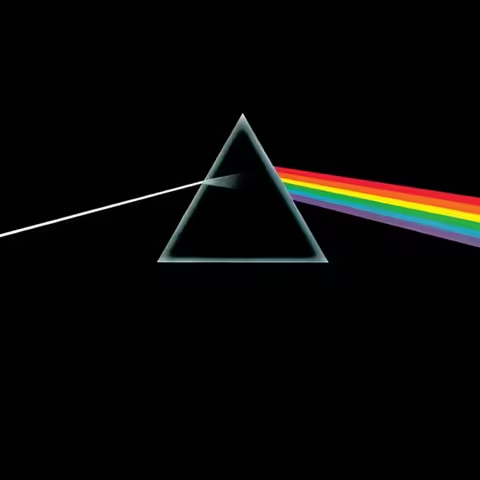
Album artwork: six colours, one prism
Wright told Hipgnosis he wanted "something simple, no photos", like the artwork of a Black Magic chocolate box. Storm Thorgerson and Aubrey Powell came back with seven roughs. The band took one look at the prism and chose it instantly. Waters: "There were no arguments. We all pointed to the prism and said 'That's the one'."
The reference was a 1963 physics textbook diagram of a triangular dispersive prism splitting white light into a spectrum, augmented by Alex Steinweiss's 1942 sleeve for the New York Philharmonic's recording of Beethoven's Emperor Concerto. George Hardie drew the final artwork. The spectrum that leaves the prism on the front cover has six bands, not seven; indigo is missing. Hipgnosis felt the conventional red-orange-yellow-green-blue-indigo-violet was visually cluttered, and the missing band has been the subject of small disputes among physics teachers ever since. Inside the gatefold, the spectrum continues across both inner sleeves and is overlaid with an ECG line that draws out the heartbeat sound. The rear cover recombines the spectrum into a second prism, deliberately so record shops could display the gatefold sideways without the design "stopping".
The first pressing included two posters (band live shots overlaid with scattered letters spelling PINK FLOYD, and a Powell-Thorgerson infrared photograph of the Great Pyramids at Giza) and two pyramid-themed stickers. For the first time in the band's history, the album lyrics were printed in full on the sleeve.
Release and reception
The press launch went badly. The band held it at the London Planetarium on 27 February 1973. The quadraphonic mix was not yet finished, so the journalists were played a poor-quality stereo PA mix while staring at four life-size cardboard cutouts of the band; only Wright actually showed up. The reviews still came in glowing. Roy Hollingworth in Melody Maker dismissed side one but called side two "solid and sound". Steve Peacock in Sounds wrote: "I don't care if you've never heard a note of the Pink Floyd's music in your life, I'd unreservedly recommend everyone to The Dark Side of the Moon." Loyd Grossman, writing for Rolling Stone, called it "a fine album with a textural and conceptual richness that not only invites, but demands involvement". Robert Christgau gave it a B and called it a "kitsch masterpiece"; that grade still rankles fans fifty years later.
It was an instant hit. The album reached number one on the US Billboard Top LPs & Tape chart on 28 April 1973 and held the position for a single week. It peaked at number two in the United Kingdom, kept off the top by Alice Cooper's Billion Dollar Babies. In Austria, Canada, France and Italy it hit number one. By April 1973 the RIAA had certified it gold; it would not get a platinum certification until 1976, because the platinum tier did not exist until then.
What the album did instead of pile up week-one numbers was refuse to leave the charts. It stayed on the Billboard 200 for 736 consecutive weeks from 17 March 1973 to 16 July 1988. After a 2009 rule change allowed catalogue albums back onto the main chart, it returned; by January 2026 it had accumulated 996 weeks on the Billboard 200, an unmatched figure. In the United Kingdom it is the highest-selling album never to reach number one; it is the seventh-best-selling album of all time there. Worldwide sales are estimated at around 45 million as of 2013, with current "slow week" US sales of 8,000 to 9,000 copies. In 2007 one in every fourteen Americans under the age of 50 was estimated to own a copy.
Awards followed slowly. Parsons was nominated for a Grammy for Best Engineered Recording, Non-Classical. The album was inducted into the Grammy Hall of Fame in 1999 and into the United States National Recording Registry by the Library of Congress in 2013. Rolling Stone's "500 Greatest Albums of All Time" placed it at 43 in 2003 and 2012 and 55 in 2020, Pink Floyd's highest single placement on the list. Both Rolling Stone and Q have called it the greatest progressive-rock album ever made.
Singles and music videos
| Single | Release | B-side | Notable peaks | Notes |
|---|---|---|---|---|
| "Money" | 7 May 1973 (US, UK) | "Any Colour You Like" | US Billboard Hot 100 13; Canada 4 | White-label promo went out with two versions of the mono side; one had "bullshit" edited to "bull", the other was uncensored and recalled. Pink Floyd's first hit single anywhere |
| "Us and Them" / "Time" | 4 February 1974 (US) | Double A-side | US Billboard Hot 100 101 | Heavily edited radio versions; Floyd issued no UK single from the album beyond "Money" |
Pink Floyd were a band who very deliberately did not make promotional videos for The Dark Side of the Moon. There is no official "Money" video from 1973, no "Time" promo, no concept clip. The closest contemporary visual document is the live performance footage shot by Adrian Maben for the 1972 reissue of Live at Pompeii, which captures the band running through "Us and Them" and "Brain Damage" inside Studio Three at EMI. The footage of the band staring into the camera in their flared jeans and long hair has become the canonical visual stand-in for the album.
The track most often given a "music video" in YouTube playlists is "Money", because Capitol's promo edit travelled around US AM radio for most of 1973 and a generation of fans first met the song there.
Touring and live: the album that ran for fourteen months before it existed
The unusual fact about The Dark Side of the Moon is that the band had already played the entire album to a paying audience more than sixty times before they finished recording the studio version. The Brighton premiere on 20 January 1972 was followed by a UK tour, Japanese dates in March 1972, a French recording detour, two North American legs across 1972, and finally a January 1973 return to London for the last sessions. The Earls Court shows in May 1973, two months after the album came out, were the first chance British audiences had to hear the finished record played live with the lighting and quadraphonic PA the band had been touring around it for a year.
By 1974 the production had grown into the giant circular screen, the inflatable pig (which would arrive on the Wish You Were Here and Animals tours), and the bank of 70mm cinema projectors that defined the Floyd live experience for the rest of the decade. The Empire Pool, Wembley shows of November 1974 were the run that the band approved for release on the 2023 anniversary box set as The Dark Side of the Moon Live at Wembley 1974. The band's setlists kept evolving; on the 1974 tour, every Dark Side song was extended, with "Money" running past nine minutes and "Us and Them" past ten.
In TV, film and other media
"Money" was the most syncable thing on the record and has been used in dozens of films, adverts and television shows, from Casino to The Squid and the Whale. "Time" provided the score to most television montages about ageing or running out of options for the next twenty years. "Brain Damage" and "Eclipse" became closing-credits choices for documentaries about mental health and Syd Barrett. The whole album sequence has been performed live in full by Phish, Dream Theater and the Flaming Lips, and re-recorded as a 2023 solo album by Waters himself, The Dark Side of the Moon Redux, with no guitar solos and substantial spoken-word passages. Easy Star All-Stars released a track-by-track reggae version, Dub Side of the Moon, in 2003, and the success of that record built a small cottage industry of full-album re-records (a string-quartet version, an a cappella version, a country-bluegrass version called Dark Side of the Moonshine).
Controversy, the lawsuit and the Wizard of Oz
Two of the album's footnotes refused to stay in the footnotes. The first was Clare Torry. She had been paid £30 (about £360 in modern money), seen her name in the credits at her local record shop, and assumed that was the end of it. In 2004, after thirty years of watching "The Great Gig in the Sky" appear in films, adverts and best-selling compilations, she filed a writing-credit suit against EMI and Pink Floyd. The case settled out of court for an undisclosed sum; every pressing of the album since 2005 credits the song to "Wright, Torry" rather than Wright alone.
The second is The Dark Side of the Rainbow: the urban legend that the album, played from the third roar of the MGM lion in The Wizard of Oz, synchronises with the film. The myth surfaced in a piece by Charles Savage in The Fort Wayne Journal Gazette on 1 August 1995 and spread on early-internet message boards. Dorothy begins to run on the line "no one told you when to run" in "Time"; she balances on a fence as Gilmour sings "balanced on the biggest wave"; she puts her ear to the Tin Man's chest as the album's closing heartbeats arrive. Members of Pink Floyd have repeatedly dismissed it. Gilmour: "Some of us have nothing better to do with our time." Parsons:
"It's a complete load of eyewash. It has nothing to do with the Wizard of Oz, it's just something that fans dreamed up. If you play any record with the sound turned down on the TV, you will find things that work."
Alan Parsons, MTV News, 1997
Covers, samples and tributes
Songs from The Dark Side of the Moon have been covered constantly. "Money" has been recorded by Velvet Revolver, the Flaming Lips, Soul Asylum, Easy Star All-Stars and dozens of bar bands; Milli Vanilli and Marky Mark and the Funky Bunch both lifted the cash-register loop on their respective songs called "Money" without paying for it. "Time" has been recovered by Anthrax (as a bonus track) and Mary Fahl. The Flaming Lips released a complete track-by-track remake in 2009 with Stardeath and White Dwarfs and guest vocals from Henry Rollins and Peaches. Dream Theater have performed the whole album twice in their live shows. Phish played the entire record at a single November 1998 show in West Valley City, Utah. Return to the Dark Side of the Moon: A Tribute to Pink Floyd (2006) featured Adrian Belew, Tommy Shaw, Dweezil Zappa and Rick Wakeman.
Reissues, remasters and the 50th anniversary box
The album has been reissued more often than any other Pink Floyd record:
- 1973: original Q4 quadraphonic LP mix by Alan Parsons; disowned by the band, withdrawn from sale within a few years
- 1979: Mobile Fidelity Sound Lab half-speed master vinyl; 1988 MFSL "Ultradisc" gold CD
- 1983-84: first CD pressings on EMI/Harvest in Japan, then EMI/Capitol worldwide
- 1992: remaster by Doug Sax and James Guthrie at The Mastering Lab as part of the Shine On box set
- 2003: 30th anniversary hybrid SACD with a new 5.1 surround mix by James Guthrie, in a stained-glass-prism sleeve; sold 800,000 copies in the US alone
- 2011: "Immersion" and "Experience" box sets remastered by James Guthrie and Joel Plante at das boot recording; the Immersion edition included the long-suppressed 1974 Wembley live recordings, the 1972 demos, and the original quad mix
- 2023: 50th anniversary box, with a new Dolby Atmos mix by Guthrie, the Live at Wembley 1974 vinyl, a Powell-Furmanovsky photo book and a Blu-ray; sold around 100,000 units in its first week
- 2024: 50th anniversary clear-vinyl edition, with the prism artwork printed in UV ink on the non-playable side of each disc
Roger Waters also released his own 2023 solo re-recording, The Dark Side of the Moon Redux, with no other members of Pink Floyd. It is largely spoken-word and contains no guitar solos. Waters told The Telegraph he wanted "to bring out the heart and soul of the album musically and spiritually", and that "not enough people recognised what it's about, what it was I was saying then". Gilmour has not commented publicly.
Legacy and influence
The Dark Side of the Moon did three things to the music business simultaneously. It proved that a concept album could outsell every conventional pop record on the market by a factor of ten. It defined what "album rock" radio would sound like for the next twenty years. And it gave Pink Floyd the financial independence to spend the rest of the decade making Wish You Were Here, Animals and The Wall without label interference, and to bankroll the live productions that made the band synonymous with arena-scale spectacle.
The album's direct musical influence is easier to feel than to chart. Radiohead's OK Computer is the comparison reached for most often, and Ben Schleifer's 2006 book 'Speak to Me': The Legacy of Pink Floyd's The Dark Side of the Moon draws the parallel explicitly: both records are about the difficulty of staying sane inside a system that rewards madness. Steven Hyden, in his 2018 book Twilight of the Gods, picks The Dark Side of the Moon and Led Zeppelin IV as the two records he listened to obsessively as a teenager, "encompassing the twin poles of teenage desire", with Zeppelin looking outward and Floyd looking inward. The album made Wright and Waters wealthy enough to buy country houses; Mason started collecting cars. Parsons, paid £35 a week as a staff engineer, did not see any royalties; in 2003 he said, with characteristic dryness:
"I think they all felt that I managed to hang the rest of my career on Dark Side of the Moon, which has an element of truth to it. But I still wake up occasionally, frustrated about the fact that they made untold millions and a lot of the people involved in the record didn't."
Alan Parsons, Rolling Stone, 12 March 2003
Mason's verdict on the record's commercial trajectory was more philosophical. "It was not only about being a good album," he said in 1995, "but also about being in the right place at the right time."
Things you might not know
| Fact | Detail |
|---|---|
| The first track recorded | "Us and Them", on 31 May 1972. "Money" came seven days later. The first track on the record, "Speak to Me", was assembled almost last as an overture. |
| The album was nearly called Eclipse | Medicine Head released an album called Dark Side of the Moon in October 1972, so Floyd retitled theirs Eclipse. When Medicine Head's record flopped, Floyd quietly took the title back. |
| It was previewed for the press 13 months before release | Floyd played the entire suite live at the Rainbow Theatre in Finsbury Park on 17 February 1972, more than a year before the studio version came out. |
| The clocks were a quadraphonic test tape | Alan Parsons had recorded each clock individually at a Soho antique shop months earlier as an EMI demo. He remembered the tape and walked it down the corridor to use on "Time". |
| The "Money" loop is hand-spliced | Roger Waters built it himself from coins thrown into his wife's pottery mixing bowl, paper tearing, a ringing cash register and a clicking adding machine, cut to a 7-beat loop. |
| The McCartneys are on the cutting-room floor | Paul and Linda answered the flashcard interviews. Waters cut them because their replies sounded rehearsed. Their Wings bandmate Henry McCullough made it on with "I don't know, I was really drunk at the time". |
| Clare Torry was paid £30 | About £360 in 2025 money. She thought her vocal had been rejected and only discovered it was on the album when she saw her name on the back cover at her local record shop. |
| The voice that ends the album | Gerry O'Driscoll, the Irish doorman at Abbey Road, sat in front of a microphone in a darkened Studio Three in February 1973 and said, "There is no dark side of the moon, really. Matter of fact, it's all dark." |
| The prism has six colours, not seven | Hipgnosis deliberately dropped indigo from the spectrum because seven bands looked cluttered. |
| Naomi Watts's father is on it | Peter Watts, the band's road manager and father of the actress Naomi Watts, supplied the repeated laughter on "Brain Damage" and "Speak to Me". |
| The album bankrolled Monty Python and the Holy Grail | The four band members were Python fans and invested some of their share of the royalties in producing the 1975 film. |
| It charted for almost a thousand weeks | 736 consecutive weeks on the Billboard 200 between 1973 and 1988, then a steady catalogue presence since 2009; the running total stood at 996 weeks as of January 2026. |
| The Wizard of Oz sync myth has a date of birth | Charles Savage of The Fort Wayne Journal Gazette wrote the first piece about it on 1 August 1995. Gilmour and Parsons both think it is nonsense. |
| The Black Strat was bought in New York | Gilmour purchased the 1969 Stratocaster he used throughout the record from Manny's Music in Manhattan in May 1970. It now sits in his personal museum. |
| The cover lyrics were a first | The band were so pleased with Waters's words that they printed the lyrics on a Pink Floyd sleeve for the first time in their career. |
The Riffology podcast on Dark Side of the Moon
The Riffology podcast covered The Dark Side of the Moon in episode RIFF014, a 63-minute walk through the recording sessions, the flashcards, the prism, the Clare Torry story, the Wizard of Oz myth and Pink Floyd's stranglehold on the Billboard 200. The episode embed sits above this article. It is also available on Apple Podcasts, Spotify, Pocket Casts, Overcast and every other major podcast platform; search for "Riffology" and the album name, or hit play above.
Comments