Donita Sparks wrote the catchiest song L7 ever recorded by ordering herself to pretend an ex-boyfriend had died, and that song, "Pretend We're Dead", turned Bricks Are Heavy into the record that hauled a feminist Los Angeles punk band onto daytime MTV in 1992. The riff that carries it sounds like a synthesizer, the band thought so too, but it is one guitar buried under so many effects pedals that it stopped sounding like a guitar at all.
That gap between how something sounds and what it actually is runs right through the album. Bricks Are Heavy is a major-label debut so meticulous that producer Butch Vig made the band tune every string against a strobe before every take, yet it was made by four women who, six months after release, would stand on the main stage at Reading and throw a used tampon into a hostile crowd. It is grunge's funniest and fiercest 1992 breakout, recorded in the wake of a record Vig had just finished for a band called Nirvana, and it is the sound of L7 meeting the mainstream exactly halfway and giving it a black eye.
Album Facts
| Field | Detail |
|---|---|
| Artist | L7 |
| Album | Bricks Are Heavy |
| Release Date | 14 April 1992 |
| Label | Slash Records (Warner Bros. distribution) |
| Producer(s) | Butch Vig and L7 |
| Studios | Sound City, Van Nuys (drums); Smart Studios, Madison, Wisconsin (overdubs, mix) |
| Genre / Subgenre | Grunge, alternative metal, punk metal |
| Track Count | 11 |
| Total Runtime | 37:28 |
| Billboard 200 Peak | 160 |
| UK Albums Chart Peak | 24 |
| Other Notable Chart Peaks | US Heatseekers 1; Australia (ARIA) 47 |
| Certifications | Not certified |
| Estimated Sales | Around 327,000 in the US by 2000 |
| Key Singles | "Pretend We're Dead", "Everglade", "Monster" |
What 1992 Sounded Like
Heavy rock had just been turned upside down. In September 1991, Nirvana released "Nevermind" and within four months it had knocked Michael Jackson off the top of the Billboard chart. The major labels, who had spent the late eighties chasing hairspray metal, were suddenly signing every loud, scruffy band within driving distance of Seattle. Grunge was the word, flannel was the uniform, and a window had opened for music that would have been unthinkable on MTV eighteen months earlier.
That same season, the racks were filling up with records that now read like a canon. The albums L7 were competing with, and in some cases sharing tour vans with, made 1992 one of the densest years rock has ever had.
- Nirvana had the whole industry in a spin with "Nevermind".
- Pearl Jam's "Ten" was turning into a slow-burning monster.
- Soundgarden had released "Badmotorfinger" the same week as "Nevermind".
- Red Hot Chili Peppers were everywhere with "Blood Sugar Sex Magik".
- Rage Against the Machine and Alice in Chains' "Dirt" were about to land.
L7 fitted that moment and stood slightly apart from it. They were not from Seattle, they were from Los Angeles. They were not men in cardigans staring at their shoes, they were four women who looked like they wanted to start a fight and tell a joke at the same time. The major-label machinery briefly had room for that, and L7 walked straight through the gap before it closed.
L7 Before Bricks Are Heavy
Sparks and guitarist Suzi Gardner founded L7 in Los Angeles in 1985, taking the name from American slang for a square, the kind of person who is hopelessly uncool. By the end of the decade the classic line-up had settled, with Jennifer Finch on bass and Dee Plakas on drums, all four of them sharing vocals and a flat refusal to behave. They were a band built on the underground circuit, not a marketing plan.
Their self-titled debut arrived on Epitaph in 1988, the label run by Bad Religion's Brett Gurewitz, and it was raw to the point of being feral. The second album, "Smell the Magic", came out on Sub Pop in 1990, putting them squarely in the same orbit as the Seattle bands just as that scene was about to detonate. It built them a devoted following and a fearsome live reputation, but it sold to the converted.
Just as importantly, in 1991 the band co-founded Rock for Choice, a series of benefit concerts in support of abortion rights that pulled in Nirvana, Pearl Jam and a long list of their peers. L7 were never only a band. They were a position, and the politics were not a press-release afterthought. By the time the majors came calling, L7 had the songs, the live show and a reputation that made them exactly the kind of act a label could either champion or completely misunderstand.
Signing to Slash and Choosing Butch Vig
The deal that produced Bricks Are Heavy was with Slash Records, the Los Angeles label distributed through Warner Bros., which gave L7 major-label muscle without quite handing them to a faceless corporation. The bigger decision was who would produce. The band had a shortlist, and at the top of it was a name almost nobody outside the underground knew yet.
Butch Vig was a Wisconsin producer who ran his own room, Smart Studios in Madison, and had built a quiet reputation recording bands for Sub Pop and Touch and Go. Then he made "Nevermind", and overnight he was the most sought-after producer in alternative rock. L7 had a personal connection to the choice that went beyond the charts.
"We just thought, Butch was our guy. We were basically following in the wake of Nirvana with that."
Donita Sparks, Life of the Record, 2022
There was an extra layer of pressure that the band, fortunately, did not fully hear at the time. Word had filtered back from Vig's camp that L7 were being lined up as the next big thing, and Sparks was glad the expectation stayed in the background.
"The people working for Butch had told them that we were gonna be the next Nirvana. I'm glad I didn't know that at the time, because that would've freaked me out."
Donita Sparks, Life of the Record, 2022
Most of the songs were road-tested and ready before the band reached the studio, which is part of why the record hits so hard. A couple were older than they looked. "Scrap" had been kicking around since roughly 1987, written on a couch at Gurewitz's place, and the title character was a real paint-huffing acquaintance who genuinely had gone to Las Vegas to find God before coming home and starting again on the fumes. The rest of the album was newer, leaner, and built for exactly the kind of clarity Vig was about to impose on it.
Making Bricks Are Heavy
Recording began in November 1991, only weeks after "Nevermind" had been released into a market that did not yet know what was about to happen to it. The basic tracks, principally the drums, were cut at Sound City in Van Nuys, the cavernous, slightly run-down San Fernando Valley room that had already given the world Fleetwood Mac's "Rumours" and the drum sound on "Nevermind" itself. L7 spent around three days there laying down the foundations with Plakas behind the kit.
From there the production moved nearly two thousand miles north to Smart Studios in Madison, where Vig and his team handled the overdubs and the mix on home turf. The change of scenery came with a brutal twist of weather and timing. Madison in December is frozen solid, the band were renting a house in an unfamiliar city, and the calendar was closing in on Christmas with a record still to finish.
"We were down to the line because it was approaching Christmas. We were using every closet in that studio to record overdubs."
Donita Sparks, Life of the Record, 2022
The defining feature of the sessions, the thing every member of the band remembers, was Vig's insistence on tuning. He worked with a strobe tuner and would not let a take begin until every string was dead in tune at every point on the neck the player was going to hit. For a band whose live reputation was built on noise and chaos, the discipline was a shock to the system.
"Every string at every point in the guitar that you were gonna hit, had to be completely in tune. So it was quite a feat for us to be ready to track. He's super, super pro."
Donita Sparks, Life of the Record, 2022
That precision is the secret of the record. The riffs are filthy but they are pinned down, the low end is thick without turning to mud, and the songs land like bricks because nothing is wasted. Vig produced, engineered and mixed, with additional engineering from Mr. Colson and Steve Marker at Smart and Jeff "Yeastie" Sheehan at Sound City, before the tapes went to Howie Weinberg at Masterdisk in New York for mastering. The toolkit that built the album was simple, loud and used hard.
- A wall of distortion and modulation pedals, stacked so heavily that the "Pretend We're Dead" hook stopped sounding like a guitar.
- A click track for Plakas on the tracks that needed a metronomic spine.
- Every spare closet and dead corner of Smart Studios used as an overdub booth.
- Bongos and handclaps drafted in from friends to fatten out "Mr. Integrity".
The result was a band that sounded bigger and clearer than ever without losing a drop of menace. Vig had done the same trick for Nirvana, taking a savage live act and making it legible to radio without sanding off the edges. On Bricks Are Heavy he pulled it off again, and the album is the best-sounding thing L7 ever put their name to.
Personnel and Credits
The four members of L7 carry almost everything, swapping lead vocals depending on who wrote the song, which is part of the album's restless personality. The handful of guests are worth knowing, because one of them is a name nobody expects to see on a Los Angeles punk record.
| Role | Player | Notes |
|---|---|---|
| Core band | ||
| Guitar, lead vocals | Donita Sparks | Lead vocal on "Wargasm", "Scrap", "Pretend We're Dead", "Diet Pill", "Mr. Integrity", "Shitlist" |
| Guitar, lead vocals | Suzi Gardner | Lead vocal on "Slide", "Monster", "This Ain't Pleasure" |
| Bass, lead vocals | Jennifer Finch | Lead vocal on "Everglade", "One More Thing" |
| Drums | Dee Plakas | Backing vocals on "Pretend We're Dead" |
| Guest musicians | ||
| Bongos | Pauli Ryan | On "Mr. Integrity" |
| Handclaps | Pete Love | On "Mr. Integrity" |
| Vocal sample | Yoko Ono | On "Wargasm", credited to Live Peace in Toronto (1969) |
| Production and engineering | ||
| Producer | Butch Vig and L7 | Vig also engineered and mixed |
| Additional engineering | Mr. Colson, Steve Marker | At Smart Studios, Madison |
| Additional engineering | Jeff "Yeastie" Sheehan | At Sound City, Van Nuys |
| Mastering | Howie Weinberg | Masterdisk, New York |
| Artwork | ||
| Art direction | Elizabeth Hale, Jeff Price | Sleeve design and layout |
| Photography | Vicki Berndt, Arlan E. Helm, Damion Romero | Band and cover imagery |
The songwriting credits are worth a glance too, because they show how plugged in L7 were. "Scrap" was co-written with Brett Gurewitz of Bad Religion, "Everglade" with Daniel Rey, who produced the Ramones, and "This Ain't Pleasure" with Phil Caivano, later of Monster Magnet. L7 were a closed shop of four, but the people they trusted to write with read like a who's who of American underground rock.
The Songs
Eleven songs, thirty-seven minutes, no fat. Bricks Are Heavy is sequenced like a live set, front-loaded with aggression, then opening out into the singles and the strange, funny detours that make it more than a one-mood record.
| # | Title | Writer(s) | Length | Single? | Notes |
|---|---|---|---|---|---|
| 1 | Wargasm | Sparks | 2:40 | No | Opens with a Yoko Ono sample |
| 2 | Scrap | Sparks, Gurewitz | 2:53 | No | Written around 1987 about a real person |
| 3 | Pretend We're Dead | Sparks | 3:53 | Yes | The breakout hit |
| 4 | Diet Pill | Sparks | 4:21 | No | A domestic nightmare in slow motion |
| 5 | Everglade | Finch, Rey | 3:18 | Yes | Finch on lead vocal |
| 6 | Slide | Gardner, Sparks | 3:37 | No | "Every line is true" |
| 7 | One More Thing | Finch | 4:07 | No | Finch's second lead |
| 8 | Mr. Integrity | Sparks | 4:06 | No | A revenge song with bongos |
| 9 | Monster | Gardner | 2:56 | Yes | Gardner on lead vocal |
| 10 | Shitlist | Sparks | 2:55 | No | Later used in Natural Born Killers |
| 11 | This Ain't Pleasure | Gardner, Caivano | 2:42 | No | Closes the record |
"Wargasm" kicks the door in. It opens with that Yoko Ono sample, a deliberate provocation given Ono's status as rock's favourite punching bag, before tearing into a two-and-a-half-minute assault on militarism and media bloodlust. It is L7 announcing that the major-label budget has not made them polite.
"Pretend We're Dead" is the song that changed their lives, and its origin is far darker than its bubblegum chorus suggests. Sparks wrote it while coming apart at the seams.
"In all actuality, the 'pretend we're dead' part came from, I was going through a breakup and it was devastating."
Donita Sparks, Life of the Record, 2022
The personal grief got sublimated into something bigger, a call to political apathy disguised as a sing-along, with "PWD" as a slogan you could chant without knowing it was born from heartbreak. Sparks has always been candid that her instincts pull toward the catchy.
"I love bubble gum. I prefer catchier stuff than to really heavy, heavy stuff. I've always had that side, which I think I repressed a little bit."
Donita Sparks, Life of the Record, 2022
And the hook everyone remembers, the one that sounds like a keyboard line, was never a keyboard at all.
"It's so funny how the riff sounds like it's a synthesizer. But it was not a synthesizer. We just had so many pedals on it that it didn't even sound like a guitar anymore."
Donita Sparks, Life of the Record, 2022
"Diet Pill" slows everything to a queasy crawl, a first-person monologue from inside a poisonous marriage that was inspired by a story Sparks heard about a country musician's wife snapping and reaching for a frying pan. The pay-off line, a sour twist on the old "Calgon, take me away" advert, became a fan favourite precisely because it lands like a curse.
"Slide" is the album's funniest and most autobiographical moment, a song Gardner and Sparks wrote together about their respective ex-partners, with the agreement that nothing would be exaggerated.
"Suzi and I had a riot writing 'Slide' because it's about our ex lovers and it's all true. Every line is true. You stuck your cane right through my amp, that's true."
Donita Sparks, Life of the Record, 2022
The detail that sums up the whole record is buried in that song, a roommate who passed out drunk in his own urine with Motorhead playing on a loop. "Mr. Integrity", meanwhile, is a revenge track aimed at a punk-scene figure who had sneered that now L7 were on a real label maybe they could write more songs about cars. Sparks took the insult and wrote exactly that, a surf-tinged car song dripping with sarcasm, and threw a set of bongos on top for good measure. "Shitlist" closes the loop, a snarling enumeration of grudges that Oliver Stone would soon press into the soundtrack of a mass-murder movie.
B-sides, Outtakes and Older Songs
Unlike a singles-era British band stuffing gems onto seven-inch flips, L7 in 1992 were an album act, and Bricks Are Heavy does not trail a long tail of legendary outtakes. The reverse is closer to the truth, with at least one song on the record predating the sessions by years. "Scrap" had existed since roughly 1987, meaning the album's second track is older than its major-label deal.
Documented studio leftovers from these specific sessions are thin on the ground, and rather than invent a vault, it is more honest to say the band walked in with eleven songs and walked out with eleven songs. What survives instead is the live record. These tracks mutated on stage across the next three years of relentless touring, and the bootleg circuit is where the alternate versions live, not on a shelved master reel.
Artwork and Packaging
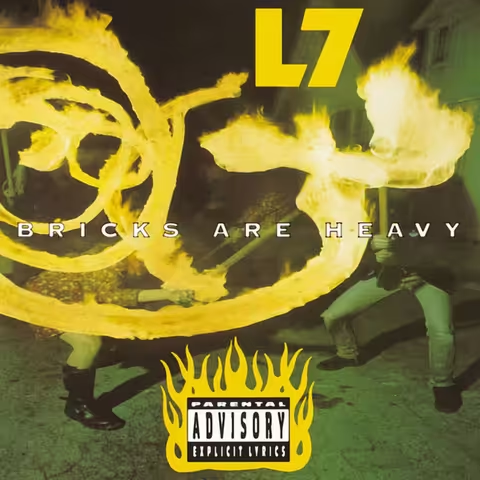
The sleeve is one of the great mood pieces of the era and almost nobody can tell you what is happening in it at first glance. It is a long-exposure night photograph of fire performers, the looping trails of flame frozen into glowing yellow-green ribbons against a black street. There is no band photo on the front, no logo theatrics, just that hypnotic, faintly menacing image and the title spaced out in plain capitals.
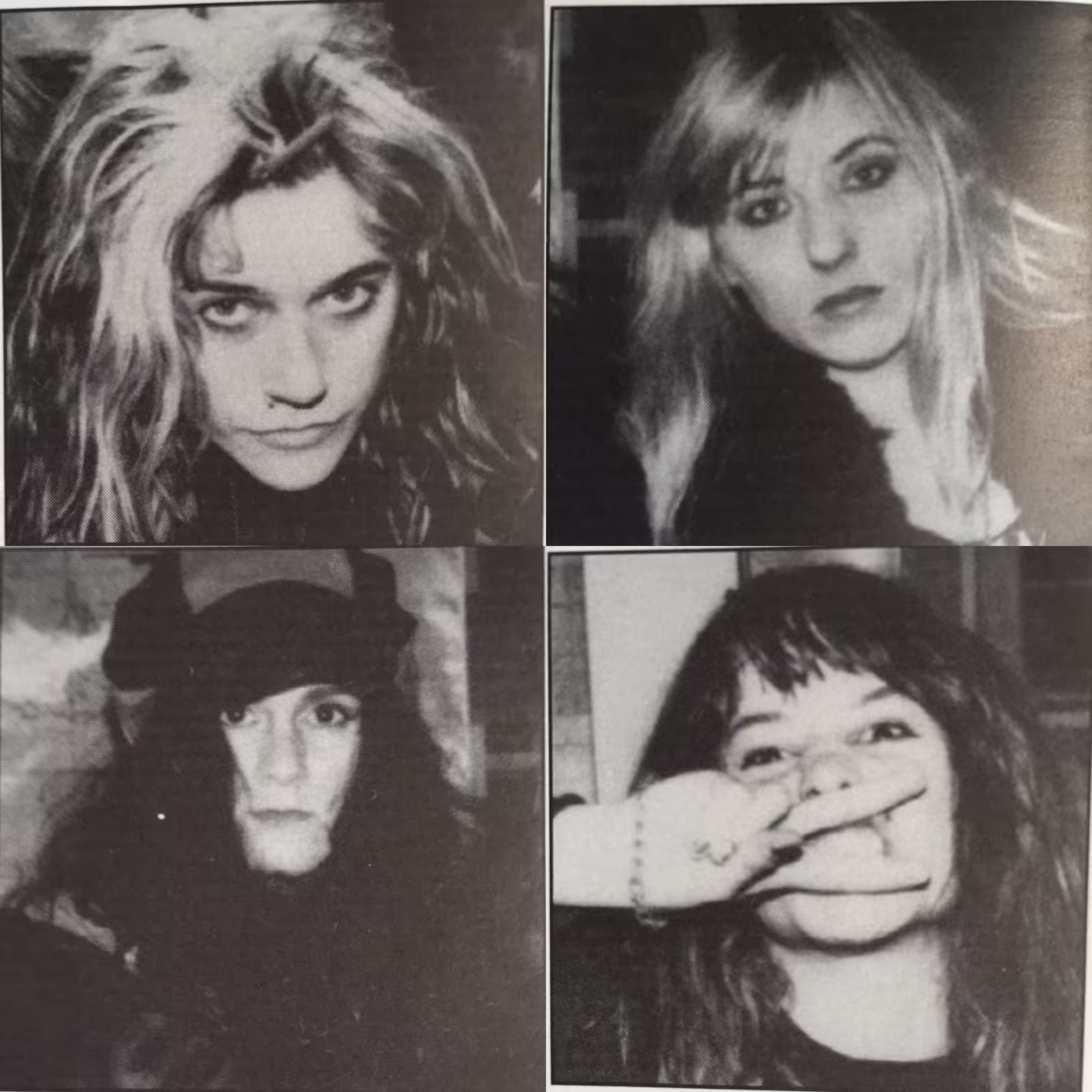
It is a deliberately ambiguous choice for a record this aggressive, and it works because it refuses to tell you what to feel. The parental advisory sticker in the corner, rendered with its own little flames, does the rest of the talking. Art direction came from Elizabeth Hale and Jeff Price, with photography credited to Vicki Berndt, Arlan E. Helm and Damion Romero. The interior carries the grainy, photocopied portrait shots of the four members that look more like a punk fanzine than a Warner Bros. budget.
Release and Reception
When Bricks Are Heavy arrived on 14 April 1992, the critics largely understood what they were hearing, even when they argued about Vig's polish. AllMusic later called it the band's "crowning achievement" and "an impossible act to follow", praising the way Vig helped L7 "obtain a tight, compact sound" without neutering them. Robert Christgau handed it an A and named it the year's fourth-best album on his ballot, calling it "an object lesson in how to advance your music by meeting the marketplace halfway".
Entertainment Weekly's Gina Arnold gave it an A and nailed the appeal, describing "catchy tunes and mean vocals on top of ugly guitars and a quick-but-thick bottom of cast-iron grunge" and calling the whole thing "simultaneously fun and furious, an intensely appealing combination". Kerrang awarded it five Ks, and NME gave it eight out of ten under the headline "Kicking Against the Bricks", insisting the album "verifies their hard rock credentials completely" rather than parking them in a grunge pigeonhole.
Not everyone was sold on the production. The Los Angeles Times, Rolling Stone and the Chicago Tribune all circled the same reservation, that Vig's neat dynamics occasionally sanded down a band who might have been more thrilling left raw. Rolling Stone's Arion Berger felt the album was "merely raucous where it might have been apocalyptic". It was a fair argument, and one the band themselves have flirted with, but it did nothing to dent the record's momentum. Bricks Are Heavy reached number 24 in the UK, topped the US Heatseekers chart, peaked at 160 on the Billboard 200 and went on to sell around 327,000 copies in America, comfortably the biggest of L7's career.
Singles and Music Videos
The campaign was built around three singles, and one of them did almost all the heavy lifting. "Pretend We're Dead" was the breakout, a genuine alternative-radio hit that climbed to number 8 on the US Modern Rock chart and into the UK top thirty, carried by a video that put the band's deadpan humour on heavy MTV rotation. "Everglade" and "Monster" followed, both finding their way onto the UK chart and keeping L7 in front of British audiences through 1992 and into 1993.
| Single | Year | US Modern Rock | UK Singles | Australia | Notes |
|---|---|---|---|---|---|
| Pretend We're Dead | 1992 | 8 | 21 | 50 | 13 weeks on the US Modern Rock chart |
| Everglade | 1992 | 27 | 85 | Jennifer Finch on lead vocal | |
| Monster | 1993 | 33 | Suzi Gardner on lead vocal |
"Shitlist" was never a single, and the reason is built into the title. With a word like that up front it was effectively barred from radio and most television, so it stayed an album track and a live favourite until Hollywood gave it a second life. The contrast is the whole story of L7 on a major label, one song engineered to sail onto daytime MTV and another that could not be named on air, sitting four tracks apart on the same record.
Touring and Live
L7 toured Bricks Are Heavy hard, and the live show is where the album's reputation hardened into legend. The defining moment came at the Reading Festival on 29 August 1992, on the main stage, in front of a notoriously fickle British crowd that had taken to lobbing mud at bands it did not rate. The band had reportedly been hand-picked for the bill by Kurt Cobain, and the conditions were a mess. Sparks's shorts had no belt and were held up with gaffer tape, the mud was flying, and the set was sliding sideways.
So Sparks reached into her own underwear, pulled out a used tampon and threw it into the crowd with the words that have followed her ever since.
"Eat my tampon, fuckers."
Donita Sparks, Reading Festival, August 1992
She followed it, with perfect comic timing, by advising the front rows to watch out for tuberculosis. Backstage afterwards her reaction was not panic but strategy, telling her team to get a press release ready, because she understood instantly that the moment was bigger than the gig. It was also, she has reflected, a peak that doubled as a turning point.
"We were expecting to keep going up. That show started the plateau."
Donita Sparks, The Guardian, 2020
The Reading tampon is now the single most retold L7 story, and it has slightly unfairly overshadowed the music. But it captures something true about the band at that moment, fearless, funny, confrontational and completely unbothered by the rules of how a major-label act was supposed to behave. Sparks has been clear-eyed about where the album sits in the arc of the band.
"This album, Bricks Are Heavy, is probably our career peak. Not that I think it's our musical peak, but it was definitely our career peak. We were hot shit."
Donita Sparks, Life of the Record, 2022
In TV, Film and Media
Songs from Bricks Are Heavy have lived a long second life on screen, which is a large part of why the album refuses to fade. "Shitlist" is the most travelled of all, soundtracking a Juliette Lewis scene in Oliver Stone's 1994 film "Natural Born Killers", a placement Sparks has gently pushed back on given the song's reputation.
"For the record, I am against violence."
Donita Sparks, Life of the Record, 2022
The reach goes well beyond one film. The album has become a quiet staple of nineties pop culture, turning up in unexpected corners across film, television and gaming.
- "Pretend We're Dead" features in the video game "Grand Theft Auto: San Andreas".
- The same song earned a "Beavis and Butt-Head" segment, with the pair conceding one member of L7 could beat them all up.
- L7 appeared as the fictional band "Camel Lips" in John Waters' 1994 comedy "Serial Mom".
- "Shitlist" became entrance music in professional wrestling, used by Jon Moxley among others.
Controversy and Censorship
For a band this provocative, the controversies were oddly good-natured, more mischief than menace. The Reading tampon throw is the headline act, an incident so famous it has its own folklore, but it sits alongside a string of moments designed to make polite society flinch. On the British television show The Word, Sparks once dropped her trousers mid-performance, the kind of stunt that was practically an L7 calling card.
The censorship was mostly structural rather than dramatic. "Shitlist" was kept off radio and daytime television purely by its title, a quiet form of gatekeeping that decided which L7 song the mainstream was allowed to hear. The parental advisory sticker on the sleeve did the rest. There were no lawsuits, no banned videos, no moral-panic headlines beyond the ones the band cheerfully generated themselves. L7's provocations were jokes with teeth, and the establishment mostly did not know whether to laugh or call security.
Covers, Samples and Tributes
The most interesting sampling story on Bricks Are Heavy runs the opposite way to most. Rather than being sampled, the album does the sampling, opening "Wargasm" with a snatch of Yoko Ono credited to her 1969 record "Live Peace in Toronto". Sparks had been immersed in Ono's Plastic Ono Band recordings and wanted that primal, shrieking energy to detonate the album, and clearing it produced one of her favourite memories of the whole campaign.
"What am I gonna say to Yoko Ono? She was just very cool and very supportive."
Donita Sparks, Life of the Record, 2022
Ono not only granted permission but telephoned Sparks personally to give her blessing, an extraordinary moment of solidarity between two women who had each spent years being treated by the rock press as easy targets. Direct cover versions of the album's songs are relatively scarce, a sign that these tracks are so welded to L7's specific delivery that other bands hesitate to touch them, but their fingerprints are all over the riot grrrl and alternative bands who followed.
Reissues, Remasters and Anniversaries
The album's reputation has only grown with time, and the band have marked it properly. In 2022, for the thirtieth anniversary, L7 toured Bricks Are Heavy in full, playing the record front to back across a run of shows, the ultimate proof that the songs still detonate in a live room three decades on.
The anniversary also brought a fresh remaster. Howie Weinberg, who mastered the original, returned to overhaul the album, and a deluxe vinyl reissue appeared in gold and black pressings through the revived Licorice Pizza brand. For long-time fans it was a chance to hear the record cleaned up by the same ears that signed off on it in 1992, and a reminder that the album's tight, compact sound was always the point.
Legacy and Influence
Three decades on, Bricks Are Heavy sits comfortably in the canon of the grunge era, regularly cited as one of the best albums the movement produced even though L7 always stood a little outside it. Spin placed it among the 300 best albums of the previous thirty years, Treble ranked it fifteenth and Loudwire sixteenth on their best-grunge lists, and Rolling Stone has folded it into multiple retrospectives, including its rundown of the fifty greatest grunge albums.
The deeper legacy is harder to chart but easier to hear. L7 proved that a band of women could be heavy, funny, political and commercially viable all at once, without softening any of it for the men who ran the industry. The riot grrrl movement that exploded alongside them, and the long line of bands who picked up the thread afterwards, owe a debt to the template L7 stamped onto a major label in 1992. The band followed it with "Hungry for Stink" in 1994 and were later the subject of the 2016 documentary "L7: Pretend We're Dead", but Bricks Are Heavy remains the record everything else is measured against. It is the sound of a band at full power, meeting the mainstream on their own terms and refusing to blink.
Things You Might Not Know
| Fact | Detail |
|---|---|
| The synth that wasn't | The keyboard-like hook of "Pretend We're Dead" is a single guitar run through so many effects pedals that it stopped sounding like a guitar at all. |
| Yoko phoned back | Yoko Ono not only cleared her sample for "Wargasm" but rang Donita Sparks personally to give her support, leaving Sparks momentarily lost for words. |
| Born from heartbreak | "Pretend We're Dead" grew out of a devastating breakup, with Sparks telling herself to pretend the person was dead simply to get through it. |
| Cobain's pick | L7 were reportedly chosen for the Reading 1992 main stage by Kurt Cobain himself. |
| The tampon heard round the world | At Reading 1992 Sparks threw a used tampon into the crowd with the line "eat my tampon, fuckers", then told her crew to get a press release ready. |
| Strobe-tuned to death | Butch Vig made the band tune every string against a strobe tuner before each take, an alien discipline for a band built on chaos. |
| Older than the deal | "Scrap" had been written around 1987, making the album's second track older than the band's major-label contract. |
| A real Scrap | The "Scrap" character was a real paint-huffing acquaintance who genuinely travelled to Las Vegas to find God before relapsing on the fumes. |
| Every line is true | Sparks and Suzi Gardner wrote "Slide" about their ex-partners on the agreement that nothing would be exaggerated, right down to a cane pushed through an amp. |
| Frying-pan inspiration | "Diet Pill" was sparked by a story about a country musician's wife hitting him with a frying pan, reframed as a domestic horror. |
| The revenge surf song | "Mr. Integrity" answered a scene rival who sneered that L7 could now "write more songs about cars" by doing exactly that, complete with guest bongos. |
| Christmas deadline | The Madison overdub sessions ran so close to Christmas that the band used every spare closet in Smart Studios to record in time. |
The Riffology Podcast
If this deep dive has you reaching for Bricks Are Heavy again, the Riffology podcast goes even further into the stories behind the songs, the sessions and the scene that shaped them. You will find the episode on L7 alongside the rest of the back catalogue wherever you get your podcasts, from Apple and Spotify to all the major platforms. Pour yourself something, turn it up loud, and join the conversation.
Comments