Introduction
The Better Life is the only album in the 3 Doors Down catalogue on which Brad Arnold plays both drums and lead vocals on every track. That single fact, easy to miss inside the personnel block on the back of the jewel case, is the production decision that shapes everything you hear on the record. The drum patterns are sung from the kit. The phrasing of the vocals is metered to the rhythm of a singer whose other arm is keeping time. The band's touring solution to the problem, hiring Richard Liles to take over the kit in 2000 so Arnold could finally front the band live, came only after Universal had signed a contract and Paul Ebersold had finished mixing eleven songs at Ardent Studios in Memphis built around the singer-drummer Arnold had been since he was a teenager.
Around that production choice, the rest of the story is one of the most lopsided commercial breakouts in turn-of-the-millennium rock. Released by Republic Records on 8 February 2000, The Better Life sold over seven million copies in the United States, parked the second single "Loser" at number one on Billboard's Mainstream Rock Tracks chart for twenty-one consecutive weeks (a then-record), and produced in "Kryptonite" a song that the songwriter himself, Arnold, has said was the third or fourth he ever wrote, started life as a daydream tapped out on a school desk in algebra class. Twenty-six years later, almost to the day, Arnold died of metastatic kidney cancer at the age of 47. This is the story of the album he made, the year it changed his life, and the band that built every record they made afterwards on the foundation it laid.
Album Facts
| Field | Detail |
|---|---|
| Artist | 3 Doors Down |
| Album | The Better Life |
| Release Date | 8 February 2000 |
| Label | Republic Records (Universal Music Group) |
| Producer(s) | Paul Ebersold |
| Studio(s) | Ardent Studios, Memphis, Tennessee (recording); The Record Plant, Los Angeles (mixing); A&M Mastering Studios, Hollywood (mastering) |
| Genre | Post-grunge, alternative rock, hard rock |
| Track Count | 11 |
| Total Runtime | Approximately 42 minutes |
| Billboard 200 Peak | #7 |
| UK Albums Chart Peak | Did not chart in the UK Top 75 |
| Other Notable Chart Peaks | "Kryptonite" #3 Billboard Hot 100; "Kryptonite" eleven weeks at #1 on Modern Rock Tracks; "Loser" twenty-one weeks at #1 on Mainstream Rock Tracks |
| Certifications | RIAA: 7× Platinum (certified February 2020); "Kryptonite" 8× Platinum; "Loser" Platinum (December 2024) |
| Estimated Sales | Over 7,000,000 US copies; the 46th-biggest-selling US album of the entire 2000s decade |
| Key Singles | "Kryptonite", "Loser", "Duck and Run", "Be Like That" |
Cultural Context
February 2000 was, by any meaningful measure, not a friendly moment for an unknown four-piece rock band from Mississippi to release a debut album. The Billboard 200 that week was led by Santana's Supernatural, which had been on the chart since the previous June and was approaching its fifteen-times-Platinum eventual ceiling. Britney Spears's debut was still in heavy circulation. *NSYNC's No Strings Attached was six weeks away and would, when it landed in March, sell 2.4 million US copies in its first week, a record that stood for fifteen years. Eminem was rehearsing the campaign for The Marshall Mathers LP. The cultural air-time on US radio, MTV, the late-night TV slots and the morning teen-pop press was almost entirely owned by pop and hip-hop.
Rock had not vanished; it had specialised. The Mainstream Rock and Modern Rock chart formats were thriving on their own terms but selling album volumes that fell well short of pop. Creed's Human Clay, released in September 1999, was sitting at the top of US rock in early 2000 and would go on to eleven-times Platinum. Limp Bizkit's Significant Other and Korn's Issues defined the nu-metal end of the market. Matchbox Twenty's Mad Season had landed in May 1999. Vertical Horizon's Everything You Want was rising on adult-alternative radio. The bands closest to 3 Doors Down's sonic neighbourhood (the melodic, post-Pearl-Jam, radio-friendly hard-rock end of the post-grunge spectrum) were Fuel, Lifehouse, Default and Nickelback, and almost all of them broke commercially in roughly the same eighteen-month window between mid-1999 and early 2001.
What the early 2000s post-grunge wave did differently from the grunge-and-alternative ascendancy of 1991 to 1995 was sell to the same record-buying audience that bought pop and country. The Better Life's eventual seven-million US sales were posted in a market where the year's biggest pop, country and rap releases routinely cleared eight to twelve million. Rock had become one large genre among several rather than a counter-cultural rallying point. Inside that market, the song that broke the door down for 3 Doors Down was a melodic, mid-tempo, lyrically vague piece of post-grunge that played comfortably on Top 40 stations, which was, in 2000, a substantially harder commercial trick than playing comfortably on Mainstream Rock.
The Band's Story Up to This Point
3 Doors Down formed in 1996 in Escatawpa, Mississippi, an unincorporated community in Jackson County a short drive inland from the Gulf Coast cities of Pascagoula and Biloxi. The founding three were teenagers from George County High School in Lucedale: drummer-and-eventual-vocalist Brad Arnold, lead guitarist Matt Roberts and bassist Todd Harrell. The band name came out of a gig in Foley, Alabama, where the trio passed a building with a damaged sign that read DOORS DOWN; the missing letters were never restored, and the trio simply prefixed the number 3 to what was left.
Arnold became the singer largely because nobody else wanted to. He has retold the story in interviews many times: he was already the drummer, Todd Harrell's then-girlfriend told him he had a good voice, and the band could not afford to pay anyone else, so the singer-drummer arrangement stuck. The set list at their earliest shows was a mix of Bush and Metallica covers (the two bands Arnold most often cites as the era's biggest influences on him) padded with a handful of originals written by Arnold from the kit.
In the spring of 1997 the trio recorded an independent demo at Holly House Recording in Biloxi, mixed and mastered by engineer Clyde Holly, and pressed a thousand CDs. Six of those demo tracks (including "Kryptonite", "Loser" and "Duck and Run") would eventually be re-recorded for The Better Life. The first thousand copies took two years to sell. The second thousand sold in ten days. The acceleration began when a single local DJ at WCPR-FM, Biloxi's mainstream-rock station, put "Kryptonite" into rotation and discovered that it generated more listener calls than anything else on the playlist.
WCPR's operations manager Kenny Vest kept the song on heavy rotation; it sat at number one on the station's listener-request count for more than fifteen weeks. WXTB in Tampa picked it up shortly afterwards. WCPR's program director eventually mailed the demo CD to New York manager Phin Daly at Bill McGathy's In De Goot Entertainment, and Daly booked the band into a showcase at CBGB, the Bowery club that had broken Television, the Ramones and Blondie and was now, improbably, a launchpad for a Mississippi post-grunge demo.
Daly told HitQuarters that the showcase decision came in seconds:
"Once they got on stage and started playing, it was apparent the magic was in the music. So we moved to sign them."
Phin Daly, In De Goot Entertainment, to HitQuarters
Universal Records and Atlantic Records both came to the table; the band signed to Republic Records, the boutique Universal imprint run by brothers Monte and Avery Lipman, in 1999. Chris Henderson, previously of a local Biloxi band called Burning Bridges, joined as rhythm guitarist in 1998, expanding the lineup to a four-piece in time for the major-label sessions.
Pre-production and Demos
The single most important fact about the pre-production of The Better Life is that the heart of the album already existed. The 1997 Holly House demo, recorded for around two thousand dollars and pressed in a thousand-copy run, contained the studio-tested arrangements of "Kryptonite", "Loser", "Duck and Run" and three other songs that would make the final album. These were not the kind of polish-and-rerecord-from-scratch demos that major-label A&R typically rebuilds from the ground up. They were the arrangements that Mississippi Gulf Coast radio had already proved would work.
Arnold has been explicit, in interviews across the album's twenty-five-year afterlife, that the band's brief to producer Paul Ebersold was to preserve the demo feel as far as possible. In a 2021 interview he put the logic plainly:
"Some songs like 'Kryptonite', we strived to make it sound very much like the demo version because we got signed on the back of those demos thanks to our local radio stations in Mississippi from playing those songs, so the last thing we want to do is change it."
Brad Arnold, 2021 interview
The five tracks that were genuinely new to the album, written after the Universal deal, were "Duck and Run" (in its Henderson-co-write form, distinct from the trio-era demo), "Not Enough", "Be Like That", the title track "The Better Life" and the closer "So I Need You". Those five are the ones on which the producer's, the mixer's and the label's fingerprints sit most visibly; the older songs were defended by the band as if they were heirlooms.
Republic released a six-song sampler CD in 1999, ahead of the album, to introduce the band to alternative-rock radio programmers outside the Mississippi-and-Tampa corridor. The sampler contained truncated versions of the songs the label had identified as singles. The campaign worked: by the time the album shipped in February 2000, "Kryptonite" had already been on US rock radio for several weeks.
Creating the Album
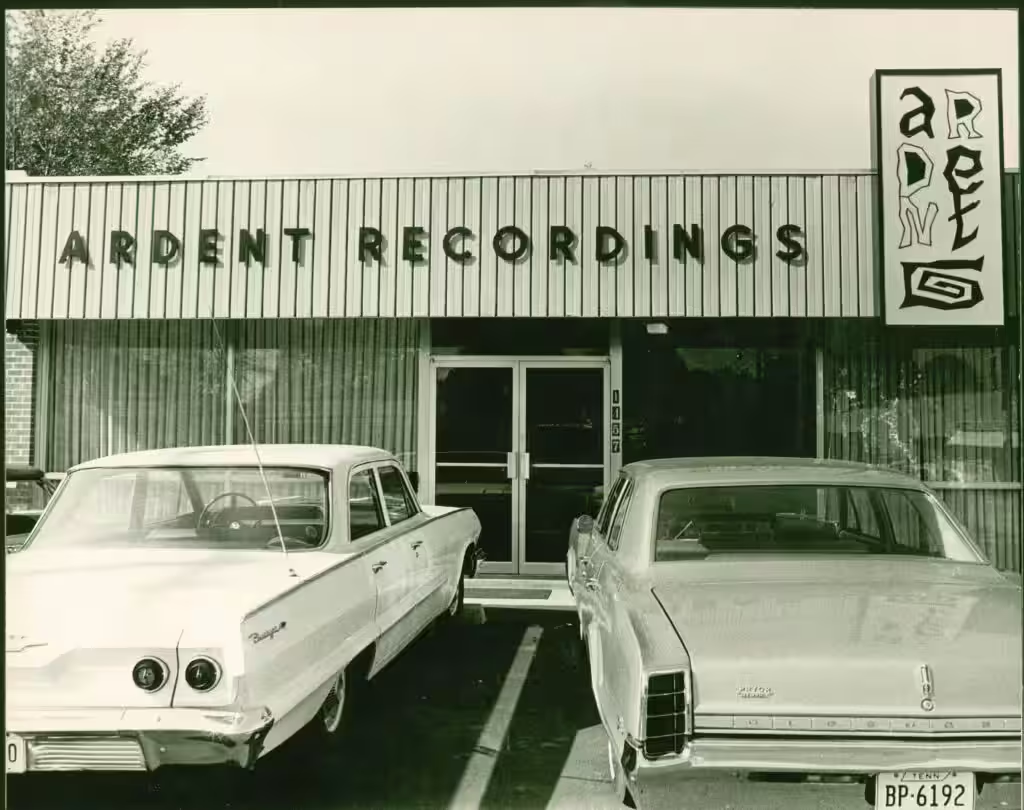
Recording took place at Ardent Studios in Memphis, Tennessee, in 1999. Ardent is one of the most storied independent studios in the American south; sessions there have included Big Star's first two albums, ZZ Top's Tres Hombres, parts of Led Zeppelin III, and a long run of R.E.M., the Replacements and Stevie Ray Vaughan dates. For a band whose previous studio experience was a two-thousand-dollar week in Biloxi, the move to Ardent was a substantial change of altitude.
Producer Paul Ebersold, then best known for his work with Sister Hazel, took the project. Ebersold engineered alongside Matt Martone. The session band consisted of the four members of the touring lineup, with one significant exception: session keyboardist Kevin Paige overdubbed atmospheric keyboard parts onto three songs ("Loser", "Duck and Run" and "Be Like That"). Brad Arnold tracked his drum parts and his lead vocals separately, working on the same songs from the two roles he had always played in the band.
Mixing was handed to Toby Wright at The Record Plant in Los Angeles. Wright's resume is one of the album's most important hidden assets: by 1999 he had mixed records for Alice in Chains (including the 1995 self-titled "tripod" album), Korn (Life Is Peachy), and Sevendust. His mixing sensibility, dense, bass-forward, heavy on midrange punch, is part of why The Better Life sits adjacent to the late-grunge end of the post-grunge spectrum rather than the lighter, country-tinged end that Sister Hazel had pioneered. Mike Butler was Wright's assistant mix engineer. Andrew Garver handled digital editing.
Mastering was completed at A&M Mastering Studios in Hollywood by Stephen Marcussen, a veteran whose credits stretch from Tom Petty to Marilyn Manson. The original release carries a 1999 copyright date, which means the album was finished and sitting on Universal's shelves for several weeks before the label sent "Kryptonite" to radio in January 2000.
The sonic target was the slot 3 Doors Down would occupy on US radio: heavier than Matchbox Twenty, more melodic than Korn, drier than Creed and tighter than Fuel. Wright's mix delivers it. The guitars are loud but never abrasive, the vocals are mixed forward enough to carry every word of Arnold's straightforward delivery, and the rhythm section sits where a singer-drummer would naturally feel it. Some critics, including the original AllMusic review, would later complain that the mix sounded compressed; the same compression is what made the album sound enormous on a car stereo, which was where most of its eventual seven million buyers would hear it.
Personnel and Credits
| Role | Player | Notes |
|---|---|---|
| Core band | ||
| Lead vocals, drums | Brad Arnold | Only 3 Doors Down studio album on which Arnold plays drums on every track |
| Lead guitar | Matt Roberts | Co-founder; departed 2012 due to health issues, died 2016 |
| Bass | Todd Harrell | Co-founder; later faced multiple legal issues |
| Rhythm guitar | Chris Henderson | Joined 1998 from Biloxi band Burning Bridges; first co-writing credits on this album |
| Additional musicians | ||
| Keyboards | Kevin Paige | Session player; contributed keyboard parts to "Loser", "Duck and Run" and "Be Like That" |
| Production & engineering | ||
| Producer, engineer | Paul Ebersold | Previously produced Sister Hazel |
| Engineer | Matt Martone | Ardent Studios |
| Mixer | Toby Wright | The Record Plant, Los Angeles; previously mixed Alice in Chains, Korn, Sevendust |
| Assistant mix engineer | Mike Butler | The Record Plant |
| Digital editing | Andrew Garver | |
| Mastering | Stephen Marcussen | A&M Mastering Studios, Hollywood |
| Artwork & live additions | ||
| Art direction & design | P.R. Brown | Bau-Da Design Lab |
| Photography | Andrew MacNaughtan | Canadian rock photographer (Rush, Our Lady Peace) |
| Best Buy live bonus tracks | Mixed by Brian Sperber, mastered by Tony Gillis | Recorded at The Roxy Theater, Atlanta and at WMFS, Memphis |
| Touring drummer (from 2000) | Richard Liles | Hired 2000–2002 so Arnold could front the band live |
Two production credits beyond the band itself deserve highlighting. Toby Wright's mixing CV is one of the album's quietly important reasons for its commercial reach: the same engineer responsible for the dense, claustrophobic mix of Alice in Chains' 1995 self-titled record gave The Better Life a wide-but-tight sonic field that survived FM compression intact. And Stephen Marcussen's mastering at A&M Mastering Studios meant the album landed on the same loudness curve as the bigger 1999 rock records Universal was already shipping at scale; the album sounded, on first listen, as if it belonged.
The Songs
| # | Title | Writer(s) | Length | Single? | Notes |
|---|---|---|---|---|---|
| 1 | Kryptonite | Arnold / Roberts / Harrell | 3:53 | Yes, January 2000 (lead) | Written by Arnold aged 15 in algebra class; #3 Billboard Hot 100; over 1 billion Spotify streams |
| 2 | Loser | Arnold / Roberts / Harrell | 4:24 | Yes, mid-2000 | 21 consecutive weeks at #1 on Mainstream Rock Tracks, then a chart record |
| 3 | Duck and Run | Arnold / Roberts / Harrell / Henderson | 3:53 | Yes, late 2000 | Three weeks at #1 Mainstream Rock; on The Hole (2001) soundtrack |
| 4 | Not Enough | Arnold / Roberts / Harrell / Henderson | 4:00 | No | Kevin Paige keyboards |
| 5 | Be Like That | Arnold / Henderson | 4:25 | Yes, 2001 | Re-recorded with alternate lyrics for American Pie 2 soundtrack |
| 6 | Life of My Own | Arnold / Harrell | 4:11 | No | Listed as "Life on My Own" on the 20th Anniversary Edition |
| 7 | The Better Life | Arnold / Roberts / Harrell / Henderson | 3:58 | No | Title track; written post-signing |
| 8 | Down Poison | Arnold / Roberts / Henderson | 3:39 | No | One of the album's heavier deep cuts |
| 9 | By My Side | Arnold / Roberts / Harrell | 4:18 | No | The album's most overtly emotional ballad |
| 10 | Smack | Arnold / Roberts / Henderson | 2:32 | No | Shortest track; aggressive palate cleanser |
| 11 | So I Need You | Arnold / Roberts / Harrell / Henderson | 4:30 | No | Album closer; written post-signing |
"Kryptonite" opens the album and is the song everything else depends on. Arnold has said in interviews that the music came first, written when he was around fifteen at George County High School, and that the rhythmic figure that defines the verse began as desk-tapping in a maths class. The Superman conceit at the heart of the lyric, "If I go crazy will you still call me Superman", is more careful than it sounds on first hearing; Arnold has been at pains to point out, when interviewers have asked, that the song is asking the same question in both directions, whether someone will still be there in the bad times and whether they will still be there in the good. It is a more emotionally articulate teenage lyric than the genre is generally credited with producing.
"Loser" is the song whose commercial performance most exceeds its current cultural recall. The lyric is the album's darkest piece of writing, by some distance: Arnold has said it is about a friend who became addicted to drugs, and that the title is the friend's view of himself rather than the songwriter's. The riff is the closest the album comes to the late-period Alice in Chains template Toby Wright had spent the previous five years mixing. It spent twenty-one consecutive weeks at number one on Billboard's Mainstream Rock Tracks chart, a chart record that stood for years. Arnold has admitted that at the time, the band were so focused on "Kryptonite" as the song that defined them that they barely noticed the chart-record run "Loser" was putting together in parallel.
"Duck and Run" is the album's third Number One Mainstream Rock single (three weeks at the top in late 2000 and early 2001) and the first 3 Doors Down song to carry a Chris Henderson co-writing credit. The riff is angular, the chorus opens out, and the song was later licensed for the Thora Birch / Keira Knightley thriller The Hole in 2001.
"Be Like That" is the softest moment on the record and the most consequential of the songs the band wrote after signing. Built on an acoustic-led arrangement with Kevin Paige's keyboards, it explores the wish-I-was-someone-else fantasy that the album's title track and the closer also circle. American Pie 2 picked it up for its 2001 soundtrack, and the band re-recorded an alternate-opening-lyric version of the song for the soundtrack release, a version that has been the more-heard one on US radio ever since.
Among the non-singles, three songs reward fan-level attention. "Life of My Own" is the album's most introspective cut and the song most often cited by long-term fans as the underrated heart of the record. "Down Poison" is the album's heaviest piece of writing, the song closest to the Alice in Chains gravity that Toby Wright's mixing aesthetic was tuned to deliver. "Smack", at two minutes thirty-two, is the shortest and most aggressive track on the album and functions as a palate cleanser before the closing ballad.
B-sides, Outtakes and Lost Songs
The Better Life had a less elaborate B-side life than the album's commercial scale might suggest. US singles in 2000 were largely promo-only at the major-label level, and most of the international commercial singles for the album's four singles were backed with album tracks rather than dedicated B-sides. The most interesting catalogue artefact is the Best Buy edition of the album, which carried a separate disc of live recordings made at The Roxy Theater in Atlanta and at the WMFS studio session in Memphis, mixed by Brian Sperber and mastered by Tony Gillis at The Hit Factory in New York. Those live cuts are the closest the album cycle came to a formal companion release before the later anniversary editions.
Two later reissues opened the vault wider. The 2007 Deluxe Edition, a two-disc set supervised by Bill Levenson, Phin Daly and Tom Mackay, paired the album with a second disc of demos, live tracks and rarities. The 2009 "Even Better Life Ultimate Fan Pack" repackaged the album with additional content for collectors. The 2020 Twentieth Anniversary Edition added another round of demo material and live performances from the 2000 to 2002 touring cycle, including some of the radio sessions the band had recorded as the singles climbed the charts.
Album Artwork and Packaging
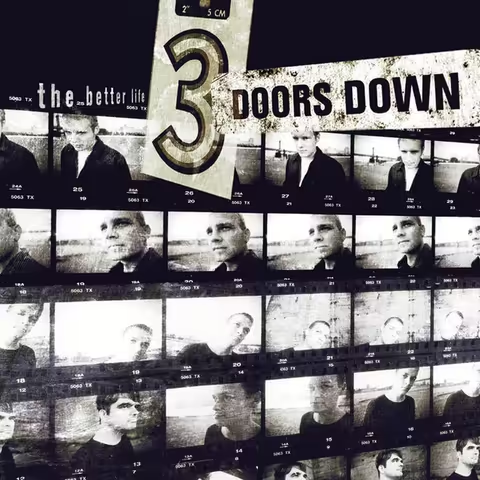
The cover is a moody, blue-toned photographic composition designed by P.R. Brown at Bau-Da Design Lab. The photography is by Canadian rock photographer Andrew MacNaughtan, whose other early-2000s work included shoots for Rush, Our Lady Peace and Avril Lavigne. Brown's art-direction sensibility is recognisable across his other turn-of-the-millennium rock work for clients including Nickelback and Sevendust: cool colour temperature, photographic naturalism, restrained typography. The cover treats the album title and band name as set on top of the image rather than integrated into it, a relatively cool design choice for a debut where most labels would have asked for the band photo on the front. The result is a sleeve that looks like a mid-career record rather than a first album from an unknown band.
The original CD pressing came in a standard jewel case with a clear tray and an eight-page booklet carrying liner notes and lyrics. The 2007 Deluxe Edition received its own treatment by designer Meire Murakami with live photography by Douglas Sonders. The 2020 Twentieth Anniversary Edition was redesigned again, this time with retrospective text. None of the redesigns has displaced the original Bau-Da Design cover as the canonical image of the record on streaming services or in retrospective coverage.
Release and Reception
The Better Life was released on 8 February 2000. "Kryptonite" had already been on US rock radio for around four weeks by that point. The album debuted on the Billboard 200 and climbed gradually as the singles compounded, peaking at number seven. By the end of 2000, US Soundscan put it as the eleventh-best-selling album in the country for the year, behind a roster of pop, rap and country releases that were several orders of magnitude more promoted. It eventually received seven-times Platinum RIAA certification in February 2020 for over seven million US copies sold, and was ranked as the forty-sixth-biggest-selling US album of the entire 2000s decade.
Critical reception was divided in the way that most enormously successful post-grunge debuts of the era were divided. Stephen Thomas Erlewine's AllMusic review acknowledged the band's technical competence but found the songwriting derivative, a judgement that would shadow the album's critical reputation for the next two decades:
"Uninspired and clichéd songwriting that draws unflattering comparisons to a grab-bag of Pearl Jam and Goo Goo Dolls influences."
Stephen Thomas Erlewine, AllMusic
The retrospective re-evaluation has been kinder. In 2025, Loudwire named The Better Life the best post-grunge album of 2000, an explicit reframing of the record's commercial scale as artistic significance within its own genre. The American Music Awards gave 3 Doors Down "Favorite Pop/Rock New Artist" in 2001, and the band received a Grammy nomination for Best Rock Song for "Kryptonite". Billboard's end-of-decade artist ranking for 2000 to 2010 placed 3 Doors Down at number thirty among all artists in any genre.
Republic Records co-founders Monte and Avery Lipman, whose decision to sign the band was the bet that built their imprint, summarised it after Brad Arnold's 2026 death:
"The impact Brad Arnold and 3 Doors Down had on us is immeasurable."
Monte and Avery Lipman, Republic Records, February 2026
Singles and Music Videos
| Single | Release | Chart highs | Video |
|---|---|---|---|
| Kryptonite | January 2000 | #3 Hot 100; 11 weeks #1 Modern Rock; 9 weeks #1 Mainstream Rock; 5 weeks #1 Pop Airplay; #6 Canada; #7 Australia; #13 New Zealand | Directed by Dean Karr; the ageing 1950s TV superhero rooftop concept |
| Loser | Mid-2000 | #55 Hot 100; 21 weeks #1 Mainstream Rock (then-record); 53 weeks on chart; #2 Modern Rock | Directed by Liz Friedlander; California, August 2000; dimly lit high-school setting |
| Duck and Run | Late 2000 | 3 weeks #1 Mainstream Rock; #11 Modern Rock; #10 Bubbling Under Hot 100 | Live performance footage; toured-life montage |
| Be Like That | 2001 | #24 Hot 100; #10 Mainstream Rock; #22 Modern Rock | Two videos: original album version and an American Pie 2 tie-in |
The "Kryptonite" video, directed by Dean Karr (whose other work includes Marilyn Manson and Ozzy Osbourne), is the single most-played piece of video in the album's afterlife. Karr's treatment follows an ageing former television superhero from the 1950s living in a rundown apartment building, intercut with the band performing on the rooftop, until the elderly hero witnesses a domestic dispute below, dons his costume and dives through a skylight. Arnold has admitted in later interviews that he was initially unconvinced by the concept; he has also acknowledged it was a key reason the song broke beyond rock radio into MTV daytime rotation.
Liz Friedlander's "Loser" video, shot in California in early August 2000, is a colder and more atmospheric piece. The band performs in a dim high-school corridor and classroom set, a deliberate stylistic match for the song's small-town-restlessness lyrical world. The "Duck and Run" video relied principally on live performance footage from the increasingly frantic 2000 to 2001 touring schedule. "Be Like That" received two videos: one for the original album version and a separate one for the lyrically-adjusted American Pie 2 soundtrack version.
Touring and Live
The single most consequential touring decision the band made during the album cycle was hiring Richard Liles as touring drummer in 2000. With Brad Arnold's vocal increasingly being asked to carry headline shows in increasingly large venues, the singer-drummer setup that had worked in Mississippi clubs was no longer practical. Liles took over the kit and Arnold stepped to the front. The change happened mid-cycle, in front of audiences that had bought the album expecting the band they had heard on it; the transition was handled cleanly.
The band toured almost without pause through 2000 and into 2002, graduating from clubs to theatres to amphitheatre support slots as each single climbed. Arnold reflected on the velocity of that period in a later interview:
"It was like a different lifetime and we were all, well, I will use the word 'work' loosely, but we did so much back then. We were just doing everything for the first time. I'd never been out of Mississippi much."
Brad Arnold, on the 2000 to 2001 touring cycle
Documented landmarks from the 2000 to 2002 cycle include:
- The Roxy Theater, Atlanta, Georgia, the source of one of the Best Buy edition's live bonus tracks.
- WMFS in Memphis, Tennessee, the radio-session source for the rest of the Best Buy live bonus material.
- The 2001 American Music Awards in Los Angeles, where the band won Favorite Pop/Rock New Artist.
- Heavy MTV Total Request Live appearances built around the Dean Karr "Kryptonite" video.
- Amphitheatre support slots through the summer of 2001 as the album's fourth single "Be Like That" climbed.
The pace was brutal. Arnold has been candid in later interviews about how volatile his personal life became during the cycle, and the alcohol-rehabilitation period that followed it.
In TV, Film and Media
The album's screen and sync afterlife rests on three principal placements, all of which arrived inside the original album cycle:
- The Hole (2001). The Nick Hamm-directed British thriller starring Thora Birch and Keira Knightley used "Duck and Run" on its soundtrack release, the album's first significant film placement.
- American Pie 2 (2001). The Universal-distributed sequel licensed "Be Like That" and the band recorded a separate version with alternate opening lyrics specifically for the soundtrack. The American Pie 2 cut has been the more frequently-played version on US radio in the years since, and is the version casually older listeners typically remember.
- NFL, NBA and college-sports broadcasts. "Kryptonite" embedded itself in US sports broadcast and arena play during the early 2000s and became one of the genre-defining stadium rock cues of the decade, alongside Nickelback's "How You Remind Me" and Creed's "Higher".
The album's broader media legacy extends through the band's later sync work. "Citizen/Soldier" (from the 2008 self-titled album) anchored a high-profile US National Guard recruitment campaign, and "Let Me Be Myself" appeared in a GEICO commercial; both placements were direct downstream consequences of The Better Life having put the band on the sync-licensing radar of every major US ad agency.
Reissues, Remasters and Anniversaries
The Better Life has had three major reissues. The 2007 Deluxe Edition was a two-disc set supervised by Bill Levenson, Phin Daly and Tom Mackay; the second disc contained demos, B-sides and live recordings from the 2000 to 2002 cycle. The 2009 "Even Better Life Ultimate Fan Pack" rebundled the album with additional material aimed at long-term collectors and was packaged in a distinct sleeve. The 2020 Twentieth Anniversary Edition, released in February 2020 around the album's RIAA seven-times-Platinum certification, added a further round of demos and live cuts and was the version that introduced "Life on My Own" (the alternative spelling of "Life of My Own") to physical-format buyers. None of the reissues has produced a half-speed-mastered vinyl edition or a Dolby Atmos remix as of 2026.
The 2020 anniversary cycle was the last full reissue campaign before Brad Arnold's 2025 cancer diagnosis. Whether a posthumous super-deluxe edition with full session-tape extracts will eventually emerge is, at the time of writing, an open question. Republic Records' catalogue division has historically been one of Universal's more active reissue operations.
Legacy and Influence
The Better Life set a commercial template that 3 Doors Down maintained, with remarkable consistency, for the next sixteen years. Their second album, Away from the Sun, arrived in November 2002 and went five-times Platinum, producing "When I'm Gone" and "Here Without You". Their third album, Seventeen Days, debuted at number one on the Billboard 200 in 2005. Their self-titled fourth album in 2008 also debuted at number one. Time of My Life (2011) peaked at three. Us and the Night (2016) peaked at fourteen. The band cleared over twenty million album sales worldwide across that run.
Inside the band, the post-Better Life years were less stable. Co-founder Matt Roberts left in 2012 due to health issues and died in August 2016, aged 38, of a prescription-drug overdose. Bassist Todd Harrell was arrested in 2013 on vehicular-homicide charges in Tennessee and was no longer a member of the band. Of the four members who recorded the album, by 2017 only Brad Arnold and Chris Henderson remained in the touring lineup. The Better Life Foundation, which the band launched in 2003 and named after the album, ran annual benefit concerts in the Gulf Coast region for years, with guest performers including Lynyrd Skynyrd and Tracy Lawrence, and expanded its work substantially in the wake of Hurricane Katrina in 2005.
In May 2025 Brad Arnold disclosed that he had been diagnosed with stage-four clear-cell renal-cell carcinoma; the cancer had metastasised to his lungs. The band cancelled their summer 2025 tour. Arnold spoke about the diagnosis publicly through the autumn of 2025 with the same directness he had used in interviews throughout his career. He died on 7 February 2026, at his home, at the age of 47, with his wife Jennifer present. The date sits one day before what would have been the album's twenty-sixth anniversary.
Tributes followed from Creed, Daughtry, Black Stone Cherry and dozens of other bands of the post-grunge era. "Kryptonite" passed one billion Spotify streams in October 2024, a milestone Arnold lived long enough to see, and continued accumulating new plays through the years afterwards. The cultural footprint of an album that took a band from a Mississippi club circuit to the eleventh-biggest-selling US release of 2000 has not faded.
Things You Might Not Know
| Fact | Detail |
|---|---|
| The only Arnold-on-drums album | The Better Life is the only 3 Doors Down studio album on which Brad Arnold both played drums and sang lead vocals on every track. The band hired Richard Liles to take the kit on tour from 2000. |
| Kryptonite was an algebra-class daydream | Arnold has said the song was the third or fourth he ever wrote, composed at age fifteen at George County High School in Lucedale, Mississippi. The verse's skippy rhythm started as desk-tapping during a maths lesson. |
| The demo arithmetic | The 1997 Holly House demo's first thousand CDs took two years to sell; the next thousand sold in ten days, after WCPR-FM put "Kryptonite" on heavy rotation. |
| The band name origin | The trio spotted a damaged sign reading DOORS DOWN on a building in Foley, Alabama; they added the number 3 to match their then-membership and the name stuck. |
| The CBGB showcase | The signing showcase that brought Universal to the table was held at CBGB on the Bowery, the New York punk-rock club that had launched the Ramones, Television and Blondie a quarter-century earlier. |
| A 21-week chart record on autopilot | "Loser" spent twenty-one consecutive weeks at number one on Billboard's Mainstream Rock Tracks chart, then a chart record. Arnold has admitted the band were so focused on "Kryptonite" that they barely registered the milestone as it was happening. |
| The American Pie 2 rewrite | "Be Like That" was re-recorded with alternate opening lyrics specifically for the American Pie 2 soundtrack in 2001; the soundtrack version is the one US radio has played most often ever since. |
| Toby Wright's mixing pedigree | The mixer of The Better Life had previously mixed Alice in Chains' 1995 self-titled "tripod" record, Korn's Life Is Peachy and several Sevendust records. The album's heavy-but-radio-ready sound owes a great deal to that lineage. |
| The cover photographer's other clients | Sleeve photographer Andrew MacNaughtan, a Canadian rock photographer, also shot album campaigns for Rush, Our Lady Peace and Avril Lavigne in the same era. |
| The album was finished before the first single dropped | The original CD pressing carries a 1999 copyright; the album was completed and sitting on Universal's shelves for several weeks before "Kryptonite" was sent to radio in January 2000. |
| The Foundation | The band launched The Better Life Foundation, named after the album, in 2003 to support children and Gulf Coast communities. It expanded its scope after Hurricane Katrina in 2005. |
| The one-day-shy anniversary | Brad Arnold died on 7 February 2026, one day before the album's twenty-sixth release anniversary. |
The Riffology Podcast
The Riffology podcast covers The Better Life in depth: the Mississippi club years, the demo-to-Republic-Records arc, the Brad Arnold singer-drummer dynamic that defined the studio recording, and the album's twenty-six-year cultural afterlife. The episode is available on Apple Podcasts, Spotify, Amazon Music and every other major platform.
Comments