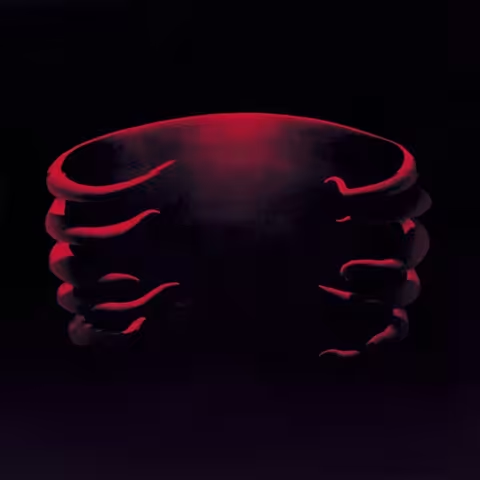
Steve Albini took the In Utero gig in February 1993; Butch Vig was mixing Vs.; Pearl Jam were the biggest band on FM rock radio; and a four-piece from Los Angeles who had spent the previous eighteen months opening for Rage Against the Machine, White Zombie and the Rollins Band put out a debut album whose front cover was a sculpture of a human ribcage and whose closing track was technically the sixty-ninth on the disc. Undertow was Tool's first full-length statement, and it set itself in deliberate opposition to almost every visual and sonic cue that grunge had taught American rock radio to expect from a heavy band in 1993.
Released by Zoo Entertainment on 6 April 1993, Undertow was tracked at Grand Master Studios in Hollywood with co-producer Sylvia Massy, mixed by Ron St. Germain at Ameraycan in North Hollywood and mastered by Howie Weinberg. It is the only Tool studio record to feature founding bassist Paul D'Amour, and the only one issued while comedian Bill Hicks, credited in the liner notes as an inspiration, was still alive. The cover ribcage, designed by guitarist Adam Jones, and the photographs inside got the album pulled from Wal-Mart and Kmart inside its first year, an early collision with mainstream retail that the band turned into a publishing-stunt rebuttal and a permanent piece of their mythology.
Album Facts
| Field | Detail |
|---|---|
| Artist | Tool |
| Album | Undertow |
| Release date | 6 April 1993 |
| Label | Zoo Entertainment |
| Producers | Sylvia Massy and Tool |
| Studios | Grand Master Studios, Hollywood (tracking); Ameraycan Studios, North Hollywood (mixing) |
| Mastering | Howie Weinberg, Masterdisk |
| Genre | Alternative metal, progressive metal, post-metal |
| Track count | 10 (the closer indexed as track 69 on most North American CDs) |
| Total runtime | 68 minutes 8 seconds |
| US Billboard 200 peak | 50 (original 1993 run); 19 on 2019 streaming re-entry |
| US Heatseekers peak | 1 |
| Other notable chart peaks | New Zealand 17; Australia 21 (2019 re-entry); Canada 49 |
| Certifications | 3x Platinum (RIAA, US); Platinum (ARIA, Australia); Platinum (Music Canada); Platinum (RMNZ, New Zealand) |
| Estimated US sales | 3,000,000+ (RIAA certification basis) |
| Key singles | Prison Sex (1993); Sober (1994) |
Cultural Context: What April 1993 Looked Like
The week Undertow shipped, the US Billboard 200 was topped by Eric Clapton's Unplugged, with Kenny G, Janet Jackson and Garth Brooks dominating the upper reaches and Stone Temple Pilots' Core grinding its way up the chart on the back of MTV play for Plush. Nirvana were inside Pachyderm Studio in Cannon Falls, Minnesota, tracking In Utero with Steve Albini for $25,000. Pearl Jam had just begun work on Vs. with Brendan O'Brien. Smashing Pumpkins were finishing Siamese Dream at Triclops in Marietta, Georgia. Rage Against the Machine, with whom Tool had toured the previous year and whose guitarist Tom Morello had originally introduced Danny Carey to Adam Jones, were on the road behind their self-titled debut.
Tool did not fit any of those rooms. They had no Seattle credibility, no Sub Pop pedigree, no obvious Lollapalooza-second-stage radio identity. The LA scene of 1992 and 1993 was tilted hard towards funk-metal (Red Hot Chili Peppers, Infectious Grooves, Fishbone) on one flank and the last gasps of Sunset Strip post-glam on the other. Undertow ran against both, with a foregrounded bass tone, a vocalist who sang rather than barked, drop-D riffs built on tension rather than groove, and a closing track whose final seven minutes consisted of cicadas chirping. It was the wrong record for the moment, which is why the moment eventually caught up to it rather than the other way round.
The Band's Story Up to This Point
Tool formed in Los Angeles in 1990 out of a network of film-industry and music-scene friendships. Adam Jones had moved west from Illinois to work in special effects; he met Maynard James Keenan, then remodelling pet stores, through a mutual friend in 1989 and was persuaded by a tape of Keenan's earlier band project that the two should form something. Carey lived in the apartment above Keenan, played with Green Jelly alongside him, and was introduced to Jones by Tom Morello, an old high-school friend of Jones who had been in Electric Sheep before Rage. Bassist Paul D'Amour, an aspiring film editor, came in last, completing the line-up in late 1990.
The band signed to Zoo Entertainment, a BMG-distributed boutique imprint whose roster also included Matthew Sweet, Green Jelly and the Odds. In March 1992 Zoo released the six-track EP Opiate, which the band described as the heaviest, most "slam and bang" material in their early book. The Hush video, with the four members stark naked and gagged with Parental Advisory stickers, was a deliberate goad to the Parents Music Resource Center and put Tool on the live circuit hard. They opened for the Rollins Band, Fishbone, Rage Against the Machine, White Zombie and Corrosion of Conformity through 1992. They walked into Grand Master Studios in late 1992 with the songs Opiate had been too hard and too narrow for: longer pieces, drop-D riffs, dynamic contrasts and an opening track that started with twenty-five seconds of near-silent gasping.
Pre-Production and Demos
Several of the Undertow tracks predated Opiate. The band has confirmed in multiple interviews that they intentionally held the slower, more dynamic, more progressive material back from the EP because they wanted the debut EP to be the unambiguous heavy statement, and the album to be the thing that broke the mould. "Prison Sex", "Sober", "Crawl Away" and "Flood" all existed in some form before the EP sessions; the EP took the singles, the album took the writing.
"Bottom", the seven-minute Henry Rollins spoken-word piece in the middle of the record, was a Keenan lyric Rollins then rewrote in the studio. The original Maynard line "I'll make weapons out of my imperfections" survives in the wraparound text on the alternate bar-code cover even though Rollins's version replaced it on the recorded vocal. The lachrymology gag, the band's claim that their guiding philosophy was a 1940s self-help pamphlet by an Ohio crop-sprayer named Ronald P. Vincent, espousing enlightenment through pain and tears, was already up and running by the recording sessions, and was inserted into Undertow's promotional press kit as a deadpan straight fact.
- Songs written for Undertow but reworked years later: an early instrumental sketch that became "Forty Six and 2" on Aenima.
- Working titles: "Undertow" was at one point referred to in interviews simply as "the long one"; "Disgustipated" was tracked under the working title "Lard".
- Demos: the band were aggressively private about their pre-production tapes. No official sanctioned Undertow demo collection has ever been released, though a handful of pre-EP rehearsal bootlegs circulate among the Tool Army.
Creating the Album at Grand Master
Sessions ran at Grand Master Recorders on Cahuenga Boulevard in Hollywood, a studio with a reputation for accommodating bands that wanted to do unconventional things to its rooms. Producer Sylvia Massy, then early in a career that would also include Johnny Cash's American Recordings work with Rick Rubin and Red Hot Chili Peppers sessions, was credited as co-producer with the band. The arrangement was unusual for a major-label debut: there was no veteran rock producer riding herd. Massy engineered, captured the takes, and let the four members make the dynamic and arrangement calls themselves.
The signature production decisions on Undertow are a list of refusals as much as choices. There is no audible reverb wash on the rhythm guitars; Jones's tone is dry and forward, almost noisily honest. D'Amour's bass is mixed up rather than down, with the high midrange picked out so that the harmonics and clank of his playing sit alongside the guitar rather than behind it. Carey's kit is close-miked and unprocessed, with the off-beat ghost notes left audible. Keenan's vocals are double-tracked sparingly, the whispers and conversational lines left dry, the choruses given only the minimum chorus-echo necessary to lift them. It is a record produced by people who understood that the band's strength was the rhythmic conversation between the four players, and that anything that buried the conversation was the enemy.
The mix went to Ron St. Germain at Ameraycan Studios in North Hollywood, who pulled the bass and drums forward another notch and gave the album its strange, almost claustrophobic, mid-range-heavy character. Howie Weinberg mastered at Masterdisk in New York. The single exception in the production credit list is "Disgustipated": Sylvia Massy is credited with mixing the closer herself, an acknowledgement that the track's structure (a spoken-word preacher monologue, a percussion-and-shotgun crescendo, seven minutes of cicadas and a hidden answerphone message at the end) was its own sub-album that needed its own ear.
The most-cited recording-session anecdote concerns those shotguns. The band bought two second-hand pianos, took them into Grand Master's indoor parking lot, and destroyed them with sledgehammers and live ammunition to make the percussion track for "Disgustipated". Chris Haskett, then guitarist with the Rollins Band, was credited in the liner notes specifically with "sledgehammers". Adam Jones has recalled in interview that the studio's owner agreed to the plan on the strict condition that the band would clean up afterwards; the shotgun holes in the parking-lot wall have, he says, been pointed out to him by other bands who later booked into the same room.
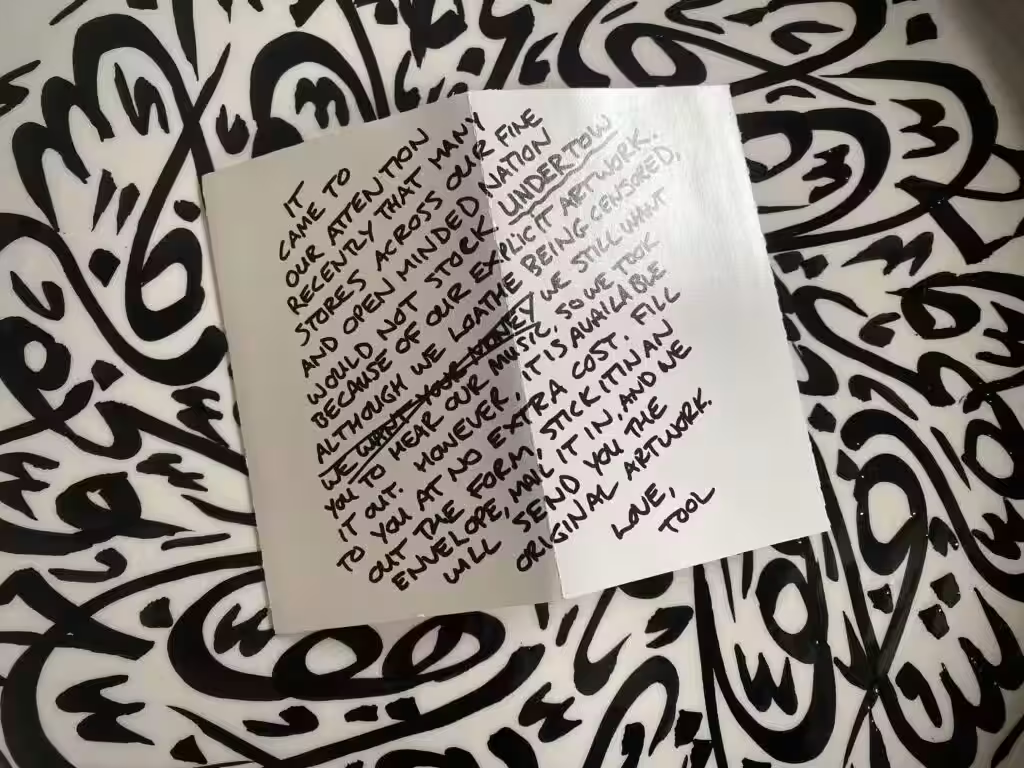
"It came to our attention recently that many stores across our fine and open-minded nation would not stock Undertow because of our explicit artwork. Although we loathe being censored, we still want you to hear our music, so we took it out. However, it is available to you at no extra cost. Fill out the form, stick it in an envelope, mail it in, and we will send you the original artwork. Love, Tool."
Tool, alternate bar-code edition of Undertow, 1993
Personnel and Credits
| Role | Player | Notes |
|---|---|---|
| Tool (the core band) | ||
| Lead vocals | Maynard James Keenan | Liner notes credit him as "Mostresticator". |
| Guitar, art direction | Adam Jones | Listed as "Bastardometer"; designed the ribcage cover sculpture and the censored bar-code reissue. |
| Bass | Paul D'Amour | Listed as "Bottom Feeder"; his only Tool studio album. |
| Drums | Danny Carey | Listed as "Membranophones". |
| Guest and session musicians | ||
| Additional vocals | Henry Rollins | The spoken-word verse on "Bottom"; rewrote Maynard's original lyric in the studio. |
| Sledgehammers | Chris Haskett | Then guitarist for the Rollins Band; credited specifically for piano-smashing duty on "Disgustipated". |
| Programming | Statik | Of LA industrial duo Collide; programming on "Disgustipated". |
| Production and engineering | ||
| Producer | Sylvia Massy and Tool | Massy also mixed "Disgustipated" alone. |
| Engineer | Sylvia Massy | Tracking at Grand Master Studios, Hollywood. |
| Mixer | Ron St. Germain | All tracks except "Disgustipated"; Ameraycan Studios, North Hollywood. |
| Mix assist | Chris Olivas | |
| Engineering assistance | Robert Fayer, Brad Cook | |
| Mastering | Howie Weinberg | Masterdisk, New York. |
| Creative direction | K. Lee Hammond | |
| Artwork | ||
| Cover sculpture and art direction | Adam Jones | The red 3D ribcage on the front; designed the alternate bar-code sleeve. |
| Liner-note photography | Danielle Bregman | Including the controversial nude photographs and the hidden cow image under the CD tray. |
| Listed inspiration | ||
| Inspiration | Bill Hicks | The only Tool album released in Hicks's lifetime; his name appears in the liner notes. |
The Songs
| # | Title | Writer(s) | Length | Single? | Notes |
|---|---|---|---|---|---|
| 1 | Intolerance | Tool | 4:53 | Opens with 25 seconds of breath and silence before the riff lurches in. | |
| 2 | Prison Sex | Tool | 4:56 | 1993 single | Stop-motion video by Adam Jones; pulled from MTV after a few showings. |
| 3 | Sober | Tool | 5:06 | 1994 single | Won Billboard Best Video by a New Artist. |
| 4 | Bottom | Tool and Henry Rollins | 7:14 | Mid-album spoken-word verse delivered by Rollins. | |
| 5 | Crawl Away | Tool | 5:30 | Drop-D riff in odd metre; includes Maynard's incongruous Ted Nugent-style "Get up, get up, NOW!" scream. | |
| 6 | Swamp Song | Tool | 5:31 | Trigonometrical riff; closest prefigure of Aenima's structural ambition. | |
| 7 | Undertow | Tool | 5:22 | Quarter-tone vocal at the climax; one of the album's defining transitions. | |
| 8 | 4 Degrees | Tool | 6:03 | D'Amour's most foregrounded performance on the record. | |
| 9 | Flood | Tool | 7:46 | The heaviest, most Melvins-adjacent moment on the record. | |
| 10 (69 in NA) | Disgustipated | Tool | 15:47 | Preacher monologue, shotgunned-piano percussion, seven minutes of cicadas, then a hidden answerphone message. |
"Sober" is the song that broke Tool. Built around a stop-time three-note guitar figure that drops into a measured mid-tempo chorus, it pairs the most accessible riff on the record with one of Keenan's most self-eviscerating lyrics ("I am just a worthless liar; I am just an imbecile"). Co-directed by Adam Jones and Fred Stuhr, the Brothers Quay-indebted stop-motion video became the Tool calling card, dropping in MTV rotation through 1994 and pulling the back catalogue, including Opiate, into the slipstream.
"Prison Sex", the lead single in late 1993, did the opposite. Keenan's lyric opens with the line "It took so long to remember just what happened. I was so young and vestal then" and walks straight into the territory of childhood sexual abuse. Adam Jones called the song's video, which he created largely single-handed, his "surrealistic interpretation" of the subject; MTV pulled it after a handful of plays and the American branch of MuchMusic asked Keenan to defend it in a televised hearing. It is the most explicit collision in Tool's catalogue between Keenan's autobiographical lyric writing and the broadcast censors he would spend the rest of the decade tangling with.
"Bottom" is the centrepiece, and the place Henry Rollins's spoken-word verse arrives on. The Keenan-and-Rollins co-write turns the song into a seven-minute dialogue: Keenan as the addict, Rollins as the indignant survivor delivering the "I've gone to great lengths to expand my threshold of pain" sermon in the middle eight. The Quietus, revisiting the record in 2013, noted that it was the most grunge-obvious thing on the album, and one of the few places where Undertow lined up cleanly with the post-Nevermind rock-radio palette.
"Crawl Away" and "Swamp Song" are where Tool stop sounding like a peer-group band at all. Both ride angular, drop-D riffs that lurch through odd time signatures; both contain the long, deliberate dynamic transitions that would become the Tool calling card on Aenima and Lateralus. "4 Degrees" is the showcase for D'Amour, whose clanking, harmonic-laden bass tone gives the song its lurching forward motion. "Flood" stretches a single, doom-laden riff for over four minutes before the song proper begins, the closest thing on Undertow to the Melvins records Adam Jones cited as a foundational influence. The title track turns on a transition: Keenan vomits an inhuman roar as the song crashes to a slower drag, and holds a queasy quarter-tone at the climax.
"Disgustipated", indexed as track 69 on most North American pressings (tracks 10 to 68 are one second of silence each, track 68 is two seconds), is the long-form epilogue: a Keenan preacher monologue from the carrots' perspective ("Life feeds on life feeds on life feeds on life"), the shotgun-and-sledgehammer piano crescendo, seven minutes of cicadas chirping in the night air, and a hidden voicemail message from "Marko, your old neighbour" rambling about a road trip. It is the most divisive thing on the record. The vinyl release omits it entirely.
B-sides, Outtakes and Lost Songs
Tool have always been austere with B-sides. The Prison Sex and Sober single releases were largely standalone, and there are no era-defining unreleased gems sitting in vaults the way there are with, say, Pearl Jam or Smashing Pumpkins. The closest thing to an Undertow-era outtake is "Opiate" itself, which was held over from the EP and appears as a bonus track on some Australian and Japanese pressings of Undertow, padding the runtime out to 73:28.
The most-circulated bootleg artefact from the era is the Live in Irwindale 1993 set (recorded at the Irwindale Renaissance Pleasure Faire site) and the Live in Dronten tape (from the Dynamo Open Air festival in the Netherlands later that year), both of which have appeared on grey-market promo-CD compilations and unofficial vinyl. Neither is a sanctioned release, but together they document an early version of the live show, including the Opiate-era "Jerk Off", which never made the album.
Album Artwork and Packaging
Adam Jones, a working visual-effects artist with credits including Predator 2 and Jurassic Park, took the art direction in-house from the start. The Undertow front cover is a three-dimensional sculpture of a human ribcage, cast in plaster and shot in deep, saturated red against a stark grey field. The liner-note booklet, photographed by Danielle Bregman, includes images of a nude obese woman, a nude thin man, and the four band members with pins inserted in the sides of their heads. Adam Jones's pet pig Moe is photographed on the back cover, standing among an array of forks driven point-up into a wooden surface.
Bregman also took the photograph hidden under the CD tray, which depicts a cow licking what appears to be its own genital region. On most US pressings the image is hidden behind the black plastic tray; on some international pressings the tray was transparent and the image was visible without disassembly. None of this survived the encounter with mass-market American retail.
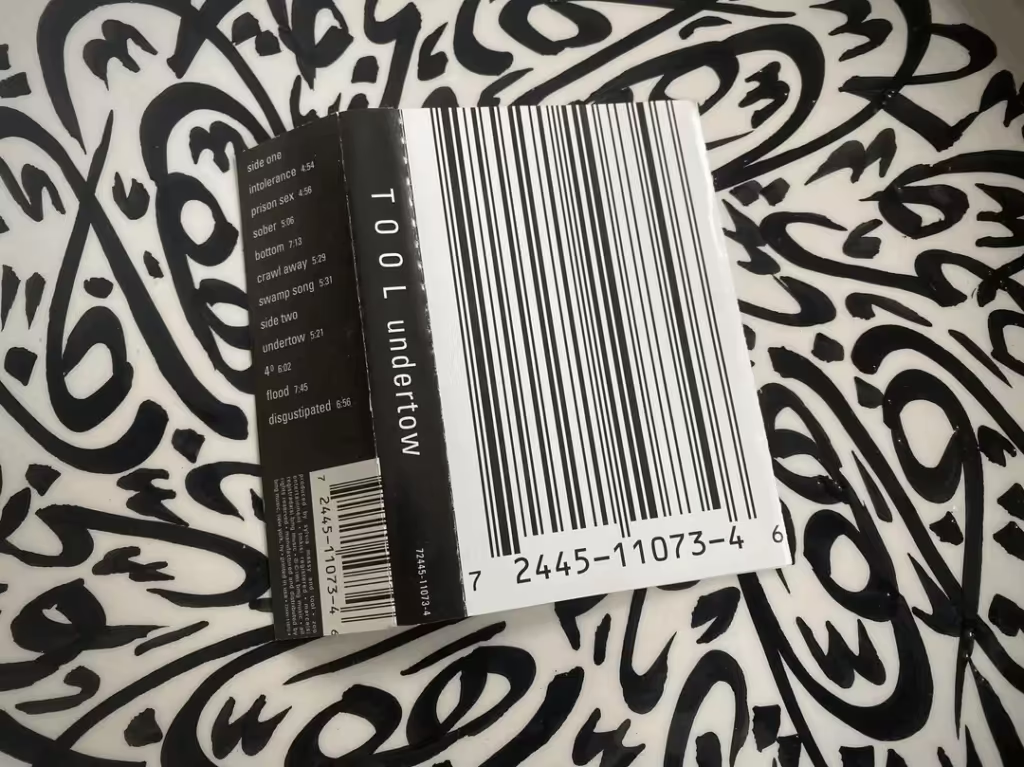
By late 1993, Wal-Mart, Kmart and several other chains had pulled the album from their racks over the nude photographs. Rather than redesign the booklet, Tool issued an alternate edition with a sleeve consisting of nothing but a giant UPC bar code on a white background, the band name, and the track list. A note inside invited the buyer to mail in a form to receive the original artwork by post, free. The bar-code edition is now one of the most collected variants in the Tool catalogue, and the open letter inside it (quoted earlier) remains a calling card in any conversation about Nineties major-label censorship.
Release and Reception
Reviews split. AllMusic's Rob Theakston, in a notice that has remained the album's reference critical assessment in catalogue-grade rock writing, gave Undertow four stars and argued that the record paved the way for several bands to break through to the mainstream and proved that metal could be simultaneously intelligent, emotional, and brutal. Entertainment Weekly's David Browne, reviewing on 28 May 1993, gave it an A-minus and put Tool a notch above their alt-metal peers on the strength of the songwriting.
"Like many of its brethren in the alternative-metal corps, Alice in Chains, Stone Temple Pilots, and Helmet, Tool can crunch and lumber about with the best of them. What put this L.A. band a notch above the rest are better songs (with actual verses, choruses, and hooks, check out the terrific 'Prison Sex') and the hints of vulnerability in singer Maynard James Keenan's voice."
David Browne, Entertainment Weekly, 28 May 1993
The UK weeklies were less convinced. NME gave it 7/10. Q and Select both gave it 2/5, with Select's Andrew Perry describing the band as bereft of "the irony, danger and maverick punkiness of grunge's finest" and predicting it would do nothing more than help Alice in Chains reassert the traditional-metal market. That reading aged poorly: within three years Aenima would be widely cited as one of the defining heavy records of the decade, and Undertow's stock would climb in retrospective writing as a result.
Chart performance was slow but persistent. Undertow peaked at 50 on the US Billboard 200 in 1993 and topped the Heatseekers chart at number one, but it was the long catalogue tail that did the work. It went gold in the United States in September 1993, platinum in 1995, and by 2021 was 3x Platinum. It is platinum in Australia, Canada and New Zealand. When Tool finally relented and put the back catalogue on streaming services in August 2019, Undertow re-entered the Billboard 200 at number 19, twenty-six years after release.
Singles and Music Videos
| Single | Release | Video director(s) | Chart and award notes |
|---|---|---|---|
| Prison Sex | 1993 | Adam Jones | Pulled from MTV after a handful of plays; MuchMusic asked Keenan to defend it on TV. Nominated for Best Special Effects in a Video at the 1994 MTV VMAs. |
| Sober | 1994 | Adam Jones and Fred Stuhr | Heavy MTV rotation through 1994; won Billboard's Best Video by a New Artist. |
Both videos were stop-motion, both were art-directed by Jones, and both were produced for budgets that, by 1994 MTV standards, were rounding errors. They set the template Tool have used in every subsequent video except "Hush" (Opiate-era) and the CGI "Vicarious": no band-member faces, stop-motion clay or puppet figures, and a deliberately unsettling, Brothers Quay-influenced visual palette. The decision to keep the band's faces out of their own videos is given as the reason: stop the audience latching onto the personalities rather than the music.
Touring and Live
Tool toured Undertow through 1993 and into 1994 as openers, second-stage festival regulars, and eventually headliners. The Lollapalooza 1993 tour was the inflection point. The band were booked to the second stage; their manager Ted Gardner, who was also a Lollapalooza co-founder, was able to bump them to the main stage mid-run after the second-stage crowds outgrew the second-stage capacity. At the final date of the tour in Tool's hometown of Los Angeles, Bill Hicks introduced the band, by that point a friend and confirmed inspiration, and asked the ten-thousand-strong audience to help him find a lost contact lens, with the deadpan instruction to "all stand very still."
One Los Angeles date in May 1993 has become Tool live folklore. The band were booked to play the Garden Pavilion in Hollywood and learned at soundcheck that the venue belonged to the Church of Scientology, an organisation whose belief framework clashed directly with the band's stated philosophical opposition to controlling spiritual systems. Maynard, refusing to cancel the show but refusing to perform it straight, spent most of his stage time bleating like a sheep at the audience. The performance is widely cited in Tool biographies as the moment the band's relationship with the music industry's institutional infrastructure crystallised.
- Notable 1993 supports: opening for Rage Against the Machine in the US, second-stage Lollapalooza, Dynamo Open Air in the Netherlands.
- Notable 1994 dates: Reading Festival debut, headline US club tour, returning Lollapalooza dates on the main stage.
- Famous live recording: the Live in Irwindale 1993 tapes capture the Undertow-era set in full, including the otherwise-unrecorded "Jerk Off".
- Tour incident: the May 1993 Church of Scientology sheep-bleating show in Hollywood.
In TV, Film and Media
Undertow's sync footprint is modest by Nineties-classic-rock standards, and that is by design: Tool have always been notoriously protective of how their music is used. "Sober" appeared in the 1995 Disney film Mr Holland's Opus as part of a montage establishing the protagonist's disaffected son's musical taste, and in early-2000s episodes of the WB drama Roswell. "Prison Sex" has been licensed only sparingly. The band's broader licensing posture became well-known enough through the Nineties that the absence of Tool from sync supervisors' wish-lists is itself a known feature of the soundtrack industry.
Controversy, Censorship and Lawsuits
Three threads run through Undertow's controversy file. First, the artwork pull by Wal-Mart and Kmart and the bar-code sleeve riposte. Second, the MTV reduction of "Prison Sex" airplay after viewer complaints about the lyric and video content. Third, the church-venue confrontation in Hollywood. Together they sketch a band testing what a major-label debut could include and how an artist could respond when retail and broadcast partners pushed back.
The legal aftermath came later. By the late 1990s Zoo Entertainment had folded into Volcano Entertainment, which sued Tool in 1998 alleging the band had violated their contract by entertaining offers from other labels. Tool counter-sued for failure to exercise a contract renewal option. The parties settled out of court in December 1998 and signed a new three-record joint-venture deal, but the dispute set the template for the late-2010s litigation with the Volcano successor that delayed Fear Inoculum by close to a decade.
Covers, Samples and Tributes
Undertow has been covered surprisingly little: Tool's arrangements are tight enough and Keenan's vocal range narrow enough that the songs do not transplant easily. "Sober" has been covered live by Korn, Deftones and several US Christian-metal acts; "Prison Sex" was covered by Lacuna Coil in club sets in the early 2000s. The record has been sampled almost not at all, in part because of the band's well-publicised hostility to clearance requests.
The album has not had a tribute record dedicated specifically to it, but Undertow appears on every credible "Best Debut Albums in Prog Metal" list since the term existed. Loudwire ranked it inside the eleven best in May 2024. AllMusic still treats it as essential in the Tool catalogue rather than as a transitional artefact.
Reissues, Remasters and Anniversaries
Undertow has had a curiously light reissue history compared with its peers. There has been no super-deluxe anniversary box, no demos-and-outtakes second disc, no expanded liner-note set. The remastered vinyl reissue rolled out as part of the Tool catalogue's 2019 streaming arrival is the closest the record has come to a major refresh, and the band have so far declined to do a 25th- or 30th-anniversary celebration of any kind. The bar-code white sleeve remains a sought-after collector edition; original first-pressings on Zoo with the un-censored artwork book regularly fetch high prices on Discogs.
Tool have publicly toyed with the idea of revisiting the Undertow approach for their long-awaited sixth album. In a January 2024 Revolver interview, Danny Carey said the band could go back to doing an Undertow-type record and that the idea was, in his words, appealing to him. Whether that turns into anything more than a passing comment by the time the next Tool album appears, the line tells you how the band themselves regard the debut: not as a juvenile work to be apologised for, but as a different mode of writing that is still on the table.
Legacy and Influence
The bands who name Undertow as a foundational record are unsurprising and unanimous: System of a Down, Deftones and Korn all cite Tool's debut in interviews as the proof that a heavy band in 1993 could write long songs, foreground a bass tone, and refuse the grunge template without being relegated to a niche. Sean Richardson, writing in the Boston Phoenix, called Tool's influence on those three groups towering. Pete Loeffler of Chevelle, Benjamin Burnley of Breaking Benjamin and Fred Durst of Limp Bizkit have all named Maynard's vocal phrasing as a direct lift. The "Big 4 of '90s Metal" list Loudwire ran in August 2025 placed Tool alongside Sepultura, Korn and Pantera.
The Quietus, revisiting the album for its twentieth anniversary in 2013, framed Undertow's strangeness with a line that has stuck in the critical literature ever since:
"1993's Undertow is in many ways the work of a very different band. You'd be hard-pressed to find members of the Tool Army who'd describe it as their best work. But conversely, it's relatively free of the trippy portentousness reviled by their detractors."
Matt Evans, The Quietus, 30 April 2013
"Original bassist Paul d'Amour is the foundation stone of the overall aesthetic, his is a clanking, metallic tone, awash with harmonics, that resembles a gremlin hammering a radiator rather than a stringed instrument."
Matt Evans, The Quietus, 30 April 2013
That is the right register. Undertow is the only Tool album where the dial is set to the animal rather than the intellectual, where the foregrounded bass tone makes the songs feel mechanical and industrial rather than spiritual and progressive, and where the singer is openly, autobiographically vulnerable rather than philosophically obscure. From Aenima onwards the intellectual won; the animal was caged. Undertow is the record where the cage is still open.
Things You Might Not Know
| Fact | Detail |
|---|---|
| Track 69 | "Disgustipated" is indexed as track 69 on most North American CD pressings. Tracks 10 to 67 are exactly one second of silence each; track 68 is two seconds. |
| The cow under the tray | Removing the CD tray on most US copies reveals a hidden Danielle Bregman photograph of a cow licking its own genital region. |
| The Tom Morello connection | Danny Carey was introduced to Adam Jones by Tom Morello, an old Illinois high-school friend of Jones who had been in Electric Sheep before Rage Against the Machine. |
| Adam Jones's day job | Jones had a working career in Hollywood special-effects, with credits on Predator 2, Terminator 2: Judgment Day, Jurassic Park and Edward Scissorhands. |
| Henry Rollins's contribution | The line "I'll make weapons out of my imperfections" was Maynard's original lyric for "Bottom"; Rollins rewrote his verse in the studio. The original line survives only on the back of the bar-code sleeve. |
| The lachrymology hoax | The band told early interviewers their guiding philosophy was a 1940s pamphlet on enlightenment through tears by a crop-sprayer named Ronald P. Vincent. The pamphlet was eventually printed for real, but its 1940s provenance remains widely disputed. |
| Statik on programming | "Statik", credited with programming on "Disgustipated", is Statik of LA industrial duo Collide. Until that credit surfaced, the name was widely assumed to be a Tool pseudonym. |
| Adam Jones's pet pig | The pig photographed on Undertow's back cover among the upturned forks is Moe, Adam Jones's pet at the time. |
| Bill Hicks's contact lens | At Lollapalooza 1993's Los Angeles closing date, Hicks introduced Tool by asking the 10,000-strong crowd to help him find a lost contact lens, instructing them to stand very still. |
| The Scientology sheep show | At the May 1993 Hollywood Garden Pavilion gig, Keenan spent most of the set bleating like a sheep at the audience after the band discovered mid-soundcheck that the venue was owned by the Church of Scientology. |
| The parking-lot shotguns | The percussion on "Disgustipated" was recorded by destroying two second-hand pianos with sledgehammers and live ammunition in Grand Master Studios' indoor parking lot. The shotgun holes in the wall are reportedly still there. |
| Bill Hicks credit | Undertow is the only Tool studio album released in Bill Hicks's lifetime; he died on 26 February 1994. He is credited in the liner notes simply as an "inspiration". |
| The Walmart bar-code letter | The alternate bar-code-on-white reissue ships with a printed form inviting buyers to mail Tool's office for the original artwork by post, free of charge. |
The Riffology Podcast
The Riffology podcast recorded a full episode on Undertow that goes deeper into the Sylvia Massy sessions, the Bill Hicks friendship, the Wal-Mart letter and Paul D'Amour's only Tool album. The show is available on Apple Podcasts, Spotify, YouTube and every major podcast platform, so subscribe so you don't miss the next deep dive, and we would love to hear your thoughts on Undertow in the comments below or on social media.
Comments