
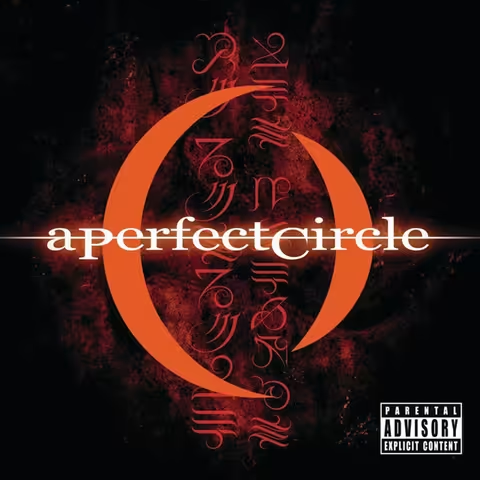
Mer de Noms is the album where a guitar tech walked off the road, into his housemate's vocal booth, and onto the highest-debuting rock debut Billboard had ever logged. Billy Howerdel had spent the late 1990s servicing the touring rigs of Nine Inch Nails, the Smashing Pumpkins, Fishbone and Tool while quietly stockpiling songs since 1988. His housemate at the time was Maynard James Keenan. When Mer de Noms landed at number four on the Billboard 200 in May 2000 with 188,000 copies in a week, the surprise was not that Keenan could sell a record. It was that A Perfect Circle did not sound like a Tool side project at all.
The album entered a market saturated with seven-string downtuning and rap-rock production tics and offered the precise inverse: voice-led clean guitar, suspended chords, violin and viola as load-bearing colours, and a vocalist working in stepwise melodic lines rather than declamatory shouting. Three singles climbed the US rock-radio charts inside fourteen months, David Fincher directed the lead-single video, and the RIAA certified the record Platinum on 31 October 2000, five months and one week after release. Twenty-five years on, it remains the moment American rock radio agreed that restraint could move units.
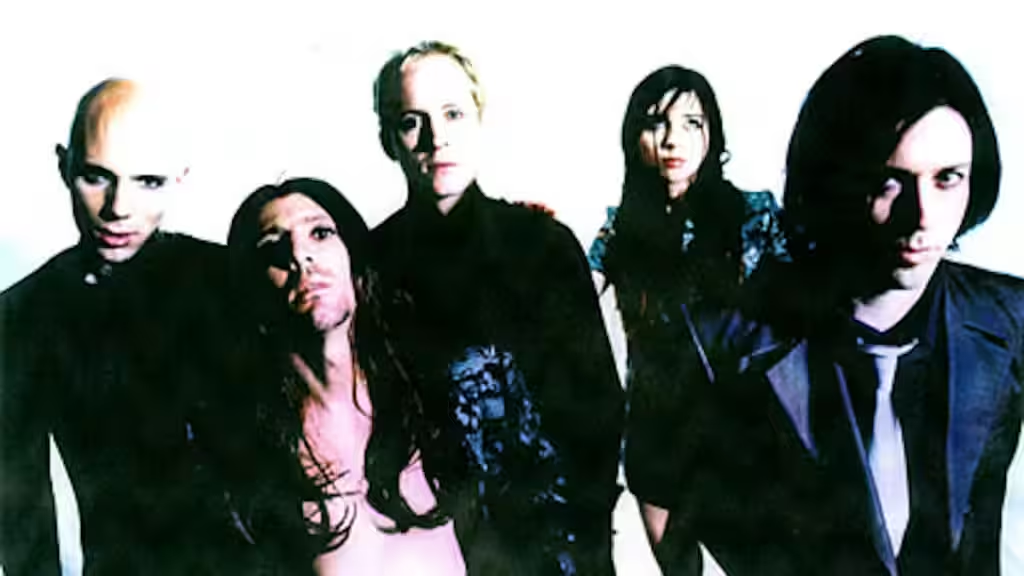
Album Facts
| Field | Detail |
|---|---|
| Artist | A Perfect Circle |
| Album | Mer de Noms |
| Release date | 23 May 2000 |
| Label | Virgin Records |
| Producer | Billy Howerdel (mixing also by Alan Moulder) |
| Studios | The Chop Shop (Hollywood), Sound City (Van Nuys), Extasy Recording (North Hollywood) |
| Engineer / Mastering | Frank Gryner (drum engineering); Eddy Schreyer (mastering) |
| Genre | Alternative metal, alternative rock, hard rock, art rock |
| Track count | 12 |
| Total runtime | 44:25 |
| Billboard 200 peak | No. 4 (highest-ever debut for a rock band's first album at the time, 188,000 copies first week, 51 consecutive weeks on chart) |
| UK Albums Chart peak | No. 55 |
| Other notable chart peaks | Australia No. 2, New Zealand No. 2, Canada No. 5 |
| Certifications | US Platinum (31 Oct 2000), Canada Platinum, Australia Gold, UK Silver |
| Estimated sales | Over 1.2 million worldwide based on certified shipments |
| Key singles | Judith (10 Apr 2000), 3 Libras (29 Aug 2000), The Hollow (17 Jun 2001) |
Cultural Context
The week Mer de Noms hit American shelves the Billboard 200 was a snapshot of a particular kind of late-90s gravity. Britney Spears's Oops!... I Did It Again sat at number one, Eminem's The Marshall Mathers LP was about to dethrone it, Creed's Human Clay was deep into its multi-Platinum run, and Limp Bizkit's Significant Other was still selling. Rock radio belonged to the rap-rock tier (Limp Bizkit, Korn, Kid Rock), to post-grunge anthemics (Creed, 3 Doors Down's Kryptonite was that month's biggest rock single), and to a wave of melodic punk and pop-punk (Blink-182, Green Day's still-touring Nimrod). Tool's AEnima was three and a half years old; the band had no plans for new material until 2001.
Into that environment came an album with violin and viola in the credits, half its songs sitting between 80 and 110 BPM, and a lead single about the singer's mother's faith in the face of stroke and Christian suffering. There was no scratching, no rapped verse, no obvious nu-metal grammar. The album's defining tonal palette was a clean arpeggiated guitar over a sustained pedal tone. Yet it arrived on a major label (Virgin), through a band that had played Coachella the previous October, and shipped 188,000 units in seven days. The marketplace was hungrier for melodic heaviness than the headline acts of the day suggested, and Mer de Noms turned out to be the album that proved it.
The other backdrop was Napster. Launched in June 1999, the file-sharing service had spent the spring of 2000 transforming how teenagers found rock music. Metallica filed suit in April 2000, a month before Mer de Noms was released. The fact that an unknown band's debut still moved 188,000 copies in the first week in that climate was, even at the time, taken as a sign that word-of-mouth and Keenan's reputation could overcome the new economics of music discovery.
- Number one album in the United States the week of release: Oops!... I Did It Again by Britney Spears
- Best-performing rock single on US radio that month: Kryptonite by 3 Doors Down
- Tool last released a studio album in September 1996 (AEnima); Lateralus was still eleven months away
- Napster had been live for eleven months; the RIAA-Napster lawsuit was filed in December 1999, Metallica's followed in April 2000
- Major rock debuts of 2000: Disturbed's The Sickness (March), Linkin Park's Hybrid Theory (October), Queens of the Stone Age's Rated R (June)
The Band's Story Up to This Point
A Perfect Circle was not really a band when Howerdel began writing its songs. He was a road-hardened guitar technician who had spent the early-to-mid-1990s working for Fishbone, Nine Inch Nails, the Smashing Pumpkins and, by the back half of the decade, Tool. The Howerdel-Keenan friendship traces to 1992, when Tool opened for Fishbone and the two struck up a conversation that survived years of intermittent touring overlap. In 1995, Keenan offered Howerdel a room in his North Hollywood house. Howerdel arrived with a hard drive of demos and started playing them through the house monitors.
Keenan's response is documented in the Mer de Noms bibliography and has been quoted by both men in interviews since: "I can hear myself singing those songs." Howerdel's first instinct was not to recruit Keenan. He wanted Elizabeth Fraser of Cocteau Twins, whose ribboning, untethered melodic style he had been writing toward. Fraser was unavailable. Keenan was already there, and willing, and the project began with him on vocals on the agreement that A Perfect Circle would be treated as a band in its own right rather than a Tool sub-brand.
Recruiting the rest took until 1999. Bassist Paz Lenchantin, an Argentinian-American multi-instrumentalist who also played violin and viola, was brought in for her ability to provide string colours as well as low end. Troy Van Leeuwen, lately of Failure, came in as second guitar specifically because his approach was textural rather than virtuosic. The first drummer was Tim Alexander of Primus; he played the band's first show at the Viper Room in LA in August 1999 and a more widely-covered set at Coachella that October, by which time he had already been replaced by Josh Freese. Freese, who had recently spent sessions working on Axl Rose's still-incomplete Chinese Democracy alongside Howerdel, became the album's drummer of record. Alexander's only studio appearance on Mer de Noms is the opening track The Hollow.
The Volcano Records (Tool's label) deal that was widely expected fell away when Keenan decided that Virgin Records better understood his intention to treat A Perfect Circle as a parallel band rather than a moonlighting project. The Virgin deal was signed in late 1999; album sessions began essentially that day.
"The [A Perfect Circle] music was very different, so I responded differently. With A Perfect Circle the process is far more mechanical and computer oriented, but at the same time it is also far more emotional and intuitive. Tool is more a left-brain masculine result, and [A Perfect Circle] is more a right-brain feminine result."
Maynard James Keenan, The New York Times, March 2000
Pre-production and Demos
The deepest songs on Mer de Noms had been in development for over a decade. Howerdel later told Guitar World Presents Nu-Metal that he had been working on The Hollow and Brena since 1988, when he was a teenage guitarist working out his harmonic vocabulary in a New Jersey bedroom. The demos he played for Keenan in 1995 were dense, layered guitar arrangements built on a borrowed ADAT rig, written for an imagined female vocalist and structured around long-form harmonic motion rather than verse-chorus repetition.
Pre-production for the album in 1999 was an unusually private affair. Howerdel had final say over every guitar voicing; Keenan would arrive with a notepad, listen to a finished instrumental and write melodies in the room. There were no jam-band group writes. Songs that became album cuts (Magdalena, Orestes, 3 Libras) generally arrived almost fully formed and were refined in pre-production for the band setting. Songs Howerdel had been carrying for years (The Hollow, Brena) had their arrangements opened up to accommodate Lenchantin's strings and Van Leeuwen's textural second guitar.
The naming convention emerged late in pre-production. The phrase Mer de Noms ("Sea of Names" in French) reflected the dawning track list: Judith, Magdalena, Orestes, Thomas, Brena, and the cryptic Renholdër (Danny Lohner's surname spelled backwards as Re:D.Lohner; Lohner did not know the song was about him for some time, despite his name appearing distorted in the vocal). The cover sigil, when decoded, reads "La Cascade des Prenoms" - the waterfall of first names. The visual identity arrived in lockstep with the lyrics.
- The Hollow and Brena were written in 1988, twelve years before the album's release
- 3 Libras was originally pitched as the lead single; Virgin's A&R team pushed for Judith on the grounds that it was closer to what Tool fans expected
- Renholdër is a back-spelling of "Re:D.Lohner", a reference to longtime collaborator Danny Lohner of Nine Inch Nails
- Howerdel's first choice of vocalist was Elizabeth Fraser of Cocteau Twins
- Orestes survives as a separate demo on later editions of the album, hinting at how minor the gap was between Howerdel's pre-production and the finished take
Creating the Album
Sessions ran across the back end of 1999 and into early 2000 in three Los Angeles rooms. The Chop Shop, a smaller Hollywood facility that had become Howerdel's working base, handled most of the guitar overdubs and the assembly of the songs. Sound City in Van Nuys, the legendary Neve room that Nirvana cut Nevermind in and Tom Petty cut Damn The Torpedoes in, hosted at least some of the drum tracking; the Judith credits list Sound City explicitly. Extasy Recording in North Hollywood handled additional sessions. The choice of three rooms rather than one was as much a function of scheduling around Freese's other work (notably the Chinese Democracy sessions) as it was a creative decision.
Howerdel produced the record himself. He had been a working engineer for years as well as a tech, and he wanted the sonic vocabulary to be his. The production approach was the inverse of the era's dominant template: instead of compressing every track until the song became a single rhythmic mass, Howerdel kept faders moving. Verses breathe, choruses lift through arrangement rather than limiting, and the high-frequency air around the clean guitars stays intact. The signature tone of the album, that sustained-clean-guitar-against-a-held-note quality, is a production choice as much as a writing choice.
Alan Moulder was brought in to mix. Moulder, by 1999, had become one of the defining mix engineers of the period for exactly the kind of album Howerdel was making: he had mixed Nine Inch Nails's The Downward Spiral, Smashing Pumpkins's Siamese Dream and Mellon Collie and the Infinite Sadness, and Ride's Nowhere. His ability to keep guitar layers articulate inside a heavy mix is audible on every track. Frank Gryner engineered the drums; Eddy Schreyer mastered. The mastering choice favoured dynamic range over the loudness-war defaults of the period - listen to The Hollow next to its 2000 chart contemporaries and the difference in headroom is immediately obvious.
Personnel decisions on individual songs were unusually fluid. Howerdel played most of the bass on Mer de Noms despite Lenchantin being the band's bassist; she played bass on Sleeping Beauty and covered backing vocals and strings across the record. Van Leeuwen plays lead guitar parts only at the end of two songs (Sleeping Beauty and Thinking of You). Paz's father Luciano Lenchantin guests on viola for 3 Libras, doubling and counterpointing her violin. Draven Godwin provides percussion on Thomas, and Kelli Shafer adds backing vocals on Renholdër. Almost every track has at least one personnel surprise once you scan the liner notes.
"With Mer de Noms, Howerdel had already written and finalised all of the music, with Keenan just contributing the lyrics and vocals."
MTV News retrospective, April 2003
Personnel and Credits
| Role | Player | Notes |
|---|---|---|
| Core band | ||
| Lead vocals | Maynard James Keenan | All tracks; also plays gord (kalimba) on Over |
| Guitar, bass, backing vocals, keyboards, piano | Billy Howerdel | Guitar on tracks 1-11; bass on tracks 1-6, 8, 10 and 11; piano on Renholder and Over |
| Drums, percussion | Josh Freese | All tracks except The Hollow; percussion on Renholder |
| Bass, violin, backing vocals | Paz Lenchantin | Violin on Rose, 3 Libras and Renholder; bass on Sleeping Beauty |
| Lead guitar (closing parts) | Troy Van Leeuwen | Closing leads on Sleeping Beauty and Thinking of You only |
| Guest and session musicians | ||
| Drums on The Hollow | Tim Alexander | Primus drummer; this is his only studio appearance with the band |
| Viola on 3 Libras | Luciano Lenchantin | Paz Lenchantin's father |
| Percussion on Thomas | Draven Godwin | |
| Backing vocals on Renholder | Kelli Shafer | |
| Production and engineering | ||
| Producer / mixing / sound engineering | Billy Howerdel | Self-produced; first record he ever produced front to back |
| Mixing | Alan Moulder | NIN, Smashing Pumpkins, Ride, U2 credits |
| Drum engineering | Frank Gryner | |
| Mastering | Eddy Schreyer | Then at Oasis Mastering, Los Angeles |
| Artwork | ||
| Sleeve art and concept | Billy Howerdel | Designed the band logo and the cover sigil that decodes as "La Cascade des Prenoms" |
The Songs
| # | Title | Writers | Length | Single? | Notes |
|---|---|---|---|---|---|
| 1 | The Hollow | Howerdel / Keenan | 2:58 | Third single, 17 Jun 2001 | Tim Alexander on drums; written 1988 |
| 2 | Magdalena | Howerdel / Keenan | 4:05 | Live set staple from the first tour | |
| 3 | Rose | Howerdel / Keenan | 3:26 | Paz Lenchantin violin | |
| 4 | Judith | Howerdel / Keenan | 4:07 | Lead single, 10 Apr 2000 | No. 4 Mainstream Rock; David Fincher video |
| 5 | Orestes | Howerdel / Keenan | 4:48 | Demo version often appended to later editions | |
| 6 | 3 Libras | Howerdel / Keenan | 3:39 | Second single, 29 Aug 2000 | No. 12 Mainstream Rock; in 6/8; violin and viola |
| 7 | Sleeping Beauty | Howerdel / Keenan | 4:10 | Paz Lenchantin on bass; Van Leeuwen closing lead | |
| 8 | Thomas | Howerdel / Keenan | 3:29 | Draven Godwin percussion | |
| 9 | Renholder | Howerdel / Keenan | 2:23 | Title is "Re:D.Lohner" backwards | |
| 10 | Thinking of You | Howerdel / Keenan | 4:32 | Van Leeuwen closing lead | |
| 11 | Brena | Howerdel / Keenan | 4:24 | Written 1988 alongside The Hollow | |
| 12 | Over | Howerdel / Keenan | 2:21 | Keenan plays gord (kalimba); piano on alternate mix |
The Hollow (track 1)
The album opens on its oldest song. Howerdel had been workshopping the riff since 1988; what arrived on tape in 1999 was a tightly arranged three-minute opener built on a descending suspended-chord progression and a kick-snare pocket that does the unusual job of letting the guitar drive the rhythm. The drummer is Tim Alexander, recorded in his single Mer de Noms session before Freese took over. The lyric is one of the album's most pointed: Maynard's reading of religious indoctrination as a hollow vessel, dropped in to set the moral temperature of the record. Released as the third single in June 2001, after Judith and 3 Libras had already done their charting work, it peaked at No. 14 on Mainstream Rock.
Judith (track 4)
Judith is the album's lead single, the song that argued for the album on rock radio, and the only song on Mer de Noms about a specific real person: Judith Marie Keenan, Maynard's mother. Maynard's mother had suffered a stroke in 1976 that left her partially paralysed for the rest of her life; she remained a devout Christian until her death in 2003, three years after Judith's release. The lyric is a son's incredulous protest at her continued faith, written from inside grief that had not yet completed. Musically it is the heaviest thing on the album: tight palm-muted riffs, a chorus that lifts through bass motion and octave guitar doubles rather than added distortion, and a vocal that goes from controlled to genuinely angry across four minutes. Virgin's A&R team pushed it ahead of Howerdel's original choice of lead single (3 Libras) on the grounds it was closer to what Tool's audience would recognise. They were correct: it hit No. 4 Mainstream Rock, No. 5 Modern Rock, and finished the year at No. 9 and No. 11 respectively on the year-end charts.
David Fincher directed the music video, an unusual coup for a debut single from an unknown band. Fincher had directed Se7en in 1995 and Fight Club the previous autumn; he was the most in-demand auteur director in Hollywood. Allen Daviau, who shot E.T. for Spielberg, was the cinematographer. The video is set in a stark white room with the band performing in tight close-up, with Fincher leaning hard on his signature high-contrast lighting and a colour grade that strips everything to bone-grey and shadow. It was the kind of music video that signalled a band was being taken seriously by the industry rather than tolerated.
3 Libras (track 6)
3 Libras is the song Howerdel wanted as the album's first single, and the song that has aged best. It is in 6/8 - the only track on the record that isn't in 4/4. Freese plays the rim of his snare on every eighth note, a tic-tic-tic carriage clock under arpeggiated clean guitar and Paz Lenchantin's violin, doubled by her father Luciano on viola for the chorus lift. The first minute is essentially chamber music; when the full band enters around the second verse it is a structural event rather than a dynamic add. The lyric ("Threw you the obvious / just to see if there's more behind the eyes of a fallen angel") is a small masterpiece of compressed disappointment. It peaked at No. 12 on both US rock airplay charts and No. 49 in the UK Singles Chart, the band's only UK singles entry to date.
Orestes, Magdalena and Rose (tracks 5, 2, 3)
The three other named character studies form the album's poised middle ground. Orestes (the matricidal son in Greek tragedy) is slow, modal, built on long sustained chords that move by half steps; the vocal weaves through the changes rather than landing on chord tones. Magdalena (a meditation that pulls on the Mary Magdalene archetype but reads as a love-and-shame song) is the album's most balanced verse-chorus form; it became a live staple from the very first tour. Rose, the shortest of the three, hides Paz Lenchantin's violin under a tight palm-muted riff and uses the chorus to release into open clean chords - the album in miniature.
Renholder, Thomas and Sleeping Beauty (tracks 9, 8, 7)
Renholder is a 2:23 interlude whose title is a back-spelling of "Re:D.Lohner". Danny Lohner of Nine Inch Nails had been a fixture on the Howerdel-Keenan periphery for years; the song is a tribute he didn't know existed until other people pointed it out. Thomas is a darker, midrange-growl piece with Draven Godwin's percussion adding off-beat colour. Sleeping Beauty is the album's quiet centrepiece, a slow build with Paz Lenchantin on bass (the only album track she plays bass on) and Troy Van Leeuwen's closing lead guitar; it remains a fan favourite that the band continued to perform through every reunion tour.
Thinking of You, Brena and Over (tracks 10, 11, 12)
The closing third of the album moves from insistent rhythmic chug (Thinking of You, with Van Leeuwen's second closing lead) through chiming melodic chamber rock (Brena, the other 1988 song) into a near-silent final coda (Over, on which Keenan plays a thumb-piano - the gord, a small wooden kalimba - and Howerdel plays piano). Over is genuinely strange as an album closer; it dissipates rather than concludes, leaving the listener with the impression that the record's argument has been made and there is no need for a victory lap. On some early CD pressings, a low-volume medley plays in the final minute of the closing silence.
B-sides, Outtakes and Lost Songs
For an album of its commercial profile, Mer de Noms left an unusually thin trail of unreleased material. Howerdel had finalised every arrangement before tape rolled; there was no surplus of half-cut songs from the sessions. The known B-side material consists of a small set of live recordings and one studio demo:
- Orestes (demo) - appears as a bonus track on some later editions and on the Judith CD single. It is structurally very close to the album version, confirming how locked-in the songs were before tracking.
- Magdalena (live) and Brena (live) - both appear on the Judith CD single, captured on the first headline tour.
- 3 Libras alternate mixes - the "Feel My Ice Dub Mix" by Danny Lohner and the "All Main Courses Mix" by Robert "3D" Del Naja of Massive Attack appeared on the 3 Libras single and were later compiled on the 2004 remix album Amotion. The Massive Attack remix in particular reframes the song as a glitchy, radio-static-laden trip-hop piece.
- Sleeping Beauty (extended intro) - the vinyl edition runs Sleeping Beauty at 4:57 with an additional intro, and presents an alternate mix of Over at 3:07. These survive only on the original vinyl pressings and are widely sought by collectors.
The biggest "lost" piece of Mer de Noms-era writing is Vacant, a song Keenan wrote with Trent Reznor and Lohner for the never-released Tapeworm project in 1999. The band performed it live as part of the Mer de Noms touring set for years, and it was eventually reworked as Passive for the 2004 covers album Emotive. The Tapeworm studio version has never officially surfaced.
Album Artwork and Packaging
Billy Howerdel designed the album sleeve himself. The two perfect circles inside the band's now-famous logo are a deliberate self-reference: in interviews Howerdel has explained that the symbol "outwardly looks like a larger and smaller crescent, but actually holds two perfect circles", representing himself and Keenan, with the geometry hiding the meaning until you notice it. He has connected the logo to the lyric "You don't see me at all" from 3 Libras, framing the design as a piece of visual songwriting about feeling unseen.
The front cover's central image - a piece of calligraphy in a custom script that ornaments a Greek-style character set - decodes as "La Cascade des Prenoms", French for "the waterfall of first names". The packaging keeps to a subdued palette of cream, sepia and gold; the typography is hand-drawn rather than typeset; there is no band photo on the front. The visual brand sat several galaxies away from the airbrushed maximalism that defined nu-metal sleeves of the same year.
For collectors, the most-sought variants are the original 2000 CD pressing (which contains the low-volume medley hidden after Over on some discs) and the 2-LP vinyl edition (which contains the extended Sleeping Beauty and the alternate Over mix). A 2013 vinyl reissue restored the album to print on standard black vinyl; subsequent coloured-vinyl reissues followed through the back half of the 2010s.
Release and Reception
Mer de Noms came out on 23 May 2000. It entered the Billboard 200 at number four behind Britney Spears, Eminem and the Dixie Chicks, selling 188,000 copies in seven days. At the time that was the highest-charting debut album by any rock band in Billboard 200 history, a record that held until Velvet Revolver's Contraband matched it four years later. It stayed on the Billboard 200 for 51 consecutive weeks, charted Top 10 in Australia, New Zealand and Canada, and reached No. 55 in the UK. It finished the year at No. 90 on the Billboard 200 year-end chart, an extraordinary placement for a record released in May. The RIAA certified it Platinum on 31 October 2000, twenty-three weeks and one day after release. Music Canada also certified Platinum; ARIA logged a Gold certification in Australia; the BPI logged Silver in the UK.
Critically, the reception was warm bordering on rapturous. AllMusic's Ned Raggett described "the addicting combination of Keenan's aching voice and Howerdel's accomplished songs and production skills" as one of 2000's "best splashes in whatever was left of 'modern rock'". Entertainment Weekly handed out an A-minus. Kerrang!, Melody Maker and Q each gave four stars. Metal Hammer gave 8/10, NME 7/10, Rock Hard 8.5/10.
"In exploring their corrupt visions, A Perfect Circle have created a work of morbid beauty. In terms of darkness, it eclipses nearly everything else."
NME album review, 2000
Awards followed quickly. A Perfect Circle won the California Music Awards' "Best Debut Album" in 2001. The album was later ranked No. 443 in Rock Hard magazine's 500 Greatest Rock & Metal Albums of All Time (2005), No. 15 in Loudwire's Best Debut Hard Rock Albums (2013), one of Metal Hammer's "10 essential alt-metal albums" (2016), and one of Metal Hammer's "20 best metal albums of 2000" (2020).
| Territory chart | Peak position | Source |
|---|---|---|
| US Billboard 200 | 4 | Billboard |
| US Billboard 200 year-end 2000 | 90 | Billboard |
| Australian Albums (ARIA) | 2 | ARIA |
| New Zealand Albums (RMNZ) | 2 | RMNZ |
| Canadian Albums (Billboard) | 5 | Billboard |
| UK Albums (OCC) | 55 | Official Charts |
| German Albums (Offizielle Top 100) | 55 | GfK Entertainment |
| Dutch Albums (Top 100) | 81 | Hung Medien |
| Norwegian Albums (VG-lista) | 32 | VG-lista |
| Swedish Albums (Sverigetopplistan) | 54 | Sverigetopplistan |
Singles and Music Videos
Virgin built the campaign in three waves over fourteen months, an unusually patient release strategy that kept the album on rock radio for the full first year of its life.
| Single | Release | US Mainstream Rock | US Modern Rock | UK Singles | Director / B-sides |
|---|---|---|---|---|---|
| Judith | 10 Apr 2000 | 4 | 5 | Did not chart | David Fincher (video); cinematography by Allen Daviau. B-sides: Magdalena (live), Brena (live), Orestes (demo) |
| 3 Libras | 29 Aug 2000 (US) / 1 Jan 2001 (UK) | 12 | 12 | 49 | Performance-led promo video. B-sides: Magdalena (live), Sleeping Beauty (live in Phoenix), Feel My Ice Dub mix by Danny Lohner, All Main Courses mix by Robert Del Naja |
| The Hollow | 17 Jun 2001 | 14 | 22 | Did not chart | Performance-led promo video |
The David Fincher coup on Judith deserves a second mention. Fincher had not directed a music video since 1996 (Madonna's Vogue and Aerosmith's Janie's Got A Gun were his most celebrated 90s clips); he was, by spring 2000, deep in post on his next feature, Panic Room. That he made time for an unknown band's debut single is testament both to Keenan's industry standing and to the strength of the song itself. The video was added to MTV's Buzz Bin on release and shipped Judith into the Modern Rock top five inside two months.
Touring and Live
Touring for Mer de Noms began before the album was even out. The band joined Nine Inch Nails on the Fragility 2.0 North American tour from April through June 2000, an inspired bill that meant Mer de Noms had several weeks of pre-release exposure to NIN's audience by the time it hit shops. The album landed in the middle of the run.
After the NIN tour, the band joined the 2000 Summersault festival in Canada with Foo Fighters, the Smashing Pumpkins and Our Lady Peace in early August, then headlined their own North American run through August and September. A second US headline tour ran from 31 January to 31 March 2001 with Snake River Conspiracy as support. A planned tour with Queens of the Stone Age fell through but the QOTSA association persisted - Troy Van Leeuwen would later join QOTSA permanently in 2002, helping prompt the Thirteenth Step lineup reshuffle.
The touring cycle lasted roughly eight straight months. By the time it ended in early 2001, Keenan was already returning to Tool for the recording of Lateralus. A Perfect Circle live, in this period, was famous for the precision of its arrangements. Howerdel insisted on accuracy to the studio versions; Keenan often wore wigs and costumes on stage, a habit carried over from Tool, to deflect attention away from his face and onto the music. Setlists hewed almost obsessively to the album sequence, with the only major variation being Vacant (the Tapeworm song that would eventually become Passive on Emotive).
- Fragility 2.0 (with NIN), Apr-Jun 2000 - North American arena tour; band's first major touring exposure
- Summersault Festival, Aug 2000 - Canadian festival run alongside Foo Fighters, Smashing Pumpkins, Our Lady Peace
- Headline North American tour, Aug-Sep 2000
- Headline North American tour with Snake River Conspiracy, Jan-Mar 2001
- Trifecta reunion tour 2010 - performed Mer de Noms, Thirteenth Step and Emotive in full across three nights in five cities
- 2022 onwards - Mer de Noms-era setlists became regular fare again on the post-Eat the Elephant reunion runs
In TV, Film and Media
Mer de Noms's reach into film and television sync has grown steadily since release rather than spiking on release week. Judith became a fixture on early-2000s rock soundtracks (it appears in films and on compilation albums through the decade) and remained a go-to needle drop for music supervisors looking for a 2000 alt-metal cue. 3 Libras has had the more interesting afterlife: its slow build and chamber-string textures have made it a frequent choice for emotional-pivot scenes in television drama, and Maynard's vocal has appeared in compilation montages on every major US streaming series at one point or another.
Renholder soundtracked a major scene in the 2003 Daredevil film, the song's high-tempo first half cut against a fight sequence. The Hollow appeared on the soundtrack to The Punisher (2004) and got further sync placements through the 2000s. Across the catalogue, Mer de Noms-era tracks remain among A Perfect Circle's most-licensed songs.
Covers, Samples and Tributes
Mer de Noms has been an unusually heavy source of cover versions for a relatively young album. Judith in particular has been covered live by Killswitch Engage, Halestorm, Bring Me The Horizon (as a snippet) and many others; an acoustic-piano cover by Vitamin String Quartet has racked up millions of streams. 3 Libras is a regular live cover for piano-driven indie acts; one of the most circulated is a slow string arrangement by guitarist Jordan Critz that appears on rock-arrangement playlists.
The song from Mer de Noms has not, to date, been sampled by a major hip-hop or electronic artist. The Massive Attack remix of 3 Libras on the Amotion compilation is the closest the album has come to a crossover reinterpretation. Internally, A Perfect Circle returned to Mer de Noms material on the 2004 remix album Amotion (which contains the Danny Lohner Feel My Ice Dub mix of 3 Libras, the Massive Attack All Main Courses mix, and several Judith and The Hollow remixes) and on the 2013 hits compilation Three Sixty.
Reissues, Remasters and Anniversaries
For an album with such an outsized commercial profile, Mer de Noms has had a quiet reissue history. There has been no remastered 25th-anniversary edition, no super-deluxe box set, no half-speed-mastered audiophile vinyl. The original 2000 CD has been kept in print continuously; the 2-LP vinyl edition was reissued in 2013 on standard black vinyl and again on coloured vinyl through the back half of the 2010s. A 2013 Three Sixty hits compilation collected the album's three singles alongside material from the rest of the catalogue. The 2013 box set A Perfect Circle Live: Featuring Stone and Echo includes a complete live recording of Mer de Noms performed in album sequence as part of the band's 2010 Trifecta tour, the most authoritative live document of the record in existence.
That absence of an anniversary remaster has become its own talking point in fan communities; the 25th anniversary in May 2025 passed without a deluxe edition, and Howerdel has hinted in podcast interviews that the master tapes remain in good condition but that the band have not yet committed to revisiting them. Given the precision of the original Alan Moulder mix, there is a reasonable argument that a remaster could only damage what is already on the record.
Legacy and Influence
Mer de Noms's commercial chart entry is still the headline statistic: at the time of release, the highest-debuting first album by a rock band in Billboard 200 history. The commercial framing matters because it shapes the album's legacy as proof of concept. A record built on suspended chords, modal voice-led guitar lines, violin and viola, songs in 6/8 and 4/4 with no scratching or rapped verse, fronted by a vocalist working in stepwise melodies rather than declamation - that record sold a million copies inside six months in a market dominated by its tonal opposite.
The influence is audible across the back half of the 2000s. VH1's 2015 retrospective made the point sharply: many of the bands that critics described as Tool-like in the early-to-mid 2000s were actually A Perfect Circle-like, because their melodies were simpler and their harmonic vocabulary more conventional, and Mer de Noms (rather than Lateralus or 10,000 Days) was the actual reference point. Karnivool, Chevelle, Trapt, Breaking Benjamin, Sevendust's mid-period work, Deftones's more textural moments, and a whole subgenre of post-grunge melodic heavy rock owe stylistic debts to the Howerdel-Moulder production grammar.
Inside the A Perfect Circle catalogue, Mer de Noms remains the high-water mark of consensus. Thirteenth Step (2003) has its serious defenders and is arguably the more accomplished record musically, but the debut is the album that gets listed and remembered first. Emotive (2004) divided the audience; Eat the Elephant (2018) found a late-career production bloom with Dave Sardy but did not commercially compare. Howerdel and Keenan have continued to play Mer de Noms material as the spine of every reunion tour. Maynard's mother Judith died in 2003; he has only rarely performed Judith since, and when he does it is treated as the loaded artefact it has become. No modern American heavy album has carried more weight per minute than this one continues to carry.
"A Perfect Circle sound like a desperate dream of what rock used to be. Maybe that's the point."
Pat Blashill, Rolling Stone, June 2000
Things You Might Not Know
| Fact | Detail |
|---|---|
| Howerdel's first-choice vocalist | Billy Howerdel wanted Elizabeth Fraser of Cocteau Twins to sing the album. She was unavailable, so the housemate (Maynard James Keenan) got the gig. |
| The oldest songs | The Hollow and Brena were both written in 1988, twelve years before the album came out. Howerdel was a teenage guitarist in New Jersey at the time. |
| The Fincher coup | David Fincher, fresh off Fight Club, directed the Judith video; Allen Daviau, who shot E.T. for Spielberg, was the cinematographer. For a debut single from an unknown band, this was unprecedented. |
| The wrong single | Howerdel wanted 3 Libras as the lead single. Virgin's A&R team overruled him in favour of Judith on the grounds it was closer to what Tool fans would expect. |
| Renholder explained | The track title is "Re:D.Lohner" spelled backwards, a tribute to Danny Lohner of Nine Inch Nails. Lohner didn't know the song was about him until other people pointed it out. |
| The cover sigil decodes | The hand-drawn calligraphy on the front cover, when read with the correct key, spells "La Cascade des Prenoms" - the waterfall of first names. |
| Two perfect circles | The band logo Howerdel designed himself contains, hidden inside the apparent crescents, two perfect geometric circles. He intended them to represent himself and Maynard. |
| One song, one drummer | Tim Alexander of Primus plays drums on the opening track The Hollow and nowhere else on the album. He was replaced by Josh Freese, fresh from the Chinese Democracy sessions, by Coachella 1999. |
| The chart record | The album's Billboard 200 debut at No. 4 with 188,000 first-week copies was, in May 2000, the highest first-week chart entry for any rock band's debut album in chart history. |
| Twenty-three weeks to Platinum | The RIAA certified Mer de Noms Platinum on 31 October 2000, twenty-three weeks and one day after release - extraordinary pace for an alternative debut. |
| 3 Libras is the odd one out | 3 Libras is the only song on Mer de Noms not in 4/4. It is in 6/8, with Freese playing the snare rim on every eighth note throughout the verses. |
| Maynard's mother | Judith Marie Keenan, the subject of the album's lead single, was paralysed by a stroke in 1976 and died in 2003. Maynard has only rarely performed Judith live since her death. |
The Riffology Podcast
If you enjoyed this deep dive, you can hear the full conversation about Mer de Noms on episode 66 of the Riffology podcast, available on Apple Podcasts, Spotify, YouTube and every other major podcast platform. The episode digs further into the Fincher video shoot, Maynard's mother, the abandoned Volcano Records deal and the strange afterlife of Tapeworm and Vacant. Subscribe so you don't miss next week's album. We would love to hear your thoughts on Mer de Noms in the comments below or on social media.
Comments