Chris Cornell came home from a Soundgarden tour in the summer of 1990 with two songs he had written about a dead friend. Say Hello 2 Heaven and Reach Down had been written into a cassette four-track on a European tour bus in the weeks after Andrew Wood, his Capitol Hill flatmate and the closest friend he had in music, had died of a heroin overdose at the age of twenty-four. Cornell did not have a band that could play them. Soundgarden was a four-piece with its own writing engine. Mother Love Bone, the band Wood had fronted and that had been about to release its major-label debut, had collapsed the day Wood died.
So Cornell phoned the two ex-Mother Love Bone musicians who had spent the previous month sitting in their rehearsal space without a singer. Stone Gossard and Jeff Ament said yes the same week. They had a new guitarist (Mike McCready, recommended by Gossard), they had a recently-arrived San Diego surfer who had auditioned for them on a tape Cameron had passed along (Eddie Vedder, who at that point had never been in a recording studio), and they had a drummer in Soundgarden''s Matt Cameron. The album that came out of fifteen days at London Bridge Studio that November and December was supposed to be a small, private goodbye. It accidentally turned into the most quietly important record of the Seattle sound, and it accidentally cast its lead single as a duet between two singers who had not yet met properly.
Album Facts
| Field | Detail |
|---|---|
| Artist | Temple of the Dog |
| Album | Temple of the Dog |
| Release Date | 16 April 1991 |
| Label | A&M Records |
| Producer(s) | Rick Parashar; Temple of the Dog |
| Studio(s) | London Bridge Studio (Seattle, WA) |
| Genre / Subgenre | Grunge, alternative rock, hard rock |
| Track Count | 10 |
| Total Runtime | 54:59 |
| Billboard 200 Peak | No. 5 (1992 reissue; album did not chart on first release) |
| UK Albums Chart Peak | Did not chart on initial release; certified Silver by BPI in 2024 |
| Other Notable Chart Peaks | Canada RPM 11; US Top Hard Rock 7; US Top Alternative 11; US Top Rock 14; Hunger Strike: US Mainstream Rock 4, US Modern Rock 7 |
| Certifications | US Platinum (RIAA, 2007); Canada Platinum; UK Silver |
| Estimated Sales | Over 1,000,000 in the US per Nielsen SoundScan by 2007; reports vary on global sales but it remained a steady catalogue title through the 2016 reissue. |
| Key Singles | "Hunger Strike" (June 1992); "Say Hello 2 Heaven" (September 1992); "Pushin Forward Back" (1992 promo only) |
Cultural Context
The sessions took place in November and December 1990, six months after Andrew Wood''s death. By the time the album hit shops on 16 April 1991 the wider world had no name for what was happening in Seattle. Mother Love Bone''s posthumous Apple had been released in July 1990. Black Sabbath-influenced sludge bands were turning into something else around them. Nevermind was still seven months from release. Pearl Jam was a band Gossard, Ament, McCready and Vedder had not yet named. Soundgarden''s Badmotorfinger was being written and would not arrive until October 1991.
The album sold its first 70,000 copies into a market that had no shelf for it. Reviews were good. Sales were tiny. By the summer of 1992, both Pearl Jam''s Ten and Soundgarden''s Badmotorfinger were on heavy MTV rotation, and A&M''s catalogue department spotted what was effectively a side-project record by the same six musicians sitting unsold in the warehouse. The reissue, with a belatedly-shot Hunger Strike video, did the rest.
- Apple, Mother Love Bone, July 1990. The posthumous record that ended Mother Love Bone.
- Sap EP, Alice in Chains, February 1992. Same producer (Parashar), same studio.
- Ten, Pearl Jam, August 1991. Tracked at London Bridge with Parashar, four months after Temple of the Dog.
- Badmotorfinger, Soundgarden, October 1991. The Cornell Soundgarden record that broke them mainstream.
- Nevermind, Nirvana, September 1991. The record that gave the Temple of the Dog reissue its market.
The Band''s Story Up to This Point
Andrew Wood was the centre of the Seattle scene before there was a Seattle scene. Mother Love Bone had signed to PolyGram subsidiary Stardog in 1988, released the Shine EP in 1989 and recorded their debut album Apple in late 1989 and early 1990 at London Bridge. They were three days from release and a major-label tour when Wood overdosed in his Capitol Hill apartment on 16 March 1990 and died three days later, on 19 March 1990, after being taken off life support. He was 24. The band collapsed within hours.
Cornell had been Wood''s roommate. Soundgarden had been on a European tour supporting Voivod when Wood died; Cornell flew home for the funeral and went straight back out to finish the tour. The two songs that became Say Hello 2 Heaven and Reach Down were written on hotel-room cassette four-tracks during the second half of that tour. Cornell phoned Gossard and Ament when he got back to Seattle to ask if they would help him demo them.
The Mother Love Bone players, by then, had been in a rehearsal room for weeks with a new lead guitarist, Mike McCready. They had recorded a five-song instrumental demo (Stone Gossard Demos ''91, often referred to as the Gossard tape) and had circulated it among friends in search of a singer. One copy reached Matt Cameron in early summer 1990 and Cameron passed it to a San Diego acquaintance, Eddie Vedder, who was working as a petrol station attendant and writing songs at night. Vedder demoed three songs against the tape, sent his vocal cassette back, and was invited north. By the time Cornell phoned Gossard about Wood''s songs, McCready was in the band, Cameron was sitting in on drums, and Vedder''s cassette had just arrived.
That is the room Cornell walked into. Five musicians who had been rehearsing together for weeks under a band that did not yet have a name (it would briefly be called Mookie Blaylock, then Pearl Jam by the spring of 1991), plus the vocalist of one of Sub Pop''s flagship bands, plus two new tribute songs to a dead friend. The plan was to record the two Cornell songs and a couple of the Gossard demo instrumentals as a one-off cassette EP, share it with friends and family, and move on.
Pre-production and Demos
Pre-production was a fortnight in the Galleria Potatohead rehearsal room in Belltown. The two Cornell songs (Say Hello 2 Heaven, Reach Down) were the only material initially earmarked. Once the band started rehearsing them they realised the chemistry warranted a proper album rather than an EP. Cornell brought in a backlog of unused songs he had been writing for Soundgarden but knew Soundgarden would not use: the slower, mid-tempo material that did not fit Soundgarden''s deliberately heavier direction. Call Me a Dog, Wooden Jesus, Your Saviour and All Night Thing were brought to rehearsal as Cornell originals.
The Gossard tape provided the other foundation. Times of Trouble began life as a Gossard instrumental (with the same backing track as Pearl Jam''s eventual Footsteps, the chord changes on which Vedder would later write the Mamasan trilogy''s closing piece). Cornell wrote new lyrics and a melody on top. Pushin Forward Back emerged from an Ament/Gossard demo. Four Walled World was another Gossard backing track to which Cornell added a vocal.
The 25th anniversary box set, released in September 2016, finally pushed the previously-bootlegged demo material into a legitimate release. The bonus disc on that box contained demo versions of Say Hello 2 Heaven, Reach Down, Call Me a Dog, Times of Trouble, Angel of Fire and Black Cat. The latter two never made the album. Angel of Fire in particular had been one of the songs Cornell wrote on the European tour bus and would have made a third Wood-tribute track had it survived to mastering.
Creating the Album
Tracking ran from late November 1990 to mid-December 1990, fifteen days at London Bridge Studio in the basement of a brick building on Aurora Avenue North in Seattle, run by brothers Rick and Raj Parashar. Rick Parashar took the producer credit, also engineered, mixed the album and played piano on three tracks (Call Me a Dog, Times of Trouble, All Night Thing) plus organ on All Night Thing. Don Gilmore handled additional engineering. The studio''s control room was built around a Neve console and the live room had the dry, mid-sized characteristics that producer Adam Kasper would later remix the Atmos versions to mimic.
The session was tracked largely live as a band. Cameron''s drums and Ament''s bass were cut together with Gossard''s rhythm guitar; McCready''s leads went on as overdubs; Cornell''s vocals were tracked in dedicated booth sessions, often in a single take. McCready, who had never been in a real recording studio before (he had cut demos in living rooms and rehearsal-room four-tracks), had to be talked into taking the long solo on Reach Down; Cornell later said McCready was reluctant to step on Gossard''s rhythm work and had to be encouraged to just play.
"There was no concern about whether it would be good or not, we didn''t even care, we just wanted to try it, which is probably why it''s good."
Chris Cornell, The News Tribune, 17 July 1992
The non-pressure was the point. A&M had given Gossard and Ament a holding deal after Mother Love Bone collapsed; the Temple of the Dog session was paid for as a goodwill development cost. There were no marketing meetings. There was no album-cycle expectation. Ament told a Seattle radio interview in April 1991 that the project had been "a really good thing at the time" for him and Gossard, putting them in a band situation again after Mother Love Bone''s end.
"It was the easiest and most beautiful record that we''ve ever been involved with."
Stone Gossard, Total Guitar, November 2002
- London Bridge Studio''s Neve console, used live across the album.
- McCready: a borrowed Stratocaster (his main guitar at the time was a 1959 reissue), into a Marshall JCM800 head; cab choices not formally documented.
- Gossard: Les Paul Custom; Marshall JCM800; slide guitar work credited on the sleeve.
- Ament: Hamer 12-string bass on the album''s several open-tuning sections; Hamer 4-string for the rest.
- Cameron: Premier kit; Zildjian cymbals; tracked into the room with minimal overhead reverb.
- Cornell: vocals through a Neumann U87; harmonica on Times of Trouble; banjo on Wooden Jesus.
- Mastered by Ken Perry with Parashar; the 2016 25th anniversary edition was remixed at Henson Recording in LA by Brendan O''Brien with three Adam Kasper alternative mixes.
The accidental moment that defined the album happened during pre-production. Cornell had written Hunger Strike as a single-vocal song. He could not get the low part to settle at rehearsal; he kept reaching for the high register. Vedder, who had stopped by the rehearsal to help carry equipment, sang the low harmony quietly to himself, standing near a vocal mic that was open. Cornell heard it through his cans, stopped the take, asked Vedder to do it again, and the song became a duet. That moment is on the record as recorded; the lead-vocal back-and-forth on Hunger Strike is a working version of the rehearsal-room accident.
Personnel and Credits
| Role | Player | Notes |
|---|---|---|
| Core band | ||
| Lead vocals; harmonica; banjo | Chris Cornell | Harmonica on "Times of Trouble"; banjo on "Wooden Jesus" |
| Rhythm; slide; acoustic guitar | Stone Gossard | Co-writer on three tracks |
| Bass; art direction; design; photography | Jeff Ament | Co-writer on "Pushin Forward Back" |
| Lead guitar | Mike McCready | His first studio session |
| Drums; percussion | Matt Cameron | On loan from Soundgarden |
| Backing vocals; co-lead | Eddie Vedder | Backing on tracks 4, 8, 9; co-lead on "Hunger Strike" |
| Production and engineering | ||
| Producer; engineer; mixer; piano; organ | Rick Parashar | Piano on tracks 5, 6, 10; organ on track 10 |
| Co-production | Temple of the Dog | Self-credited |
| Additional engineering | Don Gilmore | |
| Mastering | Ken Perry | With Rick Parashar |
| 2016 remix (25th anniversary) | Brendan O''Brien | New stereo mix, Henson Recording, LA |
| 2016 alternative mixes | Adam Kasper | "Say Hello 2 Heaven", "Wooden Jesus", "All Night Thing" |
| Artwork and packaging | ||
| Art direction and design | Rich Frankel; Walberg Design; Jeff Ament | |
| Photography | Lance Mercer; Josh Taft; Jeff Ament | |
The Songs
| # | Title | Length | Single | Notes |
|---|---|---|---|---|
| 1 | Say Hello 2 Heaven | 6:22 | Yes (2nd, Sep 1992) | Cornell wrote it directly for Andrew Wood |
| 2 | Reach Down | 11:11 | Five-and-a-half-minute McCready solo | |
| 3 | Hunger Strike | 4:03 | Yes (1st, June 1992) | Cornell/Vedder duet, accidental |
| 4 | Pushin Forward Back | 3:44 | Yes (promo, 1992) | Music by Ament and Gossard; Vedder backing |
| 5 | Call Me a Dog | 5:02 | Parashar piano; Cornell at his Lennon-balladic | |
| 6 | Times of Trouble | 5:41 | Music by Gossard; same backing track as PJ''s Footsteps | |
| 7 | Wooden Jesus | 4:09 | Cornell on banjo; the album''s most overtly bluesy moment | |
| 8 | Your Saviour | 4:02 | Vedder backing | |
| 9 | Four Walled World | 6:53 | Music by Gossard; Vedder backing | |
| 10 | All Night Thing | 3:52 | Parashar piano and organ; closes the album quietly |
Say Hello 2 Heaven opens the record. Cornell wrote it on a hotel four-track in Europe in the days after Wood''s funeral; the lyrics are a direct address ("please mother of mercy / take me from this place"). The vocal is one of his career-best, full-throated takes; the McCready solo on the bridge is a single live pass. Cornell explained the song''s genesis on his official Facebook in 2014: Say Hello 2 Heaven was, in his own words, the first of two songs he wrote directly for Andy Wood and the album was named after a lyric from the Mother Love Bone song Man of Golden Words.
Reach Down is the album''s eleven-minute centrepiece, with a five-and-a-half-minute McCready solo. The lyric''s "from up above I''ll reach down for you" line is straight elegy. The McCready solo is what Cornell had to talk him into. McCready has subsequently said in interviews that the long solo was simply Cornell encouraging him not to stop, take after take; the version on the record is a single uninterrupted pass.
Hunger Strike is the song that became the band''s commercial life. Three minutes of two-chord verse, a duet that exists because Vedder happened to be in the room, and a chorus ("I don''t mind stealing bread / from the mouths of decadence") that Cornell described in 2005 as a "somewhat of a political, socialist statement". Released as the lead single in June 1992 with a video shot at Discovery Park in Seattle in May 1992, fourteen months after the album''s original release, it reached number 4 on the US Mainstream Rock chart, number 7 on Modern Rock and number 51 in the UK.
"He sang half of that song not even knowing that I''d wanted the part to be there and he sang it exactly the way I was thinking about doing it, just instinctively."
Chris Cornell on Eddie Vedder, KISW Seattle interview, 14 April 1991
Pushin Forward Back, with its Ament/Gossard music and a Vedder backing-vocal pad, is the album''s most overtly Mother Love Bone-flavoured track and the only song to be released as a promo single in 1992. Call Me a Dog is Cornell at his most piano-balladic, with Parashar''s upright behind him; Wooden Jesus, with Cornell on banjo, is the album''s odd, almost honky-tonk moment.
Times of Trouble is the song with the strangest afterlife. Gossard had written its backing track as part of the demos that became Pearl Jam''s Footsteps the same year. Cornell wrote a melody and lyrics on top for Temple of the Dog; Vedder, hearing the same Gossard tape from a different angle, wrote a different melody and different lyrics that became Footsteps and the closing piece of the so-called Mamasan trilogy on Pearl Jam''s Lost Dogs. Two completely different songs, sharing the exact same chord progression, one melody from Cornell and one from Vedder, on records released within months of each other.
Four Walled World closes side one with a six-and-a-half-minute Gossard backing track and Cornell vocal. All Night Thing closes the record on a Parashar piano-and-organ pass and a Cornell falsetto that quietly fades to nothing. It is the album''s most underrated three minutes. Your Saviour, between the two, is the only track on which Vedder''s backing vocal is the most prominent of his three appearances on the record.
B-sides, Outtakes and Lost Songs
The 1991 release carried no B-sides because there were no commercial singles in 1991; the 1992 reissue used the album''s own songs as the b-sides for Hunger Strike and Say Hello 2 Heaven. The lost-songs cupboard, however, is unusually rich and was finally cleared out in 2016.
- Angel of Fire: a Cornell song from the European tour bus, demoed at London Bridge but not finished for the album. Released for the first time on the 2016 25th anniversary bonus disc.
- Black Cat: another full-band demo, recorded at the same sessions, never finished. On the 2016 bonus disc.
- Times of Trouble instrumental demo: the Gossard backing tape that became both this song and Pearl Jam''s Footsteps. On the 2016 bonus disc.
- Outtake mixes of every album track sat in the London Bridge tape archive for two and a half decades. The 2016 box collected them: alternate mixes of Say Hello 2 Heaven, Reach Down, Pushin Forward Back, Wooden Jesus and All Night Thing.
- Adam Kasper produced three new alternative mixes for the 2016 reissue: Say Hello 2 Heaven, Wooden Jesus and All Night Thing.
- The Off Ramp Cafe live tape, 13 November 1990, recorded during the album sessions themselves, was the band''s only live show in the album''s working period. Released for the first time on the 2016 box.
Album Artwork and Packaging
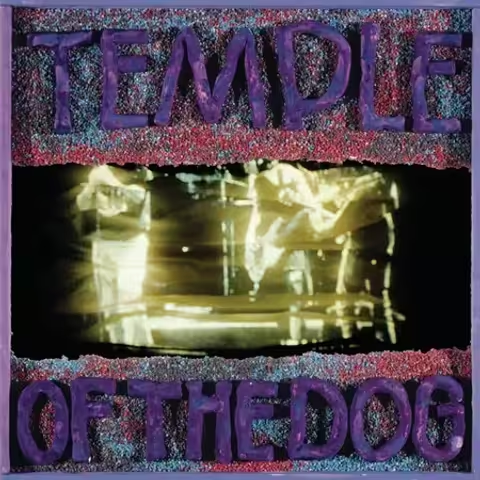
The cover is a Lance Mercer photograph of a small ornamental dog statuette positioned on a tabletop, sepia-toned and flatly lit. Ament took the art-direction credit (he had been the visual director of Mother Love Bone too), with Rich Frankel and Walberg Design handling final layout. Josh Taft contributed additional photography for the booklet, including portraits of the band that have become some of the most-circulated images of the early-1990s Seattle scene. The lyric sheet is in plain Helvetica; the back cover lists Cornell first.
The 2016 25th-anniversary deluxe-edition packaging by Sony Legacy added an extensive booklet with previously-unpublished session photos, contemporaneous Wood remembrances and a long essay by Cameron Crowe. The four-disc super-deluxe edition added a hardcover book and a cloth slipcase.
Release and Reception
The album was released on 16 April 1991 and immediately failed to chart. Reviews were good (Rolling Stone four out of five from David Fricke, Entertainment Weekly B+ from David Browne, AllMusic four-and-a-half stars from Steve Huey, NME 7/10) but A&M had no marketing budget for a side-project tribute album. It sold 70,000 copies in 1991 and was effectively retired.
The reissue was a catalogue-marketing decision. By June 1992, Pearl Jam''s Ten had been on heavy MTV rotation for six months and Soundgarden''s Badmotorfinger was in heavy alternative-radio play. A&M''s catalogue manager Robin Bechtel noticed that Hunger Strike had quietly become a radio-request track at Seattle stations KISW and KNDD on the strength of its two voices. The label commissioned the music video, paid for a single push, and re-released the album. By August 1992 it was at number 5 on the Billboard 200, by September it had cracked Canada''s RPM chart at 11, and by December it was certified Gold.
"For Hunger Strike and Reach Down alone, Temple of the Dog deserves immortality; those songs are proof that the angst that defined Seattle rock in the 1990s was not cheap sentiment, at least in the beginning."
David Fricke, Rolling Stone, December 2000
| Publication | Score | Notable line |
|---|---|---|
| AllMusic (Steve Huey, retrospective) | 4.5/5 | "Permeated by a definite, life-affirming aura." |
| Rolling Stone (Fricke, Dec 2000) | 4/5 | "Deserves immortality." |
| Classic Rock (Berelian, Sep 2016) | 4.5/5 | On the 25th anniversary edition. |
| Entertainment Weekly (Browne, May 1991) | B+ | "The untamed side of the much-hyped Seattle sound." |
| Kerrang! (Gitter, Apr 1991) | 4/5 | Issue 338. Listed in Kerrang!''s 100 Albums You Must Hear Before You Die at no. 58. |
| Mojo (Chick, Dec 2016) | 4/5 | On the deluxe. |
| NME (Pouncey, May 1991) | 7/10 | Contemporary UK review. |
| Q (Doherty, Nov 2016) | 4/5 | On the 25th anniversary edition. |
| Los Angeles Times (Cromelin, Jun 1991) | 3.5/4 | Contemporary review. |
| Spin (Anderson, Sep 2006) | 2/5 | The dissenting voice; later coverage in a Cornell discography. |
Singles and Music Videos
| Single | Released | US Mainstream / Modern | Other | Video |
|---|---|---|---|---|
| Hunger Strike | June 1992 | 4 / 7 | UK 51; CAN 50; NZ 47 | Discovery Park, Seattle, May 1992; director Paul Rachman |
| Say Hello 2 Heaven | September 1992 | 5 / - | Promo only outside US | No commissioned video |
| Pushin Forward Back | 1992 promo | - / - | US radio only | No video |
The Hunger Strike video was shot in May 1992 at Seattle''s Discovery Park, on a beach overlooking Puget Sound, by director Paul Rachman. It is the most-watched piece of Temple of the Dog footage in existence, partly because Vedder is in it and partly because it captures the now-iconic image of Cornell and Vedder trading lines into the same microphone with a backdrop of grey Pacific Northwest sky. The video pushed the song to number 4 on Mainstream Rock and gave the album its commercial second life.
Touring and Live
Temple of the Dog only ever played a handful of shows in their album''s working period:
- Off Ramp Cafe, Seattle, 13 November 1990: the band''s public debut, mid-recording, in a 280-capacity club. Bootlegged for years, finally released on the 2016 box.
- Moore Theatre, Seattle, 22 December 1990: the album-recording wrap show, opening for Soundgarden in front of an audience that included a Sub Pop A&R man who had not yet realised what was happening.
- RKCNDY, Seattle, 13 March 1992: the band''s only billed reunion appearance during the original album cycle, ahead of the reissue.
- Lollapalooza ''92, Phoenix, 8 September 1992: a one-off three-song appearance during Pearl Jam''s set, with Cornell appearing for Hunger Strike.
- Pearl Jam Twenty (PJ20), Alpine Valley, 3-4 September 2011: a five-song reunion at Cornell''s invitation during PJ''s 20th-anniversary festival.
- Benaroya Hall, Seattle, 15 January 2015: a Pearl Jam-related benefit at which Cornell performed two Temple songs with the rest of the band.
- 2016 reunion tour: five US shows in November 2016 (Philadelphia, San Francisco, Los Angeles, Seattle, New York). Their first-ever proper tour. Cornell took his own life in May 2017; the tour stands as the only complete touring run the band ever did.
In TV, Film and Media
All Night Thing appeared on the 1992 Singles soundtrack (Cameron Crowe''s film, scored as an indirect tribute to the Seattle scene Wood had been part of). Say Hello 2 Heaven was used in Aaron Sorkin''s Molly''s Game in 2017, in a sequence that bookends Cornell''s music as the film''s most charged moment. Hunger Strike appeared in Cameron Crowe''s 2011 We Bought a Zoo. The song''s chorus has been used as bumper music on US sports broadcasts and as walk-on music for several MMA fighters in the late 2000s.
Controversy, Censorship and Lawsuits
The album has had no notable censorship controversy, no banned cover and no lyrical-content disputes. The closest thing to controversy was a brief mid-1992 question, raised in the Entertainment Weekly piece In the Temple of Pearlgarden on 31 July 1992, about whether the reissue was a cynical exploitation of Pearl Jam and Soundgarden''s newly-acquired commercial heat. The piece was respectful and the band addressed it directly: A&M had every right to push the catalogue, the band had no contractual interest in slowing it down, and the album''s subject matter (a memorial to a friend) was not something they were going to feel weird about a label promoting.
The 2017 question of Hunger Strike''s lyric ("I don''t mind stealing bread from the mouths of decadence") and Cornell''s mental-health history was raised by some commentators after his suicide; the band''s response, particularly Ament''s, has consistently been that the song is a political-economic critique not a personal one and that retrospectively reading it through Cornell''s death is a misreading.
Covers, Samples and Tributes
Major covers of Hunger Strike: Pearl Jam at Pearl Jam Twenty (2011) with Cornell guesting, several festival performances by Brandi Carlile and Sammy Hagar (the latter at the 2017 Las Vegas Cornell tribute), a 2017 Nadia Ali rendition. Say Hello 2 Heaven has been covered by Audioslave during their post-Cornell live runs, by Linkin Park''s Mike Shinoda at Vector Arena Auckland in 2017, and by Ann Wilson at the 2019 I Am the Highway Cornell tribute concert at the Forum, Los Angeles.
The album itself contains no samples. Wooden Jesus''s banjo line has been compared to the riff in The Black Crowes'' Jealous Again, but no formal credit or claim has ever been made.
Reissues, Remasters and Anniversaries
- 1992 reissue, June 1992. The single-CD push that turned 70,000 sales into the album''s first platinum certification. Same master as the 1991 release.
- 2003 SACD release, hybrid layer with the original Parashar mix.
- 2016 25th anniversary edition, 30 September 2016. Brendan O''Brien new stereo mix at Henson Recording, LA, with Adam Kasper alternative mixes of three tracks. Three formats: a single-CD on the new mix; a two-CD with the bonus disc of demos and outtakes; and a deluxe four-disc set with two CDs, a DVD and a Blu-ray, including the Off Ramp Cafe (13 November 1990), Moore Theatre (22 December 1990) and Alpine Valley (3-4 September 2011) live sets, the Hunger Strike video, and a hardcover book.
- 2016 vinyl reissue, single 12-inch and double-LP variants (the latter with an etching on side D).
- 2021 30th anniversary streaming refresh, with Atmos mixes of four tracks. No physical issue.
Legacy and Influence
The album''s commercial peak came eighteen months after release and was directly attributable to the success of the bands its members had since formed. Pearl Jam''s Ten and Soundgarden''s Badmotorfinger turned the Temple of the Dog reissue into a hit; Pearl Jam''s subsequent Vs, Vitalogy and Binaural kept it in the catalogue conversation; Soundgarden''s Superunknown in 1994 gave Cornell a permanent platform from which to revisit it.
It also became the rare album to outgrow its supergroup framing. By the 2010s, Temple of the Dog was no longer a Cornell-fronted Pearl Jam side project in critical eyes; it was its own thing, a record about grief that happened to contain six of the most important Seattle musicians of the period. Rolling Stone ranked it number 12 on its 2016 40 Greatest One-Album Wonders. Pitchfork put it in its 2022 25 Best Grunge Albums of the ''90s. American Songwriter put it in 2025''s 4 Grunge Albums That Are Way Better Than Nevermind.
Cornell would form Audioslave (see Audioslave) with the three instrumentalists from Rage Against the Machine (see Rage Against the Machine) in 2001 and continued to perform Temple songs into the late 2000s. The 2016 tour was, in retrospect, his goodbye lap; he died in May 2017. The album is now a tribute album twice over: written for Andrew Wood in 1990, and read since 2017 as a meditation on a singer who became part of his own subject.
Things You Might Not Know
| Fact | Detail |
|---|---|
| The flatmate | Chris Cornell shared an apartment with Andrew Wood in the late 1980s; Wood overdosed in that flat and died at Harborview Medical Center on 19 March 1990. |
| Two songs on a tour bus | Say Hello 2 Heaven and Reach Down were demoed on a cassette four-track in European hotel rooms while Soundgarden was supporting Voivod, weeks after Wood''s death. |
| Title from Wood | The band''s name comes from a lyric in Mother Love Bone''s Man of Golden Words: "Seems I been living in the temple of the dog". |
| 15 days of tracking | The whole album was tracked in fifteen days at London Bridge Studio in November and December 1990; the same studio recorded Pearl Jam''s Ten three months later. |
| Vedder''s first studio | Eddie Vedder had never been in a recording studio before this session; he had only flown to Seattle from San Diego a few weeks earlier. |
| The accidental duet | Hunger Strike became a duet because Cornell was struggling with the low part at rehearsal and Vedder, standing near an open mic, sang the harmony quietly to himself; Cornell heard it on his cans and stopped the take. |
| The McCready solo | Cornell had to talk Mike McCready into taking the long solo on Reach Down; McCready, on his first studio session, was reluctant to play over Gossard''s rhythm work. |
| Producer at the piano | Producer Rick Parashar played the piano on Call Me a Dog, Times of Trouble and All Night Thing, plus the organ on All Night Thing. |
| Two songs from one chord progression | Times of Trouble shares its chord progression and backing track with Pearl Jam''s Footsteps; Cornell wrote one melody, Vedder wrote another. |
| The Off Ramp tape | The band played its first public show at the Off Ramp Cafe in Seattle on 13 November 1990, mid-recording; the tape sat unreleased for 26 years before the 2016 box. |
| A&M''s reissue gambit | The album sold 70,000 copies in 1991 and failed to chart. A&M reissued it in June 1992 specifically because Pearl Jam and Soundgarden had become MTV staples; it reached number 5 on the Billboard 200 by August 1992. |
| The video came after the album | The Hunger Strike music video was filmed at Seattle''s Discovery Park in May 1992, fourteen months after the song was first released, by director Paul Rachman. |
| Brendan O''Brien''s 2016 mix | The 25th anniversary edition was remixed at Henson Recording in Los Angeles by Brendan O''Brien, who had also produced Pearl Jam''s Vs and Vitalogy. |
| The first proper tour was the last | The November 2016 five-date US run was Temple of the Dog''s first-ever proper tour; Cornell died six months later. |
| The Crowe essay | Cameron Crowe wrote the essay for the 2016 box''s 60-page hardback book; he had been a friend of Wood''s and used All Night Thing in his 1992 film Singles. |
Listen to the Riffology Podcast
Riffology is the companion podcast to this site. The episode dedicated to Temple of the Dog by Temple of the Dog sits in the player above, and every other episode (covering everything from Superunknown to Ten) is available wherever you listen to podcasts. Subscribe and the next album deep dive will land on whichever app you use.
Comments