By the autumn of 1985, U2 had a problem most bands would have killed for. They had just come off the Unforgettable Fire Tour and a defining set at Live Aid that turned Bono into the rock world's most-photographed Samaritan, and their next move was supposed to be the album that confirmed all of it. Instead, the four of them decamped to Larry Mullen Jr.'s newly bought house with a pile of cassettes and a dawning sense that they were about to make the most American record ever cut by an Irish band, and they had no idea how to begin.
The album that emerged sixteen months later, on 9 March 1987, was called The Joshua Tree. It sold seven million copies inside two months, made U2 the fourth rock band ever to land the cover of Time, won Album of the Year at the 30th Grammy Awards, and remains the record by which every other 1980s rock LP is unconsciously measured. It also nearly broke them.
| Field | Detail |
|---|---|
| Artist | U2 |
| Album | The Joshua Tree |
| Release date | 9 March 1987 |
| Label | Island Records |
| Producers | Daniel Lanois, Brian Eno |
| Mixing (4 tracks) | Steve Lillywhite |
| Recording engineer | Flood |
| Studios | STS, Danesmoate House, Melbeach, Windmill Lane |
| Genre | Rock, roots rock |
| Tracks | 11 |
| Total runtime | 50:11 |
| UK Albums Chart peak | 1 (debut, 235,000 first-week sales) |
| US Billboard 200 peak | 1 (nine weeks) |
| Other number ones | Austria, Canada, Germany, Netherlands, New Zealand, Sweden, Switzerland |
| UK certification | 10x Platinum (BPI) |
| US certification | Diamond (RIAA) |
| Estimated sales | 25 million worldwide |
| Key singles | With or Without You; I Still Haven't Found What I'm Looking For; Where the Streets Have No Name |
Cultural Context: 1987
The album landed in a year already crowded with rock landmarks. Appetite for Destruction, Hysteria, Sign o' the Times, Document, Tunnel of Love, Solitude Standing and Bad, the Michael Jackson album U2 would directly beat at the Grammys, all came out within months of The Joshua Tree. MTV had moved beyond novelty into infrastructure, and the post-punk generation that U2 belonged to was either reinventing itself for arenas or vanishing.
The political weather, on both sides of the Atlantic, was as much a part of the record as the gear. Margaret Thatcher was midway through her third term, the miners' strike still a fresh wound. Ronald Reagan's second term was running into the Iran-Contra affair, and the United States' covert operations in Central America had become the moral question Bono could not stop circling. American radio, meanwhile, was thick with synth-pop that U2 found themselves recoiling from. They wanted to make a record that sounded like rooms, not machines.
The Band Going In
U2 had four albums and one live mini-LP behind them. Boy (1980) and October (1981) had set them up as serious young men with an unfashionable line in faith. War (1983) gave them their first British number one and the live anthem of "Sunday Bloody Sunday". The Unforgettable Fire (1984) had brought in Brian Eno and Daniel Lanois and pushed them into ambient, half-formed atmospherics. The shows that followed had pushed them into stadiums almost by accident.
What they did not have, by their own admission, was a tradition. While in New York in 1985, Bono spent time with Keith Richards and Mick Jagger, who played him blues and country records.
"I realised that we had no tradition, that we were from outer space."
Bono, U2 by U2 (HarperCollins, 2006)
That embarrassment, recounted at length by Bono in U2 by U2, became the engine of the new album. The Edge began listening to public radio in the southern United States during the Unforgettable Fire Tour and absorbed Howlin' Wolf, Robert Johnson, Hank Williams and Lefty Frizzell. Bono dug into Norman Mailer, Flannery O'Connor and Raymond Carver and started writing about, in the phrase he later used, "two Americas, the mythic America and the real America". The working titles of the album were The Two Americas and The Desert Songs.
Pre-production and Demos
The first sessions, in November 1985, were not really sessions at all. The band moved into Larry Mullen Jr.'s recently bought home and worked through a stack of cassette demos: jam tapes, soundcheck loops and a notebook of Bono lyrics. The earliest sketches included a song called "Womanfish", an unfinished thing that would become "Trip Through Your Wires", and rough versions of what would later be "Red Hill Mining Town" and "With or Without You". A short stint at STS Studios in Dublin with engineer Paul Barrett pushed "With or Without You" closer to a song and produced the genesis of "Bullet the Blue Sky".
The Edge has said the writing went in two directions at once: the blues record Bono kept describing and a more European, atmospheric record that the Edge himself felt drawn to. Brian Eno, when the band finally proposed releasing both as a double album in October 1986, talked them out of it.
"I know that any one of these new ideas is good enough to make the record, but we have to draw the line somewhere. If we even consider any of them we'll still be here in three months' time."
Brian Eno, quoted in U2 by U2 (HarperCollins, 2006)
The shelved material became B-sides for the singles, including "Sweetest Thing", "Luminous Times (Hold on to Love)", "Walk to the Water" and "Spanish Eyes". One song, "Birdland", was held back entirely; it would surface in 2007, re-recorded and retitled "Wave of Sorrow (Birdland)", on the 20th anniversary box set.
Creating the Album: Two Houses, One Year
Recording proper began in January 1986 at Danesmoate House, a Georgian mansion in the foothills of the Wicklow Mountains. The Edge had viewed it while flat-hunting with his wife, persuaded the owner to rent it to the band, and the production team converted it into a working studio with a control room set up in the dining room and the band cutting in the adjacent drawing room. The doors between were replaced with a glass screen. The control room was christened the "lyric room" and the recording space the "band room", a deliberate refusal of the word "studio".
Lanois and Eno were back from The Unforgettable Fire. Mark "Flood" Ellis, recommended by Bono's friend Gavin Friday on the strength of his work with Nick Cave and the Virgin Prunes, was brought in as recording engineer; this was his first U2 record, the start of a relationship that has run for forty years. Dave Meegan and Pat McCarthy assisted. The instruction to Flood, in his own words, was unusual for 1986: the band wanted a sound that was "very open, ambient, with a real sense of space of the environment you were in".
Lanois's strategy was to record the band live in a single room, with the instruments isolated only loosely by gobos and the players listening through monitor speakers rather than headphones.
"You have to make a commitment to what you put down and either use it or throw it all away."
Daniel Lanois, Sound on Sound, September 1987
That commitment is audible across the record. Two songs broke the rule: "I Still Haven't Found What I'm Looking For" and "Mothers of the Disappeared" were built up around drum tracks Mullen had played at earlier sessions, then assembled in overdub. Everything else is essentially the four of them in a room.
The sessions ran in two-week stints across the year, with the band continuing to write between them. Two events outside the studio shaped the record more than any technical decision. The first was the death of Greg Carroll, U2's roadie and Bono's personal assistant, killed in a motorcycle accident in Dublin on 3 July 1986. The band travelled to New Zealand for his Maori funeral, an experience that became the lyric of "One Tree Hill". The second was Bono's trip with his wife Ali to Nicaragua and El Salvador after the funeral, where the violence of the US-backed Salvadoran government became the lyrical foundation of "Bullet the Blue Sky" and "Mothers of the Disappeared".
By August the band had moved a second studio setup into Melbeach, the Edge's recently purchased seaside house in Monkstown, with mixing and overdubs continuing at Windmill Lane in central Dublin. During Hurricane Charley in late August, Robbie Robertson appeared at Danesmoate to record what became "Sweet Fire of Love" and "Testimony" for his self-titled debut. The Armin Family, a Toronto trio of electric string players, were brought in for "One Tree Hill"; the Arklow Silver Band, a brass band from County Wicklow, played the horn part on "Red Hill Mining Town", arranged by Paul Barrett.
The hardest song to land was "Where the Streets Have No Name". The Edge had built the demo on his own, but the time-signature changes baffled the band when they tried to play it together. Eno reckoned 40 per cent of the album's total studio time went on that one track. He also tried, at one point, to engineer an "accident" that would erase the tapes and force the band to start again. Flood has said engineer Pat McCarthy had to physically restrain him.
By the December deadline, with Eno and Flood already moving on to other projects, U2 hired Steve Lillywhite, who had produced their first three records, to mix four songs in a hurry on an SSL desk at Windmill Lane: "Where the Streets Have No Name", "With or Without You", "Bullet the Blue Sky" and "Red Hill Mining Town". Lanois, McCarthy and Meegan mixed the remaining seven at Melbeach on a 24-track AMEK 2500 desk that lacked mix automation; all three of them had to operate the console at once. On the night before the 15 January 1987 master deadline, Lillywhite's wife Kirsty MacColl came in and set the album's running order, with the band specifying only that "Where the Streets Have No Name" must open and "Mothers of the Disappeared" must close.
Personnel and Credits
| Role | Player | Notes |
|---|---|---|
| Core band | ||
| Vocals, harmonica | Bono | Sole credited lyricist |
| Guitars, backing vocals, piano | The Edge | Piano on "Running to Stand Still" |
| Bass guitar | Adam Clayton | |
| Drums | Larry Mullen Jr. | |
| Additional musicians | ||
| Keyboards, DX7 programming, backing vocals | Brian Eno | Co-producer |
| Tambourine, Omnichord, additional guitar, backing vocals | Daniel Lanois | Co-producer |
| Electric cello, viola, violin | The Armin Family (Dick, Paul, Adele) | Raad strings on "One Tree Hill" |
| Brass | The Arklow Silver Band | "Red Hill Mining Town" |
| Brass arrangement and conducting | Paul Barrett | |
| Production and engineering | ||
| Production | Daniel Lanois, Brian Eno | |
| Recording | Flood | First U2 record |
| Additional engineering | Dave Meegan, Pat McCarthy | |
| Mixing | Steve Lillywhite | "Where the Streets Have No Name", "With or Without You", "Bullet the Blue Sky", "Red Hill Mining Town" |
| Mix engineering | Mark Wallis, Mary Kettle | |
| String recording | Bob Doidge | "One Tree Hill" |
| Album sequencing | Kirsty MacColl | Volunteered the night before the master deadline |
| Artwork | ||
| Photography | Anton Corbijn | |
| Design and layout | Steve Averill | U2's long-time sleeve designer |
The Songs: A Track-by-Track
| # | Title | Length | Single? | Notes |
|---|---|---|---|---|
| 1 | Where the Streets Have No Name | 5:38 | Yes (3rd) | Edge demo; consumed roughly 40 per cent of studio time |
| 2 | I Still Haven't Found What I'm Looking For | 4:38 | Yes (2nd) | Built around an earlier Mullen drum track; gospel-tinged |
| 3 | With or Without You | 4:56 | Yes (1st) | Edge plays a prototype Infinite Guitar by Michael Brook |
| 4 | Bullet the Blue Sky | 4:32 | No | Edge instructed by Bono to "put El Salvador through an amplifier" |
| 5 | Running to Stand Still | 4:18 | No | Set in the Ballymun Flats; Edge plays piano |
| 6 | Red Hill Mining Town | 4:52 | Cancelled | 1984 UK miners' strike; Arklow Silver Band brass |
| 7 | In God's Country | 2:57 | Yes (4th, NA only) | Released as North American single, November 1987 |
| 8 | Trip Through Your Wires | 3:33 | No | Bluesy harmonica romp; one of the earliest demos |
| 9 | One Tree Hill | 5:23 | Yes (AU/NZ only) | Written for Greg Carroll; reached number one in New Zealand |
| 10 | Exit | 4:13 | No | Portrait of a psychotic killer; coda runs into the next track on early CDs |
| 11 | Mothers of the Disappeared | 5:12 | No | Inspired by Bono's meeting with COMADRES in El Salvador |
"Where the Streets Have No Name"
The album's opening minute is, in commercial-rock terms, an act of hubris: nearly two minutes of organ drone and Edge's six-note arpeggio repeating through delay before Mullen even arrives. The song's lyric was written, Bono has said, in response to the idea that in Belfast you can deduce a person's religion and income from the street they live on.
"I Still Haven't Found What I'm Looking For"
The gospel-leaning second track was, like a great deal of the album, an act of bricolage. Mullen's drum part was lifted from a much earlier session; Eno, Lanois and the Edge sang choir-style behind Bono. The Edge has said the riff was meant to sound, in Bono's phrase, like "chrome bells".
"With or Without You"
The song the band almost binned. The Edge thought early demos were "awful". What rescued it was a prototype of the Infinite Guitar, a sustain-heavy instrument hand-built by the Canadian musician Michael Brook and shipped to the Edge with its own assembly instructions and a real risk of electric shock. Bono and Gavin Friday rebuilt the arrangement in the Edge's absence; Eno layered a DX7 arpeggio underneath; Lanois listened back and said the obvious thing.
"I said, 'That sounded pretty cool,' so we listened back and I said, 'Jesus, it's better than I thought.'"
Daniel Lanois, Hot Press, November 2007
It became the band's first US number one when it topped the Hot 100 on 16 May 1987 for three weeks. In March 2024 it became the first U2 song to pass a billion Spotify streams.
"Bullet the Blue Sky"
Recorded after Bono's return from El Salvador, with the singer telling the Edge to "put El Salvador through an amplifier". The mid-song spoken passage about a man with "a face red like a rose on a thorn bush" was a direct reference to Reagan.
"Running to Stand Still"
A piano-and-harmonica ballad about heroin in north Dublin's Ballymun Flats, the seven tower blocks Bono grew up near, hence the line about seeing seven towers and only one way out. The Edge plays piano. It is the album's quietest moment and one of its bleakest.
"Red Hill Mining Town"
The 1984 UK miners' strike, written from the perspective of a couple it had broken. Originally lined up as the second single, the plan was abandoned after the band fell out with Neil Jordan's music video and Bono said he could not sing the song live. A 2017 Steve Lillywhite remix was released for Record Store Day on picture-disc vinyl.
"In God's Country"
The shortest song on the album, two minutes 57, and the most economical use of the desert metaphor. Released as a fourth single in North America only, where it peaked at 44 on the Hot 100.
"Trip Through Your Wires" and "Exit"
The bluesy "Trip Through Your Wires" was one of the earliest demos to make it through; the Edge has said it survived because it captured the Howlin' Wolf influence the band had been chasing. "Exit", by contrast, is the album's furthest detour, a three-and-a-half-minute portrait of a psychotic killer that builds into a guitar barrage. On the original CD pressing, the quiet coda of "One Tree Hill" was incorrectly bundled into the next track; the 1996 Mobile Fidelity Sound Lab gold-CD remaster fixed the split.
"One Tree Hill" and "Mothers of the Disappeared"
Both written for the dead. "One Tree Hill" takes its title from a volcanic peak above Auckland, where Greg Carroll grew up, and is dedicated to him; the Armin Family's electric strings give it its mournful sweep. "Mothers of the Disappeared" closes the album with a lullaby for the women of COMADRES, the Salvadoran mothers whose children had been "disappeared" by the local government, set to a Spanish-guitar melody Bono had originally written for Ethiopian children to sing as a hygiene lesson.
B-sides and Outtakes
The flip sides of the singles are some of the most worthwhile B-sides U2 ever cut. They were finished after the album was delivered, in a quick second burst at Windmill Lane with Meegan and McCarthy and no producers in the room.
- "Luminous Times (Hold on to Love)" and "Walk to the Water" backed "With or Without You" in March 1987.
- "Spanish Eyes" and "Deep in the Heart" backed "I Still Haven't Found What I'm Looking For" in May.
- "Sweetest Thing", "Silver and Gold" (the band's own version of the Sun City protest track Bono originally cut with Keith Richards and Ronnie Wood) and "Race Against Time" appeared on the "Where the Streets Have No Name" 12-inch in August.
- "Birdland", thought too strong for a B-side, was held back; a re-recorded version surfaced in 2007 as "Wave of Sorrow (Birdland)" on the 20th anniversary box.
"Sweetest Thing" was the one the band always regretted not finishing for the album proper. They re-recorded it in 1998 for The Best of 1980-1990.
Album Artwork and Packaging
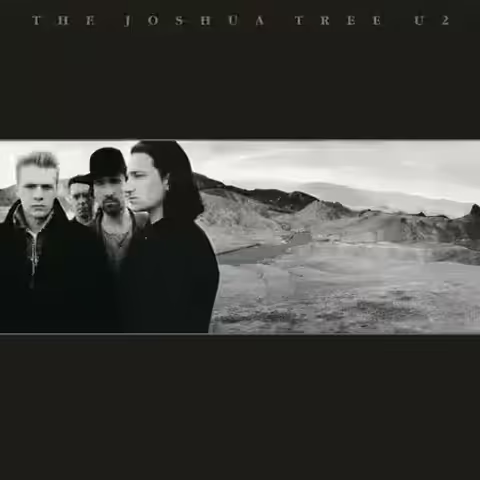
The sleeve was Steve Averill's design, built around Anton Corbijn's photography. The shoot took place over several days in December 1986, with the band, Corbijn and Averill on a hired bus through the Mojave Desert, beginning in Reno and moving to the ghost town of Bodie, the Harmony Motel in Twentynine Palms, Zabriskie Point and Death Valley Junction. Corbijn rented a panoramic camera he had never used before, focused it on the background, and accidentally left the band slightly soft in the foreground. The cover photograph, with the band framed in the left half of the frame, was Averill's deliberate nod to the cinematography of John Ford and Sergio Leone.
The band were grim-faced because, as Bono later put it, the desert was freezing and they had to take their coats off so it would look hot. Corbijn was less apologetic.
"I guess people felt they took themselves too seriously. It was definitely the most serious, I think, that you can photograph a band. You couldn't go any further down that line unless you start photographing graves."
Anton Corbijn, Uncut, October 2003
Corbijn told the band on the evening of the first day's shooting about the Joshua tree itself, the spiked yucca that early Mormon settlers had named after the Old Testament prophet, his branches raised in prayer. Bono liked the religious resonance, declared the album would be called The Joshua Tree, and the next day, on Route 190 near Darwin, California, they spotted a single specimen and shot it for twenty minutes. The tree fell around 2000. The site sits about 200 miles from Joshua Tree National Park, which has not stopped the steady stream of fans who travel out to it.
The packaging differed by format. The vinyl gatefold opened to a desert landscape with the band beside the tree (with a make-up mirror visible in one corner that nobody noticed in time to remove). The cassette used a clear alternate band photo. The first CD pressing, in 1987 a still-novel format, used a deliberately blurred image; later CD reissues reverted to the LP shot. Berkeley Breathed parodied the cover for the back of his August 1987 book Billy and the Boingers Bootleg.
Release and Reception
Island spent over $100,000 on US store displays alone; label president Lou Maglia called it "the most complete merchandising effort ever assembled". Record stores in Britain and Ireland opened at midnight on 9 March 1987 to handle queues. The album debuted at number one in the UK on 21 March with first-week sales of 235,000, the fastest-selling album in British history to that point, and was BPI Platinum within forty-eight hours. In the US it debuted on 4 April at number seven (the highest US studio-album debut in nearly seven years), and reached number one three weeks later.
By May, worldwide sales had passed seven million. Time put the band on its 27 April cover under the headline "Rock's Hottest Ticket", making U2 only the fourth rock act ever to make the front of the magazine, after the Beatles, the Band and the Who. By the end of 1988, sales had passed fourteen million.
Critically, it was the best reviewed album of U2's career to that point. Steve Pond's review in Rolling Stone framed it as the moment the band's outsized ambition finally caught up with their songs.
"For a band that's always specialized in inspirational, larger-than-life gestures, a band utterly determined to be Important, The Joshua Tree could be the big one, and that's precisely what it sounds like."
Steve Pond, Rolling Stone, 9 April 1987
Robert Hilburn, in the Los Angeles Times, went further, declaring U2 the band the Rolling Stones had stopped being. Paul Du Noyer's five-star review in Q located the record's potency in "a kind of spiritual frustration, a sense of hunger and tension which roams its every track in search of some climactic moment of release". Robert Christgau in the Village Voice demurred, calling it "one of the worst cases of significance ever to afflict a deserving candidate for superstardom" and giving it a B.
Singles, Videos and Charts
| Single | Released | US Hot 100 | UK Singles | B-sides / notes |
|---|---|---|---|---|
| With or Without You | 16 March 1987 | 1 (3 weeks) | 4 | "Luminous Times", "Walk to the Water"; videos by Meiert Avis and Matt Mahurin |
| I Still Haven't Found What I'm Looking For | 25 May 1987 | 1 | 6 | "Spanish Eyes", "Deep in the Heart" |
| Where the Streets Have No Name | 31 August 1987 | 13 | 4 | "Sweetest Thing", "Silver and Gold", "Race Against Time" |
| In God's Country | 16 November 1987 (NA only) | 44 | 48 (import) | North American radio-promoted release |
| One Tree Hill | 7 March 1988 (AU/NZ only) | Reached number one in New Zealand, Greg Carroll's home country |
"With or Without You" had two videos, both shot in Dublin in February 1987 and co-directed by Meiert Avis and Matt Mahurin, the better-known of the two featuring abstract dance footage of Morleigh Steinberg, who would later marry the Edge. The "Where the Streets Have No Name" video, directed by Avis, was shot on a rooftop on Seventh Street in Los Angeles in March 1987 and shut down by police, an incident that immediately became part of the band's mythology. The "Red Hill Mining Town" video was shelved.
The Joshua Tree Tour
The tour ran from April to December 1987 across three legs (US, Europe, US again), 109 shows. It was the highest-grossing North American tour of 1987, taking $35.1 million from 2.04 million tickets across 79 shows; the worldwide total reached $56 million from 3.17 million tickets. It was the first tour on which U2 consistently played stadiums.
- The "Where the Streets Have No Name" rooftop video was filmed mid-tour in Los Angeles.
- U2 collaborated with Bob Dylan, B.B. King and Harlem's New Voices of Freedom gospel choir along the way, and visited Sun Studio in Memphis.
- The shows were used to attack Arizona Governor Evan Mecham over his decision to cancel the state's observance of Martin Luther King Jr. Day.
- "Red Hill Mining Town" was the only track from the album never played on the tour.
- The footage and Memphis recordings became the basis of Rattle and Hum, the 1988 album and Phil Joanou film.
Bono, characteristically, was not satisfied. "We were the biggest, but we weren't the best," Mullen later admitted. Bono himself called the tour "one of the worst times of our musical life", noting the death threats, the injuries and the band's first dabble in the rock-and-roll lifestyle they had publicly resisted up to then.
Awards and Accolades
At the 30th Grammy Awards in 1988, U2 took Album of the Year (beating Michael Jackson's Bad, Whitney Houston's Whitney, Prince's Sign o' the Times and the La Bamba soundtrack) and Best Rock Performance by a Duo or Group with Vocal. They had also been nominated for Record of the Year and Song of the Year for "With or Without You". They won the Brit Award for International Group at the 1988 ceremony. Rolling Stone's 1987 readers' poll gave them five categories outright, including Best Album, Artist of the Year and Best Single.
Long-running list placements followed. The Joshua Tree was 26 on Rolling Stone's 2003 500 Greatest Albums list, 27 on the 2012 update and 135 on the 2020 revision. Q named it the best record of the 1980s. In 2014 it was inducted into the Grammy Hall of Fame and selected for preservation in the US National Recording Registry, the only Irish work ever so honoured. In 2024 Apple Music ranked it 49 on its 100 Best Albums list.
Reissues, Remasters and Anniversaries
Mobile Fidelity Sound Lab's 1996 gold-CD remaster was the first to fix the "One Tree Hill" / "Exit" track-split error that had affected early CD pressings. The 20th anniversary edition (20 November 2007) was remastered under the Edge's direction from the original analogue tapes, with the LP cover restored, fourteen B-sides, demos and unreleased tracks ("Wave of Sorrow", "Desert of Our Love", "Rise Up", "Drunk Chicken/America" featuring Allen Ginsberg) and a DVD including the 4 July 1987 Live from Paris concert and the unseen Neil Jordan video for "Red Hill Mining Town".
The 30th anniversary reissue (2 June 2017) added super-deluxe formats with a 1987 Madison Square Garden concert recording and 2017 remixes by Daniel Lanois, Jacknife Lee, Steve Lillywhite, Flood and St Francis Hotel; the Lillywhite remix of "Red Hill Mining Town" was issued on Record Store Day on picture-disc vinyl. The 30th anniversary tour, in 2017 and 2019, played the album in full at every show, took $390.8 million from 3.3 million tickets, and was the highest-grossing tour of 2017.
Legacy and Influence
Within four years of The Joshua Tree, U2 were dismantling everything it had built. Bono, asked about Achtung Baby in 1991, called it "the sound of four men chopping down the Joshua Tree". The author Bill Flanagan put the legacy more drily in his 2007 liner notes:
"The Joshua Tree made U2 into international rock stars and established both a standard they would always have to live up to and an image they would forever try to live down."
Bill Flanagan, liner notes to The Joshua Tree 20th anniversary edition, 2007
The wider influence has been quieter and more pervasive. Coldplay, Arcade Fire, Kings of Leon, the Killers and a generation of stadium-folk acts inherited the album's vocabulary: open-tuned chiming guitars, drone-and-arpeggio openings, lyrics that aim for the cheap seats without entirely embarrassing themselves. The Edge's delay pedal became an industry. The instinct to make a "cinematic" rock record, where individual songs evoke specific landscapes, runs through everything from OK Computer to How to Dismantle an Atomic Bomb to the National's stadium years.
For U2 themselves, the album defined the line they have spent four decades dancing across. Rattle and Hum over-extended its Americana. Achtung Baby, Zooropa and Pop ironised it. All That You Can't Leave Behind tried to recover its emotional directness. The 2017 anniversary tour proved that, against all of their own strategies, the songs still landed in stadiums in the manner of a record made yesterday.
Things You Might Not Know
| Fact | Detail |
|---|---|
| The first working title | The album was originally going to be called The Two Americas, with The Desert Songs as a fallback. Bono only declared it The Joshua Tree on the second day of the Mojave shoot. |
| The Eno arson plan | Brian Eno was so frustrated with "Where the Streets Have No Name" that he tried to engineer an "accident" to erase the tapes and force a fresh start. Engineer Pat McCarthy physically restrained him. |
| Adam Clayton bought the studio | After the album was finished, Clayton bought Danesmoate House outright in 1987 and made it his home. |
| A wife, a kettle, a tracklist | Steve Lillywhite's wife, Kirsty MacColl, sequenced the album the night before the master deadline. Bono later said: "She came in and she organized it and it worked as an old-fashioned album: a beginning, middle and end." |
| The mirror in the gatefold | The centre gatefold image of U2 with the Joshua tree contains a make-up mirror that the band used to check their appearance and forgot to remove. It was never edited out. |
| Three covers, three formats | The original LP, cassette and CD all used different photographs of the band. The CD got a deliberately blurred image; later CD reissues used the LP shot. |
| The Infinite Guitar prototype | The Edge played a hand-built prototype of Michael Brook's Infinite Guitar on "With or Without You". The instrument was so badly insulated that his guitar tech got electric shocks setting it up on later tours. |
| Around 30 songs were tracked | The band had roughly 22 to 30 songs in some form by November 1986. They selected 11 for the album. The leftovers seeded almost every B-side. |
| A billion streams | "With or Without You" became the first U2 song to reach one billion Spotify streams on 15 March 2024, thirty-seven years after release. |
| The tree fell | The single Joshua tree photographed on Route 190 collapsed around the year 2000. A fan-made plaque now reads "Have you found what you're looking for?". |
| An honour for Ireland alone | The album's 2014 entry into the US National Recording Registry made it the only Irish work ever inducted by the Library of Congress. |
| Beating the King of Pop | At the 1988 Grammys U2 took Album of the Year over Michael Jackson's Bad, Whitney Houston's Whitney, Prince's Sign o' the Times and the La Bamba soundtrack. |
For all the strategy that surrounds it now, The Joshua Tree was made by four men in two rented houses in Ireland, an English producer with a Yamaha DX7, a Canadian producer with an Omnichord, an English engineer who had never worked with the band before, and a road crew that had just lost a friend. They cut about thirty songs in a year, threw away two-thirds of them, almost lost the opening track to a saboteur, and finished the master tape with seven hours to spare. What landed in the world's record shops on 9 March 1987 has never quite stopped being the moment U2 stopped being a band and started being U2.
Comments