Adore is the album The Smashing Pumpkins made after the wheels came off. In the eighteen months between the diamond-selling Mellon Collie and the Infinite Sadness and the sessions that produced their fourth record, drummer Jimmy Chamberlin was fired in the wake of a touring keyboardist's overdose death, Billy Corgan's mother died of cancer, his marriage ended, and the band's stadium-rock momentum collapsed under all of it. Corgan walked into the studio in 1997 with thirty songs, no drummer and a hybrid he called "ancient and futuristic" running in his head. He walked out fourteen months later with a quiet, gothic, electronica-tinted album that sold roughly a tenth of what its predecessor had, divided the fan base, and which Corgan would later call "one of the most painful experiences of my life".
Released by Virgin Records on 2 June 1998, Adore is a 73-minute meditation on grief and reinvention played mostly on piano, drum machine and acoustic guitar, with Matt Walker, Joey Waronker and Soundgarden's Matt Cameron rotating through the kit chair Chamberlin had vacated. It debuted at number two on the Billboard 200 behind Master P, went platinum in five weeks, hit number one in six countries, then dropped quickly off the charts and became the great unloved Pumpkins record of the 1990s. Time has been kinder. Reissued at expanded length in 2014, namechecked by Radiohead and Trent Reznor, and reappraised in retrospect as the moment Corgan stopped writing for stadiums and started writing for grown-ups, Adore now reads less like a commercial mistake than a bruised, brave swerve away from the Mellon Collie template.
| Field | Detail |
|---|---|
| Artist | The Smashing Pumpkins |
| Album | Adore |
| Release date | 2 June 1998 |
| Label | Virgin Records |
| Producers | Billy Corgan, Flood, Brad Wood |
| Studios | Sunset Sound (LA), Village Recorder (LA), CRC (Chicago), Sadlands (Corgan's home studio), Streeterville (Chicago) |
| Genre | Electronic rock, gothic rock, art rock, synth-pop, industrial rock |
| Track count | 16 |
| Total runtime | 73:25 |
| Billboard 200 peak | 2 (174,000 first-week sales) |
| UK Albums Chart peak | 5 |
| Other number-one peaks | Australia, France, Ireland, New Zealand, Norway, Belgium (Flanders), Portugal |
| Certifications | Platinum (US, Australia, NZ), 2x Platinum (Canada), Gold (UK, France, Japan, Spain, Norway, Denmark) |
| Estimated worldwide sales | Approx. 3.3 million by 2005 (1.1 million US) |
| Singles | Ava Adore, Perfect, Crestfallen, To Sheila |
A Different World by 1998
The cultural ground had moved fast since Mellon Collie hit the racks in October 1995. Grunge was over. Kurt Cobain had been dead for four years, Soundgarden had broken up in April 1997, and the alternative rock that had funded a decade of major-label spending was being noisily replaced on radio by nu-metal, post-grunge balladry and a wave of teen pop that would crest in the same June Adore came out. Madonna's Ray of Light had recalibrated arena pop towards trip-hop two months earlier. Massive Attack, Portishead and Tricky had made electronica safe for serious-minded rock listeners. Radiohead's OK Computer the previous summer had shown what a guitar band could do with programmed textures and existential dread.
That was the climate Adore landed into: a record made by the band that had built the most unapologetically maximalist alt-rock album of the decade, suddenly recoiling from drums and distortion and trying to make something that, on first listen, sounds closer to Tindersticks or Depeche Mode's Ultra than to Siamese Dream. The Pumpkins were not alone in pulling back. U2's Pop, Bowie's Earthling, even Garbage's Version 2.0 (released a few weeks before Adore) all flirted with electronica. But none of them did it from a position of such recent, total, mainstream-rock dominance, and none of them paired the synthesiser pivot with the kind of public personal collapse that Corgan was carrying into the studio.
The Band's Story Up to This Point
The Smashing Pumpkins had risen from Chicago clubs through the early 90s on a series of progressively more ambitious records, climbing from the neopsychedelic Gish in 1991 through the multi-tracked guitar opera of Siamese Dream in 1993 to the rock-opera-length double of Mellon Collie and the Infinite Sadness in 1995. Mellon Collie sold ten million copies in the United States alone, won a Grammy for Bullet With Butterfly Wings, and put the band into the bracket of late-90s arena headliners. The 1996 box set The Aeroplane Flies High collected the singles' B-sides and shipped platinum off its own back. By any meaningful measure, the band were peers of U2 and R.E.M.
Then everything broke. On 12 July 1996, touring keyboardist Jonathan Melvoin overdosed on heroin in a New York hotel room he was sharing with Chamberlin, who was revived by paramedics. Within days, Chamberlin had been dismissed from the band. Corgan announced the firing publicly and bluntly, and the Mellon Collie tour finished with a temporary drummer, Matt Walker on loan from Filter. Through 1996 and 1997 Corgan's life kept collapsing. His marriage to art student Chris Fabian ended. His mother, with whom he had a famously fraught relationship, died of cancer. The two singles the band released in 1997 with leftover Mellon Collie momentum, "Eye" for the David Lynch film Lost Highway and "The End Is the Beginning Is the End" for Joel Schumacher's Batman & Robin, were wholly electronic experiments and pointed unmistakably away from the heavy-guitar Pumpkins. The band that walked into demo sessions at Corgan's Sadlands home studio in February 1997 was barely a band at all.
Pre-Production, Sadlands and the Lost Acoustic Album
The first plan was almost the opposite of the album that finally came out. In February 1997, Corgan, James Iha, D'arcy Wretzky and stand-in drummer Matt Walker spent a few days at Sadlands, Corgan's home studio, knocking out live takes of mostly acoustic songs. The band's management briefed press in autumn 1997 that the new record would be "all acoustic". Corgan dropped the phrase "arcane night music" to MTV in early 1998, then walked it back in a Mojo-era interview that rejected every label being pinned to the album:
"The people that say it's acoustic will be wrong. The people that say it's electronic will be wrong. The people that say it's a Pumpkins record will be wrong. I will try to make something that is indescribable."
Billy Corgan, MTV News, February 1998
Corgan's vision had drifted by then towards a hybrid he repeatedly described as "ancient and futuristic", a folk-rock-meets-electronica hush rather than the all-acoustic singer-songwriter record management had been advertising. By the time the band started full sessions in Chicago in summer 1997, roughly thirty songs had been written. Many of them never made the album. The Sadlands demo cache that the 2014 reissue eventually unearthed includes "Blissed and Gone", "Christmastime", "My Mistake", "Sparrow", "Valentine" and an early banjo-led take of "To Sheila", among dozens of others. The cutting-room floor on Adore is unusually deep, and the demos that survive are some of the most relaxed playing the band ever committed to tape.
Creating the Album
Recording began in earnest in summer 1997 at CRC and Streeterville in Chicago with producer Brad Wood, who had cut his teeth recording Liz Phair's Exile in Guyville and Sunny Day Real Estate's Diary, and who had worked with Corgan on much earlier sessions in the early 90s. The sessions crawled. Corgan was working mostly alone, leaving Iha and Wretzky to drift in and out, and after roughly six weeks he decided neither Wood nor Chicago was producing the record he wanted. The band, minus Wood and Walker, decamped to Los Angeles, set up at Sunset Sound and Village Recorder, and rented a house with the idea that living together would salvage the band dynamics. Corgan later wrote that Iha refused to live in the house and rarely visited. Corgan, by default, became the producer.
The drum chair turned over constantly. Matt Walker handled most of the live kit work, including To Sheila, Ava Adore, Daphne Descends, Tear, The Tale of Dusty and Pistol Pete, Annie-Dog and Behold! The Night Mare. Joey Waronker, Beck's drummer, played on Perfect and added drums to Once Upon a Time and Pug. Matt Cameron, fresh from the dissolution of Soundgarden, played on For Martha, the eight-minute closer Corgan had written for his late mother and which the band cut as a single live take. On the rest of the record, drum machines and programming did the work that Chamberlin would have done. Bon Harris of British industrial outfit Nitzer Ebb came in late to add programming on tracks 2, 3, 4, 5, 7, 8, 9 and 13, plus backing vocals on For Martha. Brad Wood, despite the studio change, kept his name on additional production and engineering for tracks 1, 2, 4, 6, 13 and 15, and played organ on Blank Page.
At the band's management's insistence, Rick Rubin was brought in to produce a single song, "Let Me Give the World to You", in the hope of giving the album a radio anchor. Corgan disliked the result, fought to keep the song off the record entirely rather than risk it being chosen as the lead single, and won. The Rubin recording leaked years later via the 2014 reissue and is a small revelation: a buoyant, almost Springsteen-shaped pop tune that would have given Adore a "1979" but completely undermined the album's atmosphere.
By late 1997 Corgan called in Flood, his Mellon Collie co-producer, to finish what had become an unmanageable thirty-song stockpile. Flood mixed the record, helped trim the tracklist to sixteen and applied the kind of restrained, intimate balance he had developed working on Achtung Baby, Pretty Hate Machine and Depeche Mode's Songs of Faith and Devotion. Howie Weinberg mastered. Sessions wrapped in March 1998. Greg Kot summed up the resulting tonal swerve in his Rolling Stone review:
"This isn't just a transitional record; it's a complete break with the past. Instead of stadium-size bombast, Adore dials down the volume to lullaby level. Instead of rat-in-a-cage rage, the new album overflows with heartsick valentines."
Greg Kot, Rolling Stone, 18 May 1998
Personnel & Credits
| Role | Player | Notes |
|---|---|---|
| Core band | ||
| Vocals, guitar, piano, keyboards, production | Billy Corgan | Sole songwriter; de facto producer after Chicago sessions |
| Lead and rhythm guitar, backing vocals | James Iha | First Pumpkins album with no Iha writing credit; concurrently making solo album Let It Come Down |
| Bass guitar, uncredited rhythm guitar | D'arcy Wretzky | Final Pumpkins album as bassist before her 2000 departure |
| Drums and percussion | ||
| Drums | Matt Walker | To Sheila, Ava Adore, Daphne Descends, Tear, The Tale of Dusty and Pistol Pete, Annie-Dog, Behold! The Night Mare |
| Drums | Matt Cameron | For Martha (one live take); fresh from the breakup of Soundgarden |
| Drums | Joey Waronker | Perfect; additional drums on Once Upon a Time and Pug |
| Drum programming | Bon Harris | Nitzer Ebb; programming on tracks 2, 3, 4, 5, 7, 8, 9, 13; vocals on For Martha |
| Guests | ||
| Backing vocals | Dennis Flemion, Jimmy Flemion | The Frogs; vocals on To Sheila and Behold! The Night Mare |
| Production and engineering | ||
| Producers | Billy Corgan, Flood, Brad Wood | Wood: tracks 1, 2, 4, 6, 13, 15 plus organ on Blank Page |
| Engineers | Robbie Adams, Neil Perry, Chris Shepard, Bjorn Thorsrud, Howard C. Willing | Multiple studios, multiple cities |
| Mixing | Flood, Robbie Adams, Neil Perry | |
| Mastering | Howie Weinberg | Masterdisk, New York |
| Digital editing | Bjorn Thorsrud, Andy Van Dette | |
| Artwork | ||
| Photography, art direction | Yelena Yemchuk | Corgan's then-girlfriend; cover model is Amy Wesson |
| Art direction and design | Frank Olinsky, Billy Corgan | |
| One that got away | ||
| Producer (one song) | Rick Rubin | Let Me Give the World to You; Corgan dropped the song from the album to prevent it being chosen as lead single |
The Songs
All sixteen tracks are written by Billy Corgan. The album's ordering is unusually steady in tempo and mood, opening on a piano-led elegy and ending on a literal seventeen-second piano postscript.
| # | Title | Length | Single? | Notes |
|---|---|---|---|---|
| 1 | To Sheila | 4:45 | Promo | Originally cut as a banjo demo at Sadlands; final version adds backing vocals from The Frogs |
| 2 | Ava Adore | 4:20 | Yes | First single; Brad Wood produced; one-take video by Dom and Nic cost $800,000 |
| 3 | Perfect | 3:22 | Yes | Second single; Joey Waronker on drums; sequel video to "1979" |
| 4 | Daphne Descends | 4:38 | One of the most overtly synth-pop tracks; promotional CD pressed with Kerry B. remix | |
| 5 | Once Upon a Time | 4:06 | Sadlands demo origin; lyric written for Corgan's late mother | |
| 6 | Tear | 5:52 | Originally written for Lost Highway; David Lynch picked Eye instead | |
| 7 | Crestfallen | 4:09 | Promo | Released to radio in 1999 as the album's third promo single |
| 8 | Appels + Oranjes | 3:34 | Lyric is a list-poem; Bon Harris programming dominates | |
| 9 | Pug | 4:46 | Originally a "minor-key blues death march" with Matt Cameron drums; album version uses programmed beats | |
| 10 | The Tale of Dusty and Pistol Pete | 4:33 | Acoustic guitar and brushed kit; one of the album's clearest folk-rock songs | |
| 11 | Annie-Dog | 3:36 | Bare piano, Corgan vocal cracking with weariness; misspelled "Annie" on first US pressings | |
| 12 | Shame | 6:37 | Late-night, hymn-like; Greg Kot singled out the chorus mantra | |
| 13 | Behold! The Night Mare | 5:12 | Brad Wood plays organ underneath; Flemion brothers on backing vocals | |
| 14 | For Martha | 8:17 | Tribute to Corgan's mother; Matt Cameron drums; recorded as one live take | |
| 15 | Blank Page | 4:51 | Brad Wood organ; album's exhausted closer before the coda | |
| 16 | 17 | 0:17 | Solo piano coda; not on vinyl pressings, where Once in a While takes the slot instead |
Three songs do most of the work for the new listener. Ava Adore opens on a four-on-the-floor drum-machine pulse and Corgan's whispered cradle-song threat ("It's you that I adore, you'll always be my whore"), the closest thing on the album to a club track. Perfect, sequenced third, is the album's pop concession, a sequel in mood and arrangement to "1979" with Joey Waronker's relaxed drumming carrying a Nellee Hooper-friendly melody. For Martha closes the album proper with the only sustained electric-guitar solo on the record, Corgan's tribute to his mother stretched across eight minutes that move from solo piano into a full-band chorale and back to a single piano note.
The deeper cuts are where Adore earns its cult. To Sheila opens the record on close-mic'd acoustic guitar and one of Corgan's most disarmingly direct vocal performances. Annie-Dog is a piano-and-voice sketch about a chemical-loving girlfriend that Greg Kot pointed to as the moment Corgan's songwriting matured beyond the bombast of the Mellon Collie singles. Shame, six minutes of a four-chord lullaby, has been covered by Passion Pit and is the song most often pulled out by retrospective writers as the case for Adore's quiet greatness. Pug, originally a heavy minor-key blues with Matt Cameron drums, becomes on the finished album a programmed industrial groove that the Pumpkins themselves would later perform live in something closer to its first form.
B-Sides, Outtakes and Lost Songs
Adore's offcuts are a record in their own right. Roughly thirty songs were demoed for the album; only sixteen survived to release. The Ava Adore single carried Czarina and Once in a While as B-sides; the Perfect single added Summer (the rare Adore-era song James Iha actually wrote) and a Kerry B. remix of Daphne Descends. The Rick Rubin-produced Let Me Give the World to You was rerecorded by the band for Machina II in 2000 after being cut from Adore. Lengthy Sadlands and CRC demo sequences of Blissed and Gone, Sparrow, Valentine, Christmastime and an early banjo To Sheila stayed in the vault until the 2014 reissue surfaced 91 unreleased tracks. The reissue also contained:
- An entire alternate-mix mono version of the album
- Matt Walker's 2014 "Reimagined" recordings of Crestfallen, Cash Car Star, Pug, Daphne Descends and Saturnine, with the drummer overdubbing real kit onto the original electronic backings
- Sean Combs' 1998 "Puff Daddy" remix of Ava Adore, briefly notorious in the music press at the time
- A Nellee Hooper mix of Perfect that nearly replaced the album version
- A live disc from a 1998 Sao Paulo radio session, plus Ryman Auditorium and Mancow's Morning Madhouse broadcasts
- A 25-minute closing improvisation on Joy Division's Transmission from rehearsals
Album Artwork and Packaging
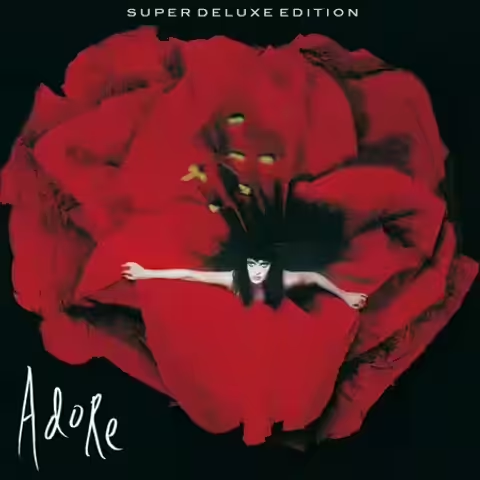
The cover is a black-and-white Yelena Yemchuk photograph of Romanian-American model Amy Wesson, leaning forward and pulling open the hem of a flowing black dress, with the album title in Corgan's looping white handwriting in the lower right. Yemchuk was Corgan's then-girlfriend and a frequent collaborator; she shot the entire album booklet and most of the singles' sleeves, and the look she gave Adore (gothic-fashion silhouettes, mausoleum lighting, lots of negative space) was unlike anything in the band's previous catalogue. Frank Olinsky and Corgan are credited alongside her on art direction. The package was an explicit reset: the cartoonish, illustrated worlds of Mellon Collie and Pisces Iscariot were gone, replaced by something closer to a Bruce Weber editorial.
The vinyl pressings dropped the seventeen-second piano coda "17" entirely and substituted a previously unreleased song, "Once in a While", a quiet B-side that some collectors still rate above several album tracks. Australian, Japanese and limited UK pressings carried bonus tracks and alternate sleeves. The 2014 reissue restored a different photograph from the same Yemchuk session for the box-set cover.
Release and Reception
Adore was released on 2 June 1998. The Ava Adore music video premiered the same day on MTV. The album debuted at number two on the Billboard 200 with 174,000 first-week units, blocked from number one by Master P's MP da Last Don. It was certified platinum by the RIAA five weeks later, then dropped quickly off the upper chart. In the rest of the world it performed better in pure ranking terms: number one in Australia, France, Ireland, New Zealand, Norway, Belgium (Flanders) and Portugal, top five almost everywhere else, number five in the UK. Worldwide sales of roughly 3.3 million by 2005 made it a hit by the standards of any other Pumpkins record except the three that came before.
The reviews were broadly positive and surprisingly persuasive given how many critics had spent the previous five years sharpening knives for Corgan. Greg Kot's Rolling Stone review remains the canonical piece on the album. Stephen Thomas Erlewine for AllMusic called it:
"A hushed, elegiac album that sounds curiously out of time."
Stephen Thomas Erlewine, AllMusic, 1998
Pitchfork's Ryan Schreiber, who had savaged Mellon Collie eighteen months earlier as "lyrical rock-bottom", reversed himself completely on Adore:
"The Pumpkins' best offering since Siamese Dream."
Ryan Schreiber, Pitchfork, June 1998 (8.1 / 10)
Jim DeRogatis at the Chicago Sun-Times, who had previously called Corgan's lyrics "sophomoric poetry", said Adore was the moment Corgan "took a big leap forward as a lyricist". Entertainment Weekly's David Browne (B+) called the lyrics "unsettled and unsettling". The dissenting voices were UK weekly NME at 5/10 and Spin's Douglas Wolk at 5/10, both of whom wanted the heavy guitars back.
| Publication | Score | Reviewer |
|---|---|---|
| Rolling Stone | 3.5 / 5 | Greg Kot |
| Pitchfork | 8.1 / 10 (1998), 8.5 / 10 (2014) | Ryan Schreiber / Ian Cohen |
| AllMusic | 3.5 / 5 | Stephen Thomas Erlewine |
| Chicago Sun-Times | 4 / 4 | Jim DeRogatis |
| The Guardian | 4 / 5 | Adam Sweeting |
| Entertainment Weekly | B+ | David Browne |
| Los Angeles Times | 3.5 / 4 | Richard Cromelin |
| Q | 3 / 5 | uncredited |
| Select | 3 / 5 | Eddy Lawrence |
| NME | 5 / 10 | Steve Sutherland |
| Spin | 5 / 10 | Douglas Wolk |
The fan response was harder to read. Adore divided the audience the band had built across Siamese Dream and Mellon Collie. Some embraced the new mood. Many wrote angry letters to Q and Spin demanding the heavy guitars back. Corgan repeatedly blamed himself in later interviews for mislabelling the record:
"I made the mistake of telling people it was a techno record. If I'd told everyone Adore was the Pumpkins' acoustic album we would have never had the problems that we had."
Billy Corgan, Smashing Pumpkins: Full Circle TV documentary, 2000
The album's title, he said, had also been "misunderstood, a joke that no one ever got". Adore was meant as a play on "A Door": the record was supposed to be a new entrance to the band's career, not a dead end. Few listeners read it that way at the time.
Singles and Music Videos
Two songs went to commercial single. Ava Adore was issued on 18 May 1998 in Europe and 16 June in the US. The accompanying music video, directed by Dom and Nic and shot in a single long take, became the most expensive thing the Pumpkins had ever filmed. Corgan revealed in 2025 that the budget topped out at $800,000. The shot is technically a sleight of hand: the camera glides at a static speed while the band, all in gothic-fashion white-face and lace, walk through interconnected sets at a series of accelerating and decelerating real-world speeds. At one point, around 2:34 in the finished cut, the operator accidentally swung the camera back across the train track and crew, breaking the fourth wall. Corgan saw the rough cut, declared the mistake his favourite moment in the video, and refused to let the director re-edit it. The clip won Most Stylish Video at the 1998 VH1 Fashion Awards.
Perfect, the second single, came out on 7 September 1998. Husband-and-wife directors Jonathan Dayton and Valerie Faris, who had directed "1979" for the band three years earlier, returned for a sequel video that found four of the five original "1979" actors and continued the story. Giuseppe Andrews was back. The fifth original actor, the band has said in commentary, was in jail. The video debuted on MTV's 120 Minutes in mid-September and was the band's last collaboration with Dayton and Faris.
| Single | Released | UK | US Hot 100 | US Modern Rock | Video director |
|---|---|---|---|---|---|
| Ava Adore | 18 May 1998 | 11 | 42 | 3 | Dom and Nic |
| Perfect | 7 Sep 1998 | 24 | 54 | 3 | Jonathan Dayton & Valerie Faris |
| Crestfallen (promo) | 1999 | None commercially released | |||
| To Sheila (promo) | 1999 | None commercially released |
Crestfallen and To Sheila were pushed to radio as promotional singles in 1999 with no commercial release and no proper video. Neither charted, and by the time they were issued the band were already moving on to the sessions that would produce Machina/The Machines of God.
Touring: An Evening With and the $2.8 Million Charity Run
The Adore tour was small by Pumpkins standards: a fourteen-date world run titled An Evening with The Smashing Pumpkins that ran from May to August 1998. The setlist was pointedly skewed towards new material, with reworked versions of older hits where they appeared at all. Venues were chosen for atmosphere rather than capacity: the rooftop of an FNAC record store in Paris, the Brussels botanic gardens, the Cannes Film Festival, an international shipping terminal in Sydney. In the US, the band donated 100% of their ticket profits to local charities at every stop. Combined with merchandise, the tour raised over $2.8 million for charity by September 1998.
The live lineup was the largest the band had carried. Kenny Aronoff, the longtime John Mellencamp drummer, took the kit chair. Two additional percussionists, Stephen Hodges and Dan Morris, played alongside him. David Bowie's Aladdin Sane pianist Mike Garson handled keyboards. The setlist for the European leg leaned heavily into Adore tracks, with the Brazilian and Chilean shows (the band's first ever in those territories) softened slightly with Today and Disarm to placate first-time crowds. Corgan later told Adore reissue annotator David Wild that the three-percussionist arrangement was a tactical mistake:
"That drove Kenny up the wall because Kenny has perfect time and one guy played on top and the other behind. I remember Kenny saying, 'I feel like I'm tripping on LSD' because he kept hearing things that were not in time, and it drove him crazy."
Billy Corgan, Adore reissue liner notes by David Wild, 2014
Live highlights from the tour, including the long-form Tear, Shame and Transmission jams, eventually surfaced on the 2014 reissue's live disc. The closing Dodger Stadium show, with its eleven-minute X.Y.U. medley and a cover of Berry Gordy's "Money (That's What I Want)", was filmed in part for the band's 1998 home video work and remains a fan favourite among setlist completists.
Awards and Accolades
Adore was nominated for the Grammy Award for Best Alternative Music Performance at the 41st Annual Grammys in February 1999, the band's third consecutive nomination in the category. They lost to Beck's Mutations. The Ava Adore video took Most Stylish Video at the 1998 VH1 Fashion Awards. The album was named one of the year's best by The Guardian and Chicago Sun-Times, made retrospective appearances on best-of-the-90s lists from The Ringer and The Music in Australia, and was reappraised at 8.5 / 10 by Pitchfork's Ian Cohen on the occasion of the 2014 reissue.
Reissues, Remasters and the 2014 Box Set
Virgin and Universal's expansive Smashing Pumpkins back-catalogue reissue programme reached Adore on 23 September 2014 with a six-CD, one-DVD super-deluxe box set carrying 107 tracks across the package. The original album was remastered by Bob Ludwig from the original session tapes and includes elements that were recorded but never used in 1998, particularly programming work by Nitzer Ebb's Bon Harris that had sat on hard drives for fifteen years. The box adds:
- The full Sadlands demos and CRC demos for the first time
- Five Matt Walker "Reimagined" recordings overdubbing real kit onto the album's electronic backings
- Six DVD-format video clips and a complete 4 August 1998 Fox Theater concert in Atlanta
- The Rick Rubin-produced Let Me Give the World to You
- The Sean Combs Ava Adore remix and the Nellee Hooper Perfect mix
- A 25-minute closing rehearsal jam on Joy Division's Transmission
A double-LP vinyl pressing of just the remastered album was released alongside the box, and a digital deluxe edition with 74 of the bonus tracks followed on 3 October 2014. Several reviewers, Ian Cohen at Pitchfork most loudly, used the reissue as the occasion to argue Adore was an underrated triumph rather than a misstep. Corgan's own framing in the reissue's promotional cycle was more measured. He described the album as the moment the Pumpkins stopped being a guitar band and started being something more elastic, even if the audience hadn't been ready.
Legacy and Influence
Where Adore sits in the Smashing Pumpkins discography depends on which Pumpkins fan you ask. As the bridge between Mellon Collie and the Infinite Sadness and Machina/The Machines of God, it marks the moment the original four-piece effectively ceased to exist as a recording band: Wretzky was gone by 2000, Iha and Corgan would not work together again until 2018, and the lineup that has cycled through the band since 2007 has included Jeff Schroeder, Mike Byrne, Nicole Fiorentino, Lisa Harriton, Ginger Pooley, Katie Cole, Jack Bates and Kiki Wong. The reunion-era Pumpkins, with Chamberlin and Iha back, have leaned more towards the heavy guitars of Siamese Dream than the electronics of Adore, but several Adore tracks (To Sheila, Perfect, Ava Adore) have stayed in setlists.
The album's longer-term influence is subtler than its sales suggest. A line of subsequent records that fold electronica, gothic atmosphere and acoustic intimacy into rock songwriting (Radiohead's Kid A and Amnesiac, Trent Reznor's With Teeth, parts of Mark Lanegan's solo catalogue) all pull from somewhere near the same well. Passion Pit covered Shame in 2010. Placebo and AFI both cited the record as a touchstone for their own goth-pop pivots. Stephen Thomas Erlewine's AllMusic biography for the band singled out Adore as the first time Corgan's songwriting was strong enough to carry a Pumpkins album with the guitars deliberately turned down, an argument the 2014 reissue cycle largely won.
Adore is no longer the great unloved Pumpkins record. It is the great misunderstood one, made by a band that was, by Corgan's own admission, falling apart, in a way that turned out to be far more durable than anybody buying Mellon Collie's heavier siblings had any reason to expect.
Things You Might Not Know
| Fact | Detail |
|---|---|
| The Ava Adore one-take | The single's seamless one-camera-move music video cost approximately $800,000 and was directed by British duo Dom and Nic, with Corgan revealing the budget publicly for the first time only in July 2025. |
| Tear's near-Lynch sync | The track was originally written for the 1997 David Lynch film Lost Highway, but Lynch picked Eye instead and Tear was rerouted onto Adore. |
| The Rick Rubin song that vanished | Rick Rubin produced "Let Me Give the World to You" for Adore at the band's management's insistence, but Corgan dropped the song from the tracklist entirely to stop Virgin using it as the lead single. It later resurfaced on Machina II in 2000. |
| Soundgarden's drummer plays the closer | Matt Cameron, fresh from Soundgarden's April 1997 dissolution, drums on the eight-minute closer For Martha and nowhere else on the album. The track was cut as a single live take in tribute to Corgan's mother. |
| The Nitzer Ebb connection | British industrial pioneer Bon Harris, of Nitzer Ebb, programmed eight of Adore's sixteen tracks and added vocals to For Martha. His unused 1998 work was restored to the 2014 remaster by Bob Ludwig. |
| The album's title is a pun | Corgan said years later that "Adore" was meant as a play on "A Door", an entrance to a new phase of the band's career rather than a final statement. He admitted the joke went unnoticed by almost everyone. |
| It nearly was an acoustic record | The band's management briefed press in autumn 1997 that Adore would be entirely acoustic. The Sadlands demos restored on the 2014 reissue suggest the all-acoustic version was a real plan, not just spin. |
| The Frogs sing on two tracks | Backing vocals on To Sheila and Behold! The Night Mare came from Milwaukee cult duo The Frogs (Dennis and Jimmy Flemion), longtime Pumpkins associates. |
| $2.8 million for charity | The 1998 An Evening With tour donated 100% of US ticket profits to local charities and raised over $2.8 million by September that year. |
| The Pitchfork U-turn | Pitchfork's Ryan Schreiber called Mellon Collie "lyrical rock-bottom" in 1996 and then named Adore the band's best work since Siamese Dream eighteen months later. |
| The vinyl tracklist is different | "17", the seventeen-second piano coda that closes the CD, doesn't appear on vinyl pressings. In its place sits a previously unreleased song called "Once in a While". |
| Cover model Amy Wesson | The cover photograph is of Romanian-American model Amy Wesson, shot by Yelena Yemchuk (Corgan's then-girlfriend), who also photographed the entire booklet and most of the singles. |
| James Iha's only Adore credit | Iha did not write a single song on Adore, the first Pumpkins album where that was true. He did write Summer, the B-side to the Perfect single, while making his solo album Let It Come Down. |
| Master P blocked the number one | Adore's 174,000 first-week sales would have been a Billboard 200 number one most weeks. They debuted at two behind Master P's MP da Last Don. |
Listen to the Riffology Podcast
If you enjoyed this deep dive on Adore, the Riffology podcast picks up the same kind of conversation in audio form, with the hosts working through a different rock and metal record every episode. The show is available on Apple Podcasts, Spotify, Amazon Music and every other major podcast platform, with new episodes added regularly. Subscribe, leave a rating, and let us know which Smashing Pumpkins album we should tackle next.
Comments