Kid A is the album that Radiohead made by trying very hard not to be Radiohead. The most lionised guitar band of the late nineties walked off stage in 1998, locked themselves in a converted barn in Oxfordshire, and emerged two and a half years later with a record built on modular synthesisers, a 1928 ondes Martenot, a Charles Mingus brass section instructed to imitate a traffic jam, and lyrics Thom Yorke had cut up from his own notebook and pulled out of a hat. They released no singles, conducted almost no interviews, replaced the music videos with ten-second animations and put the whole thing online via a Java applet called the iBlip three weeks before the discs hit shops. It went straight to number one on both sides of the Atlantic. Many critics, primed for OK Computer 2, said it was a hoax, an art-school sulk, a "lengthy, over-analysed mistake". Inside a decade, the same publications were calling it the album of the 2000s.
This is the story of how a band that had outgrown rock made the record that arguably ended rock's monopoly on the cultural high ground, and the story of why a deliberately difficult album sold a million copies in the United States alone.
| Field | Detail |
|---|---|
| Artist | Radiohead |
| Album | Kid A |
| Release date | 2 October 2000 |
| Label | Parlophone (UK), Capitol (US) |
| Producer(s) | Nigel Godrich, Radiohead |
| Studios | Guillaume Tell (Paris), Medley (Copenhagen), Batsford Park (Gloucestershire), Radiohead studio (Oxfordshire), Dorchester Abbey (strings) |
| Mastering | Chris Blair, Abbey Road Studios, London |
| Genre | Experimental rock, electronica, art rock, post-rock, ambient |
| Track count | 10 |
| Total runtime | 49:56 |
| UK Albums Chart peak | 1 (55,000 first-day sales) |
| US Billboard 200 peak | 1 (207,000+ first-week sales) |
| Other notable peaks | 1 in Canada, France, Ireland, New Zealand |
| Certifications | Platinum (UK, US, Canada x2, Australia, France, Japan) |
| Estimated US sales | 1.48 million (Forbes / RIAA) |
| Singles | None officially released |
| Awards | Grammy, Best Alternative Music Album (2001); nominated, Album of the Year |
After OK Computer: the band that broke
By the autumn of 1998, Radiohead were finished, and they almost meant it literally. The eighteen-month tour behind OK Computer had produced the documentary Meeting People Is Easy, in which Thom Yorke is shown weeping at a press junket and staring catatonically at a hotel television. The band had played their last scheduled date in May. Yorke described himself afterwards as "a complete fucking mess... completely unhinged". He was sleeping badly, drinking, and unable to write.
What was happening on a personal level was matched by something larger. By 1999 the post-OK Computer landscape had filled up with bands consciously aping Radiohead's sound: Travis, Coldplay, Muse and a hundred lesser acts were trading in big sad guitars, falsetto choruses and string-pad atmosphere. Yorke watched it happen and, by his own account, started to hate the genre he had just helped reshape. He told The Observer that he had stopped using music to make sense of his life, because the language he had been using "had been sold to the highest bidder" and he was "simply doing its bidding".
"I always used to use music as a way of moving on and dealing with things, and I sort of felt like that the thing that helped me deal with things had been sold to the highest bidder and I was simply doing its bidding. And I couldn't handle that."
Thom Yorke, The Observer, October 2000
He bought a house in Cornwall, walked the cliffs, drew, and bought a grand piano. He stopped writing songs on guitar entirely. The first song to emerge under the new regime was "Everything in Its Right Place", which he composed at the piano in a few minutes. Around the same time he became near-evangelical about the Warp Records catalogue, listening obsessively to Aphex Twin, Autechre, Boards of Canada and Squarepusher.
"It was refreshing because the music was all structures and had no human voices in it. But I felt just as emotional about it as I'd ever felt about guitar music."
Thom Yorke, The Guardian, September 2000
The other four members had no such conversion experience. Ed O'Brien wanted Radiohead's fourth album to be "short, melodic guitar songs". Jonny Greenwood feared "awful art-rock nonsense just for its own sake". Colin Greenwood found the Warp records "really cold". Phil Selway, like O'Brien, suddenly had no obvious role on songs that did not require drums. The band's bassist later admitted other guitar bands were already trying to do similar things, and that Radiohead simply had to move. Yorke was less diplomatic. He told Q magazine, in conversation with David Cavanagh, what he wanted from the next record.
"There was no chance of the album sounding like that. I'd completely had it with melody. I just wanted rhythm. All melodies to me were pure embarrassment."
Thom Yorke, Q magazine, October 2000
Paris, Copenhagen and the collapse of the band
Radiohead had used the OK Computer money to buy a barn in rural Oxfordshire and convert it into a studio. The build would not be finished until late 1999, so on 4 January 1999 they decamped to Guillaume Tell Studios in Paris, a converted cinema, with their producer Nigel Godrich. They had no deadline, no fixed plan, and a singer who arrived with sketches and atmospheres rather than songs. Yorke's lyrics, when they existed at all, were no longer the road maps the rest of the band had previously used to find their way into a track.
According to Godrich, Yorke "did not communicate much". According to Yorke, Godrich "didn't understand why, if we had such a strength in one thing, we would want to do something else". The two had made OK Computer together in twelve productive months. Now they were stuck.
The band imported the new gear without quite knowing what to do with it. They bought modular synthesisers. They hauled out the ondes Martenot, an early electronic instrument from 1928 that Jonny Greenwood had become obsessed with after hearing Olivier Messiaen. They learned Pro Tools and Cubase on the fly. They tried to play the synthesisers as a band and discovered, as Yorke later put it, that they could not. Five people in a room cannot collaboratively program a sequencer.
"It's scary. Everyone feels insecure. I'm a guitarist and suddenly it's like, well, there are no guitars on this track, or no drums."
Ed O'Brien, Q magazine, October 2000
O'Brien's solution was to invent a new way of playing his guitar. He fitted sustain units that allowed notes to ring forever, then layered loops and delay effects over them, until the guitar produced what sounded like keyboard pads or smeared sine waves. The instrument that had defined Radiohead was being asked, in O'Brien's hands, to stop sounding like a guitar at all.
In March 1999 the band moved to Medley Studios in Copenhagen for a fortnight. The sessions were unproductive: roughly fifty reels of tape, each fifteen minutes long, none of it finished. In April they tried again, this time at a hired mansion in Batsford Park in Gloucestershire. The lack of deadline became its own crisis. Tense band meetings were held. According to multiple accounts, the five members agreed that if they could not assemble an album they were proud of they would split up. O'Brien later said it had genuinely come down to a single morning.
"That felt like it could go either way, it could break. But we came in the next day and it was resolved."
Ed O'Brien, The Face, February 2020
In July 1999 O'Brien began posting an online diary of the recording sessions to Radiohead's website, an act of transparency that would prove, in hindsight, to be the seed of the album's eventual marketing strategy. By September the band had moved into the finished Oxfordshire studio. In November they staged a live webcast from the building, broadcasting new music and a DJ set to a curious online audience. By Yorke's announcement on 19 April 2000, Radiohead had finished recording. They had over twenty completed songs. They split them in half and held the second batch back for what would become the 2001 album Amnesiac.
The sound: Aphex Twin, Mingus and the ondes Martenot
Kid A's sonic palette is wider than any single record by an English rock band has any right to be. Critics filed it variously under electronica, post-rock, art pop, ambient, post-progressive and electronic rock. None of those tags is wrong; none on its own is right. Guitar is still present on most tracks, if often disguised, and most songs are still under five minutes. What changed is the band's idea of what could constitute a Radiohead song in the first place.
The principal influences, all sourced from the band themselves in interviews of the period, can be read like a syllabus:
- The IDM of Warp Records, especially Aphex Twin's Selected Ambient Works Volume II and Autechre's Tri Repetae
- Krautrock, primarily Can, whose record-everything-and-edit-later approach Yorke wanted to import wholesale
- The free jazz of Charles Mingus, Alice Coltrane, Miles Davis and Pharoah Sanders
- The modern classical of Krzysztof Penderecki and Olivier Messiaen, whose Turangalila-Symphonie had introduced a teenage Jonny Greenwood to the ondes Martenot
- The Bristol abstract hip hop of DJ Shadow and Cylob
- The cut-up lyrical approach David Byrne used on Talking Heads' Remain in Light, an album Yorke cited explicitly as a model
- Tom Waits, especially on the pump-organ delivery of "Motion Picture Soundtrack"
The instruments matched the references. Greenwood used the ondes Martenot extensively, multitracking his own playing into string-like swells and writing parts the Orchestra of St John's reportedly refused to play because they were physically impossible. Yorke processed his own voice with a vocoder on the title track, with a ring modulator on "The National Anthem", and with a Pro Tools scrubbing tool on "Everything in Its Right Place" that chops his syllables into stutters. The drums on "Idioteque" came from a pattern Greenwood programmed on a modular synthesiser, while the song's distinctive harmonic loop is sampled from "Mild und Leise", a 1973 computer-music composition by the Princeton academic Paul Lansky. Greenwood handed Yorke fifty minutes of synth improvisation; Yorke kept ten seconds of it and wrote a song.
The most discussed track on the album, "The National Anthem", existed as a Yorke demo from his school days. Drum and bass parts had been laid down in 1997 with the intention of using it as an OK Computer B-side. For Kid A, Greenwood stacked ondes Martenot drones and radio samples over the top, then in November 1999 the band hired a brass section and instructed them to play, simultaneously and without coordination, in the spirit of Charles Mingus's 1962 album Town Hall Concert.
"We knew it had to be the first song, and everything just followed after it."
Jonny Greenwood on "Everything in Its Right Place", KCRW Morning Becomes Eclectic, October 2000
Thom Yorke's cut-up lyrics
Yorke's lyrics, when he finally produced them, were a deliberate exercise in not communicating. He wrote phrases and lines over months in Cornwall, then physically cut them up, dropped them in a hat and reassembled them at random, a technique borrowed from William Burroughs via David Bowie via Byrne. "Morning Bell" alternates the banal ("Where'd you park the car?") with the genuinely disturbing ("Cut the kids in half"). Yorke described the lyrics as "like shattered bits of mirror, like pieces of something broken" and refused to print them in the liner notes. He did not, he said, want listeners to focus on words. He wanted them to listen to the texture.
Some lyrical sources are knowable in retrospect. The "I'm not here, this isn't happening" refrain of "How to Disappear Completely" is a mantra Michael Stipe of R.E.M. taught Yorke during the OK Computer tour to manage stage fright. The chorus of "Optimistic" ("the best you can is good enough") is a phrase Yorke's then partner, the artist Rachel Owen, used on him during the worst of the recording-sessions writer's block. The song "Everything in Its Right Place" is, by Yorke's own admission, about the depression he experienced on tour, when he felt he could no longer speak. The album title itself came from a filename Yorke had used on a sequencer.
The strings on "How to Disappear Completely", arranged by Jonny Greenwood and recorded at Dorchester Abbey by the Orchestra of St John's, were composed by multitracking Greenwood's own ondes Martenot playing and asking the orchestra to imitate it. Godrich later said the orchestra members "all just sort of burst into giggles, because they couldn't do what he'd written, because it was impossible, or impossible for them, anyway". Conductor John Lubbock encouraged them to improvise around Greenwood's score. The result is the most haunting four minutes of orchestral music on any rock album of its decade.
The songs, track by track
Kid A is paced like a sequenced art-house film: ten tracks, two halves, an ambient instrumental as intermission, and a hidden coda that fades into the silence at the end of the disc.
| # | Title | Length | Notes |
|---|---|---|---|
| 1 | Everything in Its Right Place | 4:11 | Prophet-5 synth, scrubbed Yorke vocals; opens the album and the new direction |
| 2 | Kid A | 4:44 | Vocoded vocals fed through the ondes Martenot; title from a sequencer filename |
| 3 | The National Anthem | 5:51 | Yorke demo from school; brass section instructed to imitate a "traffic jam" after Mingus |
| 4 | How to Disappear Completely | 5:56 | Strings by Orchestra of St John's at Dorchester Abbey; Stipe-derived refrain |
| 5 | Treefingers | 3:42 | Ambient instrumental built from O'Brien's processed guitar loops |
| 6 | Optimistic | 5:15 | The closest Kid A gets to a guitar song; received unsolicited radio play despite no single release |
| 7 | In Limbo | 3:31 | 5/4 time; Yorke vocals processed with telephone filter |
| 8 | Idioteque | 5:09 | Samples Paul Lansky's 1973 "Mild und Leise"; built from Greenwood modular-synth pattern |
| 9 | Morning Bell | 4:35 | 5/4 time; later re-recorded in 4/4 for Amnesiac |
| 10 | Motion Picture Soundtrack | 7:01 | Written before Creep in 1991; pump organ, harp, double bass, hidden coda |
Several of the songs that did not make the final cut would surface elsewhere. "Nude", "Burn the Witch" and "True Love Waits" all began life in the Kid A sessions and emerged on later Radiohead albums, in the case of "Burn the Witch" sixteen years later. The Kid A and Amnesiac sessions thus produced not only two albums but the seedbed for two more, a remarkable yield from a year and a half of supposed paralysis.
"Optimistic" is the song most often cited as the album's bridge to old Radiohead. It has guitars, a drum kit, a chorus and a falsetto. It also has Phil Selway's most propulsive recorded performance, and an Ed O'Brien layered-loops outro that would point the way to In Rainbows. Below is the band performing it for Jools Holland's series From The Basement, a pared-down live reading recorded years after the album.
The no-singles campaign and the iBlip
The decision not to release singles was Yorke's, and was driven, on his own admission, less by aesthetic principle than by self-preservation. He had been broken by the OK Computer media cycle and refused to go through it again. The label was appalled. EMI executives, denied advance copies, were instead bussed from Hollywood to Malibu and made to listen to the album in full, in sequence, on the coach. Capitol's vice president of marketing, Rob Gordon, called the album's release a "business challenge".
What replaced the singles campaign was, by 2000 standards, radical. Capitol commissioned dozens of ten-second animated clips known as "blips", featuring Stanley Donwood's mountains and pointy-toothed bears, which were serviced to MTV2 and KROQ and posted online. A Java applet called the iBlip, embeddable on fan sites, allowed users to stream Kid A in full alongside artwork, photos and Amazon pre-order links. By release week the iBlip had been embedded on more than 1,000 websites and the album had been streamed more than 400,000 times. Capitol simultaneously partnered with the file-sharing service Aimster, allowing users to swap iBlips and Radiohead-branded skins. Three weeks before release, Kid A was leaked on Napster.
The Capitol executive responsible for online marketing, Robin Sloan Bechtel, has spoken since about the moment Kid A vindicated everything she had been saying about the internet for years.
"Everything in the industry at that point was like, 'The internet isn't important. It's not selling records.' I knew the internet was generating sales but I couldn't prove it. After Kid A was a success, nobody in the industry could believe it because there was no radio and there was no traditional music video. I knew at that point: this is the story of the internet. The internet has done this."
Robin Sloan Bechtel, Grantland, 2015
Even the magazine photoshoots became guerrilla art. Q editor Andrew Harrison agreed to a Radiohead cover and was instead supplied with digitally altered portraits in which the band's irises had been recoloured and Yorke's drooping eyelid removed. Q projected the images onto the Houses of Parliament, plastered them across the London Underground and printed them on key rings, mugs and mouse mats, "to turn Radiohead back into a product". Yorke's only public response was a wry "I'd like to see them try to put these pictures on a poster".
Stanley Donwood and the mountains
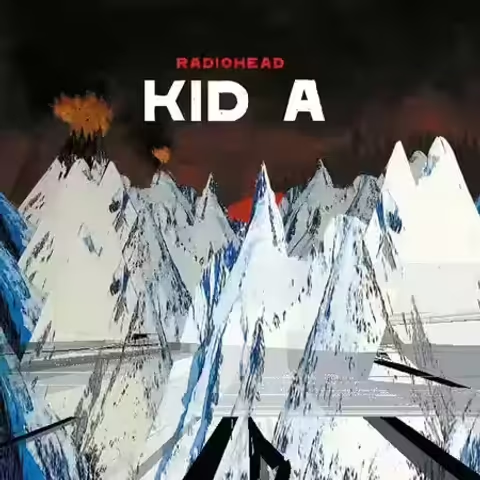
The artwork was made by Stanley Donwood and Yorke (credited as Tchock), who had collaborated on every Radiohead sleeve since the 1994 EP My Iron Lung. For the first time they used paint. Donwood worked on six-foot canvases with knives, sticks and Artex, the textured plaster used on British ceiling finishes. Yorke photographed the results and manipulated them in Photoshop. The pair became, by Donwood's account, "obsessed" with the Worldwatch Institute website and its statistics on melting ice caps. They settled on a mountain range as the cover image because, Donwood said, it suggested "some sort of cataclysmic power".
The red swimming pool that appears on the disc and spine was inspired by the 1988 Alan Moore and Bill Sienkiewicz graphic novel Brought to Light, in which fatalities of state terrorism are visualised as swimming pools full of blood. Donwood said the image had "haunted" him during the recording. The promotional bear logo, known internally as Modified Bear, came out of bedtime stories Donwood was telling his children at the time, in which abandoned teddy bears came to life and ate the grown-ups responsible.
Number one on both sides of the Atlantic
Kid A was released on 2 October 2000. Reaction inside the industry was disbelief at the sales figures, then disbelief at the reviews, then disbelief at the sales figures again.
- UK Albums Chart: number one. First-day sales of 55,000 copies, more than the rest of the top ten combined.
- US Billboard 200: number one with over 207,000 first-week sales, Radiohead's first US top-twenty album and the first US chart-topping album in three years from any British act.
- Canadian Albums Chart, French SNEP, Irish IRMA, New Zealand RMNZ: all number one.
- Pre-orders on Amazon hit number one on the platform's sales chart with more than 10,000 copies before release.
- EMI recalled 150,000 faulty European CDs on release day, slowing initial European sales but failing to dent the chart positions.
By June 2001 Kid A had sold 310,000 copies in the United Kingdom, less than a third of OK Computer's UK sales but a remarkable performance for an album with no singles, no videos, almost no interviews and a leaked digital copy circulating freely. By the time RIAA certifications came in, Kid A had sold 1.48 million copies in the United States alone. It was certified platinum in the UK, US, Australia, Canada, France and Japan, and double platinum in Canada.
| Territory | Chart | Peak | Certification |
|---|---|---|---|
| United Kingdom | UK Albums Chart | 1 | Platinum |
| United States | Billboard 200 | 1 | Platinum (1.48m) |
| Canada | Canadian Albums Chart | 1 | 2x Platinum |
| France | SNEP | 1 | Platinum |
| Ireland | IRMA | 1 | Gold |
| New Zealand | RMNZ | 1 | Gold |
| Australia | ARIA | 5 | Platinum |
| Japan | Oricon | 17 | Platinum |
At the 2001 Grammy Awards, Kid A was nominated for Album of the Year and won Best Alternative Music Album, beating PJ Harvey, Beck and Bjork to the latter prize.
The rockism debate: pretentious or prophetic?
The reviews of Kid A are now almost more interesting than the album, because they capture in real time the moment guitar journalism realised it was no longer the centre of the conversation. Spin had described Kid A as the most-anticipated rock record since Nirvana's In Utero. Q editor Andrew Harrison wrote that journalists "expected it to provide more of the rousing, cathartic, lots-of-guitar, Saturday-night-at-Glastonbury big future rock moments of OK Computer". When it did the opposite, much of the rock press reacted as if to a personal slight.
Mark Beaumont in Melody Maker gave it one and a half stars and wrote one of the most-quoted negative reviews in British rock criticism.
"Tubby, ostentatious, self-congratulatory, look-ma-I-can-suck-my-own-cock whiny old rubbish. About 60 songs were started that no one had a bloody clue how to finish."
Mark Beaumont, Melody Maker, September 2000
Nick Hornby in The New Yorker called Kid A "morbid proof that this sort of self-indulgence results in a weird kind of anonymity rather than something distinctive and original". Adam Sweeting in The Guardian called it a "mystifying experience" likely to confuse listeners "even raised on krautrock or Ornette Coleman". The Irish Times pronounced it "deliberately abstruse, wilfully esoteric and wantonly unfathomable". Jim Irvin in Mojo called it "just awful" on first listen. Rolling Stone published an editorial titled "Kid A to Zzzzz" mocking the band's seriousness.
Other critics defended the album from the start. David Fricke gave it four stars in the same Rolling Stone, calling it "a work of deliberately inky, often irritating obsession" but also "pop, a music of ornery, glistening guile and honest ache". Spin and Billboard ran rave reviews, the latter calling Kid A "an ocean of unparalleled musical depth" and "the first truly groundbreaking album of the 21st century". The most consequential review, however, was the one Pitchfork posted on the day of release, written by a 25-year-old freelancer named Brent DiCrescenzo.
"Cacophonous yet tranquil, experimental yet familiar, foreign yet womb-like, spacious yet visceral, textured yet vaporous, awakening yet dreamlike, infinite yet 48 minutes. Radiohead must be the greatest band alive, if not the best since you know who."
Brent DiCrescenzo, Pitchfork, October 2000 (10/10)
The 10.0 was the first perfect score Pitchfork had given a major rock album in front of a mainstream audience. The site, then a small operation run from a Chicago apartment, was inundated with traffic. By 2017 Bloomberg was crediting the Kid A review with putting Pitchfork on the map; by 2020 Billboard was calling it the review that "changed music criticism". The argument it set off, between rock-press critics defending the canonical guitar album and a younger online cohort celebrating an album that ignored guitars, would harden over the following decade into the rockism-versus-poptimism debate. Kid A was, in the simplest terms, the album that ended rockism's monopoly on serious music writing.
The negative reviewers, almost without exception, recanted within a decade. Beaumont himself, writing in The Guardian on the album's tenth anniversary, conceded he was "very much in the minority" and that "people whose opinions I trust claim it to be their favourite album ever". Rob Sheffield in Rolling Stone in 2015 likened the critical reception of Kid A to Bob Dylan's electric turn at Newport, noting that critics now hesitated to admit they had ever disliked it.
Things you might not know
| Fact | Detail |
|---|---|
| The first song written | Yorke wrote "Everything in Its Right Place" in minutes on a grand piano he had bought during his Cornwall recovery, having abandoned the guitar entirely. |
| Older than Creep | "Motion Picture Soundtrack" was written before Radiohead's 1992 debut single. A piano version had even been recorded during the OK Computer sessions before being shelved. |
| The title | Kid A is a filename Yorke used on one of his sequencers. He liked, in his words, its "non-meaning". |
| The traffic-jam brass | The horn section on "The National Anthem" was recorded in November 1999 with the explicit instruction, taken from Mingus's Town Hall Concert, to sound "like a traffic jam". |
| The almost-end of Radiohead | During the Batsford Park sessions in spring 1999, the five members agreed to break up if they could not produce an album worth releasing. O'Brien said it came down to a single morning. |
| The Kosovo connection | Stanley Donwood was inspired during the artwork sessions by a Kosovo War photograph showing a square metre of trampled snow filled with what he called "the detritus of war". |
| The Java applet | The iBlip was embedded on more than 1,000 websites and streamed Kid A more than 400,000 times before release, an unheard-of figure for legal streaming in 2000. |
| The Princeton sample | The chiming loop on "Idioteque" is sampled from a 1973 computer-music piece called "Mild und Leise" by the Princeton academic Paul Lansky, taken from a 1976 LP titled Electronic Music Winners. |
| Faulty CDs in Europe | EMI recalled 150,000 European pressings on release day after a manufacturing fault. Some bootleg copies of the recall pressings still circulate. |
| The hidden track | "Motion Picture Soundtrack" ends at 3:20, then resumes with an untitled hidden coda from 4:18 to 5:10, before fading into 1:51 of silence. On streaming services the coda is now listed separately. |
| The seedbed for two more albums | "Nude", "Burn the Witch" and "True Love Waits" all originated in the Kid A sessions. "Burn the Witch" did not appear in finished form until 2016, sixteen years later. |
| The Q magazine prank | Asked for a cover photoshoot, Radiohead supplied digitally altered portraits with their irises recoloured and Yorke's drooping eyelid removed. Q used them anyway, projecting the images onto the Houses of Parliament. |
| The Modified Bear | The pointy-toothed bear logo originated in bedtime stories Stanley Donwood was telling his children, in which abandoned teddy bears came to life and ate the grown-ups responsible. |
Legacy: the album that rewrote the rules
Kid A's reputation in 2026 is almost the inverse of its reputation in 2000. Pitchfork, Rolling Stone and The Times have all named it the best album of the 2000s. Pitchfork readers voted it the greatest album of the previous twenty-five years in 2021. Rolling Stone in its 2020 list of the 500 Greatest Albums of All Time placed Kid A at number 20, having ranked it 67th in 2012 and 428th in 2003, a near-perfect inverse decay curve from the album's contemporary panning. In 2025 Rolling Stone named it the second-greatest album of the twenty-first century so far, calling it a "warning call that went completely unheeded".
The album's commercial-strategy legacy is, if anything, larger than its musical legacy. Streaming services, embedded album previews, the practice of leaking your own record before release, the abandonment of the obligatory single, the use of the band website as primary promotional channel: all of these are normal in 2026 and were strange in 2000. The Grantland critic Steven Hyden has argued that Kid A "invented modern music culture as we know it", a claim that sounds inflated until you remember that Robin Sloan Bechtel of Capitol still calls it the moment the industry conceded that the internet sold records.
The musical influence is harder to quantify because so much of what came after sounds, in retrospect, like a partial answer to Kid A. Bjork, who shared instrumental territory with the album, told Deadspin in 2011 that Kid A had legitimised electronics in mainstream rock. The wave of mid-decade indie acts that came to be called post-rock, including Sigur Ros and Mogwai, had Kid A as a constant reference point. Bands such as TV on the Radio, The National and Wild Beasts have all cited it. Kanye West's 808s & Heartbreak, James Blake's debut, Bon Iver's 22, A Million and most of FKA Twigs's catalogue would be inconceivable without Kid A's normalisation of the manipulated voice as a serious vocal mode.
At Radiohead's induction to the Rock and Roll Hall of Fame in 2019, the speech was given by David Byrne, whose Talking Heads cut-up techniques had inspired Yorke during the recording. Byrne returned the compliment with one of the more striking observations any inducting artist has made about a successor.
"What was really weird and very encouraging was that Kid A was popular. It was a hit. It proved to me that the artistic risk paid off and music fans sometimes are not stupid."
David Byrne, Rock and Roll Hall of Fame induction speech, March 2019
In November 2021 Radiohead released Kid A Mnesia, a triple-album anniversary reissue that compiled Kid A, Amnesiac and a third disc, Kid Amnesiae, of previously unreleased session material. The reissue spawned the Kid A Mnesia Exhibition, an interactive Unreal Engine experience for PlayStation 5, macOS and Windows. In 2026 a physical installation, Motion Picture House: Kid A Mnesia, opened at Coachella and is set to tour the United States. Twenty-six years after EMI's Rob Gordon called it a "business challenge", Kid A has become Radiohead's most catalogued, exhibited and academically picked-over record, and the reference point against which their later albums (and most of their imitators) are measured.
What is most striking now, listening back, is how unfussy Kid A sounds for an album that famously alienated half its first audience. The melodies are compact. The runtime is under fifty minutes. There is no double album, no triple album, no overture, no concept. There is only a band that did not want to be a band of a particular kind any longer, working out, in real time and at considerable risk, what kind of band it would rather be. They got the answer right. The proof, twenty-six years later, is that no one needs the answer explained.
Comments