Pantera went into 1997 owing their label a live record, owing their fans a document of the most violent tour in heavy metal at the time, and owing themselves something to play in the van while the singer recovered from a heroin overdose that had stopped his heart on a Dallas tarmac the previous summer. Official Live: 101 Proof is the answer to all three debts in one sleeve, dressed up as a Jack Daniel's bottle and slid out on 29 July 1997 as the fifth and final entry in the band's EastWest deal.
It was the only sanctioned live album the classic lineup of Phil Anselmo, Dimebag Darrell, Rex Brown and Vinnie Paul ever released, and almost the last record they would put out as a working unit before the slow-motion implosion that culminated in the 2000 LP Reinventing the Steel and a permanent break-up three years later. Fourteen live tracks taken from the Great Southern Trendkill world tour are book-ended by two new studio cuts written and recorded in a twelve-day break between shows. The whole thing peaked at number 15 on the Billboard 200, went RIAA Gold, and bought Pantera the room they needed to walk away from EastWest on their own terms.
The live document that closed Pantera's EastWest deal
By the summer of 1997 Pantera had been on a major label for seven years and had not yet given EastWest a live album. Their deal, signed in 1990 with Atco and inherited by EastWest after a corporate reshuffle, had run through five studio LPs ending with 1996's bleak, sectioned The Great Southern Trendkill. Touring that record had been brutal: US arena headline shows, an Ozzfest run, European festivals, and a chemical-strung discipline that left the band, on bootlegs, both crushingly tight and visibly fraying. A live document was the obvious move, and it solved a contractual problem at the same time.
Vinnie Paul framed the album as a corrective. He was openly suspicious of the era's glut of greatest-hits compilations and studio-glossed live records, and wanted to put something out that sounded like the band actually did in a hockey arena at half-eleven at night.
"We felt like after 7 years of playing live, that we wanted to put out a record with all our best tunes. Songs that have our own TLC instead of all that foolishness that happens when a band puts out a greatest hits album or some overdubbed live album."
Vinnie Paul, Pantera band history archive, 1997
Album facts
| Field | Detail |
|---|---|
| Artist | Pantera |
| Album | Official Live: 101 Proof |
| Release date | 29 July 1997 |
| Label | EastWest Records (US), Elektra (international) |
| Producers | Vinnie Paul, Dimebag Darrell |
| Recorded | 1996 to 1997 (live tracks, various venues); May 1997 (two new studio tracks) |
| Studios | Chasin' Jason, Arlington, Texas (studio tracks) |
| Genre | Groove metal, heavy metal, thrash metal |
| Track count | 16 (14 live, 2 studio) |
| Total runtime | 76 minutes 23 seconds |
| Billboard 200 peak | 15 |
| UK Albums Chart peak | 54 |
| UK Rock & Metal Albums peak | 3 |
| Other notable peaks | Finland 16, Australia 19, New Zealand 19, France 24, Hungary 28, Sweden 32, Norway 36, Canada 42, Austria 46, Netherlands 59, Germany 84 |
| Certifications | RIAA Gold (USA), ARIA Gold (Australia), BPI Silver (UK) |
| Estimated sales | 500,000+ in the United States; figures elsewhere not publicly broken out |
| Key new tracks | "Where You Come From", "I Can't Hide" |
Metal in the summer of 1997
The 1997 release calendar around Official Live: 101 Proof was a transitional one for heavy music. Nu-metal was already cresting: Deftones would put out Around the Fur three months later, Korn's *[Life Is Peachy](/posts/the-making-of-life-is-peachy-by-korn/)* was still selling, and Limp Bizkit's first record had been out since July 1997 itself. On the more traditional side, Iron Maiden had just released Virtual XI, Anthrax's *[Sound of White Noise](/posts/the-making-of-sound-of-white-noise-by-anthrax/)* follow-up Stomp 442 had been quietly shelved by its label, and Metallica were two years into the Load and Reload reinvention that put much of the eighties metal audience on edge.
Pantera stood awkwardly in the middle. They had drawn from thrash without ever quite being thrash, helped invent the down-tuned half-time chug that nu-metal bands were now repackaging, and refused to compromise their look, their politics, or their songwriting toward the new mainstream. A live album that ran through the Cowboys-to-Trendkill catalogue without diluting any of it was, in 1997 terms, a defiant statement: this is the music, this is the volume, this is the audience, and we are not changing any of it.
- Released the same season: OK Computer by Radiohead, Be Here Now by Oasis, Butterfly by Mariah Carey, and Sehnsucht by Rammstein.
- Touring rivals on the road that summer: Ozzfest 1997 ([Black Sabbath](/posts/black-sabbath-a-complete-history/), Marilyn Manson, Type O Negative), the Lollapalooza farewell run, and the Warped Tour second wave.
- Heavy-music landmarks released within weeks of 101 Proof: The Gift of Game sessions for Crazy Town, Whoracle by In Flames, and Slip by Quicksand's offshoot acts.
The band's story up to 1996
Pantera as the rest of the world knew them in 1997 had only really existed since 1990. The Abbott brothers had run a four-album glam-tinged independent project out of Arlington, Texas through the eighties before Phil Anselmo joined for 1988's Power Metal and dragged the band toward something heavier. Cowboys from Hell in 1990 was the major-label debut on Atco that effectively wiped the previous decade off the record. *[Vulgar Display of Power](/posts/pantera-vulgar-display-of-power/)* in 1992 reached number 44 on the Billboard 200 and went platinum. Far Beyond Driven in 1994 debuted at number one with a sound so dense the band themselves expected the label to reject it.
By the time The Great Southern Trendkill arrived in May 1996 the cracks were starting to show. The four members were no longer in the same studio. Anselmo recorded his vocals at Trent Reznor's Nothing Studios in New Orleans, while Dimebag, Rex and Vinnie tracked the music at the Abbotts' base in Dallas. The record peaked at number four on the Billboard 200 despite that fracture, but anyone reading between the lines knew Pantera were about to spend a very long time on tour with a singer who was barely on speaking terms with the rest of the band.
The Great Southern Trendkill era
The Trendkill tour was where the songs that ended up on 101 Proof were beaten into their final live shape. The setlist drew heavily from the new record's most aggressive material ("War Nerve", "Suicide Note Pt. 2", "Strength Beyond Strength", "Sandblasted Skin"), all of which appear on the live album, but the band also leaned hard on their catalogue: the bulk of Vulgar Display of Power, the singles from Far Beyond Driven, and the now-mandatory "Cowboys from Hell" and "Cemetery Gates" from the 1990 LP.
Several of the album's live cuts include onstage segues that the band had refined over years of touring. "Becoming" rolls directly into the outro of "Throes of Rejection" from Far Beyond Driven. "I'm Broken" tags the close of "By Demons Be Driven" from Vulgar Display of Power. The eighth track, listed on the sleeve as "Dom/Hollow", is a fused live performance of "Domination" from Cowboys from Hell bleeding into "Hollow" from Vulgar Display of Power, a medley the band played almost every night they performed either song. These are not editorial inventions for the album. They are how Pantera actually played live.
Phil's 1996 overdose and its shadow
On 13 July 1996, after a Pantera headline show at the Coca-Cola Starplex Amphitheatre in Dallas, Phil Anselmo went into cardiac arrest in his tour bus from a heroin overdose. Paramedics revived him. Four days later he issued a press release that became one of the most widely quoted statements of his career.
"I, Philip H. Anselmo, am a fucking drug addict. About one hour after our concert in Dallas, in my bunk on the bus, I overdosed on heroin. For 4 to 5 minutes I was completely dead. There is no lecture in the world worse than dying itself, which I'm sure I did."
Phil Anselmo, press release, 17 July 1996 (reported in Calhoun Times, 26 April 1997)
The overdose pre-dates the recording of the new studio cuts on 101 Proof and casts a long shadow over the live performances that made the album. Some of the tracks on the record were captured before the incident, some after. The band were carrying on with the tour while their frontman was, by his own description, a fucking drug addict who had recently been clinically dead for several minutes. Anselmo later said back pain from a stage injury had pushed him into opioids; whether that explains the situation or excuses none of it depends on which interview you read.
What the overdose did not do was take Pantera off the road. The band finished the European and American legs of the tour, picked up an Ozzfest run in 1997, and kept playing. The live tapes that became 101 Proof are the recordings of a band working at full intensity while a slow private disaster played out behind them.
Compiling the live performances
Pantera never released a single-venue official live album in this period. The fourteen live tracks on 101 Proof are stitched from multiple shows across the Trendkill tour's 1996 and 1997 dates. The official record from EastWest is deliberately vague on which performances came from which night, listing only "Recorded 1996 to 1997". This is partly a function of how the album was assembled; the band took multitrack tapes from a string of venues and selected the strongest version of each song, then sequenced them as a single notional concert.
The approach is closer in spirit to AC/DC's If You Want Blood You've Got It than to a documentary-style single-night recording like Iron Maiden's Live After Death. There are no between-song speeches turned into segue tracks, no crowd-noise crossfades pretending to be a continuous performance. Each song is a live take; the running order is editorial. The audience is loud and constant, but it is the audience of many cities rather than one.
The Rolling Stone reviewer, listening cold in 1997, picked up on exactly that intensity.
"Few thrash-metal bands provoke a crowd into frothing fits of rage as effectively as Pantera. The group's first live album, Official Live: 101 Proof, captures the sonic assault that sparks such hysteria."
Jon Wiederhorn, Rolling Stone, 18 September 1997
The Chasin' Jason sessions
The two new studio tracks were the part of the project Pantera obviously cared about most. They were cut at Chasin' Jason, the Abbott brothers' own home and project studio in Arlington, Texas, in a twelve-day window in May 1997 between tour legs. Vinnie Paul and Dimebag Darrell produced. Rex Brown tracked his bass parts in the same room. Anselmo flew in from New Orleans for the vocal sessions.
"We recorded the new material during a break in our tour. We recorded them in 12 days. It was a great feeling to get back in the studio again. Especially when we knew the songs were going to go on an album that is so important for us and our fans."
Vinnie Paul, Pantera band history archive, 1997
That twelve-day figure tells you most of what you need to know about how Pantera operated in this period. They had tracked the Trendkill sessions remotely; for the bonus material they wanted to write, play, mix and master two songs in less time than most arena rock acts spent picking a single. The point was not perfection but to put something on the record that was not contractual filler.
Personnel and credits
| Role | Player | Notes |
|---|---|---|
| Core band | ||
| Lead vocals | Phil Anselmo | All tracks |
| Guitar, backing vocals | Dimebag Darrell | Also credited as producer |
| Bass, backing vocals | Rex Brown | |
| Drums | Vinnie Paul | Also credited as producer |
| Production | ||
| Producer | Vinnie Paul | Co-produced every Pantera album from Cowboys from Hell onward |
| Producer | Dimebag Darrell | First album-length co-production credit alongside his brother |
| Recording | ||
| Studio | Chasin' Jason | Abbott brothers' own facility in Arlington, Texas; used for the two new studio tracks |
| Live recording | Various venues | Multitrack tapes from 1996 to 1997 tour dates supporting The Great Southern Trendkill |
| Artwork | ||
| Sleeve concept | Pantera | Designed as a visual parody of the Jack Daniel's Tennessee Whiskey label |
Notable for what it omits, the credit list is the bare four-piece plus the Abbott brothers wearing producer hats. There are no guest vocalists, no string sections, no auxiliary percussion, no celebrity cameos. Earlier Pantera records used Terry Date as outside producer through Far Beyond Driven; from Trendkill onward, the Abbotts ran their own sessions and that decision is reflected here. The lone outside contribution is the audience, several thousand strong, captured across however many cities the band visited.
The tracklist
| # | Title | Original album | Length | Notes |
|---|---|---|---|---|
| 1 | "New Level" (titled "A New Level" on Vulgar) | Vulgar Display of Power | 4:24 | Set opener on most Trendkill-tour nights |
| 2 | "Walk" | Vulgar Display of Power | 5:50 | The career-defining mid-tempo riff |
| 3 | "Becoming" | Far Beyond Driven | 3:59 | Live outro segues into "Throes of Rejection" |
| 4 | "5 Minutes Alone" | Far Beyond Driven | 5:36 | Title sourced from a Phil Anselmo crowd quote |
| 5 | "Sandblasted Skin" | The Great Southern Trendkill | 4:29 | |
| 6 | "Suicide Note Pt. 2" | The Great Southern Trendkill | 4:20 | The pummelling sequel to the Trendkill ballad |
| 7 | "War Nerve" | The Great Southern Trendkill | 5:21 | |
| 8 | "Strength Beyond Strength" | Far Beyond Driven | 3:37 | |
| 9 | "Dom/Hollow" | Cowboys from Hell / Vulgar Display of Power | 3:43 | Live medley of "Domination" and "Hollow" |
| 10 | "This Love" | Vulgar Display of Power | 6:57 | The album's longest live cut |
| 11 | "I'm Broken" | Far Beyond Driven | 4:27 | Tagged with the outro of "By Demons Be Driven" |
| 12 | "Cowboys from Hell" | Cowboys from Hell | 4:35 | The opening salvo of the band's major-label era |
| 13 | "Cemetery Gates" | Cowboys from Hell | 7:53 | The set's quiet-to-loud showpiece |
| 14 | "Hostile" (titled "Fucking Hostile" on Vulgar) | Vulgar Display of Power | 3:56 | Sleeve title shortened for retail |
| 15 | "Where You Come From" | New studio recording | 5:11 | Released as a promo single |
| 16 | "I Can't Hide" | New studio recording | 2:16 | The album's shortest, most hardcore-leaning track |
"New Level", "Walk" and "Becoming"
The album opens with the same one-two-three the Trendkill-era setlist almost always used. "New Level" is a riff-and-shout opener that gets the crowd inside the song within the first eight bars. "Walk" follows with the most recognisable mid-tempo riff Dimebag ever wrote, all chromatic descent and bent F-sharp. Phil's between-line interjections are sharper than they are on the studio version; this is what people went to the shows to hear. "Becoming" rounds the opening trio with its squealed pinch harmonics and the spliced-on "Throes of Rejection" outro that turns the song from a single into a two-part suite.
What the live versions reveal more than the studio cuts is Vinnie Paul's metronomic discipline. The tempos rarely shift more than a beat per minute from the originals; the songs accelerate in feel rather than in clock time. Dimebag's solos are looser than the records (the "Walk" lead in particular) but the song architecture is preserved.
"5 Minutes Alone" and the deeper cuts
"5 Minutes Alone" is the album's first real fan-service moment. The title famously came from an audience member's father who, after his son was ejected from a Pantera show for moshing too hard, told the band's road crew he would like five minutes alone with the singer. Phil repeated the demand from the stage; Dimebag wrote the riff later that week. The live version on 101 Proof is the version a generation of metal fans memorised: tighter than the Far Beyond Driven recording, with a more aggressive vocal attack from the second verse onward.
Around it sit the three deep cuts that make this album an essential supplement to the catalogue rather than a redundant best-of. "Sandblasted Skin", "Suicide Note Pt. 2" and "War Nerve" together represent the only meaningful live document of The Great Southern Trendkill the band ever issued. The studio versions of those songs were sometimes obscured by Anselmo's vocal layering and the album's deliberately sectioned production; live, with one voice and one guitar tone, they hit much harder. "Strength Beyond Strength" follows them as the most thrash-leaning cut on the record, a deliberate nod to the band's pre-Cowboys roots.
The medleys and onstage segues
Three of the album's tracks are formally listed as standalone songs but are actually live medleys. "Becoming" runs into the outro of "Throes of Rejection". "I'm Broken" closes with the outro of "By Demons Be Driven". And "Dom/Hollow" is an entire combined live performance of "Domination" from Cowboys from Hell bleeding directly into "Hollow" from Vulgar Display of Power.
These segues were not editorial inventions. The band built them into the setlist because they sounded better live than the studio cuts on their own. "Hollow" in isolation has a long instrumental build that loses momentum without a crowd to hold; tag it onto the end of "Domination" and the build resolves into something cathartic. The same is true of the "By Demons Be Driven" coda on "I'm Broken", which doubles the length of the track's outro and gives Phil time to drag the room through a final scream.
"Cowboys from Hell", "Cemetery Gates" and "Hostile"
The closing live triptych is structured for impact. "Cowboys from Hell" is the song the band always saved for late in the set, the one that telegraphed the encore. "Cemetery Gates" at 7:53 is the album's longest cut and the only one that drops into a clean-guitar passage, allowing Anselmo to demonstrate that whatever opioids were doing to him at the time had not yet taken the upper-register Halford influence out of his voice. The crowd singing on the long held note at the end is one of the album's signature moments.
"Hostile" closes the live portion, listed in a shortened form for retail. The full studio title is "Fucking Hostile", and the album's printed tracklist on US copies is sometimes presented with the expletive starred out and sometimes not, depending on the manufacturer. Live, the song is even shorter and more violent than the Vulgar Display of Power recording, which was already 2:48 of compressed aggression on the original record.
"Where You Come From"
Track fifteen, "Where You Come From", is a five-and-a-bit-minute mid-tempo cruncher built on a verse riff that sits in the same harmonic neighbourhood as "Walk" without copying it. Dimebag's solo is shorter than usual, the bridge drops into a halftime feel for a single section, and Anselmo's vocal alternates the staccato bark he had been using since Cowboys with a more restrained verse delivery. It is the more conventional of the two new studio tracks and was the one EastWest pushed to rock radio as a promo single.
The song has aged into a curiosity in the discography. It is the only studio Pantera cut from the era that does not sit on a studio album proper, which gives it an orphaned quality even thirty years on. Fans who only own the studio LPs often miss it entirely; for completists, it remains one of the small clutch of "official Pantera tracks you have to dig for".
"I Can't Hide"
The album's closing cut, "I Can't Hide", is the more interesting of the two new songs. Two minutes and sixteen seconds, hardcore in its tempo and song-form discipline, it leans more on Phil's New Orleans hardcore and sludge influences than on the Pantera house style. It plays as a deliberate counterweight to "Where You Come From": instead of a single, the band offered fans a short, blunt, almost punk closer that pointed at the more compressed, more aggressive direction Reinventing the Steel would later sometimes follow.
Together the two studio tracks function as a status update from Pantera as a band. The label got a live album. The fans got two new songs that proved the four members could still walk into a room and write something they were happy to release. Whether the songs deserved to be standalone singles rather than studio-album cuts is a separate question; the answer, in 1997, was that Pantera had nothing else in the can and was not in a position to start a full studio record.
Album artwork and the "101 Proof" title
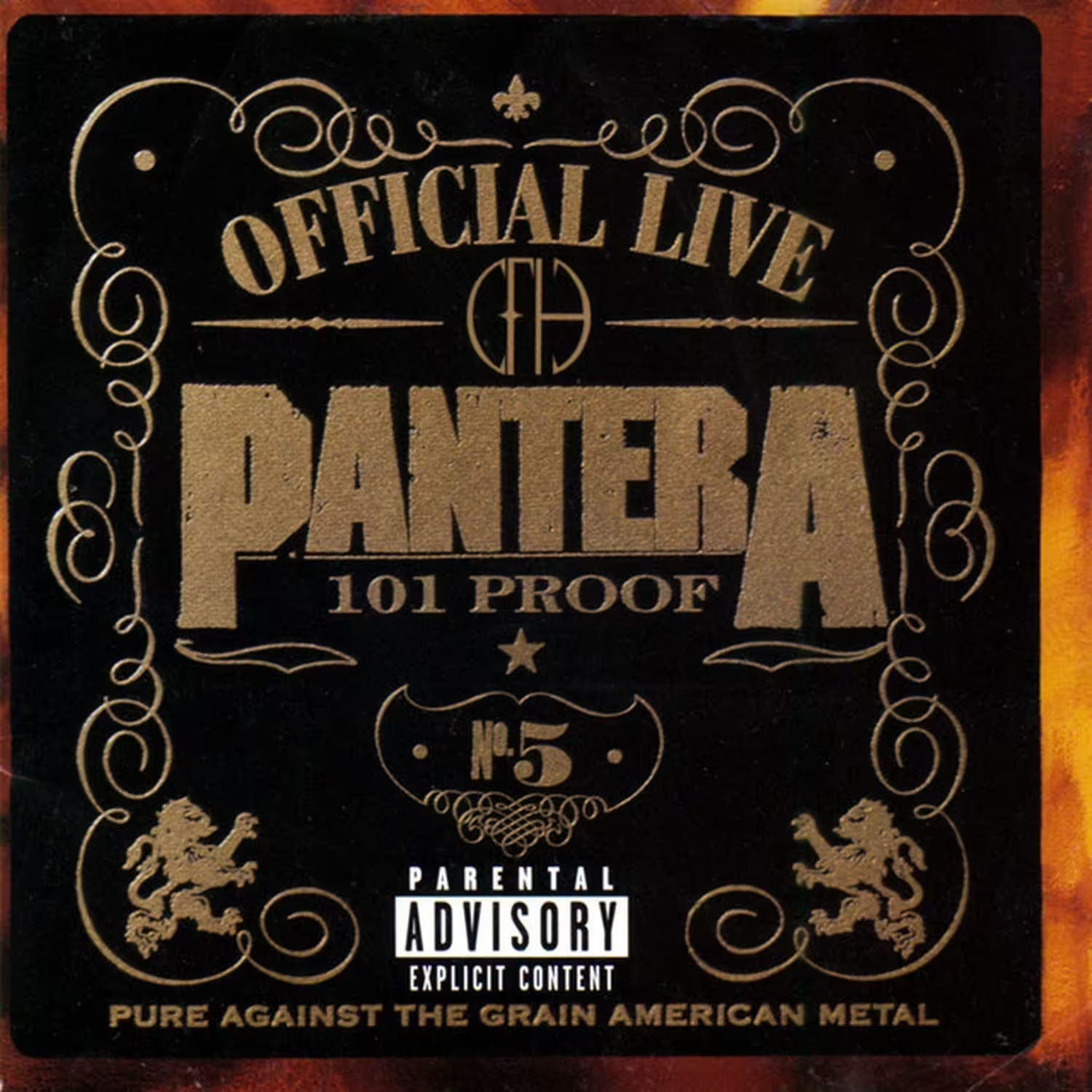
The sleeve is one of the more iconic visual jokes in nineties metal. The front cover replicates the Jack Daniel's Tennessee Whiskey label almost frame for frame, with "PANTERA" replacing "Jack Daniel's" in the curling top text, "Official Live" in place of "Old Time", "101 Proof" where the alcohol content sits on the Jack bottle, and a small "No. 5" detail. The Jack label puts "Old No. 7" in that position; Pantera's "No. 5" is a double reference. It nods to the brand convention, and it signals that this is the band's fifth official major-label release counting from Cowboys from Hell and ignoring the four self-released Metal Magic Records albums from earlier in the eighties.
The 101 proof figure itself comes from outside the Jack Daniel's universe. Wild Turkey bourbon is the brand most commonly associated with 101 proof, and Pantera were openly fond of both whiskeys. The title therefore mashes two American whiskey brands into a single visual identity in service of an album subtitle that reads as both a numerical alcohol content and a measure of the band's authenticity. It is a Texas joke. It is also a very Pantera joke.
Release and reception
Reviewers in 1997 fell into two camps. The traditional rock press largely treated the album as a competent live release with two surprisingly good new songs attached. Rolling Stone gave it three stars out of five, the Chicago Tribune three and a half, and AllMusic three. Chronicles of Chaos, the harder-line metal webzine, was less convinced and rated it 3 out of 10, partly on the basis that the band were already overexposed and partly on the suspicion that the album was contractual filler.
The contractual-filler argument was not unreasonable from outside. Pantera had given EastWest five studio albums in seven years and had no obvious next move; a live record with two studio bonuses was the most obvious way to satisfy a deal without committing to a full new LP. Whether the read is fair depends on how you weigh the new material against the live performances. Vinnie Paul's framing was that the album was the opposite of phoned-in: the band selected and sequenced the live cuts themselves, refused to overdub, and wrote the studio songs from scratch in a fortnight rather than reaching for archived demos.
The album's commercial performance bore out the band's preferred framing. A live record charting at number 15 on the Billboard 200 in 1997 was a substantial statement at a time when the format was widely treated as a contractual afterthought.
Chart performance around the world
| Territory | Chart | Peak |
|---|---|---|
| United States | Billboard 200 | 15 |
| United Kingdom | Albums Chart (OCC) | 54 |
| United Kingdom | Rock & Metal Albums (OCC) | 3 |
| Scotland | Albums (OCC) | 75 |
| Australia | ARIA Albums | 19 |
| New Zealand | RMNZ Albums | 19 |
| Finland | Suomen virallinen lista | 16 |
| France | SNEP Albums | 24 |
| Hungary | MAHASZ | 28 |
| Sweden | Sverigetopplistan | 32 |
| Norway | VG-lista | 36 |
| Canada | RPM Top Albums | 42 |
| Austria | Ö3 Austria | 46 |
| Netherlands | Album Top 100 | 59 |
| Germany | Offizielle Top 100 | 84 |
Two patterns are worth flagging. First, the UK results: 54 on the all-genres chart and 3 on the dedicated Rock & Metal chart, a split that captures Pantera's commercial reality at the time. They were a top-tier metal act and a mid-tier pop-chart act. Second, the surprisingly strong showings in Finland, France and Australia, all of which sat closer to the US peak than the UK did. Pantera's European audience was concentrated in the Nordic and French-speaking territories long before their UK profile caught up; the chart positions track that.
Certifications followed the chart performance. The album earned RIAA Gold in the United States (500,000 shipments), Gold from ARIA in Australia (35,000), and Silver from the BPI in the United Kingdom (60,000 in combined sales and streaming under the updated counting methodology).
Singles and music videos
Officially the album has one single, "Where You Come From", released to rock radio in 1997. There was no full commercial single release in most territories; the song was a promo cut intended to drive album sales rather than chart on its own. There is no music video for either "Where You Come From" or "I Can't Hide". EastWest's marketing leaned on the band's existing video catalogue (the "Walk", "Cemetery Gates", "I'm Broken" and "5 Minutes Alone" clips were all still in MTV rotation in selected territories) rather than commissioning new ones for a live release.
The absence of a video for either new studio cut is one of the small mysteries of the era. Most major-label live albums in 1997 produced a low-budget performance clip to push to rock TV; Pantera, for whatever combination of touring schedule and label budget, did not. The two new studio tracks remained more or less invisible outside fan radio play and the album itself.
Touring after 101 Proof
Pantera kept touring through late 1997 and into 1998 without rebranding the run as a "101 Proof tour"; for the band, this was still effectively the Great Southern Trendkill cycle, with the live album feeding it. Notable dates and slots in the album's touring window included:
- Ozzfest 1997 main stage alongside Black Sabbath, Marilyn Manson, Type O Negative and Powerman 5000.
- Headline European arena dates through autumn 1997, including UK shows in London and Manchester.
- South American festival appearances in early 1998, the band's largest crowds in the territory.
- A final clutch of US club and theatre dates in late 1998 before the longest non-touring stretch of their major-label years.
By late 1998 the band were off the road. Anselmo's back problems and his Down and Superjoint Ritual commitments ate into the calendar; the Abbott brothers started demoing what would become Reinventing the Steel. The 1998 to 1999 gap is the longest non-touring period in Pantera's major-label years, and Official Live: 101 Proof held their commercial profile in place during it.
The contractual backdrop and the road to Reinventing the Steel
The five-album EastWest deal expired with this release. Pantera were technically free agents in 1998. In practice, the band re-signed with the same Elektra family for Reinventing the Steel, which came out in March 2000, peaked at number four on the Billboard 200, and turned out to be their final studio record.
The continuity is not accidental. Vinnie Paul and Dimebag were unusually loyal to the production and engineering teams they had worked with, and the label had been good to them through the 1994 Billboard number one of Far Beyond Driven and the much less commercial Trendkill. The free-agent moment was real, but it never seriously became a label-shopping exercise.
Controversy: the live-versus-compilation debate
The single live-music argument that has followed 101 Proof from release to today is whether it counts as a true live album. The case against it: the running order is editorial, the tapes come from many cities rather than one, and a handful of bootleggers have over the years claimed they can hear evidence of studio sweetening on certain tracks. The case for it, made loudly by Vinnie Paul on release, is that no live overdubs were added and that the album is what a Pantera concert on the Trendkill tour actually sounded like, just sequenced for a domestic CD player.
The bootleg-comparison evidence is thin. Audience recordings of Pantera shows from 1996 and 1997 line up closely with what is on the album; the audible differences are matters of mic placement and crowd-mix decisions rather than rebuilt parts. The compilation charge is more about the album's status than its content, and it falls away once a listener compares these live cuts with the studio versions on Vulgar or Far Beyond Driven. They are not the same recordings.
On screen and in other people's records
The live versions on 101 Proof have had a long second life. The "Walk" performance in particular has been the version of choice for several sports-arena montage cuts and the soundtrack of one or two video-game trailers; programme music editors tend to reach for it because it carries the crowd ambience of an arena show without the cost of licensing original concert footage. "Cowboys from Hell" from the album turns up sporadically in wrestling and MMA broadcasts.
The two studio tracks have a smaller post-life. "Where You Come From" appears on a handful of compilation playlists and on later Pantera streaming editions; "I Can't Hide" remains the obscurer of the two and is sometimes left off territorial reissues. Neither has been covered by a major artist, which is unusual for a band whose Vulgar and Far Beyond cuts have been touched by everyone from Killswitch Engage to Avenged Sevenfold.
Reissues and anniversary releases
The album has had a quieter post-release life than the studio LPs that preceded it. There has been no full deluxe-edition campaign on the scale of the Cowboys from Hell 20th-anniversary box or the Far Beyond Driven 20th-anniversary expansion. CD pressings have continued more or less uninterrupted through Rhino's stewardship of the Atlantic and Elektra catalogues, and the album moved onto the major streaming services on the band's first wave of digital catalogue activations. There have been occasional limited-run vinyl pressings, primarily targeted at the European market and pressed as a double LP to handle the 76-minute runtime, but these have been issued as catalogue refreshes rather than full anniversary projects.
The absence of a deluxe edition is partly a source-material problem. The live tapes exist as multitrack masters somewhere in the Warner catalogue vaults, and the band drew from a much wider pool than the sixteen released cuts. A proper deluxe project could in principle allow a complete-shows treatment in the Springsteen archive style, but Vinnie Paul's 2018 death and Dimebag's 2004 murder have made any such project hard to execute and approve.
Legacy and influence
Within the Pantera discography, Official Live: 101 Proof functions as a bridge. It closes the band's first major-label deal, it preserves the live versions of Trendkill-tour songs that the band were already half-moving past, and it provides the historical record of how the four members played together in the moment between Phil Anselmo's overdose and the band's slow public unravelling. As a live document of the classic lineup at full power, it remains the only thing the band ever sanctioned.
For Pantera fans, the album's symbolic weight comes from its position in the timeline. Two years later the band would tour for Reinventing the Steel. Three years after that they would stop speaking. Six years after that Dimebag Darrell would be murdered onstage in Columbus, Ohio. Twelve years after that Vinnie Paul would die in his sleep. The performances captured on Official Live: 101 Proof are, in retrospect, one of the last clean snapshots of the band as a working four-piece. The fact that the snapshot is also one of the loudest things they ever put out is part of the point. So is the fact that Rex Brown, when he wrote his autobiography in 2013, titled it Official Truth, 101 Proof. The album's name had already become the band's shorthand for itself.
Things you might not know
| Fact | Detail |
|---|---|
| The whiskey on the cover | The sleeve copies the Jack Daniel's Tennessee Whiskey label, but the 101 proof figure refers to Wild Turkey bourbon, the brand actually associated with that strength. |
| The "No. 5" detail | The small "No. 5" on the cover is both a Jack Daniel's "Old No. 7" parody and an internal joke: this was Pantera's fifth official major-label LP, ignoring the four pre-Cowboys independent releases. |
| Twelve days, two songs | "Where You Come From" and "I Can't Hide" were written, recorded, mixed and finished inside a twelve-day window between tour legs in May 1997 at the Abbotts' own Chasin' Jason studio. |
| Phil's clinical death | On 13 July 1996, after a Dallas show, Phil Anselmo went into cardiac arrest from a heroin overdose in his tour bus and was, by his own published statement, dead for four to five minutes before paramedics revived him. |
| The album was Vinnie's anti-greatest-hits | Vinnie Paul publicly attacked the era's trend of overdubbed live records and greatest-hits compilations as the framing for why 101 Proof was being released at all. |
| "Hostile" lost its expletive | The fourteenth track, "Fucking Hostile" on Vulgar Display of Power, is listed as the bowdlerised "Hostile" on US copies of 101 Proof and is sometimes printed with a starred-out title on retail variants. |
| The Dom/Hollow medley was the live norm | The "Dom/Hollow" track is a real, captured-live segue from "Domination" into "Hollow"; the band played the two songs as a combined piece almost every time either appeared in the set. |
| No support producer | Earlier Pantera albums used Terry Date as outside producer through Far Beyond Driven; from The Great Southern Trendkill onward, Vinnie Paul and Dimebag Darrell produced everything themselves, including this album. |
| UK chart split | The album reached number 54 on the all-genres UK Albums Chart but number 3 on the dedicated UK Rock & Metal Albums Chart, a textbook illustration of Pantera's commercial profile in Britain at the time. |
| Finland over Germany | The album peaked at 16 in Finland and 84 in Germany. Pantera's European audience in 1997 was concentrated in the Nordics and France long before it caught up in the bigger Anglophone-adjacent markets. |
| Rex Brown reused the title | Bassist Rex Brown titled his 2013 autobiography Official Truth, 101 Proof, a deliberate borrowing of the live album's name as Pantera shorthand. |
| The contractual exit visa | The album closed Pantera's five-album EastWest deal that had run from 1990, giving the band a free-agent window before they re-signed with the same Elektra family for Reinventing the Steel in 2000. |
| No music videos | Despite "Where You Come From" being pushed to rock radio as a promo single, EastWest did not commission a music video for either new studio track, leaning instead on the existing Vulgar and Far Beyond video catalogue. |
| Two tagged outros | Two of the live tracks are stealth medleys: "Becoming" ends with the outro of "Throes of Rejection" and "I'm Broken" ends with the outro of "By Demons Be Driven", both reflecting how the songs were actually performed live. |
Continue the conversation on the Riffology podcast
If a deep dive into a record that doubled as a contractual exit visa, a tour souvenir and a clinical-death survivor's first album back on tape sounds like your kind of evening, the Riffology podcast covers Pantera and the rest of the nineties metal canon at length. New episodes go up regularly on all major podcast platforms, including Apple Podcasts, Spotify, Amazon Music and the major podcast clients. Subscribe, dig into the back catalogue and join the conversation about the records that built the genre.
Comments