
The story of Pretty Hate Machine begins with a janitor stealing studio time. By day, Trent Reznor was the assistant engineer and broom-pusher at the Right Track Studio in Cleveland, Ohio; by night, with owner Bart Koster's blessing, he was using the empty room to record his own demo on an E-mu Emax sampler and a Macintosh Plus, alone, playing every part himself. The tape that came out of those off-the-clock sessions in 1988 attracted multiple label offers. Reznor signed with the wrong one. TVT Records was best known for novelty discs and television jingle compilations; the deal that put Pretty Hate Machine on the shelves on 20 October 1989 also planted the seed of a four-year war that would force Reznor to record his next release under aliases and let the FBI mistake one of his music videos for a snuff film.
That collision, between a meticulous bedroom auteur with idolised producers on his wish list and a label that did not really know what to do with him, is the soul of this record. Pretty Hate Machine sounds simultaneously like a hermetic confession recorded by a depressed twenty-three-year-old in an empty room and like an aggressive dance-floor record cut by four different production teams in five different studios on two continents. Both of those things are true. Across ten tracks and forty-eight minutes, Reznor smuggled a synth-pop singer-songwriter album inside the chassis of an industrial record. It charted modestly at first, gathered word-of-mouth momentum for years, and ended up triple Platinum in the United States a full thirteen and a half years after release. There are few debuts in any genre with a longer, slower fuse.
Album Facts
| Field | Detail |
|---|---|
| Artist | Nine Inch Nails |
| Album | Pretty Hate Machine |
| Release Date | 20 October 1989 |
| Label | TVT Records (US); Island Records (UK, 1990) |
| Producers | Trent Reznor, Flood, John Fryer, Keith LeBlanc, Adrian Sherwood |
| Studios | Blackwing (London), Roundhouse (London), The Right Track (Cleveland), Syncro Sound (Boston), Unique Recording (New York City) |
| Genre / Subgenre | Industrial rock, electronic rock, synth-pop, alternative rock, industrial dance |
| Track Count | 10 (11 on the 2010 remaster) |
| Total Runtime | 48:42 (original); 53:01 (2010 remaster with bonus track) |
| Billboard 200 Peak | 75 (115 weeks on chart) |
| UK Albums Chart Peak | 67 |
| Other Notable Chart Peaks | UK Rock and Metal Albums 26; US Independent Albums 17 |
| Certifications | RIAA 3x Platinum (12 May 2003); BPI Gold (1 November 1995); CAPIF Platinum (Argentina) |
| Estimated Sales | Over three million in the United States, one of the first independently released albums to reach Platinum |
| Key Singles | Down in It; Head Like a Hole; Sin |
Cultural Context: What Was Happening When This Album Landed
October 1989 was a strange moment for a record like this to arrive. The Berlin Wall was six weeks from coming down. The American rock mainstream was dominated by hair metal and the late, glossy phase of synth-pop: Motley Crue's [Dr Feelgood](/posts/the-making-of-dr-feelgood-by-motley-crue/) and Aerosmith's Pump were both selling in vast numbers, while Tears for Fears, Tina Turner and Phil Collins were still soundtracking late-night radio. Industrial music, the genre Pretty Hate Machine would be filed under by lazy reviewers for the rest of its life, was overwhelmingly a European concern, and a wilfully inaccessible one. Throbbing Gristle, SPK, Cabaret Voltaire and Coil had spent the previous decade dragging the form away from anything resembling pop hooks. Skinny Puppy and Ministry, the two acts Reznor pointed to as direct precursors, had taken industrial closer to song form but kept its forbidding sonic surface.
Reznor's gambit was to invert the equation. He kept the surface, the metallic clatter and the sampled noise and the buzzing transposed Emax timbres, then welded it to verse-chorus-verse songwriting borrowed wholesale from his actual favourite band, Depeche Mode, whose 1986 album Black Celebration he later said had taken his love for them to a new level. That same month he was assembling Pretty Hate Machine, Depeche Mode were finishing their own touchstone, Violator, with Flood at the desk; the producer would join Reznor in the studio only after delivering that record. The two albums share a producer, a release window, and a sensibility, and they would tour the same arenas in the years that followed.
Beyond the studio bubble, the cultural ground was also shifting. MTV was at its commercial peak but increasingly forced to make room for "alternative" guitar bands; college radio was a real promotional force; and the dance club, briefly a discrete cultural space from the rock club, was about to fuse with it. Pretty Hate Machine landed at the exact moment a generation of rock kids decided they were also dance kids, and a generation of dance kids decided rock was tolerable if it had a four-on-the-floor under it.
The Band's Story Up to This Point
Nine Inch Nails did not exist as a band in any meaningful sense when the album was made. In 1987 Reznor, a Pennsylvania-born conservatory dropout, was playing keyboards in a Cleveland synth-pop outfit called the Exotic Birds, managed by his friend John Malm Jr. He took the engineering job at the Right Track to be near gear he could not afford and started building demos in the small hours. The Nine Inch Nails name and the mirrored second-N logo, designed by Reznor with Cleveland artist Gary Talpas and lifted in spirit from Tibor Kalman's lettering on Talking Heads' Remain in Light, came later. The first Nine Inch Nails live performance was at Graffiti in Pittsburgh on 27 October 1988, a year before the album would arrive.
Recorded live in November 1988, nine demos collectively known as Purest Feeling did the rounds at labels. The recording featured Chris Vrenna on keyboards and samplers and original drummer Ron Musarra, and contained early shapes of most of the songs that would become Pretty Hate Machine, plus a handful that would not: the title cut, "Maybe Just Once" and an instrumental called "Slate" that prefaced an early "Sanctified". Reznor was leaning hardest on a recent support slot for Skinny Puppy and the records he played to death in the studio: Black Celebration, Public Enemy's It Takes a Nation of Millions to Hold Us Back, Prince. The Purest Feeling tape circulates to this day as a bootleg, and listening to it next to the finished album makes the role of his four hand-picked co-producers in toughening, sequencing and translating the material immediately audible.
Pre-production and Demos
The writing happened almost entirely in the Right Track during what Reznor called studio "down-time". The sequencing was driven by a single Macintosh Plus. He used an E-mu Emax sampler not because he loved it but because he hated the factory sounds and discovered that the unit produced a high-end buzzing artefact whenever you transposed a sample down. He sampled almost every drum from records in his own collection rather than miking real kits, often modulating loops from Public Enemy in Macintosh Turbosynth with an oscillator tuned to the key of the song to get what he called "this weird flanging-type thing that's in key". Vocals were tracked in one or two takes; rough first passes were preferred to polished ones because, in his words, "any resulting infections would express a kind of vulnerability."
What the Purest Feeling tape proves is how much heavier the songs got once the producers were brought in. Compare an early "Sanctified" with the finished version and the difference is several degrees of menace. Some songs travelled a long way. "That's What I Get" had been demoed as "I Can Make Myself Forget" and Reznor very nearly bumped it to a B-side because he felt its lyric did not fit the rest of the record. "Maybe Just Once", the unreleased ballad on the Purest Feeling tape, would resurface fragments years later. Reznor's writing process, as he summarised it in a 1991 interview, was the opposite of off-the-cuff:
"It wasn't like, 'Let's go to the studio and write the record there.' It was like, 'Let's pound these songs over and over until it's just right and then go to the studio and try to keep some sort of loose, off-the-cuff feel to it.'"
Trent Reznor, Sun Sentinel, March 1990
Creating the Album
The album proper was tracked across May and June 1989 in five studios, with four production teams handling different tracks. There was no Beatles-style "everyone in one room" session. Reznor flew demos around to producers he idolised and let each one work in their own space. The strategy was equal parts ambition, necessity and naivety, and it shaped the entire sonic identity of the album.
Flood, fresh from Depeche Mode's Violator, handled "Head Like a Hole" and "Terrible Lie" at the Roundhouse in London, with Keith LeBlanc brought in for an additional remix production pass on "Head Like a Hole" that pushed the aggression higher after TVT executives complained an early version of the album was not punchy enough. LeBlanc and Adrian Sherwood, both of the dub-industrial outfit Tackhead, produced "Down in It" together at Blackwing in London without Reznor ever meeting Sherwood in person, a small detail that captures how piecemeal the record really was. John Fryer, a fixture at Blackwing and a co-architect of the 4AD house sound, produced most of the album's introspective half, including "Sanctified", "Something I Can Never Have", "Kinda I Want To", "That's What I Get", "The Only Time" and "Ringfinger", and shares the "Sin" credit with Reznor and LeBlanc. Sean Beavan, who would become an unofficial fifth member of the live band, engineered "Sanctified" and the eventual bonus track. The final song-by-song production map is unusual enough that it deserves its own breakdown.
Producer-by-track breakdown
| Track | Producer(s) | Notes |
|---|---|---|
| Head Like a Hole | Reznor, Flood, Keith LeBlanc (remix) | Last song finished; LeBlanc brought in to ratchet the aggression after label complaints. |
| Terrible Lie | Reznor, Flood | Drum fills assembled from six other songs run through tape; closing dissonance starts life as a woodblock. |
| Down in It | Reznor, Keith LeBlanc, Adrian Sherwood | Reznor and Sherwood never met in person during the session. |
| Sanctified | Reznor, John Fryer | Drone guitar at the end performed by Richard Patrick. |
| Something I Can Never Have | Reznor, Fryer | Uses unreleased This Mortal Coil backing-track fragments supplied by Fryer. |
| Kinda I Want To | Reznor, Fryer | The song Reznor has called the weakest he has ever written. |
| Sin | Reznor, Fryer, LeBlanc (remix) | Lyric "Stale incense, old sweat and lies" lifted from a Clive Barker short story. |
| That's What I Get | Fryer | Demoed as "I Can Make Myself Forget"; almost cut to a B-side. |
| The Only Time | Reznor, Fryer, LeBlanc | Two distinct production camps brought to the same song. |
| Ringfinger | Reznor, Fryer | Samples from Prince's "Alphabet St." and Jane's Addiction's "Had a Dad". |
| Get Down, Make Love (2010 bonus) | Hypo Luxa (Al Jourgensen) | Queen cover, originally the B-side of the "Sin" single. |
The gear was modest. The Emax sampler, the Macintosh Plus, a Yamaha DX7 (one of several Reznor would later kick to bits on stage with his boots), a Macintosh Turbosynth software synth, a small pile of guitar pedals and the producer in front of him at each studio. There is no string section, no horn section, almost no real drum kit. Almost the entire album is one man, a sampler, a guitar and a sequence of producers turning the screws.
Reznor was rough on himself in interviews two years later. "A lot of it sounds immature to me now," he told Select in 1991. "At first it totally sucked. I became completely withdrawn. I couldn't function in society very well. And the LP became a product of that. It's quite small scale, introverted, claustrophobic, that's the feel I went for." That claustrophobia is half the reason the record sounds the way it does. The other half is the rotating cast of producers smuggling pop architecture into what could easily have been a less listenable record.
Personnel and Credits
| Role | Player | Notes |
|---|---|---|
| Core artist | ||
| Vocals, arrangement, programming, digital editing, most instruments | Trent Reznor | Production credit on tracks 1 to 7, 9 and 10; mixing on tracks 2, 6, 7 and 10; engineering on tracks 3 and 11. |
| Guest and session musicians | ||
| Drone guitar at end | Richard Patrick | Track 4, "Sanctified"; Patrick would tour as the live guitarist and later form Filter. |
| Continuity, digital editing | Chris Vrenna | Played on the Purest Feeling demos with original drummer Ron Musarra. |
| Additional synth programming | Flood | Beyond his production duties on tracks 1 and 2. |
| Additional synth programming | Tim Niemi | Uncredited as instrumentalist on most CD pressings. |
| Production and engineering | ||
| Production, engineering | Flood | Tracks 1 and 2. |
| Production, engineering, mixing | John Fryer | Tracks 2, 4 to 10. |
| Production, engineering, mixing, remix | Keith LeBlanc | Tracks 1, 3, 6, 7 and 9. |
| Production, engineering, mixing | Adrian Sherwood | Track 3. |
| Production, engineering (bonus) | Hypo Luxa (Al Jourgensen) | 2010 bonus track 11. |
| Engineering | Sean Beavan | Tracks 4 and 11; later became live-band mixer and backing vocalist. |
| Engineering | Doug DeAngelis | Tracks 1 and 2. |
| Engineering | Kennan Keating, Ken Quartarone | Tracks 1, 3, 6, 7 and 9. |
| Engineering (bonus) | Jeff "Critter" Newell | Track 11. |
| Mastering | Tony Dawsey | Original 1989 master. |
| Mastering (2010 remaster) | Tom Baker | Precision Mastering, Hollywood. |
| Remastering preparation | Blumpy | 2010 reissue. |
| Artwork and photography | ||
| Original sleeve, logo | Gary Talpas | Cleveland designer; turbine-blade rib-cage cover. |
| Art direction (2010 reissue) | Rob Sheridan | Hand-painted reconstruction of the original artwork from scans. |
| Portrait photography | Jeffrey Silverthorne | The cornstarch-corpse pallor technique fed into the live show. |
What the table makes plain is how lean the actual credits are. Pretty Hate Machine is essentially Trent Reznor working alone, with one cameo guitar drone from Richard Patrick, a single engineer pulled in for a couple of tracks, and four producers contracted to different songs. There are no choirs, no string arrangers, no rotating cast of friends-of-the-band. The only ghost in the room is John Fryer's previous client list: the unused This Mortal Coil backing tracks he brought into "Something I Can Never Have" are themselves uncredited collaborators with a defining role on what is arguably the album's most beautiful song.
The Songs
| # | Title | Writer(s) | Length | Single? | Notes |
|---|---|---|---|---|---|
| 1 | Head Like a Hole | Trent Reznor | 4:59 | Yes | Written in roughly fifteen minutes in Reznor's bedroom; the last track finished. |
| 2 | Terrible Lie | Trent Reznor | 4:38 | No | Job-like address to an absent god; closing dissonance started as a sampled woodblock. |
| 3 | Down in It | Trent Reznor | 3:46 | Yes | The first song Reznor ever wrote as Nine Inch Nails; nursery-rhyme outro lifts "Rain Rain Go Away". |
| 4 | Sanctified | Trent Reznor | 5:47 | No | About cocaine addiction in the language of a love song; Richard Patrick plays the closing guitar drone. |
| 5 | Something I Can Never Have | Trent Reznor | 5:54 | No | Themes of depression and suicide; piano filtered through reverb over This Mortal Coil offcuts. |
| 6 | Kinda I Want To | Trent Reznor | 4:33 | No | Reznor calls it the weakest track he has written. |
| 7 | Sin | Trent Reznor | 4:06 | Yes | "Stale incense, old sweat and lies" quoted from Clive Barker's "In the Hills, the Cities". |
| 8 | That's What I Get | Trent Reznor | 4:30 | No | Demoed as "I Can Make Myself Forget"; nearly relegated to a B-side. |
| 9 | The Only Time | Trent Reznor | 4:47 | No | One of the album's most direct sex-and-power songs. |
| 10 | Ringfinger | Trent Reznor | 5:42 | No | Samples Prince's "Alphabet St." and Jane's Addiction's "Had a Dad". |
The narrative spine of the record runs through three songs. The opener arrived in a rush. By his own account, Reznor wrote "Head Like a Hole" in his bedroom in something between fifteen minutes and an afternoon, a flippant throwaway designed as a more guitar-driven palate cleanser at a moment when label executives were not impressed by an early version of the album. He has spoken about how galling it was that the song he agonised over least is the one that produced the biggest reaction. The "Clay" remix music video, directed by Eric Zimmerman at the original Exit nightclub on North Wells Street in Chicago, features Reznor, Richard Patrick and Chris Vrenna performing in a cage with guest drummer Martin Atkins, intercut with shots of a spinning model head and a climax that lifts Reznor upside down by his ankles. It became the song that defined Nine Inch Nails for a generation of MTV viewers and the encore for almost every live show that followed.
"Down in It" was the seed. Reznor has openly conceded that his original demo of it was, as he put it, "a total rip-off" of Skinny Puppy's "Dig It" from the 1986 album Mind: The Perpetual Intercourse. The finished version routes Sherwood and LeBlanc's dub-industrial production through a swaggering rap-rock cadence and a nursery-rhyme outro of "Rain rain go away". It was the first NIN single, the first Halo number in the catalogue, and the song that would, indirectly, get the band investigated by federal agents.
The album's slow centre is the run from "Sanctified" through "Something I Can Never Have" to "Kinda I Want To", three Fryer-produced tracks that operate at a register completely different from anything else on the record. "Sanctified" is, in Reznor's words, about "a relationship with a cocaine pipe", though it could be heard as a straightforward break-up song; Richard Patrick's drone guitar at the very end is one of only two non-Reznor instrumental contributions on the album. "Something I Can Never Have" is the masterpiece, six minutes of filtered piano and reverb that bury the album's most desperate lyric and that owe a quiet debt to the offcut This Mortal Coil tape Fryer brought to the session. "Kinda I Want To" is the song Reznor has called the weakest he ever wrote and has said he no longer intends to play live.
"Sin" is the literary cut. The line "Stale incense, old sweat and lies, lies, lies" is borrowed directly from Clive Barker's short story "In the Hills, the Cities" in the first volume of Books of Blood; the song's pulsing electro-rock chassis is the album's purest dance track and was kept in the set for decades, ranked the band's ninth most performed live song. "Ringfinger" closes the record with the most blatant sample work on it: a snippet of Prince's "Alphabet St." and a chunk of Jane's Addiction's "Had a Dad", all credited in the original liner notes. "Terrible Lie" earns its place as the second track partly because of Reznor's own description of it as the most live-ready song on the album, and partly because, as he revealed years later, every drum fill in it is lifted intact from six other songs running on tape simultaneously, "in and out depending on what suited the moment."
Reznor was unsentimental about the lyrics when he later reflected on the album for Rolling Stone:
"I wasn't proud of a lot of the things I was saying. But I said to myself, 'Well, no one's going to hear this stuff anyway.' The record is honest and that's where its power came from."
Trent Reznor, Kerrang!, September 1999
B-sides, Outtakes and Lost Songs
For a record with only three singles and a small ten-song body, Pretty Hate Machine spawned an unusual amount of B-side and remix material. The "Down in It" 12-inch carried two extended Sherwood and LeBlanc mixes, "Shred" and "Singe", that quietly improved on the album version. The US "Head Like a Hole" maxi-single, Halo 3 in the catalogue, runs longer than the original album: eleven tracks built around five different mixes of the title song plus two "Terrible Lie" remixes and the two "Down in It" extended pieces ported over. The UK three-track version with the "Opal" mix was, in Reznor's own words at the time, "the way I intended Head Like A Hole to be released" after he became uncomfortable that the US edition asked fans to buy the same "Down in It" tracks twice.
The most beloved B-side is the Queen cover. "Get Down, Make Love", originally on News of the World, was reworked for the "Sin" single with Al Jourgensen co-producing under the alias Hypo Luxa, samples of Dan O'Herlihy from The Cabinet of Caligari, and a fleeting interpolation of "We Will Rock You". It vanished from circulation for two decades before Reznor restored it as the bonus track on the 2010 remaster, the closest the album has come to an official outtakes salvage operation.
The other outtakes are bootleg territory. The Purest Feeling tape circulates as a fan-made compilation of the November 1988 rehearsal demos, including the unreleased title cut, "Maybe Just Once" and the instrumental "Slate" that prefaced an early "Sanctified". The audio is rough but the tracks are real, and many of them feature Vrenna and Musarra in the line-up that did not survive into the studio sessions. No official Pretty Hate Machine sessions box set has ever appeared, a notable absence in a discography otherwise littered with deluxe instrumental editions, Deviations, and Halo box sets.
Album Artwork and Packaging
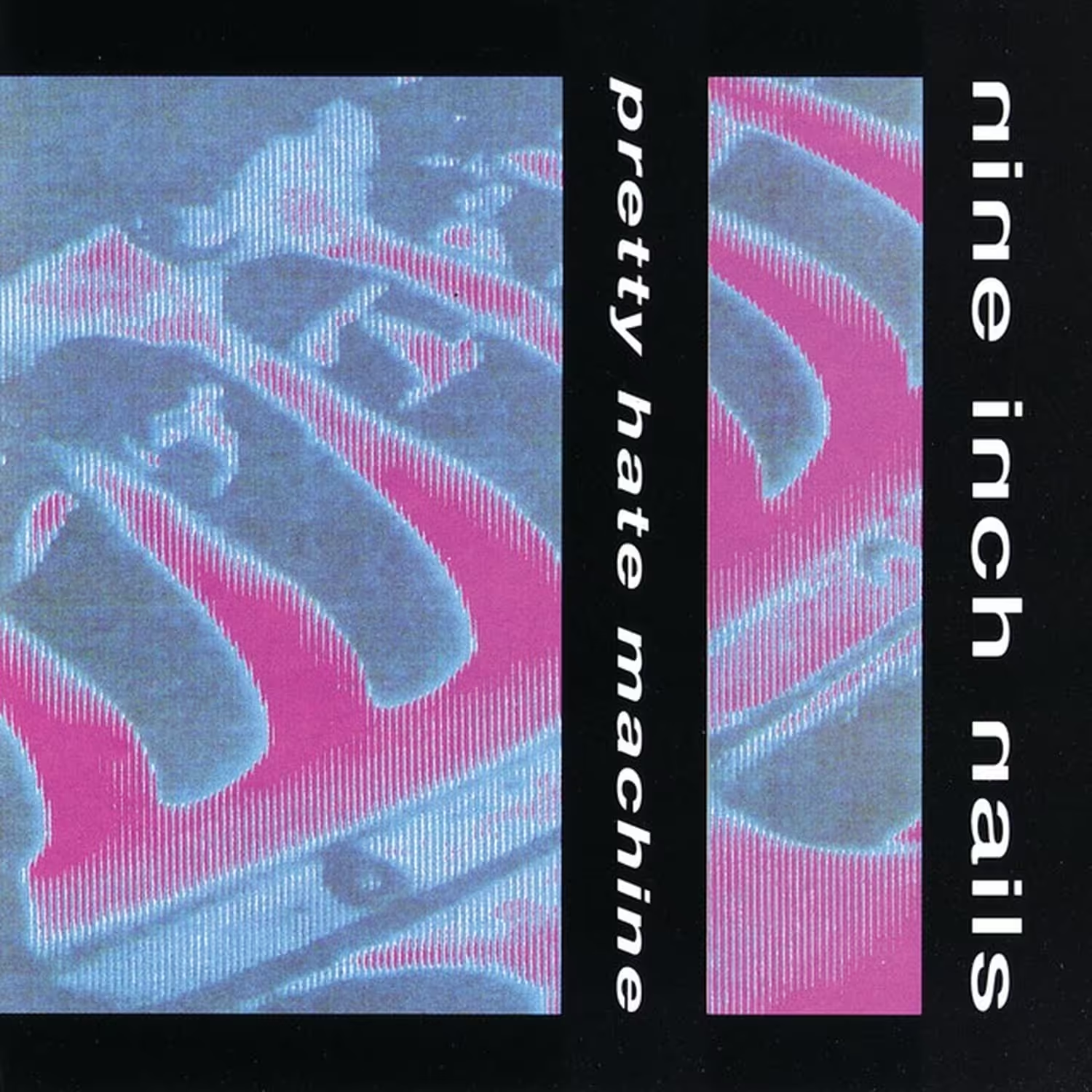
The original 1989 sleeve is a closely cropped photograph of the curved blades of a turbine, stretched vertically by Gary Talpas until the metal reads, unmistakably, as a human rib cage. The implication is straightforward, the body as machine and the machine as body, which became one of the album's recurring lyrical motifs. Talpas, a Cleveland native who had also helped design the NIN logo, would design Nine Inch Nails packaging through 1997.
The band photography is at least as influential as the cover. Reznor commissioned the Ohio-born art photographer Jeffrey Silverthorne, then best known for nudes shot in a very high-contrast style. Silverthorne's technique of dousing his subjects in cornstarch to give them a corpse-like pallor produced the publicity images that defined NIN visually in its first years, and so impressed Reznor that he took to dousing his entire band in cornstarch before every gig, a routine that became iconic at the 1991 Lollapalooza festival.
The 2010 reissue carries a different cover, painted by Rob Sheridan, the long-time NIN art director. The job was harder than it looked. Sheridan could not find the original turbine artwork anywhere; Talpas's files were effectively lost. The only option was to scan the existing CD cover at high resolution and digitally repaint the entire image at extreme magnification, tonally cooler and stripped of the late-eighties neon palette that had aged the original sleeve. The 2010 cover and the 1989 cover are visually nearly identical, but if you compare them side by side, the second is a reconstruction rather than the original work.
Release and Reception
Pretty Hate Machine entered the Billboard 200 in February 1990 and peaked at number 75. The UK Albums Chart took the album to number 67. In neither territory was it a chart event. What it was, instead, was a slow burner with an unusually long tail: 115 weeks on the Billboard 200 in total, equal to the eventual run of the next NIN album, The [Downward Spiral](/posts/the-making-of-downward-spiral-by-nine-inch-nails/). Word of mouth and college radio did the heavy lifting. Certification followed at glacial speed by 1989 standards: Gold on 3 March 1992 (more than two years after release), Platinum in 1995, and 3x Platinum on 12 May 2003, fourteen years after the album came out. In the UK, BPI Gold was awarded on 1 November 1995.
Contemporary critics were largely warm. Michael Azerrad reviewed it for Rolling Stone in early 1990 in terms Reznor would repeat in interviews for the rest of his life:
"Industrial-strength noise over a pop framework, harrowing but catchy music."
Michael Azerrad, Rolling Stone, February 1990
Robert Hilburn at the Los Angeles Times called Reznor's "dark obsession" compelling. Martin Aston in Q gave it four stars and described it as scanning the spectrum of modern dance with a "panoramic vision" both adventurous and accessible. Sounds called it a record to be treated with respect, comparable to Ministry and Foetus. The Boston Phoenix named Nine Inch Nails 1989's best new artist. The dissenters were polite: Jon Pareles in The New York Times worried that the album hewed so closely to Depeche Mode, Soft Cell and New Order that it could be heard as parody, though he conceded the music had "enough unexpected jolts to support the posturing". Mark Jenkins in The Washington Post found the material "competent but undistinctive". Tom Popson in the Chicago Tribune liked the production but disliked the "soap-on-a-rope" vocal moments.
The retrospective reception has been substantially kinder. AllMusic's Steve Huey credited Reznor with giving industrial music "a human voice, a point of connection". When Rolling Stone reviewed the 2010 reissue, Will Hermes called it "the first industrial singer-songwriter album" and credited Flood and LeBlanc with having "taught Reznor a lot". Most strikingly, in 2020 Rolling Stone placed Pretty Hate Machine at number 453 on its revised list of the 500 Greatest Albums of All Time, and the novelist Chuck Palahniuk had earlier told Blender that the album "seemed like the first honest piece of music I ever heard". Loudwire later named it the best hard rock album of 1989.
Singles and Music Videos
| Single | Released | Producer(s) | Notable Chart Peaks | B-sides / Notes |
|---|---|---|---|---|
| Down in It (Halo 1) | 15 September 1989 | Reznor, Sherwood, LeBlanc | US Alternative Airplay 16; US Dance Club Songs 16 | "Shred" and "Singe" extended mixes on the 12-inch. |
| Head Like a Hole (Halo 3) | 22 March 1990 | Reznor, Flood, LeBlanc (remix) | US Alternative Airplay 28; US Bubbling Under Hot 100 9; UK Singles 45 (1991 reissue); ARIA 57 (1995 reissue) | Five mixes on the US CD; UK three-track edition adds the "Opal" mix. |
| Sin (Halo 4) | 10 October 1990 | Reznor, Fryer, LeBlanc (remix) | UK Singles 35; US Dance Club Songs 10 | B-side "Get Down, Make Love", Queen cover co-produced by Al Jourgensen as Hypo Luxa. Issued in a novelty 9-inch vinyl format among others. Sleeve by The Designers Republic. |
The three videos were shot by two H-Gun directors, Eric Zimmerman and Benjamin Stokes, and one outsider, Brett Turnbull, with one of the three becoming the subject of one of the better federal investigations in rock history. The "Down in It" video was filmed in the Warehouse District of Chicago in late summer 1989. Its ending implied that Reznor's character had jumped from a building and was lying dead in the street, his face whitened with starch powder. To get the high-angle shots, the crew tied a camera to a helium balloon with ropes. Minutes after filming began, the ropes snapped. The camera and balloon drifted east. They eventually landed in a Michigan cornfield, were collected by the farmer, and handed to the FBI. Agents proceeded to investigate the footage as a possible snuff film. Police distributed flyers asking for leads on the apparent murder victim. The case was only closed when an art student who worked for H-Gun recognised the image. "The bottom line," a Chicago Police Department spokesperson told reporters in September 1990, "is we don't have a body and we don't have mystery or homicide." The television tabloid Hard Copy ran the story in March 1991, breathlessly framing the footage as evidence of a "satanic ritual"; TVT's Island Records subsidiary in the UK shamelessly bundled clips from the Hard Copy report into the British press kit for the album.
The "Sin" video, directed by Brett Turnbull, never aired on MTV. Reznor, with a paper bag over his head and his wrists bound, is led through an industrial complex by a woman wearing nothing but spelunking straps and a halogen lamp, then strapped into an Aerotrim and spun while the camera cuts to ritualistic dancing, two young gay lovers and close-ups of a pierced phallus and clitoris. A heavily edited cut later turned up on the Closure home video. Reznor regarded the whole exercise partly as a deliberate two-finger gesture to MTV's conventional pop-video aesthetic.
One other television appearance from this period deserves mention. In 1989, asked by a label promo person what shows they would like to appear on, the band, possibly intoxicated, suggested Dance Party USA on the grounds that it was the most absurd choice available. They were promptly booked. The lip-synced performance, lost for two decades, surfaced on YouTube in 2012; Reznor cheerfully conceded the choice and never asked for the footage to come down.
Touring and Live
The Pretty Hate Machine Tour Series ran from 1988 (the band's first show) into 1991 and is one of the longer support-act campaigns in modern rock. Reznor assembled a live band around Richard Patrick on guitar, Chris Vrenna on drums and a rotating cast of keyboard and sampler players, and spent two years opening for alternative-leaning headliners. The two key support runs were for Peter Murphy and the Jesus and Mary Chain across North America. Reznor began smashing his equipment on stage, particularly the cheap Yamaha DX7 keyboards he would strip the keys off using the heel of his boot, and a Mike Gitter Rockbeat interview from 1992 credits the live band's early success in front of rock audiences specifically to that on-stage aggression.
The defining live moment of the era was the inaugural Lollapalooza festival in 1991. NIN played the touring caravan of Perry Farrell's new festival concept alongside Jane's Addiction, Living Colour, Siouxsie and the Banshees, Ice-T's Body Count, the Butthole Surfers and the Rollins Band. The cornstarch face paint Reznor had borrowed from Silverthorne's photo sessions became a visual signature. During "Head Like a Hole", Dave Navarro and Eric Avery from Jane's Addiction, Gibby Haynes of the Butthole Surfers and Ice-T would routinely join the band on stage as additional guitarists; the exception was the opening show in Phoenix, when the band walked off after the first song in frustration. By the end of the campaign, NIN had finally graduated from support act to headliner, an arc completed by a poorly received support slot for Guns N' Roses on their European tour, which would help push Reznor toward the harder direction of the Broken EP. Notable elements of the live show included:
- The cornstarch face paint borrowed wholesale from Jeffrey Silverthorne's portrait sessions, applied before every show.
- The on-stage destruction of cheap Yamaha DX7s and other keyboards as a closing ritual.
- A live arrangement of "Head Like a Hole" that turned the studio mid-tempo into the encore at almost every show.
- Guest appearances on stage at Lollapalooza 1991 by Dave Navarro, Eric Avery, Gibby Haynes and Ice-T.
- An eventual European support stint for Guns N' Roses in 1991 that went badly enough to push the band's sound toward Broken.
In TV, Film and Media
Songs from Pretty Hate Machine have had a longer second life in television and film than the album's modest initial chart performance might suggest. "Something I Can Never Have" alone has appeared in the soundtrack to Oliver Stone's Natural Born Killers, in David Lynch's Lost Highway, in the first season of The Handmaid's Tale and in numerous indie films looking for two minutes of cinematic devastation on a tight licensing budget. "Head Like a Hole" turned up on the Atomic Train miniseries, in adverts and trailers, and most famously was reworked by Charlie Brooker, with Reznor's approval, as the bubblegum dance-pop track "On a Roll", performed by Miley Cyrus in character as Ashley O in the 2019 Black Mirror episode "Rachel, Jack and Ashley Too". Cyrus then mashed the original NIN song into her own Glastonbury 2019 headline set. "Sin" has been licensed across various horror and crime soundtracks; an unofficial early 1990s Gatorade television commercial used a "Down in It" remix without permission, triggering an unsuccessful Reznor lawsuit against the production company.
Controversy, Censorship and Lawsuits
The album itself never carried a Parental Advisory sticker. The controversies all came later. The "Sin" music video, as described above, was effectively banned by MTV and only ever circulated in heavily edited form. After the September 11 attacks in 2001, Clear Channel Communications added "Head Like a Hole" to its now-infamous internal list of "Songs with Questionable Lyrics" deemed inappropriate for radio airplay, a designation Reznor wore as a badge of honour. The plagiarism complaints around "Down in It" being a "Dig It" rewrite never reached court, but only because Reznor, in a 1991 Dutch radio interview, simply admitted it: "The original version I did was about half-speed of the one on the record and it was a total rip-off of 'Dig It' by Skinny Puppy. I'll admit to that now."
The biggest controversy attached to Pretty Hate Machine, however, was contractual rather than creative. Reznor's relationship with TVT collapsed entirely during the touring cycle. He believed the label had mishandled the album's promotion and was actively trying to prevent him from releasing a follow-up unless it was a Pretty Hate Machine sequel. His response was to record the Broken EP under pseudonyms, hiding sessions from his own record label so that, in his own later phrasing, TVT could not "confiscate all our shit and release it". The dispute ended only when Jimmy Iovine intervened and brokered a transfer to the new Interscope Records, with Reznor's new label Nothing as an imprint. In Reznor's bitter summary years later:
"We made it very clear we were not doing another record for TVT. But they made it pretty clear they weren't ready to sell. Flood and I had to record Broken under a different band name. Jimmy Iovine got involved with Interscope, and we kind of got slave-traded. It wasn't my doing."
Trent Reznor, quoted in Martin Huxley's Nine Inch Nails: Self-Destruct, 1997
The contractual mess took another decade to clean up. In 2005, Prudential Securities, then handling TVT's bankruptcy, auctioned the rights to the entire TVT back catalogue including Pretty Hate Machine. Rykodisc did not win the auction but licensed the rights from Prudential and reissued the album on CD on 22 November 2005 with slightly modified packaging. The album's rights were eventually acquired on 29 March 2010 by the Bicycle Music Company, which is where they sit today.
Covers, Samples and Tributes
The cover history of "Head Like a Hole" alone is a small genre study. Devo, whose Gary Numan-adjacent electro-pop was one of Reznor's early templates, covered the song affectionately. The hardcore band AFI took it in a darker direction. Korn recorded it for an unreleased covers album project. Buckcherry, of all people, cut a hard-rock version in 2018. The string-quartet specialists Vitamin String Quartet released an entire chamber-music tribute to Pretty Hate Machine in 2005. The Brooker-Cyrus "On a Roll" rewrite for Black Mirror is the most globally heard derivative of any NIN song to date, and was followed by Cyrus's Glastonbury 2019 medley of "On a Roll" and "Head Like a Hole".
The samples flow in both directions. Pretty Hate Machine itself credits Prince, Jane's Addiction and Public Enemy in its liner notes as artists whose music was sampled in the album, with Prince's "Alphabet St." and Jane's Addiction's "Had a Dad" both audible in "Ringfinger". Other samples, including Public Enemy loops fed through Macintosh Turbosynth, were processed so heavily as to be unrecognisable. In the opposite direction, "Down in It" itself has been sampled on a small number of hip-hop and rock records; the album's broader influence on the entire industrial-rock and nu-metal generations that followed has been so often acknowledged by Korn, Marilyn Manson, Static-X, Rammstein, [Slipknot](/posts/the-making-of-slipknot-by-slipknot/) and others that listing them all would itself fill a sidebar. Steven Wilson of Porcupine Tree, Maynard James Keenan of Tool and Phoebe Bridgers have all separately pointed to Reznor's writing on this record as foundational.
Reissues, Remasters and Anniversaries
The 22 November 2005 Rykodisc reissue is the easiest to find on the second-hand market and includes lightly modified packaging but no bonus material. Reznor had wanted a full surround-sound remaster and new remix edition similar to the The Downward Spiral deluxe edition; Rykodisc was open to the idea but expected Reznor to pay the production costs himself, and the project stalled.
The definitive reissue is the 22 November 2010 Bicycle Music edition, mastered by Tom Baker at Precision Mastering in Hollywood, with the Rob Sheridan cover reconstruction described above. The headline addition is the "Get Down, Make Love" bonus track, finally restored from the "Sin" 12-inch B-side. The Classic Rock review summed up the remaster nicely: "PHM 2.0 is far brighter and clearer than its original incarnation, but ultimately it's the strength of the songwriting that shines through." A small live segment and the videos for "Head Like a Hole", "Down in It" and the uncut "Sin" were posted on a companion fan website before the rerelease. The album and its three singles were later collected for the 2015 Record Store Day Black Friday exclusive vinyl box set Halo I to IV.
There has been no official anniversary super-deluxe box set for Pretty Hate Machine. Given the contractual chaos around its master rights and the existence of the Bicycle Music remaster, it is unlikely there ever will be. The 2010 reissue is, for now, the closest thing to a definitive edition.
Legacy and Influence
Pretty Hate Machine is the record that made Nine Inch Nails commercially viable, but its real importance is genre-shaped. It is the album that taught a generation of American rock bands that industrial music did not have to mean unlistenable, that synth-pop did not have to mean polite, and that the same audience would happily buy both. Without it, there is no Broken, no The Downward Spiral, no plausible commercial route for Korn or Marilyn Manson, no Garbage, no Filter (which Richard Patrick formed after touring this album), no Stabbing Westward, no Static-X. The "Closer" video and the Hurt-into-Johnny-Cash arc of the next decade are downstream of Reznor's discovery here that you can deliver naked confessional lyrics through industrial machinery and that the audience prefers it that way.
The longer historical view is even kinder. Rolling Stone, having ignored the album in its original 500 Greatest Albums list, slotted it in at number 453 on the 2020 revision. Loudwire named it the best hard rock album of 1989. The 1989 to 1994 NIN line of three releases (Pretty Hate Machine, Broken, The Downward Spiral) is now widely treated as the canonical early-NIN trilogy and the foundation document of mainstream industrial rock. Nine Inch Nails were inducted into the Rock and Roll Hall of Fame in 2020 with seven members named: Reznor, Atticus Ross, Chris Vrenna, Danny Lohner, Alessandro Cortini, Robin Finck and Ilan Rubin. The decision to include former live-band members in the induction was Reznor's, partly as a tip of the hat to the years on the Pretty Hate Machine Tour Series when Nine Inch Nails was a touring rock band rather than a solo project.
Reznor himself remained ambivalent about the album for decades. He has said in multiple interviews that the lyrics embarrass him now. He played fewer Pretty Hate Machine songs live than his audience would have liked through the 2000s. Yet on its thirtieth anniversary in 2019, asked by Rolling Stone what made the record matter, he turned generous:
"I remember 'Head Like a Hole' was quick. Some songs feel like months of tinkering, and other ones seem like an afternoon and it's done, and that was one of those songs that just kind of fell out."
Trent Reznor, Rolling Stone, November 2019
Charts and Certifications
| Territory | Chart | Peak | Certification | Notes |
|---|---|---|---|---|
| United States | Billboard 200 | 75 | 3x Platinum (RIAA, 12 May 2003) | 115 weeks on chart, ties The Downward Spiral as longest-charting NIN album. |
| United States | Independent Albums | 17 | One of the first independent releases to reach RIAA Platinum. | |
| United Kingdom | Albums Chart | 67 | Gold (BPI, 1 November 1995) | Album initially released by Island Records in the UK in late 1990. |
| United Kingdom | Rock and Metal Albums | 26 | Peak following the 2010 reissue. | |
| Argentina | CAPIF | Platinum | Sixty thousand units shipped. |
Things You Might Not Know
| Fact | Detail |
|---|---|
| The janitor angle | Reznor worked as the assistant engineer and janitor at Cleveland's Right Track Studio and recorded most of the album's demos during the studio's empty hours with owner Bart Koster's blessing. |
| The single Macintosh | The entire album was sequenced on one Macintosh Plus computer driving an E-mu Emax sampler that Reznor had only chosen because it produced an interesting buzzing artefact when transposed downward. |
| Sherwood by post | Adrian Sherwood produced "Down in It" at Blackwing in London without ever meeting Reznor face to face during the sessions. |
| Six songs at once | Every drum fill on "Terrible Lie" was lifted intact from six other songs playing through the track on tape simultaneously, faded in and out depending on what suited the moment. |
| The FBI's cornfield | A camera-on-a-balloon used to film the closing shot of the "Down in It" video broke loose and floated to a Michigan cornfield, prompting an FBI investigation into a possible snuff film. |
| Tibor Kalman's lettering | The NIN logo with the mirrored second N was inspired by Tibor Kalman's typography on the cover of Talking Heads' 1980 album Remain in Light. |
| Cornstarch corpse pallor | The cornstarch routine that defined NIN's early stage look came from portrait photographer Jeffrey Silverthorne, who had been using it on nude subjects to create a "corpse-like" finish in his fine-art work. |
| An accidental snuff film | The "Down in It" video was covered as a "satanic ritual" by the television tabloid Hard Copy on its 3 March 1991 episode; TVT's UK partner Island Records cheerfully bundled clips of the report into the British press kit. |
| The Hypo Luxa alias | "Get Down, Make Love", added to the 2010 remaster, was produced by Al Jourgensen of Ministry under his Hypo Luxa pseudonym; it was originally a "Sin" 12-inch B-side and the album's only cover. |
| The Clive Barker debt | The "Sin" lyric "Stale incense, old sweat and lies, lies, lies" is taken word for word from the Clive Barker short story "In the Hills, the Cities" in the first volume of Books of Blood. |
| The 9-inch novelty | The UK "Sin" 12-inch was also pressed as a novelty 9-inch playable single, a sleeve produced by the Sheffield design studio The Designers Republic. |
| Reznor's least favourite track | Reznor has repeatedly called "Kinda I Want To" the weakest song he has ever written and stopped performing it live for decades. |
| The Dance Party USA gambit | The band suggested they appear on the daytime teen dance show Dance Party USA as the most absurd answer they could think of to a promo question; to their surprise, they were booked, and lip-synced "Down in It" in 1989. |
| Thirteen years to triple Platinum | Pretty Hate Machine was certified Gold in March 1992, Platinum in 1995, and 3x Platinum on 12 May 2003, almost fourteen years after release, an unusually long arc to triple Platinum. |
| Lost cover artwork | Rob Sheridan could not locate any of Gary Talpas's original 1989 artwork files when preparing the 2010 reissue cover, so he scanned an existing CD sleeve at high resolution and digitally repainted the entire image. |
Listen on the Riffology Podcast
This is the kind of record made for the Riffology podcast, an album that takes more turns the closer you look at it. We unpack the five studios, the four producers, the FBI cornfield, the Clive Barker borrowing and the long contractual war with TVT in the episode. You can find Riffology on Apple Podcasts, Spotify, Pocket Casts, Overcast, YouTube Music and every other platform that takes a generic RSS feed; the back catalogue is at riffology.co.
Comments