The night the wigs went mainstream
For ten years before Stay Hungry, Twisted Sister had been the loudest, most painted, most unrespectable bar band in the New York and New Jersey club circuit, working five-night residencies at venues like L'Amour in Brooklyn and the Mad Hatter on Long Island and getting nowhere near a major-label contract. Two albums into a deal with Atlantic Records they were still essentially a regional act with European cult interest. Then on 10 May 1984, with a producer they had argued with for weeks and a singer who had refused to record any cover versions, they released a third album that opened with the word "Stay" and ended, twelve months later, with their frontman in front of a US Senate committee being asked to explain himself to Tipper Gore.
That arc, from a tenth-anniversary club band that had nearly broken up to an MTV-era brand standing in the same news cycle as Frank Zappa and John Denver, is the story Stay Hungry tells. It is also the story of a producer trying to turn a New York glam-shock act into something palatable to American radio, of a photographer who rented a beef bone for the cover, and of two Marty Callner videos that did more for the band's career than ten years of gigs ever had.
The quick facts
| Field | Detail |
|---|---|
| Artist | Twisted Sister |
| Album | Stay Hungry |
| Release date | 10 May 1984 |
| Label | Atlantic Records |
| Producer | Tom Werman, with arrangements by Tom Werman and Twisted Sister |
| Engineer and mixer | Geoff Workman |
| Studios | Record Plant (New York), Westlake Audio (Los Angeles), Cherokee Studios (Hollywood) |
| Mastering | George Marino at Sterling Sound, New York |
| Recording dates | February to March 1984 |
| Genre | Heavy metal, glam metal, hair metal |
| Track count | 9 |
| Total runtime | 36:58 |
| Billboard 200 peak | No. 15 |
| UK Albums Chart peak | No. 34 |
| Other notable peaks | Sweden No. 3, Canada No. 6, New Zealand No. 10, Finland No. 10, Norway No. 11, Australia No. 21, Germany No. 48 |
| Certifications | RIAA 3x Platinum (US), Music Canada 5x Platinum, ARIA Platinum, RMNZ Platinum, Sweden (GLF) Platinum, AMPROFON Gold (Mexico), IFPI Norway Silver |
| Singles | We're Not Gonna Take It (May 1984), I Wanna Rock (October 1984), The Price (December 1984) |
Twisted Sister before Atlantic
Twisted Sister had formed on Long Island in 1972 as a glam-influenced cover band, with Jay Jay French the only constant link between the New York Dolls-styled lineup of the early seventies and the Dee Snider-fronted band that would make Stay Hungry. Snider joined in 1976; bassist Mark "The Animal" Mendoza, formerly of cult New York proto-punks the Dictators, came in for the 1978 lineup change that finally settled the front line. Drummer A. J. Pero, recruited in 1982 from the Brooklyn band Cities, completed the configuration that would record every track on the album.
By the time the band signed to the British independent Secret Records in 1982 they had played, by Snider's own count, more than two thousand club shows. Under the Blade appeared in September of that year, produced by UFO bassist Pete Way, and led to a slot supporting Motorhead at Wrexham Football Ground. The album sold poorly in the United States but caught the attention of British metal fans and the BBC's Friday Rock Show, which is what got Twisted Sister to Atlantic Records in the first place. Their second album, You Can't Stop Rock 'n' Roll, followed in 1983 and gave them a UK chart placing but no real American breakthrough; both records would later be certified gold in the United States only in the slipstream of Stay Hungry.
Signing to Atlantic and the New York metal beachhead
Atlantic Records, in 1984, was not yet the metal label it would become. It had signed Twisted Sister largely on the strength of European interest and a Phil Carson-led A and R operation in London that had also pulled in Foreigner and AC/DC. By the time the band came to make their third album the company had decided that You Can't Stop Rock 'n' Roll had been too rough around the edges for American radio and that what Twisted Sister needed was a producer with a track record of polishing club bands into hit-makers.
The man Atlantic chose was Tom Werman, an A and R executive turned producer whose CV by 1984 included Cheap Trick's In Color (1977) and Heaven Tonight (1978), Ted Nugent's Cat Scratch Fever, and, most directly relevant to Twisted Sister, the previous October's [Shout at the Devil by Motley Crue](/posts/the-making-of-shout-at-the-devil-by-motley-crue/). Werman had a reputation for hitting drums hard, doubling guitars, prioritising big choruses and pushing bands toward shorter, more commercial running times. He was also based on the West Coast, which meant the New York band had to come to him.
Tom Werman in the producer's chair
Werman's first move was an act of polite provocation. During pre-production he turned up to a band meeting with cassette tapes of Saxon songs and asked Twisted Sister to listen to them. Dee Snider, the sole songwriter on every Twisted Sister album to that point, interpreted the gesture as a request to bump some of his own material in favour of covers, and refused outright. Jay Jay French has since said the row was less straightforward than that, that Werman was using the Saxon material as a tonal reference rather than literally proposing covers, but the version of the story that has stuck has Snider walking out of the meeting and Werman backing down.
The aftermath of the argument was that Werman lost two of the original Snider compositions the band had wanted on the record, with Jay Jay French claiming in a 2010s interview that the producer's preferences pushed two strong tracks off the running order in favour of shorter, punchier songs. What survived was a hard-edged but radio-conscious selection, and a working relationship between band and producer that was professional and tense in roughly equal measure. The argument is the single best-documented thing about the Stay Hungry sessions; almost everything else has the sheen of a band that knew it was making the record of its life and simply got on with it.
Recording at Record Plant, Westlake and Cherokee
Tracking and overdubs ran from February into March 1984 across three studios. Basic tracks were cut at the Record Plant in New York, the same complex that had hosted records by John Lennon, Aerosmith and a thousand others; further work was done at Westlake Audio in Los Angeles, where everyone from Michael Jackson's Thriller team to Donna Summer had recorded; and final overdubs and vocals were tracked at Cherokee Studios in Hollywood, the rented home of dozens of mid-eighties hard rock and pop records.
The sessions were 24-track analogue, mixed in the way every major-label rock record was mixed in 1984: hard-panned guitars, bricks of reverb on the snare, a bass shaped to sit under the kick drum rather than fight it. A. J. Pero's drums were tuned tight and miked close. Eddie Ojeda played most of the lead guitar, with Jay Jay French taking the lead on Stay Hungry, S.M.F. and parts of Burn in Hell and Don't Let Me Down, and the rhythm work elsewhere. Snider's vocals, the most identifiable thing about the record, were tracked at Cherokee with the singer doing multiple passes per song and then layering harmonies on top. Werman's instinct for double-tracking choruses, learned on the Cheap Trick records, is audible everywhere; the band sound bigger than five people at almost every moment.
Geoff Workman, mixing and the Sterling Sound master
Geoff Workman is the second name on the production credits and the unsung craftsman of the record. An Englishman who had engineered Queen sessions in the seventies and gone on to work with Foreigner and Journey, Workman engineered and mixed Stay Hungry across all three studios. He was assisted by Gary McGachan at Cherokee and John "Red" Agnello (later a producer in his own right for Dinosaur Jr and Sonic Youth) at Record Plant, with Greg Laney covering Westlake. Sound effects and additional handclaps were credited to Werman's young son Dean, the engineer Gary McGachan, and an in-joke credit to "Neidermeyer", the name of the Mark Metcalf character who would later turn up in the music videos.
The album was mastered by George Marino at Sterling Sound in New York. Marino was the go-to American mastering engineer for hard rock in the eighties; his fingerprints are on records by AC/DC, Aerosmith, Whitesnake and a long list of other Atlantic and Geffen acts. The Sterling Sound cut is what gave Stay Hungry its slightly compressed, mid-range-forward radio sound, distinct from the brighter mix on the band's first two albums.
The personnel
| Role | Player | Notes |
|---|---|---|
| Twisted Sister | ||
| Lead vocals | Dee Snider | Sole songwriter on all nine tracks; lead and harmony vocals. |
| Lead guitar | Eddie "Fingers" Ojeda | Backing vocals; lead guitar across most of the album. |
| Rhythm and lead guitar | Jay Jay French | Lead on Stay Hungry and S.M.F., co-lead on Burn in Hell and Don't Let Me Down; backing vocals. |
| Bass | Mark "The Animal" Mendoza | Backing vocals. |
| Drums and percussion | A. J. Pero | Backing vocals. |
| Additional musicians | ||
| Sound effects, handclaps | Dean Werman, Gabby McGachan, Neidermeyer | "Neidermeyer" is an in-joke credit referencing the Mark Metcalf character later used in the videos. |
| Production | ||
| Producer | Tom Werman | Arrangements credited to Werman with Twisted Sister. |
| Engineer and mixer | Geoff Workman | Across all three studios. |
| Additional engineers | Gary McGachan, John "Red" Agnello, Greg Laney | Cherokee, Record Plant and Westlake respectively. |
| Mastering | George Marino | At Sterling Sound, New York. |
| Art direction | Bob Defrin | Atlantic Records in-house art director. |
| Cover photograph | Mark Weiss | Beef bone shoot at his New Jersey studio in early 1984. |
The songs
Snider had written every song on every Twisted Sister album to that point, and Stay Hungry was no exception. The nine tracks that made the cut were chosen from a larger pool of demos recorded at Nino's Studios in Baldwin, New York, in December 1983, several of which would only emerge years later on the 25th anniversary edition. The selected nine come in at a tight 36 minutes 58 seconds, conspicuously short for a 1984 hard rock album and a sign of Werman's running-time discipline.
| # | Title | Length | Single | Notes |
|---|---|---|---|---|
| 1 | Stay Hungry | 3:03 | Title track, opens the album with French's lead guitar. | |
| 2 | We're Not Gonna Take It | 3:38 | 1st single, May 1984 | US Hot 100 No. 21; defining song of the band's career. |
| 3 | Burn in Hell | 4:43 | Performed in Pee-wee's Big Adventure, 1985. | |
| 4 | Horror-Teria (The Beginning): a) Captain Howdy b) Street Justice | 7:45 | Two-part suite that became the basis of Snider's 1998 film Strangeland. | |
| 5 | I Wanna Rock | 3:06 | 2nd single, October 1984 | US Hot 100 No. 68. |
| 6 | The Price | 3:48 | 3rd single, December 1984 | The album's power ballad. |
| 7 | Don't Let Me Down | 4:26 | Co-lead guitar from French and Ojeda. | |
| 8 | The Beast | 3:30 | Pero's most aggressive performance on the album. | |
| 9 | S.M.F. | 3:00 | Tribute to the band's "Sick Mother Fucking" fan club. |
We're Not Gonna Take It
Snider has said for forty years that We're Not Gonna Take It was written in twenty minutes, on the basis that he wanted a song built on the simplest, most singable melody he could think of. He used the chord progression of the Christmas carol O Come, All Ye Faithful as his template; if you sing the carol's first line over the chorus of We're Not Gonna Take It, the relationship is obvious. The riff was deliberately reduced to two-chord muscle memory, the lyric pitched at adolescent grievance generally rather than any specific target. Werman's contribution, audible in the final mix, was a relentlessly stacked chorus and a gang vocal that turned the title phrase into a chant.
The song was released as the album's lead single in May 1984 and climbed to number 21 on the Billboard Hot 100, the highest American chart position any Twisted Sister song would ever reach. It became a generational sing-along almost on impact, and has spent the four decades since being licensed for political rallies, sports broadcasts and consumer adverts to the point that Snider has had to publicly forbid Donald Trump's campaigns from using it.
I Wanna Rock
If We're Not Gonna Take It is the album's anthem, I Wanna Rock is its mission statement, and the two were always going to be released as singles in that order. The song is built on a simple ascending riff with three vocal phrases looped to exhaustion, a structure that would have been thin on a different record but works precisely because of how committed the band sound to selling it. Released as the second single in October 1984, it reached number 68 on the Hot 100, but its life on MTV was longer and more lucrative than any Hot 100 placing would suggest.
The phrase "I wanna rock" became, briefly, an entire cultural shorthand for a kind of dumb, joyful, mid-eighties American hard rock, picked up by everyone from Quiet Riot fans to people who had never bought a Twisted Sister record. The song has since become the band's second-most-licensed property, sitting just behind We're Not Gonna Take It in advert and film placements.
Burn in Hell, Horror-Teria and the Captain Howdy myth
Two of Stay Hungry's longest tracks deal in horror-movie imagery rather than fist-pumping. Burn in Hell, slotted at track three, is a four-and-a-half-minute mid-tempo grinder driven by a slowed-down arrangement that allows Snider's lyric, written from the point of view of a character warning the listener about what happens to the wicked, room to breathe. The song would acquire an unexpected second life in the summer of 1985 when Twisted Sister appeared performing it in Tim Burton's Pee-wee's Big Adventure.
The album's centrepiece, however, is Horror-Teria (The Beginning), a 7:45 two-part suite split into Captain Howdy and Street Justice. Captain Howdy, named after the demon entity in The Exorcist, follows a child predator who haunts a New York playground; Street Justice tracks the parents of his victims as they hunt him down. Snider would expand the storyline into his 1998 directorial debut Strangeland, in which he himself plays a different character also named Captain Howdy. Inside the album, Horror-Teria is the moment that complicates any reading of Stay Hungry as a piece of disposable hair metal: it is, lyrically, the darkest thing on the record.
The Price and the Stay Hungry ballad question
Werman's commercial instinct produced the album's third single, The Price, a 3:48 power ballad on which Snider sings about the cost of pursuing a rock and roll life over an arrangement built from clean guitar arpeggios and a cleanly multitracked vocal. The song, released in December 1984, did not chart in the United States but quickly became a staple of FM rock radio and the band's emotional lighters-aloft live moment for the rest of the touring cycle.
The Price has aged into the most quietly influential thing on the album. Almost every American hair metal band that mattered after 1984 attempted at least one variation on the form: [Slippery When Wet by Bon Jovi](/posts/the-making-of-slippery-when-wet-by-bon-jovi/) made the power ballad an album-side strategy two years later, and the Cinderella, Poison and Whitesnake records of the late eighties owe a debt to The Price's blueprint of restraint giving way to chorus.
Don't Let Me Down, The Beast and S.M.F.
The album's three deeper cuts are split between the relationship-failure ballad Don't Let Me Down, the doom-tinged The Beast, and the closing track S.M.F. Don't Let Me Down rides a co-lead guitar arrangement that has French and Ojeda trading bars, an unusual structural choice that gives the song its tension. The Beast is the heaviest thing on the record, with Pero's drum tracking the album's most aggressive performance and Mendoza's bass uncharacteristically forward in the mix.
S.M.F., the closer, is a 3:00 stomp written as a tribute to the band's most committed fans, who had taken to calling themselves SMFs, an acronym for "Sick Motherfucking Friends of Twisted Sister". The song was a setlist staple before it had ever been recorded; the studio version exists largely to give the live audience a chance to see their own nickname pressed into vinyl. It is also the only track on the album where Jay Jay French takes a solo lead and Snider audibly laughs in the booth between takes.
Mark Weiss and the cover photograph
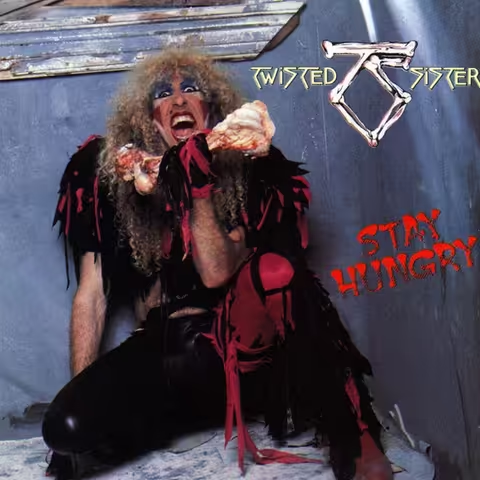
The album cover, perhaps the single most reproduced image of the band, was photographed by Mark Weiss at his New Jersey studio in the early months of 1984. Snider, dressed in shredded pink-and-black stage gear, eye makeup taken to a hardcore extreme, was photographed gnawing on a raw beef bone supplied by a local butcher. Weiss has since said the bone went off rapidly under the studio lights and that the shoot was completed in a single afternoon to spare everyone the smell.
The image, designed by Atlantic art director Bob Defrin, became the visual shorthand for the entire band. The "Stay Hungry" pose was parodied for its cover-art outrageousness in industry trade press at the time, and was later re-used in promotional materials, tour merchandise and the artwork for the 25th anniversary edition. Weiss would go on to shoot covers for Bon Jovi, Skid Row and Ozzy Osbourne; the Stay Hungry photograph remains his single best-known image.
Marty Callner and the music videos
The two music videos that broke Stay Hungry on MTV were both directed by Marty Callner, an HBO comedy-special director who had become the go-to video director for hard rock acts. The We're Not Gonna Take It video, shot in early summer 1984 on a domestic-set soundstage, opens with Mark Metcalf, the actor who had played the sadistic ROTC commander Niedermayer in National Lampoon's Animal House, reprising his character as a tyrannical father shouting at his teenage son: "What do you wanna do with your life?" The teenager, brandishing a guitar, answers by transforming into Dee Snider as the band crashes through the wall of the bedroom.
The clip was cartoonish, deliberately so, with Metcalf flying out of windows and being slammed by doors in slapstick choreography lifted directly from a Wile E. Coyote sequence. It was a fixture of MTV's heavy rotation through the summer of 1984 and the autumn of that year. The follow-up video, for I Wanna Rock, shot a few months later, brought Metcalf's character back as a high-school teacher persecuting the same student-as-Snider, with the teacher's torments escalating until the student again triggers a band-led revolt. Together the two videos are arguably the single biggest reason Stay Hungry went platinum; the songs were already strong, but the videos turned them into events.
Release, charts and certifications
Released on 10 May 1984, Stay Hungry entered the Billboard 200 and climbed to number 15 in its peak week, an extraordinary placing for a band whose previous American chart position had topped out in the mid-nineties of the Top 200. In the United Kingdom it reached number 34 on the Official Albums Chart, a step up from You Can't Stop Rock 'n' Roll's number 14 placing the previous year, although that earlier number reflected a smaller initial release; the Stay Hungry trajectory, slower to build, had longer legs.
| Single | Released | US Hot 100 | Notes |
|---|---|---|---|
| We're Not Gonna Take It | 27 April 1984 (US), May 1984 | 21 | Marty Callner video; Mark Metcalf as the father. |
| I Wanna Rock | October 1984 | 68 | Marty Callner video; Mark Metcalf as the teacher. |
| The Price | December 1984 | did not chart | Power ballad; promotional video shot but lower MTV rotation. |
The album was certified gold by the RIAA in November 1984, platinum by Christmas, and three times platinum by 1995, with shipments of over three million copies in the United States alone. It went on to platinum or higher status in Australia, Canada (where it was eventually certified five times platinum by Music Canada), New Zealand and Sweden, and gold in Mexico. Across all formats, by the band's own count, Stay Hungry has sold somewhere in the region of three and a half million copies worldwide, dwarfing every other Twisted Sister release combined.
Critical reception in 1984 and beyond
Reviews at the time of release were mixed in the way reviews of mid-eighties hair metal almost always were. American rock critics tended to file Stay Hungry alongside [Shout at the Devil](/posts/the-making-of-shout-at-the-devil-by-motley-crue/) as evidence of an approaching cultural decline; British reviewers, who had been on the band's side since the BBC sessions, were more positive. AllMusic's later retrospective by Eduardo Rivadavia gave the album four-and-a-half stars and called it the band's commercial and artistic peak in the same paragraph, an assessment that has held up.
The retrospective view has been kinder still. In 2016 Loudwire ranked Stay Hungry at number 6 on their Top 30 Hair Metal Albums list. In 2017 Rolling Stone placed it at number 76 on their list of the 100 Greatest Metal Albums of All Time, an unusual outcome for a record the magazine had largely ignored at the time. Metal Rules ranked it fifth on their Top 50 Glam Metal Albums list. The 25th anniversary 2-CD reissue in 2009, with its bonus disc of unreleased demos, was widely treated as one of the better metal reissues of the late 2000s.
Touring 1984 and the Stay Hungry World Tour
The Stay Hungry World Tour ran from May 1984 through August 1985, taking in the United States, Canada, Japan, the United Kingdom and continental Europe. The band opened for Iron Maiden on parts of the European leg of the World Slavery Tour, returning the favour by headlining North American dates with Y and T and Dokken in support. By the end of 1984 they had moved up from theatres to arenas in the United States; by the spring of 1985 they were headlining festival bills in Europe.
The tour's signal moment was the Donington Monsters of Rock festival on 17 August 1985, where Twisted Sister played in the afternoon to a crowd of around 70,000 on a bill headlined by ZZ Top and including Marillion, Bon Jovi, Metallica and Magnum. Snider's between-song banter at Donington, addressing the British crowd directly about their place in metal history, has been preserved on bootlegs and remains, for many British fans, the moment Twisted Sister stopped being a punchline and started being a band. A live recording from the tour, Live at Hammersmith, was eventually released in 1994 from a January 1984 London show captured shortly before the album sessions.
The Filthy Fifteen and the PMRC hearings
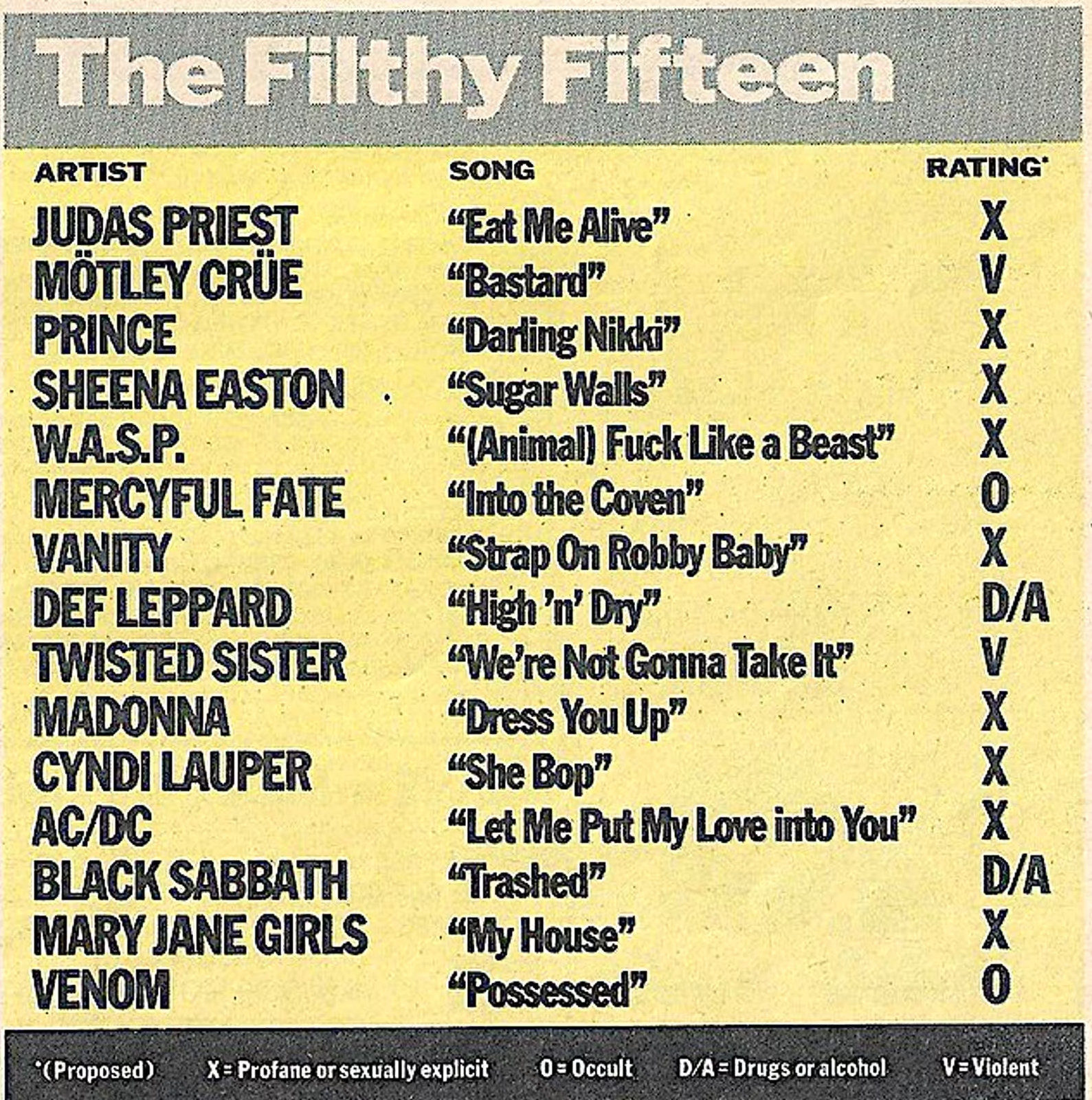
In 1985 the Parents Music Resource Center, an organisation co-founded by Tipper Gore and other prominent Washington spouses, published a list of fifteen songs they argued were inappropriate for children. The list, quickly nicknamed the Filthy Fifteen, mixed sexual content (Prince's Darling Nikki, the Mary Jane Girls' In My House) with violence (Black Sabbath's Trashed, Motley Crue's Bastard, Mercyful Fate's Into the Coven) and the supposedly satanic. We're Not Gonna Take It was included under the violence category; the PMRC's case rested on the slapstick of the Marty Callner video, in which Mark Metcalf's character is repeatedly thrown out of windows.
The Senate Commerce Committee held a hearing on the PMRC's proposed labelling regime on 19 September 1985, with Frank Zappa, John Denver and Dee Snider invited to testify against. Snider, who had been chosen partly because the PMRC had assumed his stage persona would discredit him, arrived in jeans and a denim cut-off jacket and delivered a calm, prepared statement pointing out that the lyric to We're Not Gonna Take It contained no references to violence whatsoever, and that the song's "violent" content was a thirty-second cartoon visual added a year after the song was written. The transcript and footage of the hearing remain among the most-quoted moments in eighties-rock history. The Twisted Sister of the next twelve months toured a country where their biggest single had been formally accused of corrupting children by the wife of a future Vice-President, and behaved as though that were the correct level of attention for them to be receiving.

Pee-wee, Iron Eagle and the screen afterlife
The album's afterlife on screen began almost as soon as the record was in shops. In summer 1985 Twisted Sister appeared in a cameo in Pee-wee's Big Adventure, Tim Burton's directorial debut, performing Burn in Hell on a soundstage built to look like a Hollywood film studio; the joke is that Pee-wee Herman's bicycle, the object of his quest, is being used as a prop in a Twisted Sister music video. The cameo, less than a minute long, has aged into one of the most fondly remembered moments of either Twisted Sister's or Burton's careers.
We're Not Gonna Take It featured prominently the following year in Iron Eagle, the 1986 fighter-pilot adventure film, where it scored the climactic flying sequence; the song would go on to appear in Alvin and the Chipmunks: The Road Chip (2015), The Emoji Movie (2017) and Ready Player One (2018). I Wanna Rock has shown up in Road Trip, the HBO drama The Deuce and several video games. The total volume of Stay Hungry sync placements over four decades is the single biggest reason Snider has been able to make the album the centre of his post-band income.
Come Out and Play and the fall
The follow-up was always going to be difficult, and Come Out and Play, released in November 1985 with Werman again producing, was duly difficult. The lead single, a cover of the Shangri-Las' Leader of the Pack, baffled Twisted Sister's hard rock audience and was ignored by radio. The album reached number 53 on the Billboard 200, less than a third of Stay Hungry's peak, and was certified gold rather than multi-platinum. By the time Twisted Sister's fifth album, the more conventional Love Is for Suckers, appeared in 1987, the band had effectively become a Dee Snider solo project, with the other members reduced to nominal roles, and the disbandment that followed in 1988 came as no surprise to anyone.
Snider went on to form Widowmaker; Mendoza joined Quiet Riot; Pero played in a string of New York-area metal bands. The band's eighties peak was, in retrospect, sharper than almost any of its peers'. Where [Permanent Vacation by Aerosmith](/posts/the-making-of-permanent-vacation-by-aerosmith/) and [Hysteria by Def Leppard](/posts/def-leppard-hysteria/) carried their bands through the back half of the decade and into the nineties, Stay Hungry stood essentially alone in Twisted Sister's commercial story.
Reissues, Still Hungry and the 25th anniversary
In 2004 the reformed Twisted Sister, with all five Stay Hungry-era members back in the lineup, re-recorded the entire album as Still Hungry for Spitfire Records, restoring tracks Werman had cut from the original sessions, including Heroes Are Hard to Find, Blastin' Fast and Loud and Come Back. The re-recording is rougher and longer than the 1984 original; opinions among fans on whether it improves the album are divided, but its existence is the clearest possible documentary record of how the band wanted the record to sound before Werman shaped it.
The 25th anniversary 2-CD edition followed on Rhino Records on 30 June 2009. The first disc was a remaster of the original nine tracks; the second contained fifteen unreleased outtakes and demos from the Nino's Studios sessions of December 1983, plus a brand-new song called 30, recorded by the 1984 lineup at Audio Magic in West Babylon, New York. Independent record stores who stocked the package on its release day received a free DVD of the band's Stay Hungry Live 1984 San Bernardino concert, originally broadcast on MTV, that had been commercially unavailable for years. A 40th anniversary edition was scheduled for 2024 with further unreleased material.
Reunion, Wacken and A. J. Pero
Twisted Sister reformed in 2003 after a New York Steel benefit show in support of post-9/11 victims' families, and toured intermittently for the next decade. The 2005 release A Twisted Christmas repackaged Christmas standards in Stay Hungry's arrangement style; Live at Wacken: The Reunion, recorded at the German festival in 2003, captured the reunited lineup at full force. Drummer A. J. Pero died of a heart attack on 20 March 2015 while on tour with his other band, Adrenaline Mob; Twisted Sister played out their previously announced farewell run with Mike Portnoy on drums, finishing on 12 November 2016 at the Monsters of Rock festival in Sao Paulo.
The farewell tour was the closing chapter of a career whose commercial peak was forty years old. Snider has continued solo work, including a string of post-Twisted Sister hard rock albums and an unexpected detour into musical theatre with the Off-Broadway musical Dee Snider's Rock and Roll Christmas Tale. Jay Jay French has become a music industry author and consultant; Eddie Ojeda and Mark Mendoza have continued to play, occasionally appearing on tribute releases.
Legacy and influence
Forty years on, Stay Hungry sits in an odd place in the metal canon. It is not a virtuoso record, in the sense that [Ride the Lightning by Metallica](/posts/metallica-ride-the-lightning/) released the same summer was a virtuoso record. It is not a stylistic invention, in the way that [Back in Black by AC/DC](/posts/ac-dc-back-in-black/) or [High 'n' Dry by Def Leppard](/posts/def-leppard-high-n-dry/) had been a few years earlier. What it is, instead, is the most successful translation of New York-and-New Jersey club glam onto American radio that the eighties produced. Without Stay Hungry the careers of Bon Jovi, Cinderella and Skid Row, all New York-area bands within a fifty-mile radius of Twisted Sister's old residencies, would have arrived to a less fully prepared mainstream.
The album's other legacy is political. The Filthy Fifteen and the PMRC hearings led, by 1985, to the introduction of the Parental Advisory sticker, a labelling regime that has shaped American record retail ever since. Dee Snider's Senate testimony was, in retrospect, the moment a New York hair metal band acquired permanent civic seriousness; it is the reason Snider is still asked, decades later, to comment on free-speech and censorship questions in American media. The cartoon father in the We're Not Gonna Take It video did, at the same hearing, get described into the official Congressional record. Few mid-eighties pop records can claim that.
Things you might not know about Stay Hungry
| Fact | Detail |
|---|---|
| The Christmas-carol chord trick | Dee Snider has said for forty years that he wrote We're Not Gonna Take It around the chord progression of O Come, All Ye Faithful, deliberately reaching for the simplest, most universally singable melodic shape he could find. |
| The Saxon argument | Tom Werman played the band Saxon cassettes during pre-production. Snider read it as a request for cover versions and refused; Jay Jay French has since said two of Snider's own songs were dropped from the running order as a consequence of Werman's preferences. |
| The beef-bone cover | Mark Weiss shot the album cover in his New Jersey studio with a raw bone bought from a local butcher. The shoot was completed in a single afternoon because the bone began to spoil under the lights. |
| The Animal House reunion | Mark Metcalf, hired for the We're Not Gonna Take It video, was reprising the Niedermayer character from National Lampoon's Animal House at Marty Callner's specific request. |
| Neidermeyer in the credits | The album sleeve credits Dean Werman, Gabby McGachan and "Neidermeyer" with sound effects and handclaps; the third name is an in-joke pre-empting Metcalf's later appearance in the video. |
| The Pee-wee cameo | The band's appearance performing Burn in Hell in Pee-wee's Big Adventure was the directorial debut of Tim Burton, with whom Twisted Sister has otherwise had no professional connection. |
| The PMRC ambush | The Parents Music Resource Center reportedly chose Snider as a target for the 19 September 1985 Senate hearing on the assumption that his stage persona would discredit him; Snider arrived in jeans, read a measured prepared statement and had the panel on the back foot inside ten minutes. |
| The Strangeland origin | Horror-Teria's two-part suite about a child predator named Captain Howdy was expanded into Snider's 1998 horror film Strangeland, in which Snider himself plays a different character also called Captain Howdy. |
| The Donington moment | Twisted Sister's Donington Monsters of Rock appearance on 17 August 1985, on a bill below Bon Jovi and Metallica, was widely reported in the British press as the moment the band stopped being a punchline in the UK. |
| The Still Hungry restoration | The 2004 Spitfire re-recording Still Hungry restored three songs Werman had cut from the 1984 sessions: Heroes Are Hard to Find, Blastin' Fast and Loud, and Come Back. |
| The 25th anniversary DVD | The Rhino 25th anniversary 2-CD edition of Stay Hungry came with a free bonus DVD of the 1984 San Bernardino concert, but only on launch day and only through participating independent record stores. |
| Trump's licensing ban | Snider has formally and repeatedly demanded that Donald Trump's presidential campaigns stop using We're Not Gonna Take It, and has gone on television to make the demand specifically when his requests have been ignored. |
Listen to the Riffology podcast on Stay Hungry
If this article has rebooted any old affection for Stay Hungry, the Riffology podcast goes deeper still on the recording, the videos, the PMRC hearings and the band's long second act, with the same crib-sheet approach to the album's history. Episodes are available on Apple Podcasts, Spotify, Pocket Casts and every other major platform. New shows go up most weeks, and each one is a fresh deep dive into a record that earned the right to be argued about.
Comments