The quick facts
| Fact | Detail |
|---|---|
| Album | Hybrid Theory |
| Artist | Linkin Park |
| Released | 24 October 2000 |
| Label | Warner Bros. Records |
| Recorded | NRG Recordings, North Hollywood, California, March to July 2000 |
| Producer | Don Gilmore |
| Mixer | Andy Wallace |
| Mastered by | Brian Gardner |
| Executive producer | Jeff Blue |
| Length | 37:45 |
| Tracks | 12 |
| Genres | Nu metal, rap metal, rap rock |
| Singles | One Step Closer, Crawling, Papercut, In the End |
| Billboard 200 peak | Number two (in 2002) |
| UK Albums peak | Number four (in 2001) |
| RIAA certification | Diamond, twelve-times Platinum |
| Worldwide sales | Over 27 million copies |
| Grammy 2002 | Best Hard Rock Performance for Crawling |
Where Linkin Park stood before Hybrid Theory
By the time Linkin Park walked into NRG Recordings in March 2000 to start cutting their debut album, the band had spent more than three years working its way through line-up changes, rejection from most of the major labels and a slow climb through the Los Angeles club circuit. The five members who would record Hybrid Theory had all been involved in some configuration of the band since at least 1999, but the project had only become Linkin Park late in that year, after a Warner Bros. signing finally landed.
The commercial backdrop was a moment when nu metal and rap-rock were dominating American rock radio and MTV. Korn, Limp Bizkit and Slipknot were all in the middle of multi-platinum runs, and Warner Bros. saw in Linkin Park a band who could compete with that field on their own terms while still bringing a more melodic vocal sensibility. The pressure on the four-month NRG sessions was correspondingly high. A debut album from a previously unsigned band needed to introduce the band, define the sound, and produce at least one radio single, and Hybrid Theory ended up doing all three on a scale no one involved had quite anticipated.
From Xero to Hybrid Theory
The story of the band's name traces back to 1996, when Mike Shinoda, Brad Delson and Rob Bourdon, three high-school friends from Agoura Hills in the San Fernando Valley, formed a rap-rock band called Xero. They recruited Joe Hahn on turntables, Dave Farrell on bass and Mark Wakefield on vocals, and recorded a four-track demo in Shinoda's bedroom studio in November 1997. Brad Delson, a student at UCLA, used his college internship at Zomba Music to introduce the band to A and R executive Jeff Blue, who took an interest but did not deliver a deal.
After Wakefield and Farrell left out of frustration with the lack of label progress, the remaining members renamed the band Hybrid Theory and continued to develop the material that would eventually become the debut album. The Hybrid Theory EP was released independently in 1999 with temporary bassist Kyle Christner. When the group finally signed with Warner Bros. in late 1999, they renamed themselves once more, settling on Linkin Park. The original name then became the album title, a deliberate signal that the debut would carry forward the project the band had been working on under their earlier banner.
Chester Bennington arrives from Arizona
The single largest change between the earlier Xero demos and the eventual Linkin Park line-up was the arrival of Chester Bennington. Jeff Blue, having watched a Xero performance in 1998, had become convinced the band needed a different vocalist. He was pointed towards Bennington, an Arizona-based singer who had previously fronted Grey Daze, and called him on 20 March 1999, Bennington's twenty-third birthday. Blue sent two tapes of unreleased instrumentals the next day and asked for Bennington's interpretation.
Bennington wrote and recorded new vocals over the tracks and sent them back. By 23 March he was in Los Angeles auditioning. The band auditioned a long list of singers; Mike Shinoda admitted later that the group had initial concerns about Bennington's image, but said his performance settled the question. Brad Delson recalled that Bennington was the final piece of the puzzle, with nothing the band had seen coming close to his talent. With Bennington in, the five members renamed themselves Hybrid Theory, recorded the self-titled EP and began the search for a deal that would eventually be the Linkin Park signing.
Signing with Warner Bros.
The signing was hard-won. The 1999 nine-track demo had been sent to most of the major labels, and the band had performed forty-two showcases for industry representatives, including a now well-documented set for Los Angeles promoter Mike Galaxy at The Gig on Melrose. Most of those showcases produced nothing. The deal that finally came together did so because Jeff Blue, having moved from Zomba to a vice-president role at Warner Bros. Records, kept advocating internally for the band. By November 1999 the contract was signed.
The name change to Linkin Park happened in the same window, partly to clear up the trademark situation with another Hybrid Theory and partly to allow the band to present a clean public face for the debut album rollout. Warner Bros. then committed to the budget for a full studio album, with Don Gilmore producing and Andy Wallace mixing, and recording sessions were scheduled for the first half of 2000.
Don Gilmore in the producer chair
Producer Don Gilmore was the figure who finally agreed to head up the project, after the band had encountered initial difficulty in finding a producer willing to work with a newly signed and as yet unproven group. Gilmore had built a reputation in the late 1990s and early 2000s on a series of rock projects that combined heavy guitars with disciplined, radio-aware arrangements. He pushed Linkin Park to re-record the songs from the 1999 demo rather than simply polish them, and his contribution to the Hybrid Theory sessions extended into substantial structural editing as well as conventional production work.
Shinoda's rap sections, in particular, were rewritten significantly during the recording, while most of the choruses, often the strongest hooks on the demo tapes, were left largely intact. The result was a record that combined the band's earlier songwriting instincts with a more focused single-friendly structure on almost every track. Gilmore's engineering work alongside Steve Sisco and John Ewing Jr. created the dense yet clean sonic signature that became one of the album's most copied features.
Sessions at NRG Recordings
Recording took place at NRG Recordings in North Hollywood, California, between March and July 2000. NRG, founded by Jay Baumgardner, had become a favoured Los Angeles room for the kind of guitar-and-electronics-heavy productions that Linkin Park were aiming for. The four-month session window allowed the band to track, edit and re-edit material at a level of detail that few debut albums could afford, but the discipline imposed by Don Gilmore meant the sessions were structured around a fixed list of twelve songs that would form the standard edition.
The technical team beyond Gilmore included Steve Sisco on engineering, John Ewing Jr. on additional engineering and Pro Tools work, and Mike Shinoda himself contributing Pro Tools assistance. Matt Griffin handled engineering assistance. Mixing was performed by Andy Wallace, the engineer whose previous credits included Nirvana's Nevermind and [Rage Against the Machine](/posts/the-making-of-rage-against-the-machine-by-rage-against-the-machine/)'s debut. Brian Gardner mastered the record and handled the digital editing. Jeff Blue carried the executive producer credit.
The personnel on the record
Personnel on Hybrid Theory follow the band's liner notes. Chester Bennington is credited with vocals. Rob Bourdon is credited with drums and backing vocals. Brad Delson is credited with guitar, bass and backing vocals. Joe Hahn is credited with turntables, samples and backing vocals. Mike Shinoda is credited with rap vocals, backing vocals, programming, samples, and piano on the bonus track My December. Dave Phoenix Farrell is credited as a band member and bassist but does not perform on the album, as he was on tour with the band Tasty Snax during the sessions.
Additional musicians filled the bass roles Farrell could not. Ian Hornbeck played bass on Papercut, A Place for My Head and Forgotten. Scott Koziol played bass on One Step Closer and appeared in the music video. The Dust Brothers contributed additional programming and sampling on the third track With You. Production credits beyond Don Gilmore include Steve Sisco and John Ewing Jr. on engineering, Andy Wallace mixing, Brian Gardner mastering, and Jeff Blue as executive producer. Artwork credits include Frank Maddocks on graphic design, James Minchin III on photography, and Mike Shinoda and Joe Hahn on the line art and the iconic winged-soldier illustration.
The sound of Hybrid Theory
The album is most commonly grouped under nu metal, rap metal and rap rock, with secondary descriptions reaching into alternative metal, alternative rock and hard rock. Bennington's vocal style drew openly on Depeche Mode and Stone Temple Pilots, while Brad Delson cited Deftones, Guns N Roses, U2 and The Smiths as guitar influences. The band's combination of those reference points was always more melodic and more tightly arranged than its closest 2000 peers, and Hybrid Theory's twelve tracks remain remarkably focused; the longest is five minutes and twenty-five seconds, the standard edition runs only thirty-seven minutes and forty-five seconds.
The construction of each song followed a clear template. Mike Shinoda's rapping carries most of the verses. Chester Bennington's singing carries the bridges and choruses, frequently breaking into a scream at peak emotional points. Underneath, Brad Delson's downtuned guitar parts trade off with Joe Hahn's turntable scratches, samples and electronics, while Rob Bourdon's drumming, often doubled by programmed beats, provides the rhythmic backbone. The unusually clear separation between hip-hop verses, melodic choruses and heavy bridges is part of what made the singles so radio-friendly and what defined the band's sonic identity from the first record onwards.
Papercut and the opening statement
Papercut opens the album as a statement of intent. Sequenced at 3:04, it leads with a programmed beat from Joe Hahn before Mike Shinoda's verse establishes the rap-rock template the band would build their early identity on. The lyrics describe paranoia, with the chorus moving from Shinoda's measured rap to Chester Bennington's partially-rapped, partially-sung delivery. A music video shot in a dark hallway, with the song's lyrics scribbled on the walls, was directed by Joe Hahn and Nathan "Karma" Cox, the pairing that would direct most of the band's early video output.
Inside the album, Papercut serves as an audition for the entire sound. Drums and downtuned guitar establish the heavier register, Hahn's scratches and samples mark out the electronic layer, and the alternation between Shinoda's verses and Bennington's choruses sets up the template that the next eleven tracks would repeat with variation. The track was released as the third single on 18 June 2001, after the album had already broken commercially on the back of the first two singles.
One Step Closer and the breakthrough single
One Step Closer was the album's first single, released on 29 August 2000, almost two months before the album itself. The song was reportedly assembled in increments after the band had struggled with the song Runaway in the studio. The introduction pairs a riff with electronic percussion before opening into a heavy-guitar bridge. The track became famous for Chester Bennington's "Shut up when I'm talkin' to you!" refrain, screamed at one minute and forty-eight seconds in, which became a defining moment in the band's early live shows.
The music video was shot in a Los Angeles subway and went into heavy rotation on MTV almost immediately. Stand-in bassist Scott Koziol is shown performing with the band in the video, capturing the only filmed appearance by a non-Farrell bassist in the Hybrid Theory era. The single charted on the US Modern Rock Tracks list and gave the album the radio platform it needed to debut on the Billboard 200 at number sixteen in November 2000.
Crawling and the Grammy
Crawling was the second single, released on 2 April 2001. Chester Bennington later described the song as being about feeling like he had no control over himself in terms of drugs and alcohol; he framed it as a song about taking responsibility for his own actions rather than blaming external forces. The arrangement pairs a string-pad keyboard motif with one of Brad Delson's heaviest guitar parts on the album, while Bennington's vocal moves from controlled verses into the screamed chorus that defined the song's identity for the next two decades.
Crawling was the track that took home the album's Grammy. At the 44th Grammy Awards in February 2002, it won Best Hard Rock Performance. The win arrived alongside two more nominations for the band, for Best New Artist and Best Rock Album. The Best New Artist award went to Alicia Keys; the Best Rock Album award went to U2 for All That You Can't Leave Behind. The win in the hard-rock category was the validation that pulled Hybrid Theory firmly into the centre of mainstream rock criticism. The official video below presents the song in full.
In the End and the crossover
In the End, released as the fourth and final single on 11 September 2001, was the song that pushed Hybrid Theory from a successful rock record into a genuine crossover phenomenon. The track is anchored by a piano motif performed by Mike Shinoda, with the verses dominated by his rap and the chorus joined by Chester Bennington's vocals. The single peaked at number two on the US Modern Rock Tracks chart and gave the album the radio reach that pushed it to its eventual number-two peak on the Billboard 200.
The music video was directed by Joe Hahn and Nathan "Karma" Cox and shot at various stops along the 2001 Ozzfest tour. Although the desert backdrop was filmed in California, the band itself performed on a studio stage with prominent CGI compositing. Pipes above the stage were used to drench the band near the end of the video. The video won Best Rock Video at the 2002 MTV Video Music Awards and is now one of the most-watched rock videos of the early 2000s. The official video is embedded below.
The full tracklist
The standard release contains twelve tracks with a total running time of 37:45. All tracks were written by Linkin Park except where additional songwriters are noted in the source liner. The full tracklist is below.
| No. | Title | Length |
|---|---|---|
| 1 | Papercut | 3:04 |
| 2 | One Step Closer | 2:37 |
| 3 | With You | 3:23 |
| 4 | Points of Authority | 3:20 |
| 5 | Crawling | 3:28 |
| 6 | Runaway | 3:03 |
| 7 | By Myself | 3:09 |
| 8 | In the End | 3:36 |
| 9 | A Place for My Head | 3:04 |
| 10 | Forgotten | 3:14 |
| 11 | Cure for the Itch | 2:37 |
| 12 | Pushing Me Away | 3:11 |
Deeper cuts on the album
Beyond the four singles, the standard album carries a set of deeper cuts that became fan favourites in their own right. Points of Authority, the fourth track, was famously assembled out of a Brad Delson riff that Mike Shinoda cut up and rearranged on the computer; Delson then had to learn his own part back from the digital edit. Runaway, originally co-written with previous vocalist Mark Wakefield, was one of the songs the band reworked extensively at NRG. By Myself and A Place for My Head sequence two of the album's heaviest moments back to back.
Forgotten and Pushing Me Away close the standard edition with a darker, more reflective register, while Cure for the Itch sits in between as a turntable showcase for Joe Hahn. The Japanese and bonus editions add My December and High Voltage as bonus tracks; My December debuted at the KROQ Almost Acoustic Christmas concert in December 2000 and was recorded in roughly two hours, while High Voltage was re-recorded from the 1999 Hybrid Theory EP. High Voltage was originally slotted as track twelve on the standard album, but was dropped after Warner Bros. asked the band to choose between it and the rap verses on In the End.
The Dust Brothers on With You
The third track With You is the album's clearest external collaboration. The Dust Brothers, the Los Angeles production duo of Mike Simpson and John King best known for their work on Beck's Odelay and the Beastie Boys' Paul's Boutique, contributed additional programming and sampling to the track. Their involvement underlined the band's commitment to making the electronic layer of Hybrid Theory more than decorative, and the Dust Brothers' contribution sits inside the song as one of the most clearly identifiable production signatures on the record.
The collaboration also signalled where the band's ambitions lay. Two years later, the Reanimation remix album would expand the same approach across the entire Hybrid Theory catalogue, with contributions from Black Thought, Pharoahe Monch, Jonathan Davis, Stephen Carpenter and Aaron Lewis. The Dust Brothers' work on With You is the seed that those expanded remix sessions grew out of.
The artwork and the winged soldier
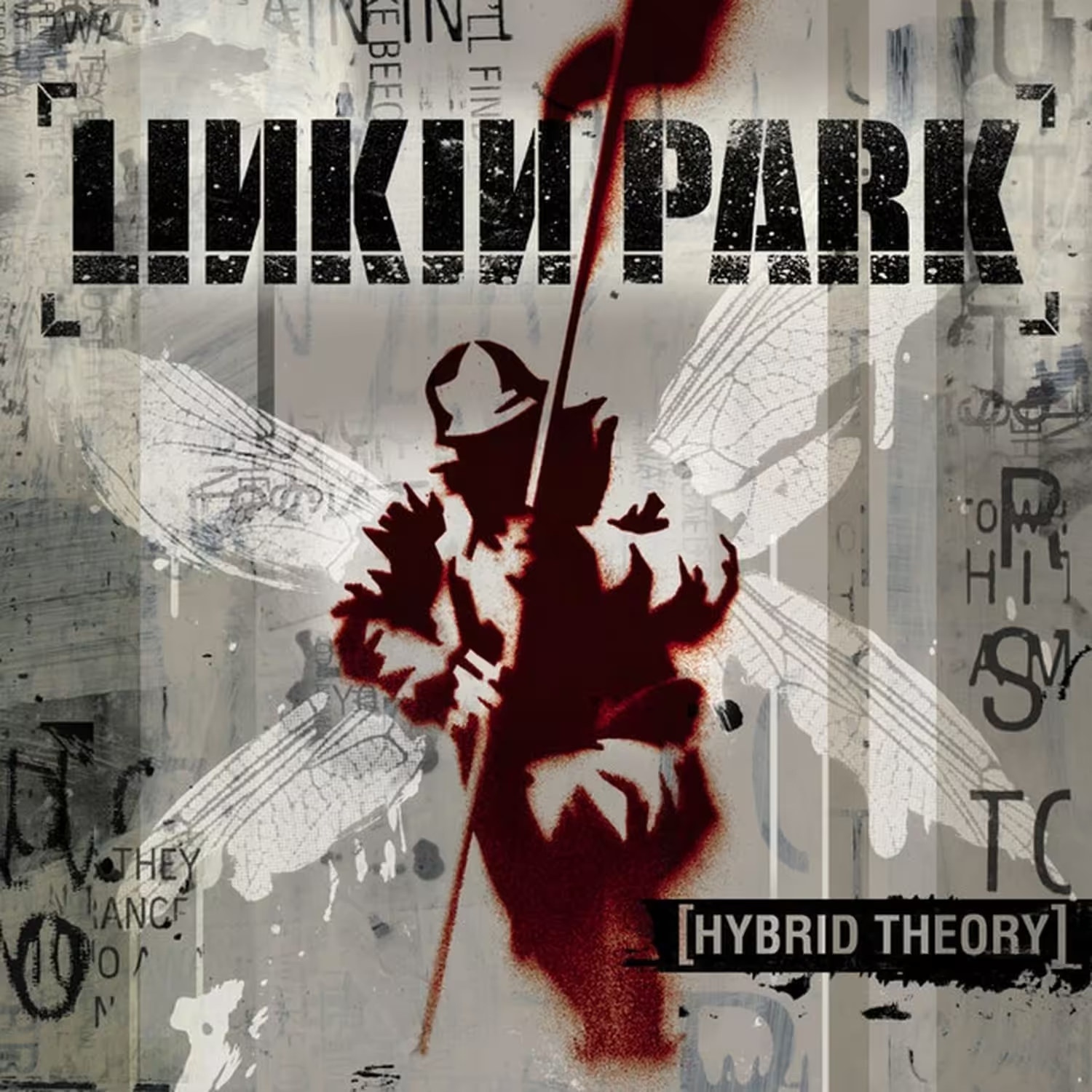
The album's visual identity is built around a single illustration: a stencilled soldier with dragonfly wings, carrying a flag. Mike Shinoda, who had worked as a graphic designer before becoming a professional musician, drew the soldier himself, and Chester Bennington explained the image as a way to describe the blending of hard and soft musical elements; the jaded look of the soldier paired with the frail dragonfly wings. The art style was openly influenced by stencil graffiti, including early work by Banksy.
The cover also features scrambled lyrics from across the album's twelve tracks in the background, with the lyrics of One Step Closer the most prominent. Frank Maddocks handled the graphic design, James Minchin III handled the photography, and Joe Hahn contributed the line-art sketches alongside Shinoda. The combination produced one of the most instantly recognisable album covers in the nu-metal era and a visual identity that the band would refine but never abandon on subsequent records.
Release and rollout
Hybrid Theory was released on 24 October 2000 in the United States by Warner Bros. Records, on the strength of radio airplay for One Step Closer that had already begun in late August. The album debuted at number sixteen on the Billboard 200 in its first week, selling 50,000 copies, and was certified Gold by the RIAA only five weeks after release. Over the next year it climbed steadily as each single hit radio and MTV in turn.
The rollout was supported by an extraordinary touring schedule. Linkin Park played 324 shows in 2001, on bills including Ozzfest, the Family Values Tour, KROQ's Almost Acoustic Christmas and the band's own self-curated Projekt Revolution tour. During this period the band's original bassist Dave Phoenix Farrell rejoined the line-up after his Tasty Snax commitments ended, becoming the touring bassist for every show from that point onwards.
Chart performance
The commercial story of Hybrid Theory is largely a 2001 story. In that calendar year the album sold 4.8 million copies in the United States, making it the best-selling album of 2001 in the country. Early in 2002 it was estimated to be still moving 100,000 copies a week. The album peaked at number two on the Billboard 200 in 2002 and reached the top ten in fifteen other countries, including number one in New Zealand and on the Australian Alternative Albums chart, number two in Australia, Austria, Germany and Italy, number three in Belgium, number four in Denmark, Finland, Hungary, Sweden, Scotland and the United Kingdom, and number five in Canada, Norway, Portugal and Switzerland.
Long-term sales were correspondingly strong. The album reached Diamond status in the United States in 2005, was certified eleven-times Platinum in 2017 and twelve-times Platinum in September 2020. As of April 2023, Billboard reported total United States units of 13.58 million equivalent album units, including 11 million in pure album sales. Worldwide totals stand at over 27 million copies sold per the band's official figures, with the most recent Wikipedia summary citing 32 million as the running estimate, making Hybrid Theory the best-selling debut album since Guns N Roses' Appetite for Destruction in 1987 and one of the best-selling albums of all time. In 2025, the Official Charts Company named it the second best-selling rock album of the twenty-first century in the United Kingdom.
Critical reception
Critical reception in 2000 and 2001 was mixed but largely positive. Kerrang! gave the album a maximum five-out-of-five and described it as one of the most important rock albums of all time in retrospective coverage. Q magazine awarded four stars and praised the band for giving angst-ridden rock an effective electronic spin. Melodic praised Don Gilmore's production and described the album as destructive and angry but always with a well-controlled melodic feeling. PopMatters' Stephanie Dickison described the band as a far more complex and talented group than the hard-rock boy bands of late.
Not every notice was positive. AllMusic's William Ruhlmann described the band as a Johnny-come-lately to an already overdone style. NME's Noel Gardner called the album a decent but uneven record in need of editing. Rolling Stone's Matt Diehl conceded the band knew its way around a hook but panned the lyrics. Robert Christgau gave the record a two-star honorable mention. In retrospective coverage, the consensus moved substantially in the band's favour. Pitchfork's Gabriel Szatan, reviewing the 2020 anniversary edition, credited the band with helping to normalise discussion of mental health within pop, rock, rap and the heavier genres.
Awards and accolades
The album's awards profile is anchored by the 2002 Grammy for Crawling, but the broader accolades sit alongside it. Hybrid Theory won the band the ECHO Awards' Best International Newcomer in 2002. Rock Sound named it the best modern classic album of the last fifteen years in its 2012 list. Loudwire ranked it tenth in its 2013 Best Hard Rock Debut Albums list and later named it the best hard-rock album of the year 2000. Kerrang! placed it at number eight in its 2014 list of the fifty best rock albums of the 2000s.
In genre-specific retrospectives the album sits even higher. Readers of Revolver voted it the greatest nu-metal album of all time in 2018, and Revolver's staff included it in its 2021 list of the twenty essential nu-metal albums. In 2025, Loudwire ranked it third on its top fifty nu-metal albums of all time list. Beyond the nu-metal lens, the album appeared in 1001 Albums You Must Hear Before You Die in 2006 and in the NARM and Rock and Roll Hall of Fame's Definitive 200 list in 2007.
Touring Hybrid Theory
The touring cycle that supported Hybrid Theory remains one of the most extensive runs of any major-label rock debut from the period. 324 shows in 2001 alone established the band as a relentless live act, while the breadth of festival bookings, from Ozzfest in the United States to the European summer-festival run, gave the album a level of stage exposure that no purely radio-driven campaign could match. The Projekt Revolution touring brand, launched in 2002, served as the band's own headlining vehicle, with Cypress Hill and Adema among the early supporting acts.
The setlist on the touring cycle leaned heavily into the four singles, with One Step Closer, Crawling, Papercut and In the End as recurring closers and encore material. The remaining standard-edition tracks rotated through the body of the set across the cycle, while Points of Authority and A Place for My Head developed reputations as live highlights well beyond their non-single status on the studio album. The band's relentless work ethic during this period is one of the recurring reference points in subsequent interviews about how Hybrid Theory's commercial success was built.
How the fans reacted
Fan reaction in late 2000 and through 2001 was the engine that turned a modestly received debut into the best-selling album of the year. The early audience was concentrated among teenagers and twenty-somethings who responded to the combination of hip-hop verses and screamed choruses, and the radio play for One Step Closer and Crawling translated quickly into demand for live tickets. The arrival of MTV's heavy rotation behind the music videos pushed the audience wider, into mainstream pop coverage that nu-metal records of the period did not usually receive.
The Linkin Park Underground fan club, established in 2001, became one of the most active major-label fan organisations of the era, and the band's habit of distributing demo material, B-sides and live cuts through the fan club generated an unusually long tail of catalogue activity around Hybrid Theory. The 2020 twentieth-anniversary edition drew explicitly on that fan-club archive, releasing material that had been circulating among the early audience for almost two decades.
Reanimation, Meteora and what came next
The immediate follow-up was not a new studio album but a remix project. Reanimation, released on 30 July 2002, took the twelve standard tracks from Hybrid Theory and reworked them with contributors from across nu-metal and underground hip-hop. Black Thought, Pharoahe Monch, Jonathan Davis, Stephen Carpenter and Aaron Lewis all appeared. The remix album debuted at number two on the Billboard 200, behind only the Bruce Springsteen album The Rising, and demonstrated that the band could extend the Hybrid Theory material across format lines without losing audience.
The proper second album, [Meteora](/posts/the-making-of-meteora-by-linkin-park/), arrived in March 2003. It applied the Hybrid Theory formula with a slightly enlarged toolkit and went on to its own multi-platinum success. From there the band's catalogue diverged steadily from the nu-metal template, with [Minutes to Midnight](/posts/the-making-of-minutes-to-midnight-by-linkin-park/) in 2007 marking the most significant pivot, followed by [A Thousand Suns](/posts/the-making-of-a-thousand-suns-by-linkin-park/) in 2010 and [Living Things](/posts/the-making-of-living-things-by-linkin-park/) in 2012.
The 20th anniversary reissue
For the twentieth anniversary, Warner Records announced a major reissue on 13 August 2020. The Hybrid Theory 20th Anniversary Edition was released on 9 October 2020 and assembled the original album, the Reanimation remix album, the Hybrid Theory EP, B-sides, demos, live tracks and remixes into a single curated package. The super deluxe edition added three DVDs, art prints and an eighty-page book, with the previously unreleased demo She Couldn't released on 13 August 2020 as the first new music. An In The End demo followed on 1 October 2020.
The reissue tracked back chart-wise as well. The 20th Anniversary Edition reached number one on the Australian Albums chart, number two in Portugal and number three in Hungary, with placements in Belgium, Croatia and the United States. The campaign was the largest legacy event of the band's catalogue history. In November 2023 Kyle Christner, the bassist who had played on the original Hybrid Theory EP, filed a lawsuit seeking compensation for material that appeared on the reissue. The parties reached an undisclosed settlement in March 2024.
Legacy and influence
The long-term legacy of Hybrid Theory sits across several registers at once. As a commercial object, it is one of the small handful of debut albums certified Diamond by the RIAA and has been part of every serious conversation about best-selling rock albums of the twenty-first century. As a stylistic statement, it became the template that countless rap-rock and nu-metal followers tried to copy across the decade that followed. As a touring record, it sustained more than three hundred shows in its first full year of release and was the platform that established Linkin Park as one of the major-label live acts of the early 2000s.
The death of Chester Bennington on 20 July 2017 brought the album back to the foreground of public discussion. Hybrid Theory re-entered the Billboard 200 at number twenty-seven and climbed back into the top ten the following week. In Australia it returned to number one seventeen years after release. In the United Kingdom it returned to its 2001 peak position. The combination of the 2017 chart response and the 2020 anniversary reissue established the album as a permanent part of the catalogue conversation in a way that few other nu-metal records have been able to match.
Things you might not know
Several details from the Hybrid Theory sessions are worth flagging for context. The band auditioned more than forty bands' worth of vocalists before settling on Chester Bennington, and his audition was carried out from Arizona by tape before he flew to Los Angeles three days later. The original 1999 demo contained nine tracks; the album cuts were drawn largely from re-recorded versions of those songs. Mike Shinoda's rap verses were rewritten significantly in the studio, while most of the choruses came through almost untouched.
Dave Phoenix Farrell does not play bass anywhere on the album despite his band-member credit. Brad Delson covered most of the bass parts in studio, with Ian Hornbeck handling Papercut, A Place for My Head and Forgotten, and Scott Koziol handling One Step Closer. The Dust Brothers contributed additional programming and sampling on With You. The original 1997 four-track demo, recorded in Mike Shinoda's bedroom under the band's original Xero name, still exists in fan-club archives, and several of its melodic and structural ideas survived the long route from Xero through Hybrid Theory the band into Hybrid Theory the album.