Sharon Arden walked into a hotel room on Sunset Boulevard in late 1979 and found Ozzy Osbourne face-down on a mattress, ringed by lager cans, three months into a methodical drinking project he had begun the morning Black Sabbath sacked him. She told him she had a guitarist for him to hear. He waved her away. She sent the guitarist anyway. The guitarist was a 22-year-old Californian called Randy Rhoads, who had walked out of his own band, Quiet Riot, only because his bass-playing best friend Dana Strum would not stop ringing him about the audition. When Rhoads arrived at the Los Angeles studio, Osbourne was still drunk in the control room and never came out. Rhoads plugged into a practice amp, warmed up with classical scales, played a couple of riffs, and was told by Strum, on his way back to the parking lot, that he had the job. He had not yet met the singer he had been hired to play for.
Eleven months later, on 12 September 1980, the record those two strangers eventually made together was released on Jet Records. Blizzard of Ozz sounded like nothing else in 1980 because almost nothing else in 1980 was being written by an English bassist with a degree in literature, a Californian guitarist who could quote Vivaldi, a Uriah Heep drummer who hit timpani, and a singer who had spent the previous decade fronting the heaviest band in the world. It went on to outsell every album Black Sabbath ever made in the United States, certified five times platinum, and reset the template for what a metal guitarist was permitted to do with a Les Paul.
| Field | Detail |
|---|---|
| Artist | Ozzy Osbourne |
| Album | Blizzard of Ozz |
| Release date | 12 September 1980 (UK), 27 March 1981 (US) |
| Label | Jet |
| Producers | Ozzy Osbourne, Randy Rhoads, Bob Daisley, Lee Kerslake (Max Norman uncredited) |
| Studios | Ridge Farm Studio, Rusper, West Sussex (recording); Monnow Valley Studio, Wales (writing); Clearwell Castle, Gloucestershire (rehearsals) |
| Recorded | 22 March to 19 April 1980 |
| Genre | Heavy metal, hard rock, neoclassical metal |
| Tracks | 9 |
| Runtime | 39:31 |
| UK Albums Chart peak | 7 |
| Billboard 200 peak | 21 |
| Canada (RPM) | 8 |
| Certifications | 5x Platinum (US, RIAA 2019); Silver 1981 then Gold 2011 reissue (UK, BPI); Platinum (Canada); Gold (Australia) |
| Estimated sales | Over 6 million worldwide |
| Key singles | "Crazy Train" (29 August 1980), "Mr. Crowley" (1980 live UK, 1981 studio US) |
Ozzy after Sabbath: the 1979 sacking
By the spring of 1979, Black Sabbath had been a band for eleven years and Ozzy Osbourne had been an alcoholic for most of them. The sessions for what would become Never Say Die! the previous summer had degenerated into long stretches of Tony Iommi waiting at the desk while Osbourne, slumped in the live room, failed to remember the lyrics he had written the night before. When the band reconvened in Los Angeles in early 1979 to begin work on a successor, Iommi told Osbourne he was out. The official reason was drug and alcohol abuse. The unofficial reason was that nobody else in Sabbath could write a song while Osbourne was in the studio.
Osbourne moved into a suite at the Le Parc hotel in West Hollywood and, by his own admission in I Am Ozzy, spent the next three months trying to drink himself out of the music industry. Sabbath replaced him with Ronnie James Dio and went on to record Heaven and Hell, the album that, far from killing the brand, gave it a second life. Osbourne, by contrast, was contracted to Jet Records but had no band, no songs, and no obvious plan beyond ordering room service.
Sharon Arden's intervention
Sharon Arden was 26, the daughter of Jet boss Don Arden, and had spent her teens around the office watching her father bully the British rock business into giving him a slice of it. She was not yet Osbourne's manager and not yet his fiancee, but she had been delegated by her father to keep an eye on the company's most expensive asset. Sharon flew to Los Angeles, found Osbourne in the state described above, and made two decisions on his behalf. The first was that he was going to make a solo record. The second was that he was going to do it with a Californian guitarist a Jet contact had mentioned to her in passing.
Years later Sharon would describe the period of making Blizzard of Ozz as one of the best stretches of her life, even though, as Bob Daisley has been careful to note, she was actually in Los Angeles during the recording itself and not present at Ridge Farm. The intervention came earlier. It was Sharon, more than anyone else, who got Osbourne out of the hotel and on a plane back to England with a contract in his pocket and a guitarist's phone number.
Finding Randy Rhoads
The guitarist's name kept being mentioned because Dana Strum would not stop saying it. Strum, later the bassist in Slaughter, was a friend of Rhoads from the Los Angeles club circuit and had heard Osbourne was looking. He rang Rhoads relentlessly. Rhoads, by then disillusioned with Quiet Riot's failure to land an American deal despite their albums being released in Japan, was reluctant. Rudy Sarzo, the band's bassist, recalled in his book Off the Rails that Rhoads finally agreed to the audition mostly to get Strum off the phone.
The audition took place at a Los Angeles studio the day before Osbourne was due to fly back to England. Rhoads turned up with a 1974 Gibson Les Paul Custom and a small practice amp and began warming up alone, because Osbourne, drunk, never came out of the control room. Rhoads played for less than ten minutes. Strum emerged from the control room and told him the job was his. Rhoads went home and told Sarzo he had never actually met the singer. The two of them met properly the next night at Osbourne's hotel.
"He played this fucking solo and I'm like, am I that fucking stoned or am I hallucinating or what the fuck is this? I gave him the job there and then."
Ozzy Osbourne, I Am Ozzy, 2010
Rhoads flew to England in early November 1979 and was promptly turned around by immigration at Heathrow because he had no work permit. He spent a night in a holding cell and was put back on a plane to Los Angeles the next morning. A Jet representative was supposed to clear it up; the Jet representative never showed up. Rhoads finally arrived properly on 27 November 1979 and was driven straight to Bullrush Cottage in Staffordshire, Osbourne's house, where he lived for the next few weeks with Osbourne, Osbourne's first wife Thelma, and the couple's two young children, while a rehearsal room was rigged in the back.
Bob Daisley and Lee Kerslake
The rhythm section was assembled in pubs. A Jet employee called Arthur Sharpe introduced Osbourne to Bob Daisley, an Australian bassist who had played with Chicken Shack, Widowmaker and, most recently, Rainbow under Ritchie Blackmore. Daisley had also, crucially, written lyrics for other people, which Rhoads could play guitar and Osbourne could shout but neither of them showed any interest in doing. The pair hit it off. Daisley joined the project and immediately became the project's writer.
An English guitarist had been working with Osbourne and Daisley in the very early days; he was quietly let go once Daisley convinced Osbourne to fly Rhoads back over. Osbourne's management had wanted to keep the lineup all-British, but Don Arden eventually relented. The drum stool took longer to settle. Ozzy's friend Barry Scrannage stood in while songs were sketched at Monnow Valley Studio in Wales. Demos were then cut in Birmingham with ex-Lone Star drummer Dixie Lee. "He wasn't the final piece of the puzzle," Daisley later said. After auditioning several others, the band settled on Lee Kerslake, the recently-departed drummer from Uriah Heep, whose hard, snare-forward style and willingness to add tubular bells, timpani and vibraslap to a session made him a more interesting drummer than most British metal had on offer in 1980.
Kerslake joined late enough that the songs were already largely written. The band booked Clearwell Castle in Gloucestershire for six days of rehearsal so he could learn them, then drove down to Ridge Farm in late March 1980 to record.
The Blizzard of Ozz band, not the solo album
None of the four men involved thought they were making an Ozzy Osbourne solo record. The project was called The Blizzard of Ozz and was meant to be a band. The "Crazy Train" single, released a couple of weeks before the album, has the band name in larger print than Osbourne's; its back cover refers to a forthcoming Jet album called Ozzy Osbourne / Blizzard of Ozz Vol. 1. When the band played the Reading Festival on 23 August 1980 they were billed in the programme as "Ossie Osborne's New Band". When the album itself shipped three weeks later, the typography had quietly inverted. Osbourne's name was huge and the band's name was the title.
"When the album was released the words 'Ozzy Osbourne' were in bigger print than 'The Blizzard of Ozz' which made it look like an Ozzy Osbourne album called The Blizzard of Ozz. Randy was never one to rock the boat. When Lee and I were ousted, Randy had no allies and the act became 'Ozzy Osbourne' and no longer a band."
Bob Daisley, bobdaisley.com, 2014
The flip from band to solo artist was, by Daisley's account and the entertainment attorney Steven Machat's account in his 2011 memoir Gods, Gangsters and Honour, a decision driven by Sharon and her father about creative ownership and royalties. The musicians who actually wrote the album would spend the next quarter-century trying to be paid for it.
Ridge Farm Studio
Ridge Farm sits down a long lane outside the village of Rusper, on the West Sussex side of the Surrey border, in a converted seventeenth-century farmhouse with a residential block, a stone-walled live room and a long lawn that runs down to a swimming pool. It had been built as a residential studio in the mid 1970s by Frank Andrews and had already hosted Queen, Bad Company, Roxy Music and the Tubes by the time Osbourne's people booked it. The point of a residential studio in 1980 was that the band ate, slept and drank on site. The point of this residential studio was that it was deep enough in the country that the singer could not easily get to a pub.
The band moved in on or around 22 March 1980 and worked through to 19 April. Osbourne's then-wife Thelma was present for much of the session. Sharon was not. The room sound on Blizzard of Ozz, that big, slightly dry crack on Kerslake's snare and the bell-like decay on the timpani in "Revelation (Mother Earth)", is the sound of Ridge Farm's live room.
Recording, March to April 1980
Sessions began with Chris Tsangarides in the producer's chair and Max Norman as house engineer. Tsangarides had recently produced Judas Priest and was the obvious choice on paper for a heavy English record. On the floor it did not work. The band were unhappy with his approach, and within days Tsangarides was out. Norman, who had been at the desk anyway, stepped up to produce as well as engineer, and stayed in that role for the next four Osbourne studio albums and one of the most loved live records in metal, 1987's Tribute. He took no production credit on Blizzard of Ozz; the sleeve still says only "Produced by Ozzy Osbourne, Randy Rhoads, Bob Daisley and Lee Kerslake."
"Daisley and Kerslake made considerable songwriting contributions during their time in the band. The Osbourne camp might want to dispute that now."
Max Norman, KNAC interview, 2014
Rhoads's signature studio trick on the album, double-tracking his solos note for note, came out of these sessions. Norman would record one pass, then ask Rhoads to play the entire solo again identically, and layer the two takes hard against each other. The tiny imperfections in alignment are what give the "Crazy Train" and "Mr. Crowley" solos their slightly impossible width. The amps were 100-watt Marshall 1959 Super Lead heads through 4x12 cabinets loaded with Altec speakers. The Les Paul was a 1974 Custom; the polka-dot Karl Sandoval V also made an appearance. The pedalboard was almost laughably minimal. The only effect Rhoads relied on, by his own account, was an MXR Distortion+.
Don Airey and the uncredited keyboards
Don Airey, a journeyman keyboard player who had worked with Cozy Powell and Rainbow, was brought in late in the sessions to add textures. He stayed for four years. His contributions to Blizzard of Ozz ended up larger than the sleeve admits: the church-organ intro to "Mr. Crowley", parts of the architecture of "Revelation (Mother Earth)", and the harpsichord-like figures that thread through the back half of the record are all his.
"The band said they wanted an intro. I threw them all out and said, 'Go away for half an hour.' So it was just me and Max Norman. Ozzy came back and listened to it and said, 'It's like you plugged into my head.'"
Don Airey, interview with Ralph Viera, 2004
Airey declined a songwriting credit and has been generous about it ever since. Osbourne, he has said, was broke at the time and taking a real risk putting a band together; Airey was a session player on a fee and he took the fee. He was also, he points out, then employed for the next four years.
Personnel and credits
| Role | Player | Notes |
|---|---|---|
| Core band (1980 original recording) | ||
| Lead vocals | Ozzy Osbourne | His first studio recording outside Black Sabbath in twelve years |
| Guitar | Randy Rhoads | 1974 Gibson Les Paul Custom, Karl Sandoval Polka Dot V, Marshall 1959 head, MXR Distortion+ |
| Bass guitar, lyrics | Bob Daisley | Ex-Rainbow; wrote almost all the lyrics on the album |
| Drums, tubular bells, timpani, vibraslap | Lee Kerslake | Ex-Uriah Heep; the vibraslap is the rattle on the intro to "Crazy Train" |
| Session and uncredited | ||
| Keyboards | Don Airey | Wrote the "Mr. Crowley" intro and parts of "Revelation (Mother Earth)"; declined a writing credit |
| Production and engineering | Max Norman | Uncredited co-producer and engineer after Chris Tsangarides was fired early in sessions |
| Original producer (replaced) | Chris Tsangarides | Hired and dismissed within days; receives no credit on the sleeve |
| Artwork | ||
| Sleeve design | Steve "Krusher" Joule | Jet Records in-house art director; the cover was shot in a London studio |
| 2002 reissue (overdubs, since reversed) | ||
| Bass | Robert Trujillo | Replaced Daisley's parts; removed again for the 2011 reissue |
| Drums, percussion, timpani, gong | Mike Bordin | Replaced Kerslake's parts; removed again for the 2011 reissue |
| Tubular bells | Danny Saber | 2002 only |
| Additional backing vocals | Mark Lennon, John Shanks | "Steal Away (The Night)", 2002 only |
The songwriting credit dispute
The original UK first pressings of Blizzard of Ozz credit every song except "Dee" and "No Bone Movies" to Osbourne, Rhoads and Daisley. Daisley has always maintained that he wrote 99 percent of the lyrics. Lee Kerslake earned his only writing credit on "No Bone Movies", a track Daisley wrote to express his dislike of pornography and which was added to the album in part so Kerslake had something to be credited on, all the other material having been written before he joined.
By late 1981, after the second album Diary of a Madman had been recorded, Sharon Osbourne fired both Daisley and Kerslake. Diary of a Madman shipped in October 1981 with their parts on the record but with Rudy Sarzo and Tommy Aldridge pictured in their places. Daisley and Kerslake sued in 1986 and eventually won songwriting credits on both albums. In 2002, in what Bob Daisley has called the most cynical move of his career, Sharon had Robert Trujillo and Mike Bordin re-record the bass and drums on Blizzard of Ozz and Diary of a Madman and reissued the albums without telling fans. A sticker explaining the substitution was added only later, after the outcry.
Osbourne, in his autobiography, said he had nothing to do with the decision and that Sharon "just snapped" and had it done. The lawsuit Daisley and Kerslake filed over the 2002 reissue was dismissed in Los Angeles in 2003, a dismissal upheld by the Ninth Circuit. In 2011, for the 30th anniversary, the original 1980 bass and drum tracks were quietly restored. Every subsequent reissue, including the 2020 40th-anniversary expanded edition pictured at the top of this page, uses Daisley and Kerslake's parts.
The songs
| # | Title | Writers | Length | Notes |
|---|---|---|---|---|
| 1 | I Don't Know | Osbourne, Rhoads, Daisley | 5:16 | Osbourne's reply to fans asking for life advice |
| 2 | Crazy Train | Osbourne, Rhoads, Daisley | 4:52 | F-sharp minor; lead single; Cold War lyrics |
| 3 | Goodbye to Romance | Osbourne, Rhoads, Daisley | 5:36 | First song written; Osbourne's farewell to Black Sabbath |
| 4 | Dee | Rhoads | 0:50 | Solo classical-guitar instrumental for Rhoads's mother Delores |
| 5 | Suicide Solution | Osbourne, Rhoads, Daisley | 4:20 | Lyrics by Daisley about Osbourne's drinking; riff from Rhoads's Quiet Riot song "Force of Habit" |
| 6 | Mr. Crowley | Osbourne, Rhoads, Daisley | 4:57 | D minor; Airey's organ intro; second single |
| 7 | No Bone Movies | Osbourne, Rhoads, Daisley, Kerslake | 3:58 | Daisley's lyric about pornography; added late so Kerslake had a credit |
| 8 | Revelation (Mother Earth) | Osbourne, Rhoads, Daisley | 6:09 | Climate-change parable using biblical imagery |
| 9 | Steal Away (The Night) | Osbourne, Rhoads, Daisley | 3:28 | Closing uptempo rocker; chosen to end the record the way Sabbath ended sets with "Paranoid" |
"Goodbye to Romance" was the first song written for the record, and Osbourne has said openly that the lyric was his goodbye to Black Sabbath. Forced to choose a single in late 1980, the band briefly remixed it for that purpose. Jet's response, the next morning, was to demand a brand-new song instead. Daisley, Kerslake and Rhoads quickly wrote a track called "You Said It All" at soundcheck, Kerslake performing the guide vocal while a drunken Osbourne slept under the drum riser. The song was never properly recorded, though a live version appeared on the Mr Crowley Live EP later in 1980.
"Revelation (Mother Earth)" is the strangest piece on the record, a six-minute song-cycle with biblical imagery used to argue against humanity's treatment of the planet. The melodic and harmonic frame Don Airey built around it gives the song its hymn-like middle section. "Steal Away (The Night)" closes the record because, as Osbourne said in the 2011 anniversary interview, he liked the idea of finishing an album the way Sabbath finished gigs, with the loudest, fastest thing they had.
Crazy Train, in F-sharp minor
The "Crazy Train" riff sits in F-sharp minor, an unusual key for a 1980 metal single and a Rhoads-specific choice. Osbourne has said since that Rhoads made a rule early on never to write two consecutive songs in the same key, a discipline that came directly from his classical lessons at his mother Delores's music school in North Hollywood. The chord progression Daisley wrote for Rhoads to solo over uses the natural minor scale across its full range, which is why the solo sounds, as AllMusic's Steve Huey put it, "a classic, making use of the full minor scale in a way not seen since Ritchie Blackmore's heyday with Deep Purple."
The title, and the song's most famous noise, both came from Daisley. Rhoads had been jamming over a chugging effect pedal at rehearsals; Daisley said it sounded like a crazy train, and the phrase stuck. Daisley wrote the lyric about the Cold War, about Mutually Assured Destruction and the "heirs of a cold war" his generation had inherited. The "All aboard!" that opens the studio version, the line that has launched every American sports event the song has ever been played at, was originally voiced by Daisley as a guide and redubbed by Osbourne for the final take. The rattle in the intro is Kerslake on vibraslap.
"Crazy Train" reached number 49 on the UK singles chart on first release in 1980 and bubbled under the Hot 100 at number 106 in the United States. It has since become the most-played live song in Osbourne's catalogue, with more than 1,150 performances logged by 2021 according to Metal Hammer, and it eventually entered the Billboard Hot 100 for the first time in August 2025 in the week following Osbourne's death, peaking at number 39.
Mr. Crowley, written at the kitchen table
"Mr. Crowley" was written at Ridge Farm after Osbourne picked up Aleister Crowley's The Diary of a Drug Fiend, which he had been working through on the tour bus, and the band found a deck of Crowley-designed tarot cards lying around the studio. Daisley wrote the lyric as a question to Crowley rather than a hymn to him, an interrogation of the darkness rather than a celebration of it. The line "polemically sent" near the end refers to Crowley's habit of signing books "Polemically yours, Aleister Crowley". The line "Won't you ride my white horse" has launched a thousand pub debates about whether it refers to opium, heroin or the white horse of the Book of Revelation; Daisley, in his 2013 book For Facts Sake, says the obvious drug reading is wrong.
The musical structure is Rhoads's. The song is in D minor and the first solo, the one Rhoads later said was his favourite of any he had recorded with Osbourne, was nailed in two takes after he had spent hours getting nowhere and Osbourne told him to stop thinking and go and play what he felt. The ceremonial keyboard intro is Don Airey on a Yamaha CP-30 voiced through a Leslie cabinet, played alone after he had asked the rest of the band to leave for thirty minutes.
Suicide Solution and the McCollum case
"Suicide Solution" is a Daisley lyric built around a riff Rhoads brought over from a Quiet Riot song called "Force of Habit". Osbourne has long said the song was about the alcohol-related death of his friend Bon Scott, the AC/DC singer, in February 1980; Daisley has said since 2002 that he wrote the lyric with Osbourne's own drinking in mind. The line "wine is fine but whiskey's quicker" is, on either reading, a warning rather than an instruction.
On 27 October 1984, John Daniel McCollum, a 19-year-old from Indio, California, shot himself in the head. His parents filed a wrongful-death suit on 1 November 1985 against Osbourne and CBS Records, alleging that the song contained a subliminal line, "Why try? Get the gun and shoot!", that had encouraged their son's act. Osbourne and Daisley insisted the disputed line was actually "Get the flaps out", flaps being British vulgar slang. The case was dismissed on First Amendment grounds. Two further suits, by the parents of Michael Jeffery Waller and Harold Matthew Hamilton in 1986 and 1988, were similarly dismissed; the Supreme Court let the lower-court rulings stand in October 1992. Osbourne's response, in a later Mojo interview, was characteristically dry: "It'd be a pretty bad career move for me to write a song saying 'Grab a gun and kill yourself.' I wouldn't have many fans left."
Album artwork and packaging
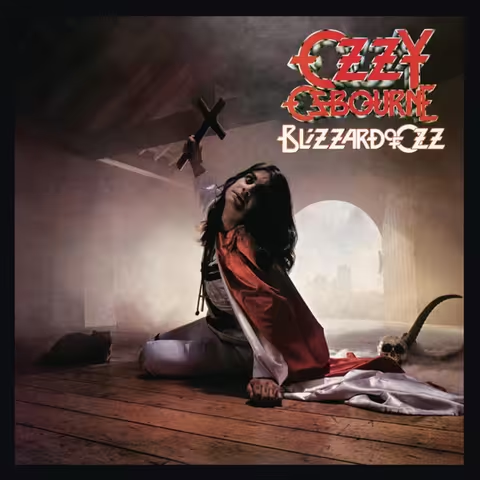
The sleeve was designed by Jet Records in-house art director Steve "Krusher" Joule and shows Osbourne in a black robe, dramatically lit against a stormy backdrop, holding a candle and a crucifix. The image was shot in a London studio rather than on location and consciously echoed the gothic-horror posters of the late 1960s. The back cover lists a four-piece band; the production line credits four producers; nowhere on the original LP does the word "solo" appear.
The first UK pressings have small printing variations around the song-writing credits that collectors still hunt for. The 2002 reissue carries a Sharon-era cover sticker about the re-recorded parts that was applied months after release. The 40th-anniversary expanded edition, released on 18 September 2020, restores the original layout in a tip-on gatefold and adds seven live tracks from the 1980 tour.
Singles, B-sides and music videos
| Single | Released | B-side | Chart peaks | Notes |
|---|---|---|---|---|
| "Crazy Train" | 29 August 1980 (UK); February 1981 (US) | "You Lookin' at Me Lookin' at You" | UK 49; US Mainstream Rock 9; US Bubbling Under 6 | The B-side is the studio outtake that never made the LP |
| "Mr. Crowley" (live) | November 1980 (UK) | "You Said It All" (live) | UK Rock and Metal chart | Recorded at the Mayflower Theatre, Southampton, 2 October 1980 |
| "Mr. Crowley" (studio) | 1981 (US) | "No Bone Movies" | US gold (RIAA) | EP also includes a live "Suicide Solution" |
The 1980 live "Mr. Crowley" was the only single in the run with a non-LP B-side proper, "You Said It All", the song the band wrote at soundcheck after Jet asked for new material. The studio "Crazy Train" was not given a music video on first release. The famous "Crazy Train" promo footage seen on MTV later, with the polka-dot Flying V in shot, is from a 28 April 1981 broadcast filmed at Channel 31 TV Studios in Rochester, New York, on the After Hours programme; it features Rhoads with Sarzo and Aldridge already in the live lineup. In 2020, for the 40th anniversary, the Osbourne camp commissioned a new animated music video for "Crazy Train" in which an illustrated Rhoads ascends to heaven after the solo.
Chart performance
In the United Kingdom Blizzard of Ozz entered the Official Albums Chart on 14 September 1980 at number 7, Osbourne's first solo chart appearance and the highest he would place on the UK chart until No More Tears hit number 17 in 1991. The BPI certified the original release Silver (60,000 shipped) in August 1981, and the 2011 30th-anniversary reissue eventually picked up a separate Gold (100,000) certification in 2013.
In the United States, where the album shipped six months later, it climbed to number 21 on the Billboard 200 in mid 1981 and stayed on the chart for over 50 weeks. The RIAA certified it Platinum in 1981, double Platinum in 1986, quadruple Platinum in 1997 and 5x Platinum (five million units) in October 2019. It is, by a wide margin, the best-selling album of Osbourne's solo career. Canada was the strongest international market outside the US and UK, with the album peaking at number 8 on the RPM chart and Music Canada certifying it Platinum (100,000).
Reception
Contemporary reviews in 1980 and 1981 were largely positive but cautious. The British rock press treated the album as proof that Osbourne could function outside Sabbath, even as it tried to work out who the Californian guitarist on the sleeve was. The American press, given six months more to think about it, was warmer; Rolling Stone's eventual four-star reassessment came later. AllMusic's retrospective review, by Steve Huey, calls the album "a masterpiece of neo-classical metal that, along with Van Halen's first album, became a cornerstone of '80s metal guitar" and concludes that it "deservedly made Ozzy a star, and set new standards for musical virtuosity in the realm of heavy metal." Rolling Stone ranked it ninth on their 2017 list of the 100 Greatest Metal Albums of All Time. Guitar World readers placed it thirteenth on a 100 Greatest Guitar Albums poll.
Touring, 1980 to 1981
The Blizzard of Ozz tour opened in the UK in mid September 1980, with the band billed under Osbourne's name. Highlights of the British run included a stop at the Apollo in Manchester on 12 September, a Cardiff date captured in the contemporaneous press photograph reproduced on the Wikipedia article, and an October pass through the Mayflower Theatre, Southampton, on the 2nd that yielded the live "Mr. Crowley" single. The band crossed to the United States in spring 1981 in support of the long-delayed US release, and the second-album tour that followed in early 1982 (officially the Diary of a Madman tour) ran with a substantially different lineup, Sarzo replacing Daisley and Aldridge replacing Kerslake.
- UK theatre tour, September to November 1980, with the original four-piece
- European stop-off dates in early 1981 supporting "Mr. Crowley" as a continental single
- US arena run from spring 1981, with Daisley and Kerslake on stage before they were fired
- Diary of a Madman tour, North America, late 1981 into 1982, with the revised lineup and the live shows that would later be released as Tribute
The most-told anecdote from the period belongs to the Diary tour rather than the Blizzard tour proper. On 20 January 1982, at the Veterans Memorial Auditorium in Des Moines, Iowa, a fan threw a bat onto the stage. Osbourne, assuming it was a rubber prop, picked it up and bit its head off. It was real. He spent the rest of the night being treated for rabies. The bat had a busier afterlife than most: it was central to building the mythology Sharon would spend the next three decades monetising.
Randy Rhoads, 19 March 1982
Rhoads played his last show at the Knoxville Civic Coliseum on Thursday 18 March 1982. The next morning, on the way to a festival in Orlando, the tour bus stopped at Flying Baron Estates in Leesburg, Florida, to fix a faulty air-conditioning unit. On the property was an airstrip and a single-engine Beechcraft Bonanza F35. The bus driver, Andrew Aycock, who held a private pilot's licence and was, the post-crash toxicology would show, on cocaine, took Don Airey and tour manager Jake Duncan up first; then he took Rhoads and tour hairdresser Rachel Youngblood. Rhoads, who was afraid of flying, only went up because he wanted to take photographs of the bus from the air.
Aycock made two close low passes to wake drummer Tommy Aldridge, who was asleep in the bus. On the third pass, the plane's wing clipped the bus. The aircraft cartwheeled into a pine tree and exploded into the garage of a neighbouring house. Rhoads was 25. The plan to record a live album of Black Sabbath covers that had been put forward by Osbourne's management a few weeks earlier, and which Rhoads had refused to participate in, was put on hold and then quietly executed in November 1982 as Speak of the Devil. Sharon Osbourne told investigators Aycock had been the pilot in a fatal helicopter crash six years earlier in the United Arab Emirates and that she had known about it before the tour without telling anyone.
"I was already sitting at the bar when Bob Daisley came into the bar. I turned and looked at Bob and said, 'Fuck, you have gone all white. What is wrong?' Bob said, 'Lee, there was a plane crash this morning and Randy was in it, and he is dead.' That was it. Bob and me were crying our eyes out over him, because we loved him. He was such a lovely guy."
Lee Kerslake, interviewed for bobdaisley.com, 2012
Reissues, remasters and anniversaries
The album's reissue history is unusually contentious for a record that has sold five million copies, because of the 2002 reissue described above. The headline events:
- 1995 remaster: a straight digital remaster on Epic that preserves the original Daisley and Kerslake performances.
- 2002 reissue: Sharon Osbourne commissions Robert Trujillo and Mike Bordin to re-record bass and drums; the album ships without an explanatory sticker. Fan outcry forces a sticker on later pressings.
- 2011 30th anniversary: The original Daisley/Kerslake performances are restored. Three bonus tracks added: "You, Looking at Me, Looking at You", a 2010 vocal-and-guitar mix of "Goodbye to Romance", and a Rhoads in-studio outtake titled "RR".
- 2011 30th Anniversary Deluxe Box Set: packages Blizzard and Diary of a Madman together on 180-gram vinyl with the Thirty Years After the Blizzard DVD, 70 minutes of rare live performances, a replica cross and a two-sided poster.
- 2020 40th Anniversary Expanded Edition: released 18 September 2020 with seven live recordings from the 1980 tour and one additional live track on top of the previous bonuses. The expanded edition cover, with the "-1" suffix in our file naming, is the artwork at the top of this page.
Covers, samples and tributes
"Crazy Train" alone has been covered, parodied and sampled almost continuously since the late 1990s. Pat Boone covered it in lounge-singer style for his 1997 In a Metal Mood album. Trick Daddy's 2004 single "Let's Go", featuring Twista and Lil Jon, sampled the song's main riff and reached number 7 on the Billboard Hot 100. Hollywood Undead interpolated it on "Undead" in 2009. The MTV reality show The Osbournes used a remade Lewis Lamedica version as its theme. The song has been used as the walk-out music for Aston Villa FC, Osbourne's home-town club in Birmingham, and as the in-stadium entrance song for the New England Patriots.
"Mr. Crowley" has been a touchstone for the entire neoclassical guitar movement that followed Rhoads's death. Yngwie Malmsteen, John Petrucci, Dimebag Darrell of Pantera, Zakk Wylde, Alexi Laiho of Children of Bodom and Mick Thomson of Slipknot have all cited Rhoads's playing on the song as foundational. Tom Morello of Rage Against the Machine, inducting Rhoads into the Rock and Roll Hall of Fame in October 2021, called him "the Robert Johnson of metal", a tiny catalogue of immense influence.
Legacy and influence
Blizzard of Ozz did three things to heavy music. It proved a singer the British music press had written off in 1979 could come back the next year with a record harder, faster and weirder than the band that had fired him. It opened the door to a generation of American guitarists who could blend modal classical phrasing with Marshall-stack volume, and who would later be filed under neoclassical metal. And it built the commercial template Sharon Osbourne would scale into Ozzfest, The Osbournes television show, and the four-decade brand that took Osbourne to a solo induction into the Rock and Roll Hall of Fame in 2024.
The Karl Sandoval Polka Dot V and the white Jackson Concorde Rhoads commissioned just before his death became the templates for the Jackson Rhoads line of guitars, now in its fifth decade of production. Marshall built a signature 1959RR amp head in his honour at NAMM 2008. Gibson built a 1974 Les Paul Custom signature in 2010. Rhoads was named the 21st-greatest guitarist of all time by Rolling Stone in 2023. Osbourne died on 22 July 2025 at the age of 76, seventeen days after performing "Crazy Train" from a chair at the Back to the Beginning concert in Birmingham. The song re-entered the Billboard Hot 100 the following week.
Things you might not know about Blizzard of Ozz
| Fact | Detail |
|---|---|
| The audition Ozzy slept through | Randy Rhoads never met Osbourne at his September 1979 audition. Osbourne stayed drunk in the control room throughout; bassist Dana Strum told Rhoads he had the job on the way out. |
| The night in a Heathrow cell | Rhoads flew to England in early November 1979 with no work permit, was held overnight at Heathrow and put back on a plane to LA. He finally arrived properly on 27 November 1979. |
| The drum stool went through three people | Ozzy's friend Barry Scrannage filled in at the writing sessions at Monnow Valley; ex-Lone Star drummer Dixie Lee played the Birmingham demos; only then did the band settle on Lee Kerslake of Uriah Heep. |
| Producer fired in the first week | Chris Tsangarides was originally hired to produce. He was fired within days and replaced by engineer Max Norman, who took no production credit on the sleeve but produced every subsequent Osbourne album up to The Ultimate Sin. |
| Don Airey wrote the Mr. Crowley intro alone | Airey cleared the studio for half an hour and wrote the church-organ introduction by himself. He took a session fee and no writing credit. He stayed in the touring band for four years. |
| The vibraslap on Crazy Train | The rattling sound that opens "Crazy Train" is Lee Kerslake on vibraslap, the same instrument heard on Jimi Hendrix's "All Along the Watchtower". |
| "All aboard!" was originally Bob Daisley | The famous opening shout on "Crazy Train" was first recorded by Bob Daisley as a guide vocal. Osbourne re-cut it for the master. |
| The Reading Festival billing | When the band played the Reading Festival on 23 August 1980, three weeks before the album shipped, they were billed in the programme as "Ossie Osborne's New Band". |
| Crazy Train solo was tracked twice | Rhoads played the entire "Crazy Train" solo note for note, twice. Max Norman layered the two takes together, which is why it sounds so wide on record. |
| The pedalboard was a single box | Rhoads's only signature pedal on the album was an MXR Distortion+, run into a 100-watt Marshall 1959 head through a 4x12 cabinet loaded with Altec 417-8H speakers. |
| Dee was for Delores | The 49-second classical guitar piece is named for Randy Rhoads's mother Delores, a UCLA music graduate who ran the North Hollywood music school where Rhoads grew up teaching guitar. |
| The lyrics were almost all Daisley | Bob Daisley wrote nearly every word on the album, including "Crazy Train", "Mr. Crowley" and "Suicide Solution". Osbourne is credited as a co-writer on every track he sings on. |
| Suicide Solution riff was a Quiet Riot reject | The main riff to "Suicide Solution" was based on a riff Rhoads had used in the Quiet Riot song "Force of Habit", which had only been released in Japan. |
| Sharon was not at Ridge Farm | Despite her later claims about the sessions, Sharon Arden was in Los Angeles during recording and not yet involved with the band. Ozzy's first wife Thelma was present for much of it. |
| An egg for breakfast | The garbled voice at the end of "Crazy Train" is a Ridge Farm engineer saying "An egg" through an oscillator, in answer to Ozzy asking him what he had eaten that morning. |
Final thoughts
What makes Blizzard of Ozz the foundational document it is, more than four decades on, is that it sounds like four people genuinely trying to invent a different kind of heavy band in a small Sussex farmhouse, on a budget, with a singer they were not sure could still sing and a guitarist most of England had never heard of. Bob Daisley's lyrics gave Osbourne better words than Sabbath had given him in years. Lee Kerslake's drumming made the songs swing instead of trudge. Don Airey added textures nobody in metal in 1980 was bothering with. And Randy Rhoads, who would be dead inside eighteen months, played the entire record like he was trying to graduate from a music school nobody had built yet.
The post-album lawsuits, the sackings, the 2002 redub and the eventual restoration are all part of the story, and so is the fact that the sleeve still does not credit Max Norman as producer or Don Airey as a writer. The record itself, in its 2011-or-later configuration, is intact: the same nine songs, in the same running order, played by the same four men who walked out of Ridge Farm in April 1980 thinking they had made a band album. The Riffology podcast covers the album, its sessions and its long afterlife in full, and is available on all major podcast platforms.
Comments