By the spring of 1994, the second-best-selling album in America was a record made by four men from Garden Grove for twenty thousand dollars in a North Hollywood studio they could only afford during the small hours. The Offspring's Smash had no major-label muscle behind it, no MTV campaign at launch, no glossy press junket, and a sleeve depicting a half-melted skeleton on a black background. By the time the chart dust settled it had outsold every independent album ever pressed, in any genre, by any artist, on any label, and the figure it set, more than 11 million copies worldwide, has not been bettered since.
What follows is the long version of how a band who could barely fill a club in Orange County managed to drag a 14-track punk record onto the Billboard 200 at number four, and in the process turned Brett Gurewitz's living-room imprint into the most commercially significant indie label of the decade.
The state of punk on the eve of 1994
To understand why Smash hit as hard as it did, it helps to remember what American rock radio sounded like in the months before it arrived. Grunge had completed its takeover. Nirvana's Nevermind had already done the heavy lifting of breaking guitar music back into the mainstream three years earlier, and by early 1994 the centre of the rock universe was firmly in the Pacific Northwest. Soundgarden's Superunknown landed in March and Nine Inch Nails' The Downward Spiral arrived a fortnight before that, both records sitting at the bleak, expensively produced end of the rock spectrum.
Punk, by contrast, was still a regional concern. The southern Californian scene that had produced Black Flag, the Descendents and Bad Religion was alive but commercially invisible. Skate parks, fanzines and college radio carried the genre between coasts, and a handful of labels, chief among them Epitaph in Los Angeles, Lookout in Berkeley and Fat Wreck Chords in San Francisco, formed the entire commercial infrastructure. The notion that an album of melodic three-chord hardcore, recorded on the cheap and released through a label run out of Brett Gurewitz's house, could reasonably hope to cross the platinum threshold was, in late 1993, simply not on the table.
The previous year had seen Bad Religion's Recipe for Hate make a small dent on commercial radio, enough to earn the band a deal with Atlantic for the follow-up. That follow-up, Stranger than Fiction, was being readied for September 1994. Green Day, meanwhile, were finishing Dookie at Fantasy Studios in Berkeley with Rob Cavallo, a record that would arrive on Reprise on 1 February 1994 and start its own assault on MTV by mid-spring. The market for punk was about to be tested in a way it had never been tested before, and by mid-year three records would be running in parallel: Dookie, Stranger than Fiction and Smash. Only one of them was on an independent label.
The road to Epitaph
The Offspring had been a band, in one form or another, since 1984, when the Garden Grove high-school friends Bryan "Dexter" Holland and Greg Kriesel started playing together under the name Manic Subsidal. By the time Kevin "Noodles" Wasserman joined on lead guitar in 1985, recruited at least partly because he was old enough to buy the others beer, the lineup that would carry the band through the next decade was almost in place. James Lilja held the drum stool until 1987, when he left to pursue a medical career and was replaced by a sixteen-year-old Ron Welty.
Their self-titled debut album came out in 1989 on the tiny Nemesis Records, produced by Thom Wilson at his usual Los Angeles haunts on a few thousand dollars. It was a competent if unremarkable hardcore record that sold next to nothing. A 7-inch single, Baghdad, followed in 1991 and proved more interesting, a Middle-Eastern-tinged piece that hinted at the more melodic, exotic textures the band would chase on Smash. By the time Brett Gurewitz signed them to Epitaph in 1992, the band had moved enough in his direction musically that the fit made sense, and the album that resulted, Ignition, sold around 15,000 copies in its first two years, a respectable figure for the label and a survivable one for the band.
Ignition is also where the partnership with Wilson hardened into something approaching a house style: dry, mid-rangey, vocals to the front, guitars hot but not over-layered, almost no studio polish. It was a sound born of budget as much as taste. By the time the four of them reconvened in late 1993 to start demoing the songs that would become Smash, they had been making records the same way, with the same producer, on essentially the same equipment, for five years.
The lineup that recorded Smash
Smash was made by the same four players who had cut Ignition. Dexter Holland sang lead and played rhythm guitar, having begun an on-and-off PhD in molecular biology at USC alongside the band's increasingly unmanageable schedule. Noodles played lead guitar and contributed backing vocals, working day shifts as a janitor at an elementary school in Garden Grove almost up to the album's release. Greg K. played bass with the loose, melodic bounce that would become a quiet trademark of the band's pop-punk era, and Ron Welty, still only in his early twenties, anchored the rhythm section on drums and added more backing vocals than the credits usually let on.
The only outside voices on the record belong to two uncredited friends. Jason "Blackball" McLean, of the Long Beach skate-punk band Blackball, shouted the "you gotta keep 'em separated" interjections on the song that would become Come Out and Play. A friend of the band named John Mayer, no relation to the singer-songwriter who would later release Room for Squares, read the deadpan lounge-style monologues that frame the album: the spoken introduction on Time to Relax, the short interlude that follows Genocide, and the lengthy meditation that drifts in over the long fade of the title track. None of them were paid scale; all of them are part of the record's character.
Track Record, $20,000 and 20 days
Sessions began in January 1994 at Track Record in North Hollywood, a respected mid-size studio that had previously hosted Tom Petty, Stevie Nicks and a long roster of country and rock acts. Track Record was not normally where bands with twenty thousand dollars made records. Wilson knew the room, and the band knew Wilson, and between them they devised a strategy of booking around the studio's downtime, sneaking in at off-peak rates whenever the main rooms went unused.
Noodles later summarised the method bluntly: "we were constantly calling our studio to find out when it was empty just so we could sneak in at a discount price". The schedule that resulted was odd, fragmented, and absolutely fixed by money. The album was tracked, overdubbed and mixed inside roughly twenty working days spread across January and February 1994. Ken Paulakovich engineered, with Mike Ainsworth, Ulysses Noriega and Christopher C. Murphy assisting. Eddy Schreyer mastered, his name a recurring credit on indie rock records of the era. Wilson produced for the third and, as it turned out, last time with The Offspring.
The compressed schedule had a direct effect on the songwriting. Holland has admitted on several occasions, most explicitly in a Total Guitar interview reprinted by Loudersound in 2017, that he was writing material right up to the booking, finishing four of the songs in the final two nights of the sessions and demoing them onto whatever was to hand. Among that last-minute batch was Gotta Get Away, eventually the album's third single and one of the most recognisable basslines of the record. The decision not to second-guess any of it was as much practical as artistic: there was no budget to come back and try again.
The production, heard now, is striking for what it leaves out. There are very few overdubs. Guitars are almost entirely double-tracked rather than stacked. Vocals carry a small amount of slap but very little reverb. Drums are close-miked and almost completely dry. The whole record runs hot, with the master clearly pushed into the red on the louder choruses, an aesthetic decision that reads now as part of the punk-rock honesty of the project and was at the time a side effect of being unable to spend more time on the mix.
The cover art and the skeleton motif
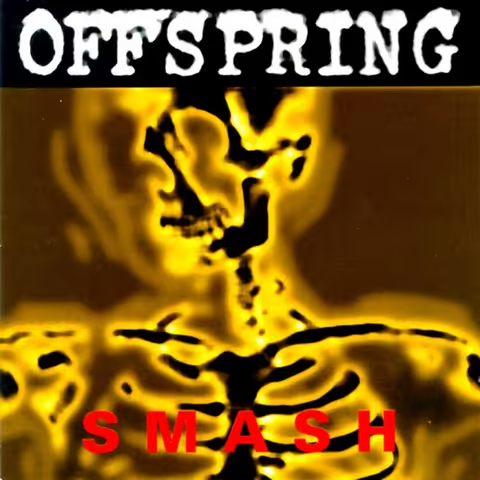
The sleeve was art-directed by Fred Hidalgo, with photography by Lisa Johnson, who had been documenting the southern Californian punk scene through the late 1980s and early 1990s. The image is a black background with a distorted, X-ray-style skeleton that appears to be screaming or smashing forward, the bones rendered in a stark grey-white that bleeds into a slight haze at the edges. Earlier legacy listings have at times credited Kevin Head with cover design, suggesting Hidalgo and Head shared the work on the wider package; what is uncontested is that Hidalgo signed off the final art direction and that Lisa Johnson supplied the imagery.
The skeleton became one of the few visual through-lines for a record otherwise sold on the strength of its singles. It was reused, in modified forms, on the sleeves of the three single releases, and it appeared in the music videos for Self Esteem and Come Out and Play, scratched and animated as a low-budget motif by the directors. For a band that did not own a recognisable logo at the time, the skeleton served, briefly, as one.
Side one, Time to Relax through Genocide
The album opens with a joke. Time to Relax, twenty-five seconds long, is a piece of imaginary lounge music with John Mayer's smooth voiceover inviting the listener to settle into an easy chair, kick back, and enjoy a record that will, on cue, do anything but. The exotica is cut dead by the count-in of Nitro (Youth Energy), a two-and-a-half-minute melodic hardcore sprint that resolves into an enormous singalong chorus and effectively establishes the template for the entire album: speed, melody, and the deliberate roughness of a band who could not afford to overthink.
Bad Habit follows, a song built around a stop-start palm-muted riff, a slow-burn bridge in which Holland recounts a road-rage fantasy at length, and a closing chorus that became one of the most-requested KROQ songs of early 1995 despite the absence of a formal single release. The bridge, with its long string of expletives, kept the song off network radio and broadcast television entirely; KROQ ran an edited version, but the album track remained the version everyone actually wanted, which is part of the reason Bad Habit functioned as a single in cultural terms without ever being one in commercial terms.
Gotta Get Away, by Holland's own admission written and tracked in the final stretch of the sessions, sits at the third position and is the first sign of the band's pop instincts asserting themselves. The bass line drives the verse, the chorus is hooky enough to have run for twenty weeks on Modern Rock Tracks the following summer, and the production is restrained even by the album's standards. Genocide closes the opening four-song run with a faster, angrier piece that segues straight into John Mayer's second appearance, a brief spoken interlude about the futility of trying to change anything, which lands as black comedy rather than nihilism.
Something to Believe In and the religion-and-rage subtext
Something to Believe In has tended to be undersold in retrospectives, partly because it sits in the album's central, less-streamed stretch, and partly because its lyric is uncharacteristically direct. Holland addresses the absence of a guiding meaning, an exhausted faith, with an opening lyric about searching the rubble for a purpose he no longer expects to find. Musically the song borrows from the longer, more melodic Bad Religion tradition, slowing the tempo, opening out the chord changes, and letting Noodles double the vocal line with a clean guitar.
It functions, in the running order, as the album's first ballad equivalent, a brief breather before Come Out and Play resets the energy. Holland has occasionally cited it as the song that marked the point at which The Offspring stopped writing exclusively about high-school grievances and started widening the lens, a shift that would become the central project of the following two records.
Come Out and Play, Arabic-flavoured motif, KROQ summer 1994, the cheap video
Come Out and Play is the song that broke the album. Holland built it around an Arabic-flavoured slide guitar motif, a phrase he had been carrying around for months and which sat uneasily with the band's hardcore back catalogue. He paired it with a stop-start chant chorus, ad-libbed Jason McLean's "you gotta keep 'em separated" hook on top of the breakdown, and ended up with a song whose structure resembled nothing else in the Epitaph catalogue. On the 2008 remaster, the track was retitled Come Out and Play (Keep 'Em Separated), an acknowledgement of how the world had come to know it.
Epitaph released it as the first single on 29 August 1994. By the autumn it was the most-played song on KROQ in Los Angeles, and from there it spread outward: Modern Rock Tracks number one for what would eventually total 26 weeks on the chart, Mainstream Rock number ten, and a peak of 39 on the Hot 100 Pop Songs. The accompanying music video, directed on a shoestring with the skeleton motif animated by hand, ran in heavy rotation on MTV's Buzz Bin through the autumn and winter, and by Christmas the album it came from was on its way to the top ten of the Billboard 200.
Self Esteem, Bauhaus chant comparison, second single
Self Esteem opens with a low, chanted vocal that has, more or less ever since the record came out, drawn comparisons to Bauhaus's Bela Lugosi's Dead. The melodic shape and the doomy, rhythmic intoning are similar enough that the homage feels deliberate, although Holland has never explicitly named the source. From there the song moves into a verse-and-chorus structure that is straightforwardly pop, with Holland delivering a self-deprecating lyric about being held in contempt by a partner he refuses to leave, the chorus repeating the title in a way that practically demanded singalong status.
Released as the second single on 13 February 1995, Self Esteem rose to number four on Modern Rock Tracks and held the chart for 26 weeks, almost exactly matching the run of Come Out and Play. It reached number seven on Mainstream Rock. The video, directed in the same skeleton-and-handheld idiom as its predecessor, intercut performance footage with cartoonish staged interactions between Holland and a stand-in girlfriend, and by spring 1995 it was a fixture on both MTV in the United States and on the equivalent video channels through Europe and Australia.
Deep cuts, It'll Be a Long Time, Killboy Powerhead, What Happened to You?
The middle of side two belongs to three songs that have, with the benefit of three decades, become the album's connoisseur favourites. It'll Be a Long Time is a fast, propulsive piece in standard Offspring tempo, two minutes and forty-three seconds of mid-tempo melodic hardcore with a chorus that resolves on a major chord and a Welty drum part that probably accounts for more snare-rim hits per minute than anything else on the record.
Killboy Powerhead is the album's lone cover, written by Rick Sims of the Champaign, Illinois band the Didjits and originally released on the Didjits' 1990 album Hey Judester. The Offspring's version is faster and considerably more polished than the original, with Noodles giving the central riff a slightly cleaner attack and Holland reaching for the falsetto on the chorus.
What Happened to You? is the album's most explicit stylistic outlier. The song is built on a Jamaican ska beat, with Greg K.'s bass walking through major chords and Welty playing a one-drop pattern on the off beats. The lyric concerns a friend who has fallen into hard-drug use and the music's lightness sets the subject matter in unsettling relief. The ska experiment would become a recurring tool for the band on later records, particularly on Pretty Fly (For a White Guy) and Why Don't You Get a Job?, but its first outing is here, on track eleven of an album otherwise made of three-chord hardcore.
Home stretch, So Alone, Not the One, political fatigue
So Alone is the album's shortest piece at one minute and seventeen seconds, a flat-out hardcore blast that takes the energy back up after the ska detour and functions almost as a palette cleanser. Not the One follows, a slightly longer, more melodic piece that closes the album's main body before the title track. Its lyric is a piece of political weariness aimed at Holland's own generation: the chorus disavows responsibility for the social problems inherited from earlier decades while quietly acknowledging that disavowal solves nothing.
It is in these two tracks, sitting between the singles and the long closer, that the album's craft is easiest to underestimate. There are no obvious hooks on the scale of Self Esteem and Come Out and Play, no stylistic stunts on the scale of What Happened to You?, but the writing is concise, the arrangements are taut, and the band sound, more than anywhere else on the record, like the working hardcore band they had been since 1984.
The title track and the hidden acoustic coda
The title track, Smash, runs to 10:42, a length that has confused first-time listeners since the day the album shipped. The actual song ends at 2:52, a focused piece of melodic hardcore whose chorus repeats the album's title as both manifesto and dismissal. What follows is a long structural appendix that lifts the album out of being a 36-minute hardcore record and into the more sprawling territory the band would explore on Ixnay on the Hombre three years later.
From around three minutes into the track, John Mayer returns one final time, reading a long monologue against a sparse instrumental backdrop, riffing on the album's themes of conformity, individuality and exhaustion in the same lounge-singer cadence he used on Time to Relax. A short jam follows, internally credited by the band as Genocide (Reprise), built on a churning, descending riff that fans would later recognise as the basis of Change the World, the opening track of Ixnay on the Hombre. The album then drops into near-silence for several minutes before, at around the nine-minute mark, a hidden acoustic reprise of Come Out and Play emerges and plays the record out.
The hidden track is not on every territory's pressing identically, and it has been mixed slightly differently on the 2008 remaster, but on the original 1994 CD it functions as a quiet closing rejoinder to an otherwise punishingly loud record. It is also one of the few moments on Smash where the production gives the band any room: the acoustic guitar is recorded close, the vocal is single-tracked, and the whole thing fades out without a chorus.
Release, slow burn, then explosion, KROQ, MTV, the Billboard 200 climb
Smash was released on 8 April 1994, catalogue number Epitaph 86432. The first weeks were quiet. Epitaph's promotional budget was, as ever, almost non-existent. There was no major-label radio push, no television campaign, no consumer-press launch, and almost no print advertising outside of fanzine territory. The album sold steadily, in line with Ignition's pace, for the first four months.
The turning point was KROQ. Once Come Out and Play was added to rotation at the Pasadena station in the middle of August, the song spread to other Modern Rock stations within weeks. By October the album was on the Billboard 200 and rising, and on 29 October 1994 it peaked at number four. It would stay on the chart for 101 consecutive weeks. Internationally the climb was even steeper: number one in Australia and Iceland, number two in Austria, top five in Canada, France, Germany, the Netherlands, Sweden and Switzerland. In the United Kingdom it reached number 21 on the main albums chart and went all the way to number one on the Rock and Metal chart.
Certifications followed at a pace neither the band nor the label had ever had cause to plan for. The RIAA awarded six platinum discs in the United States, with SoundScan tallying 6.3 million sales there alone. Canada and Australia both posted multi-platinum runs, with Canada at six platinum and Australia at four. The United Kingdom went platinum. France went double platinum on the back of around 650,000 units, the highest-selling independent album in that country's history. IFPI awarded a Platinum Europe Award in 1996. Worldwide sales, as compiled across various trade reports through the late 1990s and into the 2000s, settled at around 11 million copies. Smash was the first Epitaph release to obtain gold or platinum status, and it remains the best-selling album ever released through an independent record label.
Critical reception was generally warm without being ecstatic. Stephen Thomas Erlewine called it a "solid record, filled with enough heavy riffs to keep most teenagers happy" and "relentlessly heavy" in his AllMusic review. The Chicago Tribune gave it three stars, Entertainment Weekly a B-minus, NME a six out of ten, Rolling Stone three stars. Robert Christgau famously rated it "neither". The more interesting readings came later, with Sputnikmusic awarding four out of five in a retrospective, the New Rolling Stone Album Guide upgrading it to four stars, Guitar World naming it the second-best guitar album of 1994 between Bad Religion's Stranger than Fiction and Weezer's Blue Album, Loudwire placing it at number four in its 10 Best Hard Rock Albums of 1994, and Rock Sound listing it at six in its 51 Most Essential Pop Punk Albums of All Time in September 2014.
Touring on Smash, Pennywise, SNFU, Guttermouth, Rancid, Big Day Out 1995
The Smash touring cycle ran, with very few breaks, for almost two years. It began in May 1994 with a North American club run alongside SNFU, Battery Club and Pennywise, a tour scheduled before any of the band had any reason to expect the album would chart. By the summer leg, with Guttermouth and Big Drill Car in support, ticket demand was outstripping venue capacity in market after market. By October and November 1994, with the band still routed through clubs and small theatres, they were being supported by Rancid, whose own Let's Go had come out that summer on Epitaph stablemate Lookout (and would be followed in 1995 by their major breakthrough record).
It is in this period that the band's now-famous decision to turn down two summer 1994 offers came to light: an invitation to replace Alice in Chains on Metallica's Shit Hits the Sheds amphitheatre tour, and a separate offer to open for Stone Temple Pilots on theirs. Holland later explained the choice in the bluntest possible terms: "It just really didn't seem like the right thing to do. I still like the club thing, even if it's a big club." The band stayed in the smaller rooms, kept ticket prices low, and built audience word of mouth in a way that arena slots would not have allowed.
In January 1995 they finally crossed the Pacific, playing their first headline tours of Japan and Australia and co-headlining the Big Day Out festival with Ministry, Primal Scream, Hole and The Cult. European dates filled in the gaps through 1995 and into 1996, with the final Smash-era show eventually played in Europe in August 1996, by which point the band were already rehearsing material for what would become their first major-label release.
The legacy, best-selling indie LP ever, Epitaph's transformation, the 2008 remaster, the 2014 tour
The commercial consequence of Smash, for Epitaph specifically, is hard to overstate. The label had been profitable in a small way for a decade before the album arrived; the year after it shipped, it had to lease additional warehouse space, expand staff and reorganise its distribution to keep up. Brett Gurewitz's other band, Bad Religion, had already begun a parallel ascent to a major in 1993 when they signed to Atlantic for Stranger than Fiction. The double event, with Bad Religion taking the major-label deal and The Offspring riding the indie all the way through the platinum threshold, made 1994 the year that Epitaph's role in the wider American music industry changed permanently.
For The Offspring themselves, the next steps were more complicated. In 1996, with the Smash cycle finally wound down, they signed to Columbia for an enormous advance and released Ixnay on the Hombre in February 1997. The opening track of that record, Change the World, is built around a descending riff that listeners had first heard on the Genocide (Reprise) jam tucked inside the closing minutes of Smash, a piece of self-quoting that signalled both continuity and a clean break.
Smash was remastered and reissued in 2008 as Epitaph 86868, with subtly improved low-end and a redesigned sleeve. In 2014, for the album's twentieth anniversary, Epitaph put out a more substantial commemorative edition: a remastered CD and 180-gram vinyl with restyled artwork and a 24-page booklet, plus a limited box set including an art print (the first 250 of which were signed and presented on linen), a photo print, a replica tour pass, a pin, a patch and a guitar pick. The band toured that year playing Smash front-to-back, an exercise that allowed Bad Habit and What Happened to You? to be performed live in their album sequence for, in many cities, the first time since the original Smash run.
"the success of Smash was still a heartening triumph of DIY. Before the creation of the mp3 blog and Lil' Jon blurring the lines in terms of what an independent label actually is, Smash destroyed the record for albums sold on an indie, despite nonexistent promotion and videos with A/V Club production values."
Ian Cohen, Stylus Magazine, 2006
Placed against its 1994 peers, the record's position is clear enough. Dookie was the punk record that took its commercial cues from major-label pop. Stranger than Fiction was the punk record that took its commercial cues from a long-established cult act being given a proper studio. Smash was the punk record that took none of those cues, was made in three weeks for the cost of a used family car, and outsold both of them. Holland, asked in 1994 by Flux Magazine why he thought the album had connected as it had, gave perhaps the most honest assessment any of the band members ever offered: "When we recorded this album, our last one has sold maybe 15,000 copies, so the possibility of us getting played on the radio or anything like that was pretty much nonexistent. Especially because this kind of music is not generally considered acceptable by the mainstream, so for something like this to happen, it really took us by surprise."
Personnel
| Musician | Role |
|---|---|
| The Offspring | |
| Dexter Holland | Lead vocals, rhythm guitar |
| Noodles (Kevin Wasserman) | Lead guitar, backing vocals |
| Greg K. (Greg Kriesel) | Bass guitar |
| Ron Welty | Drums, backing vocals |
| Additional musicians | |
| Jason "Blackball" McLean | Additional vocals on "Come Out and Play" (uncredited) |
| John Mayer (no relation to the singer-songwriter) | Spoken word on "Time to Relax", the interlude after "Genocide", and the long coda inside "Smash" |
| Production | |
| Thom Wilson | Producer |
| Ken Paulakovich | Engineer |
| Mike Ainsworth, Ulysses Noriega, Christopher C. Murphy | Assistant engineers |
| Eddy Schreyer | Mastering |
| Artwork | |
| Fred Hidalgo | Art direction |
| Lisa Johnson | Photography |
Tracklist
| # | Title | Writer | Length |
|---|---|---|---|
| 1 | Time to Relax | Dexter Holland | 0:25 |
| 2 | Nitro (Youth Energy) | Dexter Holland | 2:27 |
| 3 | Bad Habit | Dexter Holland | 3:43 |
| 4 | Gotta Get Away | Dexter Holland | 3:52 |
| 5 | Genocide | Dexter Holland | 3:33 |
| 6 | Something to Believe In | Dexter Holland | 3:17 |
| 7 | Come Out and Play | Dexter Holland | 3:17 |
| 8 | Self Esteem | Dexter Holland | 4:17 |
| 9 | It'll Be a Long Time | Dexter Holland | 2:43 |
| 10 | Killboy Powerhead | Didjits | 2:02 |
| 11 | What Happened to You? | Dexter Holland | 2:12 |
| 12 | So Alone | Dexter Holland | 1:17 |
| 13 | Not the One | Dexter Holland | 2:54 |
| 14 | Smash | Dexter Holland | 10:42 |
Things you might not know
| Fact | Detail |
|---|---|
| Twenty thousand dollars | The entire recorded budget for Smash, every studio hour, every assistant engineer fee and every master, came in at roughly 20,000 US dollars, less than the catering bill on most of its 1994 chart neighbours. |
| Off-peak sneaking | The band booked Track Record only when the studio's main clients were not in, with Noodles later admitting they were "constantly calling our studio to find out when it was empty just so we could sneak in at a discount price". |
| The other John Mayer | The deadpan lounge voiceovers on Time to Relax, the spoken interlude after Genocide and the coda of the title track are all read by a friend of the band named John Mayer, unrelated to the singer-songwriter who would later release Room for Squares in 2001. |
| The school janitor | Noodles was still working day shifts as a janitor at an elementary school in Garden Grove almost up to the album's release, holding down the day job through the final mix because nobody yet trusted the record to support him full-time. |
| The PhD that nearly was | Dexter Holland was several years into a PhD in molecular biology at the University of Southern California while writing the album, and only formally completed the doctorate in 2017, twenty-three years after Smash came out. |
| The Metallica refusal | The band declined an offer to replace Alice in Chains on Metallica's Shit Hits the Sheds amphitheatre tour in summer 1994, and a separate offer to open for Stone Temple Pilots, choosing to stay in clubs because, in Holland's words, "I still like the club thing, even if it's a big club". |
| The hidden coda | The title track Smash runs to 10:42 because the actual song ends at 2:52 and is followed by a long spoken-word section, a jam internally called Genocide (Reprise) whose riff was later reused as the opening of Change the World on Ixnay on the Hombre, and a hidden acoustic reprise of Come Out and Play that fades in around the nine-minute mark. |
| The Didjits cover | The only non-Holland composition on the album is Killboy Powerhead, written by Rick Sims of the Champaign, Illinois band the Didjits and originally released on their 1990 album Hey Judester, and royalties from the Offspring's cover are widely reported to have arrived at a useful moment for Sims. |
| Best-selling indie ever | Smash remains the best-selling album ever released on an independent record label, with sales of more than 11 million copies worldwide and certifications including six-times platinum in the United States and double platinum in France, where it is the highest-selling independent album in the country's history. |
| The 2014 box set | For the album's twentieth anniversary Epitaph issued a limited box set whose first 250 copies came with an art print signed by the band and presented on linen, alongside a photo print, replica tour pass, pin, patch and guitar pick. |
How to listen now
The most easily available version of Smash is the 2008 Epitaph remaster, catalogue number 86868, released on 17 June 2008. The remaster tightens the low end and slightly evens out the dynamic range without redoing the mix, and it is the version that streams on most platforms. The cover art is unchanged; the only audible additions are a smoother top end on the cymbals and a marginally more present bass guitar.
For collectors, the 2014 twentieth-anniversary edition is the definitive package. Available on both CD and 180-gram vinyl, it includes a 24-page booklet of session photography and interviews, restyled artwork built around the original skeleton motif, and, in its limited box-set form, a signed and linen-mounted art print (numbered to the first 250 copies), a separate photo print, a replica laminate from the 1994-1996 tour, an enamel pin, an embroidered patch and a band guitar pick. The audio is the same remaster as the 2008 edition, which means that for pure listening the cheaper CD or stream is musically equivalent. For anyone wanting to hear the record in its original CD form, the 1994 Epitaph 86432 pressing remains relatively easy to find second-hand and is, for purists, still the version of Smash that matches the version the world first heard.
Comments