
Roadrunner Records signed off on a project no metal label had ever bankrolled before: fly a Brazilian thrash band, a Californian producer who had just finished Korn's debut and a small recording party into the Mato Grosso state to spend two days inside the Xavante reservation, jam with the tribe, and bring the tapes home as the spine of a major-label heavy metal album. The result was Roots, and it is the only record of the 1990s that you can credibly call both a definitive nu-metal text and a piece of indigenous ethnomusicology.
Released by Roadrunner on 20 February 1996 in Europe and 12 March in the United States, Roots would peak at No. 27 on the Billboard 200, top the UK Rock & Metal Albums Chart, sell over two million copies worldwide and earn gold certifications across eight countries. It would also be the last Sepultura album with founder Max Cavalera, who walked away by Christmas after the death of his stepson and a row over management. Almost three decades on, every conversation about heavy metal's relationship with non-Western music still starts here.
Album facts
| Field | Detail |
|---|---|
| Artist | Sepultura |
| Album | Roots |
| Release date | 20 February 1996 (Europe), 12 March 1996 (U.S.) |
| Label | Roadrunner |
| Producer | Ross Robinson, with Sepultura |
| Studios | Indigo Ranch Studios, Malibu, California (October, December 1995); field recordings on the Xavante reservation, Mato Grosso, Brazil; mixed at Soundtrack Studios, New York City |
| Engineer | Chuck Johnson |
| Mixed by | Andy Wallace |
| Mastered by | George Marino, Sterling Sound, New York City |
| Genre / subgenre | Groove metal, nu metal, with world music, tribal and Brazilian folk elements |
| Track count | 16 (15 on the original vinyl, which omitted the hidden Canyon Jam) |
| Total runtime | 72:08 |
| Billboard 200 peak | No. 27 |
| UK Albums Chart peak | No. 4 (No. 1 on UK Rock & Metal Albums) |
| Other notable peaks | No. 2 Austria, No. 2 European Top 100, No. 3 Australia, No. 3 Belgium (Wallonia), No. 4 France, No. 5 Belgium (Flanders), Finland, Italy, Sweden, No. 6 Netherlands, No. 7 Germany, No. 8 Norway, New Zealand, Portugal |
| Certifications | Gold in U.S. (RIAA), UK (BPI), France (SNEP), Australia (ARIA), Canada (Music Canada), Netherlands (NVPI), Austria (IFPI), Poland (ZPAV) |
| Estimated sales | More than two million worldwide |
| Key singles | Roots Bloody Roots (Feb 1996), Attitude (Jun 1996), Ratamahatta (Oct 1996) |
Cultural context
February and March 1996 were a strange moment to drop a heavy record. The U.S. mainstream was awash with Alanis Morissette's Jagged Little Pill, Mariah Carey's Daydream and the long tail of Cracked Rear View by Hootie and the Blowfish. Grunge as a commercial event was running on fumes after Kurt Cobain's death, and the records that would invent the next chapter of heavy music were still in progress: Tool's Aenima would arrive that September, Korn's Life Is Peachy in October, Marilyn Manson's Antichrist Superstar a few weeks before that, and Metallica's polarising Load in June.
Into that gap walked Sepultura with what one Los Angeles Times reviewer called an "intoxicating" mixture of dense metal and Brazilian music. The album landed in the same first quarter as Pantera's The Great Southern Trendkill, Rage Against the Machine's Evil Empire (April) and Marilyn Manson's Smells Like Children remix EP. None of those records sounded like Roots. Almost nothing sounded like Roots.
The band's Brazilian context mattered more than usual. The country had just survived the 1992 impeachment of President Fernando Collor de Mello, was wrestling with hyperinflation under the new Real plan, and was in the middle of a violent argument about Amazon deforestation and indigenous land rights, the very topics that "Ambush" (a tribute to murdered activist Chico Mendes), "Endangered Species" and "Dictatorshit" (about the 1964 Brazilian coup) put on a major-label metal album.
The band up to this point
Brothers Max and Igor Cavalera formed Sepultura in Belo Horizonte in 1984. The band's name is the Portuguese word for "grave", lifted from Max's translation of the Motorhead lyric "Dancing on Your Grave". After bassist Paulo Jr. joined and Andreas Kisser replaced original lead guitarist Jairo Guedz in 1987, the classic four-piece was set. Roadrunner signed them in 1988 on the strength of Schizophrenia tapes alone, sight unseen.
The albums that followed, Beneath the Remains (1989), Arise (1991), Chaos A.D. (1993) and now Roots, drew a slow but unmistakable line away from death and thrash and towards groove, with Brazilian percussion creeping further forward each time. Chaos A.D. went gold and put the band in the same conversation as Pantera; the supporting tour saw them open the Far Beyond Driven dates in North America and travel for a year and a half. By the time they reconvened to write the sixth album, they had relocated to Phoenix, Arizona, and Max's American wife Gloria Bujnowski was managing them.
Two side projects fed directly into Roots. Max and Igor's industrial detour Nailbomb, with Fudge Tunnel's Alex Newport, produced 1994's Point Blank and a brutal one-off Dynamo set, and convinced both brothers that Sepultura could move further from thrash orthodoxy than its fanbase yet realised. And on the road in 1994 they had crossed paths with Korn, then a brand-new band whose self-titled debut, produced by an unknown Californian named Ross Robinson, was about to rewire metal's bottom end.
Pre-production and demos
Demoing began in Phoenix in 1995. Igor was deep into the Salvador-based samba-reggae of Olodum and had been quietly carrying a wish list of Brazilian rhythms since before he was a drummer. Max had recently watched At Play in the Fields of the Lord, the 1991 Hector Babenco film in which Tom Berenger's character parachutes into an Amazonian village populated by the fictional Niaruna people, and the image would not leave him alone. He pitched Roadrunner an idea that no thrash band's label had ever heard: book a recording party into an actual indigenous Brazilian community and use what they captured as raw material for a major-label metal record.
Roadrunner agreed, on the condition that the trip happen alongside, not instead of, conventional studio sessions. Max contacted Angela Pappiani at Brazil's Núcleo de Cultura Indígena (Indigenous Culture Center). Nearly a year of negotiation followed before Pappiani arranged a visit to the Xavante in Mato Grosso. In parallel, the band wrote at home with the working assumption that everything would be down-tuned, slower than Chaos A.D., and built around groove rather than blast. The Korn debut, which Igor would later concede had been heavily influential, was on heavy rotation in the rehearsal room.
Several songs arrived in skeletal form. "Roots Bloody Roots" began as a Max guitar phrase looking for a vocal, eventually pinned down by what he called "really powerful but simple lyrics" about heritage and self-belief. "Attitude" carried co-writing input from Max's stepson Dana Wells, who also pitched the video concept. "Cut-Throat" was a barely-disguised diss aimed at Epic Records, who had handled Chaos A.D. in North America and with whom Sepultura had clashed; the last words of the song, "Enslavement, Pathetic, Ignorant, Corporations", spell E-P-I-C in acrostic.
Creating the album
Sessions ran from October to December 1995 at Indigo Ranch Studios in Malibu, the high-desert facility that Ross Robinson favoured for the spirit-extraction sessions he had perfected with Korn. Chuck Johnson engineered. Robinson's brief was the opposite of polish: he wanted the worst, ugliest, most uncomfortable performance the band could give him, and then he wanted them to do it again angrier. Max's guitars were tuned down further than ever (his rhythm tracks lean on a four-string instrument as well as a six-string). Paulo Jr. switched between bass and the Brazilian timbau grandé. Andreas Kisser played his usual lead and brought a sitar in for atmospheric layers. Igor's drum kit was augmented with timbau, djembe and an array of hand percussion.
Mid-sessions, the recording party flew south. Producer, band, Pappiani and Gloria Cavalera travelled into Mato Grosso to spend two days with the Xavante. The visit was not a typical session; the tribe explained that songs in their tradition cannot simply be written, they have to be received in dreams, and they invited Sepultura to share music in return. The chant that opens "Itsari" (the word means "roots" in the Xavante language) was captured in that encounter, along with the percussion textures that re-appear later on "Born Stubborn" and weave through the record. Igor Cavalera told Nashville Scene in 2016:
"Every second of that trip was insane in a very inspiring way. But there's a few things that really stand out. Like when they explained to us that the only way they wrote music was if someone in the tribe dreamed of the music. They couldn't just write a lyric or a melody. It has to be transmitted to them in a dream. From a musician's point of view, it was like, 'Wow, this is a completely different way of approaching music.'"
Igor Cavalera, Nashville Scene, 2016
Back at Indigo Ranch, the band took on more material than they could finish. Igor would later admit it was a struggle to stop the record collapsing into "a gigantic jam that didn't turn into actual songs". Carlinhos Brown, the Bahian percussionist and bandleader, arrived to arrange and guide the long ensemble percussion sections that anchor "Ratamahatta" and "Canyon Jam"; he also contributed vocals, berimbau, timbau, wood drums, lataria and surdos. Korn's then-drummer David Silveria sat in on "Ratamahatta" as well.
The session that produced "Lookaway" was the loudest concentration of guest stars on any Sepultura record. Jonathan Davis sang on it; Mike Patton, in between Faith No More and Mr. Bungle records, brought his catalogue of voices; House of Pain / Limp Bizkit turntablist DJ Lethal contributed scratches and co-wrote the music with the band. (Korn guitarist Brian Welch later complained to a French magazine that his customised Big Muff pedal had been borrowed and used "to his great dismay" on the Sepultura record.) Mixing was handed to Andy Wallace at Soundtrack Studios in New York; George Marino mastered it at Sterling Sound.
When the band took the finished album to Roadrunner, the label loved everything except the title. As Max told Kerrang! in 2008:
"Roots came from a blurry dream I had about going to the rainforest. Wine may have been involved. In the end, when we actually went into the forest to record, it was unbelievable. The whole album was a huge personal journey for me, and as a Brazilian, it felt as an incredible achievement. Everyone was inspired and Igor was at the top of his game. The percussion was crazy and we worked with so many great musicians, in the end coming out with a 15-minutes drum jam that someone likened to a crazy Brazilian Pink Floyd. When we took the album to Roadrunner they loved it except for the title. They thought it would sound like a Bob Marley tribute album. We explained it to them, and thankfully they got it."
Max Cavalera, Kerrang!, June 2008
Personnel and credits
| Role | Player | Notes |
|---|---|---|
| Core band | ||
| Lead vocals, rhythm guitar (4 and 6-string), berimbau | Max Cavalera | Final studio album with the band |
| Lead guitar, backing vocals, sitar | Andreas Kisser | Sitar used for atmospheric layering |
| Bass, timbau grandé | Paulo Jr. | Brazilian percussion instrument in the bass role on several tracks |
| Drums, percussion, timbau, djembe | Igor Cavalera | Lead architect of the album's Brazilian percussion direction |
| Guest and session musicians (credited) | ||
| Vocals, percussion, berimbau, timbau, wood drums, lataria, xequere, surdos | Carlinhos Brown | On Ratamahatta and the album's ensemble percussion sections |
| Vocals | Jonathan Davis | On Lookaway; also co-wrote the lyric |
| Vocals | Mike Patton | On Lookaway |
| Turntables | DJ Lethal | On Lookaway; co-credited on the music |
| Drums | David Silveria | On Ratamahatta (additional drums alongside Igor) |
| Percussion, chanting | Xavante people | Field recordings on Itsari, re-used as bed for Born Stubborn |
| Production and engineering | ||
| Producer | Ross Robinson, with Sepultura | Fresh from Korn's debut |
| Engineer | Chuck Johnson | Indigo Ranch |
| Additional engineering | Richard Kaplan | |
| Second engineer | Rob Agnello | |
| Mixer | Andy Wallace | Soundtrack Studios, New York City |
| Mix engineer | Steve Sisco | |
| Mastering | George Marino | Sterling Sound, New York City |
| Artwork | ||
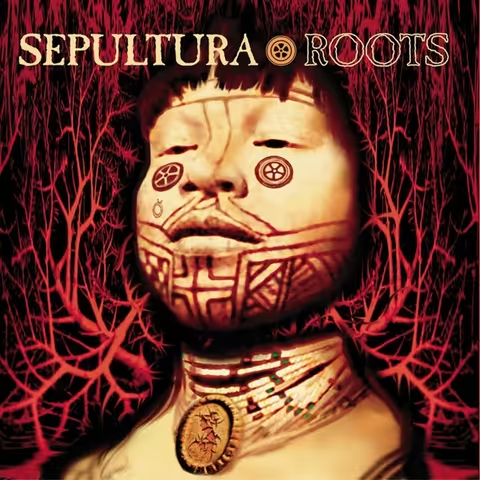
| Cover art | Michael Whelan | Red roots and locket added to a Karaja tribesman portrait taken from a 1990 Brazilian cruzeiro banknote |
| Indigenous collaboration and logistics | ||
| Brazilian indigenous cultural coordinator | Angela Pappiani | Of the Nucleo de Cultura Indigena; arranged the Xavante visit |
| Management | Gloria Cavalera (Bujnowski) | Travelled with the recording party to Mato Grosso |
The songs
| # | Title | Writer(s) | Length | Single? | Notes |
|---|---|---|---|---|---|
| 1 | Roots Bloody Roots | Sepultura (lyrics: Max Cavalera) | 3:32 | Yes | Album opener, the band's defining anthem; charted on U.S. Mainstream Rock Tracks |
| 2 | Attitude | Lyrics: Max Cavalera, Dana Wells | 4:15 | Yes | Video features the Gracie family of Brazilian jiu-jitsu; the only Sepultura lyric co-written by Max's stepson |
| 3 | Cut-Throat | Sepultura | 2:44 | No | Acrostic attack on Epic Records; final line spells E-P-I-C |
| 4 | Ratamahatta | Sepultura, Carlinhos Brown | 4:30 | Yes | Sung mostly in Portuguese; celebration of favela life referencing Coffin Joe and the outlaw Lampiao |
| 5 | Breed Apart | Andreas Kisser, Max Cavalera | 4:01 | No | The cleanest groove on the record |
| 6 | Straighthate | Sepultura | 5:21 | No | |
| 7 | Spit | Sepultura | 2:45 | No | Hardcore tempo, the record's shortest non-segue cut |
| 8 | Lookaway | Lyrics: Jonathan Davis; music: Sepultura, DJ Lethal | 5:26 | No | The all-star track: Jonathan Davis, Mike Patton, DJ Lethal and David Silveria |
| 9 | Dusted | Andreas Kisser | 4:03 | No | Kisser sole writing credit |
| 10 | Born Stubborn | Sepultura | 4:07 | No | Re-uses Xavante chanting captured on the Itsari trip |
| 11 | Jasco | Andreas Kisser | 1:57 | No | Instrumental, classical guitar interlude |
| 12 | Itsari | Xavante Tribe, Sepultura | 4:48 | No | Field recording from Mato Grosso; the album's literal and figurative centre. Itsari is Xavante for roots |
| 13 | Ambush | Sepultura | 4:39 | No | Tribute to murdered Amazon activist Chico Mendes |
| 14 | Endangered Species | Sepultura | 5:19 | No | Environmental destruction |
| 15 | Dictatorshit | Sepultura | 1:26 | No | Addresses the 1964 Brazilian coup d'etat |
| 16 | Canyon Jam | Sepultura, Carlinhos Brown | 13:16 | No | Hidden track, omitted from the original vinyl pressing for length; the ensemble percussion improvisation Max likened to "a crazy Brazilian Pink Floyd" |
Roots Bloody Roots remains the cleanest distillation of the project: a four-note descending riff in dropped tuning, a tribal stomp underneath, and Max howling about heritage and self-determination over the top. Andreas Kisser told the band's Belgian fan archive that the simplicity was the point, the song needed to land as a chant, not as a guitarist's showcase. Max explained it on MTV Europe in 1996 as a song about "don't give in. What you believe is for life, even if people try all the time to change you. The song is about 'don't let the bastards grind you down.'"
Attitude is the album's most loaded track in retrospect. Lyrically co-written by Max's stepson Dana Wells, it also features Wells's video concept (the Gracie family of Brazilian jiu-jitsu fame demonstrating their craft). Wells's death in a car accident in August 1996, while Sepultura were at Donington Monsters of Rock, would be the inciting event in Max's departure from the band.
Ratamahatta is the moment Carlinhos Brown's arrangements take centre stage. Sung mostly in Portuguese, the lyric stitches together the names of Brazilian folk figures, the Z-grade horror director Jose Mojica Marins (Coffin Joe), and Lampiao, the leader of an early-1900s cangaceiro outlaw band whose severed head was put on public display after his capture. It was the third single, released in October 1996.
Lookaway is where Roots tips its hat to nu-metal most explicitly. Jonathan Davis brings his trademark falsetto-to-snarl arc, Mike Patton supplies the demented counterpoint, DJ Lethal's turntables establish the framework. Davis himself would later concede that Roots was "a blatant Korn ripoff" in places, a charge Igor Cavalera agreed with in part, telling Metal Injection in 2016 that Korn's debut had absolutely been a sonic touchstone.
Itsari is the structural centre of the record. It is, in literal terms, a Xavante healing ceremony chant captured in Mato Grosso during the recording trip, with minimal accompaniment from the band. It is also the song that the Brazilian UFC fighter Alex Pereira walks out to before every fight, a use that has given the track a wholly unexpected second life among combat-sports fans.
Canyon Jam is the hidden 13-minute closer, omitted from the original vinyl pressing because it would not fit and replaced on later vinyl reissues by outtakes and B-sides. It is the most direct document of the band-plus-Carlinhos Brown ensemble approach: thirteen minutes of overlapping berimbau, timbau, surdo, hand drums and atmosphere, recorded outdoors at Indigo Ranch.
B-sides, outtakes and lost songs
The post-album sessions were unusually fruitful. The bonus disc that has accompanied the 2005 25th Anniversary Series reissue and various deluxe editions collects most of what came out:
- Procreation (Of the Wicked), a Celtic Frost cover and a long-standing live staple.
- Mine, an original featuring Mike Patton, recorded around the Lookaway session.
- War, a Bob Marley cover that the band also contributed to the 1996 Red Hot Organization AIDS benefit album Silencio=Muerte: Red Hot + Latin as "War (Guerra)".
- Master Vibe and Andy Wallace alternative mixes of Lookaway and Mine.
- Demos of Dusted, Roots Bloody Roots, R.D.P. and an untitled instrumental.
- A live recording of Attitude from Ozzfest 1996.
- Two Megawatt remixes of Roots Bloody Roots, evidence the band was happy to let the song travel into club-friendly territory.
Beyond those, the 1996 compilation The Roots of Sepultura (released by Roadrunner in November 1996, often confused with the album proper) gathered earlier rarities including covers of Os Mutantes, Dead Kennedys and Ratos de Porao, alongside live tracks from the Under Siege (Live in Barcelona) home video.
Album artwork and packaging
Cover artist Michael Whelan worked from a portrait of an indigenous man of the Karaja tribe that had appeared on a 1990 banknote of the discontinued Brazilian cruzeiro. He retained the tribesman's facial tattoos and beadwork necklaces, added a locket bearing Sepultura's "tribal S" logo, made the neck transparent and laid the bust over a background of red-rooted arteries on black. The result is, deliberately, a piece of street folk art rather than a stock metal sleeve. The original cassette and CD jacket featured the band name and the album title in large block capitals at the top with the Sepultura "S" tattoo motif between them; later expanded editions have used the same imagery in modified colour treatments.
Inner artwork carried photographs from the Xavante trip and detailed sleeve notes by Steffan Chirazi, later collected in expanded form in the 2005 25th Anniversary Series booklet.
Release and reception
Roadrunner released Roots in Europe on 20 February 1996 and in the United States on 12 March. The critical reaction divided along predictable lines: the metal press loved it, the general-interest American outlets either embraced the audacity or dismissed it as a stunt.
AllMusic gave it 4.5 stars out of 5. The Houston Chronicle gave it four. The Chicago Tribune, NME, Q, Record Collector, Spin and the Los Angeles Times all landed at three or three-and-a-half. Rolling Stone's Jon Wiederhorn gave it three out of five and called it "a refreshing step forward in a genre full of bands that are creatively bankrupt". Entertainment Weekly's Chuck Eddy was the lone dismissal at the upper end, with a C-minus; the critic Robert Christgau gave the album an outright "dud".
Among the metal-specialist publications the reception was uniformly enthusiastic. Martin Popoff ranked it the 11th best metal record of all time in The Collector's Guide to Heavy Metal, calling it "a masterpiece, accomplished by a band with an enormous heart and an even larger intellect". Kerrang! placed it at number two in its 100 records you must hear before dying list; Q named it one of the 50 Heaviest Albums Of All Time in 2001. The Brazilian edition of Rolling Stone ranked it the 57th greatest Brazilian album. In April 2005 Decibel inducted it into the magazine's Hall of Fame, only the third album ever to receive that honour.
Chart performance dwarfed everything Sepultura had done before. Roots hit No. 27 on the Billboard 200, the band's highest-ever placing, and topped the UK Rock & Metal Albums Chart while reaching No. 4 on the main UK Albums Chart. It peaked at No. 2 in Austria and on the European Top 100 Albums, at No. 3 in Australia and in Belgium (Wallonia), at No. 4 in France, and in the top ten of charts across the Netherlands, Germany, Belgium (Flanders), Italy, Finland, Sweden, Norway, New Zealand and Portugal. Year-end summaries pulled it onto the European Top 100 Albums for 1996 at No. 45 and the German Top 100 of the year at No. 73.
Certifications followed in 1996 and 1997: gold from the RIAA in the United States (500,000 shipments), the BPI in the United Kingdom (100,000), SNEP in France (100,000), ARIA in Australia (35,000), Music Canada (50,000), NVPI in the Netherlands (50,000), IFPI in Austria (25,000) and ZPAV in Poland (50,000).
Singles and music videos
| Single | Release | B-sides / extras | Video | Chart placings |
|---|---|---|---|---|
| Roots Bloody Roots | 18 February 1996 | Procreation (Of the Wicked), Megawatt mixes | Directed in 1996; heavy MTV Headbangers Ball rotation | U.S. Mainstream Rock Tracks chart entry |
| Attitude | June 1996 | Mine (with Mike Patton), live cuts | Concept by Dana Wells, featuring the Gracie family demonstrating Brazilian jiu-jitsu | U.S. Mainstream Rock Tracks chart entry |
| Ratamahatta | October 1996 | Lookaway (Master Vibe mix), Itsari (alt mix) | Animated and live footage hybrid showcasing favela imagery | European radio play, UK Rock Chart presence |
The Attitude video is the most documented of the three. Dana Wells, Max's stepson, drafted the concept featuring the Gracie family; the same Wells whose name shares the song's lyric credit and whose death later that year triggered the Cavalera split. The Ratamahatta video and Roots Bloody Roots both received heavy rotation on MTV's Headbangers Ball and on European specialist rock television.
Touring and live
The touring cycle began in early 1996 and ran almost continuously for the rest of the year. Sepultura played the inaugural Ozzfest in 1996 with Ozzy Osbourne, Slayer and Danzig. They appeared on the main stage at the Donington Monsters of Rock festival on 17 August 1996, alongside Kiss, Ozzy Osbourne, Paradise Lost, Type O Negative, Biohazard and Fear Factory.
That Donington show became the defining and devastating moment of Max's Sepultura career. Earlier the same day, news reached the site that Dana Wells, Max's stepson and a co-writer on Attitude, had been killed in a car accident in Phoenix. Max left immediately, and the band, told to play or lose the slot, performed as a three-piece with Andreas Kisser taking lead vocals.
Max returned for the funeral and then rejoined the tour, which continued through autumn 1996. His final show with Sepultura was at the Brixton Academy in London on 16 December 1996. The split was publicly announced in January 1997, citing Max's disagreement with the rest of the band over their decision to dismiss his wife Gloria Bujnowski as manager. He left the band saying, as quoted in Exclaim!:
"I started Sepultura back in the day. I used to write that name on my schoolbooks. What I'm going through now, is like watching my own son die. I cry every day, I feel hurt, sad, angry, it's like half of me has died."
Max Cavalera, quoted in Exclaim!, August 2011
Beyond the original cycle, the album has had three notable live afterlives. Max and Igor Cavalera staged the Return to Roots tour in 2016 for the 20th anniversary, playing the album in full as a Cavalera-billed project rather than under the Sepultura name. The current Sepultura lineup (Kisser, Paulo Jr., Derrick Green and most recently Greyson Nekrutman) has continued to play the album's anthems throughout the Celebrating Life Through Death farewell tour that began in March 2024 and is due to conclude in late 2026. And several of the Xavante chants captured during the original sessions have been incorporated into Sepultura's live shows in São Paulo and elsewhere over the years.
In TV, film and media
- "Itsari" is the walkout song used by Brazilian UFC light-heavyweight and middleweight champion Alex Pereira before every fight, a placement that has introduced the track to an audience of millions outside metal.
- "Roots Bloody Roots" appears in the Tony Hawk's Pro Skater 3 (2001) skateboarding soundtrack, alongside genre-broad selections including AC/DC and Motorhead.
- Sepultura's appearance on the 1996 AIDS benefit compilation Silencio=Muerte: Red Hot + Latin with "War (Guerra)" is a Roots-era recording produced under Robinson.
- Brazilian Volkswagen used Sepultura in a 2008 television advertisement for the Voyage sedan; the band, in a knowing wink to the Roots-era expansion, performed bossa nova rather than metal.
Controversy, censorship and lawsuits
The album itself drew no formal censorship; the parental-advisory sticker on the original was uncontested. Two more interesting arguments arose from it later, both involving Korn.
In October 2016 Jonathan Davis, asked by Metal Injection how he had felt the first time he heard Roots, replied bluntly that he had thought it was "a blatant Korn ripoff", a charge picked up across the metal press the same week. Igor Cavalera then conceded in an interview with the same outlet that Korn's first album had been a heavy influence on the record's tone and tuning while pushing back on the "ripoff" framing, pointing out that Roots's entire indigenous-collaboration concept was something no one in the nu-metal world had attempted before or since. The conversation, with both parties firmly cordial, has run on and off ever since.
The other lingering disagreement is over Cut-Throat and the E-P-I-C acrostic. Epic Records, the label that had handled Chaos A.D. in North America under licence from Roadrunner, were not amused, but no legal action followed; the relationship was already over by the time the song landed.
Covers, samples and tributes
- Gojira's "Amazonia" (2021), a single about anti-deforestation that was so obviously Roots-shaped that Joe Duplantier publicly described it as "a tribute to Sepultura. It's about Brazil. It's about the Amazon. It's tribal."
- Alien Weaponry, the Maori-language New Zealand metal band, have been repeatedly compared to Roots-era Sepultura for their use of indigenous language and ritual in metal songs; the band themselves have said they were not directly aware of Roots when they began but recognise the lineage now.
- Songs from Roots have been covered live by Korn, Soulfly, Cavalera Conspiracy, and a long list of nu-metal era bands; the album is widely cited in genre histories including Revolver's "20 Essential Nu-Metal Albums" (2021) and Loudwire's "Top 50 Nu-Metal Albums of All Time" (2026) where it placed 18th.
- The track Roots Bloody Roots has been performed by everyone from Sebastian Bach to school marching bands and shows up in countless YouTube covers, the closest the band has to a universally known anthem.
- The album itself does not sample any other records; the chants on Itsari and Born Stubborn are first-generation field recordings made with the Xavante's consent and credited to "Xavante people".
Reissues, remasters and anniversaries
- 1996, The Roots of Sepultura: a double-disc Roadrunner compilation released in November 1996, often mistaken for an expanded Roots. The second disc gathers earlier rarities, including covers of Os Mutantes, Dead Kennedys and Ratos de Porao, plus live tracks from Under Siege (Live in Barcelona).
- 2005, 25th Anniversary Series 2-CD reissue: Roadrunner's deluxe edition with a bonus disc of B-sides (the Celtic Frost and Bob Marley covers, Mine with Mike Patton, alternative mixes, demos and a live Attitude from Ozzfest), plus an expanded 24-page booklet with new Steffan Chirazi liner notes.
- 2016, 20th anniversary Return to Roots tour: Max and Iggor Cavalera staged a global tour performing the entire album in sequence, billed under the Cavalera name rather than Sepultura.
- 2017, Expanded Edition vinyl: a Record Collector-reviewed reissue that restored Canyon Jam and adjusted the bonus material to suit the format.
- 2021, 25th anniversary retrospectives: Keith Kahn-Harris in The Quietus and Revolver's "20 Essential Nu-Metal Albums" both placed it back into the conversation; Loudwire returned to it in their 2026 nu-metal poll.
Legacy and influence
The most direct measure of Roots's legacy is institutional: gold certifications in eight countries, a Decibel Hall of Fame plaque, repeated appearances on greatest-of-all-time lists across the metal press for nearly thirty years. The deeper measure is what the record made possible.
Saby Reyes-Kulkarni, writing for PopMatters in 2016, observed that "Before Chaos A.D., the overwhelming majority of metal had a 'white' feel to it. Sepultura changed that forever. And with Roots, the band went a step further, asserting once and for all that the genre can accommodate native stylings from any culture, much like jazz had done for decades prior." The line is the cleanest summary the album has yet received.
"Roots is inarguably one of the most radical stylistic departures from convention in heavy metal history, an album that blew the doors open on our perceptions of metal and so-called 'world music'. We haven't heard anything quite like it since."
Saby Reyes-Kulkarni, PopMatters, March 2016
For the Xavante, the consequences were tangible. Pappiani and the tribe's then-leader Cipasse both told UOL in 2016 that Roots had measurably increased awareness of the tribe, to the point where outsiders would identify them as Xavantes rather than as generic "indigenous people". The same article notes that interest in Xavante music and culture has continued to follow the album.
For metal, the album sits at the start of two lineages. The first runs into nu-metal proper: Korn, Limp Bizkit, Slipknot, System of a Down, Sepultura's own Cavalera-led successor Soulfly, all of which inherited the down-tuned-and-tribal idea. Igor Cavalera was matter-of-fact about it in 2016: Korn's debut had inspired the record, and the record then fed back into nu-metal's middle period. The second lineage runs into what we now call folk metal, world metal and indigenous metal: Korpiklaani in Finland, Orphaned Land in Israel, Melechesh's Mesopotamian arc, Chthonic in Taiwan, and most directly Alien Weaponry in New Zealand. Few of those bands would name Roots as their literal blueprint, but the concept of major-label heavy metal welded to a specific non-Western indigenous tradition starts with this record.
For Sepultura, Roots was both a peak and a fault-line. The band has not bettered its commercial reach since; Max went on to form Soulfly and Cavalera Conspiracy, Igor followed him out in 2006, and the band has continued with Andreas Kisser as the institutional memory and Derrick Green on vocals through fifteen further years of touring and recording. The Celebrating Life Through Death farewell tour, currently winding down through 2026, is in many ways the final closing of the door that Roots opened thirty years ago.
Things you might not know
| Fact | Detail |
|---|---|
| The album was nearly retitled | Roadrunner loved the record but worried Roots sounded like a Bob Marley tribute album. Max had to talk them out of changing it. |
| The opening image came from a film | Max's concept for the indigenous collaboration was sparked by the 1991 film At Play in the Fields of the Lord, specifically the scene where Tom Berenger parachutes into an Amazonian village. |
| The Xavante's songwriting rule | The tribe explained to the band that songs cannot simply be composed; they must be received in dreams. Igor Cavalera later said the conversation changed his entire approach to music. |
| Cut-Throat hides an acrostic | The final phrase of the song, "Enslavement, Pathetic, Ignorant, Corporations", spells E-P-I-C, a direct attack on the band's former North American label Epic Records. |
| The cover face came from a banknote | Michael Whelan worked from a portrait of a Karaja tribesman that had appeared on a 1990 Brazilian cruzeiro note, before the cruzeiro itself was discontinued in 1993. |
| Brian Welch's stolen pedal | Korn's guitarist later complained that his customised Big Muff guitar pedal had been borrowed for the Roots sessions, "to my great dismay". |
| The original vinyl is missing a track | Canyon Jam, the 13-minute closing improvisation, was omitted from the first vinyl pressing because it would not fit. Most subsequent vinyl reissues have replaced it with B-sides and outtakes rather than restore it. |
| The all-star cameo session | Lookaway was tracked with Jonathan Davis, Mike Patton, DJ Lethal and David Silveria all in the same Indigo Ranch room within a few days of each other. |
| Itsari has a second career in cage-fighting | Brazilian UFC champion Alex Pereira walks out to the song before every fight; commentators routinely mention his Pataxo indigenous heritage in the same breath. |
| Carlinhos Brown's instrument haul | The Bahian percussionist's credits on the sleeve list vocals, berimbau, timbau, wood drums, lataria, xequere and surdos. He is the only non-band member credited as a percussion arranger. |
| Attitude was Dana Wells's only lyric | Max's stepson Dana Wells co-wrote the lyric and pitched the video concept. He was killed in a car accident in August 1996, the day Sepultura played the main stage at Donington Monsters of Rock. |
| Max's last Sepultura show was Brixton | The final Cavalera-fronted Sepultura performance was at the Brixton Academy in London on 16 December 1996. The split was announced publicly in January 1997. |
| Andy Wallace mixed it in New York | The mixer who had handled Nirvana's Nevermind and Slayer's Reign in Blood handled Roots at Soundtrack Studios in New York City, after recording finished at Indigo Ranch. |
| Eight gold discs across three continents | Roots is certified gold in the U.S., U.K., France, Australia, Canada, the Netherlands, Austria and Poland, the most decorated Sepultura album in any market. |
| Robert Christgau hated it | The Village Voice's longtime "Dean of American Rock Critics" gave Roots a flat "dud" rating, his harshest grade. Decibel inducted it into their Hall of Fame nine years later. |
The podcast
If this story scratched the itch, the Riffology podcast goes deeper into the records, the rows and the riff-by-riff anatomy of metal's pivot decade. Subscribe wherever you get your podcasts and join the conversation about the albums that built this music; Roots is exactly the kind of record we live to argue about.
Comments