In the spring of 2015, the most theatrical and least photographed band in heavy metal walked into EastWest Studios in Hollywood with a Swedish pop producer who had never made a metal record. Their singer was an anonymous figure in skull paint and papal vestments. Their five backing musicians were credited only as alchemical symbols. Their drummer for the session was a hired hand whose name almost nobody in the audience would ever know. And the man at the desk, Klas Åhlund, had spent the previous decade building radio hits for Robyn, Britney Spears and Madonna.
What came out the other side of that strange collision, six months of writing, four studios and a famously chaotic Stockholm post-production, was Meliora: the third Ghost album, the one that took a cult Swedish occult-rock band onto The Late Show with Stephen Colbert, onto the Billboard 200 at number 8, and onto a Grammy stage in February 2016. It is also the album where Ghost stopped being a costume and started being a career.
Album facts
| Field | Detail |
|---|---|
| Artist | Ghost |
| Album | Meliora |
| Release date | 21 August 2015 |
| Label | Loma Vista Recordings (US), Spinefarm (EU and UK) |
| Producer | Klas Åhlund |
| Mixed by | Andy Wallace |
| Mastered by | Brian Lucey (Magic Garden Mastering) |
| Studios | EastWest Studios, Hollywood; The Village Studios, Los Angeles; Ameraycan Studios, Hollywood; Riksmixningsverket, Stockholm |
| Genre | Heavy metal, hard rock, doom metal, progressive rock, with elements of psychedelic and pop rock |
| Track count | 10 |
| Total runtime | 41:32 |
| Billboard 200 peak | Number 8 (29,000 first-week US sales) |
| UK Albums Chart peak | Number 23 (Number 2 on the UK Rock and Metal chart) |
| Other notable peaks | Number 1 Sweden, Number 1 Finland, Number 2 Norway, Number 6 Netherlands, Number 9 Canada, Number 19 Germany, Number 20 Australia, Number 28 France |
| Certifications | Platinum (Sweden, GLF, 40,000); Gold (Canada, Music Canada, 40,000); Silver (UK, BPI, 60,000) |
| Key singles | Cirice; From the Pinnacle to the Pit; Majesty |
Cultural context
The summer of 2015 was a difficult environment for new heavy metal records. The mainstream rock conversation had drifted towards stadium-sized arena pop and EDM crossovers, and the metal racks were dominated by long-running heritage acts squeezing one more lap from the catalogue. The week Meliora arrived, the album charts were waiting on Iron Maiden's enormous double The Book of Souls in early September; the previous month had seen Slayer return with Repentless, their first record without Jeff Hanneman; and Faith No More had reunited earlier in the year for Sol Invictus. Anything trying to make a mark in the rock press had to elbow past those three.
What Ghost had, that none of those records had, was novelty. The band were Swedish, anonymous, theatrical and unfailingly polite in interviews conducted through faceless representatives. Their previous two albums, 2010's Opus Eponymous and 2013's Infestissumam, had been niche cult successes. Infestissumam in particular had been a difficult campaign; the album debuted at number 28 on the Billboard 200 but was banned from several CD-pressing plants over the Antichrist artwork, and the band had spent most of 2014 watching their audience grow steadily without ever quite breaking through to a mainstream rock listenership.
Meliora was being made into a rock landscape that was hungry for a new costume. Foo Fighters had spent the year touring Sonic Highways from a broken-leg throne. Muse had released Drones in June. Within the harder end of the spectrum, Lamb of God's VII: Sturm und Drang, Killing Joke's Pylon and Clutch's Psychic Warfare were the strongest competition. Ghost were the only band in that cohort whose singer might plausibly turn up to the interview wearing prosthetic skull paint and a chasuble.
The band going in
By late 2014, Ghost were a band built around one creative engine and a rotating cast of masked players. Tobias Forge, then still legally a private citizen rather than a publicly named frontman, was the songwriter, the singer and the brand architect. His identity would not be confirmed in any court of law until the 2017 Linköping case brought by four former Nameless Ghouls; until then, every interview was conducted in character by an unnamed Ghoul, and every photograph of the singer was of the painted Papa figure.
The Papa Emeritus II character had fronted Infestissumam. By the time Meliora began, that character had been retired in favour of Papa Emeritus III, ostensibly a younger sibling, in practice the same person under fresh prosthetics. The conceit allowed Forge to refresh the costume design and the stage business for each album cycle without ever putting himself in front of a camera. The Ghouls, identifiable only by alchemical symbols on the inner sleeves, played the parts of Fire (lead guitar), Water (bass), Quintessence (rhythm guitar), Air (keyboards) and Earth (drums).
Infestissumam had introduced a wider sonic palette than the band's debut: prog-rock keyboards, choirs, more ambitious arrangements. It had also, in interviews, exposed how much of the writing was being done by Forge alone, with the Ghouls treated as session players for the studio and a touring company for the road. That tension would erupt in court a few years later. In late 2014 it was simply the working model. A Ghoul told Loudwire that the seed for the new album had been planted before Infestissumam was even on tour: during rehearsals, a Ghoul had built a "spacey echoed" riff while trying a new guitar rig, and that riff sounded "futuristic [and] sci-fi". It became the opening of Spirit, and the conceptual germ for everything that followed.
Choosing Klas Åhlund
The producer hire was the most consequential single decision of the campaign. Forge wanted to break out of the rock-producer comfort zone that had defined the first two albums, and he wanted, above all, to avoid making another record whose sonic vocabulary the press could file alongside the rest of the occult-rock revival. He went looking for somebody with no metal pedigree at all.
Klas Åhlund was already a senior figure in Swedish pop. As a member of the group Teddybears, and as a writer and producer working out of Stockholm, he had built credits with Robyn (most notably the Body Talk series), Madonna, Britney Spears, Kylie Minogue and Katy Perry. He had never produced a heavy metal record. He had, however, grown up with the same record collection as Forge, and the conversations the two of them had before agreeing the deal were less about studio philosophy than about specific Mellotron parts, specific Blue Oyster Cult albums and specific 1970s arrangement quirks.
A Nameless Ghoul told Guitar World that despite Åhlund's reputation for working with pop singers, "he had many of the same musical interests as Ghost". A band member added, more bluntly, to Blabbermouth: "I definitely think that we got a lot of ideas and a lot of new angles that we wouldn't have had, had we worked with a more established rock producer." The point was not that Åhlund would teach them how to make a metal record. The point was that he would not let them make one by reflex.
"He had many of the same musical interests as Ghost."
A Nameless Ghoul on Klas Åhlund, Guitar World, July 2015
Pre-production
Forge and Åhlund spent roughly three months in Stockholm in pre-production before a single guitar was tracked for the album proper. The pre-production phase was, by every account given since, the longest and most thorough of any Ghost record. Forge later told interviewers that the writing and arranging took so long that there was no time left over to record any non-album material. The only outtake from the entire sessions was a track called Zenith, which was held back and later issued on the limited Meliora Redux edition in September 2016.
Two creative decisions came out of pre-production that would shape the final record. The first was conceptual. The dystopian, pre-apocalyptic urban setting that the Spirit riff had suggested in rehearsal was developed into a full thematic backbone: where Opus Eponymous had been about the coming of the Antichrist and Infestissumam about his presence, Meliora would be about the void that opened when no god was there at all. A Ghoul told Guitar World that the album was concerned with "the void that happens when there is no god, when there is no one there to help you", and that the band itself was now to be presented as "the religious party that comes in there with a guiding hand".
The second decision was structural. The guitar had been pushed into the background on Infestissumam, drowned by keyboards and choirs. Åhlund and the band agreed that guitar would return to the centre of the arrangement, and that the writing for Meliora would be riff-led. That single principle dictated the recording approach that would follow in Los Angeles.
Creating the album
Recording proper began in January 2015. Drums were tracked first, in Los Angeles, with a hired session player. The session drummer was Ludvig Kennberg, whose name appears in the booklet under "Additional personnel" rather than as a member of the band. The touring Ghoul who played drums on stage (the alchemical Earth) was a different musician altogether. The use of a session drummer rather than a band member was consistent with how Forge had handled previous Ghost records, where Ghoul costumes on stage were not always worn by the players who had been on the tape, but it was carefully not advertised at the time.
From the drum sessions, the production moved through EastWest Studios, The Village Studios and Ameraycan Studios in the Los Angeles area for the bulk of guitar, bass and keyboard tracking. EastWest in particular gave the album its rhythm-section room sound; the studio's Neve 8078 console and live rooms have shaped enough rock records that the influence is audible by association. Vocals and the more elaborate arrangements were saved for the move back to Stockholm, where Åhlund worked out of Benny Andersson's Riksmixningsverket.
The guitar approach was the single most carefully planned element of the tracking. With Åhlund's encouragement, the band rejected the standard one-guitar-one-amp approach and built each rhythm part out of four different guitars, each one played through three different amplifiers. The arithmetic adds up to twelve amps stacked across each rhythm performance. The guitar collection assembled for the sessions included two Gibson SGs (an early-1980s instrument and a 1960s instrument), a 1962 Gibson Les Paul, and a Fender Telecaster. The Telecaster, in particular, was responsible for the brighter, more articulated guitar tonalities that distinguish Meliora from the muddier wash of Infestissumam.
| Recording phase | Studio | Material tracked |
|---|---|---|
| January 2015 | The Village Studios, Los Angeles | Drums with session drummer Ludvig Kennberg |
| Early 2015 | EastWest Studios, Hollywood | Bulk of guitar, bass, additional instrumentation |
| Early 2015 | Ameraycan Studios, Hollywood | Overdubs and additional tracking |
| Spring 2015 | Riksmixningsverket, Stockholm | Vocals, Mellotron choirs, arrangement overdubs, on-site production |
| Spring 2015 | Off-site | Andy Wallace mix |
| Spring 2015 | Magic Garden Mastering | Brian Lucey master |
Mellotron choirs are everywhere on Meliora, and they are deliberately synthetic. A Ghoul told Loudwire: "There are a lot of mellotron choirs on there because we wanted it to feel [a] little bit synthetic and simulated. The choir symbolizes the gothic element that comes in all of a sudden." On Infestissumam, choirs had been recorded with real singers and had been a logistical nightmare; on Meliora, the band budgeted properly for the Mellotron sound they actually wanted, rather than chasing a "real" choir on the cheap.
The Stockholm sessions, lavish and stupid
The return to Stockholm is the most quoted phase of the whole campaign, almost entirely because Forge was so cuttingly honest about it in retrospect. Riksmixningsverket is one of the most expensive rooms in Sweden, and the band spent freely. Forge later told Blabbermouth that the sessions were "very, very lavish, stupid" and that the studio was full of "multiple people coming in and going or just hanging around, of which... on one hand, you think it's good for morale to do that, but no, it wasn't, evidently, in the end". The hangers-on were friends, friends of friends, label representatives, technical staff, and the entourage that follows a band the moment they have a proper budget. It made for a vibrant atmosphere and it made for slow days.
"Very, very lavish, stupid sort of procedure in a large studio with multiple people coming in and going or just hanging around. On one hand, you think it's good for morale to do that, but no, it wasn't, evidently, in the end."
Tobias Forge on the Stockholm Meliora sessions, Blabbermouth, June 2018
The lesson stayed with Forge. On Prequelle, three years later, he would lock down the personnel list and the studio diary far more tightly. The luxurious openness of the Riksmixningsverket sessions never recurred. What it did produce, however, was an album whose vocal production has the relaxed, lived-in feel of singers who knew they had as many takes as they wanted. The harmonies on He Is and the layered backing chorale on Deus in Absentia are products of that environment, even if Forge has come to regard the conditions that made them possible as an indulgence.
Andy Wallace and Brian Lucey
Once the Stockholm sessions wrapped, the mix went to Andy Wallace. Wallace's CV by 2015 stretched from Nirvana's Nevermind to Slayer's Reign in Blood, with Faith No More's Angel Dust, Sonic Youth's Dirty, Rage Against the Machine's debut, Linkin Park's Hybrid Theory and dozens of others in between. He is the mixer most often hired when a record needs to be aggressive without being narrow, and when a band needs the rhythm section to hit hard without burying the vocal. On Meliora, that brief was almost the whole job. The twelve-amp guitar stacks and the Mellotron arrangements had to coexist with Papa's lead vocal, which sits unusually clean and dry for the genre.
The master went to Brian Lucey at Magic Garden Mastering in Los Angeles. Lucey's catalogue is heavier on alternative rock and indie than on metal proper (The Black Keys, Royal Blood, Arctic Monkeys, Ghost themselves on later records), and his mastering style favours dynamics over brick-walled loudness. The Meliora master is noticeably less compressed than most metal records of its year, which is part of what gives the album its capacity to swing.
Personnel and credits
| Role | Player | Notes |
|---|---|---|
| Ghost | ||
| Vocals | Papa Emeritus III (Tobias Forge) | Identity not legally confirmed until 2017 |
| Lead guitar | A Nameless Ghoul (Fire) | Identified later as Martin Persner |
| Bass | A Nameless Ghoul (Water) | |
| Rhythm guitar | A Nameless Ghoul (Quintessence) | |
| Keyboards | A Nameless Ghoul (Air) | |
| Drums (on tape) | A Nameless Ghoul (Earth) | Credited but not the player on the LA drum sessions |
| Additional personnel | ||
| Drums (sessions) | Ludvig Kennberg | Hired Swedish session drummer who tracked the album in Los Angeles |
| Production and engineering | ||
| Producer | Klas Åhlund | First heavy metal production of his career |
| Mixing | Andy Wallace | Nirvana, Slayer, Faith No More, Rage Against the Machine |
| Mastering | Brian Lucey | Magic Garden Mastering, Los Angeles |
| Artwork | ||
| Cover and album art | Zbigniew M. Bielak | Polish artist, also worked with Behemoth, Watain, Paradise Lost |
| Zenith artwork (limited edition) | David M. Brinley | |
The most contested item on that list, even today, is the lead-guitar credit. Persner was later named in interviews and court documents as the Ghoul who had been in the lineup throughout the Infestissumam and Meliora cycles, but the band have never publicly itemised which players performed which parts on the record. The session drummer, Kennberg, is the only Additional Personnel entry in the booklet, which has been read by close fans as confirmation that everything else (bass, guitars, keyboards, vocals, choirs) was tracked by Forge and the existing Ghouls.
Themes and concept
Meliora is Latin for "better things", a translation the band themselves have not always rendered correctly. They have framed it more romantically as "the pursuit of something better", but the etymology is just the plural of the comparative form of bonus. The thematic content is more interesting than the etymology. Forge has described the album as being concerned with the modern, urban, post-religious individual: the person whose grandparents went to church on Sunday and whose own life has no equivalent ritual.
A Ghoul told Blabbermouth that the record was "more about the modern man and woman in their pursuit of purpose in life. It's hard to live in a society if you're not willing to buy that you are in a collective, yet usually in the Western world, there is a big disregard for individual responsibility." Set against that, the band positioned themselves, in character, as the institution that fills the gap. The Ghost church on Meliora is offered as a working alternative to the absent one.
The dystopian backdrop, the band's preferred shorthand for the album's setting, was always meant to feel cinematic. A Ghoul told Blabbermouth that the title and the music were meant to paint a "super-urban, metropolitan, pre-apocalyptic, dystopic futuristic thing". That theatrical environment was what the artwork and the live show then had to deliver.
The songs
The Meliora running order is unusually disciplined for a Ghost record. The pacing of the album is built around two short instrumentals (Spöksonat and Devil Church) that sit between three pairs of full songs, and a long, doomy closer (Deus in Absentia) that opens up into Mellotron choirs and string arrangements. The album is short by metal standards (forty-one minutes and thirty-two seconds across ten tracks) and it is sequenced to feel even shorter than it is.
| # | Title | Writer(s) | Length | Single? | Notes |
|---|---|---|---|---|---|
| 1 | Spirit | Forge, Persner | 5:15 | No | Built on the "spacey echoed" riff that spawned the whole album concept |
| 2 | From the Pinnacle to the Pit | Forge, Åhlund, Persner | 4:02 | Yes (Jul 17, 2015) | Bass-led "Led Zeppelin-style" stomper, the only Meliora track to chart in its own right |
| 3 | Cirice | Forge, Åhlund | 6:02 | Yes (May 30, 2015) | Lead single; won the 2016 Grammy for Best Metal Performance |
| 4 | Spöksonat | Forge, Åhlund | 0:56 | No | Brief instrumental interlude (Swedish for "ghost sonata"), sits between Cirice and He Is |
| 5 | He Is | Forge, Åhlund, Persner | 4:13 | No | Originally written in 2007 and attempted for Infestissumam; lyrics influenced by the suicide of Selim Lemouchi |
| 6 | Mummy Dust | Forge, Åhlund, Persner, Gustaf Lindström | 4:07 | No | The heaviest track on the album, doom-leaning, with a horn-section breakdown in the bridge |
| 7 | Majesty | Forge, Persner | 5:24 | Yes (Aug 7, 2015) | Hymn to the dark lord that doubles as a portrait of populist hero-worship |
| 8 | Devil Church | Forge | 1:06 | No | Originally the opening to Cirice; split off into its own instrumental at Åhlund's urging |
| 9 | Absolution | Forge, Åhlund, Persner | 4:50 | No | Streamed in advance of release on 31 July 2015; the album's most pop-leaning chorus |
| 10 | Deus in Absentia | Forge, Åhlund, Johan Ingvar Lindström | 5:37 | No | Closing track; opens into a Mellotron-choir crescendo built around the phrase "this is the end" |
Spirit
Spirit opens the album with the riff that started everything. A Ghoul had built the "spacey echoed" guitar figure in a rehearsal room a month or so before Ghost went out on the Infestissumam tour, while trying a new rig. The figure sounded, to the Ghoul who wrote it, "futuristic [and] sci-fi", and it stuck in his head for two years before the band went into the studio. That single riff is the album's thesis statement; everything that follows in the running order is, in one way or another, a development of the same idea.
From the Pinnacle to the Pit
The second single, released as a free stream on 17 July 2015. A Nameless Ghoul described it to Kerrang! as "a truly stomping riff-based song, Led Zeppelin-style", and as "something that would sound great coming out of a car stereo in an American high school parking lot". The stomping bass line was the hook, played high up the neck rather than buried in the low end, and it is the only Meliora track that the band have admitted was specifically written with the American rock-radio format in mind.
Cirice
The lead single, released as a free download via the band's website on 30 May 2015 (some sources give 31 May; the band's own site listed the song that weekend). Cirice was originally conceived together with Devil Church (which was its opening) as a single nine-minute, very dark, very doomy instrumental without a chorus. Åhlund pushed Forge to keep working on it, and a chorus eventually materialised; the two pieces were then split into a long song with a real hook and a short standalone instrumental. The decision is the single most consequential edit on the album. Without it there is no Grammy, no Colbert appearance, no commercial breakthrough.
Spöksonat
Less than a minute long, Swedish for "ghost sonata", and a deliberate piece of stagecraft rather than a song proper. The interlude functions as a pacing reset between Cirice and He Is. The title is a nod to August Strindberg's 1907 play of the same name, an absurdist ghost story set in a Stockholm apartment block; the literary reference is the kind of detail Ghost rarely flag in interviews but reliably bury in the running order.
He Is
Of the ten tracks on Meliora, He Is is the oldest. It was written in 2007, attempted for Infestissumam, and then put back on the shelf because the band could not make it sound like Ghost. During Meliora pre-production, Forge added it back to the list of candidates. Åhlund praised the song when he heard the demo and pushed for it to be recorded essentially as it was, without trying to disguise it. The lyric, a Nameless Ghoul told Loudwire, was influenced by the suicide of Selim Lemouchi, the guitarist and songwriter of The Devil's Blood, who had taken his own life in March 2014 and had been a friend of the band. He Is is the only Meliora song that does not, on a close reading, belong to the album's dystopian universe; it is a quiet hymn that has more in common with 1970s soft rock than with anything else on the record.
"The lyrics to the song were influenced by the suicide of Selim Lemouchi, guitarist of The Devil's Blood, who was friends with members of Ghost."
A Nameless Ghoul on He Is, Loudwire, November 2015
Mummy Dust
The album's heaviest track, doom-leaning, with the only writing credit on the record to Gustaf Lindström (one of the touring Ghouls). The arrangement opens with a slow grinding riff and resolves through a horn-led bridge that owes more to King Crimson than to any metal antecedent. Mummy Dust was rarely played live during the Meliora cycle, partly because the horn arrangement is hard to reproduce on stage without auxiliary players; when the song returned to setlists on later tours it had been rearranged.
Majesty
The third single, released on 7 August 2015, two weeks before the album. A Ghoul told Kerrang!: "Lyrically, it's on one hand a hymn about the dark lord of the underworld. On the other hand it paints a picture of a swarm of people, whom in a world of complete disaster, idolizes an authority that is clearly looking down upon them. How to love something that hates you back." It is the most explicitly political lyric on the album, and arguably the one that has aged into a stronger reading since 2015.
Devil Church
The other half of the Cirice doomy-instrumental concept, set free as its own track. Devil Church is just over a minute long, built around a Hammond-organ figure that introduces the riff motif of Mummy Dust which immediately follows. The sequencing means it functions as a connective tissue rather than a true instrumental break, and it is one of the small pieces of craft that holds the album's second side together.
Absolution
Streamed in advance of release on 31 July 2015. Absolution is the most pop-leaning chorus on the record; the verse riff is a standard rock figure but the chorus melody, harmonised in thirds, would not be out of place on an ABBA record. The Åhlund influence is most audible on this track. It was never released as a true single (no video, no commercial push) but it has been one of the most-streamed Meliora songs on every platform since release.
Deus in Absentia
The closer, and the only track on the album with a co-write credit to Johan Ingvar Lindström. Deus in Absentia opens as a relatively conventional mid-tempo rocker and resolves into a four-part Mellotron-choir coda built around the repeated phrase "this is the end". It is the most theatrical piece of writing on the record, the one most obviously designed to function as a live closer, and the track that did the most to set up the more orchestrated arrangements of Prequelle three years later.
Zenith, the outtake
The only song to survive the Meliora sessions and not make the standard album was Zenith, a six-minute, slow-building track in the same register as Spirit. Forge said in 2015 that the pre-production phase was so long that there had been no time to record anything else, but Zenith was finished and shelved late in the process for reasons that have never been fully explained. It was released in September 2016 as part of the Meliora Redux limited edition, paired with the Popestar EP and a David M. Brinley sleeve, and has since become a fan favourite by reputation. The Redux pressing of Meliora is also the only place to hear Zenith in its album-context running order.
Artwork and packaging
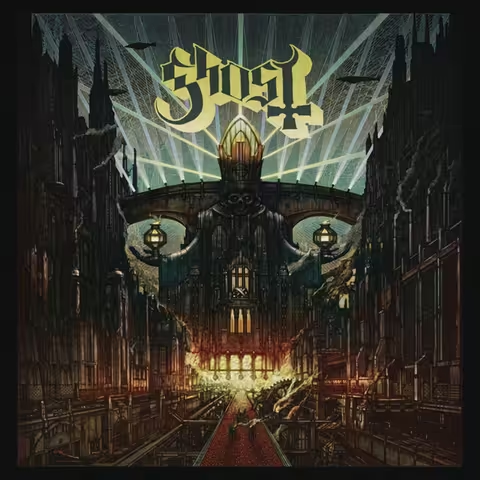
The Meliora sleeve was designed by Zbigniew M. Bielak, the Polish artist who has spent the last fifteen years building the visual identity of European occult and extreme metal. By 2015 Bielak's credits included Behemoth's The Satanist, Paradise Lost's Tragic Idol and Watain's The Wild Hunt; his work on Meliora was Ghost's first collaboration with him, and the band have used him on every studio album since.
The cover image is a stylised, dystopian skyline rendered in muted greys and gold, with the Meliora wordmark set into the centre. The interior gatefold and the inner-sleeve panels expand the city motif into a series of brutalist-cathedral renderings that echo the album's "super-urban, metropolitan, pre-apocalyptic" verbal framing. Bielak's draughtsmanship throughout the package is unusually clean for a metal record; the package looks more like a Wallpaper-magazine architectural feature than a heavy metal album, which is exactly the effect Ghost were after.
The limited-edition Meliora Redux pressing, issued in September 2016, used additional artwork by David M. Brinley for the Zenith track. The Redux release was bundled with the Popestar EP, which gave the band's commercial story between Meliora and Prequelle a single physical artefact and pushed the album back into shops at exactly the moment Square Hammer was breaking on US rock radio.
Release and reception
Meliora was released on 21 August 2015. Its artwork and tracklisting had been announced on 29 May, in a coordinated reveal across the band's website and Blabbermouth; the lead single Cirice had come out as a free download the following day, with the official music video, directed by Roboshobo, premiering on 8 June. Absolution was streamed on 31 July. From the Pinnacle to the Pit was released as a single on 17 July, and its Zev Deans-directed video followed on 14 September, a few weeks after the album. Majesty closed the singles rollout on 7 August.
The reviews were broadly positive. Metacritic settled at 78 out of 100 from twelve aggregated reviews, which it categorised as "generally favourable". AnyDecentMusic, the more demanding British aggregator, scored Meliora at 7.6 out of 10. The Guardian gave the record four stars out of five, with a review headlined "Ghost: Meliora review, rocking the papal" praising the album's commitment to its own theatrical conceit. AllMusic awarded it a top score and singled out the discipline of the arranging. PopMatters gave it eight out of ten. The most-discussed review, then and since, was Andy O'Connor's at Pitchfork, which scored Meliora at 6.2 and conceded that it marked a return to heavier material while remaining unconvinced by the band's broader project.
| Publication | Score | Notable line |
|---|---|---|
| The Guardian | 4/5 | "Rocking the papal" |
| AllMusic | 5/5 | Praised the discipline of the arranging |
| PopMatters | 8/10 | Highlighted the integration of pop sensibility into the riff writing |
| Pitchfork (Andy O'Connor) | 6.2/10 | "Meliora marks a return to a heavier sound" but ambivalent overall |
| Metal Forces | 7/10 | Strong but reserved |
| AnyDecentMusic? (aggregate) | 7.6/10 | Twelve reviews |
| Metacritic (aggregate) | 78/100 | Generally favourable |
Beyond the daily review cycle, Meliora landed on a long list of best-of-2015 features. Rolling Stone, AXS TV and LA Weekly named it one of the year's best metal albums. Metal Hammer placed it at number 13 on its overall list of 2015's best albums across all genres. Revolver placed it second in hard rock and heavy metal. Loudwire's editorial best-of placed it second; the same outlet's readers voted it number one in the fifth annual Loudwire Music Awards.
Singles, music videos, Lzzy Hale and Colbert
The Cirice video, directed by Roboshobo, was the band's first piece of high-budget moving-image work. It depicts a school auditorium in which a group of children, watching what appears to be a Ghost performance, begin to develop telekinetic powers; the imagery deliberately echoes early-1980s John Carpenter and Brian De Palma. Its YouTube view count has since cleared a hundred million, an order of magnitude larger than anything Ghost had previously released.
The From the Pinnacle to the Pit video, directed by Zev Deans, is more abstract: an animated piece built around occult symbolism and a recurring church-collapse motif. Deans had become the in-house video director for Ghost's more conceptual work, and he would go on to direct further videos for the band through the Prequelle and Impera cycles.
The He Is lyric video, uploaded on 9 November 2015, is the only major piece of visual content from the album to use the song that was not released as a single. The decision to invest in a lyric video for an album track was a deliberate signal that the band considered He Is to be part of the long tail of the campaign rather than a deep cut.
On the road, the Black to the Future tour produced two of the most-shared moments of the campaign. The band had started a tradition of recruiting local female fans to dress as nuns and serve alcoholic beverages from a stage-side bar during the song Sisters of Sin. On 6 October 2015, in St Louis, the Sister of Sin was Lzzy Hale of Halestorm, who happened to be in town and turned up unannounced. Photos of Hale in nun's habit serving drinks at a Ghost show circulated for weeks afterwards.
The Late Show with Stephen Colbert appearance on 30 October 2015 was the band's first US television performance. It was a Halloween-themed episode of the show; Ghost played Cirice; and the segment was filmed on the Ed Sullivan Theater stage with Papa Emeritus III in full vestments. For a band that had spent five years quietly building a North American cult audience, walking onto Colbert in costume and playing a six-minute progressive metal single about ancestral guilt was an unusually direct statement of intent.
Charts and certifications
Meliora debuted at number 8 on the Billboard 200 with 29,000 first-week US sales, a vault from the number 28 debut of Infestissumam two years earlier. In the band's home market, the album topped the Sverigetopplistan chart at number 1, the band's first Swedish number one. It also debuted at number 1 in Finland.
| Territory | Chart | Peak |
|---|---|---|
| United States | Billboard 200 | 8 |
| United States | Top Hard Rock Albums | 2 |
| United States | Top Rock Albums | 2 |
| Sweden | Sverigetopplistan | 1 |
| Finland | Suomen virallinen lista | 1 |
| Norway | VG-lista | 2 |
| Netherlands | Album Top 100 | 6 |
| Canada | Billboard Canadian Albums | 9 |
| United Kingdom | UK Albums Chart | 23 |
| United Kingdom | UK Rock and Metal Albums | 2 |
| Germany | Offizielle Top 100 | 19 |
| Australia | ARIA | 20 |
| France | SNEP | 28 |
| Scotland | OCC Scottish Albums | 17 |
The certifications followed the chart positions in a fairly predictable pattern, though with one quirk: the UK certification came in noticeably later than the others, only crossing the Silver threshold (60,000 units, including streams) in 2025. Sweden was Platinum (40,000) by the end of 2016, and Canada hit Gold (40,000) in late 2023. The slow burn of the certifications, particularly in the UK, illustrates how Meliora has continued to sell long after its release week, a pattern more typical of catalogue rock records than of contemporary metal.
Awards and the Grammy
The first major award was the 2015 Grammis (the Swedish Grammys) for Best Hard Rock/Metal Album, presented in February 2016. Ghost performed He Is at the ceremony, in costume. It was the band's second win in the same category; Infestissumam had taken the prize two years earlier.
Six days after the Grammis, on 15 February 2016, Cirice won the Grammy Award for Best Metal Performance at the 58th Annual Grammy Awards in Los Angeles. It was Ghost's first Grammy, and the first time a Swedish metal act had won in the category. The award was accepted on the band's behalf by a non-band member; the Ghouls and Papa did not appear in person, and the band's anonymous frame held all the way through the broadcast.
The Grammy was the single most important event in the band's commercial history. It moved Ghost from a "critics' choice" act to a band whose name carried weight at radio and at retail. Every subsequent campaign, from Popestar onwards, has been built on the foundation that Cirice laid in February 2016.
Legacy and what came next
The album's after-life is best read in three movements. The first was the Meliora Redux release in September 2016, bundled with the Popestar EP and its standalone single Square Hammer. Square Hammer was a hit in a way that no Meliora track had been; it spent two weeks at number 1 on the Billboard Mainstream Rock chart and remains, by streaming counts, Ghost's most-played song. The fact that Square Hammer was an EP track rather than an album single is something of an accident of timing, but the Popestar EP would not exist in the form it does without the audience that Meliora had built. The Redux pressing is the bridge between the two campaigns.
The second movement was Prequelle, released in June 2018. Prequelle moved away from Klas Åhlund (Tom Dalgety produced) and away from the Stockholm "lavish and stupid" approach; it was a more disciplined, more orchestrated record, with full string arrangements and a Saxophone solo and a higher-profile guest list. The Meliora aesthetic (theatrical, conceptual, riff-led) was the foundation Prequelle was built on, even as the new album moved further from straight rock into something closer to an art-rock concept album.
The third movement was the unmasking. In April 2017, four former members of Ghost (Simon Soderberg, Mauro Rubino, Henrik Palm and Martin Hjertstedt) filed suit against Forge in Linköping district court, claiming unpaid royalties and forcing the legal disclosure that Forge had been the sole owner of the Ghost partnership and the sole credited author of the music. The court ruled in Forge's favour in October 2018, but the case had already moved Ghost permanently out of the anonymity that had defined the Meliora cycle. By the Prequelle tour, Forge was giving interviews under his own name. The mystique of the masked frontman that had been one of the most striking things about the Meliora campaign was, by then, over.
Meliora's musical influence is harder to pin down than its commercial after-life, but the band most often cited as having taken something from it are the wave of European theatrical-metal acts that followed: Tribulation, Avatar, Sweden's own The Hellacopters in their later phase, Italy's Lacuna Coil on the Black Anima cycle. In the United States, the record's clearest sonic descendant is probably Greta Van Fleet, who borrow Meliora's combination of vintage tonalities and arena-rock ambition without the occult costuming.
Reissues and anniversaries
The major reissue history is short by classic-rock standards. Meliora Redux, released on 16 September 2016, packaged the original album with Zenith, the Popestar EP and a David M. Brinley-illustrated booklet; it was issued on CD and as a digital download. A 5.1 surround mix has been rumoured but never confirmed. There has not, as of the album's tenth anniversary in August 2025, been a deluxe anniversary box, a half-speed master vinyl pressing, or an official Dolby Atmos mix; the band's reissue programme has tended to favour their later, more orchestrated records.
The vinyl pressings of the original Meliora have been steady catalogue items since 2015 and the album has been pressed on coloured vinyl variants (clear, white, gold) at various points; the original black-vinyl pressing has remained the most common edition in shops.
Covers and sync placements
Cirice and From the Pinnacle to the Pit have both become standard cover-band fare at metal nights and at student talent shows; the Cirice riff in particular is the kind of mid-tempo hook that translates to a thrown-together cover with minimal arrangement work. The most widely documented "official" cover moment from the Meliora cycle remains Lzzy Hale of Halestorm joining the band on stage in St Louis on 6 October 2015 as a Sister of Sin, pouring drinks during the live performance of Sisters of Sin.
Beyond live covers, Meliora's footprint on the band's later visibility owes more to Square Hammer (released the following year on the Popestar EP) than to anything on the album proper. Square Hammer dominated Ghost's sync and trailer history through the late 2010s; the Meliora tracks themselves remained album favourites and live-set staples rather than soundtrack-placement workhorses, with deeper cuts such as Mummy Dust and Deus in Absentia growing into fan rituals at later tours.
Things you might not know
| Fact | Detail |
|---|---|
| The producer's day job | Klas Åhlund had never produced a metal album before Meliora; his previous decade was almost entirely pop, including Robyn's Body Talk series, songs for Madonna, Britney Spears and Katy Perry, and his own band Teddybears. |
| The session drummer | The drums on Meliora were tracked in Los Angeles by Ludvig Kennberg, a hired session player. The Ghoul credited on stage as the drummer was a different musician altogether. |
| One riff to rule the album | The entire futuristic-dystopian concept of Meliora grew from a single "spacey echoed" guitar figure that a Nameless Ghoul created in a rehearsal room while trying a new rig before the Infestissumam tour. That figure became the opening of Spirit. |
| Twelve amplifiers per track | Each rhythm-guitar performance on Meliora was recorded using four different guitars, each played through three different amps, for a stacked total of twelve amplifiers per take. |
| Cirice was never meant to have a chorus | Cirice and Devil Church started life as a single nine-minute doomy instrumental without a chorus. Åhlund insisted on more work; a chorus materialised; the piece was then split into the Grammy-winning single and a one-minute interlude. |
| He Is is older than the band's first album | He Is was written in 2007 (three years before Opus Eponymous) and was attempted, then shelved, during the Infestissumam sessions. It only made it onto a record because Åhlund pushed for it during Meliora pre-production. |
| The hidden tribute | The lyric to He Is was influenced by the suicide of Selim Lemouchi, guitarist of The Devil's Blood, a friend of the band. |
| Forge on his own record | Forge later called the Stockholm sessions "very, very lavish, stupid", with too many people hanging around the studio. He has tightened the door policy on every record since. |
| The unannounced Sister of Sin | At a Black to the Future show in St Louis on 6 October 2015, Lzzy Hale of Halestorm turned up unannounced, put on the nun habit, and served drinks during Sisters of Sin. |
| The translation the band got wrong | "Meliora" is the plural comparative form of the Latin bonus, meaning "better things". The band have framed it as "the pursuit of something better", which is closer to a marketing line than a translation. |
| The outtake that wouldn't die | The one song left off Meliora, Zenith, was held back from the regular release and issued a year later on the Meliora Redux limited edition, packaged with the Popestar EP and the standalone single Square Hammer. |
| First US TV in costume | Ghost made their US television debut on The Late Show with Stephen Colbert on 30 October 2015, performing Cirice on the Ed Sullivan Theater stage in full vestments during a Halloween-themed episode. |
Things you might not know, the bullet edition
- The album's title was almost the only thing about Meliora that the band publicly confirmed in advance of the May 2015 reveal. Almost everything else, including the producer credit, was kept dark until the artwork drop.
- The Meliora sessions overlapped with Klas Åhlund's mixing work on an unrelated Robyn release, and Åhlund flew between Stockholm and Los Angeles several times during the early 2015 tracking.
- The Spöksonat title comes from August Strindberg's 1907 absurdist play of the same name, set in a Stockholm apartment block.
- Devil Church was not originally on the tracklisting; it was created when Åhlund split the long Cirice instrumental into two pieces.
- The Deus in Absentia choir coda is performed entirely on Mellotron rather than with live singers; the band's previous album had used live choirs and the experience put them off.
- The cover artist Zbigniew M. Bielak had previously designed Behemoth's The Satanist (2014); Meliora was his first Ghost commission and he has designed every subsequent Ghost album sleeve.
- The Cirice video has cleared a hundred million views on YouTube, more than every previous Ghost video combined.
- The 2018 Blabbermouth interview in which Forge described the Stockholm sessions as "lavish and stupid" was given while he was promoting Prequelle, which had been recorded under a deliberately stricter regime.
Meliora on the Riffology podcast
Meliora is one of those records that rewards a longer conversation than a review can offer; the choices Forge and Åhlund made in early 2015, the room they hired in Stockholm, the riff that started in a rehearsal and ended on the Grammy stage. The Riffology podcast covers the album and the wider Ghost story in its album deep-dive series, available on Apple Podcasts, Spotify, Pocket Casts and every other major podcast platform. Search for Riffology, settle in and let the Ghouls do their work.
Comments