By the spring of 1992, Gun had a problem most Glasgow bands would have killed for. They had toured the United States in 200-capacity bars where nobody knew them, flown straight to Rotterdam to open for the Rolling Stones in front of 60,000 people a night, played roughly thirty more stadium shows across Europe with Mick Jagger telling them they had been picked because they reminded him of his own band thirty years earlier, and then come home to a debut album, Taking on the World, that had peaked at number 44 in the UK charts. The Stones tour had been the most expensive piece of advertising any A&M act would receive that decade. The album it was supposed to break, hadn't.
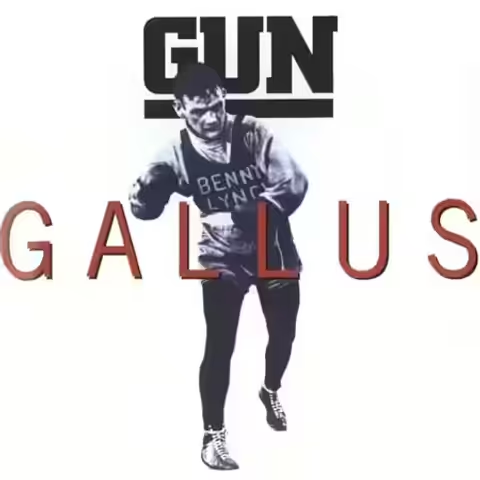
Their answer was Gallus, released on 30 March 1992 as a deliberately heavier, deliberately more Glasgow-shaped record. They named it after the Glaswegian word for bold and cheeky, put a sepia photograph of the 1930s flyweight world champion Benny Lynch on the cover instead of a band shot, kept producer Kenny MacDonald from the debut, brought in Al Clay (engineer on the Pixies' Bossanova) to sharpen the sound, and trusted three brawnier singles to do the work. Gallus went to number 14 in the UK, more than thirty places higher than the debut, and stayed there long enough to send the band out on Def Leppard's Adrenalize tour as the obvious British support act of the year. It is also the last album Gun made with the classic five-man lineup; everyone who plays on this record except the Gizzi brothers would be gone within two years.
Album facts
| Field | Detail |
|---|---|
| Artist | Gun |
| Album | Gallus |
| Release Date | 30 March 1992 (UK) |
| Label | A&M Records |
| Producer | Kenny MacDonald |
| Engineer | Al Clay |
| Studio | Recorded in Scotland during late 1991 and early 1992 (the precise studio is not documented in the album's standard credits) |
| Genre | Hard rock, rock |
| Track Count | 10 |
| Total Runtime | 50:16 |
| UK Albums Chart Peak | 14 |
| Other Notable Chart Peaks | New Zealand 41 |
| Certifications | None on record (the band's debut and Swagger each took BPI Silver; Gallus did not) |
| Estimated Sales | Below the 60,000 BPI Silver threshold in the UK; international sales are not publicly disclosed |
| Key Singles | "Steal Your Fire" (UK 24), "Welcome to the Real World" (UK 43), "Higher Ground" (UK 48) |
Cultural context: a Britain caught between glam and grunge
March 1992 sat exactly on the seam between two rock eras. Nevermind had been out for six months and was selling 300,000 copies a week in the United States. Pearl Jam's Ten was still climbing. Alice in Chains, Soundgarden and the rest of the Sub Pop diaspora were elbowing the last of the hair-metal bands off the racks. In the UK, the press had not quite given grunge a verdict yet, but everyone could feel the wind change. The bands that had spent the late 1980s in spandex were either trying to grow stubble (Adrenalize, also out that spring, was Def Leppard's commercial peak but already sounded like the end of an argument) or being quietly sidelined by an A&R class hunting for the next Nirvana.
That is the gap Gun walked into. They had never been a glam-metal band, but A&M had marketed the debut close enough to that scene to confuse American radio. Gallus is the first Gun record made with an explicit case to answer: were they a hard-rock band with songs, or were they about to be left behind by a new sound born in a different rainy port city? In the UK, hard rock still had a meaningful audience, kept alive by Iron Maiden's Fear of the Dark (also 1992), Def Leppard, the Almighty, Thunder, the Wildhearts and Skin. Gallus was built to sit on that shelf.
- Def Leppard, Adrenalize, March 1992: the album whose UK tour Gun were about to support.
- Iron Maiden, Fear of the Dark, May 1992: still the genre's UK flagship.
- Faith No More, Angel Dust, June 1992: redrawing what hard rock could sound like.
- Pantera, Vulgar Display of Power, February 1992: the year's grenade in the metal trenches.
- Alice in Chains, Dirt, September 1992: closing the year's grunge case.
- Stone Temple Pilots, Core, September 1992: the format's American hit.
The band's story up to this point
Gun's origin story is, by Scottish rock standards, unusually clean. Guitarist Giuliano "Jools" Gizzi formed the band in Glasgow in 1987, briefly as Blind Allez, then Phobia, then Gun. The Italian-Glaswegian Gizzi brothers (Jools on guitar, Dante eventually on bass) came out of the Calton area in Glasgow's East End. They signed to A&M in 1988 on the strength of a demo. Kenny MacDonald, a Glasgow-based producer best known by then for shaping Texas's Southside and a handful of Del Amitri, Love and Money, Wet Wet Wet and Lloyd Cole records, took the production chair for the debut. The lineup that finished Taking on the World was Mark Rankin on vocals, Jools and Dante Gizzi on guitar and bass, Alex Dickson on second guitar and Scott Shields on drums.
Taking on the World came out in July 1989. "Better Days" reached UK number 33, got Gun their first Top of the Pops appearance and even charted on the US Mainstream Rock chart at number 19. The album peaked at UK 44 and 26 in New Zealand, which was respectable but not the breakthrough the label expected. Then came the moment that defined the band for the rest of their career. The Rolling Stones' management, having sifted through, by Dante Gizzi's later count, around 60 bands competing for the Steel Wheels / Urban Jungle European support slot, picked Gun.
The band were a month into a two-month tour of small US clubs when the fax arrived in Texas. Dante Gizzi told the Press and Journal in October 2022 that other shortlisted acts had sent elaborate riders, demanding stage time and load-in conditions; Gun answered the brief differently.
"We just sent a fax saying, 'we'll take whatever you can give us'. I think that sealed the deal for The Stones."
Dante Gizzi, Press and Journal, 13 October 2022
They opened for the Stones at De Kuip in Rotterdam on 18 May 1990 and played roughly 30 more shows on the run, including the Stones' sold-out runs at Wembley and Hampden Park. In a Munich club afterwards, Dante asked Mick Jagger why Gun had got the gig over the other 60 contenders.
"That's easy. It was because you reminded me of us when we first started out."
Mick Jagger to Dante Gizzi, recounted in the Press and Journal, 13 October 2022
By the time the tour ended Gun had played roughly thirty stadium-sized shows in front of audiences hundreds of times bigger than anything their debut album had earned them. They came back to Glasgow with about eighteen months of stage instinct compressed into one summer, a fan base across mainland Europe, an A&M Records who now had to decide whether to commit to a second album, and the small problem that the album the tour was meant to break had only sold modestly. The plan for Gallus was to write a record those new European audiences would recognise as the band they had seen open for the Stones, only bigger.
Pre-production and the second-album problem
The songs were written across late 1990 and 1991, around a touring schedule that took the band back through the UK and Europe several times. With Mark Rankin and Jools Gizzi as the primary writing axis, the band leaned into longer, heavier arrangements than the debut's radio-friendly singles had carried. Every song on the final tracklist runs over four minutes; six clear five. Where Taking on the World had been built around three-and-a-half-minute hooks, Gallus is structured to give the lead and second guitar more room to play off each other and to keep the rhythm section (Dante Gizzi and Scott Shields) audible in the mix.
Demos have never been officially released, and the band have not publicly named the studio used to track them. What is consistent across the various retellings is that the band wanted Kenny MacDonald back to keep the personality of the debut intact, but they also wanted somebody new behind the desk to push them somewhere harder. Their choice of engineer is the surprise of the record's credits.
Creating the album: MacDonald, Clay and the Pixies in the room
Kenny MacDonald produced Gallus, his second consecutive Gun record. Al Clay engineered it. That second name is, on paper, an unusual pairing for a Scottish hard-rock album in 1992. Clay had spent the preceding years engineering left-of-centre alternative records: he had worked with the Pixies on Bossanova in 1990, with Pere Ubu on Worlds in Collision in 1991, and would later move into producing for Stiltskin, Vinny Peculiar, Travis and Catatonia. Bringing him in for a Glasgow hard rock record was a deliberate choice on the band's part, an attempt to harden the mid-range without losing the melodic clarity MacDonald had given the debut. The combination is unmistakable on the record. The drums are drier than on Taking on the World; the rhythm guitars sit lower; the vocals are pushed forward; the cymbals do not splash.
The production credits in the Wikipedia entry for the album, drawn from the 1992 CD sleeve, are unusually thin: producer (Kenny MacDonald), engineer (Al Clay), and the five band members on their respective instruments. Beyond that, the sleeve does not name a mastering engineer, a mix engineer, an assistant, an art director or a photographer. This is, frankly, low documentation for a record on a major label, and various long-running fan resources have only ever been able to add Sharleen Spiteri of Texas and original Gun drummer Alan Thornton as guest backing vocalists. The standard sources do not publicly identify the studio. We have left those rows blank in the Personnel table rather than fill them with speculation; that is the price of writing a definitive piece on a record whose label never reissued it.
What the production does tell you, audibly, is that this was a record made in a room that knew how to record loud music quietly. Clay's signature touch on Gallus is the way the rhythm guitars sit just behind the bass, rather than blanketing it. Dante Gizzi's bass lines on "Long Road" and "Borrowed Time" are unusually clear; you can hear the right-hand articulation in a way you would not on most British hard-rock records of the period. The choruses are stacked with Mark Rankin's lead and harmony vocals, layered by Sharleen Spiteri and Alan Thornton without ever turning into the wall-of-sound that A&M would have wanted out of a Mutt Lange production. The album opens with the cleanest snare hit on any Gun record, and that single first beat tells you what kind of band Clay decided he was engineering.
Personnel and credits
| Role | Player | Notes |
|---|---|---|
| Core band (as credited on the 1992 A&M sleeve) | ||
| Lead vocals | Mark Rankin | Last Gun studio album as frontman until reunion-era reissues; co-wrote every track with Giuliano Gizzi. |
| Guitar | Giuliano "Jools" Gizzi | Founder member; primary musical writer; the only original member still in the band continuously to this day. |
| Guitar | Alex Dickson | Left Gun before Swagger (1994); subsequently joined Bruce Dickinson's solo band and toured extensively with Robbie Williams. |
| Bass | Dante Gizzi | Jools's brother; later moved to lead vocals in the 2010 reunion lineup that remains active. |
| Drums | Scott Shields | Left Gun alongside Dickson before Swagger; later worked extensively as guitarist and writer with the Alarm and as a session player. |
| Guest contributions | ||
| Backing vocals | Sharleen Spiteri | Then the lead singer of Texas, also produced by Kenny MacDonald. |
| Backing vocals | Alan Thornton | Founding-era Gun drummer who left the band before the debut; remained close to the Gizzi brothers. |
| Production and engineering | ||
| Producer | Kenny MacDonald | Second consecutive Gun album; also produced records for Texas, Del Amitri, Lloyd Cole, Love and Money, Wet Wet Wet and Bourgie Bourgie. |
| Engineer | Al Clay | Previously engineered the Pixies' Bossanova and Pere Ubu's Worlds in Collision; subsequently produced for Stiltskin and Catatonia. |
| Mixing / mastering credit | Not separately credited on the original sleeve | Mix is usually attributed to Clay alongside the engineering role. |
| Artwork and packaging | ||
| Cover subject | Benny Lynch (archival photograph) | Glasgow-born flyweight world champion, died 1946. Photographer not credited on the sleeve. |
| Sleeve design | Not individually credited on the 1992 sleeve | Designer and art director are not named in the standard A&M release. |
The songs
| # | Title | Writers | Length | Single? | Notes |
|---|---|---|---|---|---|
| 1 | "Steal Your Fire" | Rankin / G. Gizzi | 4:53 | Lead single (UK 24) | The album's most direct moment; opening riff that audibly sets up the back half. |
| 2 | "Money to Burn" | Rankin / G. Gizzi | 4:44 | No | The Stones-shaped swing of the album, an explicit lyrical jab at music-business excess. |
| 3 | "Long Road" | Rankin / G. Gizzi | 5:06 | No | Dante Gizzi's most articulated bass performance on the record. |
| 4 | "Welcome to the Real World" | Rankin / G. Gizzi | 5:10 | Single (UK 43) | Title track in spirit; the record's most quoted chorus. |
| 5 | "Higher Ground" | Rankin / G. Gizzi | 5:30 | Single (UK 48) | The album's gospel-shaped anthem (not the Stevie Wonder song). |
| 6 | "Borrowed Time" | Rankin / G. Gizzi | 4:34 | No | Side two opener; one of two tracks under five minutes. |
| 7 | "Freedom" | Rankin / G. Gizzi | 5:05 | No | Spiteri's most audible backing vocal on the record. |
| 8 | "Won't Back Down" | Rankin / G. Gizzi | 5:43 | No | Longest track on side one of the original vinyl pressing. |
| 9 | "Reach Out for Love" | Rankin / G. Gizzi | 4:19 | No | Shortest track on the album. |
| 10 | "Watchin' the World Go By" | Rankin / G. Gizzi | 5:07 | No | Closer; the most explicitly Glasgow-flavoured lyric on the record. |
"Steal Your Fire" is the lead single and the song that does the most work introducing the new Gun. It is built around a riff that arrives, in Jools Gizzi's hands, with audibly fewer effects than anything on the debut, and a Rankin vocal that holds the line "I'm gonna steal your fire" over a bed that drops to almost nothing on the second beat of every other bar. The song peaked at UK 24, which was the band's second-highest UK singles position to that point (the debut's "Better Days" had reached 33), and the music video, directed in Glasgow with the band's local crew, was an MTV Europe staple through the early summer of 1992. The Riffology podcast's episode on this album spends a useful chunk of its run-time on the way "Steal Your Fire" frames the rest of the record; it is the song that explains what Gun were now.
"Welcome to the Real World" arrived as the second single in the summer of 1992 and went to UK 43. It is the most concise statement of the album's lyrical concerns: the chorus uses the phrase as both a welcome and a warning, and Rankin's vocal performance pitches between the two readings without ever forcing the listener to pick. The arrangement is the most Texas-shaped on the record, which makes sense given the production lineage; Sharleen Spiteri's backing vocal on the bridge is one of the small details that points to it. "Higher Ground" (the third single, peaking at UK 48) shares neither lyric nor melody with the famous Stevie Wonder song of the same name. The Gun "Higher Ground" is a piano-shaded anthem about perseverance with a vocal hook designed to be sung back in arenas.
The deep cuts do a lot of the album's heavy lifting. "Money to Burn" is the Stones-influenced second track and is plainly the song the Gizzi brothers had been writing in their heads on the Steel Wheels tour two years earlier; the swing in the verse is more Keith Richards than Glasgow. "Long Road" has the album's most precise bass performance; Dante Gizzi later moved to vocals partly because that performance and others like it told the rest of the band he had a voice worth fronting. "Won't Back Down" is the album's longest track and its closest moment to a power ballad. "Watchin' the World Go By" closes the record on a hushed lyric about Glasgow's slow decade-by-decade reinvention; it is the song the band picked, on the 25th-anniversary tour for the debut in October 2014, to close their full-album Gallus performance at King Tut's Wah Wah Hut.
B-sides, outtakes and the missing demos
The 1992 singles from Gallus carried a smaller crop of B-sides than the debut had. "Steal Your Fire" was issued on 7-inch, cassette and 12-inch with live and acoustic flips; "Welcome to the Real World" carried live versions of earlier Gun songs as B-sides; "Higher Ground" leaned on extended mixes for its 12-inch. None of the B-sides have been collected on an official compilation, which makes the 1992 singles themselves the only way to hear them in good audio quality. The pre-production demos from late 1991 have never been officially released, and the band have not publicly indicated whether the tapes survive in A&M's vaults. The 2003 Spectrum compilation The Collection and the 2006 River Sessions album both draw from this era of the band but neither includes unreleased Gallus material.
Album artwork and Benny Lynch
The cover is the album's loudest single statement. There is no band photograph, no logo treatment, no Glasgow skyline. There is a sepia archival portrait of Benny Lynch, the Glasgow-born flyweight who held the world title for three years in the mid-1930s and who died of pneumonia and chronic alcoholism in a Knightswood hospital on 6 August 1946, aged 33. Lynch is, to Glasgow, what Joe Louis is to Detroit. He came out of the Gorbals, fought his way to two versions of the world title between 1935 and 1937, became Scotland's first world boxing champion, and lost the title on the scales (not in the ring) before drinking himself out of the sport. By 1992, the campaign for a statue of Lynch in Glasgow was already underway; the statue was eventually unveiled in 2018, in the Gorbals.
Picking Lynch was an act of local cultural translation. Gallus is Glaswegian slang for bold, cheeky, daring; calling somebody "pure gallus" in the East End is somewhere between a compliment and a warning. Lynch was the dictionary illustration. The band's choice to put him on the sleeve, with no name printed and no caption, assumed that the Glasgow audience would recognise him and that everyone else would ask why. The A&M sleeve does not credit the original photographer, which suggests the image was licensed through an archive rather than commissioned for the record. There is no separately credited art director or designer on the original UK pressing. The deliberate plainness, sepia tint, mostly empty negative space, the title set in a small block of text in the lower corner, was as much a part of the statement as the choice of subject.
Release and reception
Gallus went on sale on 30 March 1992 and entered the UK Albums Chart at number 14, a thirty-place jump on the debut's peak. It charted at 41 in New Zealand, which was the only other territory to give it a published peak position. The three singles staggered out across the spring and summer: "Steal Your Fire" preceded the album, "Welcome to the Real World" arrived alongside it, and "Higher Ground" carried the campaign into the autumn. None of the three crossed the UK top 20, but all three made the top 50, which was the bar then for radio rotation, music-press coverage and the music videos to land on regular MTV Europe rotation. Contemporary British rock press coverage was generally positive, framing the album as a credible second record from a band that had earned its support-act stripes; the press did not always credit it as a great album, but it was widely received as a Gun album worth owning. Retrospective coverage has been kinder, both from Scottish outlets and from the rock-historical reassessments that have surrounded the band's late-2010s and 2020s reunion-era output.
Gallus did not pick up BPI Silver certification (60,000 UK units), unlike either Taking on the World or the much bigger Swagger. It did, however, do precisely what the band needed it to do; it confirmed Gun as a chart-presence band heading into the support slot on Def Leppard's UK Adrenalize tour, which is what the second album existed to set up.
Singles and music videos
| Single | Released | UK Singles Peak | Format / notes |
|---|---|---|---|
| "Steal Your Fire" | February 1992 (pre-album) | 24 | 7-inch, cassette, 12-inch, CD; band-performance music video shot in Glasgow. |
| "Welcome to the Real World" | Spring 1992 (album release window) | 43 | 7-inch and CD with live B-sides; music video on MTV Europe rotation. |
| "Higher Ground" | Summer 1992 | 48 | 7-inch and 12-inch with extended mixes; final single from the campaign. |
The music videos were modest by 1992 standards. "Steal Your Fire" was shot largely as a band-performance piece in a Glasgow location, and is the one of the three that has lasted best on YouTube and in retrospectives. "Welcome to the Real World" leaned on stylised band shots and brief storytelling cutaways. "Higher Ground" went the simplest route, performance footage cut against live recordings from the early Gallus tour dates. None of the three videos has been remastered or reissued in HD; the versions in circulation today are the original SD broadcast tapes ripped to YouTube by fans and re-uploaded by the band's own channel.
Touring: Adrenalize, Europe and the second wind
Two years on from the Stones tour, Gun spent the summer of 1992 opening for Def Leppard on the UK leg of the Adrenalize World Tour. The biggest of those dates was Earls Court Arena, a venue Def Leppard played repeatedly that summer; the Def Leppard tour history pages still list Gun on the support bill. For a British hard-rock support act in 1992 there was no bigger tour to be on. It also meant Gun were playing in front of, on average, ten to twenty thousand people a night, which is enough time on a big stage to harden a record permanently into a band's live identity. The shock of stadium-scale audiences was still fresh in Dante Gizzi's memory more than thirty years later.
"You have to imagine what it was like playing a month of 200 and 300-capacity shows in the States. Then BANG, straight into 60,000 sell-out stadiums. You're walking out onto the stage thinking two days ago I was playing to 200 people."
Dante Gizzi, Press and Journal, 13 October 2022
The wider Gallus touring also took Gun into mainland Europe in their own headline right and back through the UK club and theatre circuit. The band did not tour the United States in earnest behind the record; A&M had effectively given up on breaking them stateside after the debut underperformed there, despite the US Mainstream Rock chart placement for "Better Days". The most lasting live document from the album's era is fragmentary: a handful of TV performances, some German broadcasts, a few bootlegs traded on tape. Gun did not release an official live album from this era. The closest thing to one is the 2006 The River Sessions, which pulls live material from across the 1990s.
Twenty-two years later, in October 2014, the band returned to the album in full for one of the most fan-rewarding things they have ever done. To celebrate the 25th anniversary of Taking on the World, Gun played three sold-out nights at King Tut's Wah Wah Hut in Glasgow, each one performing a different album in its entirety: Taking on the World, Gallus and Swagger. That second night is the only documented performance of Gallus end-to-end in front of an audience and remains the record's clearest fan-event moment.
In TV, film and media
Gun's most famous screen placement, by some distance, is the band's 1994 cover of Cameo's "Word Up!" from Swagger, which was used in the 1996 Pamela Anderson film Barb Wire and won an MTV Europe Music Award for Best Cover Version, and which more recently was rebooted in the 2017 Tonya Harding film I, Tonya. The Gallus singles themselves do not have a high-profile sync footprint. None of the three singles has been used in a major film, television series or video game soundtrack on the publicly documented record, and Gun have not pursued sync placement for the album in the way the Swagger material has been pursued by their licensing teams. The album's lasting media presence is the music videos, the BBC and German TV broadcasts from 1992, and the occasional radio documentary that pulls in "Steal Your Fire" as the era marker for British melodic hard rock between glam and grunge.
Controversy and the cover question
There was no public controversy attached to Gallus on release. The press did not pick a fight with the band over the Benny Lynch cover; the Scottish press treated it as a knowing nod, and the English press largely did not interrogate it. Lynch's biography (the title lost on the scales, the alcoholism, the early death) was sympathetic enough as a working-class Glasgow story that nobody at the time seems to have read the choice as a glamorisation of self-destruction. With hindsight, given the way the rest of the 1990s reshaped how rock bands talked about addiction (this was the same year as Dirt, Vulgar Display of Power, the year Layne Staley relapsed and Eric Clapton's Unplugged), the cover reads more starkly now than it did at the time; nobody at A&M asked the band to change it, and nobody in the press picked a fight over it. Gun have not, in subsequent interviews, indicated any second thoughts.
Reissues, remasters and anniversaries
Unlike Taking on the World, which got a full 25th-anniversary reissue in October 2014 (with B-sides, live tracks and bonus material, released through Caroline), Gallus has never had an official anniversary edition. A&M and its successor labels have not put out a remaster, a deluxe edition, an Atmos / spatial-audio reissue, or a vinyl reissue series for the record. The album is available digitally on the major streaming services; the original 1992 CDs and LPs remain the only audiophile-grade physical pressings. There is no half-speed-master vinyl edition. The single most accessible way to revisit it remains the original 1992 CD in second-hand stores, or the streaming masters that A&M's catalogue division uploaded as part of the back-catalogue digitisation in the mid-2010s.
The 2022 album The Calton Songs, named after the Glasgow neighbourhood the Gizzi brothers grew up in, includes acoustic re-recordings of "Steal Your Fire" and "Higher Ground" (released as "Steal Your Fire 2022" and "Higher Ground 2022"). Those re-recordings, with Dante Gizzi now on lead vocals, are the most recent official band re-engagement with the Gallus songbook and have become a staple of the post-2022 live set.
Legacy and influence
For a record that did not go gold, did not get reissued, did not tour the United States, and was made by a band whose biggest hit was still two years away, Gallus has held on well. It is the album most cited by the wave of British melodic hard-rock bands who came up in its wake, Thunder, Little Angels, the Wildhearts, Skin, the Almighty, all of whom were on the same UK club circuit and several of whom shared bills with Gun. It is also the album that completed Gun's pivot from "the band that opened for the Stones" to "the band that put a Glasgow boxer on the cover and meant it". By the time Swagger arrived in 1994 with its all-conquering "Word Up!" cover, Gun were a different proposition than the relatively polished group A&M had signed five years earlier, and Gallus is where that change took place.
The classic Gallus lineup did not survive the next album cycle. Both Alex Dickson and Scott Shields had left Gun before the recording of Swagger. Dickson would go on to join Bruce Dickinson's solo band in 1994, and from there into a long touring partnership with Robbie Williams; Shields would later spend years writing and playing guitar for the Alarm. Mark Rankin stayed through Swagger and the 1997 album 0141 632 6326, after which he stepped away from being a public rock vocalist; he stayed in the music industry in production and management roles, and remained close to the Gizzi brothers personally. In 2010, Dante moved from bass to lead vocals, the lineup that has fronted the band's resurgence through Break the Silence (2012), Frantic (2015), Favourite Pleasures (2017) and the UK number 10 / Scotland number 1 Hombres (2024). The two Gizzi brothers remain the only continuous link back to the band that walked into the studio to record Gallus in late 1991.
"Every 1's A Winner is known as a funk-meets-pop track, but its riff is pure rock, to me, it's right up there with Sweet Child O' Mine. I won't tell you which of our songs Jools and I ripped it off for, and you'll never guess."
Dante Gizzi, Classic Rock / Louder, 1 September 2015
Dante's half-joke about plagiarising the Hot Chocolate riff into one of the band's own songs is, taken in the wider context, the right note on which to read Gun's whole catalogue and Gallus in particular. This is a band whose two brothers grew up listening to the Stones, Hot Chocolate, Cameo, Lloyd Cole and Texas in roughly equal measure, and whose first instinct as songwriters was always to write the hardest-rock version of whatever pop or soul song had been in their heads that week. Gallus is the album that captures that approach at its purest, before "Word Up!" turned the band's cover-version instinct into a worldwide hit and changed the equation for good.
Things you might not know
| Fact | Detail |
|---|---|
| The fax that won the Stones tour | Roughly 60 bands were shortlisted to open for the Rolling Stones in Europe in 1990; while rivals sent elaborate stage and rider demands, Gun answered with a one-line fax saying they would "take whatever you can give us", and Dante Gizzi credits that fax with sealing the deal. |
| Jagger's reason | In a Munich club after a 1990 Stones show, Mick Jagger told Dante Gizzi the band had been picked because "you reminded me of us when we first started out". |
| The 200-to-60,000 jump | Gun went from playing 200-capacity bars in the United States to opening for the Stones at the 60,000-seat De Kuip in Rotterdam on 18 May 1990, with no other bookings in between. |
| The Pixies engineer | The man at the desk for the Gallus sessions, Al Clay, had just come off engineering the Pixies' Bossanova (1990) and Pere Ubu's Worlds in Collision (1991). He is the unlikeliest single name in the credits of a Glasgow hard-rock album. |
| The Texas connection | Sharleen Spiteri of Texas sings backing vocals on the record; producer Kenny MacDonald had produced Texas's debut Southside in 1989, and the two bands shared a Glasgow scene and label-side connections. |
| The boxer on the cover | Benny Lynch, the cover star, was Scotland's first world boxing champion. He died of pneumonia and chronic alcoholism in a Glasgow hospital in 1946 at the age of 33; a statue of him was finally unveiled in Glasgow's Gorbals in 2018. |
| The word itself | Gallus is Glaswegian slang for bold, cheeky or daring, originally derived from "fit for the gallows", a Scots compliment with a darker historical lining than English speakers usually realise. |
| The departing lineup | Both guitarist Alex Dickson and drummer Scott Shields left Gun before the next album Swagger (1994); the entire rhythm and second-guitar section of Gallus was replaced before the band's biggest commercial moment. |
| The Dickson afterlife | After leaving Gun, Alex Dickson joined Bruce Dickinson's solo band in 1994 and went on to spend years as Robbie Williams's touring lead guitarist, a rare jump from Scottish hard rock to global pop. |
| The one full-album live performance | The only documented full live performance of Gallus took place at King Tut's Wah Wah Hut in Glasgow in October 2014, as the middle of three sold-out nights in which the band played their first three albums in full. |
| The missing reissue | Of Gun's first three albums, only Gallus has never had an official anniversary edition, remaster or expanded reissue, even though Taking on the World was reissued in 2014 and Swagger received a UK CD repackage. |
| The non-cover "Higher Ground" | The Gallus single "Higher Ground" shares neither lyric nor melody with Stevie Wonder's 1973 song or with the Red Hot Chili Peppers' 1989 cover of it; it is an original Rankin / Gizzi composition. |
| The Bon Jovi sequel | Gun's 1990s touring CV reads like a major-tour speedrun: the Rolling Stones in 1990, Def Leppard's Adrenalize tour in 1992, and Bon Jovi's These Days tour in 1996, all in their first eight years as a recording band. |
Listen to Riffology
The Riffology podcast's episode on this album, RIFF050, walks the songs in detail and gives the Stones-tour origin story the space it deserves. The podcast is available on Apple Podcasts, Spotify, Pocket Casts and every other major platform; if you have read this far on a Glasgow hard-rock record that the wider rock-historical canon has slightly under-rated, you will get on with the show.
Comments