Introduction
In 1987, Def Leppard unleashed Hysteria, a record that changed not just their fortunes, but the very shape of rock music. With its blend of pop hooks, polished production, and anthemic choruses, the album redefined what a hard rock band could achieve in the mainstream. The journey to its release was anything but easy, marked by tragedy, innovation, and an unyielding drive for perfection. Today, Hysteria stands as one of the best-selling and most influential albums of the 1980s, a testament to both ambition and resilience.
This article covers every aspect of Hysteria: its origins, the band’s transformation, the painstaking recording process, commercial triumph, track-by-track breakdown, lyrical analysis, the album’s far-reaching legacy, and more. You’ll find verified facts, stories from those who were there, and detailed tables to guide you through the details. Whether you’re a long-time fan or discovering the album for the first time, you’ll find everything you need to understand why Hysteria still matters.
| Attribute | Details |
|---|---|
| Release date | 3 August 1987 |
| Album title | Hysteria |
| Genre | Glam metal, arena rock, hard rock, pop rock |
| Total runtime | 62:32 |
| Number of tracks | 12 (standard edition) |
| Record label | Bludgeon Riffola, Mercury Records |
| Recording studio | Wisseloord (Hilversum), Windmill Lane (Dublin), Studio Des Dames (Paris) |
| Producer(s) | Robert John “Mutt” Lange |
From the moment of its release, Hysteria made waves across the globe. The album topped charts in the UK, US, Canada, and Australia, selling over 20 million copies worldwide and producing seven hit singles. Joe Elliott once said, “It’s the most iconic thing we’ll ever do… It’s the benchmark by which we’re judged.” (Def Leppard Tour History, 2017)
Rick Savage, the band’s bassist, reflected, “Every song was crafted with detail. Love Bites isn’t just a rock ballad—it’s a mainstream love song with weight.” (Reddit, r/defleppard) Even rival musicians and producers have called Hysteria a technical marvel, a “pop-metal” album with “dense sonic detail” (Steve Huey, AllMusic).
The album’s story is so compelling that we dedicated a full podcast episode to it. For an in-depth audio discussion, listen to The Making of Hysteria by Def Leppard on our podcast.
The Genesis of “Hysteria”
Before Hysteria, Def Leppard were already a force in the hard rock world. Their 1983 album Pyromania was a global hit, but the band were determined to go even further. The mid-1980s music scene was dominated by flashy videos, pop hooks, and the new wave of British heavy metal, yet few bands dared to blend these influences as boldly as Def Leppard. The band set out to make a record where “every track could be a single,” aiming for a rock version of Michael Jackson’s Thriller.
Work began in February 1984, just as their profile was soaring. The original lineup included Joe Elliott (vocals), Rick Savage (bass), Steve Clark (guitar), Phil Collen (guitar), and Rick Allen (drums). Songwriting sessions in Dublin produced early sketches of “Animal,” “Gods Of War,” and “Armageddon It.” Yet, challenges soon emerged. Producer Mutt Lange, exhausted after Pyromania, was unavailable, so Jim Steinman (famed for Meat Loaf’s Bat Out of Hell) was brought in. Steinman’s raw style clashed with the band’s vision for slick, layered pop-rock, leading to his departure within months. The band even tried self-producing, but progress was slow.
Then, on New Year’s Eve 1984, tragedy struck. Rick Allen lost his left arm in a car accident. Many doubted he would ever play again, but Allen’s determination, combined with the band’s support, led to the creation of a custom electronic/acoustic drum kit. Meanwhile, Lange returned in 1985, pushing the band harder than ever before. Recording costs soared, and setbacks mounted—including Lange’s own car accident and Joe Elliott’s bout of mumps. Yet, the group pressed on, determined to realise their vision.
Below is a table listing the band members and their roles during the making of Hysteria:
| Member | Instrument(s) / Role(s) |
|---|---|
| Joe Elliott | Lead vocals |
| Phil Collen | Guitars, backing vocals |
| Steve Clark | Guitars, backing vocals |
| Rick Savage | Bass, backing vocals, jangle guitar on “Hysteria” |
| Rick Allen | Drums, backing vocals |
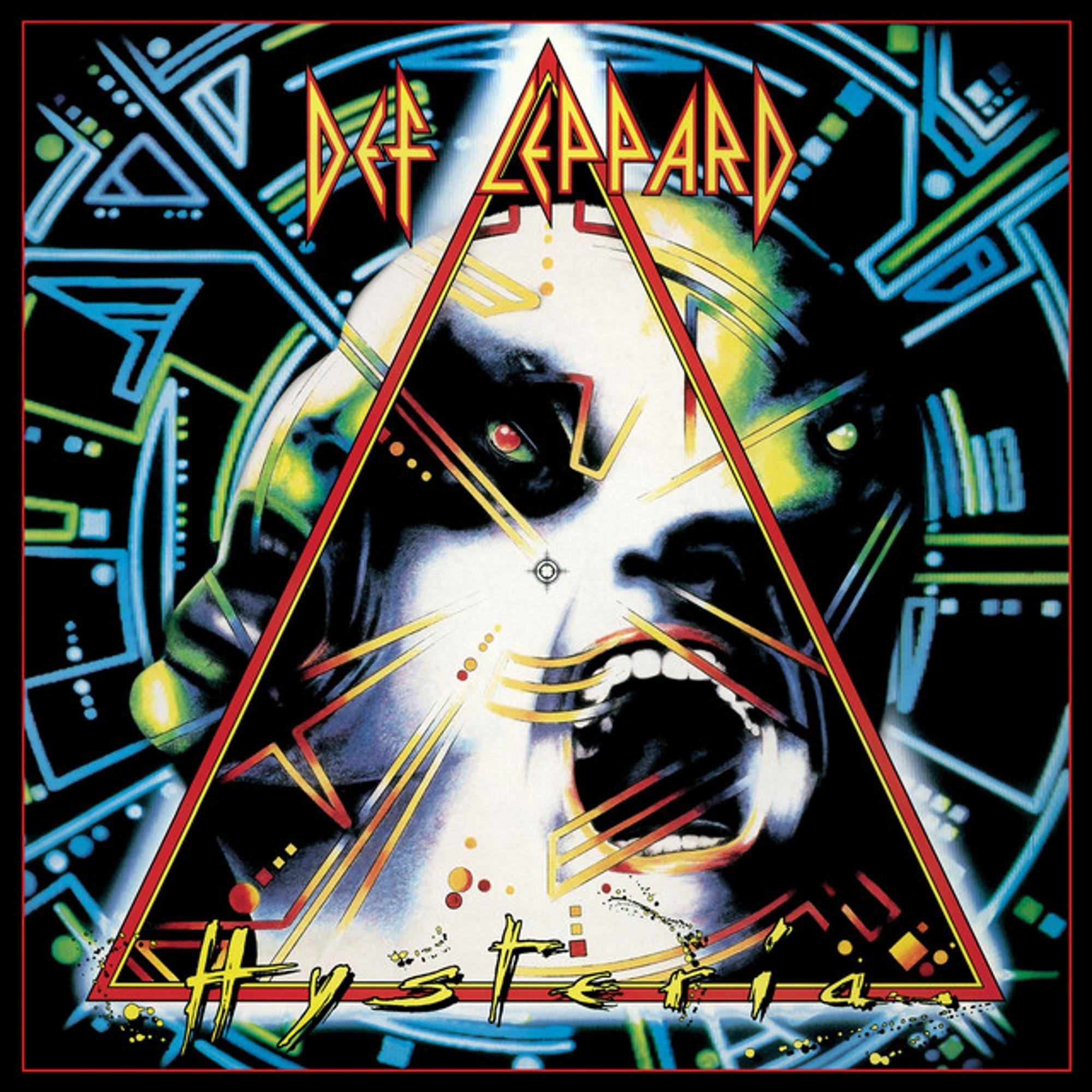
The album’s production costs reportedly reached $4.5 million, making it one of the most expensive British records ever made at the time (Guitar.com). The band and label (Mercury/Bludgeon Riffola) funded the project, but the financial pressure was immense: the album needed to sell five million copies just to break even. Yet, the investment paid off. The title “Hysteria” was suggested by Rick Savage, inspired by the chaos surrounding the band’s journey. The artwork, designed by Andie Airfix (Satori), featured a striking face motif and geometric shapes, capturing the high-tech, futuristic sound of the record.
Recording Process
The recording of Hysteria is legendary for its length and complexity. Sessions stretched from February 1984 to January 1987, spanning Wisseloord Studios in Hilversum, Windmill Lane in Dublin, and Studio Des Dames in Paris. The band recorded guitars first to a LinnDrum click track, with bass and drums added last—a reversal of standard practice. Mutt Lange, the producer, was central to the album’s sound, known for his perfectionism and desire to push the boundaries of studio technology.
Key personnel included Nigel Green (engineering, mixing), Mike Shipley (mixing), Bob Ludwig and Howie Weinberg (mastering), and Fairlight CMI programmer Philip Nicholas. Lange’s approach was painstaking: every vocal and guitar part was overdubbed, layered, and adjusted for pitch and timing. The use of the Rockman amplifier, developed by Tom Scholz of Boston, gave the guitars their distinctive, compressed sheen. Drum sounds were created with samples and played via the Fairlight CMI synthesiser. The result was a dense, polished sound unlike anything else in hard rock at the time.
The table below outlines the hardware and gear likely used in the studio, based on information from Guitar.com and community sources:
| Hardware / Gear | Studio Use / Notes |
|---|---|
| Rockman amplifier (modified) | Used for most guitar parts, giving a clean, compressed tone |
| Fender Stratocaster (“Felix”) | Phil Collen’s main guitar, fitted with DiMarzio Super Distortion humbucker |
| Gibson Les Paul (three-pickup, Kahler tremolo) | Steve Clark’s main guitar, providing tonal contrast |
| Charvel, Jackson guitars | Additional guitars used by Collen |
| Gallien-Krueger amp | Used on the demo for “Love Bites” and “Animal” intro feedback |
| Fairlight CMI synthesiser | Used for drum samples and programming |
| LinnDrum | Provided click track for guitars |
| Various studio microphones, desks, compressors | Assumed to include Neumann, Shure, SSL desks, Urei/DBX compressors (based on typical studios of the era) |
| Custom electronic/acoustic drum kit (Rick Allen) | Developed after Allen’s accident, used with MIDI pedals |
Lange’s perfectionism extended to writing as well. He co-wrote every song, sometimes rebuilding tracks from scratch. For example, “Animal” took nearly three years to complete, while “Pour Some Sugar on Me” was written and recorded in just two weeks near the end of the sessions. The process was slow, expensive, and exhausting, but the results were clear: every track sounded like a potential hit.
Below is a table of other albums produced by Robert John “Mutt” Lange, making clear his role for each album:
| Producer | Artist | Album | Year |
|---|---|---|---|
| Robert John “Mutt” Lange | Def Leppard | Pyromania | 1983 |
| Robert John “Mutt” Lange | Def Leppard | High ‘n’ Dry | 1981 |
| Robert John “Mutt” Lange | AC/DC | Back In Black | 1980 |
| Robert John “Mutt” Lange | AC/DC | Highway to Hell | 1979 |
| Robert John “Mutt” Lange | Foreigner | 4 | 1981 |
| Robert John “Mutt” Lange | The Cars | Heartbeat City | 1984 |
| Robert John “Mutt” Lange | Shania Twain | Come On Over | 1997 |
Commercial Performance and Reception
When Hysteria finally arrived in August 1987, expectations were sky-high. The album entered the UK Albums Chart at number one and climbed steadily in Europe. In the US, sales started slowly—partly because the lead single, “Women,” only reached number 80 on the Billboard Hot 100. Yet, everything changed when “Pour Some Sugar on Me” hit the airwaves, propelling the album to number one on the Billboard 200, where it stayed for six weeks. Hysteria spent 96 weeks in the US Top 40, tying Bruce Springsteen’s Born in the U.S.A. for the decade’s record.
The album sold over 12 million copies in the US alone (certified 12x Platinum by RIAA in 1998) and more than 20 million worldwide (Def Leppard Tour History). Seven singles were released, with “Love Bites” reaching number one in the US, and three others making the top ten. In the UK, “Animal” became the band’s biggest hit, peaking at number six. Hysteria is the highest-selling glam rock album ever and remains Def Leppard’s best-selling record.
Below is a table of Def Leppard’s studio albums, including sales data where available:
| Album Title | Year | Sales Data |
|---|---|---|
| On Through the Night | 1980 | 1.12 million |
| High ‘n’ Dry | 1981 | 2.6 million |
| Pyromania | 1983 | 12.1 million |
| Hysteria | 1987 | 25.3 million |
| Adrenalize | 1992 | 6 million |
| Slang | 1996 | 805,000 |
| Euphoria | 1999 | 689,000 |
| X | 2002 | Not stated |
| Yeah! | 2006 | Not stated |
| Songs from the Sparkle Lounge | 2008 | Not stated |
| Def Leppard | 2015 | Not stated |
| Diamond Star Halos | 2022 | Not stated |
Hysteria earned a slew of awards and certifications: 12x Platinum in the US, 2x Platinum in the UK, Diamond in Canada, and Platinum in Australia, New Zealand, and Switzerland. The album won Favourite Heavy Metal/Hard Rock Artist and Album at the 1989 American Music Awards and has been included in Rolling Stone’s “500 Greatest Albums of All Time.”
In 1987, the heavy music world saw a flood of notable releases by other artists. Key albums released that year include:
- Appetite for Destruction by Guns N’ Roses
- Permanent Vacation by Aerosmith (read our review)
- Girls, Girls, Girls by Mötley Crüe
- Among the Living by Anthrax (read our review)
- Once Bitten by Great White
- Keeper of the Seven Keys: Part I by Helloween
- Electric by The Cult
- Whitesnake by Whitesnake (read our review)
- Love Is for Suckers by Twisted Sister (read our review of their earlier album)
- Raise Your Fist and Yell by Alice Cooper
Throughout 1987, the music world changed rapidly. MTV’s Headbangers Ball debuted, Bon Jovi headlined Monsters of Rock, and new bands like Alice in Chains and Nirvana formed. In the wider world, Margaret Thatcher won her third term as UK Prime Minister, the Great Storm battered southern England, and Withnail and I became a cult film classic. It was a year of transformation in both music and culture.
Track Analysis
Hysteria produced an extraordinary seven singles: “Animal,” “Women,” “Pour Some Sugar on Me,” “Hysteria,” “Armageddon It,” “Love Bites,” and “Rocket.” Each single was released with its own artwork and track listing, and all were written by Joe Elliott, Rick Savage, Phil Collen, Steve Clark, and Mutt Lange, unless otherwise noted. The singles achieved the following chart positions:
- “Love Bites” – US #1
- “Pour Some Sugar on Me” – US #2
- “Armageddon It” – US #3
- “Animal” – UK #6, US #19
- “Rocket” – US #12
- “Women” – US #80
- “Hysteria” – US #10
Below is a table listing every song from the album, their lengths, and writing credits. Singles are marked with a *.
| Track Name | Length (s) | Writing Credit |
|---|---|---|
| Women* | 45 | Elliott, Clark, Collen, Savage, Lange |
| Rocket* | 54 | Elliott, Clark, Collen, Savage, Lange |
| Animal* | 64 | Elliott, Clark, Collen, Savage, Lange |
| Love Bites* | 62 | Elliott, Clark, Collen, Savage, Lange |
| Pour Some Sugar On Me* | 71 | Elliott, Clark, Collen, Savage, Lange |
| Armageddon It* | 54 | Elliott, Clark, Collen, Savage, Lange |
| Gods Of War | 48 | Elliott, Clark, Collen, Savage, Lange |
| Don’t Shoot Shot Gun | 42 | Elliott, Clark, Collen, Savage, Lange |
| Run Riot | 43 | Elliott, Clark, Collen, Savage, Lange |
| Hysteria* | 68 | Elliott, Clark, Collen, Savage, Lange |
| Excitable | 40 | Elliott, Clark, Collen, Savage, Lange |
| Love And Affection | 45 | Elliott, Clark, Collen, Savage, Lange |
Note: Songs marked with * were released as singles. Chart positions: “Love Bites” (#1 US), “Pour Some Sugar on Me” (#2 US), “Armageddon It” (#3 US), “Animal” (#6 UK, #19 US), “Rocket” (#12 US), “Women” (#80 US), “Hysteria” (#10 US).
Song Meaning and Lyrics
Every single from Hysteria has a story. The band’s meticulous approach to songwriting, guided by Mutt Lange, produced tracks that combined pop sensibility with hard rock power. Below, I’ll explore the meaning and inspiration behind each major single, drawing on interviews, band commentary, and published sources.
“Animal”: This was the first single released in the UK, and its creation was famously arduous, taking nearly three years. According to Joe Elliott, “Animal” began with a vocal melody recorded in Paris, but the band rebuilt the entire track around that vocal under Lange’s guidance (Ultimate Classic Rock). The lyrics evoke primal desire and the wild side of love, fitting the band’s reputation for energy and intensity.
“Women”: The opening track and first US single, “Women” is a hard rocker that delves into the story of creation and the power of women. Rick Savage noted that it began as a three-minute idea, but Lange helped the band expand it into an epic opener (Reddit, r/defleppard). The lyrics are both literal and symbolic, exploring themes of love, temptation, and the origins of human passion.
“Pour Some Sugar on Me”: Written last, this song’s infectious hook was inspired by bubblegum pop, specifically the lyric “pour a little sugar on me” from 1960s hits (99.1 WFMK). Phil Collen has said the song’s meaning is playful and not explicitly sexual, though it’s often interpreted that way. The vocal style, influenced by hip-hop and country, and the deliberate rhythmic gaps in the riff, give the track its distinctive swagger (Def Leppard Tour History).
“Hysteria”: The title track explores the feeling of overwhelming emotion and longing. Phil Collen explained that the lyrics started as a relationship song but grew to reflect the idea of enlightenment and the intensity of new love. The chorus—“Oh, I get hysterical, hysteria / Oh, can you feel it, do you believe it?”—captures that sense of magical, almost uncontrollable passion (Def Leppard Tour History | Musixmatch).
“Armageddon It”: The song’s title is a play on “Am I getting it?”—a tongue-in-cheek nod to the band’s sense of humour. Joe Elliott has said the band preferred the lyric style of T. Rex and Marc Bolan, focusing on words that sound good rather than literal meaning (Ultimate Classic Rock). The lyrics are filled with rock ‘n’ roll innuendo and glam influences.
“Love Bites”: This was Def Leppard’s only US number one single. Originally written as a country ballad by Mutt Lange, it was transformed in the studio into a power ballad with rich vocal harmonies. The lyrics explore the pain and risk of love, with lines like “Love bites, love bleeds / It’s bringing me to my knees.” Rick Savage said the song transcends the typical rock ballad, delivering both melody and a hard message (Reddit, r/defleppard).
“Rocket”: A celebration of the band’s musical heroes, “Rocket” references songs and artists from the 1960s and 1970s, including the Beatles, David Bowie, and T. Rex. The lyrics are packed with call-outs (“Jack Flash,” “Rocket Man,” “Ziggy,” “Bennie and the Jets,” “Major Tom”) and the song’s tribal drum rhythm was inspired by Burundi Black. The middle section was meant to be a modern take on Led Zeppelin’s “Whole Lotta Love” (Ultimate Classic Rock | Reddit, r/defleppard).
Touring and Promotion of Hysteria
Promotion for Hysteria was relentless. The band released seven singles, each with a dedicated music video. “Pour Some Sugar on Me” and “Animal” received heavy rotation on MTV, helping to push the album into the mainstream. The band also appeared on major TV shows and undertook a massive world tour, performing more than 200 shows between 1987 and 1988.
The Hysteria World Tour kicked off in Ireland and the UK, with a now-legendary three-night run at London’s Hammersmith Odeon and two nights in their hometown of Sheffield (Def Leppard Tour History). The band’s innovative “in the round” stage set-up brought fans closer to the action. Support acts included Tesla, who joined for much of the European and North American legs.
In 1987, Def Leppard played alongside other major acts on the Monsters of Rock festival circuit and headlined venues across North America, Europe, and Japan. Notable events included a triumphant homecoming in Sheffield and a series of sold-out shows in the US. The tour solidified their reputation as one of the biggest live acts of the era.
Influences and Legacy
Hysteria drew on a wide range of influences, from glam rock to pop and new wave. The band cited artists like Queen, T. Rex, David Bowie, and AC/DC as key inspirations. At the same time, their use of cutting-edge studio technology set a new standard for production in rock music.
The table below summarises some of the main influences and those influenced by Hysteria:
| Influences on “Hysteria” | Artists Influenced by “Hysteria” |
|---|---|
| Queen | Bon Jovi |
| T. Rex / Marc Bolan | Mötley Crüe |
| David Bowie | The Darkness |
| AC/DC | Taylor Swift |
| The Police | Matt Nathanson |
| Boston (Tom Scholz) | Modern pop-rock and metal bands |
Released in 1987, Hysteria arrived in a year packed with cultural and global events. The UK saw Margaret Thatcher win her third term, the Black Monday stock market crash shook economies, and new technology began to reshape daily life. In music, MTV’s Headbangers Ball launched, and artists like U2, Guns N’ Roses, and INXS also released landmark albums. The year was a turning point for alternative, pop, and heavy music alike.
Five Things About Hysteria
Here are five verified facts about Hysteria that underline its unique place in music history:
| Fact | Details |
|---|---|
| Most expensive British album of its time | Production costs reached $4.5 million; needed to sell 5 million copies to break even (Guitar.com). |
| Rick Allen’s comeback | Drummer Rick Allen lost his left arm but returned using a custom electronic/acoustic kit. |
| Seven hit singles | The album produced more hit singles than any other Def Leppard album. |
| Mutt Lange’s “Thriller” vision | Lange aimed for a “rock version of Thriller,” where every track could be a single. |
| Last album with Steve Clark | Guitarist Steve Clark died in 1991; Hysteria was his final full album with the band. |
Media and Television Usage
Songs from Hysteria have been widely used in film, TV, and popular culture. The table below shows notable media appearances, based on data from Tunefind:
| Song Title | Media Appearance | Year |
|---|---|---|
| Animal | 9-1-1 (TV, S2E4 “Stuck”) | 2018 |
| Armageddon It | American Horror Story (TV, S9E7 “The Lady in White”) | 2019 |
| Love Bites | Hysteria (Deluxe Edition), multiple TV shows | Various |
| Hysteria | Hysteria! (TV, S1E4 “Dance Macabre”) | 2024 |
| Pour Some Sugar on Me | Brooklyn Nine-Nine, Young Sheldon, Family Guy, Coyote Ugly (film), The Tonight Show, America’s Got Talent, and more | 2000–2021 |
| Rocket | Various TV shows and video games | Various |
Critical Reviews and Retrospectives
On release, Hysteria was met with widespread acclaim. AllMusic’s Steve Huey awarded it five stars, calling it “arguably the best pop-metal album ever recorded.” Rolling Stone ranked it in their “500 Greatest Albums of All Time” and topped their “50 Greatest Hair Metal Albums.” The album was also featured in “1001 Albums You Must Hear Before You Die.” Critics praised its dense production, songwriting, and innovation.
The table below summarises key reviews and scores:
| Publication | Score | Notable Quote | Link |
|---|---|---|---|
| AllMusic | 5/5 | “Arguably the best pop-metal album ever recorded.” | Read review |
| Rolling Stone | Top 500 | “The most iconic thing Def Leppard will ever do.” | Read feature |
| Loudwire | #2 Hair Metal | “A pop-metal masterpiece.” | Read list |
After Hysteria
The years after Hysteria were bittersweet. The band’s popularity soared, but tragedy struck again when Steve Clark died in 1991. The next album, Adrenalize (1992), was recorded as a four-piece and topped charts worldwide. Vivian Campbell joined as guitarist, and Def Leppard continued to tour and record, releasing Retro Active, Slang, and a string of successful albums through the 1990s and 2000s. The band were inducted into the Rock and Roll Hall of Fame in 2019 and remain active, touring globally and releasing new music as recently as 2024.
As of April 2025, Def Leppard are touring North America and Canada, with a major festival appearance at the Rock The Tides Festival in Riviera Maya, Mexico, and new releases including the “Pyromania 40 Box Set” and digital singles (Def Leppard Tour History).
Remasters and Reissues
There is no available information in the data sources about remasters or reissues of Hysteria for this section.
Conclusion
Few albums have left as deep a mark on music and culture as Hysteria. From its turbulent creation to its commercial triumph, it is a story of ambition, innovation, and sheer willpower. Def Leppard’s willingness to embrace new technology, their attention to detail, and their ability to craft timeless anthems ensured the album’s place in history. More than three decades later, its songs remain staples of radio, film, and live shows. As Def Leppard continue to tour and record, Hysteria stands as both a high point and a turning point—a reminder of what happens when a band dares to dream big.
Further Reading
For more on Def Leppard and the era of Hysteria, check out these articles and podcasts from our own archive:
- Def Leppard’s Pyromania: The Ultimate Rock Album (blog article)
- The Making of High ‘n’ Dry – Def Leppard’s Breakthrough (blog article)
- One Night Only Live at the Leadmill Sheffield by Def Leppard – album review (blog article)
- The Making of Hysteria by Def Leppard (podcast)
External resources:
Let us know in the comments what your thoughts are on Hysteria by Def Leppard. Did we miss anything? Share your experiences and join the conversation!
About the Author