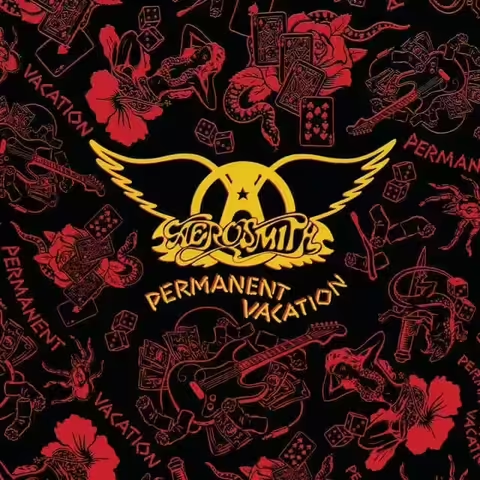
On 18 August 1987 Geffen Records released a record that nobody in the music business had any rational reason to expect. Aerosmith had not had a Top 40 single in nine years. Their 1985 reunion album Done with Mirrors, the first to put Steven Tyler, Joe Perry and Brad Whitford back in the same studio since 1979, had stalled at number 36 on the Billboard 200 and produced no hit. The Boston club circuit, not arenas, had been paying the bills for most of the decade. Yet Permanent Vacation entered the chart, kept climbing, peaked at number 11, threw off three Top 20 singles in a row and went on to ship five million copies in the United States alone. It is, in the most literal sense, the moment Aerosmith stopped being a 1970s band and became an MTV band.

The story of how that happened is not really a story about songs. It is a story about an A&R man in New York, a producer in Vancouver, a small group of professional songwriters in Los Angeles and Manhattan, and a band that, for the first time in roughly a decade, was sober enough to take direction. Permanent Vacation is the record on which Aerosmith stopped trying to be the Aerosmith of Toys in the Attic and Rocks and started trying to be a brand new commercial proposition. They did not all enjoy the process. The press did not entirely buy it at the time. None of that mattered: the template they invented in Vancouver in the spring of 1987 carried them all the way to Pump in 1989 and Get a Grip in 1993, and it became the de facto blueprint for every veteran-rock comeback that followed.

The August 1987 comeback

August 1987 was, by every reasonable measure, the worst possible moment to bet on an old hard rock band. Michael Jackson was about to release Bad, Whitesnake's self-titled album was halfway through a year on the chart, Def Leppard were finishing Hysteria in Holland, and U2's The Joshua Tree had already redrawn what a rock album was supposed to sound like in the post-Live Aid era. The new commercial centre of hard rock was Sunset Strip pop metal and a polished, MTV-shaped production style that Aerosmith had never been remotely associated with. Their last platinum album, Draw the Line, had been released ten years earlier.

What Permanent Vacation got right, almost immediately, was its understanding of how albums actually broke in 1987. The lead single, Dude (Looks Like a Lady), shipped to radio and MTV on 22 September 1987 and crossed over from rock formats to Top 40 within weeks. Angel followed on 5 January 1988 and ran all the way to number 3 on the Hot 100, the highest singles peak of Aerosmith's career to that point. Rag Doll, the third single, was released on 3 May 1988 and reached number 17. By the time the album fell off the chart it had clocked nearly a year of steady MTV rotation and was about to send the band back into arenas. The Permanent Vacation Tour, which ran from late 1987 through 1988, was the first headline arena run Aerosmith had played since the end of the original Rocks era.

The lead single and MTV smash that announced the comeback.

From Done with Mirrors to a second chance

The road to Permanent Vacation begins with a record almost nobody outside the band remembers. Done with Mirrors, released on 4 November 1985, was the album that brought Joe Perry and Brad Whitford back to Aerosmith after both guitarists had left during the chaotic Night in the Ruts sessions of 1979. It was also the first album of the band's deal with Geffen, signed by A&R chief John Kalodner the previous summer. On paper, it should have been a moment. In practice, Done with Mirrors stalled at number 36 on the Billboard 200, the lead single Let the Music Do the Talking failed to chart on the Hot 100 entirely, and the album fell out of view within months.

The reasons were not mysterious. Producer Ted Templeman, fresh off a run of Van Halen and Doobie Brothers records, had captured the band more or less live in the studio, which suited their swagger but produced a record that sounded thin against the radio mixes of the period. Tyler and Perry were still working through the back end of long-running substance problems. There were no obvious singles. Geffen, having taken a risk on a band most of the industry considered finished, had been left with a record that confirmed every skeptic's suspicion. Kalodner, who believed in the band more than almost anyone else at the label, refused to give up. By the end of 1986 he was already pushing for a complete reset on the next record: new producer, new studio, and, most contentiously, a new approach to songwriting.

Walk This Way with Run-DMC and the MTV primer

While Aerosmith were licking their wounds from Done with Mirrors, an unrelated record was quietly setting the stage for their second act. In July 1986, Run-DMC and producer Rick Rubin released a hip-hop reworking of Walk This Way that featured Steven Tyler and Joe Perry on guest vocals and guitar. The video, in which Tyler and Perry literally break through a wall to join Run-DMC in performance, was an immediate MTV phenomenon. The single climbed to number 4 on the Billboard Hot 100. For most of 1986 it was unavoidable on radio and television. It was also, crucially, a Run-DMC record on which the original band appeared as guests, not a comeback record on Aerosmith's own terms.

What the Walk This Way collaboration did was reintroduce Tyler and Perry to an MTV audience that, in 1986, was younger than the original Aerosmith singles. A generation that had grown up on Toys in the Attic via classic-rock radio now had a current, video-friendly point of contact. Kalodner understood the value of that gift immediately. The Run-DMC collaboration had primed MTV and pop radio for a new Aerosmith record in a way no amount of label promotion could have engineered from scratch. What Permanent Vacation needed to do was meet that primed audience with songs and videos that could live on the channel without the help of a guest artist. That, in turn, dictated almost every decision the band made about the album that followed.

Cleaning up: the sobriety years

The other precondition for Permanent Vacation was the slow and difficult business of getting the band clean. Tyler and Perry had been the public face of two decades of substance abuse, and the early reunion period had been only patchily sober. By 1986 the situation had shifted decisively. Tyler had gone through formal rehabilitation and was sober from 1986; Perry had cleaned up around the same time. Whitford, Tom Hamilton and Joey Kramer had been through their own struggles and were, for the first time since the original lineup had reformed, all in roughly the same shape at the same time. The band that walked into Little Mountain Sound in Vancouver in March 1987 was three years away from the closing crisis of the original era and, for the first time, capable of taking direction.

That mattered for two reasons. The first was practical: the schedule Bruce Fairbairn ran in Vancouver was disciplined, daytime, and absolutely not built for chaos. Fairbairn liked his sessions to start at noon and finish at midnight. He expected the band to turn up, work the songs and go home. Aerosmith of 1979 could not have completed an album under those conditions; Aerosmith of 1987 could and did. The second was creative: a sober Tyler was a Tyler who could sit in a hotel room in Los Angeles with Desmond Child and rewrite a chorus eight times until it worked. Sobriety, in that sense, was not just a personal recovery story. It was the precondition for the kind of disciplined commercial writing that Permanent Vacation would require.

John Kalodner and the Geffen gamble

John Kalodner was, by 1987, one of the most powerful A&R executives in the American music business. He had signed Foreigner at Atlantic in the 1970s, moved to Geffen at the label's founding in 1980, and spent the first half of the decade quietly building a roster around the idea that classic-rock acts could be repositioned for the MTV era with the right songs and the right producers. Aerosmith, signed in 1984 for what was widely considered a leap of faith, were the test case. Done with Mirrors had failed that test. Kalodner spent the back half of 1986 working out what to do about it.

His answer was to apply to Aerosmith the same recipe that was already working at other labels. The most successful hard rock records of the moment, Bon Jovi's Slippery When Wet, Heart's Bad Animals, Starship's No Protection, all leaned heavily on a small circle of professional songwriters who knew how to build a chorus that would work on Top 40 radio. Desmond Child had co-written You Give Love a Bad Name and Livin' on a Prayer with Jon Bon Jovi and Richie Sambora. Holly Knight had a hand in Heart's Never and Pat Benatar's Love Is a Battlefield. Jim Vallance was Bryan Adams's principal co-writer and had produced an enormous run of mid-1980s hits. Kalodner's pitch to Tyler and Perry, delivered with what every account of the period describes as quiet relentlessness, was simple. Put yourselves in a room with these people. Write together. Let the producer do his job. Stop trying to recreate 1975.

Bruce Fairbairn comes south from Vancouver

The producer Kalodner had in mind was Bruce Fairbairn. Fairbairn, a former trumpet player from Vancouver, had spent the early 1980s producing Loverboy. In 1986 he had walked into Little Mountain Sound with Jon Bon Jovi, Richie Sambora and a young engineer called Bob Rock and emerged a few months later with Slippery When Wet, which by the time Aerosmith arrived in Vancouver had already shifted past seven million copies in the United States and was on its way to twelve. He was, on a strict commercial reading, the hottest hard rock producer in the world. He was also methodical, sober, and famously unsentimental about cutting songs that were not working. The fit with what Kalodner wanted was almost too neat to be true.

What Fairbairn brought to Aerosmith was a way of working that the band had simply never experienced. Songs were demoed in pre-production, taken apart, reassembled, and only then committed to multi-track. Vocal takes were comped from multiple passes. Choruses were doubled and stacked. Backing vocals, in particular Tyler's high harmonies, were built in layers. Bob Rock engineered the basic tracking, the same Bob Rock who would, four years later, co-produce and mix Metallica's Black Album. Mike Fraser, then a junior engineer at Little Mountain, engineered and mixed substantial portions of the record and is credited in the liner notes for plunger mute as well. George Marino mastered at Sterling Sound in New York. None of these names were household names in August 1987. By the mid-1990s, between them, they had touched almost every major hard rock record in the world.

Co-writes with Desmond Child, Jim Vallance and Holly Knight

The songwriting summit that Kalodner had pushed for took place in late 1986 and early 1987, mainly in Los Angeles and New York. Tyler and Perry, the two members of the band who did all of the lead writing, were put on planes and sent to spend days at a time in rooms with people whose entire professional life was about constructing a chorus. The reports from inside those sessions are remarkably consistent: it was uncomfortable, the band was suspicious of the process, and the songs that came out of it were better than anything they had written on their own in a decade. Desmond Child contributed to Dude (Looks Like a Lady), Angel and Heart's Done Time. Jim Vallance, working principally with Tyler, co-wrote Rag Doll, Magic Touch, Hangman Jury and Simoriah. Holly Knight added a co-write on Rag Doll.

The result is an album that, more than any Aerosmith record before or after, is the product of two distinct creative cultures pressed against each other. The Tyler and Perry blues-and-swagger instinct is still everywhere; you can hear it in the riff on Heart's Done Time, in the harmonica on Hangman Jury, in the Beatles cover that closes the original CD. What Child, Vallance and Knight added was structure: choruses that landed in the right place, bridges that built tension, lyrics that resolved cleanly enough to be sung along to on first hearing. Tyler later acknowledged that the experience taught him a craft he had never previously had to think about. Perry, more reluctantly, came to the same view in time for Pump, on which the outside-writer model was retained almost unchanged.

Little Mountain Sound and Unique Recording

Tracking proper began at Little Mountain Sound in Vancouver in March 1987 and ran through May. Little Mountain, owned at the time by the Vancouver-based mogul Bob Brooks, was a working studio rather than a destination, two rooms of solid mid-1980s outboard built around a Neve console and a Studer multi-track. It was the room where Fairbairn was completely at home and where Bob Rock had spent the previous year cutting Slippery When Wet. Additional sessions, including some of the overdubs and guest performances, were tracked at Unique Recording in New York. The album was mixed at Little Mountain by Mike Fraser and Bob Rock and mastered by George Marino at Sterling Sound.

The recording itself was conventional by the standards of major-label hard rock in 1987: analogue multi-track tracking, generous overdubbing, digital reverb and delay, and a mix philosophy that placed the lead vocal and the snare drum aggressively forward. What was unusual was the speed. The album was tracked and mixed inside roughly three months, a tight schedule for a record of that ambition, and Fairbairn's reputation for finishing on time was a large part of why Geffen had signed off on the budget. The band were settled in apartments in Vancouver, working a relatively normal day. Tyler later said it was the first record he could remember making in which the work happened during daylight hours and the band went home at night sober.

Horns, mellotrons and steel drums

The single most distinctive production decision on Permanent Vacation was the use of a full horn section. Fairbairn, himself a trumpet player, had wanted to lean into brass on a hard rock record for years; the Aerosmith catalogue, with its R&B and soul heritage, was the natural place to try it. The arrangements were written by the Vancouver saxophonist and arranger Tom Keenlyside and performed by what amounted to a working Vancouver horn section: Ian Putz on baritone saxophone, Bob Rogers on trombone, Bruce Fairbairn himself on trumpet, and Henry Christian on a second trumpet. The horns appear most prominently on Dude (Looks Like a Lady), where they punctuate the chorus, and on Rag Doll, where they carry the entire arrangement.

The horn experiment was not the only departure from standard hard rock instrumentation. Drew Arnott, of the Vancouver band Strange Advance, played Mellotron on Angel and on the closing instrumental The Movie, providing the airy string-pad textures that give both pieces their cinematic feel. Morgan Rael added a steel drum part to the title track, an unlikely flourish that reinforces the album-title imagery of escapism and beach holiday. Mike Fraser, credited in the liner notes for plunger mute alongside his engineering and mixing duties, also stepped out of the control room to contribute that effect to the record. Tyler himself filled out his own credits with harmonica and piano in addition to the lead vocal. The cumulative effect is a record whose sonic palette is much wider than its hard rock packaging suggests.

Dude (Looks Like a Lady) and the title that wrote the song

The story of Dude (Looks Like a Lady) has been told often enough to acquire the worn edges of folklore, but the core of it is true. Tyler, on a night out in Los Angeles during the early co-writing period, ran into Vince Neil of Motley Crue at a club. Neil, at the time, was wearing the kind of teased-up glam metal hair and full makeup that was standard issue on the Sunset Strip in 1986. Tyler, working from the back of the room, mistook him for a woman until he got close enough to see otherwise. The phrase "dude looks like a lady" came out of that moment of confusion, was filed away in Tyler's notebook, and resurfaced in a co-write with Joe Perry and Desmond Child. Child, by his own account, talked Tyler out of his original working title for the song, Cruisin' for the Ladies, on the grounds that it was generic. The dude-looks-like-a-lady phrase had a hook built into it. They built the song around it.

What turned the song into a single, though, was the production. The horn section gives the chorus a swing that no straight hard rock arrangement could have delivered. The video, directed by Marty Callner and shot largely in performance with Tyler in occasional cross-dressing gags, became one of the most-played clips on MTV in the autumn of 1987 and was nominated for two MTV Video Music Awards. The single climbed to number 14 on the Billboard Hot 100, the band's first Top 20 hit since 1977. It would also become, in due course, the song that announced the entire reinvention. When the Geffen marketing department needed to explain in one sentence what the new Aerosmith sounded like, Dude (Looks Like a Lady) was the sentence they used.

Rag Doll and the swing experiment

Rag Doll began life as a Jim Vallance song called Rag Time and was reshaped during a co-writing session with Tyler and Perry into something closer to the band's blues-and-swing instincts. Holly Knight contributed during a later revision. The arrangement that ended up on the record leans even further into the horn-section template than Dude (Looks Like a Lady): a shuffle groove, a brass-driven hook, and a vocal performance from Tyler that quotes more from his record collection of pre-war jump blues than from any of his own previous lead vocals. It is the song on the album that most explicitly states the case for outside collaboration. None of the writers in the room on their own would have arrived at it.

Released as the third single on 3 May 1988, with a Marty Callner video that pastiches the burlesque imagery of the lyric, Rag Doll climbed to number 17 on the Billboard Hot 100 and consolidated the album's run of three consecutive Top 20 singles. By the time Rag Doll peaked, Permanent Vacation had been in the chart for the better part of nine months and the supporting tour was well into its arena run. The single also achieved one of the more useful side-effects of late-stage MTV success in 1987 and 1988: a foothold in the United Kingdom market, where Aerosmith had historically failed to break. Rag Doll reached number 42 on the UK singles chart, the album peaked at number 37, and the band were able to schedule their first proper UK tour leg since the late 1970s.

Angel and the power ballad gamble

Angel was, in many ways, the song that completed the commercial logic of the album. It is a Tyler and Desmond Child co-write, built around a piano figure rather than a guitar riff, with a vocal arrangement that asks Tyler to spend most of the song in the upper half of his range. It is, structurally, a Desmond Child power ballad of the same family as You Give Love a Bad Name's mirror image side of the Bon Jovi catalogue. For a band whose ballad history to that point ran through Dream On and Seasons of Wither, both written by Tyler alone, the decision to put their commercial fate in the hands of a Child co-write was not uncontroversial inside the group. Perry, in particular, made his unease known. Recorded with Drew Arnott's Mellotron and a layered Tyler vocal arrangement, the result was the biggest hit single of Aerosmith's entire career to that point.

Angel: a Tyler and Desmond Child power ballad that climbed to number 3 on the Billboard Hot 100.

Released as the second single on 5 January 1988, Angel peaked at number 3 on the Billboard Hot 100, sat in the Top 10 for weeks, and remains the band's highest-charting non-Diane Warren single. The Marty Callner video, which intercut performance footage with a stylised storyline, was again ubiquitous on MTV. The critical reception was more divided. Some reviewers, then and since, treated Angel as the moment Aerosmith abandoned the guitar-band identity that had made them interesting; Martin Popoff's Collector's Guide later called it "a career low" while still rating the album 8 out of 10. Others heard it as evidence that the band had finally figured out how to write a song that the wider pop audience would buy. In commercial terms there is no contest. Angel was the song that put the album over the top.

The deeper cuts, from Heart's Done Time to The Movie

The three singles are the public face of Permanent Vacation, but they sit inside a longer running order whose deeper cuts repay attention. Heart's Done Time, the Perry and Child opener, sets the album's stall with a riff that could have come off any pre-1980 Aerosmith record and a chorus that obviously could not. Magic Touch, a Tyler, Perry and Vallance pop-rock workout, sits in second position and delivers one of the most efficient four-minute pop-metal arrangements on the album. Simoriah, another Vallance co-write, leans on organ and is the closest thing on the record to a deep-cut showcase for the rhythm section of Tom Hamilton and Joey Kramer. St. John, a rare Tyler solo write, is a short and impressionistic interlude that exists mainly to set up the album's quieter back half.

That back half is where Permanent Vacation reveals how much wider its palette is than the singles suggest. Hangman Jury, a Tyler, Perry and Vallance co-write, is an acoustic blues piece with a slide-guitar feature for Perry and a long Tyler harmonica solo that sounds like a deliberate quotation from the band's earliest records. Girl Keeps Coming Apart, a Tyler and Perry song from before the Child sessions, is the closest the album comes to the old rocker template. I'm Down, the Lennon and McCartney cover that closes the original CD's main set, is performed as a high-speed homage. The Movie, an instrumental credited to all five band members, closes the album with Drew Arnott's Mellotron, cellos performed by Bruce and Scott Fairbairn, and backing vocals from Christine Arnott. It is a deliberate piece of cinematic scene-setting, an end-credits sequence for the record that follows it.

Reception, the press and the charts

Critical reception in the autumn of 1987 was decidedly mixed. Deborah Frost's review in Rolling Stone in October 1987 was the loudest sceptical voice, calling the recruitment of outside songwriters "one of the dumbest moves of a checkered career" while simultaneously conceding that the band had "never sounded better or more charged." Robert Christgau in The Village Voice gave the album a C+, summarising it as "running out of gas again already." The Rolling Stone Album Guide later filed it with 2 stars out of 5. Against that, AllMusic awarded 4 stars out of 5, the Metal Forces critic Dave Reynolds gave it 9.9 out of 10, and Martin Popoff's later Collector's Guide settled on 8 out of 10 in spite of his complaints about Angel. Loudwire's much later ranking of the band's catalogue placed Permanent Vacation as Aerosmith's sixth-best album, behind a cluster of mid-1970s records and, notably, ahead of every other record from the Geffen era except Pump.

The commercial story was less ambiguous. The album peaked at number 11 on the Billboard 200, number 37 in the United Kingdom, number 16 in Canada, number 42 in Australia and number 50 in Japan. Three Top 20 singles, Dude (Looks Like a Lady) at 14, Angel at 3 and Rag Doll at 17, gave the band their biggest pop-radio run since the mid-1970s. Sales certifications followed quickly and kept building: the BPI in the United Kingdom awarded Silver in July 1989 and Gold in March 1990, Music Canada certified the album 5x Platinum, the RIAJ in Japan awarded Gold, and by the time the RIAA's recertification process caught up the album was sitting on 5x Platinum status for shipments above five million in the United States alone. By any commercial measure Permanent Vacation had done exactly what Kalodner had hoped it would.

The Permanent Vacation Tour and the template for Pump

The Permanent Vacation Tour ran from late 1987 through 1988 and was the band's first headline arena tour since the original lineup era. The Permanent Vacation 3x5 home video, released by Geffen in 1988, compiled the three single videos with behind-the-scenes footage and became a quiet best-seller in its own right. Television appearances on shows including Saturday Night Live cemented the band's return to the cultural centre. For an act that had spent the first half of the decade playing small theatres and clubs, the scale of the touring operation was a recalibration in itself.

What Permanent Vacation also did was establish a working method. Bruce Fairbairn returned for Pump in 1989, with the same engineering team at Little Mountain Sound and many of the same outside writers. Pump climbed to number 5 on the Billboard 200, produced four hit singles including Love in an Elevator and Janie's Got a Gun, and pushed past seven million United States sales. The model was extended again on Get a Grip in 1993, with Fairbairn producing for a third time, Desmond Child returning as a co-writer alongside Diane Warren on Crazy and Cryin', and the album eventually surpassing seven million United States copies. None of that would have been imaginable on any reading of the band's trajectory in late 1986. All of it followed directly from the bet that the band, Kalodner, Fairbairn and a handful of professional songwriters had made together in the spring of 1987. The template they built around Permanent Vacation became, in retrospect, the model for an entire generation of veteran-rock reinventions that came after it.

Personnel

  • Steven Tyler - lead vocals, harmonica, piano
  • Joe Perry - lead and rhythm guitar, slide guitar, pedal steel, backing vocals
  • Brad Whitford - rhythm and lead guitar
  • Tom Hamilton - bass guitar
  • Joey Kramer - drums, percussion
  • Drew Arnott - Mellotron on Angel and The Movie
  • Christine Arnott - backing vocals on The Movie
  • Morgan Rael - steel drums on the title track
  • Tom Keenlyside - horn arrangements
  • Ian Putz - baritone saxophone
  • Bob Rogers - trombone
  • Bruce Fairbairn - trumpet, producer
  • Henry Christian - trumpet
  • Bruce Fairbairn and Scott Fairbairn - cellos on The Movie
  • Bob Rock - engineering
  • Mike Fraser - engineering, mixing, plunger mute
  • George Marino - mastering at Sterling Sound, New York
  • Kim Champagne - art direction and design
  • John Kalodner - A&R, Geffen Records

Tracklist

#TitleLength
1Heart's Done Time4:42
2Magic Touch4:40
3Rag Doll4:21
4Simoriah3:21
5Dude (Looks Like a Lady)4:23
6St. John4:11
7Hangman Jury5:33
8Girl Keeps Coming Apart4:13
9Angel5:09
10Permanent Vacation4:51
11I'm Down2:21
12The Movie4:01

Things you might not know

FactDetail
Bob Rock's day jobThe album was engineered by Bob Rock, then a junior at Little Mountain Sound, who four years later co-produced and mixed Metallica's Black Album.
Where Dude got its titleSteven Tyler coined the phrase "dude looks like a lady" after mistaking Motley Crue's Vince Neil for a woman in a Los Angeles club in 1986, with Crue's Girls Girls Girls then in the air.
Tyler's sobriety yearTyler had completed formal rehabilitation in 1986 and was the longest he had been clean in twenty years by the time tracking began.
Fresh from Slippery When WetBruce Fairbairn arrived in Vancouver to start the album having just delivered Bon Jovi's Slippery When Wet, which by mid-1987 had already shifted past seven million copies in the United States.
Kalodner's strategyJohn Kalodner essentially copied his own Bon Jovi playbook for Aerosmith: contemporary producer, outside writers from the Desmond Child and Jim Vallance circle, and a polished Little Mountain mix.
The horn sectionProducer Bruce Fairbairn played trumpet himself on the horn arrangements and recruited a working Vancouver brass section, including baritone saxophonist Ian Putz, around arranger Tom Keenlyside.
The 3x5 home videoGeffen released the three video singles as a long-form home video titled Permanent Vacation 3x5 in 1988, which became a steady catalogue seller on VHS through the early 1990s.
5x Platinum United StatesThe album was eventually certified 5x Platinum by the RIAA for shipments above five million copies in the United States alone.
The template for Pump and Get a GripThe Fairbairn and outside-writer model was retained almost unchanged for Pump in 1989 and Get a Grip in 1993, with the latter eventually surpassing seven million United States copies.
Run-DMC's giftThe 1986 Walk This Way collaboration with Run-DMC, which peaked at number 4 on the Hot 100, primed MTV and pop radio for the new Aerosmith record before a single note of Permanent Vacation had been written.

How to listen now

Permanent Vacation has been continuously in print since 1987 and is available on all major streaming services in its original twelve-track sequence. The album has been remastered for compact disc twice, in 1993 for the Geffen catalogue refresh and again in 2012 for the high-resolution digital editions, both supervised by the original mastering engineer George Marino at Sterling Sound. Original 1987 Geffen vinyl pressings remain easy to find on the second-hand market and are usually the cheapest way to hear the analogue mix in its first-pressing form. For listeners coming to the record for the first time, the standard streaming master is faithful to the original Little Mountain mix; for collectors, the 1988 Permanent Vacation 3x5 home video remains the easiest way to see the three singles in their original MTV context.