Robert John "Mutt" Lange told Def Leppard, in a Dublin rehearsal room in early 1984, that their next album was going to be a rock Thriller: twelve tracks, every one a potential single, no riff left unsanded, no chorus left unlayered. Three months later their drummer lost his left arm in a Corvette wreck on the A57 west of Sheffield. Three years after that, on 3 August 1987, the band actually delivered the record Lange had pitched.
The making of Hysteria took four years, three studios in three countries, two car crashes, one fired producer (Jim Steinman), an episode of mumps and a sum of studio money usually quoted as the highest ever spent on a British album to that point. Phil Collen has said the band needed to sell five million copies just to break even. They sold more than 20 million. The album spent six weeks at number one in America, spawned seven hit singles, and gave Def Leppard the rare distinction of simultaneously holding the top of the Billboard Hot 100 and the Billboard 200 for a week in October 1988. The story is impossible. The record proves it happened.
Album Facts
| Field | Detail |
|---|---|
| Artist | Def Leppard |
| Album | Hysteria |
| Release date | 3 August 1987 |
| Label | Bludgeon Riffola / Mercury |
| Producer | Robert John "Mutt" Lange |
| Studios | Wisseloord (Hilversum), Windmill Lane (Dublin), Studio Des Dames (Paris), with mixing at Mutt Lange's private studio in Hindhead, Surrey |
| Recording dates | February 1984 to late January 1987, with mixing through to spring 1987 |
| Genre | Glam metal, arena rock, hard rock, pop rock |
| Track count | 12 |
| Total runtime | 62:32 |
| UK Albums Chart peak | 1 |
| US Billboard 200 peak | 1 (six weeks in total, reached 23 July 1988) |
| Other number-one territories | Australia, New Zealand, Norway, Finland, Cashbox (US) |
| Certifications | 12-times Platinum (US, RIAA), Diamond (Canada), 2-times Platinum (UK), 4-times Platinum (Australia) |
| Estimated sales | More than 20 million worldwide; some sources cite 25 million-plus |
| Key singles | Women, Animal, Hysteria, Pour Some Sugar on Me, Armageddon It, Love Bites (US number one), Rocket |
Def Leppard before Hysteria
The story starts in Sheffield in 1976, when a trio of Tapton School pupils, Rick Savage among them, formed a covers act called Atomic Mass. A chance bus-stop encounter with a young Joe Elliott in November 1977 added a frontman; the spelling-modified name Def Leppard was Elliott's, scribbled on a poster in art class. Steve Clark joined in January 1978 after auditioning with the entirety of Lynyrd Skynyrd's "Free Bird". By the end of the year, fifteen-year-old Rick Allen had answered an advert headlined "Leppard loses skins" and become the band's full-time drummer.
Their debut EP, three songs recorded for around 150 pounds, caught the ear of John Peel on BBC Radio 1 and pulled them into the orbit of the new wave of British heavy metal. Phonogram signed them. Peter Mensch of Leber-Krebs took over management after Joe Elliott had a fistfight with their original manager on tour. The first album, On Through the Night, hit the UK top fifteen in March 1980, but a perceived attempt to court America with songs like "Hello America" earned them a reputation for selling out and, at the Reading Festival that August, a hail of beer cans and urine-filled bottles from the audience.
The second album, High 'n' Dry (1981), introduced the relationship that would define everything that followed: a young South African producer named Robert John "Mutt" Lange, fresh from Highway to Hell and Back in Black with AC/DC, who insisted on tracking guitars one chord at a time and stacking vocals into harmonised banks. The video for "Bringin' On the Heartbreak" became one of the first hard-rock clips on MTV. Then, in July 1982, rhythm guitarist Pete Willis was fired for chronic drinking and replaced overnight by Phil Collen of glam metallers Girl, with the slot taken mid-recording on what would become the third album.
That album, Pyromania, landed in January 1983 and broke the band wide open. "Photograph" displaced Michael Jackson's "Beat It" as the most requested video on MTV, and the record sold ten million copies in the United States, held off the Billboard top spot only by Thriller itself. Def Leppard were, by 1984, the second-biggest rock band in the world. The bar for what came next was set, and the band knew it.
The Thriller ambition
In February 1984, fresh off the Pyromania tour and shifted to Dublin for tax reasons, the band sat down with Mutt Lange to demo their next record on Fostex four-track cassette machines. Early sketches of "Animal", "Gods of War" and "Armageddon It" emerged. The ambition, set out by Lange almost immediately, was startling for a hard rock band: Hysteria would be the rock Thriller. Every song would be a potential single. Every chorus would be designed for radio. The riffs that had cemented Pyromania on the Album Rock Tracks chart were to be sanded down, layered, prettified, and weaponised for the Hot 100.
Lange would later refine and re-export the same template, with results that bear remarking on. Working with his then-wife Shania Twain in the 1990s, he applied an almost identical "every song is a single" approach to Come On Over, which went on to become the best-selling album by a solo female artist in history. Hysteria was the laboratory.
What disappointed metal fans waiting for a straight sequel to Pyromania would later be exactly what crossed the album over to the audience that had bought Born in the U.S.A. and Brothers in Arms. But none of this was apparent in early 1984. What was apparent was that Lange, exhausted from a brutal five-year production schedule, did not actually want to produce the album he had just helped sell to the band.
Rick Allen's accident
The first crisis was creative. Lange begged off, citing burnout, and recommended the band hire Jim Steinman, the Wagnerian Broadway veteran behind Meat Loaf's Bat Out of Hell. Steinman, with engineer Neil Dorfsman in the chair, started sessions at Wisseloord Studios in Hilversum on 11 August 1984. It went badly. Steinman wanted to capture moments; Def Leppard wanted to construct cathedrals. As Joe Elliott observed afterwards, "Steinman wouldn't adapt and we wouldn't compromise." By October he was gone. Dorfsman, who had to leave to begin work on Dire Straits' Brothers in Arms, later said the band "barely had drums and bass on seven songs" after three months of work. The tapes were scrapped.
The band tried producing the album themselves with Lange's engineer Nigel Green. Progress was glacial. "It was very slow work because we didn't have any sort of headmaster there," Steve Clark recalled, "and we had to try everything five different ways." And then came New Year's Eve.
The car in front of Allen's Corvette on the A57 had been baiting him for several miles, slowing down when he tried to pass and accelerating when he gave up. In frustration, he finally floored it. The C4 left the road, struck a dry stone wall, and ended in a field with Allen flung clear. His left arm, tangled in the seat belt, remained in the car. His passenger and then-girlfriend, Miriam Barendsen, survived.
"What I've experienced through losing my arm, I wouldn't change. The human spirit is so strong."
Rick Allen, quoted in Laura Jeffrey's Def Leppard: Arena Rock Band, 2010
The other four members never seriously considered replacing him. Allen, propped up by, as he later put it, "family, friends and hundreds of thousands of letters from all over the planet", worked out that the basic four-limb pattern of a rock drummer could, with enough mechanical help, be remapped onto three. He went into a separate studio room to practise, while Lange (lured back during 1985 for vocal sessions in Paris) began the wholesale process of rewriting and re-recording everything that had been done so far.
The Simmons kit
Allen worked with engineers from electronic-drum company Simmons, with input from Jeff Rich of Status Quo who briefly toured alongside him as a safety net, to design a hybrid kit. Acoustic shells on the right side; an array of electronic pads triggered, via MIDI, from four foot pedals on the left. From left to right those pedals fire a closing hi-hat, a bass drum, a snare and a tom: precisely the voices Allen's missing left arm used to cover. Whirlwind built him custom cable routing so that the spaghetti of triggers and audio runs didn't trip up the rest of the stage.
The other members tested the new arrangement in private. Allen's first sign-off moment came when he gathered the band in a Dublin rehearsal room and played the opening of Led Zeppelin's "When the Levee Breaks" all the way through. "A very emotional moment," Joe Elliott called it. His first live performance came on 5 August 1986 in Ireland, ahead of an emotional return at the Monsters of Rock festival at Castle Donington on 16 August. The audience response answered any lingering question about whether the band could continue.
The four-year recording marathon
Lange's return in summer 1985 did not, as the band had hoped, accelerate the process. After listening back to what they had cut, he decided most of it sounded too much like Pyromania and would have to be redone. That added another eighteen months. Sessions ricocheted between Paris (six weeks at Studio Des Dames for vocals), Hilversum (Wisseloord), and Dublin (a cheap jingle studio at Windmill Lane that the band found congenial precisely because it lacked the polish of a "proper" rock facility). Lange's own car accident in 1986 cost more time, as did the bout of mumps Joe Elliott contracted in late 1986.
The recording methodology was unlike almost any other rock album of its era. Guitars went to tape first, played to a LinnDrum click track so that Lange could re-arrange and re-record at will. Bass and drums came last, once every other decision had been made. This allowed Lange to keep editing structure for years after the parts had been laid down. Individual notes, not phrases, were the unit of recording: Phil Collen has said that for some solos Lange would have him punch in a single note at a time and audition takes.
Vocals were stacked in extraordinary detail. The band, the producer, and a stray vocalist called Rocky Newton (collectively credited as The Bankrupt Brothers) layered backing tracks in passes that pitched individual lines up or down by tiny intervals to fatten the harmonic field. Gary Kemp and Steve Norman of Spandau Ballet contributed uncredited backing vocals to "Animal". The drum sounds were sampled, programmed and sequenced on a Fairlight CMI by Philip "Art School" Nicholas, with engineer Mike Shipley noting in a 1999 Mix magazine interview that the team would record source sounds at half speed to give the eight-bit machine enough harmonic information to play them back convincingly.
By the autumn of 1986 the project had a managing director at Phonogram, David Simone, telling colleagues it might be the most expensive record ever made in Britain. Phil Collen later said the album needed to sell five million copies just to break even. The final sessions ran into late January 1987, with "Armageddon It" cut last and one final composition added in a panic: "Pour Some Sugar on Me", written, demoed and tracked inside two weeks at Lange's insistence that the album still needed a single. Lange then took the tapes home to his private studio in Hindhead, Surrey, and spent another three months mixing them with Nigel Green and Mike Shipley.
Lange's production tricks
Some of the choices that define the album's sound:
- A custom-modified Rockman headphone amplifier, designed by Boston's Tom Scholz, was used for the majority of guitar tones. Mike Shipley later called it "a shitty little box" with "a godawful sound" that "had no real balls to it", but Lange preferred its compressed, layerable character to a "crunchy" Marshall stack.
- Phil Collen tracked most of his parts on a Fender Stratocaster nicknamed "Felix", retrofitted with a DiMarzio Super Distortion humbucker. Steve Clark favoured a three-pickup Gibson Les Paul fitted with a Kahler tremolo.
- Drum sounds were Fairlight CMI samples rather than mic'd kits, programmed by Philip Nicholas. The drums were recorded last, so that any change to song structure earlier in the process did not stick the band with a fixed rhythm bed.
- Every backing vocal was pitched separately and stacked, with no two passes sharing exactly the same intonation, giving the wall-of-harmonies effect that became the band's signature.
- Bob Ludwig and Howie Weinberg both did mastering passes on different formats.
Personnel
| Role | Player | Notes |
|---|---|---|
| Def Leppard | ||
| Lead vocals | Joe Elliott | Battled mumps during late 1986 sessions |
| Guitars, backing vocals | Phil Collen | Joined 1982; main lead guitar throughout |
| Guitars, backing vocals | Steve Clark | His final full Def Leppard album; died January 1991 |
| Bass, backing vocals | Rick Savage | Also played the jangle guitar on the title track "Hysteria" |
| Drums, backing vocals | Rick Allen | Played a hybrid Simmons electronic and acoustic kit with foot-triggered pads |
| Additional and guest personnel | ||
| Backing vocals | The Bankrupt Brothers | Collective credit for Def Leppard, Mutt Lange and Rocky Newton |
| Backing vocals (uncredited) | Gary Kemp | On "Animal" |
| Backing vocals (uncredited) | Steve Norman | On "Animal" |
| Fill-in drummer (touring rehearsal) | Jeff Rich | Status Quo drummer; brought in August 1986 as a safety net for Allen's return, dropped after Allen proved he could play solo |
| Production | ||
| Producer | Robert John "Mutt" Lange | His third and final Def Leppard production |
| Engineering, mixing, production assistance | Nigel Green | Held the studio together through Lange's absences in 1985 |
| Engineering (Steinman sessions) | Neil Dorfsman | Left to engineer Dire Straits' Brothers in Arms |
| Engineering | Ronald Prent, Erwin Musper, Pete Woolliscroft | Misspelled as "Pete Williscroft" in original sleeve credits |
| Fairlight CMI programming | Philip "Art School" Nicholas | Drum sample creation and sequencing |
| Mixing | Mike Shipley | At Lange's Hindhead studio with Nigel Green |
| Mastering | Bob Ludwig, Howie Weinberg | |
| Artwork | ||
| Illustration, artwork, design | Andie Airfix (Satori) | |
| Photography | Ross Halfin, Laurie Lewis | |
| Production team (rejected) | ||
| Original producer | Jim Steinman | Worked August to October 1984 at Wisseloord; sacked when sessions yielded little more than basic tracks for seven songs |
The songs
The twelve-track running order is one of the most ruthlessly sequenced of any 80s rock album, designed to put the four most radio-ready tracks on the first half of the LP and break up the heavier material with breathers.
| # | Title | Writers | Length | Single? | Notes |
|---|---|---|---|---|---|
| 1 | Women | Clark, Collen, Elliott, Lange, Savage | 5:42 | US/Canada | Released as the first US single ahead of "Animal" on Cliff Burnstein's insistence that the band reconnect with rock radio first |
| 2 | Rocket | Clark, Collen, Elliott, Lange, Savage | 6:37 | Yes | Burundi-influenced tribal drum pattern, samples Jack King's Apollo 11 launch commentary, packed with call-outs to 70s glam icons |
| 3 | Animal | Clark, Collen, Elliott, Lange, Savage | 4:04 | Yes (UK lead) | Took nearly three years to finish; the band's first UK top ten single |
| 4 | Love Bites | Clark, Collen, Elliott, Lange, Savage | 5:46 | Yes | Originally a country ballad sketched out by Lange; Def Leppard's only US Hot 100 number one |
| 5 | Pour Some Sugar on Me | Clark, Collen, Elliott, Lange, Savage | 4:27 | Yes | Written, demoed and tracked in two weeks at the end of sessions; later voted number two on VH1's 100 Greatest Songs of the 80s |
| 6 | Armageddon It | Clark, Collen, Elliott, Lange, Savage | 5:24 | Yes | Title is a pun on "Am I getting it?"; final new song cut for the album |
| 7 | Gods of War | Clark, Collen, Elliott, Lange, Savage | 6:37 | Coda samples Ronald Reagan and Margaret Thatcher speeches plus Solidarity chants | |
| 8 | Don't Shoot Shotgun | Clark, Collen, Elliott, Lange, Savage | 4:26 | One of the heavier deep cuts | |
| 9 | Run Riot | Clark, Collen, Elliott, Lange, Savage | 4:39 | The closest the album gets to straight Pyromania-era hard rock | |
| 10 | Hysteria | Clark, Collen, Elliott, Lange, Savage | 5:54 | Yes | Title track; Rick Savage plays the jangle guitar figure |
| 11 | Excitable | Clark, Collen, Elliott, Lange, Savage | 4:19 | Showcase for Lange's stacked vocal techniques and Fairlight programming | |
| 12 | Love and Affection | Clark, Collen, Elliott, Lange, Savage | 4:37 | Closes the record on a relatively restrained note |
"Animal" was the song that, more than any other, defined the album's painful gestation. Joe Elliott has said it began with a single vocal melody captured at Studio Des Dames in Paris, around which the band rebuilt the entire arrangement under Lange's direction. Three years passed between the first sketch and the final mix. Ironically, after all that work it stalled at number 19 on the Billboard Hot 100, becoming the band's biggest UK hit but only the fourth or fifth most successful single from the album in America.
"Pour Some Sugar on Me" arrived under wildly different circumstances. With sessions winding down in January 1987, Lange listened back to the running order and decided it lacked one final, undeniable anthem. The hook, "pour a little sugar on me", was borrowed and inverted from the 1965 Archies-adjacent bubblegum hit "Sugar, Sugar". The vocal cadence drew on early hip-hop. Phil Collen has consistently said the lyric was meant to be playful rather than literally suggestive, though stripclubs across America have spent four decades disagreeing. The deliberate gaps in the riff, the chant-along bridge, and the cowbell-driven verses make it the most efficient piece of pop construction on the record.
"Love Bites" sounded so unlike a Def Leppard song that the band were nervous about releasing it. The melody and lyric came almost wholesale from a country ballad Lange had been kicking around in his own writing for some time. Def Leppard reworked it into a power ballad with the album's most elaborate vocal harmonies. Released in July 1988, it spent a week at number one on the Billboard Hot 100 in October 1988, the same week the album returned to number one on the Billboard 200, giving the band the rare and slightly disorienting honour of simultaneously holding the top spot on both charts.
"Rocket" is the album's biggest love letter. Built on a tribal drum pattern modelled on the African polyrhythms of Burundi Black (the same source that had inspired Adam and the Ants and Bow Wow Wow earlier in the decade), it stitches in call-outs to Bowie ("Major Tom", "Ziggy"), Elton John ("Rocket Man", "Bennie and the Jets"), the Stones ("Jack Flash") and others. The middle eight reportedly began as a deliberate update of Led Zeppelin's "Whole Lotta Love". Samples of Apollo 11 launch commentator Jack King appear in the mix. Released as the seventh and final single in early 1989, it still made the US top fifteen, more than eighteen months after the album's release.
The deeper cuts repay the attention they rarely get. "Gods of War" is the most overtly political thing the band ever recorded, its coda stitched from Reagan and Thatcher soundbites and chants of "Solidarność" from the Polish trade union movement. "Excitable" turns the Fairlight loose almost as a featured instrument. "Don't Shoot Shotgun" and "Run Riot" are the closest the album gets to the riff-first hard rock of Pyromania, and they sit deliberately in the second half so that anyone who came for the singles has to earn them.
B-sides and outtakes
The seven-singles strategy meant Def Leppard had to find a small library of additional songs to populate the B-sides of an enormous run of formats. Most were cut in February 1987, after the album had been completed but before mixing was finished. The notable extras:
- "Tear It Down", a heavier track left over from the Hysteria writing sessions, eventually rerecorded for 1992's Adrenalize.
- "I Wanna Be Your Hero", a melodic mid-tempo number that became a fan favourite on the B-sides circuit.
- "Ring of Fire" (not the Johnny Cash song), used as a B-side to "Armageddon It" in the UK and "Pour Some Sugar on Me" in the US.
- "Ride into the Sun", a 1987 re-recording of the song from the band's 1979 debut EP, tucked away on the "Hysteria" single.
- "Release Me", a tongue-in-cheek Engelbert Humperdinck cover credited to "Stumpus Maximus and the Good Ol' Boys", actually the band singing backup behind their roadie-turned-tour-manager Malvin Mortimer.
- "Tonight", recorded on 5 May 1988 during a break in the tour and shelved; eventually rerecorded for Adrenalize, with the original 1988 Steve Clark version released later on box sets.
Two further compositions from the period, "Desert Song" and "Fractured Love", surfaced in remixed form on 1993's B-sides compilation Retro Active, before the unaltered Hysteria-era versions were finally restored to the 2006 deluxe edition.
The Andie Airfix cover
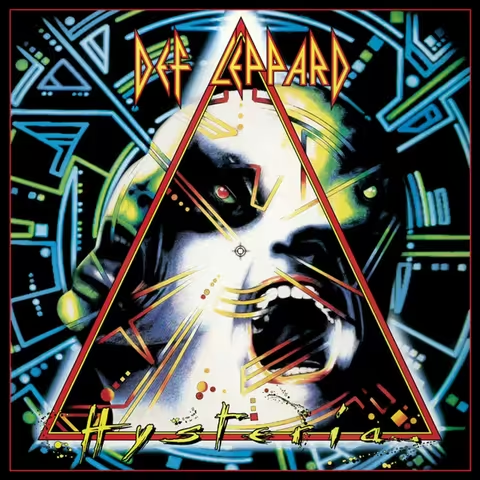
The sleeve was designed by Andie Airfix at his Satori studio. The cover image, a stylised face surrounded by interlocking geometric panels, was meant to capture the high-gloss, future-shock feel of Lange's production rather than reference any of the songs literally. The same visual language extended across the seven single sleeves, each of which used a different colour palette and panel arrangement so that fans could line them up as a set. Photographer Ross Halfin supplied the band shots, with additional photography by Laurie Lewis. The original Phonogram inner sleeve carried the unusual courtesy of a band note apologising to fans for the long wait between albums, with a promise (later disastrously broken by Steve Clark's death) never to make them wait that long again.
Release and reception
Hysteria was released on 3 August 1987 and entered the UK Albums Chart at number one in its first week. European success followed quickly. In the United States, however, the lead single "Women" stalled at number 80 on the Billboard Hot 100. The choice of "Women" over the more obviously commercial "Animal" was a deliberate strategy by then-manager Cliff Burnstein, who reasoned that the band needed to lock in the rock radio audience before chasing top forty crossover. It worked at AOR (number seven on the Mainstream Rock chart) and missed everywhere else.
The album entered the Billboard 200 at number 12 and then began an unusual climb. Each new single (Animal, then Hysteria, then Pour Some Sugar on Me, then Armageddon It, then Love Bites, then Rocket) pushed it higher rather than letting it slip away. It finally reached number one in the United States on 23 July 1988, nearly a year after release, and spent six weeks at the top over three separate visits. It would spend 96 weeks in the US top forty, tying a 1980s record held only by Bruce Springsteen's Born in the U.S.A.
Critical reception was generally positive but cautious at the time. AllMusic's Steve Huey, writing retrospectively, gave it five stars and called it "arguably the best pop-metal album ever recorded", noting that some critics had dismissed it on release as "a stiff, mechanized pop sell-out". Pitchfork's Ian Cohen, reviewing the album for the first time in April 2025, gave it 8.7 out of 10. Classic Rock's Dave Everley, reviewing the 30th anniversary edition for Louder in 2017, gave four and a half stars.
"By the time we did Hysteria, everything had fallen into place. Airplay and hit singles were one aspect of it but there was also all the hard work we put into the album. We literally did slave over it to get every sound on it right."
Joe Elliott, Kerrang! magazine, May 2008
Retrospectively, the album has been near-canonised. Rolling Stone placed it at number 464 on its 500 Greatest Albums of All Time list, ranked it number one on its 50 Greatest Hair Metal Albums, and included it on its 50 Rock Albums Every Country Fan Should Own. Loudwire put it second on its Top 30 Hair Metal Albums. The Ringer's Rob Harvilla, marking the album's 30th in 2017, called it "the greatest hair-metal album ever made". The 1989 American Music Awards gave Def Leppard both Favourite Heavy Metal/Hard Rock Artist and Favourite Heavy Metal/Hard Rock Album.
Singles and music videos
| Single | Released | UK peak | US peak | Selected B-sides |
|---|---|---|---|---|
| Animal | 20 July 1987 (UK lead) | 6 | 19 | Tear It Down, I Wanna Be Your Hero |
| Women | August 1987 (US lead) | 80 (Hot 100); 7 (Mainstream Rock) | Tear It Down | |
| Pour Some Sugar on Me | 7 September 1987 | 18 (1987), 2 (1988 reissue) | 2 | Ring of Fire, I Wanna Be Your Hero, extended Lunar mix of Rocket |
| Hysteria | 16 November 1987 | 26 | 10 | Ride into the Sun (1987 re-recording), Love and Affection (live) |
| Armageddon It | 28 March 1988 | 20 | 3 | Ring of Fire (UK), Release Me (US), Nuclear mix |
| Love Bites | 4 July 1988 | 11 | 1 | Billy's Got a Gun (live), Excitable Orgasmic mix |
| Rocket | 30 January 1989 | 15 | 12 | Release Me, Women (live), Lunar mix |
The videos were directed largely by Wayne Isham, whose long collaboration with the band defined their MTV-era visual identity. The clip for "Pour Some Sugar on Me" was filmed at Joe Elliott's request after the song stalled on its initial UK release; it became one of the most heavily rotated videos of 1988 in America and arguably did more for the album's US trajectory than the song itself. The "Hysteria" video was shot in monochrome with extensive use of in-the-round footage from the early tour dates. The "Armageddon It" and "Rocket" videos drew on the same in-the-round stage to give them a continuity that few singles campaigns of the era managed.
The Hysteria World Tour
The tour opened in February 1988 in Dublin and ran for sixteen months through Britain, mainland Europe, North America, Japan and Australia. Its defining innovation was the stage. Working with production designer Marc Brickman, the band built a circular, in-the-round set in the centre of the arena floor, with the audience surrounding them on all sides and a lighting rig overhead that owed something to Tron. American support acts included Tesla; in the UK, a homecoming three-night run at the Hammersmith Odeon and two nights at the Sheffield City Hall in late 1987 sold out instantly. By the time the tour closed in October 1989 the band had played to roughly four million people.
The in-the-round design was, by 1988 standards, ferociously expensive to mount and meant the tour could only play arenas built with a 360-degree sightline. It also meant Rick Allen's kit could be seen from every seat, which mattered: the visual image of a one-armed drummer playing in the centre of a packed arena became part of the show in a way it could not have been on a traditional thrust stage.
Commercial performance and certifications
By the close of 1989 Hysteria was the third-best-selling album of the decade in the United States, behind only Thriller and Born in the U.S.A. Final RIAA certification of 12-times Platinum came in 1998, marking US sales of 12 million units. Canada certified it Diamond and later 13-times Platinum. Australia: 4-times Platinum. The UK, where Def Leppard had always struggled relative to their US success: 2-times Platinum.
Cumulative worldwide sales are usually given as more than 20 million, with the band and several reference works (including the New Zealand Herald in 2008) putting the figure above 25 million. As one of only five rock acts in history (alongside the Beatles, Led Zeppelin, Pink Floyd and Van Halen) to have two original studio albums each pass ten million sales in the US, Def Leppard achieved with Hysteria something that almost no British band of their era managed: a record that outsold its own legacy.
Steve Clark's struggle
The four years it took to make Hysteria took a particular toll on Steve Clark, the band's introverted, melodically gifted lead guitarist. The piecemeal recording method, which often left him sitting around for days while Lange built another song around a single chord, left him with too much time and not enough purpose. His drinking, present since the band's early days, deepened.
It would worsen after the album's release. By the recording of Adrenalize in 1990 he was in and out of rehab, and was granted a six-month leave of absence from the band mid-year. He died from a mix of prescription drugs and alcohol on 8 January 1991, in his Chelsea home, aged 30. Hysteria was his final full album with Def Leppard, although his co-writes and demo guitar parts appear on several Adrenalize tracks. The Hysteria-era B-side "Tonight" preserved his last formal Def Leppard guitar performance.
Covers, samples and afterlife
"Pour Some Sugar on Me" has become one of the most-sync-licensed rock songs of the late 20th century, finding its way into Coyote Ugly (whose plot effectively turns on it), Brooklyn Nine-Nine, Young Sheldon, Family Guy, multiple Marvel-adjacent trailers, an avalanche of beer adverts and the standard wedding-DJ rotation. Taylor Swift has repeatedly cited Hysteria as a formative influence, recording a CMT Crossroads television special with Def Leppard in 2008 and covering "Photograph" and "Hysteria" tracks live; Matt Nathanson has cited the album as the reason he became a songwriter.
The band themselves rerecorded "Pour Some Sugar on Me", "Hysteria" and "Rock of Ages" in the early 2010s as part of a deliberate strategy to regain control of their catalogue from Universal, before relenting and licensing the originals back for digital distribution in 2018. In March 2013, during an eleven-date residency at The Joint in Las Vegas, Def Leppard performed the album in its entirety, recorded as the live album Viva! Hysteria. They repeated the feat at London's O2 Arena on 6 December 2018, released as Hysteria: Live at the O2.
Reissues and anniversary editions
A two-disc deluxe edition arrived on 24 October 2006, pairing the remastered original album with the B-sides and 12-inch mixes from the singles campaign. On 4 August 2017, the 30th anniversary editions appeared in multiple configurations: a remaster, the B-sides and remixes, the BBC Classic Albums documentary on the making of the album, and an audio version of the Live: In the Round, in Your Face concert film from McNichols Arena, Denver, on 12 and 13 February 1988. A 10-disc vinyl box gathering every 7-inch single from the album appeared at the end of 2018.
Legacy and influence
If Pyromania invented 80s pop-metal, Hysteria showed everyone else who else how far the form could go. Bon Jovi's New Jersey (1988), Whitesnake's late-decade output, Aerosmith's Pump, and the entire commercial back half of glam metal owe something to its production template: clean compressed guitars, drum samples instead of room mics, harmony vocals stacked to architectural density, hooks engineered to read on AM radio and FM rock alike. It is also, with all the reservations attached to any commercial peak, the high point of the band's catalogue. Nothing they have released since has matched its scale, although Adrenalize and the 2022 Diamond Star Halos have outsold most rock records of their respective release years.
Def Leppard were inducted into the Rock and Roll Hall of Fame in 2019, by Queen guitarist Brian May, who described them as "a magnificent rock group, in the classic tradition of what a rock group really is, and a bunch of magnificent human beings". The band's other surviving original members (Pete Willis and the late Steve Clark) were inducted alongside them.
"I can say objectively, because I wasn't in the band then, that Hysteria is one of the greatest records of all time."
Vivian Campbell, Classic Rock, May 2018
Things You Might Not Know
| Fact | Detail |
|---|---|
| Who named the album | The title Hysteria was coined by Rick Allen, not by Rick Savage as is sometimes reported. He chose the word as a reference to his crash, his amputation and the worldwide media circus that followed. |
| The Corvette myth | Allen's car was a left-hand-drive Corvette C4, not a Stingray (the Stingray nickname applied to the earlier C2 and C3 generations). The C4 had only entered production for the 1984 model year. |
| The break-even target | Phonogram's David Simone called Hysteria the most expensive British album ever made at the time, and Phil Collen has said the band needed to sell 5 million copies just to break even. |
| Spandau Ballet on Animal | Gary Kemp and Steve Norman of Spandau Ballet added uncredited backing vocals to "Animal" during the Paris sessions. |
| The last-week save | "Pour Some Sugar on Me" did not exist when the album was thought to be complete. Lange asked for one more song; it was written, demoed and tracked inside two weeks at Wisseloord in January 1987. |
| Country roots of Love Bites | Mutt Lange had written the bones of "Love Bites" as a country ballad before the band reworked it into a power ballad. It became Def Leppard's only US number one single. |
| The Engelbert cover | The B-side "Release Me" is credited to Stumpus Maximus and the Good Ol' Boys, which is in fact the band's roadie and later tour manager Malvin Mortimer singing lead with Def Leppard on backing vocals. |
| Two albums, two charts, one week | For the week ending 8 October 1988, Def Leppard simultaneously held number one on both the Billboard Hot 100 (with Love Bites) and the Billboard 200 (with Hysteria). |
| Single-note recording | Phil Collen has said that some solos were assembled by Lange a single note at a time, with multiple takes auditioned for each note before the next one was punched in. |
| The Bankrupt Brothers | The collective vocal credit refers to the four band members, Mutt Lange, and an outside vocalist named Rocky Newton, with the name a wry comment on what the sessions had cost them all. |
| The Apollo 11 cameo | The intro to "Rocket" samples NASA launch commentator Jack King counting down Apollo 11 in July 1969. |
| Reagan and Thatcher on a hair-metal record | The coda of "Gods of War" stitches together speech samples from Ronald Reagan and Margaret Thatcher with chants of Solidarność from the Polish trade union movement. |
| Lange's other Thriller | The "every song is a single" template Lange built on Hysteria was later applied to his then-wife Shania Twain's Come On Over, which became the best-selling album by a solo female artist in history. |
| 96 weeks in the US top 40 | Hysteria spent 96 weeks in the US Billboard top 40, a record for the 1980s that it shares with Springsteen's Born in the U.S.A. |
Final thoughts
What makes Hysteria endure is not, in the end, the four years or the four and a half million pounds or the seven singles or the Diamond plaques. It is the fact that a record this calculated, this engineered, this obviously the product of a producer's relentless will, manages to sound joyful. The harmonies still pop. The choruses still land. Rick Allen's foot-triggered Simmons hits still drive "Pour Some Sugar on Me" with the same swagger they did in a Coventry NEC car park in 1988. A band that on paper had no business making any record at all in 1985 made the best-selling rock album of the decade. The story is impossible. The record proves it happened.
Comments