Tony Platt had spent ten minutes wandering the live room at Compass Point Studios on a spring morning in 1980, hitting a snare drum and listening for the spot where it sounded fullest. He found it halfway back, slightly left of centre, and that is where Phil Rudd''s kit was put down. AC/DC were in Nassau because every studio in the United Kingdom was full, because their management wanted them out of the country for tax reasons, and because their singer had been dead for seven weeks. They had nine song shells, no finished lyrics, no second voice anyone had ever heard on a record, and a producer who would not let a syllable pass that he could not justify.
Seven weeks later they walked out of the Bahamas with Back in Black, a tribute to Bon Scott credited to Young, Young and Johnson. It was released on 25 July 1980, went straight to number one in the United Kingdom, sat in the American top ten for thirteen consecutive months, and on 21 August 2024 was certified 27-times Platinum by the Recording Industry Association of America. Forty-six years and roughly fifty million copies into its life, it remains the only album sold in eight-figure quantities that never reached number one on the Billboard 200, and the second best-selling studio album of all time by most reckonings, sat behind Thriller. None of which seemed remotely on the table the morning Mutt Lange got the phone call.
The blogs on this site are often used as the basis for podcast episodes where the album, the people and the moment all get the full treatment. The Riffology episode on Back in Black sits with this article.
Album Facts
| Field | Detail |
|---|---|
| Artist | AC/DC |
| Album | Back in Black |
| Release date | 25 July 1980 (US); 31 July 1980 (UK / Europe); 11 August 1980 (Australia) |
| Label | Albert Productions (Australia) / Atlantic Records (rest of world) |
| Producer | Robert John "Mutt" Lange |
| Studio | Compass Point Studios, Nassau, Bahamas (tracking); Electric Lady Studios, New York City (mix) |
| Genre | Hard rock, heavy metal |
| Tracks | 10 |
| Runtime | 42:11 |
| Billboard 200 peak | 4 |
| UK Albums Chart peak | 1 (two weeks) |
| Other notable peaks | 1 in Australia (ARIA, March 1981), Canada (RPM), France, Germany; 3 in Switzerland; 4 in US |
| Certifications | 27x Platinum (RIAA, August 2024); 12x Platinum (ARIA); Diamond (Music Canada); 2x Platinum (BPI); 2x Platinum (BVMI) |
| Estimated sales | 27 million in the US; around 50 million worldwide |
| Key singles | You Shook Me All Night Long; Hells Bells; Rock and Roll Ain''t Noise Pollution; Back in Black |
Cultural Context
1980 was, in retrospect, the year hard rock and heavy metal stopped being a slightly suspect inheritance from the previous decade and became a properly industrialised genre. Iron Maiden released their self-titled debut on 14 April. Judas Priest had put out British Steel on 14 April as well. Black Sabbath, fresh out of Ozzy Osbourne and freshly into Ronnie James Dio, dropped Heaven and Hell on 25 April. Motörhead were already touring Ace of Spades, due in November. The New Wave of British Heavy Metal was at full broadcast volume, and the press was finally paying attention. Metal Hammer''s Paul Brannigan would later call 1980 the greatest year for heavy metal, and ranked Back in Black as one of the ten albums that re-established the genre''s global popularity that year.
What none of those bands could have predicted was that the record built to outsell all of them was being made by a five-piece who had spent the previous two months in mourning. AC/DC had broken into the United States with Highway to Hell the previous year, their first gold record there, peaking at number 17 on the Billboard 200 and number 8 in the UK. They were not yet superstars. Bon Scott''s death on 19 February 1980 should have ended the upward curve. Instead the band, the new singer and Lange spent April and May making an album that arrived into a market primed for exactly its shape and immediately rewrote what hard rock could sell.
- Iron Maiden, Iron Maiden (April 1980)
- Judas Priest, British Steel (April 1980)
- Black Sabbath, Heaven and Hell (April 1980)
- Van Halen, Women and Children First (March 1980)
- Rush, Permanent Waves (January 1980)
- Motörhead, Ace of Spades (November 1980)
The Band''s Story Up to This Point
AC/DC were a Sydney bar band when Bon Scott replaced original singer Dave Evans in October 1974. By 1977 they had broken into the United Kingdom with Let There Be Rock; by 1978 Powerage had pushed them into mid-table chart contention and yielded their first UK Top 30 single, "Rock ''n'' Roll Damnation". A blistering live document, If You Want Blood You''ve Got It, was recorded at the Glasgow Apollo on the same tour and went out in October 1978. The breakthrough proper came with Highway to Hell in July 1979, the first AC/DC album produced by Mutt Lange. He tightened their arrangements, cleaned the production and gave them a singalong chorus on the title track. The album cracked the United States, sold gold within months and made their first big leg of an arena-class tour viable.
The band was the classic five-piece by then: brothers Angus Young on lead guitar and Malcolm Young on rhythm, Cliff Williams on bass (in since 1977''s Powerage), Phil Rudd on drums (in since 1975''s T.N.T.) and Scott on vocals. They were a road-hardened, profit-making concern. They had also, by all accounts, become Bon Scott''s extended family.
On the night of 18 February 1980 Scott went to a London club called the Music Machine in Camden with friends, drank heavily and was driven back to a flat at 67 Overhill Road in East Dulwich by an acquaintance named Alistair Kinnear. Kinnear could not rouse him from the back seat of his Renault 5 and left him there to sleep it off. Scott was found unresponsive the following day and pronounced dead on arrival at King''s College Hospital, aged 33. The coroner returned a verdict of death by misadventure with acute alcohol poisoning recorded as cause. Scott was cremated and his ashes interred at Fremantle Cemetery in Western Australia on 1 March 1980, by which time AC/DC had to decide whether they were carrying on.
It was Scott''s father, Chick, who pulled Malcolm Young aside at the funeral and told him that he and Bon''s mother wanted the band to continue. Angus Young recalled the moment as the lift the rest of them needed. "Bon would have done the same," he said. "We felt we had his blessing too." A fortnight after the funeral Malcolm and Angus picked up guitars in a rented flat in London and began writing again, partly for the album, partly as therapy.
Pre-production and Demos
Scott had recorded drums on demos of two songs that would end up on Back in Black. Angus Young has variously named them as "Let Me Put My Love into You" and "Have a Drink on Me", and on one later occasion "Hells Bells" and "Have a Drink on Me". Angus has consistently said in print that this was the full extent of Scott''s contribution to the album. AC/DC''s 1980s drummer Simon Wright has said publicly that Angus once played him a demo of Scott drumming on the title track too. The published lyric credits on every song read Young, Young and Johnson, and Brian Johnson has stated in writing that he was given only a riff and a working title for each song and wrote the words from there.
One of those riffs, a stop-start figure that Malcolm Young had been throwing around in soundchecks on the closing leg of the Highway to Hell tour, became the song "Back in Black". Another, born of an idea Scott had told the band about a heckler shouting that rock and roll was noise pollution, became the album closer. The Youngs spent the second half of March in a small London rehearsal space called Vanilla Studios in Pimlico, working with bassist Cliff Williams and drummer Phil Rudd, and auditioning singers.
Among the names floated were Slade''s Noddy Holder (who declined) and Terry Slesser, formerly of Back Street Crawler. Brian Johnson''s name had come up twice: first from Bon Scott himself, who had once watched the singer of Newcastle glam-rock band Geordie roll around on stage screaming and told Angus he had never seen a better Little Richard impression in his life. (What Bon did not know, Johnson would later explain, was that he had been screaming because of an acute attack of appendicitis.) Second, from Lange himself, who had heard Geordie''s 1973 UK Top 10 hit "All Because of You" and stored the name. A third recommendation came in the post from a Cleveland fan who sent the band a Geordie record. Johnson was 32, recently separated, living with his parents in Gateshead, running a small windscreen-repair and vinyl-roof business, and singing on the side for beer money with a covers act called Geordie II.
Johnson got a phone call from a woman with a German accent who would not name the band she was calling on behalf of until he asked for initials. She offered him A, C, D, C. He drove down on the day of a parallel Hoover advert jingle session that paid £350. The first car he had borrowed for the trip got a puncture on the M1; he made it to Vanilla Studios in time and walked in to find Malcolm Young waiting with a bottle of brown ale. Asked what he wanted to sing first, Johnson chose Ike and Tina Turner''s "Nutbush City Limits". After every other auditioner had reached for "Smoke on the Water", that landed well. Then he sang "Whole Lotta Rosie". Phil Rudd has said the band knew that night.
"I just remember the lads had been waiting there for quite a while for us, they''d been in that studio a long time, auditioning singers. They were just great. I''d never met such a bunch of non-prats. As soon as I walked in I just felt comfortable. Malcolm came over and said: ''There you go, mate'' and gave me a bottle of brown ale."
Brian Johnson, Classic Rock, issue 141 (2010)
Johnson was offered the job on 29 March 1980 by a phone call from Malcolm Young. The announcement was made on 1 April. His younger brother, when told, assumed it was an April Fool. A week later Johnson was on a plane to Nassau, in the Bahamas, with no recording experience above demo level and a brief to write ten sets of lyrics from scratch.
Creating the Album
Compass Point Studios was owned by Island Records'' Chris Blackwell and modelled internally on his Basing Street Studios in London. The control room was built around a 48-channel MCI console feeding a 24-track MCI tape machine, with Tannoy Red drivers in Lockwood cabinets for monitoring. AC/DC had wanted to record in the United Kingdom, but no studio was available; their management wanted them offshore for tax reasons; Compass Point had an opening. Three weeks of pre-production at London''s E-Zee Hire Studios were compressed into one, and the band flew out in early April 1980.
The Bahamas in April produced two welcomes. The first was a series of tropical storms that knocked out the studio''s electricity and made working on certain nights impossible. The second was customs, which held a portion of the band''s gear for several days while a fortune in additional kit was slowly freighted in from England. Engineer Tony Platt, who had mixed Highway to Hell for Lange the previous year, spent the early days wandering around the live room hitting a snare and listening for resonance. The studio was relatively dead, with a low ceiling. The spot he found, halfway back and slightly left, sat in front of a recess above the false ceiling that lifted the snare''s body considerably. Phil Rudd''s kit went there. Malcolm Young''s guitar rig was screened off to the left, Angus Young''s to the right, and Cliff Williams''s bass in what Platt has dryly described as "a tiny area that people laughingly referred to as the vocal booth".
The Youngs ran multiple Marshall heads, switching combinations from track to track. Angus is associated with a Gibson SG into a Marshall stack and the Schaffer-Vega Diversity System wireless transmitter, the latter of which provided not only mobility but a noticeable signal boost and slight compression before the amp. He used it for solos. Platt would mic each cabinet with a Neumann U67 alone, or a U67 paired with a U87, switching between cardioid, omni and figure-of-eight, and never repeating the same combination twice. Rudd''s drums were captured with two U87 overheads, a Neumann U47 and an AKG D20 on the kick, a Neumann KM86 on top of the snare with a Shure SM57 underneath, an AKG 414 on the hi-hat, and Sennheiser MD421s or U87s on the toms as required, plus a Neumann stereo ambience mic floating around the room. Cliff Williams''s Ampeg Portaflex was tracked with an AKG D20 and a 414, plus a DI box. Brian Johnson''s vocals were cut on a U87.
Backing tracks went down in complete takes with editing on quarter-inch tape, then transferred to two-inch when everyone was happy. Vocals went on last, with Johnson screened off at the back of the live room because, in Platt''s telling, he wanted some privacy and could not face having the band stare at him while he worked. Lange was the inquisitor.
"It was like, ''Again, Brian, again. Hold on, you sang that note too long so there''s no room for a breath''. He wouldn''t let anything go past him. He had this thing where he didn''t want people to listen to the album down the road and say there''s no way someone could sing that, they''ve dropped that in, even the breaths had to be in the right place. And you cannot knock a man for that, but he drove me nuts."
Brian Johnson, The Lives of Brian (HarperCollins, 2022)
Johnson wrote every lyric on site, often in his bedroom, often the same day the vocal was cut, while the band tracked the next song in the room next door. He had no time to listen back. The first song he completed lyrics for was "Back in Black", at the band''s insistence that he treat it as a celebration of Bon rather than a dirge. The hardest was "Hells Bells", which arrived on a night when a tropical storm broke over the studio. Lange asked Johnson to write down "rolling thunder" and the rest of the opening verse fell out in minutes: pouring rain... coming on like a hurricane... lightning''s flashing across the sky. The last song written was the closer, "Rock and Roll Ain''t Noise Pollution"; Malcolm pitched the title to a disbelieving Johnson, who recorded the spoken-word intro in a single take with a cigarette burning. He thought it would be thrown away.
The album took roughly seven weeks at Compass Point. With Johnson''s vocals on tape, Malcolm Young, Mutt Lange and Tony Platt flew to New York and booked into Studio A at Electric Lady Studios, where they mixed the record on a Neve 8078 console in May 1980. Lange and Williams added a handful of backing vocals during the mix. Bob Ludwig mastered the original LP at Masterdisk in New York. Lange and Platt sat in on the test pressings before the record was released.
Personnel and Credits
| Role | Player | Notes |
|---|---|---|
| Core band | ||
| Lead vocals | Brian Johnson | First AC/DC album; also wrote every lyric, replacing Bon Scott |
| Lead guitar | Angus Young | Gibson SG, Marshall heads, Schaffer-Vega Diversity System wireless on solos |
| Rhythm guitar, backing vocals | Malcolm Young | Wrote the riffs with Angus; co-mixed the album at Electric Lady |
| Bass guitar, backing vocals | Cliff Williams | Tracked through an Ampeg Portaflex with DI |
| Drums | Phil Rudd | Kit placed in a single resonant spot in the Compass Point live room |
| Production and engineering | ||
| Producer, additional backing vocals | Robert John "Mutt" Lange | Second AC/DC record after Highway to Hell |
| Engineer | Tony Platt | Also recorded the bell for "Hells Bells" at the John Taylor foundry, Loughborough |
| Assistant engineers | Benji Armbrister, Jack Newber | Compass Point staff |
| Mixer | Brad Samuelsohn | Mix at Electric Lady, New York, May 1980 |
| Mastering | Bob Ludwig | Original LP, at Masterdisk, New York |
| Mastering | Barry Diament | Original CD release |
| Remastering | Ted Jensen, George Marino | Later EMI / Atco and Epic reissues |
| Artwork | ||
| Art direction | Bob Defrin | Atlantic Records; conceived the all-black sleeve as a sign of mourning |
| Photography | Robert Ellis | |
| Disputed and rumoured | ||
| Lyric contributions | Bon Scott (claimed) | Argued by Jesse Fink in Bon: The Last Highway (2017) on the basis of statements by Scott''s former partner Margaret "Silver" Smith and others; denied by Brian Johnson in his 2022 memoir, who states he wrote every lyric from a title alone |
| Drum demos | Bon Scott | Played drums on demos for at least two album tracks (variously identified as "Let Me Put My Love into You" and "Have a Drink on Me", or "Hells Bells" and "Have a Drink on Me") shortly before his death |
The Songs
| # | Title | Writer(s) | Length | Single? | Notes |
|---|---|---|---|---|---|
| 1 | Hells Bells | A. Young / M. Young / B. Johnson | 5:10 | Yes (Oct 1980) | Opens with the tolling of a custom 2,000-pound bell; 13 strikes |
| 2 | Shoot to Thrill | A. Young / M. Young / B. Johnson | 5:17 | No | Solo replaced at Electric Lady during the mix |
| 3 | What Do You Do for Money Honey | A. Young / M. Young / B. Johnson | 3:33 | No | |
| 4 | Givin the Dog a Bone | A. Young / M. Young / B. Johnson | 3:30 | No | Spelled "Given the Dog a Bone" on some Australian and early international pressings |
| 5 | Let Me Put My Love into You | A. Young / M. Young / B. Johnson | 4:16 | No | Bon Scott played drums on the demo |
| 6 | Back in Black | A. Young / M. Young / B. Johnson | 4:15 | Yes (Dec 1980, US) | Title riff written by Malcolm at a soundcheck on the Highway to Hell tour |
| 7 | You Shook Me All Night Long | A. Young / M. Young / B. Johnson | 3:30 | Yes (Aug 1980) | AC/DC''s first US Top 40 hit, peaked at 35 on the Hot 100 |
| 8 | Have a Drink on Me | A. Young / M. Young / B. Johnson | 3:57 | No | Bon Scott played drums on the demo; lyric is a toast to him |
| 9 | Shake a Leg | A. Young / M. Young / B. Johnson | 4:06 | No | Brian Johnson''s highest vocal on the album |
| 10 | Rock and Roll Ain''t Noise Pollution | A. Young / M. Young / B. Johnson | 4:15 | Yes (Nov 1980, UK) | Written in 15 minutes; intro spoken-word in one take |
"Hells Bells" is the strange one. It opens slowly, funereally, on a tolling bell, the only piece of percussion on a hard-rock album that resembles a parish church on a Sunday morning. The bell strikes thirteen times before Angus Young''s guitar enters. Johnson''s lyric, written on the night a tropical storm broke over the studio, reads like the soundtrack to its own arrival. "Shoot to Thrill", track two, was Angus replacing his own solo at Electric Lady, working without the Schaffer-Vega wireless he had used in the Bahamas, and reportedly costing Platt some scrambling to match the sound.
The title track is the centre of the record. Malcolm''s riff is a stutter on the lower strings, four bars, repeated; Angus answers it; the chorus is one of the most recognisable hooks in any genre. Johnson''s lyric, written first, reframes the music as a survival anthem rather than a memorial. "Back in black, I hit the sack, I been too long, I''m glad to be back." It works as the band declaring a return, and equally as Scott (or whoever you want to imagine) speaking from somewhere else. "Have a Drink on Me", a few tracks later, was the straight toast. The Bon Scott demo had been cut with him on drums and no lyric finished; what Johnson wrote (Whisky, gin and brandy / with a glass I''m pretty handy) was direct and unsentimental, and exactly the form of grief Malcolm and Angus seemed able to recognise.
"You Shook Me All Night Long" landed the singles slot. Johnson had been worried the line about "American thighs" was too far over the line, but Lange let it stand. The song is two-and-a-half minutes of pure forward motion: a clean intro riff, a verse that scans like a Chuck Berry update, a chorus everyone learned within a hearing, and a back-end that handles the wider crowd that hard rock was beginning to attract. It became AC/DC''s first US Top 40 single, peaking at 35 on the Hot 100. It has remained the band''s most-played song on American radio for forty years.
"Rock and Roll Ain''t Noise Pollution" closes the album in fifteen-minute-written defiance, with Johnson''s spoken intro caught with a lit cigarette audible on the take. He thought it would never make the record. It did, and it became a single in the UK in November 1980, reaching number 15. Of the deeper cuts, "Shake a Leg" sits where most fans place a top-five Brian Johnson vocal, a screaming high register that he has rarely attempted live since. "Let Me Put My Love into You" is the song the band have been most willing to revisit on tour, with its slow burn, its hard-stop turnaround, and a Johnson vocal that earned Lange''s rare full nod first time through.
B-sides, Outtakes and Lost Songs
Singles in the 1980s era did not behave the way they do now, and AC/DC released no original B-sides from Back in Black. The 7-inch B-side of "You Shook Me All Night Long" was the previous album''s "Have a Drink on Me" in the United Kingdom and another album track in other territories. "Hells Bells" was backed in Europe by "What Do You Do for Money Honey". The completist commerce around the record sits in the demo tape that Lange and the Youngs cut in London in mid-February 1980, before Scott''s death, with Scott on drums. AC/DC have never released those demos officially. Wikipedia and several biographers cite Angus Young as identifying them variously as "Let Me Put My Love into You" and "Have a Drink on Me", and on one later occasion "Hells Bells" and "Have a Drink on Me", with later AC/DC drummer Simon Wright claiming Angus also played him a Bon Scott drum demo of the title track. Whether more tapes survive in the AC/DC vault is a matter of well-fed rumour. No officially released anniversary edition, deluxe set or rarities compilation has ever surfaced for Back in Black; the band have preferred to leave the album alone.
Album Artwork and Packaging
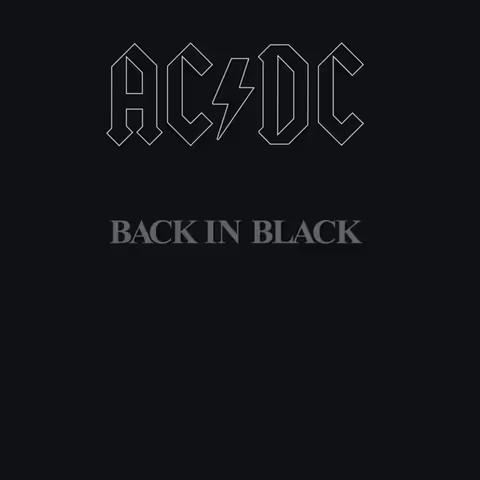
The sleeve is the most economical statement on the record. Atlantic Records'' New York art director Bob Defrin designed an all-black cover at the band''s insistence, intended as a sign of mourning for Scott. Atlantic''s sales department disliked it on the entirely reasonable grounds that nobody would see it in a record-shop rack. They demanded, and got, a grey outline around the AC/DC logo and the title type, applied as a hot stamp on the original LP pressings. First-pressing United Kingdom copies are embossed in black-on-black with the outline registered in grey, and are now collectible. Robert Ellis took the band photography for the inner sleeve and gatefold.
The grey outline solved Atlantic''s shelf-visibility problem and immediately produced one of the most recognisable album covers in rock. It is one of the few cases where a label''s commercial intervention improved an artist''s deliberately uncompromising design.
Release and Reception
The album was released in the United States on 25 July 1980, in the United Kingdom and Europe on 31 July and in Australia on 11 August. It debuted at number one in the United Kingdom, where it held the top spot for two weeks. In the United States it peaked at number 4 on the Billboard 200, a figure that Rolling Stone noted at the time was "an exceptional showing for a heavy-metal album". It stayed in the American top ten for more than five months. In Australia it reached number one on the ARIA Chart by March 1981. France, Germany and Canada also took it to number one. Within weeks the band''s back catalogue, Highway to Hell, If You Want Blood You''ve Got It and Let There Be Rock, all re-entered the British charts. AC/DC became the first act since the Beatles to put four albums simultaneously in the UK top 100.
Reviews split between awe and discomfort. David Fricke, writing for Rolling Stone in November 1980, called the album "not only the best of AC/DC''s six American albums" but "the apex of heavy-metal art, the first LP since Led Zeppelin II that captures all the blood, sweat and arrogance of the genre". Smash Hits''s Red Starr gave it three out of ten and complained about a "lowest common denominator headbanging" sameness. Robert Christgau called the band "primitive". The critical consensus took longer to settle than the commercial one. By 2003 Rolling Stone had placed the album at number 73 on its 500 Greatest Albums of All Time list (rising to 77 in 2012, slipping to 84 in 2020). The 2024 Apple Music 100 Best Albums list placed it at 90. Rock Hard''s 500 Greatest Rock and Metal Albums (2005) placed it at number one. Loudwire named it the best hard-rock album of 1980. Kitty Empire, writing in The Observer in 2011, conceded the album''s "casual sexism" and "questionable attitude to sexual consent" while declaring it her favourite album ever.
The album was inducted into the Grammy Hall of Fame in 2012. Worldwide sales sit at around 50 million copies. On 21 August 2024 the Recording Industry Association of America certified Back in Black at 27x Platinum, marking 27 million American units shipped or streamed. It is the best-selling album in United States history to have never reached number one on the Billboard 200, and by most counts the second best-selling studio album of all time worldwide, sat behind only Thriller.
Singles and Music Videos
| Single | Released | US peak | UK peak | Notes |
|---|---|---|---|---|
| You Shook Me All Night Long | 15 August 1980 | 35 (Hot 100) | 38 | AC/DC''s first US Top 40 hit; Eric Dickinson directed the 1986 re-shoot of the video in the North-East of England for the Who Made Who compilation, with Johnson on a tractor |
| Hells Bells | 31 October 1980 (Europe) | did not chart Hot 100 | did not chart UK | Live performance video shot at Compass Point |
| Rock and Roll Ain''t Noise Pollution | 7 November 1980 (UK) | did not chart Hot 100 | 15 | Lange-mixed UK 7-inch with picture sleeve |
| Back in Black | December 1980 (US) | 37 (Hot 100) | did not chart UK | US-only single release; backed with "What Do You Do for Money Honey" |
The promotional video for "You Shook Me All Night Long" became the band''s first proper MTV asset, with the original 1980 clip showing the band in performance. The far more famous 1986 re-cut, made to promote the Who Made Who compilation, was shot in the North-East of England and features Johnson singing on a tractor while a model in a leotard rides a mechanical bull. It received enormous airplay on MTV and remains one of the most-recognised hard-rock videos of the decade. Promo videos were also produced for "Hells Bells", the title track and "Rock and Roll Ain''t Noise Pollution"; further clips were assembled for "Let Me Put My Love into You" and "What Do You Do for Money Honey" without those tracks being commercially released as singles.
Touring and Live
The Back in Black World Tour opened in Erie, Pennsylvania on 23 June 1980, five weeks before the album hit the shelves, and ran through to a closing date in Tokyo in February 1981. It was AC/DC''s first headline arena tour of the United States and their biggest production to that point. Compulsory tour expense: the 2,000-pound bronze bell that Tony Platt had recorded in Loughborough was custom-fabricated for the road, installed in a flight case and rigged to descend from above the drum riser during the opening of "Hells Bells". Brian Johnson would clamber up and ring it. The bell on stage is an octave higher than the bell on the record, because the recording was slowed down to half-speed at Electric Lady to simulate a notionally two-ton bell that would have been physically impossible to take on tour. Johnson has hung from that bell every night of every AC/DC tour since 1980.
Notable stops included a return to Australia in late January and early February 1981 (their first since 1976) and a sequence of shows at New York''s Madison Square Garden in November 1980, by which point Back in Black was in its second platinum certification. Bon Scott''s mother Isa watched the band play in Sydney and told Johnson backstage afterwards, "Our Bon would have been proud of you, son." Johnson has cited the line as the moment he knew he had been accepted. The tour ended with the band negotiating directly with promoters for a third leg through 1981, by which point sales had crossed 10 million in the United States.
In TV, Film and Media
The album''s afterlife in screen and stadium contexts has been industrial. "Back in Black" anchored the opening sequence of Iron Man (2008) and AC/DC compiled the 2010 soundtrack Iron Man 2, drawn entirely from across their catalogue with five songs from Back in Black. "You Shook Me All Night Long" has been used in dozens of films and television sequences from Maid in Manhattan to Stripes and is a staple of stadium PA systems in the United States, Australia and the United Kingdom. "Hells Bells" is the entrance music for the Chicago White Sox closing pitcher Bobby Jenks, has been adopted by college football teams and is the most-licensed AC/DC track for trailer cues. "Thunderstruck" has eclipsed it for sport in recent years but "Hells Bells" was there first. Six Feet Under, the American death-metal group, covered the entire album in 2004 under the title Graveyard Classics 2.
Controversy and Debate
The most persistent argument around Back in Black is the question of whether any lyrics on the album originated with Bon Scott. Scott''s former partner Margaret "Silver" Smith told Jesse Fink, in Fink''s 2017 book Bon: The Last Highway, that Scott had called her on the night of his death to celebrate finishing the lyrics for the new AC/DC record. Vince Lovegrove, Scott''s ex-bandmate in The Valentines, told Fink that Scott''s family receives royalties for Back in Black. Angus Young has at different times said both that Scott contributed lyrics and that he did not. Atlantic''s London chief in 1968-85, Phil Carson, told Fink, "Johnson wrote all the lyrics. It''s fucking stupid to say anything else."
Brian Johnson''s 2022 memoir The Lives of Brian is the most direct account. Johnson states he was given only a riff and a title for each song and wrote the lyrics from scratch in the Compass Point bedrooms. He makes a particular point of naming "You Shook Me All Night Long", "Have a Drink on Me", "Hells Bells" and "Back in Black" as songs whose words came entirely from him. He concedes only that the title of "Rock and Roll Ain''t Noise Pollution" originated in a story Scott had told the band about a heckler. The published songwriting credits on every Back in Black track read Angus Young, Malcolm Young, Brian Johnson, and have done since 1980. The argument continues to surface in books and interviews; it has not produced legal action.
Covers, Samples and Tributes
Six Feet Under covered the album in full as Graveyard Classics 2 in 2004, the most direct tribute to the record from inside the metal community. The title track has been covered live by Guns N'' Roses, Living Colour, Shakira (with Brian May guesting), and the Foo Fighters with Lars Ulrich at the 2022 Taylor Hawkins tribute concert in Wembley Stadium, with Johnson himself on lead vocals. "You Shook Me All Night Long" was famously covered by Celine Dion (with Anastacia) at the VH1 Divas Las Vegas show in 2002, an event whose surreal qualities still circulate online. The album has not been sampled in any high-profile hip-hop track and has not been the basis of a tribute album in its own right, although nearly every AC/DC compilation since 1980 has been organised around its songs.
Bands who cite the album as a direct influence include Guns N'' Roses (Slash has said it "saved rock''n''roll"), Metallica (Lars Ulrich has called it the heaviest record of the 1980s), Pantera, Airbourne (entirely modelled on the AC/DC template), Greta Van Fleet and The Darkness. Producer Rick Rubin has named Mutt Lange''s production on Back in Black as the benchmark for hard-rock studio sound.
Reissues and Anniversaries
AC/DC have been unusually disciplined about not re-issuing Back in Black. The album appeared on CD in the 1980s mastered by Barry Diament, and was remastered by Ted Jensen for the EMI / Atco reissue series in the early 1990s and by George Marino for the Epic reissue series in 2003. The most substantial repackaging was the 1997 Bonfire box set, released as a Bon Scott tribute, which included a remastered Back in Black alongside live discs and rarities (although the rarities were Scott-era recordings, not Back in Black outtakes). No 25th-, 30th-, 40th- or 45th-anniversary deluxe edition has been released. There is no super-deluxe box, no demos-and-alternates disc, no half-speed master cut. The band have left the record in its original 1980 sequence and presentation, and have steadily resisted suggestions that any of the Compass Point session tapes survive in releasable form.
The album has, however, been re-pressed on vinyl repeatedly, including standard black, picture disc and various coloured-vinyl variants over the years, and has remained continuously in print. It is one of the very few hard-rock albums of its vintage to have done so.
Legacy and Influence
Forty-six years after release, Back in Black has sold an estimated 50 million copies worldwide and 27 million in the United States. It sits second on the most reliable list of the best-selling studio albums of all time, behind only Michael Jackson''s Thriller. Within the United States it is the sixth best-selling album per the RIAA and the best-selling album never to have hit number one on the Billboard 200. The album propelled AC/DC from a successful arena-touring band into a stadium concern, and reset the commercial ceiling for hard rock. The single biggest hard-rock or heavy-metal albums of the subsequent decade (Def Leppard''s Pyromania and Hysteria, both Lange productions; Guns N'' Roses'' Appetite for Destruction; Metallica''s self-titled "Black Album", whose production team explicitly cited the Lange sound) are all built, in some sense, in its shadow.
Tony Platt''s production on the album has had an unusually long technical afterlife. Studios in Nashville used to use it to check the acoustics of a room before tracking. Motörhead used it to tune their stage rig. Producers point to it as a study in what to leave out: minimal effects, no obvious compression, no reverb tails. AC/DC themselves continued making records with Lange (For Those About to Rock We Salute You in 1981), then took over producing themselves for most of the rest of the 1980s with diminishing returns. By the time they returned to a full-strength producer-led record (The Razors Edge in 1990 with Bruce Fairbairn), they had effectively ceded lyric writing entirely to the Young brothers. Back in Black remains the only album on which Brian Johnson and Mutt Lange worked together; arguably the most consequential rock-and-roll collaboration to last exactly one record.
Things You Might Not Know
| Fact | Detail |
|---|---|
| The bell weighed a tonne | The bell on "Hells Bells" was custom-cast at the John Taylor Bellfoundry in Loughborough, Leicestershire, weighing 2,000 pounds; the recording was slowed to half-speed to imitate a notionally two-ton bell. |
| Pigeons in the belfry | Tony Platt first tried to record the bell of a nearby church, but every strike scattered roosting pigeons whose wings ruined the take; the foundry then rushed AC/DC''s own bell out of its mould. |
| The bell strikes thirteen times | Platt and Lange spun the bell recording in by hand from a quarter-inch tape; the bell tolls thirteen times before Angus Young''s guitar enters. |
| Johnson had no recording experience | Brian Johnson had never sung on an album made by a producer of Mutt Lange''s standing before; he was 32 years old, recently separated and running a windscreen-repair business in Gateshead. |
| The first audition song | Johnson''s first song at his Vanilla Studios audition was Ike and Tina Turner''s "Nutbush City Limits", not a rock standard; the band had spent the day saying no to other singers'' "Smoke on the Water". |
| Lange and Platt were in the next studio | When the news of Bon Scott''s death arrived, Mutt Lange and Tony Platt were working together at London''s Battery Studios on an album for a band called Broken Home. |
| Hoover beat Bon to a phone call | The day Johnson drove down for his AC/DC audition he had taken a parallel paid jingle session for Hoover, earning £350; the jingle was for "the new high-powered mover from Hoover". |
| Atlantic forced the grey outline | Atlantic Records disliked the all-black cover for fear it would be invisible on shop shelves; the band agreed to a hot-stamped grey outline around the logo, now the album''s defining visual. |
| Schaffer-Vega secret weapon | Angus Young''s solos were tracked through a Schaffer-Vega Diversity System wireless transmitter, which acted as both a radio link and a low-level signal compressor before the amp. |
| The album was nearly delayed by customs | A significant portion of the band''s equipment was held in Bahamian customs while sessions had to begin without it; tropical storms knocked out the studio''s electricity on multiple nights. |
| Brown ale at the audition | Malcolm Young handed Brian Johnson a bottle of Newcastle Brown Ale when he walked into Vanilla Studios for the audition; Johnson cites it as the moment he relaxed. |
| Closer written in fifteen minutes | "Rock and Roll Ain''t Noise Pollution" was the last song completed for the album; Malcolm and Angus wrote it in around 15 minutes and Johnson recorded the spoken intro in a single take with a lit cigarette audible. |
| The first AC/DC US Top 40 hit | "You Shook Me All Night Long" was AC/DC''s first US Top 40 single, peaking at number 35 on the Billboard Hot 100 in October 1980, after the band had released seven previous studio albums. |
| Six Feet Under did the lot | American death-metal band Six Feet Under covered the entire album in full in 2004 as Graveyard Classics 2, the only commercial track-for-track tribute of its kind. |
| The chord that ran the room | Tony Platt found the resonant spot in Compass Point''s live room by walking around with a snare drum and hitting it; the recess above the false ceiling there gave Phil Rudd''s kit its body on the record. |
Riffology Podcast
Want to hear the stories that did not fit in the article, the back-and-forth between hosts who have lived with this album since 1980, and the deeper dive into what Mutt Lange actually changed between Highway to Hell and Back in Black? The Riffology episode covering Back in Black sits at the top of this page. You can also find Riffology on Apple Podcasts, Spotify and every major podcast platform. Subscribe and you will not miss any of the deep-dive episodes that come out of this site.

Comments