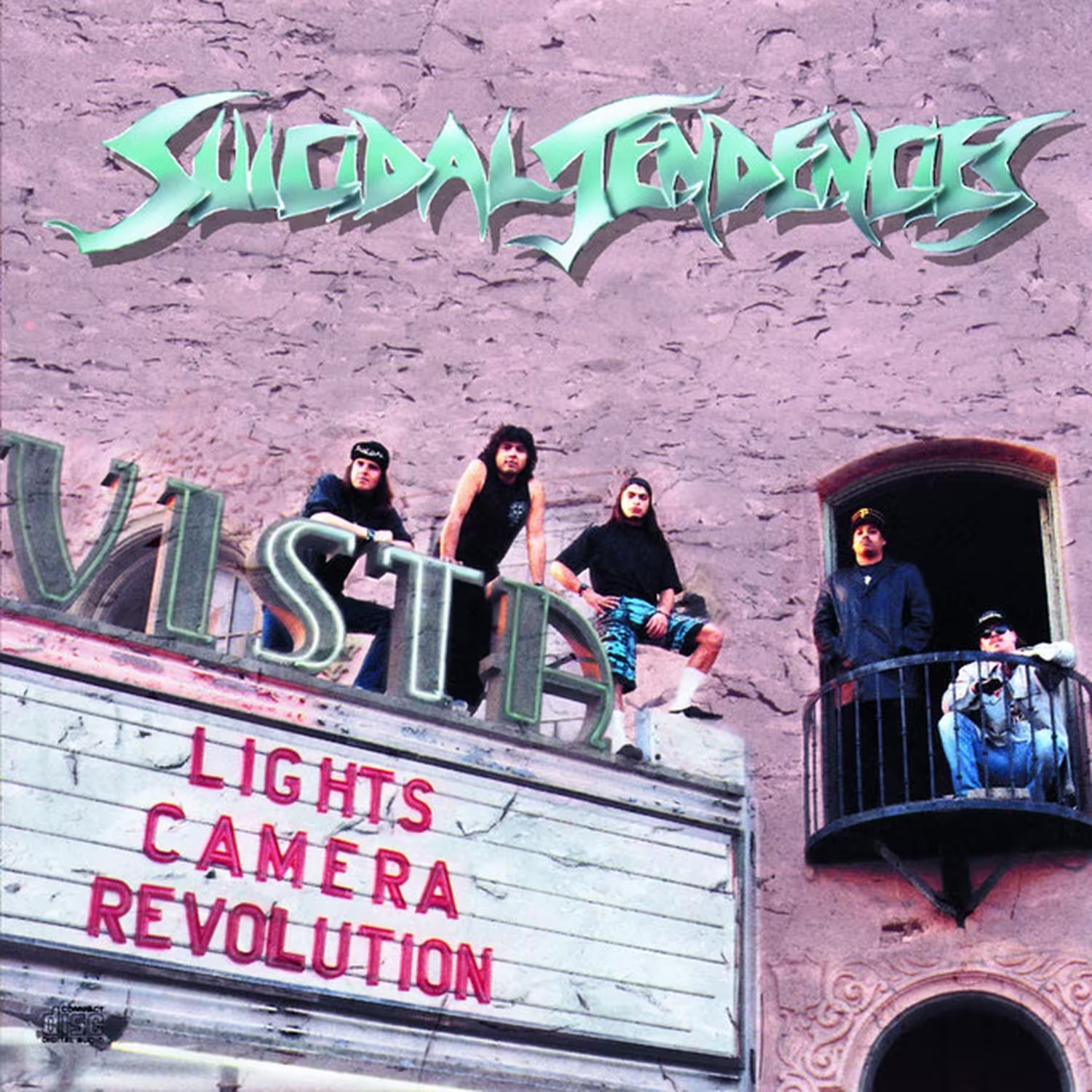
Banned from playing their own home city for most of the 1980s, Suicidal Tendencies came back in the summer of 1990 by climbing onto the marquee of the Vista Theatre in Los Feliz and spelling out the title of their fifth album in red plastic letters: Lights, Camera, Revolution. Released on 3 July 1990, Lights...Camera...Revolution! was the record that turned a notorious local punk band, long blamed for the violence at its own shows, into a gold-selling, Grammy-nominated crossover force that could headline arenas in the cities that had once shut the door on them.
It was also the album that introduced a twenty-five-year-old bass player named Robert Trujillo, whose slap-and-pop funk runs gave a thrash band a groove that none of its peers could match. The Grammy nomination the album earned for Best Metal Performance lost to Metallica's "Stone Cold Crazy", which made the result sting twice over, because thirteen years later Trujillo would walk into Metallica himself. This is the story of how five musicians from Venice turned a ban, a new bassist and an old producer into the definitive Suicidal Tendencies record.
Album Facts
Before the deep dive, here is the record at a glance. Officially the title is stylised Lights...Camera...Revolution!, complete with ellipses and exclamation mark, though most fans and shops have always just written it Lights Camera Revolution.
| Field | Detail |
|---|---|
| Artist | Suicidal Tendencies |
| Album | Lights...Camera...Revolution! |
| Release Date | 3 July 1990 |
| Label | Epic Records |
| Producers | Mark Dodson and Suicidal Tendencies |
| Studios | Rumbo Recorders (Canoga Park) and Amigo Studios (Hollywood); mixed at A&M Recording Studio (Hollywood) |
| Genre / Subgenre | Crossover thrash, thrash metal, funk metal |
| Track Count | 10 |
| Total Runtime | 42:52 |
| Billboard 200 Peak | No. 101 |
| UK Albums Chart Peak | Did not chart |
| Other Notable Chart Peaks | "Send Me Your Money" was the band's only UK-charting single |
| Certifications | RIAA Gold (US) |
| Estimated Sales | 500,000+ in the US |
| Key Singles | "You Can't Bring Me Down", "Send Me Your Money", "Alone", "Lovely" |
What 1990 Sounded Like
The summer of 1990 was a strange, fertile moment for heavy music. Thrash metal had spent the back half of the 1980s clawing its way up from the underground, and by 1990 the genre's biggest names were either crossing over to the mainstream or about to. Within a few months of Lights...Camera...Revolution! the metal world would see Megadeth's Rust in Peace, Anthrax's Persistence of Time, Slayer's Seasons in the Abyss and, the following summer, Metallica's self-titled "Black Album", which dragged the whole movement onto daytime radio.
Suicidal Tendencies sat in an odd corner of that landscape. They had started as a hardcore punk band, not a metal one, and they carried the suspicion of both scenes. To the punks they had gone metal, to the metalheads they were still skaters and street kids, and to the city of Los Angeles they were a public-order problem. What made them impossible to file was that they were now doing something none of the thrash elite were doing, which was bolting funk and groove onto thrash without it sounding like a novelty.
It helps to remember what else was happening that month and that year, because the album landed into a culture that was already arguing about exactly the things the band wrote about.
- The Parents Music Resource Center had spent five years pushing the "Parental Advisory" sticker, and censorship was a live national argument.
- Skateboarding was deep in a street-style boom, and Suicidal were the house band for a generation of skaters.
- Funk-rock and rap-metal were bubbling up through Faith No More, Jane's Addiction, the Red Hot Chili Peppers and Living Colour.
- MTV's Headbangers Ball was the single most important shop window a metal band could get into.
Into that mix came an album made by a band that had been told, in effect, that it could not perform at home. The chip on the shoulder was real, and it is all over the record.
Suicidal Tendencies Before the Album
Suicidal Tendencies formed in Venice, California, in 1980, built around the singer Mike Muir, a wiry, motor-mouthed frontman who turned paranoia, alienation and bloody-minded individualism into a whole identity. Their 1983 self-titled debut, released on the independent Frontier label, is one of the defining hardcore punk records of its era, and it contained "Institutionalized", a spoken-word rant about a teenager pushed to the edge by adults who will not listen, set to a lurching punk riff. The song became one of the first true hardcore videos to break onto MTV, and it turned up in Alex Cox's cult film Repo Man in 1984 and, later, on an episode of Miami Vice in 1986.
That early notoriety came at a price. The band's shows had a reputation for violence and were dogged by talk of gang affiliations, and Los Angeles authorities responded by making it almost impossible for Suicidal Tendencies to play in their own city for years. It is the central fact of their early career, and it is the wound the new album would pick at directly.
Musically, the band kept moving. Join the Army in 1987 was their first record to dent the Billboard 200 and showed the metal influence of lead guitarist Rocky George pulling them away from straight hardcore. Then came the move that changed everything: a deal with Epic Records, brokered in part through the metal producer Mark Dodson. Their first Epic album, How Will I Laugh Tomorrow When I Can't Even Smile Today in 1988, was a full plunge into thrash metal, and the 1989 mini-album Controlled by Hatred/Feel Like Shit...Déjà Vu became the band's first gold record. By the end of the decade Suicidal Tendencies were no longer a hardcore band that flirted with metal. They were one of the founding acts of crossover thrash, and they were about to make the album that proved it.
A New Bassist and an Old Producer
The most important thing to happen to Suicidal Tendencies between Controlled by Hatred and Lights...Camera...Revolution! was a change at the bottom end. Bassist Bob Heathcote left the band in early 1989 to support his family, and the vacancy was filled by Robert Trujillo, a young Los Angeles bass player whose background was steeped in funk and fusion as much as in metal. He joined just before a summer European tour supporting Anthrax, and although he appeared in the videos around Controlled by Hatred, the bass on that record had been handled in the studio by guitarists Rocky George and Mike Clark. Lights...Camera...Revolution! would be the first Suicidal Tendencies album that Trujillo actually played on, and his arrival is audible from the first downbeat.
Trujillo did not play like a thrash bassist. He slapped, he popped, he slid, and he treated the bass as a lead instrument that could carry a groove rather than just shadow the guitars. That funk sensibility became the secret weapon of the album, and it quickly spilled over into a side project, Infectious Grooves, that Muir and Trujillo launched with Jane's Addiction drummer Stephen Perkins and Excel guitarist Adam Siegel. The funk-metal hybrid that Suicidal Tendencies started chasing on this record was, in large part, Trujillo's doing.
Behind the glass sat a familiar face. Mark Dodson, who had produced the band's previous two Epic releases, returned to produce, engineer and mix the album. Dodson was no stranger to fast, heavy music, having produced Anthrax's landmark Among the Living in 1987, and he understood how to keep thrash legible without sanding off its edges. The combination of a producer who knew exactly how this band worked and a bassist who pulled them somewhere new is the engine that drives Lights...Camera...Revolution!. One member who was on his way out completed the line-up: drummer R.J. Herrera, for whom this would be the final Suicidal Tendencies album.
Making Lights...Camera...Revolution!
Recording ran from December 1989 to April 1990, spread across two Los Angeles rooms. The bulk of the tracking happened at Rumbo Recorders in Canoga Park, the San Fernando Valley studio built by Captain and Tennille that had hosted everyone from Guns N' Roses to Tom Petty, with further work at Amigo Studios in Hollywood. When tracking was done, the album was mixed at the A&M Recording Studio in Hollywood, the storied lot on the old Charlie Chaplin film studios site. Dodson handled the bulk of the engineering and the mix himself, with additional engineering from Chris Steinmetz, Brian Scheuble, Greg Goldman and Andy Udoff.
The sound they chased was clarity. Earlier Suicidal records could be a wall of noise, thrilling but murky, and one of the quiet triumphs of Lights...Camera...Revolution! is how much air sits between the instruments. You can hear every one of Rocky George's solos, every one of Mike Clark's rhythm parts, and crucially you can hear Trujillo's bass as a distinct, funky voice rather than a low rumble. For a band whose roots were in deliberately ugly hardcore, the leap in fidelity is enormous.
That clarity served the songwriting, which had quietly become some of the most ambitious of the band's career. The riffs were faster and tighter, the arrangements longer and more sectional, and the band were not afraid to let a song breathe, drop into a clean passage, or take a left turn into a funk break. Several elements pulled the record together in the studio.
- Rocky George's lead guitar moved to the front, full of whammy-bar dives, tapping and extended solos that gave the album a virtuoso streak.
- Trujillo's bass was mixed loud and proud, treated as a melodic lead voice rather than a support part.
- Mike Muir's vocals shifted between melodic singing, hardcore barking and his trademark sardonic spoken-word rants.
- Dodson's production kept the low end tight and the cymbals crisp, so the speed never turned into mush.
The result is a record that sounds expensive without sounding tame. It is unmistakably the same band that made Institutionalized, but one that had learned how to harness its chaos. By April 1990 they had ten tracks and a little over forty-two minutes of music that would become the high-water mark of their catalogue.
Personnel and Credits
The line-up here is a specific, fleeting one. It is the only Suicidal Tendencies studio album to feature both Robert Trujillo and R.J. Herrera, the moment the classic crossover band locked into place just before it began to change again.
| Role | Player | Notes |
|---|---|---|
| Core band | ||
| Lead vocals | Mike Muir | Founder and only constant member; wrote or co-wrote every track |
| Lead guitar | Rocky George | Backing vocals; the album's solo showcase |
| Rhythm guitar | Mike Clark | Backing vocals; co-wrote seven of the ten songs |
| Bass | Robert Trujillo | Backing vocals; his first ST album, later joined Metallica |
| Drums | R.J. Herrera | His final ST album |
| Production and engineering | ||
| Producer | Mark Dodson and Suicidal Tendencies | Dodson also produced the band's two previous Epic releases |
| Engineer and mixer | Mark Dodson | Mix completed at A&M Recording Studio, Hollywood |
| Additional engineering | Chris Steinmetz, Brian Scheuble, Greg Goldman, Andy Udoff | Across Rumbo and Amigo sessions |
The most interesting credit is the bass chair. Because Trujillo had appeared in the band's videos but not on the previous record, Lights...Camera...Revolution! is where casual fans first actually heard him, and the contrast with the older material is stark. The other quiet story is Mike Clark, whose name sits next to Muir on seven of the ten writing credits, making him a far bigger creative force on the album than his "rhythm guitarist" billing suggests.
The Songs
Ten tracks, no filler, and a clear sense of a band stretching itself. Here is the full running order with writers and lengths.
| # | Title | Writer(s) | Length | Single? | Notes |
|---|---|---|---|---|---|
| 1 | You Can't Bring Me Down | Muir, George | 5:50 | Yes | The album's anthem and statement of intent |
| 2 | Lost Again | Muir, George | 5:16 | No | Groove-driven thrash with a long instrumental stretch |
| 3 | Alone | Muir, Clark | 4:24 | Yes | The album's most melodic, introspective moment |
| 4 | Lovely | Muir, Clark, Trujillo | 3:45 | Yes | Sarcastic swipe at moral campaigners and censorship |
| 5 | Give It Revolution | Muir, Clark, Herrera | 4:22 | No | Hardcore call to arms |
| 6 | Get Whacked | Muir, Clark | 4:23 | No | Fast, riff-heavy classic Suicidal aggression |
| 7 | Send Me Your Money | Muir | 3:24 | Yes | Funk-driven satire of crooked televangelists |
| 8 | Emotion No. 13 | Muir, George | 3:43 | No | Short, sharp blend of melody and bite |
| 9 | Disco's Out, Murder's In | Muir, Clark, Herrera | 3:07 | No | Tongue-in-cheek title over a speedy thrasher |
| 10 | Go'n Breakdown | Muir, Clark | 4:39 | No | A headbanging closer built for the pit |
The album opens with its calling card. "You Can't Bring Me Down" begins not with a blast of speed but with a hypnotic, almost meditative whammy-bar solo over a clean, near-acoustic rhythm part, before Rocky George layers in eight-finger tapping and the tempo finally snaps into the main riff. It is nearly six minutes long and it earns every second, dropping back to a clean passage around the three-and-a-half-minute mark before storming back. By the end Muir has abandoned singing for one of his sardonic spoken-word rants, mocking anyone who would call the band crazy, before signing off with a yelped "Suicidal!" and a cackle. It is the band's manifesto in song form, and it remains the track most people reach for first.
Elsewhere the record shows its range. "Alone" is the album's emotional centre, a melodic, almost mournful piece that proves the band could write something heartfelt without losing its teeth. "Lovely", co-written by Trujillo, turns its sarcasm on the moral panic of the era, and given the band's open hostility to the PMRC it has always been read as an anti-censorship satire. "Disco's Out, Murder's In", with its deadpan title, rejects trend-chasing over one of the album's fastest riffs.
Then there is "Send Me Your Money", the track where Trujillo's funk takes the wheel. It opens with a drum intro and a slinky, popping bass line before the guitars arrive, and it features two quick bass solos that would have been unthinkable on an earlier Suicidal record. The main riff is actually recycled from the band's own past, lifted from "You'll Be Sorry", the second half of "Suicide's An Alternative" on the 1983 debut. Lyrically Muir aims squarely at crooked televangelists fleecing the faithful, a target that was very much in the news in the late 1980s. The song had, in fact, been a live staple since 1985, fully five years before it finally appeared on a record.
B-sides, Outtakes and Lost Songs
Suicidal Tendencies were never a band that buried a vault's worth of outtakes behind their albums, and the documented extras here are modest but worth knowing. The "You Can't Bring Me Down" single carried two non-album tracks as B-sides, "Don't Give Me Your Nothing" and a longer cut called "Waking the Dead", the latter running close to seven minutes. They are the kind of B-sides that reward digging, the sort of thing a Riffology listener will want to track down after the episode.
The most interesting "lost" song on the album is not lost at all, but it is a survivor. "Send Me Your Money" had been kicking around the band's live set since 1985, surviving multiple line-ups and stylistic shifts before it was finally committed to tape for this record. That five-year gestation is a reminder that, for all the talk of reinvention, Lights...Camera...Revolution! also gathered up loose ends the band had been carrying for years.
The Vista Theatre Cover
Few album covers are as literal about their title as this one. The photograph was taken at the Vista Theatre, the single-screen cinema at 4473 Sunset Drive in the Los Feliz district of Los Angeles, with its distinctive marquee pressed into service. Three band members, Mike Clark, R.J. Herrera and Robert Trujillo, are perched on top of the marquee behind the theatre's "Vista" sign, while Rocky George and Mike Muir look down from a small balcony window to the right. Below them, spelled out in the marquee's red plastic letters, are the three words of the title.
It is a perfect piece of staging for a record called Lights...Camera...Revolution!. The band that the city tried to keep off its stages is photographed clambering all over one of its landmark buildings, in broad daylight, owning the street. The salmon-pink, cracked stucco of the old theatre and the spiky green Suicidal Tendencies logo give the sleeve a sun-bleached Los Angeles character that is impossible to fake. For a band so rooted in a specific place, the cover is as much a statement of belonging as the music inside.
Release and Reception
Released on 3 July 1990, Lights...Camera...Revolution! became the band's commercial peak to that point. It reached number 101 on the Billboard 200 and went on to be certified gold by the RIAA for sales of half a million in the United States, only the second Suicidal Tendencies release to reach that mark after Controlled by Hatred. For a band that had spent the 1980s as outsiders, gold certification was a genuine breakthrough.
Critics, then and since, have been warm. Writing for AllMusic, Alex Henderson rated it four stars out of five and placed it among the very best things the band ever did.
"Not since the mid-'80s had the L.A. band sounded this confident, focused and inspired. This is a disc that no Suicidal fan should be without."
Alex Henderson, AllMusic
The American critic Robert Christgau was more clipped but no less approving, picking out the album's opener in his Village Voice Consumer Guide.
"Choice cut: You Can't Bring Me Down."
Robert Christgau, Consumer Guide, The Village Voice, 1991
Select magazine's Sue Smith gave the album a solid three out of five in August 1990, and the metal historian Martin Popoff later scored it seven out of ten in his Collector's Guide to Heavy Metal. The consensus was that Suicidal Tendencies had made the leap from cult act to serious contender, and the record's reputation has only grown.
The crowning institutional recognition came in early 1991, when the album earned the band their first Grammy nomination, for Best Metal Performance. They lost, in a detail that history has had great fun with, to Metallica's cover of "Stone Cold Crazy", the same Metallica that Trujillo would join a little over a decade later.
Singles and Music Videos
The album was worked hard at radio and, more importantly for a band like this, on MTV's Headbangers Ball, where its videos became fixtures. Four singles were drawn from the record across 1990 and 1991.
| Single | Released | Notes |
|---|---|---|
| You Can't Bring Me Down | 1990 | Lead single; major Headbangers Ball hit; B-sides "Don't Give Me Your Nothing" and "Waking the Dead" |
| Send Me Your Money | 1990 | The band's only single ever to chart in the UK; video directed by Sara Nichols |
| Alone | 1991 | The melodic third single, with its own MTV video |
| Lovely | 1991 | Issued as a further single from the album's campaign |
The "You Can't Bring Me Down" video is one of the band's most pointed. It opens with a mock newspaper headline reading "Suicidal Tendencies Banned In L.A.", then follows Muir as he is seized by unnamed authorities and, despite a revolt from his gang of supporters, executed in an electric chair. As the execution plays out, the United States Constitution flashes in the background, a deliberate jab at the PMRC and at what the band saw as an assault on free speech. It is rare for a metal video to wear its politics so openly, and it turned the song into a rallying cry.
The "Send Me Your Money" video, directed by Sara Nichols, is the funnier counterpart. It cuts between the band performing, Muir wielding a camera in front of psychedelic backdrops, and a conspicuously wealthy preacher, with the band miming a gospel choir on the chorus, before Muir takes a sledgehammer to a television set at the end. It is broad, gleeful satire, and it gave the band one of its most recognisable promos. The single also carried a piece of trivia the band rarely matched: it became the first and only Suicidal Tendencies single ever to chart in the United Kingdom.
On the Road
The album's success finally did what years of lobbying could not, and helped lift the cloud over the band's hometown shows. With a gold record behind them, Suicidal Tendencies became a formidable live draw and a constant presence on the road through the early 1990s. They shared stages with a who's-who of heavy music, headlining and supporting across a run of tours.
- Headline and co-headline US runs alongside Pantera, Exodus, Armored Saint, Jane's Addiction, 24-7 Spyz, White Zombie and Leeway.
- The European leg of the Clash of the Titans tour in 1990, sharing a bill with Megadeth, Slayer and Testament.
- Main-stage festival slots and Headbangers Ball-driven club and theatre dates across North America and Europe.
One performance from this era has become a touchstone. On 18 June 1993, by which point the album's songs were road-tested staples, Suicidal Tendencies tore through "You Can't Bring Me Down" at the Rayo Vallecano stadium in Madrid as the support act on Metallica's European tour, a stadium-sized airing of the song that captures just how far the band had travelled from the clubs that once shut them out. Footage of that performance still circulates as a fan favourite.
In TV, Film and Media
Suicidal Tendencies had been a fixture of screen culture since "Institutionalized" appeared in Repo Man and Miami Vice in the mid-1980s, and the Lights...Camera...Revolution! era kept that going. The "Send Me Your Money" video earned the ultimate early-1990s pop-culture stamp of approval when it was featured on an episode of Beavis and Butt-Head titled "Door to Door", the MTV cartoon's running commentary being a strange but genuine marker of a band's cultural reach at the time.
The album's reach extended into skate culture too, the world Suicidal Tendencies had always belonged to. "You Can't Bring Me Down" later soundtracked Danny Way's part in The DC Video, one of the most celebrated skateboarding films of its day, a fitting home for a band whose audience grew up with a deck under its feet. Between the cartoon, the skate videos and the constant MTV rotation, the record embedded itself in the everyday media diet of early-1990s youth culture far beyond the metal press.
Censorship, the PMRC and the LA Ban
For a band that built so much of its identity on conflict, the controversy around Lights...Camera...Revolution! was less about the record itself and more about the world it pushed against. Two fights run through the album. The first is the Los Angeles concert ban, the years-long inability to play their own city that the band turned into the central image of the "You Can't Bring Me Down" video. The second is the PMRC, the parental-advisory campaign that dominated arguments about music in the second half of the 1980s.
The band's anti-censorship streak is woven into the album, most explicitly in the Constitution imagery of the "You Can't Bring Me Down" video and in the satirical target of "Lovely", widely read as a swipe at the moral campaigners of the day. Where many of their thrash peers dealt in fantasy, horror or politics at arm's length, Suicidal Tendencies wrote about being personally policed, banned and lectured, which gave the record a chip-on-the-shoulder authenticity that resonated with an audience that felt the same way.
Covers, Samples and Tributes
The most notable act of recycling on the album came from within. "Send Me Your Money" is built on the same main riff as "You'll Be Sorry", the second part of "Suicide's An Alternative" from the band's 1983 debut, making the song a quiet bridge between the hardcore band of the early 1980s and the funk-metal crossover act of 1990. It is the kind of self-reference that rewards long-time fans, who would have recognised the riff instantly.
More broadly, the album's influence shows up less in literal covers than in the DNA of the bands that followed. The funk-thrash hybrid that Trujillo brought to Suicidal Tendencies fed directly into Infectious Grooves, the side project that became a vehicle for exactly the groove-metal ideas the parent band had started to explore here. The album's songs, "You Can't Bring Me Down" and "Send Me Your Money" above all, became permanent fixtures of the band's set and of the wider crossover-thrash canon.
Reissues and Anniversaries
Unusually for an album of its stature, Lights...Camera...Revolution! has never been given the lavish, demo-stuffed deluxe-reissue treatment that lesser records routinely receive. There is no sprawling super-deluxe box with alternate mixes and session outtakes, which is both a frustration for collectors and, in its way, a testament to a band that has always seemed more interested in its next record than in repackaging an old one.
What does exist is worth knowing. The album was accompanied at the time by a companion home video, Lights...Camera...Suicidal, collecting the era's promos and live material. Its songs have anchored compilations such as Prime Cuts in 1997 and Playlist: The Very Best of Suicidal Tendencies in 2010, and a 2008 reissue paired it on disc with the band's 1993 re-recording album Still Cyco After All These Years. Anniversary vinyl pressings have circulated as the record's milestones have come and gone, though the album has yet to receive the kind of remastered, expanded edition its reputation arguably deserves.
Legacy and Influence
More than three decades on, Lights...Camera...Revolution! is routinely cited as the definitive Suicidal Tendencies album and one of the great records of crossover thrash, the subgenre the band helped invent alongside the likes of D.R.I., Corrosion of Conformity and Stormtroopers of Death. In 2015, Loudwire's Eduardo Rivadavia ranked it at number eight on a list of the top ten thrash albums not released by the so-called Big Four, a neat summary of its standing as a record that belongs in any serious thrash conversation despite coming from a band that never quite fit the box.
The album's afterlife is partly a story of where its players went. Trujillo's tenure pointed the way to Infectious Grooves and, eventually, to Metallica, which he joined in 2003. R.J. Herrera left after this album, replaced in time by a procession of drummers including the journeyman Jimmy DeGrasso, and the band's centre of gravity kept shifting around the constant of Mike Muir. Suicidal Tendencies are routinely named as an influence by an enormous spread of acts, from Anthrax, Megadeth and Pantera to Rage Against the Machine, Green Day, NOFX and The Offspring.
Perhaps the best testimony to the album's reach comes from someone who later joined the band. Ben Weinman, the former Dillinger Escape Plan guitarist who became a Suicidal Tendencies member, has spoken about the record as the thing that set him on his path.
"Suicidal Tendencies' 1990 album, Lights... Camera... Revolution was a game-changer. I'll never forget going across town to this dude's house with a halfpipe and skating to this album. ST made me want to play guitar. I played that cassette tape so much it would pitch up and down from the wear and tear. Somehow I now play guitar in this band."
Ben Weinman, via Revolver, 2021
That is the album in a sentence: a record so alive that a kid skating to a worn-out cassette grew up to play the songs himself. Looking back from 2021, Revolver summed up where the record sits in the band's catalogue.
"An absolute banger that was an instant fan favorite, and also a serious level-up moment for the SoCal crew."
Revolver, 2021
The level-up stuck.
Things You Might Not Know
| Fact | Detail |
|---|---|
| Banned at home | For years Suicidal Tendencies were effectively unable to play concerts in Los Angeles, the city that made them, a ban dramatised in the "You Can't Bring Me Down" video. |
| The Grammy irony | The album's 1991 Best Metal Performance nomination lost to Metallica's "Stone Cold Crazy"; bassist Robert Trujillo joined Metallica in 2003. |
| Trujillo's debut | Despite appearing in the band's earlier videos, this was the first Suicidal Tendencies album Robert Trujillo actually played bass on. |
| Herrera's farewell | It was the last Suicidal Tendencies album to feature drummer R.J. Herrera, making it the only studio record with both him and Trujillo. |
| The cover location | The sleeve was shot at the Vista Theatre on Sunset Drive in Los Feliz, with the band literally climbing onto the cinema's marquee and balcony. |
| A riff reborn | "Send Me Your Money" reuses the main riff from "You'll Be Sorry" on the band's 1983 debut, linking the hardcore and funk-metal eras. |
| Older than the album | "Send Me Your Money" had been a live staple since 1985, five years before it was finally recorded for this album. |
| The producer's pedigree | Mark Dodson, who produced, engineered and mixed the album, had earlier produced Anthrax's Among the Living. |
| A first for the UK | "Send Me Your Money" became the first and only Suicidal Tendencies single ever to chart in the United Kingdom. |
| Cartoon canon | The "Send Me Your Money" video was featured on the Beavis and Butt-Head episode "Door to Door". |
| Skate soundtrack | "You Can't Bring Me Down" later soundtracked Danny Way's part in the celebrated skateboarding film The DC Video. |
| Funk on the brain | The funk that Trujillo brought to the album fed straight into Infectious Grooves, the side project he launched with Mike Muir and Jane's Addiction's Stephen Perkins. |
The Riffology Podcast
If this deep dive has you wanting to spin Lights...Camera...Revolution! from the top, the Riffology podcast goes even further, digging into the stories, the songs and the funk-thrash alchemy that made it the definitive Suicidal Tendencies record. You will find the Riffology podcast on all major platforms, so press play, turn it up, and get a little bit Cyco.
Comments