
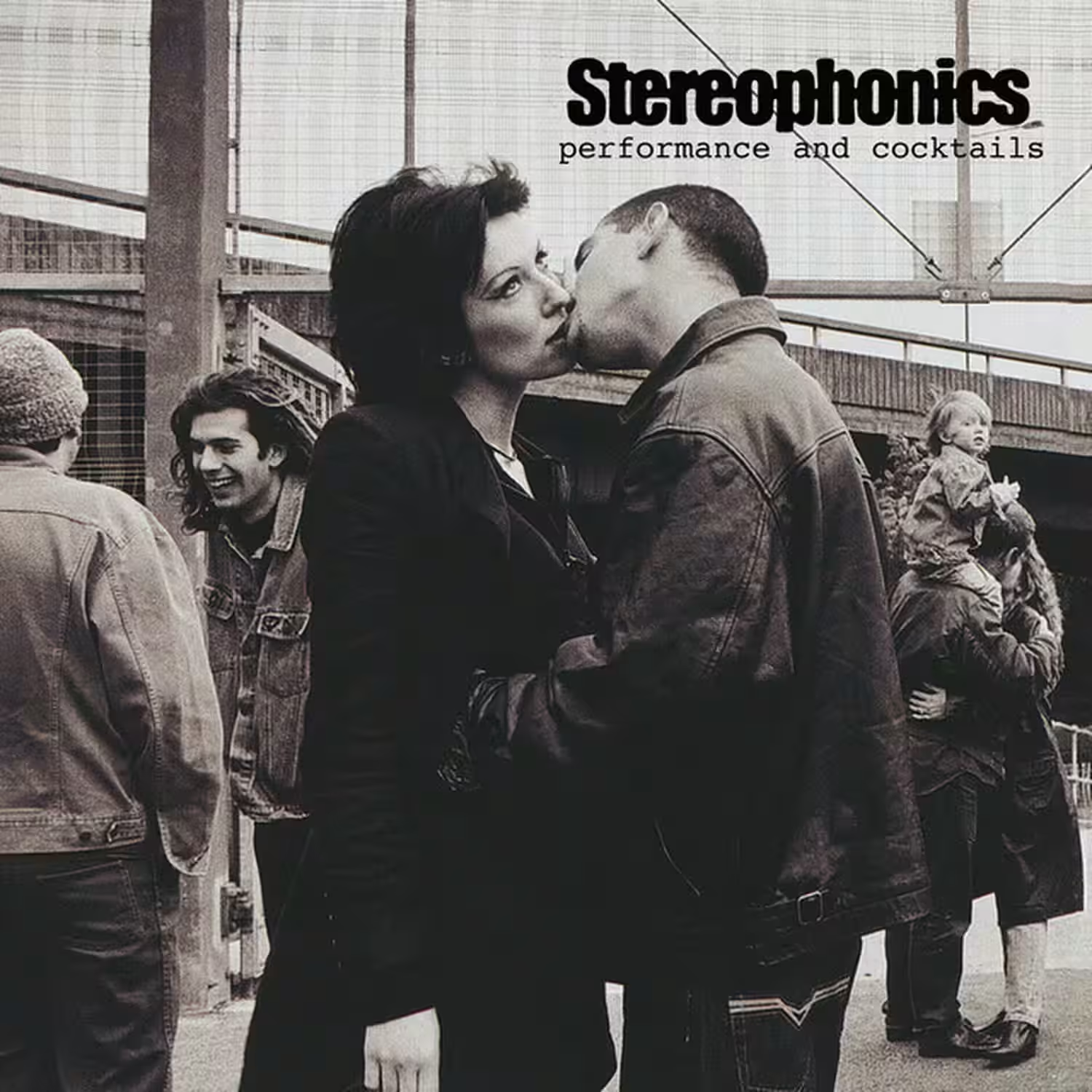
Lucy Joplin was paid seventy-five pounds in cash to kiss a stranger on a football pitch under the Westway after a night of absinthe and opium. The photograph that came out of that morning in west London in autumn 1998 ended up on the cover of an album that, within twelve weeks of its release in March 1999, had taken three lads from a Welsh mining village no one outside the Cynon Valley could pronounce to the top of the UK chart and into the foothills of European stadium rock.
Performance and Cocktails is the second studio album by Stereophonics, released on V2 Records on 8 March 1999. It debuted at number one in the UK with first-week sales of 119,954, went on to be the country's fifth best-selling album of the year, eventually reached six times Platinum on 1,804,810 logged sales and over two and a half million worldwide. It was made on the road in hotel rooms in Amsterdam and New York between dates of the Word Gets Around tour, recorded across four studios in three counties, sleeved in a borrowed Annie Leibovitz pose and then carried by a singles run, a Cardiff Castle show and a 50,000-capacity gig at the soon-to-be-demolished Morfa Stadium in Swansea that turned Kelly Jones, Richard Jones and Stuart Cable from a club act into something the British music press finally had to take seriously, even when it didn't want to.
Album Facts
| Field | Detail |
|---|---|
| Artist | Stereophonics |
| Album | Performance and Cocktails |
| Release date | 27 February 1999 (Japan); 8 March 1999 (UK and rest of world) |
| Label | V2 Records |
| Producers | Bird & Bush (Steve Bush and Marshall Bird) |
| Studios | Courtyard (Sutton Courtenay, Oxfordshire); Parkgate (Catsfield, East Sussex); Real World (Box, near Bath); Rockfield (Monmouth) |
| Mastering | Ian Cooper at Metropolis (London) |
| Genre / Subgenre | Alternative rock; post-Britpop; pop rock; British rock |
| Track count | 13 |
| Total runtime | 50:55 |
| UK Albums Chart peak | 1 (debut, 14 March 1999; 119,954 first-week sales) |
| Other notable chart peaks | Scottish Albums 1; Irish Albums 3; French Albums 24; New Zealand 31; German Albums 82; Australian Albums 67 |
| Certifications | 6× Platinum (BPI, UK); Platinum (IFPI Europe) |
| Estimated sales | 1,804,810 UK chart sales (Music Week, 2019); over 2.5 million worldwide |
| Key singles | The Bartender and the Thief; Just Looking; Pick a Part That's New; I Wouldn't Believe Your Radio; Hurry Up and Wait |
Cultural Context
The cultural weather of early 1999 was strange and quiet. Britpop had run its course. Oasis had released the bloated Be Here Now in August 1997 and gone to ground. Blur had retreated into the lo-fi reinvention of 13. Pulp's This Is Hardcore had sold respectably but spooked the room. The bands that had filled the front pages of NME and Melody Maker for half a decade were, more or less, in convalescence. The chart that Performance and Cocktails entered on 14 March 1999 was a transitional one: the week's number one single was Britney Spears with "Baby One More Time", a record that had just been chased off the top by Boyzone's "When the Going Gets Tough". On Top of the Pops that month, dance acts and US pop dominated, with British guitar music looking for a second act.
Into that vacuum walked a clutch of records that would define what the British weekly press took to calling post-Britpop. Travis released The Man Who in May, an album so quietly successful it would still be selling at Christmas. Embrace's The Good Will Out from the previous summer was still in the charts. Catatonia's International Velvet had paved a Welsh pop pathway twelve months earlier. The Manic Street Preachers were finishing their own breakthrough-from-the-margins record, This Is My Truth Tell Me Yours, which would dominate the 1999 Brit Awards. The mood was tilting away from arch art-school posturing and back towards songcraft, vocals, melody and big chorus rooms full of singalongs.
Wales had a moment too. Catatonia, Manic Street Preachers, Super Furry Animals and Gorky's Zygotic Mynci had been bunched together by a London press desperate for a regional storyline and given the entirely synthetic but commercially useful label "Cool Cymru". Stereophonics, signed to V2 since 1996 and already platinum off the back of Word Gets Around, were the most commercial face of the movement. Performance and Cocktails landed in the same eight-week stretch as Travis's "Why Does It Always Rain on Me?", Blur's 13 and the Manics' second number-one single "You Stole the Sun from My Heart". Other 1999 British rock records vying for the same shelf included:
- Travis — The Man Who (May)
- Blur — 13 (March, the same week)
- Muse — Showbiz (September, debut)
- Feeder — Yesterday Went Too Soon (August)
- Idlewild — Hope Is Important (February)
- Supergrass — Supergrass (September)
- Ash — Nu-Clear Sounds had landed late 1998 and was still in conversation
Stereophonics were, in early 1999, almost everyone's third or fourth choice. Twelve months later they were headlining stadiums.
The Band's Story Up to This Point
Kelly Jones and Stuart Cable lived on the same street in the Welsh village of Cwmaman, in the Cynon Valley above Aberdare. They had jammed together as teenagers from 1986 in Jones's father's garage under the name Zephyr. Jones's father Arwyn was himself a singer, having recorded under the stage name Arwyn Davidson because there were already too many Joneses in the music industry; he had once supported Roy Orbison. Kelly, Stuart and Richard Jones (no relation; bass, harmonica) came back together as a three-piece in 1992 under the name Tragic Love Company, a portmanteau of three of their favourite bands: The Tragically Hip, Mother Love Bone and Bad Company.
The trio gigged the working men's clubs of South Wales until a promoter, Wayne Coleman, told them no one was booking a band with a name that long. Cable spotted the manufacturer's name "Falcon Stereophonic" on his grandmother's old gramophone. The Stereophonics were born, the "the" later dropped. After a support slot for Smalltown Heroes at the Borderline in London, two producers caught the set: Marshall Bird and Steve Bush, working together as Bird & Bush. They produced a demo of "A Thousand Trees". Manager John Brand brought in over thirty-five label interests. In May 1996 they signed with Richard Branson's brand-new V2 label, the very first act on it.
Word Gets Around came out in August 1997, reached number six in the UK, went gold and made the band the surprise winners of the BRIT Award for Best New Group in February 1998. They toured relentlessly: Europe, Australia, the United States. On 12 June 1998 they played to over ten thousand in the grounds of Cardiff Castle, filmed for VHS and DVD release. Stuart Cable's mother Mable, of all people, was simultaneously becoming a minor national celebrity as the elderly audience plant "Betty" on Graham Norton's Channel 5 show V Graham Norton.
That was the platform. The pressure on the follow-up was straightforward: do not waste it. Kelly Jones, by his own account, was determined not to repeat the small-town vignettes of the debut. He wanted bigger choruses, broader stories, songs people would shout back. The band wrote the entirety of the second album on the road, on hotel-room acoustics in cities they could barely remember the next morning.
Pre-production and Demos
Almost every track on Performance and Cocktails was written in 1997 or early 1998, in hotel rooms in cities the band were visiting for the first time. The album's liner notes carry per-song writing dates that read like a tour itinerary. "Just Looking" was written in September 1997 in a hotel in Amsterdam. "Pick a Part That's New" was written in the same month in a hotel in New York. "The Bartender and the Thief" was written later, in April 1998, after the band had returned from touring. These weren't laptop demos. Kelly Jones wrote on an acoustic guitar with a Dictaphone running, captured a rough vocal, then brought the song into soundcheck for Richard Jones and Stuart Cable to drum and bass into shape that evening.
That working method left a trail. Several of the album's surviving outtakes — "Nice to Be Out", "Postmen Do Not Great Movie Heroes Make" (originally typo'd as "Make Great Movie Heroes" on a sleeve), "Raymond's Shop", "Same Size Feet" — were tracked as full demos at this stage. Most ended up as B-sides on the singles campaign or were saved for the 2010 super-deluxe edition. The recording dates carried over from the Word Gets Around campaign too. Wikipedia's session window for the album is given as April 1995 to January 1999, the lower end reflecting reused source material that pre-dates the Stereophonics name itself.
The trio rehearsed the new material in soundchecks and in a back room above a pub on Saturday afternoons in Cwmaman. There was no pre-production retreat to a country house. Bird & Bush wanted the songs delivered loud, fast and live, the way they were already played on stage. By the time the band booked into the first proper studio session in summer 1998, most of the songs had already been played in front of an audience.
Creating the Album
Sessions ran in fragments across the summer and autumn of 1998 and into early 1999. Stereophonics did not stop touring to make the record, they made it between dates. Four studios served, each picked for what it could give a particular song:
- Courtyard Studios in Sutton Courtenay, Oxfordshire: Radiohead's first three albums, including The Bends, had been worked on there. The Stereophonics tracked early sessions for the album here.
- Parkgate Studios in Catsfield, East Sussex: a residential studio set in farmland. "Pick a Part That's New" was recorded here in full.
- Real World Studios in Box, near Bath: Peter Gabriel's complex on the river, with one of the largest live rooms in Europe and a Neve VR mixing desk. "The Bartender and the Thief" and "Just Looking" were both tracked here, taking advantage of the room's natural ambience.
- Rockfield Studios in Monmouth: where Queen had cut "Bohemian Rhapsody" and where, by 1995, Oasis had decamped to make (What's the Story) Morning Glory? Stereophonics used the Quadrangle room for the album's heavier guitar overdubs.
Bird & Bush produced everything, with Steve Bush and Marshall Bird splitting engineering between them. Al Clay mixed most tracks; Bird & Bush mixed "She Takes Her Clothes Off". Mastering was handed to Ian Cooper at Metropolis Studios in London, the same engineer responsible for hundreds of British rock records from the 1980s onwards.
The recording philosophy was simple to the point of austerity. Track the rhythm section live to tape, Kelly Jones playing live guide vocal and rhythm guitar, Richard Jones on bass, Stuart Cable on drums, all in the same room, then add solos and vocal comps. Marshall Bird overdubbed Hammond organ, Rhodes piano, Mellotron and acoustic piano onto specific tracks — the keyboard wash on "Hurry Up and Wait", the church-organ swell at the end of "Just Looking" — without the band ever turning into a keyboard-led project. Backing vocals were thin on the ground; the only credited guest is the singer Astrid Williamson, on backing vocals for the closing track "I Stopped to Fill My Car Up". The total budget has never been published, but V2 had spent considerably more on Performance and Cocktails than it had on Word Gets Around, by Jones's own admission in later interviews; the band still kept the spend below the seven-figure mark.
The recording gear, where reported in trade press at the time, was conservative. Kelly Jones's main guitar amp throughout the album was a Matchless DC30 driven by a Gibson SG and a sequence of Fender and Gibson alternates. Stuart Cable's kit was tuned low and miked tight to keep the toms in front of the cymbals. Vocals were tracked at Real World through a Neumann U87 into the SSL chain. There were no tape-versus-digital arguments; the album was recorded to multitrack tape and the mixes summed to half-inch.
What kept the sessions tight was that the band genuinely sounded like a band by this point. They had played the songs on the road, and most of the keepers were live first or second takes with very limited punch-ins.
Personnel and Credits
| Role | Player | Notes |
|---|---|---|
| Core band | ||
| Lead vocals, electric & acoustic guitar | Kelly Jones | Sole lyricist; co-composer with Richard Jones and Stuart Cable on every track |
| Bass guitar, harmonica, backing vocals | Richard Jones | No relation to Kelly |
| Drums, percussion | Stuart Cable | Last appearance on a Stereophonics studio album would come on 2003's You Gotta Go There to Come Back before his dismissal that September |
| Guest & session musicians (credited) | ||
| Hammond organ, Rhodes piano, piano, Mellotron | Marshall Bird | Producer doubling as keyboard player on most tracks |
| Backing vocals on "I Stopped to Fill My Car Up" | Astrid (Astrid Williamson) | Scottish singer-songwriter, formerly of Goya Dress |
| Production & engineering | ||
| Producers, engineers | Bird & Bush (Steve Bush, Marshall Bird) | Had worked with the band since the Tragic Love Company demo |
| Mixing | Al Clay | Mixed the majority of tracks |
| Mixing on "She Takes Her Clothes Off" | Bird & Bush | |
| Mastering | Ian Cooper | At Metropolis Studios, London |
| Artwork | ||
| Cover photography | Scarlet Page | Daughter of Led Zeppelin's Jimmy Page; shot at a football pitch under the Westway in west London, autumn 1998 |
| Cover models | Lucy Joplin (foreground female) and a male model | Joplin paid £75 cash; identity confirmed by Tony Barrell in the Sunday Times in 2007 |
| Sleeve concept | Stereophonics with Scarlet Page | Inspired by an Annie Leibovitz photograph of a couple kissing outside a prison |
Two of these credits matter more than they look. Marshall Bird's keyboards are the secret architecture of the album. Strip the Hammond out of "Hurry Up and Wait" or the Mellotron from "Plastic California" and the songs sit flat. Astrid's vocal on "I Stopped to Fill My Car Up" is so high in the closing chorus that first-time listeners often think Kelly Jones has been multi-tracked into a harmony arrangement — in fact she is its top line.
The Songs
| # | Title | Writer(s) | Length | Single? | Notes |
|---|---|---|---|---|---|
| 1 | Roll Up and Shine | K. Jones / R. Jones / S. Cable; lyrics K. Jones | 3:58 | No | Opening track; contains the lyric "performance and cocktails" from which the album takes its name |
| 2 | The Bartender and the Thief | K. Jones / R. Jones / S. Cable; lyrics K. Jones | 2:54 | Yes (Nov 1998) | Lead single; UK #3; recorded at Real World; Gold (BPI) |
| 3 | Hurry Up and Wait | K. Jones / R. Jones / S. Cable; lyrics K. Jones | 4:40 | Yes (Nov 1999) | Fifth single; UK #11; Marshall Bird's Hammond carries the arrangement |
| 4 | Pick a Part That's New | K. Jones / R. Jones / S. Cable; lyrics K. Jones | 3:34 | Yes (May 1999 UK) | Third single; UK #4; written in a New York hotel September 1997; recorded at Parkgate |
| 5 | Just Looking | K. Jones / R. Jones / S. Cable; lyrics K. Jones | 4:13 | Yes (Feb 1999) | Second single; UK #4; written in Amsterdam September 1997; recorded at Real World; Gold (BPI) |
| 6 | Half the Lies You Tell Ain't True | K. Jones / R. Jones / S. Cable; lyrics K. Jones | 2:56 | No | Shortest track; a barroom shuffle |
| 7 | I Wouldn't Believe Your Radio | K. Jones / R. Jones / S. Cable; lyrics K. Jones | 3:50 | Yes (Aug 1999) | Fourth single; UK #11; mid-paced singalong that lifted in setlists from 2000 onwards |
| 8 | T-Shirt Sun Tan | K. Jones / R. Jones / S. Cable; lyrics K. Jones | 4:05 | No | AllMusic's Jason Damas singled this out as an album highlight |
| 9 | Is Yesterday, Tomorrow, Today? | K. Jones / R. Jones / S. Cable; lyrics K. Jones | 4:02 | No | Sole "philosophical" lyric on the album, about deja vu |
| 10 | A Minute Longer | K. Jones / R. Jones / S. Cable; lyrics K. Jones | 3:46 | No | Acoustic-led; one of the few songs that didn't make the live set |
| 11 | She Takes Her Clothes Off | K. Jones / R. Jones / S. Cable; lyrics K. Jones | 3:55 | No | The only track mixed by Bird & Bush rather than Al Clay; AllMusic highlight |
| 12 | Plastic California | K. Jones / R. Jones / S. Cable; lyrics K. Jones | 4:30 | No | Closest the album comes to a Laurel Canyon pastiche; Mellotron-heavy |
| 13 | I Stopped to Fill My Car Up | K. Jones / R. Jones / S. Cable; lyrics K. Jones | 4:29 | No | Closing track; backing vocals by Astrid Williamson; written as a single-take vignette |
"Roll Up and Shine" announces the album with a flat-fifth riff and a barked vocal. The phrase that gives the album its title sits in the second verse: a sneer at the way the music industry asked you to be entertaining on demand. The song was the last to be written, brought in only weeks before tracking finished, and gave the rest of the record its name retrospectively. The same trick had worked on Word Gets Around: the previous album's title was lifted from the closing track "Billy Davey's Daughter".
"The Bartender and the Thief" is the engine. Written in April 1998, recorded at Real World on what Bird later described as a couple of long afternoons, it is the heaviest thing Stereophonics had put on tape, two minutes and fifty-four seconds of saloon-bar Western. Kelly Jones has admitted in subsequent interviews that the song's two-chord drone in the bridge is a deliberate lift from Motörhead's "Ace of Spades", to the point where he frequently splices Lemmy's lyric into the vocal live: "The ace of spades, the ace of spades. The bartender and the thief were lovers". It became a Top 3 single without ever being intended as one; V2 picked it as a lead single after the band's manager played a board mix in a meeting room.
"Pick a Part That's New" is the most obviously poppy track on the record and the lyric the band were proudest of in 1999. Written in a New York hotel room in September 1997 while the trio were touring the United States off the back of Word Gets Around, it is the rare song where Kelly Jones throws away the third-person small-town storytelling and writes plainly about how disorienting the early months on the road had been. Recorded at Parkgate, not Real World, and finished quickly. The acoustic version on the B-side of the single is in many fans' opinion the better version.
"Just Looking" is the album's lighter heart. Written in Amsterdam in September 1997 on an acoustic in a hotel room, recorded at Real World, it is built around a four-chord progression so simple that Marshall Bird's organ swell in the final verse is the only thing stopping the song from collapsing into pure folk. As a live song it became Stereophonics' "Wonderwall" — a guaranteed crowd singalong, lighters up, every show.
"I Wouldn't Believe Your Radio" is the most blatantly Britpop track. Released as the fourth single in August 1999, it suffered the law-of-diminishing-returns problem common to fifth or sixth singles — it stalled at UK number 11 — but in setlists it lifted into one of the album's biggest moments. It is also the track on which Richard Jones's harmonica gets its only outing.
"T-Shirt Sun Tan" is buried at track eight and was one of two songs (along with "She Takes Her Clothes Off" and "Pick a Part That's New") that AllMusic's Jason Damas singled out as the album's high points. The song's lazy summer-on-the-road imagery anticipated the band's later style by a couple of years.
"She Takes Her Clothes Off" is the one track on the album not mixed by Al Clay. Bird & Bush kept hold of it themselves, gave it a slightly drier vocal and a much more upfront bass. The track is a short story in a man's voice about a woman who undresses in his bedsit window for the boys on the street outside; the lyric was widely read at the time as Jones reporting something he had seen as a teenager in Cwmaman.
"Plastic California" is the album's quiet centrepiece, four and a half minutes of Mellotron pad and slow piano that veers closest to Laurel Canyon early 1970s. Closing track "I Stopped to Fill My Car Up" is the curveball: a four-and-a-half-minute story-song about an attempted murder at a petrol station, lifted from a real news article Kelly Jones had read on the tour bus, with Astrid Williamson's vocal soaring above the chorus.
B-sides, Outtakes and Lost Songs
For a Britpop-adjacent act, Stereophonics ran an unusually generous singles campaign. Every UK CD single from the album carried two or three additional tracks, with original B-sides sitting alongside Kelly Jones's well-worn habit of covering 1960s songwriters. The B-side catalogue from this album would later anchor the deluxe edition. Highlights:
- "Sunny Afternoon" — a cover of The Kinks' 1966 number one, on the B-side of "Just Looking"
- "Positively 4th Street" — a Bob Dylan cover on the B-side of "Pick a Part That's New", one of the band's most-played covers
- "Fiddler's Green" — a cover of The Tragically Hip, the band who had inspired half of Stereophonics' original name
- "Something in the Way" — a Nirvana cover on the B-side of "Pick a Part That's New", recorded the year after Kurt Cobain's death entered its fifth anniversary
- "The Old Laughing Lady" — a Neil Young cover on the B-side of "I Wouldn't Believe Your Radio"
- "Angie" — the Rolling Stones song, on the B-side of "Hurry Up and Wait"
- "Nice to Be Out" — an album-quality original that didn't make the cut, released as a B-side of "Pick a Part That's New" in demo form
- "Postmen Do Not Great Movie Heroes Make" — an outtake B-side, the title a deliberate inversion of a Kelly Jones one-liner
- "In My Day" — B-side to "Pick a Part That's New", a contemporary recording deemed too slow for the album
- "Raymond's Shop" — a live recording from Cardiff Castle, on the B-side of "The Bartender and the Thief", an early Stereophonics original about Jones's local newsagent that pre-dates Word Gets Around
- "Same Size Feet" — another original that did not make either album, available as a Radio 1 live track on "Just Looking"
Two unreleased recordings circulate among collectors: a version of "I Wouldn't Believe Your Radio" with Stuart Cable on lead vocal (Cable was a frustrated singer; the take was eventually released as a B-side to "Hurry Up and Wait" and is one of the rarest official Stereophonics recordings) and a fully completed studio version of the title track "Performance and Cocktails" that the band briefly considered including before deciding the album's name didn't need a song to match it.
Album Artwork and Packaging
The cover is Scarlet Page's photograph: a young couple kissing on a football pitch under the Westway flyover in west London, captured one cold morning in autumn 1998. Scarlet is Jimmy Page's daughter, then in the early stages of what would become one of the British music industry's busiest photography careers. The composition was lifted, with full knowledge, from an Annie Leibovitz portrait of a couple kissing outside a prison; the band wanted that exact ambivalence in the body language, where the lips are meeting but the hands hang inert at the woman's sides.
The woman in the foreground was Lucy Joplin, a 23-year-old singer-songwriter from Twickenham. Tony Barrell tracked her down for a Sunday Times feature in November 2007, almost nine years after the shoot, and got the cover's secret out of her in one go.
"I gave them something money couldn't buy that day. Me and my boyfriend had been up all night on absinthe and opium, and that faraway look in my eyes couldn't have been achieved any other way."
Lucy Joplin, the cover model, interviewed by Tony Barrell, the Sunday Times, 2007
She was paid £75 cash and, in her own words, "blew it all on underwear and went home to my lover". Her opinion of the band that had bought her face for the cost of a tank of petrol was unsentimental. Invited to a Stereophonics BBC event, she found a thirty-foot backdrop of herself kissing the male model and a hospitality room where every laminate had her face on it. When a band member asked her what she did and she answered "I'm a singer-songwriter", he walked off, and the trio, she told Barrell, blanked her for the rest of the evening. Her summary:
"I don't like the album but I do love the cover."
Lucy Joplin, the Sunday Times, 2007
The sleeve interior, designed by V2's in-house team with Kelly Jones, carries individual band photographs over a tobacco-coloured washed background and a typewritten lyric book in unjustified columns. The first pressing UK CD (catalogue VVR1004492) is the most common; a limited-run gatefold double-vinyl was pressed in much smaller numbers and is now one of the most expensive Stereophonics records on the second-hand market. The Japanese pressing, released eleven days before the UK version, carried a bonus track ("Postmen Do Not Great Movie Heroes Make") and is collected for that reason.
Release and Reception
The album was released in Japan on 27 February 1999 and in the UK on 8 March 1999. It debuted on the UK Albums Chart at number one on 14 March with first-week sales of 119,954 copies, knocking Boyzone's By Request off the top. It went platinum within three weeks. By the end of 1999 it was the fifth best-selling album in the UK and the highest-charting album by a British rock act that didn't include the words "Travis" or "Manics". It also charted at number 1 in Scotland, number 3 in Ireland, number 24 in France, number 31 in New Zealand, number 67 in Australia, and number 82 in Germany.
Critical reception was sharply divided and remains the most-quoted aspect of the album in retrospective coverage. AllMusic's Jason Damas gave it three and a half stars but argued it was less consistent than Word Gets Around, picking "T-Shirt Sun Tan", "She Takes Her Clothes Off" and "Pick a Part That's New" as the high points. NME gave it 6/10. Q magazine three stars out of five. The two notorious negative reviews came from Pitchfork and Rolling Stone, both reaching for the same simple comparison.
"Basically, what Performance and Cocktails boils down to is loud music engineered and crafted for Britain's summer festival circuit that practically guarantees a perennially muddy experience."
Brent DiCrescenzo, reviewing Performance and Cocktails for Pitchfork, 25 May 1999 (the review famously scored the album 4.4 out of 10)
"[They] sound like Oasis trying to be Radiohead."
Barry Walters, Rolling Stone, 30 September 1999
The verdict from the British music weeklies was warmer and the radio response warmer still. Radio 1, in particular Mark and Lard and the Evening Session, hammered the singles. Within twelve weeks of release the album had passed half a million UK sales. It would log 101 weeks on the UK Top 100, re-entering the chart in January 2004 at number 25 on the back of a renewed touring cycle. The album won Best Album at the 1999 Kerrang! Awards on 17 August 1999, where the band also took Best British Band. Kerrang!'s Albums of the Year list for 1999 placed it at number 5. Performance and Cocktails was on the 1999 Mercury Prize shortlist, eventually losing to Talvin Singh's OK. Absolute Radio's later listener poll for Album of the 1990s placed Performance and Cocktails at number 27.
Singles and Music Videos
| Single | UK release | UK chart peak | Cert | B-sides | Video director / concept |
|---|---|---|---|---|---|
| The Bartender and the Thief | 9 November 1998 | 3 | Gold | "She Takes Her Clothes Off"; "Fiddler's Green" (Tragically Hip cover); live tracks from Cardiff Castle | Shot in Kanchanaburi Province, Thailand; loosely based on Francis Ford Coppola's Apocalypse Now, with the band staging a jungle club |
| Just Looking | 22 February 1999 | 4 | Gold | "Postmen Do Not Great Movie Heroes Make"; "Sunny Afternoon" (Kinks cover); BBC Radio One live tracks | Band in a car with Stuart Cable driving, passing round a packet of Jelly Babies; the car eventually sinks underwater |
| Pick a Part That's New | 3 May 1999 (UK); 27 February 1999 (Japan) | 4 | Silver | "Nice to Be Out" (demo); "Positively 4th Street" (Bob Dylan cover); "Something in the Way" (Nirvana cover); "In My Day" | Filmed in Turin; parodies the 1969 Italian Job, with the band performing in a coach teetering on a cliff edge |
| I Wouldn't Believe Your Radio | 23 August 1999 | 11 | — | "T-Shirt Sun Tan" (live at Morfa Stadium); "I Wouldn't Believe Your Radio" with Stuart Cable on lead vocal | Performance video shot at Morfa Stadium during soundcheck |
| Hurry Up and Wait | 8 November 1999 | 11 | — | "Angie" (Rolling Stones cover); various live tracks | Black-and-white performance video with intercut tour footage |
The Bartender video shoot in Thailand was, by Stuart Cable's account in his 2009 memoir Demons and Cocktails, the moment the three of them realised the band had become a different proposition. They had flown business class for the first time, slept in a Bangkok hotel that cost more per night than their Cwmaman rents, and woken up on day three to find the local press camped in the lobby. The "Italian Job" video for "Pick a Part That's New" used a real coach balanced on a real Turin hillside and required Stereophonics to perform inside it while the production crew physically rocked the vehicle from outside.
Touring and Live
Stereophonics toured Performance and Cocktails for most of 1999 and the first half of 2000. The campaign followed the V2 model of riding singles momentum into ever-bigger venues. Key dates:
- March 1999: a UK album-launch club run, including a sold-out 1 March show at the London Hippodrome that yielded a stack of live B-sides
- Summer 1999 festivals: T in the Park, V99 (replacing Tom Petty on the Saturday Chelmsford bill), Reading and Leeds (high up the bill but not yet headlining), and a series of European festivals
- 12 June 1999: revisiting Cardiff Castle for a second outdoor home-soil show, fewer than twelve months after their first there
- 31 July 1999, Morfa Stadium, Swansea: the album's defining live event. Over 50,000 attended what was effectively the band's "we made it" homecoming gig, held at the demolition-bound athletics stadium that had once been a residential training centre for Welsh athletics. The show was filmed and released on 1 November 1999 as Performance and Cocktails: Live at Morfa Stadium, the band's first concert film
- Autumn 1999: UK arena tour with support from Catatonia and (on some dates) Reef
- Spring 2000: their first major US dates as a headline act, which underperformed against UK expectations — Stereophonics never broke America in the way V2 had hoped
Television and broadcast appearances followed the singles. The band performed "The Bartender and the Thief" on Later... with Jools Holland in late 1998; "Just Looking" on Top of the Pops three times in February and March 1999; and recorded a Pinkpop Festival broadcast in May 1999 that BBC2 aired in full. Live performances of "Just Looking" and "The Bartender and the Thief" from this period quickly entered British rock canon, the kind of show clips that ended up on every "Britpop's Last Stand" retrospective in the years afterwards.
In TV, Film and Media
"Pick a Part That's New" had the most prominent commercial second life of any track on the album. BT licensed it for a 2013 advert promoting its Totally Unlimited Broadband package, which ran on UK television and cinema for several months and reintroduced the song to listeners who had been at primary school when the album came out. "The Bartender and the Thief" became a sports-broadcast staple in the UK, used as the closing music on Sky Sports football coverage during the 1999–2000 Premiership season. "Just Looking" has appeared on the soundtracks of several British TV dramas, most notably as the closing track of an episode of Cold Feet. The album itself has been name-checked in episodes of Gavin & Stacey (unsurprising given the show's Welsh setting) and on Channel 4's Top of the Pops 2 retrospective specials.
Controversy, Censorship and Lawsuits
Performance and Cocktails escaped the parental-advisory sticker treatment of its US release, but it carried a couple of pieces of low-grade controversy at home. "She Takes Her Clothes Off" caused mild complaint from listener groups about the song's framing of voyeurism, though no formal censure followed. "The Bartender and the Thief" attracted a small number of complaints from the Methodist Church in Wales over the line "Singing for Jesus, hooked on heroin, the bartender and the thief were lovers" being broadcast at teatime; Radio 1 ignored them and Top of the Pops aired the song uncut. The Motorhead "Ace of Spades" lift in the bridge has never been formally challenged; the songwriting credits to Kelly Jones, Richard Jones and Stuart Cable have stood unaltered for over twenty-five years.
The closest the album came to a real news story was via the cover. After Tony Barrell's 2007 Sunday Times piece identified Lucy Joplin as the model and reported her absinthe-and-opium morning, several British tabloids ran follow-ups speculating that the cover had been "drug-influenced" without anyone in the band's camp having known. Stereophonics's management declined to comment.
Covers, Samples and Tributes
The album's songs have been covered widely but rarely famously. "Just Looking" has become a pub-band fixture across the UK and is regularly covered acoustically on busking-style YouTube channels. The Welsh choir Only Boys Aloud included a choral arrangement of "Just Looking" on their 2014 album. Welsh schoolteachers' chorus Only Men Aloud have performed "The Bartender and the Thief" at Six Nations rugby openers. Kelly Jones's own subsequent solo career has frequently revisited the album in acoustic-tour rearrangements; his 2019 tour included a half-hour Performance and Cocktails-only segment.
The album itself does not contain sampling in the modern sense but does have two well-documented influences. "The Bartender and the Thief" interpolates the two-chord drone of Motörhead's "Ace of Spades" (1980), as discussed above. "Pick a Part That's New" lifts a melodic figure from The Hollies' "Long Cool Woman in a Black Dress" (1972) in its verse chord movement — an influence Kelly Jones has happily acknowledged in interviews. The Tragically Hip's "Fiddler's Green", covered on the B-side of "The Bartender and the Thief", was the band's tribute to the Canadian songwriters from whom Tragic Love Company had taken half their original name.
Reissues, Remasters and Anniversaries
On 24 August 2010, eleven years after the album's release, Stereophonics announced that Performance and Cocktails and Word Gets Around were to be re-released in a coordinated reissue campaign. Both albums came out on 18 October 2010 in two formats:
- Deluxe edition (2-CD): the original album on one disc and a second disc carrying twelve B-sides and rare tracks, including "Sunny Afternoon" (Kinks), "Positively 4th Street" (Dylan), "Fiddler's Green" (Tragically Hip), "The Old Laughing Lady" (Neil Young), "Something in the Way" (Nirvana) and a clutch of live recordings from Cardiff Castle, the Hippodrome and the Belfort Festival
- Super-deluxe edition (3-CD box set): the original album plus two further bonus discs (one of fifteen B-sides, one of ten rare tracks), art cards and a replica of Kelly Jones's lyric notebook. The lyric notebook reproduction is the single most-collected piece of Stereophonics merchandise: a facsimile of the spiral-bound A5 pad Jones had carried through the Word Gets Around and Performance and Cocktails tours, with crossings-out, drawings and rewrites visible
To accompany the reissues, Stereophonics performed both albums in full at the Hammersmith Apollo (now the Eventim Apollo) on 17 and 18 October 2010, the first time the band had played either album back-to-back live. The shows were not officially recorded but high-quality audience bootlegs circulate.
No remaster of the album has been issued for streaming. The original Ian Cooper mastering from 1999 remains the version of record on every digital service. A 20th-anniversary reissue was rumoured in 2019 but never appeared; the band's switch from V2 to Parlophone in 2017 complicated any reissue arrangement. A 25th-anniversary deluxe is reported to be in slow preparation by Universal's catalogue arm for late 2024 or 2025.
Legacy and Influence
Performance and Cocktails is the album that ended Stereophonics's status as a regional Welsh band and turned them into a UK institution. It set the pattern for everything that came afterwards: a consistent run of UK number-one albums (they have had nine in total through 2025's Make 'Em Laugh, Make 'Em Cry, Make 'Em Wait), a touring schedule of arenas and festival headlines, and a singles catalogue that has stayed in heavy UK radio rotation continuously since 1999. In the band's own discography it sits as the moment everything became possible: the album before this one (Word Gets Around) showed they could write songs; the album after this one (Just Enough Education to Perform, 2001) gave them their second number-one album and "Have a Nice Day". Performance and Cocktails is the hinge.
For the wider British rock scene, it sits alongside Travis's The Man Who, the Manics' This Is My Truth Tell Me Yours and Coldplay's Parachutes as the records that defined what a post-Britpop UK chart act looked like in the years between 1998 and 2000: tuneful, story-driven, melodically conservative, hostile to art-school cleverness and beloved by Radio 1 daytime. Several of the late-1990s British acts that followed — Feeder, Embrace, Toploader, Starsailor, the early Snow Patrol — took directly from the Stereophonics playbook. Younger Welsh rock acts (Funeral for a Friend, Lost Prophets, the Automatic, even Catfish and the Bottlemen a decade later) have cited the Morfa show as a touchstone for what was possible from a small Welsh town. The record's place on retrospective lists has held up: it appears regularly in "best British albums of the 1990s" features in MOJO, Uncut and Q (during the latter's run), even when the critical orthodoxy of those publications now leans towards the records Pitchfork preferred at the time.
It is also the last great Stuart Cable album. He would play on one more studio Stereophonics record (You Gotta Go There to Come Back, 2003) before being sacked over commitment issues. He died, alone and far too young, in his home in Aberdare on 7 June 2010, choking on his own vomit after a heavy drinking session, two days after Stereophonics had opened the new Cardiff City Stadium with a sold-out 30,000-capacity show. Performance and Cocktails is the album where his drumming is most clearly the engine, particularly on "The Bartender and the Thief" and the closing thirty seconds of "I Stopped to Fill My Car Up". Listeners who only know the post-2004 Stereophonics from the radio sometimes find the album surprising for how heavy Cable hits.
Things You Might Not Know
| Fact | Detail |
|---|---|
| The £75 cover model | Lucy Joplin, the woman kissing on the album sleeve, was paid £75 in cash and told the Sunday Times in 2007 she'd been up all night on absinthe and opium before the shoot. |
| Scarlet's surname | The cover photographer is Scarlet Page, daughter of Led Zeppelin's Jimmy Page, whose own portrait career started while Performance and Cocktails was on the racks. |
| The Westway location | The shoot took place on a football pitch directly beneath the Westway flyover in west London, a stretch of elevated A40 that has appeared on more record sleeves (most famously The Clash's London Calling) than anywhere else in the city. |
| The "Ace of Spades" lift | The bridge of "The Bartender and the Thief" lifts its two-chord drone from Motörhead's "Ace of Spades"; Kelly Jones often sings Lemmy's lyric over it live. |
| The Apocalypse Now video | The "Bartender" video was shot in Kanchanaburi Province, Thailand, with the band staging a jungle scene loosely modelled on Francis Ford Coppola's Apocalypse Now. |
| The Italian Job parody | The "Pick a Part That's New" video was filmed in Turin and stages the band performing in a coach balanced on a cliff edge, a direct callback to the 1969 Michael Caine film. |
| Jelly Babies and a sinking car | The "Just Looking" video features Stuart Cable at the wheel, passing round a packet of Jelly Babies to the others, before the car ends up sinking underwater. |
| The Tragic Love Company origin | The band's original name combined three of their favourite acts: The Tragically Hip, Mother Love Bone and Bad Company. The Hip's "Fiddler's Green" appears as a B-side to "The Bartender and the Thief". |
| Falcon Stereophonic | The band name was lifted from the manufacturer's plate on Stuart Cable's grandmother's gramophone, which read "Falcon Stereophonic". |
| The first V2 signing | Stereophonics were the very first act signed to Richard Branson's newly formed V2 Records label in May 1996. |
| Hotel-room songwriting | "Just Looking" was written in a hotel in Amsterdam in September 1997; "Pick a Part That's New" in a hotel in New York the same month; "The Bartender and the Thief" in April 1998. |
| The lyric notebook reissue | The 2010 super-deluxe box set includes a facsimile of Kelly Jones's spiral-bound lyric notebook, with the rewrites and crossings-out from the tour preserved intact. |
| Astrid hiding in the closer | The high vocal in the chorus of closing track "I Stopped to Fill My Car Up" is Scottish singer-songwriter Astrid Williamson, the album's only credited vocal guest. |
| Stuart Cable's mother on telly | While the album was in the charts, Stuart Cable's mother Mable was simultaneously a national television fixture as the elderly audience plant "Betty" on Channel 5's V Graham Norton. |
| The Morfa film | The 31 July 1999 Morfa Stadium show, played to over 50,000, was filmed and released on VHS and DVD on 1 November 1999 as Performance and Cocktails: Live at Morfa Stadium. The stadium itself was demolished four years later. |
The Riffology Podcast
Riffology covers Performance and Cocktails as a full deep-dive episode of the podcast, with extended discussion of the recording, the cover-art saga, the Morfa show and where the album sits in the late-1990s British rock canon. Riffology is available on Apple Podcasts, Spotify, Amazon Music, Pocket Casts, Overcast and every other major podcast platform. Stream the episode above or search "Riffology" on the app you already use.
Comments