
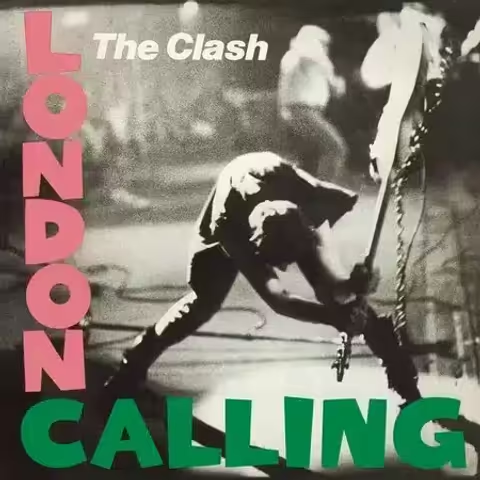
London Calling did not arrive as a punk record. It arrived as the sound of a band who had been written off six months earlier deciding to play with everything they had ever loved at once: rockabilly, reggae, New Orleans piano, lounge jazz, ska, gospel, the Spanish Civil War, the Three Mile Island reactor, the Brixton riots that had not happened yet, the Elvis Presley sleeve from 1956, the BBC World Service from 1942. It is a 19-track double album that the Clash made in five or six weeks in a converted Highbury church hall with a producer who poured a bottle of wine over Joe Strummer's piano because he wanted a bigger noise.
This is the story of how that record was written in a Pimlico garage, recorded by a man whose business cards might fairly have read "the British Phil Spector" if he could have stayed sober long enough to print them, and packaged inside an out-of-focus photograph that the photographer herself thought was a write-off. It is also the story of how the Clash, broke and unmanaged in May 1979, walked out of Wessex Studios five months later with the album that Rolling Stone would later call the best of the 1980s.
| Field | Detail |
|---|---|
| Artist | The Clash |
| Album | London Calling |
| Release date | 14 December 1979 (UK), January 1980 (US and Canada) |
| Label | CBS Records (UK), Epic Records (US/Canada) |
| Producer | Guy Stevens |
| Chief engineer | Bill Price; Jerry Green (second engineer) |
| Studio | Wessex Sound Studios, Highbury, London (rehearsals at Vanilla Studios, Pimlico) |
| Genre | Punk rock, post-punk, new wave, reggae, rockabilly, ska, R&B |
| Track count | 19 |
| Total runtime | 65:07 |
| UK Albums Chart peak | 9 |
| US Billboard 200 peak | 27 |
| Other notable peaks | Sweden 2, Norway 4, Finland 8, Canada 12, New Zealand 12, Australia 16, Austria 17 |
| Certifications | UK 2x Platinum (BPI), US Platinum (RIAA, Feb 1996), Italy Platinum, Canada and France Gold |
| Estimated sales | Over 5 million worldwide |
| Key singles | "London Calling" / "Armagideon Time" (UK No. 11); "Train in Vain" / "London Calling" (US No. 23); "Clampdown" (Australia only) |
| Cover photograph | Pennie Smith, New York Palladium, 20 September 1979 |
| Sleeve design | Ray Lowry (homage to Elvis Presley's 1956 RCA debut) |
Cultural Context
London Calling lands in the second week of December 1979, twelve days before Christmas, and into a country in which Margaret Thatcher has been Prime Minister for seven months. Inflation is running over 17 per cent. The previous winter has just been rebranded the Winter of Discontent. The IRA killed Lord Mountbatten in August. The Soviet Union invades Afghanistan a fortnight after the album's release. Three Mile Island had its partial meltdown in March, the image of which Joe Strummer would lift wholesale into the title track's "nuclear error".
The records the Clash were standing alongside in the British shops that fortnight tell their own story about how strange a moment it was. Pink Floyd's The Wall and Fleetwood Mac's Tusk were both new. AC/DC had released Highway to Hell at the end of July. Led Zeppelin's In Through the Out Door was still on the chart. Joy Division's Unknown Pleasures had arrived in June, and Public Image Ltd's Metal Box in November. Punk was either dead or already mutating into something else, depending on which paper you read. The Clash's response was to make a record that contained a Vince Taylor cover, a track named after a Jamaican disc jockey, an attack on consumer culture, a meditation on Spanish anarchists shot by Franco's troops, and a lover's rock pastiche about contraception.
The Band Up to This Point
By the start of 1979 the Clash were, by their own account, finished. Their second album, Give 'Em Enough Rope, had been delivered the previous November under the AOR-leaning American producer Sandy Pearlman and had divided the punk press. Their long-time manager Bernard Rhodes was sacked in October 1978 after a row over money, which left them without a rehearsal space (he owned the lease in Camden Town) and without anyone fielding the lawsuits that CBS were preparing over their unrecouped advance. Joe Strummer and Mick Jones had not finished a new song in over a year. The April 1979 Cost of Living EP was padded with a cover of "I Fought the Law" and three older songs.
Tour manager Johnny Green and roadie Baker found them a new room: an unheated, windowless garage behind a row of shops at 36 Causton Street, Pimlico, which they renamed Vanilla Studios. The band moved in during May 1979, told their hangers-on not to bother turning up, and started rehearsing for an album that did not yet exist.
Vanilla Studios and the Vanilla Tapes
What happened in Pimlico over the summer of 1979 is the part of the London Calling story that most fans only learned a quarter of a century after the fact. The Clash, sealed away from CBS and from each other's friends, fell into a routine. Afternoon rehearsals. A football game outside in the car park, four-a-side, with the road crew making up the numbers. Drinks at the pub. Evening rehearsal. Repeat. They started by playing rockabilly and reggae and R&B covers, mostly to amuse themselves, and discovered something the punk records had never let them discover: that Topper Headon could play in any style they could think of.
"We felt that we were struggling about to slip down a slope or something, grasping with our fingernails. And there was no one there to help us."
Joe Strummer, on the writing of "London Calling"
Demos were taped on a TEAC 4-track that someone produced from a flat in Holland Park. Fifteen of the 19 songs that ended up on the album exist on those tapes in early form, sometimes with no lyrics, sometimes under different titles. "Paul's Tune" was an instrumental sketch that became "The Guns of Brixton". "Up-Toon" was the embryonic "The Right Profile". "Working and Waiting" became "Clampdown". A Sonny Okosun cover called "Where You Gonna Go (Soweto)" and a reggae take on Bob Dylan's "The Man in Me" were both rehearsed and dropped. Crucially, "Spanish Bombs", "Wrong 'Em Boyo", "The Card Cheat" and "Train in Vain" are nowhere on the demos: those four were written or chosen during the actual studio sessions.
The cassettes were believed lost for decades. Johnny Green wrote in his 1999 memoir A Riot of Our Own that he left them on the London Underground the week before Wessex began. In 2004 Mick Jones found them in a packing box while moving house. Twenty-one of the recordings were issued the same year as the bonus CD on the album's 25th-anniversary Legacy Edition.
Creating the Album: Wessex, Stevens and the Eighteen-Hour Days
The band moved into Wessex Sound Studios in early August 1979. Wessex was a former church hall on Highbury New Park in north London, run by Bill Price, and by the time the Clash arrived its echoey tracking room had already been used by the Sex Pistols (for Never Mind the Bollocks), the Pretenders, the Tom Robinson Band, and Queen. Price was kept on as chief engineer. Jerry Green served as second.
The producer the Clash demanded, against CBS's wishes, was Guy Stevens. Stevens was 36, a former Sue Records DJ who had given Mott the Hoople their name, signed Free, brought Chuck Berry to Britain, and named Procol Harum after a friend's cat. He was also a chronic alcoholic, on prescription medication for his drinking, and the kind of man whose presence in a room could turn an ordinary Tuesday into an emergency. CBS reportedly thought he was uninsurable. The Clash, encouraged by Strummer, hired him anyway because, in their reading, the British R&B and beat booms of the 1960s would not have existed in their actual recorded form without Stevens, and that was the music the band were now trying to absorb.
"There are only two Phil Spectors in the world, and I'm one of them."
Guy Stevens, on himself
The recording was compressed: a five-to-six-week block of eighteen-hour days, with most takes kept in one or two passes. The first track committed to tape was "Brand New Cadillac", recorded as a warm-up after the band had been playing it to loosen up before sessions. Stevens preserved the warm-up. Where Pearlman a year earlier had asked the Clash to be tighter, cleaner, more American-radio-ready, Stevens was after the opposite. He swung a step ladder around the live room during one take. He up-ended chairs to "create a rock and roll atmosphere". During a session for "The Card Cheat" he poured a bottle of wine into the back of the upright piano Strummer was hammering on, by some accounts to make the sound bigger, by others to make Strummer stop.
The methods worked because the band were inside the take. "The Card Cheat" was double-tracked in its entirety, every instrument played twice, to give it the swelling, Phil Spector-meets-Lou Reed wash that the lyrics need. The horn parts on "Rudie Can't Fail", "Jimmy Jazz", "The Card Cheat" and "Revolution Rock" came from the Irish Horns, a four-piece who had played with Graham Parker and Ian Dury: Ray Bevis on tenor saxophone, John Earle on tenor and baritone sax, Chris Gower on trombone, Dick Hanson on trumpet and flugelhorn. Mickey Gallagher of the Blockheads sat in on Hammond organ. Mixing was finished in November. Bill Price's mix sheets, later reproduced in Mix magazine in 2000, show that some songs went through more than thirty tracks of tape.
"This is an album that captures all the Clash's primal energy, combines it with a brilliant production job by Guy Stevens, and reveals depths of invention and creativity barely suggested by the band's previous work."
John Rockwell, The New York Times, 4 January 1980
Personnel and Credits
| Role | Player | Notes |
|---|---|---|
| The Clash | ||
| Vocals, rhythm guitar, piano | Joe Strummer | Lead vocals throughout, except where noted |
| Lead guitar, vocals, piano, harmonica | Mick Jones | Lead vocals on "Lost in the Supermarket", "I'm Not Down", "The Card Cheat", "Train in Vain"; co-lead on "Rudie Can't Fail" and "Clampdown" |
| Bass, vocals | Paul Simonon | Lead vocals on "The Guns of Brixton" (his first writing and lead-vocal credit on a Clash album) |
| Drums, percussion | Topper Headon | Multi-style playing across reggae, ska, rockabilly, jazz and rock |
| Additional musicians | ||
| Hammond organ | Mickey Gallagher | On loan from Ian Dury and the Blockheads |
| Tenor saxophone | Ray Bevis | The Irish Horns |
| Tenor / baritone saxophone | John Earle | The Irish Horns |
| Trombone | Chris Gower | The Irish Horns |
| Trumpet, flugelhorn | Dick Hanson | The Irish Horns |
| Production | ||
| Producer | Guy Stevens | Died 29 August 1981 from a prescription-drug overdose; the Clash wrote "Midnight to Stevens" in tribute |
| Chief engineer | Bill Price | Wessex house engineer; later remixed the album for the 2012 single edit of the title track |
| Second engineer | Jerry Green | |
| Artwork | ||
| Sleeve design | Ray Lowry | The pink-and-green logotype is a direct quotation of RCA Victor's 1956 Elvis Presley sleeve |
| Cover photography | Pennie Smith | NME staff photographer; later awarded Q magazine's Greatest Rock 'n' Roll Photograph of All Time (2002) and an MBE for services to photography (2024) |
The Songs
Nineteen tracks across four sides, two of them covers, one of them written by the bassist, and one of them not even printed on the back of the sleeve. The track list runs as follows.
| # | Title | Writer(s) | Length | Single? | Notes |
|---|---|---|---|---|---|
| 1 | London Calling | Strummer / Jones | 3:19 | UK No. 11 (Dec 1979); US b/w "Train in Vain" Feb 1980 | Closes with Morse code S-O-S |
| 2 | Brand New Cadillac | Vince Taylor | 2:09 | Originally a Vince Taylor and his Playboys B-side, 1959; first track committed to tape at Wessex, recorded as a warm-up | |
| 3 | Jimmy Jazz | Strummer / Jones | 3:54 | Working title "The Police Walked in 4 Jazz" on the Vanilla Tapes | |
| 4 | Hateful | Strummer / Jones | 2:45 | ||
| 5 | Rudie Can't Fail | Strummer / Jones | 3:26 | Co-lead vocals Strummer and Jones; horn arrangement by the Irish Horns | |
| 6 | Spanish Bombs | Strummer / Jones | 3:18 | Written during the Wessex sessions, not present on the Vanilla Tapes | |
| 7 | The Right Profile | Strummer / Jones | 3:54 | About the actor Montgomery Clift; demo title "Up-Toon" | |
| 8 | Lost in the Supermarket | Strummer / Jones | 3:47 | Lead vocal Mick Jones; Strummer wrote the lyric imagining Jones's basement childhood with his mother and grandmother | |
| 9 | Clampdown | Strummer / Jones | 3:49 | Australia-only, 1980 | Originally instrumental, titled "Working and Waiting" |
| 10 | The Guns of Brixton | Paul Simonon | 3:07 | Simonon's first writing and lead-vocal credit on a Clash album; vanilla-tape demo titled "Paul's Tune" | |
| 11 | Wrong 'Em Boyo | Clive Alphonso | 3:10 | Cover of the Rulers' 1967 single; opens with a "Stagger Lee" interpolation | |
| 12 | Death or Glory | Strummer / Jones | 3:55 | ||
| 13 | Koka Kola | Strummer / Jones | 1:46 | Vanilla Tape title "Koka Kola, Advertising and Cocaine" | |
| 14 | The Card Cheat | Strummer / Jones | 3:51 | Lead vocal Mick Jones; every instrument double-tracked to maximise size | |
| 15 | Lover's Rock | Strummer / Jones | 4:01 | Lyric advocates contraception and considered planning | |
| 16 | Four Horsemen | Strummer / Jones | 2:56 | ||
| 17 | I'm Not Down | Strummer / Jones | 3:00 | Lead vocal Mick Jones | |
| 18 | Revolution Rock | Jackie Edwards / Danny Ray | 5:37 | Cover of Danny Ray and the Revolutionaries | |
| 19 | Train in Vain | Strummer / Jones | 3:09 | US No. 23, Feb 1980 | Lead vocal Mick Jones; not listed on the original sleeve, only on a sticker on the cellophane and scratched into the run-off groove |
"London Calling"
The opening track is built around a martial Headon snare pattern and a Jones guitar figure that snaps between staccato hard rock and reggae upstroke. The lyric is bullet-pointed dread: a "nuclear error" lifted from Three Mile Island in March 1979, a Thames flood that prefigures the Thames Barrier opening three years later, "phoney Beatlemania has bitten the dust" as a settling of accounts with the previous decade. The title is the BBC World Service's wartime station identification, "This is London calling". The fade-out spells S-O-S in Morse, picked up on Strummer's guitar.
The song was released as a single on 7 December 1979, a week before the album. BBC Radio 1's Annie Nightingale bet Strummer that it would crack the top ten without a Top of the Pops appearance, the stake being a Cadillac. It peaked at number 11. A listener subsequently donated a Cadillac to settle the debt, which was later auctioned to raise money for the recession-hit Northamptonshire steel town of Corby.
"Brand New Cadillac"
Vince Taylor's 1959 rocker, written and recorded as a B-side for "Pledgin' My Love" on Parlophone, is the album's pivot from punk to rock and roll memory. The Clash had been using it to warm up for sessions at Wessex. Stevens recorded one of those warm-ups, and that take is what survives.
"The Guns of Brixton"
Paul Simonon, growing up in south London, had been listening to Jimmy Cliff records and watching the early Notting Hill Carnival riots. He wrote the music and the words at home and was unsure about the lyric, which voices a paranoid character preparing for a confrontation with the police. Strummer encouraged him to keep going. It is the first track on a Clash album credited to Simonon and the first on which he sings lead. Two years later the song's bassline was reused by Beats International for "Dub Be Good to Me", a UK number one.
"Train in Vain"
The story behind the album's last and most American song is the strangest commercial accident on any Clash record. Train in Vain was written and recorded after the rest of the album was finished, intended as a free flexi-disc giveaway to be glued to the cover of the NME. The deal collapsed at the last minute. CBS could not get the track on the printed sleeve in time, so the original UK pressing announces it only on a sticker stuck to the outer cellophane and in handwriting scratched into the vinyl run-off on side four. In the United States, where it was released as the lead single in February 1980, it became the Clash's first US top-30 hit.
Album Artwork: Pennie Smith, Ray Lowry and the Out-of-Focus Bass
The cover photograph was taken on the night of 20 September 1979 at the New York Palladium on East 14th Street, on the Clash's 16 Tons Tour of North America. Pennie Smith, the NME staff photographer the band had brought along to document the tour, was crouched at stage left with a Pentax. Paul Simonon, furious that the venue's bouncers were not letting the seated audience stand up, lifted his white Fender Precision Bass over his head and brought it down onto the stage so hard that the headstock broke off. Smith squeezed the shutter as she stepped back from the edge of the stage to avoid being hit, which is why the picture is, by her own assessment, slightly out of focus.
"I had no idea it was out of focus. Half-blind at the best of times and half-pissed at the time, that simply had to be the one."
Ray Lowry, sleeve designer, on his decision to use the photograph
"I wasn't taking it out on the bass guitar, cos there ain't anything wrong with it."
Paul Simonon, interview with Fender, 2011
Smith argued against using the picture. Strummer and Lowry, the cartoonist and graphic designer the Clash had brought on the tour as a sort of in-house chronicler, overruled her. Lowry had already designed the sleeve as a colour-shifted homage to the 1956 RCA Victor sleeve for Elvis Presley's self-titled debut: pink letters down the left edge, green block text across the bottom, a black-and-white action shot in the middle. The Clash's previous album sleeves had pictured the band as a defined group of four. London Calling pictures only the rhythm section's bass, in mid-destruction. In 2002 Q magazine voted it the greatest rock and roll photograph of all time. In 2010 the Royal Mail issued it as a postage stamp. The smashed Precision Bass is now in the Museum of London.
Release and Reception
London Calling was issued in the UK as a double LP on 14 December 1979 and in the US on vinyl and 8-track in mid-January 1980. CBS had initially refused the band's request for a double album and a free 12-inch single thrown in. The compromise was a double LP sold for the price of a single LP, with the Clash taking the financial hit on royalties. The British price was £5. The band considered it the only way to release the music without being sued for inflation by their own fans.
The contemporary reviews were close to unanimous. Charles Shaar Murray in NME wrote that it was the first Clash record to live up to the band's hype. James Truman in Melody Maker said the Clash had "discovered themselves" by embracing American forms. Tom Carson, in Rolling Stone in April 1980, called it vast, engaging and enduring enough to leave listeners "not just exhilarated but exalted and triumphantly alive". Down Beat's Michael Goldberg reviewed it as a five-star "classic rock album which, literally, defines the state of rock and roll". The dissenters were a smaller group: Garry Bushell in Sounds gave it two stars and accused the Clash of regressing to "tired old rock cliches". The DJ Charlie Gillett complained that some tracks sounded like Bob Dylan with a horn section, which one suspects the band would have taken as a compliment.
"It generated an urgency and vitality and ambition (that Elvis P. cover!) which overwhelmed the pessimism of its leftist world-view."
Robert Christgau, The Village Voice, 1980 Pazz & Jop poll
At the end of 1980 the album won the Pazz & Jop critics' poll in The Village Voice. It reached number 9 in the UK Albums Chart, was certified silver by the BPI in December 1979, and was eventually upgraded to 2x Platinum. Outside the British and American markets it performed even better. It hit number 2 in Sweden, number 4 in Norway, number 8 in Finland. In the United States, where the band were still a cult concern, it climbed only to number 27 on the Billboard 200, but it stayed on the chart and the RIAA certified it Platinum in February 1996.
Singles and Music Videos
| Single | B-side | Released | Director (video) | Chart peaks |
|---|---|---|---|---|
| "London Calling" | "Armagideon Time" | 7 December 1979 (UK, CBS 8087) | Don Letts | UK No. 11; Australia No. 28; Ireland No. 16 |
| "Train in Vain (Stand by Me)" | "London Calling" | 12 February 1980 (US, Epic 50851) | Don Letts (live performance footage) | US Billboard Hot 100 No. 23; Hot Dance Club Play No. 30 |
| "Clampdown" | "The English Civil War" | 1980 (Australia only) | Promo single only |
The video for "London Calling" was shot by Don Letts in early December 1979, in pouring rain, on a small wooden boat at Festival Pier on the south bank of the Thames near Albert Bridge and Battersea Park. The band perform the song lashed by water and wind, instruments visibly soaked. It is one of the very small number of music videos from the era that has aged better than the song's eventual chart position would predict.
Touring and Live
London Calling was promoted on the road by the 16 Tons Tour, named for the Tennessee Ernie Ford song the Clash had been using as walk-on music. The first leg ran across the UK from January 1980 with Mikey Dread on the bill as the second support act and Lee Dorsey as the first. The North American leg of the tour had taken place in September 1979, before the album was even mixed: that is the leg on which Pennie Smith took the cover photograph at the New York Palladium on 20 September. Continental European dates followed in spring 1980, and a second North American run in March 1980.
- 9 January 1980, Friars Aylesbury, England, first UK date of the 16 Tons Tour
- 27 February 1980, ABC Theatre, Aberdeen, only Scottish date on the first leg
- 8 March 1980, Lewisham Odeon, London, recorded by the BBC for later broadcast
- 12 February 1980, Capitol Theatre, Passaic, New Jersey, broadcast on King Biscuit Flower Hour
- March 1980, Massey Hall, Toronto, Mickey Gallagher joined the touring band on Hammond from this point onwards
The tour's setlists drew heavily on London Calling, often opening with "Clash City Rockers" or "Brand New Cadillac" and using the title track as a mid-set anchor. "Train in Vain" entered the live set only after it became a US hit. "The Card Cheat", with its piano and horns, was almost never attempted on stage.
In TV, Film and Media
"London Calling" has had a sync afterlife wildly out of step with the Clash's own stated views on advertising. The band turned down a British Telecom request in the early 1990s. In 2002 they licensed the song to Jaguar for a car advertisement, which several long-term fans took as betrayal. In 2012 it was used by British Airways for a London Olympics campaign. The song has appeared on the soundtracks of the Bond film Die Another Day (2002) and the video game Tony Hawk's American Wasteland (2005). In 2007 the original 1979 recording was inducted into the Grammy Hall of Fame.
Other album tracks have had their own placements. "Train in Vain" recurs in Stranger Than Fiction (2006) and several US TV dramas. "Clampdown" was used in Futurama in 2011. "Death or Glory" appeared in New Girl in 2012. After the Russian invasion of Ukraine in 2022, the Clash gave permission to the Ukrainian punk band Beton to rewrite "London Calling" as the charity single "Kyiv Calling". Joe Strummer, who died in December 2002, hosted a BBC World Service show in his last years that he named, in deliberate self-quotation, Joe Strummer's London Calling.
Reissues, Remasters and Anniversaries
The album has been reissued more times than any other Clash record. Highlights:
- 1999, first CD remaster supervised by Mick Jones and Bill Price.
- 2004, 25th Anniversary Legacy Edition. Bonus CD: The Vanilla Tapes (21 demos, presumed lost since 1979 and rediscovered by Jones in 2004 while moving house). Bonus DVD: Don Letts's documentary The Last Testament: The Making of London Calling, plus the official videos for "London Calling", "Train in Vain" and "Clampdown" and home video footage from inside Wessex. Metacritic score 100/100.
- 2010, limited-edition picture-disc LP and Royal Mail postage stamp. The image of Simonon's bass is one of ten classic British album covers commemorated in the same set.
- 2012, Record Store Day 7-inch with a new mix of the title track by Mick Jones and Bill Price, paired with an instrumental version on the B-side.
- 2013, included in the Sound System career box set, freshly remastered.
- 2019, 40th-anniversary scrapbook hardback published by Thames & Hudson, with new commentary by Jones and Simonon and previously unseen Pennie Smith photographs from the New York Palladium roll.
Legacy and Influence
Within ten years of release the album had been recategorised in the rock canon. In 1989 Rolling Stone named the 1980 American edition the best album of the 1980s, despite the fact that the British edition belongs unambiguously to the 1970s. The magazine ranked it 8th on its 500 Greatest Albums of All Time list in 2003 and again in 2012, with the position dropping only slightly to 16th in the 2020 revision. Pitchfork ranked it second in its 100 Best Albums of the 1970s list in 2004. Q put it 4th on its 100 Greatest British Albums in 1999. NME placed it 6th in its Greatest Albums of the '70s. The BBC inducted it into the Radio 1 Masterpieces series in 2009.
The musical inheritance is harder to summarise because it ran in two directions at once. The Clash's diverse, magpie approach to genre fed directly into the 1990s American punk revival of Green Day, Rancid (whose ...And Out Come the Wolves sleeve is a near-direct quotation of London Calling) and the Bouncing Souls. It also fed into a quieter strand of British rock and roll songwriting: the Pogues, Carter USM, Manic Street Preachers, the Libertines, Arctic Monkeys, Frank Turner. Beats International's "Dub Be Good to Me", Norman Cook's first UK number one, was built from the bassline of "The Guns of Brixton". The opening salvo of "London Calling" itself has been borrowed by every London Olympics opening ceremony, every BA advert, every football documentary about the late 1970s, and a Ukrainian punk anthem.
Things You Might Not Know
| Fact | Detail |
|---|---|
| Working title for "Clampdown" | It existed as an instrumental called "Working and Waiting" on the Vanilla Tapes before lyrics were added during the Wessex sessions. |
| "The Guns of Brixton" was "Paul's Tune" | Paul Simonon's track was untitled and lyric-less on the demo cassettes, listed simply as "Paul's Tune". It is the first Clash composition with Simonon as sole writer. |
| The opening track was a warm-up | "Brand New Cadillac" was the first thing committed to tape at Wessex. The Clash had been using the Vince Taylor cover to loosen up; Guy Stevens kept the warm-up take. |
| The wine-on-the-piano story | During a session for "The Card Cheat", Stevens poured a bottle of wine into the back of the upright Strummer was playing. Witnesses give two reasons: to fatten the sound, or to make Strummer stop. |
| "The Card Cheat" is double-tracked end-to-end | Every instrument was recorded twice and stacked, in pursuit of a Phil Spector-scale wall of sound. It is the most production-heavy track on the record. |
| The cover bass is in a museum | The white Fender Precision Bass smashed by Simonon at the New York Palladium on 20 September 1979 lives in the Museum of London after a long spell at the Cleveland Rock and Roll Hall of Fame. |
| The photographer hated the cover | Pennie Smith argued against using the picture because it was out of focus, the result of her stepping back as Simonon advanced on her. Strummer and Ray Lowry overruled her. |
| The Vanilla Tapes were lost on the Tube | Roadie Johnny Green wrote in his 1999 memoir A Riot of Our Own that he left the demo cassettes on the London Underground. They turned up in a packing box in 2004, when Mick Jones found them while moving house. |
| "Train in Vain" was meant to be a free flexi-disc | It was written for an NME giveaway promotion. When the deal collapsed it was bolted on as track 19, too late for the printed sleeve, announced only on a cellophane sticker and scratched into the run-off groove. |
| Annie Nightingale's Cadillac | BBC Radio 1 DJ Annie Nightingale bet Strummer that "London Calling" would crack the UK top ten without a Top of the Pops appearance, the stake being a Cadillac. The single peaked at 11; a listener donated a Cadillac to settle the bet, which was then auctioned for the steel town of Corby. |
| The album cost CBS its profit margin | The Clash insisted London Calling be sold for the price of a single LP, taking the royalty hit themselves so fans were not charged double. |
| Guy Stevens died less than two years later | He was found dead at his Forest Hill home on 31 August 1981 from an overdose of prescription drugs he was taking to manage his alcoholism. The Clash wrote "Midnight to Stevens" in tribute, eventually released on the 1991 box set Clash on Broadway. |
| The fade-out of the title track is a real S-O-S | Strummer's guitar at the end of "London Calling" spells the Morse code letters S-O-S, reinforcing the lyric's "London is drowning, and I live by the river". |
| The cover is on a Royal Mail stamp | In January 2010 the Royal Mail issued a set of ten Classic Album Cover stamps. London Calling was one of them, alongside Pink Floyd's The Division Bell, Coldplay's A Rush of Blood to the Head and the Rolling Stones' Let It Bleed. |
| Pennie Smith eventually got an MBE | The 16-year-old NME staffer who took the photograph was made a Member of the Order of the British Empire for services to photography in the 2024 King's Birthday Honours. |

Comments