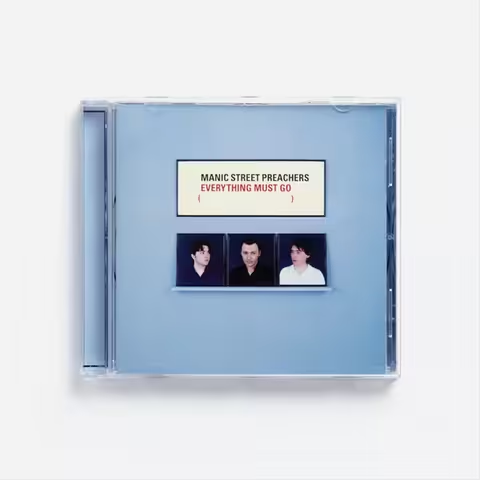
Richey Edwards left behind a folder of unused lyrics, a Vauxhall Cavalier abandoned at Severn View services on 1 February 1995, and three friends who spent the next eighteen months in genuine doubt about whether Manic Street Preachers still existed. Everything Must Go is the record that answers the question. James Dean Bradfield, Nicky Wire and Sean Moore took five sets of those lyrics into a converted chateau in rural Normandy, hired the producer Edwards himself had wanted since The Holy Bible, and built one of the most defiantly orchestral British rock albums of the decade around the gap their friend had left.
The result, released on 20 May 1996, debuted at number two on the UK Albums Chart, was certified 3x Platinum at home on shipments above 1.08 million copies, swept the 1997 Brits and ended up at number one in Melody Maker''s and Vox''s end-of-year lists. It is the album on which the most uncompromising literary band in British rock learned to write hooks the size of stadiums, and it did so by accident, in grief, with a producer who insisted on recording the drums first.
Album Facts
| Field | Detail |
|---|---|
| Artist | Manic Street Preachers |
| Album | Everything Must Go |
| Release Date | 20 May 1996 |
| Label | Epic Records (Sony) |
| Producer(s) | Mike Hedges; Manic Street Preachers (co-prod.); Dave Eringa ("No Surface All Feeling"); Stephen Hague (original "The Girl Who Wanted to Be God") |
| Studio(s) | Chateau de la Rouge Motte, Domfront en Poiraie, Normandy; Big Noise, Cardiff; Real World, Box, Wiltshire; mastering at Abbey Road, London |
| Genre / Subgenre | Alternative rock, Britpop, hard rock |
| Track Count | 12 |
| Total Runtime | 45:24 |
| UK Albums Chart Peak | No. 2 (entered May 1996, 104 weeks in Top 100) |
| Other Notable Chart Peaks | Scotland No. 2; Ireland No. 12; Sweden No. 21; Finland No. 29; New Zealand No. 29; Denmark No. 40; Australia No. 55; Netherlands No. 63 |
| Certifications | UK: 3x Platinum (BPI, shipments 1,083,005); Europe: Platinum (IFPI, 1997) |
| Estimated Sales | More than two million copies worldwide |
| Key Singles | "A Design for Life" (UK No. 2, Silver); "Everything Must Go" (No. 5); "Kevin Carter" (No. 9); "Australia" (No. 7); "Further Away" (Japan only) |
Cultural Context: Britpop, Cool Cymru and the Mercury Class of 96
By the spring of 1996, the British charts had reorganised themselves around guitars and a flag. Oasis''s (What''s the Story) Morning Glory? had ended 1995 as the fastest-selling album in UK history; Pulp''s Different Class had landed in October to ecstatic notices; Blur had spent the previous summer pretending to enjoy beating Oasis to number one with "Country House". The press, by then, had a label for it. Britpop was a year past its commercial peak and had begun the slide into self-parody that Be Here Now would soon make permanent.
The Manics had not been part of that party. The Holy Bible, released in August 1994, had reached number six and stalled there, a barbed wire album about anorexia, the Holocaust, capital punishment and Edwards''s collapsing mental health. It had been received as a masterpiece and avoided like one. The band who had launched themselves in 1991 with a stencilled manifesto promising one perfect record then a self-immolation in front of a stadium had instead spent the next four years getting smaller, darker and stranger, and then losing a member.
Wales itself was about to enjoy what the press christened Cool Cymru, the wave that would push Super Furry Animals, Catatonia, 60ft Dolls, Stereophonics and Gorky''s Zygotic Mynci into the British mainstream. The Manics, the band who had spent five years insisting they were not a Welsh act so much as a band who happened to come from Blackwood, would end up its accidental flagship. The Mercury Prize class of 1996 they joined on shortlist included Pulp, Underworld, Black Grape and the eventual winner Pulp''s rivals only on paper, Beth Orton and the Mercury''s 1996 winner Pulp. Everything Must Go would lose the prize to a Pulp record the public had already lived with for six months.
The Band''s Story Up to This Point
Manic Street Preachers had formed in Blackwood, in the South Wales valleys, in 1986. Bradfield (cousin of drummer Moore) and bassist Wire had grown up together; Edwards joined later as driver and provocateur, then guitarist when the band reorganised. They had released three albums of decreasing commercial visibility and increasing critical seriousness: Generation Terrorists (1992), the eighteen-track double LP that was meant to sell sixteen million copies and break the band up, then Gold Against the Soul (1993), a more conventional rock record they later disowned, then The Holy Bible (1994), Edwards''s lyrical magnum opus and the album that more or less broke him.
By the autumn of 1994 Edwards was hospitalised. He spent time at the Whitchurch Hospital in Cardiff and then at the Priory in Roehampton, being treated for alcoholism, self-harm and anorexia. He returned to the band in early 1995 for promotional duties for a planned American tour with Suede. On 1 February 1995, the day they were due to fly to the United States, he checked out of the Embassy Hotel in Bayswater, leaving a packed suitcase behind. His silver Vauxhall Cavalier was found a fortnight later at the Severn View motorway services, near a stretch of the Severn Bridge that has long been a site of suicide. His passport, credit cards and Prozac had been left at home; he has never been seen since. He was declared presumed dead in 2008.
The three remaining members played one gig with Edwards in Spain that January, then nothing for nine months. Bradfield, Wire and Moore re-emerged for a small string of dates in late 1995 as a trio, including support slots for The Stone Roses and the Reading Festival, and tested an audience response to "A Design for Life" before they had even recorded it. The reception, by all three accounts, was the thing that convinced them there was a fourth album to make.
Pre-production, the Folder and Sounds in the Grass
The folder of unused lyrics Edwards had left behind ran to several hundred typed pages, with annotations in his own hand. The band drew from it carefully. Five would make the album: "Elvis Impersonator: Blackpool Pier", "Kevin Carter", "Small Black Flowers That Grow in the Sky", "The Girl Who Wanted to Be God" (co-written with Wire) and "Removables". A larger set would be set aside; Bradfield and Moore would eventually return to them for 2009''s Journal for Plague Lovers, an album they cut with Steve Albini using only Edwards lyrics from the same archive.
Demos for the new songs were tracked across 1995 at Wire''s house in Newport ("acoustic demo, Nick''s house ''95" appears repeatedly on the 10th anniversary edition), at a rehearsal room in Cardiff (a now-famous first run-through of "A Design for Life" and "Kevin Carter" survives in that form) and at Big Noise Studios in the city. The working title throughout was Sounds in the Grass, the name of a Jackson Pollock series; the album that would eventually take its title from a play by Wire''s brother, the poet Patrick Jones.
The breakthrough song was "A Design for Life". Wire posted Bradfield two sets of lyrics in the same envelope, "A Design for Life" and "Pure Motive". Bradfield combined them. The opening line, "Libraries gave us power", was taken from an inscription Wire had spotted above Pillgwenlly public library in Newport; the chorus, "We don''t talk about love, we only want to get drunk", was meant as a savage rejoinder to the lad-culture tabloid coverage of working-class Britain in 1996, and is routinely sung back to the band by audiences who have only ever heard it as an anthem. Bradfield wrote the music in twenty minutes on a Sunday afternoon and rang Wire in tears. Wire later said it was the moment he knew the band could go on.
- Songs the band rehearsed but cut from the running order included "Black Garden", "No-one Knows What It''s Like to Be Me", "Hanging On" and "Dead Trees and Traffic Islands", all later restored on the 10th anniversary set.
- A Stephen Hague production of "Australia" and "The Girl Who Wanted to Be God" was abandoned; the band re-cut both songs with Hedges and the bonus discs preserve Hague''s mixes.
- Mark Farrow''s sleeve concept used an installation shot by photographer Rankin: a chair in a white room, suggesting both Edwards''s absence and a fresh start.
Creating the Album: A Chateau, a Wall of Sound and the Cure''s Pornography
Mike Hedges had been on the Manics'' wanted list since The Holy Bible, but he had been booked when those sessions came around. By the time the band were free to write a fourth album, Hedges was free too. He owned a residential studio in Normandy, the converted Chateau de la Rouge Motte at Domfront en Poiraie. The band moved in for the bulk of the recording in late 1995 and early 1996, with overdubs at Big Noise in Cardiff and a single track ("The Girl Who Wanted to Be God") finished at Peter Gabriel''s Real World in Box. Mastering went to Chris Blair at Abbey Road.
Hedges and Bradfield agreed on a first principle: the drums had to be enormous. Bradfield had been listening to Pornography by The Cure, an album Hedges himself had engineered in 1982, and to the Joy Division, Wire, Magazine, Banshees, Wah! and Associates records he later listed for Sound on Sound. "Everything starts with the drums" was his line; Sean Moore''s kit was set up in the chateau''s stone-walled main room and miked at a distance, the way Hedges had learned to record under producer Mike Thorne in the late 1970s. The strings, arranged by Martin Greene and the Wired Strings ensemble of Gini Ball, Sally Herbert, Anne Stephenson, Chris Pitsillides and Clare Orsler, with harp from Julie Aliss, were tracked at the same chateau and treated as a second rhythm section, not as sweetening on top of a guitar record. Wire''s touchstone for the sound was Phil Spector''s Wall of Sound, and the band asked Hedges to listen back to "River Deep, Mountain High" before any vocal session.
"I loved records like Pornography by The Cure and Joy Division records and Wire records and Magazine records and Banshees records and Wah! records and Associates records where everything starts with the drums."
James Dean Bradfield, Sound on Sound, 2008
Bradfield played all the guitar parts; his vocals were tracked live with the band in the chateau''s ballroom rather than in a vocal booth, with two Neumann U67s and a vintage EMI console. Sean Moore added trumpet (his other instrument, learned at school) to "Kevin Carter" and the title track; the band were keen to point out, repeatedly, that the most famous brass on the record had been played by their own drummer. John Green added Hammond organ and keyboards where the arrangements demanded it. Hedges'' engineer Ian Grimble handled the mixing of the bulk of the album. Dave Eringa, the producer who had worked with the band on B-sides since Generation Terrorists, was brought in to finish "No Surface All Feeling" (the song on which Edwards''s rhythm guitar appears, recorded with him in early 1995) and to mix "Australia".
The sessions, by all accounts, were calm rather than fraught. Hedges built fires in the chateau''s vast hearths in the evenings. The band cycled to the local boulangerie. There were no rows, no walkouts, no firings. Bradfield admitted later that the only real arguments were musical ones with Hedges about reverb levels.
Personnel & Credits
| Role | Player | Notes |
|---|---|---|
| Core band | ||
| Lead vocals, lead and rhythm guitar, piano | James Dean Bradfield | All guitar parts on the album except a partial rhythm on "No Surface All Feeling" |
| Drums, percussion, trumpet, backing vocals | Sean Moore | Trumpet on "Kevin Carter" and title track; classically trained at school |
| Bass guitar, backing vocals | Nicky Wire | Wrote the lyrics for seven tracks; co-wrote "Elvis Impersonator" and "The Girl Who Wanted to Be God" with Edwards |
| Guest & session musicians (credited) | ||
| Rhythm guitar | Richey Edwards | Partial rhythm guitar on "No Surface All Feeling", recorded before his disappearance. Only the second Manics studio track to feature his guitar work (after "La Tristesse Durera") |
| Hammond organ, keyboards | John Green | |
| Percussion | Martin Ditcham | |
| Harp | Julie Aliss | |
| Violin | Gini Ball, Sally Herbert, Anne Stephenson | Members of the Wired Strings session ensemble |
| Viola | Chris Pitsillides, Clare Orsler | |
| String arrangements | Martin Greene | |
| Production & engineering | ||
| Production | Mike Hedges | Engineer on The Cure''s Pornography (1982); had been on the band''s wishlist since The Holy Bible sessions |
| Additional production | Dave Eringa | Produced "No Surface All Feeling"; mixed "Australia" and "No Surface All Feeling" |
| Original production | Stephen Hague | Original takes of "The Girl Who Wanted to Be God" and "Australia"; both were re-recorded with Hedges, Hague''s mixes survive on bonus discs |
| Engineering, mixing | Ian Grimble | Hedges'' regular engineer |
| Engineering ("The Girl Who Wanted to Be God") | Spike Drake | At Real World, Box |
| Mixing assistant ("Australia") | Guy Massey | |
| Mastering | Chris Blair | Abbey Road Studios, London |
| Artwork | ||
| Design and direction | Farrow Design (Mark Farrow) | Designed Pet Shop Boys and Spiritualized sleeves in the same era |
| Photography | Rankin (John Rankin Waddell) | Co-founder of Dazed & Confused magazine |
The Songs
The running order of Everything Must Go is the work of three people thinking very hard about how a record opens, peaks and lets go. Side one builds from the dislocated swirl of "Elvis Impersonator" through "A Design for Life" into the album''s emotional and commercial heart; side two darkens, drifts and finally surrenders. Every song is in a different key, every drum sound is different, every chorus tries to be the biggest moment on the album.
| # | Title | Writer(s) | Length | Single? | Notes |
|---|---|---|---|---|---|
| 1 | "Elvis Impersonator: Blackpool Pier" | Wire, Edwards (lyrics) / Bradfield, Moore (music) | 3:29 | No | Edwards lyric; portrait of Britain''s embrace of American kitsch |
| 2 | "A Design for Life" | Wire / Bradfield, Moore | 4:16 | Yes | UK No. 2, Silver; Wire spliced two lyrics; opening line from a Newport library inscription |
| 3 | "Kevin Carter" | Edwards / Bradfield, Moore, Wire | 3:24 | Yes | UK No. 9; Edwards lyric about the Pulitzer-winning South African photojournalist who took his own life in 1994; Sean Moore plays the trumpet solo |
| 4 | "Enola/Alone" | Wire / Bradfield, Moore | 4:07 | No | Inspired in part by Roland Barthes''s 1980 book Camera Lucida |
| 5 | "Everything Must Go" | Wire / Bradfield, Moore | 3:41 | Yes | UK No. 5; title from Patrick Jones''s play |
| 6 | "Small Black Flowers That Grow in the Sky" | Edwards / Bradfield, Moore, Wire | 3:02 | No | Edwards lyric on captive zoo animals; producer Mike Hedges''s favourite track; title quotes The Best Years of Our Lives (1946) |
| 7 | "The Girl Who Wanted to Be God" | Wire, Edwards / Bradfield, Moore | 3:35 | No | Title from Sylvia Plath; cut twice (Stephen Hague version abandoned, Hedges/Real World version released) |
| 8 | "Removables" | Edwards / Bradfield, Moore, Wire | 3:31 | No | Cut as a live one-take in the chateau; Edwards lyric, contains the line "broken hands never ending" |
| 9 | "Australia" | Wire / Bradfield, Moore | 4:04 | Yes | UK No. 7; Wire''s lyric of escapist longing, "I want to fly and run til it hurts"; final UK single |
| 10 | "Interiors (Song for Willem de Kooning)" | Wire / Bradfield, Moore | 4:17 | No | Tribute to the Dutch-American painter, who in his later years was working through Alzheimer''s |
| 11 | "Further Away" | Wire / Bradfield, Moore | 3:38 | Japan only (Oct 1996) | Wire described it as "almost" a love song; B-side "Sepia" referenced the closing freeze-frame of Butch Cassidy and the Sundance Kid |
| 12 | "No Surface All Feeling" | Wire / Bradfield, Moore | 4:14 | No | Features Edwards''s rhythm guitar recorded before his disappearance; produced and mixed by Dave Eringa; closes the album with Wire''s farewell to a missing friend |
The opening "Elvis Impersonator: Blackpool Pier" was Edwards''s last great cultural snapshot, a song about a British seaside town watching America perform itself badly back at it: pirate radio, neon, "all the world weeping". Bradfield said later that it was the kind of lyric Wire and Edwards used to write together in school exercise books in the front room at Blackwood and that it set the mood for the album, even though it was not commercial enough for any record company to consider as a single.
"A Design for Life" is the song the album is built around. Bradfield received Wire''s lyric in the post on a Friday afternoon, wrote the music on a Sunday in his flat in Cardiff and could not stop crying afterwards. The opening line, "Libraries gave us power", was Wire''s memory of the Pillgwenlly library inscription, "Knowledge is power"; the chorus, "We don''t talk about love, we only want to get drunk", was meant as a deliberate provocation, a lyric the singer of one of the most literate British bands could put in the mouth of his own audience and watch them sing it back. The single went to number two on 28 April 1996, kept off the top spot only by Mark Morrison''s "Return of the Mack". The Stealth Sonic Orchestra string arrangement on the released version was tracked at the chateau with Hedges; the band have never played the song live without it.
"Kevin Carter" is Edwards''s memorial to a man he never met. Carter was the South African photojournalist who in March 1993 photographed an emaciated Sudanese child being stalked by a vulture; the picture won him the Pulitzer Prize the following year. Carter took his own life in July 1994 at the age of 33. Edwards drafted the lyric not long before he disappeared. Sean Moore''s trumpet solo on the released version is the moment the song stops being a recital and becomes a lament; Bradfield has said in interviews that it took Moore one take.
"Small Black Flowers That Grow in the Sky", Edwards''s lyric about caged zoo animals, is the song Hedges has consistently said is his favourite on the album. Bradfield approached the vocal differently from anything he had sung before; he wanted to take a deep breath before each line, an effect you can hear clearly on the released take. The title is a line from William Wyler''s 1946 film The Best Years of Our Lives; the line "Here chewing your tail is joy" reads as much like an autobiographical line about Edwards''s self-harm as it does about an animal in distress.
"Removables", reportedly cut in a single live take at the chateau, contains the line "broken hands never ending"; "Interiors" was inspired by a documentary Wire had seen on Willem de Kooning, the Dutch-American Abstract Expressionist who in his last years went on painting despite Alzheimer''s having stripped his memory of what he had already painted. The album closes with "No Surface All Feeling", Wire''s tender, slow-burning farewell, with the missing friend playing rhythm guitar on the recording he is being mourned in.
B-sides, Outtakes and Lost Songs
The 1996 singles campaign turned the album into a cottage industry of B-sides. The CD2 of "A Design for Life" alone carried "Mr Carbohydrate" (Wire''s own list of personal likes and dislikes set to music) and a Stealth Sonic Orchestra remix; "Everything Must Go" added "Black Garden", "Hanging On" and the Chemical Brothers remix; "Kevin Carter" produced a Stealth Sonic Orchestra remix and a Jon Carter house remix titled "Kevin Carted (Busts Loose)"; "Australia" brought "Take the Skinheads Bowling" (a Camper Van Beethoven cover), "Velocity Girl" (a Primal Scream cover) and Lionrock''s nine-minute drum-and-bass reworking of the title track. Three more songs that did not fit the album''s running order ("No-one Knows What It''s Like to Be Me", "Dead Passive" and "Dead Trees and Traffic Islands") went out as B-sides; "Sepia", on the Japanese-only "Further Away" single, was Wire''s lyric about the closing freeze-frame of Butch Cassidy and the Sundance Kid.
A pair of Stephen Hague productions of "Australia" and "The Girl Who Wanted to Be God" exists in completed form. Hague, who had produced Pet Shop Boys, OMD and New Order, was brought in early in the project for a more polished take on those two songs; the band scrapped both and re-recorded them with Hedges, but Sony preserved Hague''s mixes for the 10th anniversary edition. A rough early version of "A Design for Life", recorded at a rehearsal room in Cardiff in autumn 1995, is also on that set; it is essentially the released arrangement, written before the band knew what to do with it.
Album Artwork and Packaging
The sleeve is the work of London designer Mark Farrow, then best known for his austere geometric covers for the Pet Shop Boys, and the photographer Rankin, co-founder of Dazed & Confused. The front cover is an installation shot, taken in a London studio: a single chair in an empty white-walled room, dressed and lit so the white reads as off-white and the room reads as a gallery. There is no band photograph and no logo on the front. The reading of the image as a memorial to Edwards is unavoidable, but Farrow and the band have always been careful in interviews not to confirm it directly.
The CD insert carries a single quoted passage from Jackson Pollock, the artist whose Sounds in the Grass series had given the album its working title: "The pictures I contemplate painting would constitute a halfway state and attempt to point out the direction of the future, without arriving there completely." Below it, a dedication: to Tower Colliery in the Cynon Valley, where in 1995 a group of 239 miners led by Tyrone O''Sullivan had each pledged £8,000 of their redundancy pay-outs to buy the mine back from the British government and run it themselves as a workers'' co-operative. It was the kind of political gesture the Manics had been making in print since 1991 and the only one of its kind on a Britpop-era sleeve.
Release and Reception
Epic released Everything Must Go on 20 May 1996. It entered the UK Albums Chart the same week at number two on first-week sales of 60,000 copies, kept off the top spot by Alanis Morissette''s Jagged Little Pill, which had spent half of the previous year embedded near the summit. It stayed in the Top 100 for 104 weeks, longer than any Manics record before or since, and was still inside the Top Five a year after release. Internationally it charted at number two in Scotland, number twelve in Ireland, number 21 in Sweden, number 29 in Finland and New Zealand, and in lower positions across Europe and Australia. The BPI eventually certified it 3x Platinum on shipments above 1.08 million UK copies; the IFPI awarded it Platinum Europe in 1997.
The reviews ranged from warm to ecstatic. Q''s Tom Doyle, writing in the June 1996 issue, called it an "epic pop-rock" album with "little in common" with The Holy Bible and drew comparisons with Phil Spector''s "reverb-laden" production and Kurt Cobain''s lyrical instincts. Mojo gave it five stars; Alternative Press and Select both gave it 5/5; Entertainment Weekly''s Mike Flaherty handed out a full A; NME''s Ted Kessler rated it 8/10. The Independent''s Nicholas Barber called it "the most immediate, assured and anthemic British hard rock album since Oasis''s Definitely Maybe".
"Above all, Everything Must Go is a cathartic experience. It is genuinely moving to hear the Manics offering hope without sinking to mawkish sentimentality or collapsing under the weight of their situation."
Stephen Thomas Erlewine, AllMusic (4.5/5)
Vox''s Mark Sutherland gave it 9/10, calling it the band''s "most approachable" record and "a record so superb it might just make intelligence fashionable again". Rolling Stone''s David Fricke, writing six months later when Sony finally released the album in the United States in late 1996, called it the "most underrated album of the year, a record of painstaking melodic craft and thundering execution". The end-of-year lists were emphatic: number one in Melody Maker and Vox, number two in both NME and Kerrang!, and a spot in Q''s top five.
The Mercury Prize shortlist that summer included the album alongside Pulp, Underworld, Black Grape, Beth Orton, Mark-Anthony Turnage and the eventual winner. The Manics did not win (Pulp''s Different Class did) but Bradfield, Wire and Moore arrived at the ceremony in matching Saint Laurent suits and were photographed laughing for the first time in two years. The British public awards followed in February 1997: Best British Album and Best British Group at the Brits, Album of the Year, Best Live Act and Best Single ("A Design for Life") at the NME Awards.
Singles and Music Videos
| Single | Released | UK Peak | Other Notable Peaks | B-sides / Notes |
|---|---|---|---|---|
| "A Design for Life" | 15 April 1996 | 2 | Scotland 1; Ireland 3 | "Mr Carbohydrate", "Dead Passive", "Dead Trees and Traffic Islands"; Stealth Sonic Orchestra remix; certified Silver (200,000+) |
| "Everything Must Go" | 22 July 1996 | 5 | Scotland 4; Ireland 9 | "Black Garden", "Hanging On", "No-one Knows What It''s Like to Be Me", Chemical Brothers remix |
| "Kevin Carter" | 30 September 1996 | 9 | Scotland 6; Ireland 21 | "First Republic", "Horses Under Starlight", Stealth Sonic Orchestra remix, Jon Carter "Kevin Carted (Busts Loose)" remix |
| "Further Away" | 16 October 1996 (Japan) | Not applicable | Japan only | "Sepia"; Japan-only release |
| "Australia" | 2 December 1996 | 7 | Scotland 6; Ireland 12 | "Take the Skinheads Bowling" (Camper Van Beethoven), "Velocity Girl" (Primal Scream), "Can''t Take My Eyes Off You", Lionrock remix |
The video for "A Design for Life", directed by Pedro Romhanyi, intercuts grainy black-and-white footage of the band in a derelict London street with archive shots of working-class life and protest; it played heavily on the Chart Show and made Top of the Pops. The "Everything Must Go" video was Romhanyi again, this time with the band on a slowly rotating circular stage; "Kevin Carter" was directed by Geoff Wonfor, who had filmed The Beatles''s Anthology; "Australia" was a road movie shot in the American Southwest by Roger Pomphrey, with the band driving an old American convertible through Monument Valley. None of the videos were banned; "Kevin Carter" attracted complaint for the brief reuse of Carter''s own Pulitzer-winning vulture photograph, but the family had granted permission.
Touring and Live
The post-album touring schedule was a deliberate widening. The band played the European festival circuit in summer 1996 (T in the Park, the Reading and Leeds bill, Lowlands in the Netherlands), then a sold-out UK theatre tour in the autumn. The crowning moment, the gig Wire has repeatedly cited as the one where he knew the band had "made it", was the 12,000-capacity Manchester Nynex Arena on 24 May 1997. It was their largest headline show to that date. The set drew heavily on Everything Must Go, opened with the Stealth Sonic Orchestra string version of "A Design for Life", and closed with an encore that included an acoustic "Raindrops Keep Falling on My Head". The full Nynex recording, filmed by Dick Carruthers under the title Everything Live, was released on VHS on 29 September 1997 with the first 12,000 copies including five postcards by the band''s photographer Mitch Ikeda; it has only ever been reissued on DVD in Japan.
- Television: a Later... with Jools Holland appearance performing "Small Black Flowers That Grow in the Sky" and "Australia"; a TFI Friday performance of "A Design for Life"; a Brit Awards acceptance speech in which Wire wore a wedding dress and used his time at the microphone to attack the Conservative government''s policy on the arts.
- Festivals: Reading 1997, where they played "No Surface All Feeling" for the first time live; Glastonbury 1998 (a year later, in support of This Is My Truth Tell Me Yours, but with much of the Everything Must Go set still intact).
- The Manchester Nynex run was the gig that pivoted the band from theatres to arenas; from late 1998 they played stadiums on the back of the This Is My Truth Tell Me Yours tour, including the famous Cardiff Millennium Stadium New Year''s Eve 1999 show, the first concert ever held at the venue.
In TV, Film and Media
"A Design for Life" became a kind of unofficial Welsh anthem in the years after release. It has been used as the closing music for Welsh rugby internationals on the BBC and as a sports walk-on for the Welsh football team; it played over the closing credits of Sky''s 2018 documentary The Rise of the Murdoch Dynasty; it has appeared in episodes of Skins and This Is England '90. "Kevin Carter" has been used in journalism documentaries; the title track was used in trailers for the 2015 BBC drama The Casual Vacancy. The Manics themselves performed "A Design for Life" at the closing ceremony of the 1999 Rugby World Cup at the Millennium Stadium in Cardiff, and again at the band''s 1999 New Year''s Eve concert there.
Covers, Samples and Tributes
"A Design for Life" has been covered live by Coldplay (on the band''s 2002 European tour), by Suede (Brett Anderson reading the lyric over a slow piano arrangement at a 2013 charity gig), by Marcus Mumford and by Frank Turner. The song was sampled by Joy Orbison on the 2018 single "Sin Palta". "Australia" has been covered in concert by Dave Grohl. The Chemical Brothers'' remix of the title track became a club staple in late 1996. The album as a whole has been cited as an explicit influence by Coldplay, Editors, White Lies, Kaiser Chiefs (whose Ricky Wilson has interviewed Bradfield on the subject more than once), Idlewild, Manics-adjacent Welsh acts including Catatonia and Stereophonics, and by James Blake, who covered "Enola/Alone" on a 2017 BBC Radio 1 session.
Reissues, Remasters and Anniversaries
The first major reissue was the 10th anniversary edition on 6 November 2006, a 3-disc set assembled by the band themselves: the remastered album, a second CD of demos, B-sides, remixes, rehearsals and alternate takes spread across thirty-odd tracks, and a DVD of the music videos, TV appearances, a 45-minute making-of documentary and two films by Patrick Jones. Wire used the sleevenotes to deliver his famous line, "I think it''s our best record, I am not afraid to say that."
The 20th anniversary edition followed on 20 May 2016, exactly twenty years to the day after the original. The standard edition was a double-CD remaster paired with the full 1997 Nynex Arena concert; the deluxe edition added a heavyweight vinyl reissue, the Nynex DVD fully restored, a new making-of film, the original videos and a 40-page booklet. On 18 June 2016 HMV released a limited blue-vinyl pressing of 1,000 copies for Vinyl Record Week, strictly one per customer. The band played the album in full at Liberty Stadium in Swansea on 28 May 2016 with Super Furry Animals as special guests, the biggest headline show the band had played since 1999.
Legacy and Influence
Everything Must Go is the album on which Manic Street Preachers became a permanent fixture of British public life. It set up This Is My Truth Tell Me Yours two years later, which would top the UK Albums Chart on a 1.7-million-copy first week and produce the band''s only number-one single in "If You Tolerate This Your Children Will Be Next". It also indirectly produced Journal for Plague Lovers in 2009, the album on which the band finally returned to the rest of Edwards''s unused lyrics, with Steve Albini at the desk, as a deliberate companion piece to The Holy Bible.
The retrospective lists have been generous. In 1998 Q readers voted the album the eleventh greatest of all time; in 2000 the magazine itself placed it at number 39 on its "100 Greatest British Albums Ever". NME''s 2013 redraft of "The 500 Greatest Albums of All Time" placed it at number 182. Kerrang! has it at number 24 on its "100 Best British Rock Albums Ever" and at number 22 on its "100 Albums You Must Hear Before You Die". Melody Maker placed it at number 41 on the magazine''s "All Time Top 100 Albums" in 2000; Absolute Radio''s 2016 listener poll of greatest albums of all time included it. Robert Dimery''s book 1001 Albums You Must Hear Before You Die features it.
It is also, three decades on, the album that demonstrated something genuinely useful for British rock: a literate, politically engaged band could write huge, melodic, string-laden anthems without abandoning anything that made them literate, politically engaged or strange. The Manics have made twelve more albums since, but every one of them has been measured against this one.
Things You Might Not Know
| Fact | Detail |
|---|---|
| The working title | Was Sounds in the Grass, the title of a series of Jackson Pollock paintings the band were obsessed with during the writing sessions. |
| The actual title | Came from a play of the same name by Nicky Wire''s brother, the Welsh poet and playwright Patrick Jones. |
| "Libraries gave us power" | Wire took the line from an inscription above the door of the Pillgwenlly public library in Newport, which itself paraphrases Francis Bacon''s "scientia potestas est". |
| The two-lyrics-in-one envelope | Wire posted Bradfield two separate lyrics for "A Design for Life" and "Pure Motive" in the same envelope; Bradfield combined them into a single song over a weekend. |
| The chateau studio | Mike Hedges''s Chateau de la Rouge Motte in Domfront en Poiraie, Normandy, was where U2 also tracked parts of Pop the same year. |
| Hedges was Plan A | The band had wanted Hedges since The Holy Bible in 1994 but he was booked; he became free in time for the fourth album. |
| Mike Hedges'' favourite track | Was "Small Black Flowers That Grow in the Sky", the Edwards lyric about animals caged in zoos. |
| The trumpet on "Kevin Carter" | Was played not by a session brass player but by drummer Sean Moore, a classically trained trumpeter from his school years; he cut it in one take. |
| Richey''s rhythm guitar | Appears on "No Surface All Feeling". It is only the second Manics studio track to feature his playing, after 1993''s "La Tristesse Durera (Scream to a Sigh)". |
| The "Australia" Stephen Hague mix | Stephen Hague (Pet Shop Boys, OMD) produced an early version of "Australia" and "The Girl Who Wanted to Be God"; both were scrapped and re-cut with Hedges, but Hague''s mixes survive on the 10th anniversary box. |
| The "Pollock" CD insert | Carries a quote from the painter Jackson Pollock about pointing towards the future without arriving there, lifted from a 1947 application for a Guggenheim Fellowship. |
| The dedication | Goes to Tower Colliery in the Cynon Valley, where in 1995 a group of 239 miners pledged £8,000 each from their redundancy pay to buy the mine back from the government and run it themselves. |
| Mark Farrow''s sleeve | Was shot by Rankin in a London studio: a single chair in an empty white room. The band have never publicly confirmed it is a memorial image, and Farrow has never denied it either. |
| The Manchester Nynex moment | Wire has said it was the 24 May 1997 Nynex Arena show, captured on the Everything Live VHS, where he knew the band had "made it". |
| The wedding-dress speech | At the 1997 Brits, Wire collected the Best British Group award in a white wedding dress and used his thirty seconds at the microphone to attack the previous government''s funding cuts to the arts. |
| The unused Richey lyrics | The folder left behind in 1995 produced not just the five lyrics used here but enough material that thirteen years later the band could make 2009''s Journal for Plague Lovers entirely from Edwards lyrics, with Steve Albini producing. |
"With Everything Must Go, in the way we talked about it, we were the most timid we''d ever been, because we were very nervous. It was strange because it was the most un-Manics we''ve been about in an album, and then it was the most successful."
Nicky Wire, quoted in the 10th anniversary edition sleevenotes, 2006
"It is genuinely moving to hear the Manics offering hope without sinking to mawkish sentimentality or collapsing under the weight of their situation."
Stephen Thomas Erlewine, AllMusic review
"I think it''s our best record. I am not afraid to say that."
Nicky Wire, 10th anniversary edition sleevenotes, 2006
Riffology Podcast
Everything Must Go is the subject of an episode of the Riffology podcast, available wherever you get your podcasts. The hosts dig into the recording sessions at Chateau de la Rouge Motte, the question of what to do with Richey''s lyrics, the production decisions that gave the album its size, and why a record made by three people in genuine grief somehow became the most uplifting British rock album of 1996. The embed is at the top of this article.
Comments