Introduction
Some albums define an era, but few do it with the raw honesty and spirit found on Blind Melon’s debut. Released in 1992, “Blind Melon” didn’t just give the world “No Rain”—it delivered a full record of vibrant, emotional alternative rock that still feels alive today. Blind Melon emerged from the chaos and creativity of early ‘90s America, fusing southern roots, psychedelia, and grunge in a way no one else dared. For many, this album is more than nostalgia; it’s a touchstone for genuine expression in a changing world.
This article leaves no stone unturned. I’ll explore the album’s origins, the band’s rise, the recording process, and the intricate details of each track. You’ll find out how “Blind Melon” was made, how it was received, and why it continues to matter. There are stories from inside the studio, the meaning behind the lyrics, the artwork, and the touring years that followed. If you want the definitive story of Blind Melon’s first album, you’re in the right place.
| Attribute | Details |
|---|---|
| Release date | 22 September 1992 |
| Album title | Blind Melon |
| Genre | Alternative rock, neo-psychedelia, folk rock |
| Total runtime | ~50 minutes |
| Number of tracks | 13 (standard edition) |
| Record label | Capitol Records |
| Recording studio | London Bridge Studio, Seattle |
| Producer(s) | Rick Parashar, Blind Melon |
“Blind Melon” made a lasting mark on the music industry. Its blend of styles and heartfelt songwriting broke through the noise of the early ‘90s, reaching listeners who wanted something more than grunge’s darkness or pop’s gloss. The album went quadruple platinum in the US and produced the chart-topping single “No Rain.” Yet, its legacy is broader: it influenced countless bands and kept the spirit of honest, unfiltered rock alive. As guitarist Rogers Stevens said, “We just wanted to be ourselves and let the music speak for us.” Shannon Hoon once remarked, “I’d rather be hated for who I am than loved for who I’m not.” That attitude is stamped on every note of this record.
The Genesis of “Blind Melon”
Blind Melon’s debut didn’t appear out of nowhere. The band’s story starts in Los Angeles in 1990, when guitarist Rogers Stevens and bassist Brad Smith moved from Mississippi and began searching for kindred spirits. Stevens and Smith soon met vocalist Shannon Hoon, a fellow Midwesterner with a wild, soulful voice and a fearless approach to songwriting. Christopher Thorn (guitar) and Glen Graham (drums) completed the lineup. The chemistry was instant—raw, unpolished, and genuine.
At the time, American rock was shifting. Grunge was exploding in Seattle, while Los Angeles still clung to the last threads of glam. Blind Melon didn’t fit neatly into either camp. Their early demo, “The Goodfoot Workshop,” caught the attention of Capitol Records, who signed them in 1991. Early sessions with producer David Briggs didn’t satisfy the band, so they scrapped those recordings. Meanwhile, Hoon’s friendship with Axl Rose brought the band extra attention—he sang backing vocals on Guns N’ Roses’ “Use Your Illusion” albums. Still, Blind Melon wanted to carve their own path, so they relocated to Durham, North Carolina, and then to Seattle to work with Rick Parashar at London Bridge Studio.
The creative drive behind the album came from all five members. Shannon Hoon’s lyrics were deeply personal, drawing from his struggles, dreams, and observations. Stevens and Thorn shaped the guitar sound, often blending folk and psychedelic influences. Brad Smith and Glen Graham locked in a tight rhythm section, giving the songs their swing and pulse. The band wrote together, each member contributing ideas and arrangements. The only outside influence was Rick Parashar, who produced, guided, and helped focus their vision.
Here’s a look at who played what on “Blind Melon”:
| Band Member | Role(s) |
|---|---|
| Shannon Hoon | Lead vocals, acoustic guitar, percussion |
| Rogers Stevens | Lead guitar, backing vocals |
| Christopher Thorn | Rhythm guitar, slide guitar, mandolin, backing vocals |
| Brad Smith | Bass, backing vocals, flute |
| Glen Graham | Drums, percussion, conga, backing vocals |
Capitol Records financed the album, giving the band a reported budget of around $400,000—a considerable sum for a new act in 1992. Yet, the band lived modestly during recording, choosing to focus on music rather than excess. There were some financial pressures, as the band felt the weight of expectation from the label and their own desire to succeed. They knew this was their shot.
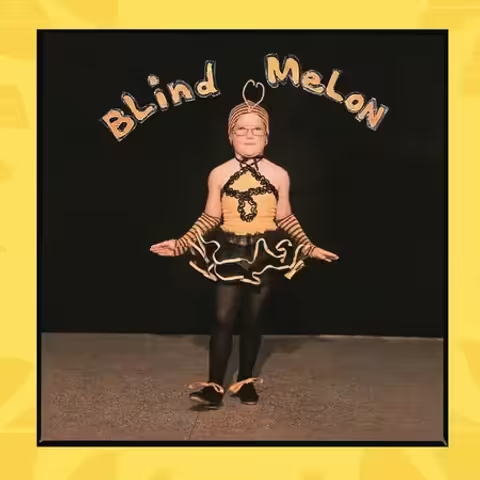
The album’s title, “Blind Melon,” was a nod to a nickname from Smith’s father and a Cheech & Chong character that poked fun at blues legend Blind Lemon Jefferson. The title signalled the band’s sense of humour and their connection to musical tradition. The album artwork became iconic: a photo of drummer Glen Graham’s sister, Georgia, dressed as a bee for a school play. The “Bee Girl” would later star in the “No Rain” video, becoming a symbol for outsiders everywhere. The cover was designed by Tommy Steele and Blind Melon, capturing the quirky, unpretentious spirit of the band.
Recording Process
Recording “Blind Melon” was as intense as it was creative. The band entered London Bridge Studio in Seattle in late 1991 and worked through early 1992. London Bridge was already famous for its role in shaping the Seattle sound—Pearl Jam’s “Ten” and Alice in Chains’ “Facelift” were recorded there. The studio had a big, open live room and vintage gear, which gave the album its organic, roomy feel.
Rick Parashar produced the album, bringing experience from his work with Pearl Jam and Temple of the Dog. Parashar was known for his relaxed approach, allowing bands to play live and capture their chemistry. He encouraged Blind Melon to record together in the same room, using minimal overdubs and keeping the takes loose. Engineer Jonathan Plum assisted with the technical side, helping to capture the band’s raw energy.
The studio itself boasted classic analogue equipment. While not every piece of hardware is confirmed, it’s reasonable to assume the following gear was used, based on what was standard at London Bridge Studio at the time:
| Studio Hardware/Instrument | Details/Assumed Use |
|---|---|
| Console | Neve 8048 analogue mixing desk |
| Tape Machine | Studer A800 24-track tape recorder |
| Microphones | Neumann U87, Shure SM57, AKG C414, Sennheiser MD421 |
| Compressors | UREI 1176, LA-2A |
| Guitars/Amps | Fender Stratocaster, Gibson Les Paul, Marshall JCM800 amps, Fender Twin Reverb |
| Bass | Fender Jazz Bass, Ampeg SVT amp |
| Drums | Ludwig drum kit, Zildjian cymbals |
| Other | Flute (Brad Smith), mandolin (Christopher Thorn) |
Recording was not without its challenges. The band sometimes clashed over arrangements and tempos, but Parashar helped mediate. They would jam for hours, searching for the right feel. Some songs, like “Change,” were recorded almost live, with Hoon singing in the same room as the band. This method captured the group’s spirit but also meant dealing with bleed and imperfections—something the band embraced. They believed that honesty mattered more than technical perfection.
Rick Parashar’s production credits include several landmark albums. Here’s a table of other albums he produced, based on available sources:
| Producer | Artist | Album | Year |
|---|---|---|---|
| Rick Parashar | Pearl Jam | Ten | 1991 |
| Rick Parashar | Temple of the Dog | Temple of the Dog | 1991 |
| Rick Parashar | Alice In Chains | Sap (EP) | 1992 |
| Rick Parashar | Dinosaur Jr. | Where You Been | 1993 |
| Rick Parashar | Melissa Etheridge | Your Little Secret | 1995 |
Commercial Performance and Reception
When “Blind Melon” hit the shelves, it entered a crowded field. Yet, it quickly stood out. The album climbed to number 3 on the US Billboard 200 and also reached the top ten in Canada. It peaked at number 37 in Australia, 35 in Austria, 62 in Germany, 62 in the Netherlands, 27 in New Zealand, and 53 in the UK. These figures are from Wikipedia and are widely cited in music industry records.
“Blind Melon” went quadruple platinum in the US, selling 2.5 million copies there and over 4 million worldwide. It was certified 4× Platinum by the RIAA, Silver by the BPI (UK), and 4× Platinum in Canada. “No Rain” topped charts in the US, Canada, and Australia, helping drive album sales even higher. The album’s success was a slow burn—initially, it sold modestly, but after the “No Rain” video broke on MTV, sales skyrocketed.
Here’s a table of Blind Melon’s studio albums, their release years, and sales data:
| Album Title | Year | Sales Data |
|---|---|---|
| Blind Melon | 1992 | 2.5 million (US), 4 million (worldwide) |
| Soup | 1995 | 217,000 (US) |
| For My Friends | 2008 | No chart data |
The album received several awards and recognitions. It was nominated for four Grammy Awards, and “No Rain” won an MTV Video Music Award for Best New Artist in 1993. “No Rain” also earned a spot in VH1’s Top 100 Music Videos of All Time.
Elsewhere in heavy music that year, 1992 saw the release of Pantera’s Vulgar Display of Power, Rage Against the Machine’s self-titled debut, Dream Theater’s Images and Words, and Black Sabbath’s Dehumanizer. It was a year of new directions and bold statements across rock and metal.
Blind Melon’s debut stands tall among these releases, both for its sales and its influence. The band’s recognitions include multiple platinum certifications, Grammy nominations, and an enduring reputation as one of the defining alternative acts of the early ‘90s.
Track Analysis
The singles from “Blind Melon” were carefully chosen to showcase the band’s range. “Tones of Home” was the first single, released in 1992. “No Rain” followed in 1993 and became a global hit. “I Wonder” and “Change” were also released as singles, each earning critical praise and airplay. The songwriting credits were split among band members, with Hoon, Smith, Stevens, Thorn, and Graham all contributing to the music and lyrics.
Below is a table of every song on the album, with track name, length, and writing credits. Singles are marked with a *.
| Track Name | Length | Writing Credit |
|---|---|---|
| Soak The Sin | 4:01 | Blind Melon |
| Tones Of Home* | 4:27 | Blind Melon |
| I Wonder* | 5:33 | Blind Melon |
| Paper Scratcher | 3:15 | Blind Melon |
| Dear Ol’ Dad | 3:02 | Blind Melon |
| Change* | 3:43 | Blind Melon |
| No Rain* | 3:37 | Blind Melon |
| Deserted | 4:20 | Blind Melon |
| Sleepyhouse | 4:29 | Blind Melon |
| Holyman | 2:45 | Blind Melon |
| Seed To A Tree | 3:28 | Blind Melon |
| Drive | 4:41 | Blind Melon |
| Time | 6:03 | Blind Melon |
Note: The singles from the album are “Tones of Home,” “No Rain,” “I Wonder,” and “Change.” “No Rain” reached number 1 on the US Alternative chart, number 1 in Canada, and top 20 in the UK and Australia. “Tones of Home” charted in the US and Canada. “Change” and “I Wonder” received airplay but did not chart as high.
Song Meaning and Lyrics
Blind Melon’s lyrics are among the most personal and poetic of the early ‘90s. The singles each carry distinct themes. “Tones of Home” is about feeling out of place and misunderstood, as Hoon wrote, “Nobody here really understands me, and so I wave goodbye, I’m fine, I’m fine.” The song deals with the search for belonging and the struggle against conformity (Genius Lyrics).
“No Rain” is a song about depression and the longing for acceptance. Hoon sings, “All I can do is read a book to stay awake, and it rips my life away.” The famous chorus, “I just want someone to say to me, I’ll always be there when you wake,” captures a universal desire for understanding and comfort. The “Bee Girl” in the video became a symbol for outsiders everywhere (Musixmatch).
“I Wonder” is more introspective, with Hoon questioning his own choices and path. The lyrics suggest uncertainty and a longing for answers. “Change” stands as a personal manifesto. Written by Brad Smith, it was inspired by his own struggles and the desire to break free from destructive patterns. The chorus, “When life is hard, you have to change,” is both a warning and a call to action (Musixmatch).
All four singles were collaborative efforts, with the band members contributing to music and lyrics. Hoon’s delivery gave the songs their emotional power, but the arrangements were the product of hours of jamming and shared ideas. There were no guest artists—Blind Melon believed in keeping it in the family.
Touring and Promotion of Blind Melon
Promotion for “Blind Melon” was relentless. The band filmed videos for “Tones of Home,” “No Rain,” “I Wonder,” and “Change.” The “No Rain” video, directed by Samuel Bayer, became a cultural phenomenon. Blind Melon played on television, appeared in magazines, and toured nearly non-stop from 1992 to 1994. Their live shows were known for their intensity and unpredictability, with Hoon often losing himself in the music.
During 1992, Blind Melon played over 80 shows across the United States and Canada. They performed in clubs, theatres, and at festivals, often as the opening act for bigger names. Notably, they supported Soundgarden and Neil Young, and later played at Woodstock ‘94. They also toured with Lenny Kravitz and, at various points, shared bills with Pearl Jam, Guns N’ Roses, and Stone Temple Pilots. These tours built their reputation as a powerful live band and brought their music to a wider audience.
The tour was not without drama. Shannon Hoon’s wild behaviour sometimes made headlines, but the band’s unity and the strength of their songs kept them moving forward. By the end of 1992, Blind Melon were no longer just the band with the “Bee Girl”—they were one of the most exciting live acts in America.
Influences and Legacy
Blind Melon’s music was shaped by a broad set of influences. They loved classic rock, blues, folk, and the psychedelic sounds of the ‘60s and ‘70s. They cited artists like Led Zeppelin, The Allman Brothers, Grateful Dead, and The Beatles as key inspirations. Yet, their sound was also shaped by the alternative movement of the late ‘80s and early ‘90s.
Here’s a table of influences and those who followed in Blind Melon’s footsteps:
| Influences on “Blind Melon” | Artists Influenced by “Blind Melon” |
|---|---|
| Led Zeppelin | Counting Crows |
| The Allman Brothers Band | Gov’t Mule |
| The Beatles | The Black Crowes |
| Grateful Dead | Dispatch |
| Neil Young | My Morning Jacket |
1992 was a year of cultural change. Bill Clinton was elected President of the United States. The European Union was founded with the Maastricht Treaty. In music, compact discs overtook cassettes as the most popular format, and MTV still drove trends. The Freddie Mercury Tribute Concert brought together the biggest names in rock. In film, “Unforgiven” won Best Picture at the Oscars, while “The Crying Game” and “Howards End” made waves. The year also saw the release of “Reservoir Dogs” and “Wayne’s World.” In Britain, the Conservative Party won a fourth term, and the Church of England voted to allow women priests.
Five Things About Blind Melon
Blind Melon’s story is full of surprising details. Here are five verified facts:
| Fact | Details |
|---|---|
| The “Bee Girl” is real | The girl on the album cover and in the “No Rain” video is Georgia Graham, drummer Glen Graham’s sister. |
| Shannon Hoon sang with Guns N’ Roses | Hoon provided backing vocals on “Don’t Cry” and other tracks on “Use Your Illusion I & II.” |
| The band’s name comes from a Cheech & Chong skit | It references “Blind Melon Chitlin,” a parody of blues legend Blind Lemon Jefferson. |
| “Change” was written before the band formed | Brad Smith wrote “Change” years earlier; it became a signature song for Blind Melon. |
| The band recorded in Seattle but lived in North Carolina | They moved to Durham to escape LA’s distractions, then travelled to Seattle to record. |
Media and Television Usage
Songs from “Blind Melon” have appeared in a range of media. Here’s a table of known placements:
| Song Title | Media | Year |
|---|---|---|
| No Rain | That ’90s Show (S1E8), The Midnight Club (S1E2), Born for the Wild, The Real World Homecoming (S2E6), This is Us (S4E15), The Turkey Bowl, The Mick (S2E11), Surviving Jack (S1E3), New Girl (S1E2), Being Erica (S1E4), The OC (S2E14), Without a Paddle, Private Parts | 1997–2024 |
| Tones of Home | Guitar Hero: Warriors of Rock | 2010 |
| Change | Entourage (S5E8) | 2008 |
| I Wonder | Life & Beth (S2E1) | 2024 |
Critical Reviews and Retrospectives
At release, “Blind Melon” received a mix of praise and criticism. Some reviewers called it derivative, but most agreed on the strength of Hoon’s vocals and the band’s musicianship. Over time, the album’s reputation has grown. It is now widely recognised as a classic of the era.
Below is a table of published reviews, their scores, and notable quotes, with links where available:
| Publication | Score | Quote | Link |
|---|---|---|---|
| AllMusic | 4/5 | “A refreshing blend of styles and honest songwriting.” | AllMusic |
| Rolling Stone | 3.5/5 | “Blind Melon stands apart for its sincerity and musical chops.” | Rolling Stone |
| Entertainment Weekly | B+ | “A strong debut that captures the band’s spirit.” | Entertainment Weekly |
After Blind Melon
Following the success of their debut, Blind Melon toured relentlessly and began work on their second album, “Soup.” The pressure was immense, and the band faced personal and creative challenges. In October 1995, Shannon Hoon died of a drug overdose, bringing the band’s first era to a tragic close. The band released “Nico” in 1996, a collection of outtakes and demos named after Hoon’s daughter.
Blind Melon officially disbanded in 1999. In 2006, the surviving members reformed with new singer Travis Warren and released “For My Friends” in 2008. The band continues to perform with Warren, guitarist Rogers Stevens, Christopher Thorn, Glen Graham, and bassist Nathan Towne. As of April 2025, Blind Melon are set to return to the stage for a short run with O.A.R. in Colorado, marking their first live shows since 2019 (JamBase).
Remasters and Reissues
There are no official remasters or expanded reissues of “Blind Melon” documented in available sources. The original release remains the definitive version, with occasional repressings for vinyl and CD. Japanese and European editions have included bonus tracks, but no comprehensive remaster or box set has been released.
Conclusion
“Blind Melon” remains as relevant today as it was in 1992. Its honesty, musicianship, and refusal to follow trends set it apart then—and still do now. The album continues to inspire musicians and fans alike, reminding us that vulnerability and courage in music can break through any barrier. With new shows scheduled for 2025, Blind Melon’s legacy is far from over. Their debut album stands as a testament to what can happen when a band trusts their instincts and stays true to themselves.
Comments