Pearl Jam’s Ten: The Album That Redefined Rock
Few records have shifted the direction of popular music quite like Ten by Pearl Jam. Released at the tail end of summer 1991, it landed in a world on the brink of change—socially, politically, and musically. From the very first notes of “Once,” it was clear that this album was more than just another debut. It was a statement, a raw expression of emotion, and a rallying cry for a generation. Ten became a cornerstone of the grunge movement, but its impact reached far beyond Seattle or the early 90s. It is still heard, debated, and loved decades later.
In this article, I’ll take you through every facet of Ten: its origins, the creative forces behind it, the turbulent recording sessions, its commercial triumphs, and the stories behind each track. You’ll find exact details about its production, sales, and critical response, as well as insights into the lyrics and themes that have kept it relevant. We’ll also explore its legacy, media appearances, and how it continues to shape rock music. By the end, you’ll have the most complete, factual, and engaging resource on Ten available anywhere.
| Attribute | Details |
|---|---|
| Release date | 27 August 1991 |
| Album title | Ten |
| Genre | Grunge, alternative rock, hard rock |
| Total runtime | 53:20 |
| Number of tracks | 11 (original release) |
| Record label | Epic Records |
| Recording studio | London Bridge Studios (Seattle, WA); Ridge Farm Studios (Surrey, England, for mixing) |
| Producer(s) | Rick Parashar and Pearl Jam |
Ten is not just a high-water mark for Pearl Jam; it’s one of the most commercially successful and influential rock albums ever. It has sold over 17 million copies worldwide and spent more than five years on the US Billboard 200. The record is packed with songs that still fill arenas and airwaves: “Alive,” “Even Flow,” “Black,” and “Jeremy.” Its themes of alienation, trauma, and hope spoke directly to listeners, making it a cultural touchstone. As Stone Gossard said, “We went from clubs to opening for the Red Hot Chili Peppers in a matter of months. It was surreal.” Eddie Vedder later reflected, “The record’s success was a double-edged sword. It let people know they weren’t alone, but it changed our lives overnight.”
The Genesis of Ten
The birth of Ten was shaped by both tragedy and opportunity. After the death of Andrew Wood, the charismatic singer of Mother Love Bone, bassist Jeff Ament and guitarist Stone Gossard found themselves at a crossroads. They started writing new, heavier material and soon teamed up with guitarist Mike McCready. The trio recorded a five-song demo, hoping to attract a singer and drummer. This tape would eventually find its way to Eddie Vedder in San Diego, thanks to Jack Irons (former drummer for Red Hot Chili Peppers). Vedder, inspired by the music, quickly wrote lyrics for three tracks and sent his audition tape back. His raw emotion and storytelling were exactly what the band needed.
Vedder flew to Seattle and joined the group, which was then called Mookie Blaylock, named after the basketball player. Drummer Dave Krusen completed the line-up. They played their first show in October 1990 and soon changed their name to Pearl Jam. The new band signed with Epic Records, eager to make their mark. Most of the songs that would become Ten were already in place as instrumentals before Vedder added his distinctive lyrics and melodies. The album title itself is a nod to their early days: Mookie Blaylock’s jersey number was 10, and the band wanted to honour that history.
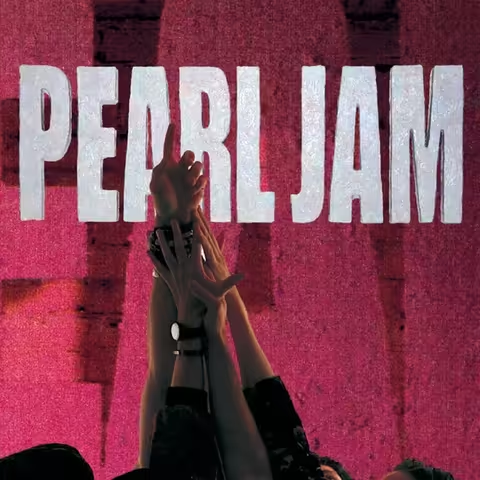
The creative team behind Ten was tight-knit but diverse in their skills. Vedder’s lyrics brought a personal, confessional style, while Gossard and Ament shaped the musical direction. McCready’s lead guitar added bluesy fire, and Krusen’s drumming gave the songs drive and energy. The band worked closely with producer Rick Parashar, who also contributed piano, organ, and percussion. The cover art, featuring the band reaching up in unity, was conceived by Jeff Ament, symbolising their collective spirit. The original plan was for a burgundy cover, but the record label released it in pink, making it instantly recognisable.
Below is a table of the band members and their roles during the making of Ten:
| Member | Instrument/Role |
|---|---|
| Eddie Vedder | Lead vocals, lyricist, additional art |
| Jeff Ament | Bass guitar, art direction/concept |
| Stone Gossard | Rhythm guitar, slide guitar on “Deep” |
| Mike McCready | Lead guitar, acoustic-electric guitar on “Alive” |
| Dave Krusen | Drums, timpani |
The album’s recording costs were financed by Epic Records, with a modest budget by major label standards. The band faced some financial challenges, particularly as they were still developing their sound and identity. Despite this, the focus remained on capturing the energy and emotion of their live performances. The concept for the artwork, created by Ament, was to show unity and strength—a vision that carried through every aspect of the project.
Recording Process
Recording for Ten began in March 1991 at London Bridge Studios in Seattle. The studio was built by Rick Parashar and his brother Raj, and quickly became the centre of the Seattle sound. Sessions lasted about a month, as much of the material had already been written and rehearsed. Rick Parashar took the lead as producer and engineer, while Tim Palmer was brought in to mix the album at Ridge Farm Studios in Surrey, England. Palmer added some unusual overdubs—such as a fire extinguisher and pepper shaker on “Oceans”—to create a unique sonic texture.
London Bridge Studios was equipped with state-of-the-art gear for the time, including classic analogue consoles and high-quality microphones. Both Stone Gossard and Mike McCready favoured Marshall JCM800 amplifiers, often blending them with Fender Tweed amps via an Ernie Ball pedal for their signature guitar tones. The band also made use of a variety of pedals, such as Tube Screamers and phasers, to achieve their sound. Parashar contributed piano and organ, especially on “Black” and “Jeremy,” and co-wrote the album’s hidden intro/outro piece “Master/Slave.”
There were challenges along the way. Dave Krusen left the band after recording to enter rehab, which meant the line-up changed before the album’s release. Some band members later expressed dissatisfaction with the mix, particularly the heavy use of reverb. Despite this, the finished album captured a balance of rawness and polish that helped it stand out. Below is a table outlining the likely hardware and gear used during the sessions, based on what was available at London Bridge Studios in 1991:
| Equipment/Hardware | Details/Usage |
|---|---|
| Mixing Desk | Likely Neve or SSL analogue console |
| Microphones | Neumann U87, Shure SM57, AKG C414 (assumed based on studio standards) |
| Guitar Amps | Marshall JCM800, Fender Tweed, blended via Ernie Ball pedal |
| Effects Pedals | Tube Screamer, phaser, wah, univibe |
| Drums | Standard 5-piece kit, likely Ludwig or Pearl (assumed) |
| Keyboards | Fender Rhodes, piano, organ (played by Rick Parashar) |
| Other Studio Gear | Fire extinguisher, pepper shaker (used for percussion on “Oceans”) |
Tim Palmer, the album’s mixing engineer, had previously produced acts like Cutting Crew and mixed for Tears for Fears. Rick Parashar’s credits included work with Soundgarden, Alice in Chains, and Temple Of The Dog. Both Parashar and Palmer played crucial roles in shaping the sound of Ten. The recording was fast-paced, but the chemistry between the musicians and producers made it work. The sense of urgency and emotional honesty is evident in every track.
Here is a table of other albums produced by Rick Parashar, highlighting his role as producer or engineer:
| Producer | Artist | Album | Year |
|---|---|---|---|
| Rick Parashar | Temple Of The Dog | Temple Of The Dog | 1991 |
| Rick Parashar | Blind Melon | Blind Melon | 1992 |
| Rick Parashar | Soundgarden | Louder Than Love | 1989 |
Commercial Performance and Reception
When Ten was released, its commercial impact was not immediate. Initial sales were slow, but the band’s relentless touring and growing word-of-mouth quickly turned the tide. By late 1992, the album broke into the US Billboard 200 top ten, peaking at number two and staying on the chart for 264 weeks. It was kept from the top spot only by Billy Ray Cyrus’s Some Gave All. In the US alone, Ten sold over 13 million copies and is certified 13× Platinum by the RIAA. Worldwide sales exceed 17 million, making it one of the highest-selling rock albums of all time. Not only that, Ten outsold Nirvana’s Nevermind in the US by February 1993, a remarkable feat considering the era’s competitive scene.
Let’s look at where Ten sits in Pearl Jam’s discography. The table below lists all their studio albums, release years, and available sales data:
| Album | Year | Sales Data |
|---|---|---|
| Ten | 1991 | 17.6 million (worldwide) |
| Vs. | 1993 | 10.6 million (worldwide) |
| Vitalogy | 1994 | 8.5 million (worldwide) |
| No Code | 1996 | 3.4 million (worldwide) |
| Yield | 1998 | 3.6 million (worldwide) |
| Binaural | 2000 | 2.1 million (worldwide) |
| Riot Act | 2002 | 1.5 million (worldwide) |
| Pearl Jam | 2006 | 1.7 million (worldwide) |
| Backspacer | 2009 | 1.7 million (worldwide) |
| Lightning Bolt | 2013 | Unknown |
| Gigaton | 2020 | Unknown |
| Dark Matter | 2024 | Unknown |
Ten has earned numerous awards and certifications. It was nominated for a Grammy for Best Rock Song (“Jeremy”) and Best Hard Rock Performance. The “Jeremy” video won four MTV Video Music Awards in 1993, including Video of the Year. The album is certified multi-platinum in the US, UK, Canada, Australia, and several other countries. In 2021, it was inducted into the Grammy Hall of Fame.
In 1991, the musical landscape was rich with other major releases. Albums from that year include:
- Nevermind by Nirvana [US sales: 11 million]
- Badmotorfinger by Soundgarden
- Blood Sugar Sex Magik by Red Hot Chili Peppers
- Metallica (The Black Album) by Metallica
- Gish by The Smashing Pumpkins
- Use Your Illusion I & II by Guns N’ Roses
- Slave to the Grind by Skid Row
- Innuendo by Queen
- Out of Time by R.E.M.
- Loveless by My Bloody Valentine
Ten has been recognised in countless “greatest albums” lists. It was ranked #207 in Rolling Stone’s 500 Greatest Albums of All Time (2003), #160 in the 2020/2023 update, and voted 42nd greatest album ever by Q readers. Kerrang! called it “arguably the greatest rock debut record of all time.” It also appears in the book 1001 Albums You Must Hear Before You Die and is listed in the Grammy Hall of Fame.
Elsewhere in heavy music during 1991, the world saw the birth of bands like Machine Head, Behemoth, Emperor, and Cradle of Filth. Major events included the Moscow “Monsters of Rock” concert and the death of Queen’s Freddie Mercury. Metallica’s “Black Album” and Skid Row’s “Slave to the Grind” both debuted at number one on the Billboard charts, while Guns N’ Roses achieved a record by holding the top two positions with their Use Your Illusion albums. It was a year of transformation, with alternative and heavy music reaching new heights of popularity.
Track Analysis
Four singles were released from Ten: “Alive,” “Even Flow,” “Jeremy,” and “Oceans.” Each single had its own release date and left a significant mark on the charts and on fans. “Alive” was released first, on 7 July 1991, followed by “Even Flow” on 30 March 1992, “Jeremy” on 17 August 1992, and “Oceans” on 7 December 1992 (video only outside the US). Songwriting credits for these tracks are mostly shared between Stone Gossard, Jeff Ament, and Eddie Vedder, with McCready and Krusen contributing to some.
Here is a detailed table of every song from the album, including length and writing credits. Singles are marked with a *:
| Track Name | Length | Writing Credit |
|---|---|---|
| Once | 3:51 | Stone Gossard, Eddie Vedder |
| Even Flow* | 4:53 | Stone Gossard, Eddie Vedder |
| Alive* | 5:41 | Stone Gossard, Eddie Vedder |
| Why Go | 3:20 | Jeff Ament, Eddie Vedder |
| Black | 5:43 | Stone Gossard, Eddie Vedder |
| Jeremy* | 5:18 | Jeff Ament, Eddie Vedder |
| Oceans* | 2:42 | Stone Gossard, Jeff Ament, Eddie Vedder |
| Porch | 3:30 | Eddie Vedder |
| Garden | 4:59 | Stone Gossard, Jeff Ament, Eddie Vedder |
| Deep | 4:18 | Stone Gossard, Jeff Ament, Eddie Vedder |
| Release | 9:05 | Gossard, Ament, Krusen, McCready, Vedder |
Note: Tracks marked with * were released as singles. “Alive” reached number 16 in the UK, “Even Flow” hit number 3 on the US Mainstream Rock chart, “Jeremy” reached number 5 on the US Alternative chart, and “Oceans” was a video single outside the US.
Song Meaning and Lyrics
The lyrics of Ten tackle dark, deeply personal themes. “Alive” is based on Eddie Vedder’s own experience of learning as a teenager that the man he thought was his father was not, in fact, his biological dad. The song’s story continues through “Once” and “Footsteps” (the latter was not on the original album), forming a trilogy known as the “Momma-Son” tapes. Vedder explained, “Alive is about facing a terrible truth and surviving it. At first, it was a curse, but fans made it a celebration of being alive.” (Source: Pearl Jam Wiki)
“Even Flow” draws on Vedder’s encounters with a homeless Vietnam veteran in Seattle. The lyrics—“Freezin’, rests his head on a pillow made of concrete”—capture the harshness and dignity of life on the streets. Vedder once said, “I didn’t even realise he inspired the song until after he died.” (Source: Rock and Roll Garage)
“Jeremy” was inspired by a real-life tragedy: the suicide of Jeremy Wade Delle in his classroom. Vedder read about the event in a newspaper and wrote the song to explore themes of alienation, bullying, and the failure of adults to recognise a child’s pain. The line “Daddy didn’t give affection, and the boy was something that mommy wouldn’t wear” uses metaphor to show rejection and neglect. (Source: Quora)
“Oceans” stands apart as a love song, inspired by Vedder’s passion for surfing and his relationship with then-girlfriend Beth Liebling. It uses the sea as a metaphor for longing and reunion: “Hold tight the ring, the sea will rise, please stand by the shore. I will be there once more.” (Source: Pearl Jam Wiki)
Touring and Promotion of Ten
Pearl Jam promoted Ten with an aggressive touring schedule. In 1991, they played dozens of shows across the US and Europe, supporting acts like the Red Hot Chili Peppers and The Smashing Pumpkins. Notable early performances include the RIP Magazine 5th Anniversary at the Hollywood Palladium (6 October 1991) and the Singles Movie Wrap Party in Seattle (25 May 1991). The band’s live shows quickly became legendary for their intensity and unpredictability.
In 1992, they embarked on their first European tour and played the entire album at Munich on 13 March. They also joined the Lollapalooza tour, sharing the stage with Red Hot Chili Peppers, Soundgarden, Ministry, and Ice Cube. Dave Abbruzzese replaced Dave Krusen on drums for the tour. The band often played small clubs, building a loyal following before breaking into larger venues.
Promotion for the album included four singles, several music videos, and memorable television appearances. The video for “Jeremy” became a staple on MTV and won multiple awards. Despite the album’s success, Pearl Jam often shunned industry conventions, rarely giving interviews and limiting their participation in traditional marketing.
Influences and Legacy
Ten was shaped by a range of musical influences. Pearl Jam drew from classic rock giants like Led Zeppelin, The Who, The Rolling Stones, and Neil Young, as well as punk and alternative acts like R.E.M. and The Ramones. The result was a blend of 70s riff-rock and 80s post-punk energy, filtered through a modern, confessional sensibility.
The table below shows the key influences on Ten and some of the artists who were influenced by the album after its release:
| Influences on Ten | Artists Influenced by Ten |
|---|---|
| Led Zeppelin | Silverchair |
| The Who | The White Stripes |
| Neil Young | The Strokes |
| R.E.M. | Countless alternative and indie bands |
| The Rolling Stones | Indie rock scenes worldwide |
In 1991, the world was changing fast. The Gulf War dominated headlines, the Soviet Union collapsed, and the first website was launched by Tim Berners-Lee. In music, grunge exploded into the mainstream, alternative rock reached new heights, and MTV played a central role in youth culture. The same year saw the release of Nevermind, Blood Sugar Sex Magik, and Metallica (The Black Album), all of which redefined their genres. The death of Freddie Mercury marked the end of an era, while the first Lollapalooza tour brought alternative music to a wider audience. Ten is inseparable from this context—it both reflected and shaped the world around it.
Five Things About Ten
Let’s explore five fascinating facts about Ten, all backed by credible sources:
| Fact | Details |
|---|---|
| 1. The album title is a basketball reference | “Ten” refers to Mookie Blaylock’s jersey number, the band’s original name before signing to Epic Records. (Source: Wikipedia) |
| 2. “Alive,” “Once,” and “Footsteps” form a mini-opera | Eddie Vedder wrote a trilogy of songs telling a dark, interconnected story. (Source: Pearl Jam Wiki) |
| 3. “Jeremy” is based on a true story | The song was inspired by Jeremy Wade Delle, who died by suicide in his classroom in 1991. (Source: Quora) |
| 4. Rick Parashar played instruments on the album | The producer added piano, organ, and percussion, notably on “Black” and “Jeremy.” (Source: Pearl Jam Community) |
| 5. The album cover’s colour was changed by the label | Jeff Ament intended a burgundy cover, but Epic released it in pink. (Source: Wikipedia) |
Media and Television Usage
Songs from Ten have appeared in various TV shows, films, and games. Here’s a table of confirmed media appearances:
| Song Title | Media Appearance | Year |
|---|---|---|
| Alive | Stumptown S1 E17 “The Dex Files” | 2020 |
| Alive | The Nineties S1 E7 “Isn’t it Ironic?” | 2017 |
| Alive | Eastbound and Down S3 E4 “Chapter 17” | 2012 |
| Black | Cold Case S6 E23 “Into the Blue” | 2009 |
| Even Flow | Super Pumped S1 E1 “Grow or Die” | 2022 |
| Even Flow | Only The Brave (film) | 2017 |
Critical Reviews and Retrospectives
Ten received mostly positive reviews on release. David Fricke of Rolling Stone called it “mystic and powerful.” Melody Maker praised Vedder’s focus, while Q magazine predicted it could be “the face of 90s metal.” Stereo Review and Kerrang! both commended its emotional force. Retrospective reviews have been even stronger: AllMusic called it “a flawlessly crafted hard rock masterpiece.” Rolling Stone’s Album Guide noted its less original approach compared to Nevermind but still praised the guitar work and vocals. The album’s Metacritic score is not available, but it is consistently ranked among the best rock debuts ever.
After Ten
Following the release of Ten, Pearl Jam’s career soared. They released Vs. in 1993, which sold over 950,000 copies in its first week. Vitalogy followed in 1994, earning them a Grammy for Best Hard Rock Performance. The band’s line-up changed, with Dave Abbruzzese and then Jack Irons joining on drums before Matt Cameron became the permanent drummer in 2000. Pearl Jam became known for their activism, famously battling Ticketmaster over concert prices. Their later albums explored new musical territory, from the experimental Binaural to the politically charged Riot Act. As of 2025, Pearl Jam are still active, with their twelfth album Dark Matter released in April 2024 and a world tour underway, despite some recent show cancellations due to illness. The band remains a vital force in rock, continuing to tour and record new music.
Conclusion
Over thirty years since its release, Ten remains a touchstone for rock fans and musicians alike. Its raw emotion, powerful performances, and timeless songwriting have ensured its place in music history. Pearl Jam’s journey from grief and uncertainty to global stardom is captured in every note of this album. Today, the band is still going strong, headlining festivals and selling out arenas worldwide. Whether you’re hearing Ten for the first time or the hundredth, its power and honesty never fade.
Further Reading
For more on Pearl Jam and related artists, check out our own articles and podcasts:
- Vs. – Pearl Jam’s Defining 90s Album (blog article)
- Exploring Binaural: Pearl Jam’s Experimental Journey (blog article)
- The Making of Vitalogy: Pearl Jam’s Evolution (blog article)
- The Making of Temple Of The Dog by Temple Of The Dog (blog article)
- Blind Melon by Blind Melon: The Story Behind a Timeless Alternative Classic (blog article)
- Soundgarden’s Badmotorfinger: Grunge Meets Alternative Metal (blog article)
- The Making of Nevermind by Nirvana (blog article)
- Dark Matter by Pearl Jam – album review (blog article)
- All Pearl Jam articles on Riffology
- Wikipedia: Ten (Pearl Jam album)
- Official Pearl Jam website
- Epic Records (Sony Music)
Let us know in the comments what your thoughts are on Ten by Pearl Jam. Did we miss anything? Share your experiences and join the conversation!
Comments