
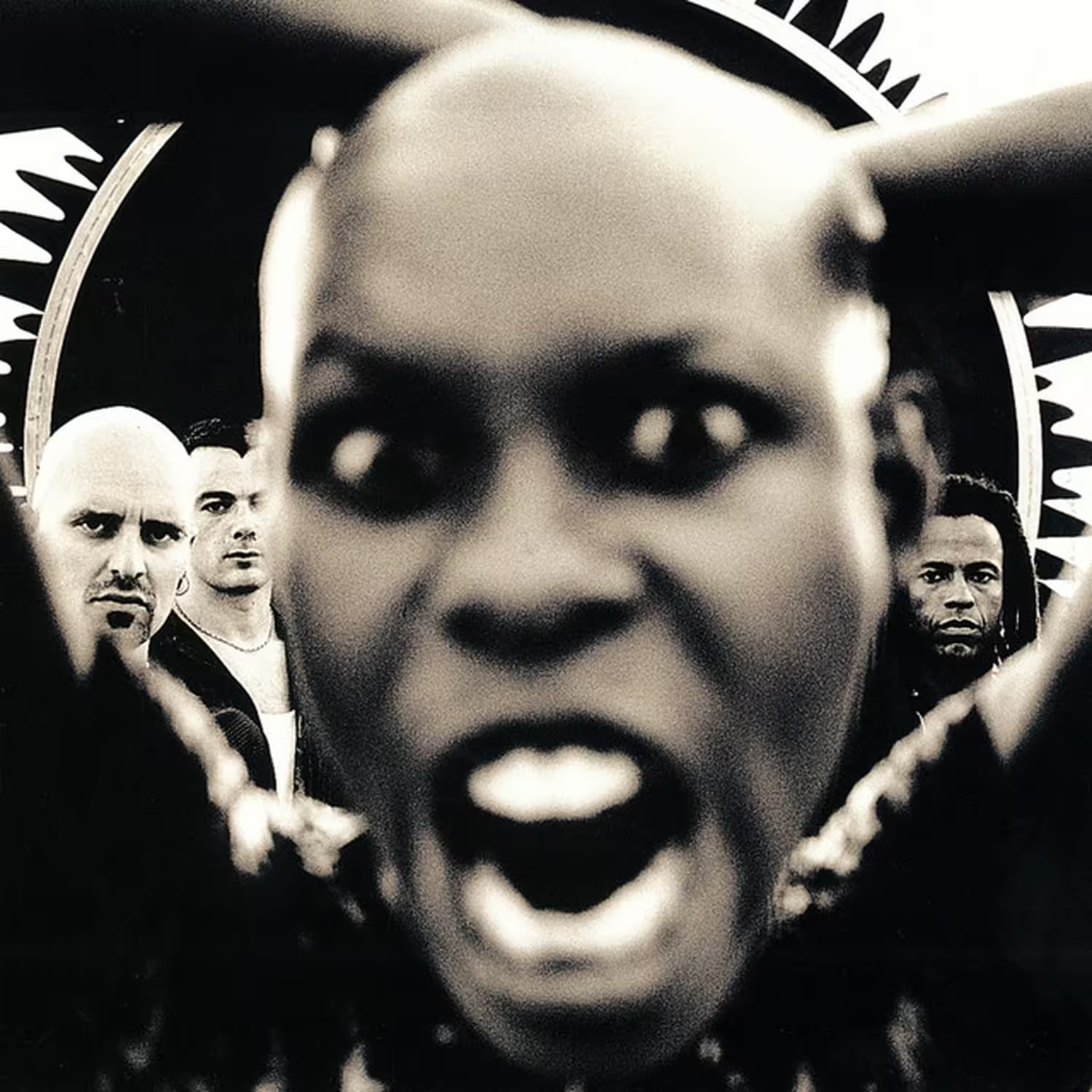
Skunk Anansie made Stoosh in the autumn that Oasis sold out Knebworth, and they made it in defiant opposition to almost everything Knebworth represented. While the rest of Britain was busy turning rock music into a pub-friendly Union Jack, four people from London with reggae, dub, soul, hip-hop and Sex Pistols records in their bags went up the M1 to a country house in Milton Keynes, locked the doors and set about a record that opened with a track called Yes It's Fucking Political. The bald, six-foot, mixed-race singer at the front of it was about to spend the next two years calmly demolishing what a British rock star was supposed to look like and sound like.
Released on 7 October 1996 by One Little Indian, Stoosh was Skunk Anansie's second studio album, the record that turned them from a critically loved Kerrang! curiosity into a platinum-selling chart band with a Top 20 single, three years before Skin walked onto the Pyramid Stage at Glastonbury and became the first Black woman to headline the festival. Produced by Canadian Garth Richardson, fresh off Rage Against the Machine and L7, it remains the band's defining statement: harder than Britpop, more melodic than American grunge, and angrier than both.
| Field | Detail |
|---|---|
| Artist | Skunk Anansie |
| Album | Stoosh |
| Release date | 7 October 1996 |
| Label | One Little Indian (UK), Epic (US) |
| Producer | GGGarth Richardson |
| Studio | Great Linford Manor, Milton Keynes, England |
| Genre | Alternative rock, hard rock, Britrock |
| Track count | 11 (plus four hidden interludes) |
| Total runtime | 47:33 |
| UK Albums Chart peak | 9 |
| UK Rock and Metal Albums peak | 1 |
| Other notable peaks | Netherlands 5, Austria 6, Switzerland 8, Norway 8, Germany 11, Australia 37, US Billboard 200 91 |
| Certifications | UK Platinum, Italy 3x Platinum, Germany Gold, France Gold, Netherlands Gold, plus Gold in Austria, Belgium, Norway, Sweden and Switzerland |
| Key singles | All I Want, Twisted (Everyday Hurts), Hedonism (Just Because You Feel Good), Brazen (Weep) |
Cultural Context: Britpop, Britrock and the Bald Black Woman in the Middle
The British rock landscape Skunk Anansie released Stoosh into was, on the surface, the most parochial it had been since the early eighties. Be Here Now was a year away but its shadow was already lengthening; Blur and Oasis had spent the summer of 1995 staging a circulation war for the music weeklies; Pulp had played Glastonbury; Different Class was on every student's bedroom floor. Britpop's gaze was retrospective, suburban and overwhelmingly white. The bands the press cared about were quoting the Kinks and the Small Faces. The gatekeepers wanted lager, irony and Cool Britannia.
Skunk Anansie wanted none of it. They were a London band, but London the way it actually was: Brixton, Hackney, the squats and the rehearsal rooms behind the Westway, where Skin had moved from Brixton in the early nineties to study interior design at the LCC. Skin, born Deborah Anne Dyer, was the daughter of Jamaican parents; she was queer, shaven-headed, classically trained as a singer and entirely uninterested in the Britpop costume party. Cass and Ace had cut their teeth in London hardcore and dub bands. Mark Richardson came in via Little Angels, a Scarborough hard-rock outfit who had supported Bon Jovi and Van Halen. The chemistry that fell out of those four sets of records was Britrock, a term the music press began using almost specifically to describe a small group of louder, harder, less ironic British bands that included Therapy?, the Wildhearts, Reef and Skunk Anansie themselves.
Stoosh arrived four weeks before Be Here Now was even being demoed and within a year of three other albums it would have to share the racks with: Metallica's Load, Beck's Odelay and No Doubt's Tragic Kingdom. None of them sounded anything like it. None of them were fronted by anyone like Skin.
"I refused to play the game. I refused to pretend I was someone I wasn't, refused to soften my edges, refused to laugh along when people called us angry. We were angry. We had reasons."
Skin, The Guardian, 2020
The Band's Story Up to This Point
Skunk Anansie had played their first gig at the Splash Club in King's Cross in March 1994. Skin had answered an ad placed by Cass; Ace had auditioned shortly afterwards. The original drummer, Robbie France, was replaced by Mark Richardson within a year. By 1995 they had been voted Best New British Band by Kerrang! readers, recorded a debut album, Paranoid and Sunburnt, with producer Sylvia Massy at Real World, and watched two of their songs, Selling Jesus and Feed, end up on Kathryn Bigelow's Strange Days soundtrack alongside Tricky and PJ Harvey. Howard Stern, of all people, had championed the song Little Baby Swastikkka on his US morning show and predicted the band would be huge.
Paranoid and Sunburnt got them onto Top of the Pops with Weak, a song that has refused to die ever since. It also wore the band out. They had toured the debut continuously across Europe, the US and Asia, with everyone from U2 to Aerosmith to Therapy? as bedfellows on the bill. By the time they came to write Stoosh, the songs were being written in dressing rooms, hotels and on the back lounge of tour buses, often with Skin and her long-term writing partner Len Arran, who would end up with co-writes on five of the eleven tracks.
That co-writing partnership matters. Arran, an old friend from Skin's London art-school days, played acoustic guitar on demos, brought in chord shapes and turnaround structures that the band would then sandblast in rehearsal until they sounded like Skunk Anansie. Hedonism, Twisted, Brazen, Pickin On Me and She's My Heroine all came through that filter. Yes It's Fucking Political, All I Want, Infidelity, We Love Your Apathy, Milk Is My Sugar and Glorious Pop Song were band compositions, written in a room with all four members swinging.
Pre-Production and Demos
Pre-production was modest by 1996 standards. The band had a basement rehearsal space in north London where they demoed the bones of every track to a cassette four-track. By the spring of 1996 they had something close to a final shape for ten of the eleven songs. Glorious Pop Song was a late arrival and very nearly didn't make the album at all. Skin has always been clear that the band were terrified of accidentally writing a hit so disposable that it would define them, the way More Than Words had defined Extreme.
"This song was originally called You're Still A Strange One. It was so poppy that we got worried that the record company would release it and that we would become known for it, like Extreme did with More Than Words. When we recorded it, we covered it with swear words, so it will never be a single."
Skin to Select, November 1996
Working titles for other songs survive in fan tape-trading lore. Infidelity (Only You) was on early setlist printouts as just "Only You" before the parenthesis flipped. Brazen had cycled through "Weep" and "Hush" before the band landed on the brittle, aggressive opening word as the title. Yes It's Fucking Political was, by Skin's own account, written specifically as a clenched fist aimed at the music journalists who had been telling the band their politics got in the way of their tunes.
Two songs that the band demoed in the Stoosh sessions did not make the album: Song Recovery and So Sublime. Both ended up as B-sides on the Hedonism single. Two further B-side tracks, Let It Go and Strong, also came out of the same sessions. The Stoosh-era B-sides, taken together, are arguably the strongest run of off-cuts of any Britrock album of the decade and remain a holy grail for collectors who never made the jump to the box-set era.
Creating the Album: Garth Richardson at Great Linford Manor
One Little Indian had the band's loyalty. Bjork's old label, run by Derek Birkett out of a converted coach house in Acton, was tiny by major-label standards but had stood by Skunk Anansie through two years of touring losses. For Stoosh, however, Birkett wanted a producer with American hard-rock credibility, somebody who could make Skin's voice as huge on tape as it was at the front of the stage. The shortlist came down to two names. Sylvia Massy, who had done the debut, was tied up with Tool's Aenima. Garth Richardson, recently nominated for a Grammy for his self-titled Rage Against the Machine debut and fresh off L7's Bricks Are Heavy, was the pick.
Richardson, the son of legendary Canadian producer Jack Richardson and known to everybody as GGGarth, flew over to London in May 1996 and decamped with the band to Great Linford Manor, a Tudor country house in Milton Keynes that Cliff Richard's old keyboard player Pete Winkelman had converted into a residential studio. The complex had a Neve VR60 console in the live room and a vintage EMI desk inherited from Abbey Road in a smaller B room. The four-acre grounds, the proximity to the M1, the lack of any reason to leave, and the fact that the band could live on site for as long as it took were all part of the appeal.
The basics were tracked live. Mark Richardson's drums went down first to two-inch tape, with Cass's bass DI'd alongside on most takes; Ace's rhythm guitars followed, almost always doubled and sometimes tripled, the layered Marshall and Vox tones one of Richardson's signature production tricks borrowed from his RATM playbook. Skin tracked her vocals last, often standing in the live room rather than a booth, with the band watching through the glass.
"Skin's vocals grab the listener by the scruff of the neck and demand attention. The rest of the band backs her with a frenzied, yet focused, sonic attack."
Tom Demalon, AllMusic, retrospective review
Richardson brought one outside arranger into the sessions: Michael McKeegan, the bassist from Belfast metallers Therapy?, who is also a trained cellist. McKeegan arranged the string parts that appear on Infidelity (Only You) and contribute the unsettling counter-melody to Twisted. He played cello on the date himself. The strings are easy to miss on first listen because Richardson buries them in the mix, but they are doing a lot of the emotional heavy lifting on the album's two slowest songs.
Tensions in the room were not what tabloid mythology has since suggested. The band were tight, road-hardened and used to working fast. Where the rows happened was around the mix. Richardson initially turned in mixes that the band felt were too compressed and too American-radio-shaped; a second pass at Mushroom Studios in Vancouver pulled the high-end back and let the bass guitar breathe. The sequencing went through three drafts. Skin won an argument to put Yes It's Fucking Political at track one against Birkett's preference for All I Want as opener. The whole record was finished, mixed and mastered inside ten weeks. Total cost, never officially confirmed, has been reported in the region of 250,000 pounds.
A note on hidden tracks and Easter eggs
One of Stoosh's best-remembered quirks is the hidden material. There is an instrumental remix of 100 Ways To Be A Good Girl, taken from the debut, hidden in the pre-gap before track one, accessible by rewinding the CD past 0:00. Three further short jam-band interludes hide in the pre-gaps before tracks four, eight and ten. Glorious Pop Song closes with two seconds of silence followed by thirty seconds of recorded studio laughter, a deliberate nod to the way the band actually behaved between takes when the politics got too heavy.
Personnel and Credits
| Role | Player | Notes |
|---|---|---|
| Core band | ||
| Lead vocals, theremin, backing vocals | Skin (Deborah Anne Dyer) | Theremin audible most clearly on Brazen and the album's hidden interludes |
| Guitars | Ace (Martin Kent) | Marshall and Vox AC30 stacks layered with a Roland JC-120 for cleans |
| Bass guitar, backing vocals | Cass (Richard Lewis) | Predominantly DI'd through a Demeter pre amp on Richardson's request |
| Drums, percussion, backing vocals | Mark Richardson | Tracked live in the Manor's converted dairy room |
| Guest and session musicians | ||
| Cello, string arrangement | Michael McKeegan | Therapy? bassist; arranged strings on Infidelity and Twisted |
| String quartet | Uncredited London session players | Booked through McKeegan's contacts |
| Acoustic guitar, demo arrangements | Len Arran | Long-time Skin co-writer; not credited as a player on the finished album |
| Production and engineering | ||
| Producer | GGGarth Richardson | Tracked at Great Linford Manor; mixed at Mushroom Studios, Vancouver |
| Engineer | Ben Kape | Manor in-house engineer at the time |
| Mastering | Howie Weinberg | Masterdisk, New York |
| Artwork | ||
| Photography | Hamish Brown | Cover and inner-sleeve portraits of the band |
| Sleeve design | Paul West / Form | Magenta and black palette; deliberately stripped back |
The Songs: A Track-by-Track Walk Through Stoosh
The tracklist is the canonical UK and European running order. Some early US Epic pressings re-sequenced the album to lead with Hedonism; the band have always considered the UK order definitive.
| # | Title | Writer(s) | Length | Single? | Notes |
|---|---|---|---|---|---|
| 1 | Yes It's Fucking Political | Skin, Cass, Ace | 3:51 | Opens with feedback and a thrown-down gauntlet | |
| 2 | All I Want | Skin, Cass, Ace | 3:52 | Yes (Sep 1996) | Lead single in the UK and Europe; UK 14 |
| 3 | She's My Heroine | Skin, Len Arran | 5:03 | Slow burn; first appearance of the McKeegan strings | |
| 4 | Infidelity (Only You) | Skin, Cass, Ace | 6:00 | Six-minute string-led piece; album's longest song | |
| 5 | Hedonism (Just Because You Feel Good) | Skin, Len Arran | 3:29 | Yes (Jan 1997) | UK 13; Iceland 1; Switzerland 2; BPI Silver |
| 6 | Twisted (Everyday Hurts) | Skin, Len Arran | 4:13 | Yes (Nov 1996) | Second single; UK 26 |
| 7 | We Love Your Apathy | Skin, Cass, Ace | 5:11 | Anti-Labour, anti-Tory equal-opportunity sneer | |
| 8 | Brazen (Weep) | Skin, Len Arran | 4:38 | Yes (Jun 1997) | Their highest-charting UK single before Hedonism |
| 9 | Pickin On Me | Skin, Len Arran | 3:18 | Acoustic, voice-and-guitar; race in the classroom | |
| 10 | Milk Is My Sugar | Skin, Cass, Ace | 3:48 | Skin called it "a fucking disgusting song about sex" | |
| 11 | Glorious Pop Song | Skin, Cass, Ace | 4:18 | Hidden laughter outro at 3:43 |
Yes It's Fucking Political is the album in microcosm. Cass's bassline is the engine, Mark Richardson's drums sit a full beat behind it, and Skin's opening line ("Some people are still hungry") is delivered as a flat statement of fact rather than a rallying cry. By the end of the song she has worked her way up to a roar. That arc, statement to roar, is repeated across most of the album's harder tracks.
All I Want, the lead single, was written in America during the Paranoid and Sunburnt tour about the leeches who attach themselves to bands. It is the most uncomplicated rock song on the record. The riff and the chorus are designed to fit on a TOTP performance, and they did; the band performed it on the show on 27 September 1996.
She's My Heroine and Infidelity (Only You) form the first slow patch on the album. Both are Skin in confessional mode, a setting most of the British music press refused to admit she had. McKeegan's strings on Infidelity loop a single descending phrase under the chorus that sounds like it has been borrowed from a Sergio Leone soundtrack. Skin has variously described both songs as being about the same partner.
Hedonism, the album's anchor, was written almost entirely by Skin and Arran in a London bedroom, on acoustic guitar, with no thought of arena performance. Richardson's production trick on the recorded version is to refuse to widen the arrangement until the final chorus. The first two thirds of the song are essentially Skin and a guitar; it is only when she sings "you're just because you feel good" for the third time that the band crashes in. It is the only true ballad Skunk Anansie ever recorded, it gave them their biggest hit, and Skin sings it in a whisper for the entire first verse.
"This is one of my favourite lyrics on the album, just because it is so simple but says so much. As a band, you are forced into so many situations where you are pushed to just have a good time all the time, and you sometimes have to take a step back and see what success is doing to you."
Skin, Select, November 1996
Twisted (Everyday Hurts) is the bleakest song on the record dressed up in the brightest arrangement. Skin has said she is not entirely sure what the lyrics are about, only that she wrote them inside a bad situation she has since left. The band themselves credit Twisted as the moment they realised Skin's writing partnership with Arran had crossed into something genuinely Beatles-esque, the kind of bittersweet songwriting where the music argues against the words and wins.
We Love Your Apathy, sequenced as the album's centrepoint, is its angriest moment, a four-square attack on a British electorate that had spent fifteen years voting for Margaret Thatcher and John Major and was, in October 1996, weighing up Tony Blair as a fix. Released six months before Blair won by a landslide, it has aged considerably better than New Labour did.
Brazen (Weep) opens with a deliberately demonic laugh, kept in by Richardson at the band's insistence, and proceeds into the album's most extreme dynamic shift. It became the band's highest-charting UK single from Stoosh's first run after Hedonism eventually overtook it; it remains one of the songs Skin still opens her solo sets with three decades on.
Pickin On Me is, against the odds, the most quietly devastating thing on the album. Voice and acoustic guitar, three minutes, no second verse, no bridge. Skin uses it to talk about a boy she went to school with who used to grass on the Black kids in her class to the teachers. The song closes with the line "I bet you grew up to be a policeman" and is left hanging.
Milk Is My Sugar and Glorious Pop Song close the album as a deliberate one-two of the band laughing at themselves. Milk is sex; Glorious Pop Song was the band's nervous laugh in the face of their own commercial potential.
B-Sides, Outtakes and the Singles Era
The Stoosh singles came out in the high-water mark of the British CD-single B-side, and Skunk Anansie used the format properly. Across the four singles' UK CD1, CD2 and cassette formats, more than a dozen unique B-sides were released, almost all of them recorded during the Great Linford Manor sessions and intended for the album before the running order was tightened.
- So Sublime, on the Hedonism CD1, is the best of the lot: a dark, looping, almost Massive Attack-shaped piece that the band have rarely played live.
- Strong and Let It Go, also Hedonism B-sides, are heavier than anything that made the album proper.
- Song Recovery, Contraband and I Don't Believe appeared on the Hedonism CD2 and have been quietly bootlegged for decades as a "lost mini-album".
- The All I Want, Twisted and Brazen singles each carried live tracks recorded on the 1996 European tour; a full official live album of that tour has never been released.
The cleanest place to find the lot today is the 2009 compilation Smashes and Trashes and the deluxe streaming editions of the singles. A fan project on the band's official forum collated the lot in 2014 and circulated a tracklist that runs to nineteen songs. None of it has had the deluxe-anniversary treatment the album probably deserves.
Album Artwork and Packaging
The sleeve, designed by Paul West at Form using Hamish Brown's portrait of Skin, is one of the most striking British rock covers of the decade. The image is an extreme close-up of Skin's face shot in low blueish light, her shaved head dominating the frame, her gaze fixed slightly off camera; the magenta-on-black Stoosh wordmark sits below in a thin slab serif. There is no band name on the front of the original UK CD pressing. Birkett, the One Little Indian boss, wanted Skin presented as the band's anchor and he won the argument in the artwork even when he had lost it on the running order.
The Epic US release, on a major label that did not entirely understand what to do with a bald, queer, Black British rock singer, kept the same cover but added the band's logo back to the front. Inside, both versions used a mix of black-and-white tour photography and gloomy band portraits in shadow, with all four members shot on equal footing.
Release and Reception
Stoosh entered the UK Albums Chart at number 9 the week of 13 October 1996, the band's first top-ten album. It topped the UK Rock and Metal Albums Chart and reached number 5 on the UK Independent Albums chart. Across the rest of Europe it performed even better in places: number 5 in the Netherlands, 6 in Austria, 8 in Norway and Switzerland, 11 in Germany and Finland. The album spent more than a year on the UK chart and was certified Platinum by the BPI for shipments above 300,000 by the close of 1997.
Critics were, by the standards of the British music weeklies' relationship with the band, kind. Music Week gave it four stars in a 28 September 1996 review. Entertainment Weekly in the US settled on a B and a memorable line.
"Stoosh finds Skunk Anansie trading their debut's polite Pat Benatar-ish rock for a bigger, more confrontational sound that flirts with metallic overkill even as it embraces folk and pop. They've toughened up with Stoosh."
Tom Sinclair, Entertainment Weekly, 1996
Where the press genuinely wobbled was in the broadsheets, where David Sinclair at The Times singled Hedonism out as "the most obvious hit yet from their album Stoosh" and Tania Branigan in Melody Maker compared the same track to Sheryl Crow and Joan Osborne, an analysis Skin would later cheerfully describe as deranged. Robert Christgau, in characteristic form, gave the album a "neither" rating in his Consumer Guide. Rock Hard in Germany gave it 9.5 out of 10 and would, by 2005, place it at number 367 in their book The 500 Greatest Rock and Metal Albums of All Time.
Retrospective opinion has only sharpened. PopMatters included Stoosh in its 2020 list of "15 Overlooked and Underrated Albums of the 1990s". Most British critical revisions of the Britpop era now name-check the album as the corrective the genre needed and refused to acknowledge at the time.
Singles and Music Videos
Four singles, four videos, two of them genuinely controversial in their day.
| Single | Released | UK Singles peak | Other notable peaks | Director |
|---|---|---|---|---|
| All I Want | 16 September 1996 | 14 | Switzerland 31 | Howard Greenhalgh |
| Twisted (Everyday Hurts) | 18 November 1996 | 26 | Iceland 9 | Jamie Thraves |
| Hedonism (Just Because You Feel Good) | 13 January 1997 | 13 | Iceland 1, Switzerland 2, Netherlands 6, Norway 8, Austria 11, Germany 12 | Thomas Krygier |
| Brazen (Weep) | 2 June 1997 | 11 | Switzerland 11, Netherlands 17 | Thomas Krygier |
The Hedonism video, shot by Krygier in a single London flat, intercuts straight performance footage with cutaway scenes of various people enacting their innermost desires; CGI is used to manipulate the faces in the cutaways. One of those cutaways involves two women kissing, and the video was briefly censored on MTV Europe and edited for some daytime UK rotations. Skin has more recently described the controversy as "extraordinarily stupid" given how mild the scene is. The Brazen video, also Krygier, is a deliberately uglier counterpart, all cracked light and red filters.
Music television was good to the band. Top of the Pops performances of All I Want, Twisted and Hedonism are still on YouTube; Skin's appearance on Later... with Jools Holland in 1996, performing Hedonism on the same show as Beck, is part of the band's permanent legend. Hedonism would go on to be certified Silver by the BPI in 2019 for sales and streaming above 200,000.
Touring and Live
The Stoosh tour officially ran from late 1996 through to early 1998 and was, in retrospect, the moment Skunk Anansie's reputation as a live band overtook their reputation as a studio band. The first European leg, October to December 1996, was a club and theatre run; by spring 1997 they had been bumped up to arena support slots with Bryan Adams and Aerosmith on the latter's Nine Lives European stretch. They played the Phoenix Festival in Stratford-upon-Avon, the Bizarre festival in Germany, Lowlands in the Netherlands and the Pinkpop main stage. They were voted Kerrang! Best British Live Act for the second consecutive year.
The high-water mark of the era arrived later, on 27 June 1999, on the back of Stoosh and its successor Post Orgasmic Chill. Skunk Anansie closed the Pyramid Stage at Glastonbury that Sunday night, with Skin becoming the first Black woman to headline the festival, a fact that took the British press another twenty years to fully understand. The set drew heavily on Stoosh: Twisted, Brazen, Hedonism and Yes It's Fucking Political all featured.
"Skunk Anansie's full-frontal charge can be wearing at times, but for a good dose of aggressive, hard rock with better-than-average lyrics, Stoosh succeeds more than it fails. Skin's vocals demand attention."
AllMusic, Tom Demalon
In TV, Film and Media
Hedonism has had the most durable sync afterlife of anything on the album. The most-cited placements:
- Closing credits of an episode of Cold Case
- Key scene in the British film Honest (2000)
- Soundtrack to Strictly Sinatra (2001)
- Promotional spots for the BBC adaptation of State of Play (2003), using the album version of Brazen
- Multiple ITV crime-drama trailers across the 2010s, recurring use of Twisted
The band's relationship with film soundtracks predates Stoosh and continues after; their cover of the Stooges' Search and Destroy bookends Zack Snyder's Sucker Punch in 2011.
Controversy and Pushback
The track listing alone gave a generation of supermarket buyers a small heart attack. HMV and Our Price stocked Stoosh openly; Tesco and Asda for several months stocked it under the counter, with the Yes It's Fucking Political track title obscured on the back-of-jewel-case sticker. Some US Epic pressings printed the track title with asterisks. The Hedonism video's brief lesbian kiss was the other flashpoint; complaints to the ITC about a daytime broadcast in early 1997 were not upheld, but the video was placed on a watershed-only rotation by some commercial broadcasters.
The deeper backlash, though, was more insidious. The British music press in 1996 spent an extraordinary amount of column inches on Skin's sexuality, her shaved head and her race; comparatively few on the band's playing. Skin has been remarkably patient about this in interviews since, and remarkably impatient about it in 1996.
"You can't mix politics and music? That seems like quite a fascist idea coming from music journalists. Everything is fucking political, and we'll always have that element to our music."
Skin, track-by-track for Select, November 1996
Covers, Samples and Tributes
Hedonism has been covered by, among others, Within Temptation on a B-side, Anneke van Giersbergen at multiple solo shows and a faithfully sub-bass-heavy cover by Ben Howard during a 2014 BBC Radio 1 Live Lounge appearance. A Hedonism string-quartet rendition was used in the British TV show Skins. Brazen has been covered by Dutch metalcore band Within the Ruins. The Stoosh tracks themselves do not, as far as is documented, contain any samples or interpolations.
The album's influence on the next wave of Black female-fronted rock has been quietly enormous. Skin is regularly cited as a reference point by Big Joanie, Nova Twins, Bob Vylan, Willow Smith and Saturnalia. The band's MOBO Lifetime Achievement and Kerrang! Hall of Fame awards (2019) both named Stoosh in their citations.
Reissues, Remasters and Anniversaries
One Little Indian re-pressed Stoosh on 180-gram vinyl on 17 August 2018, with a remaster by Tim Young at Metropolis Studios. The reissue used the original tracklist and the original sleeve. There has not, to date, been a full deluxe-edition expansion of the album with the singles-era B-sides attached, despite years of fan campaigning. The 25th anniversary in 2021 came and went with no official release; Skin and Ace did, however, perform an acoustic Hedonism for BBC 6 Music as a marker.
The half-speed master vinyl audience has so far been left to assemble its own copy of Stoosh from the better-pressed European 1996 vinyl, which trades for 60-plus pounds in clean condition.
Legacy and Influence
Stoosh did three things at once. It made Skunk Anansie a genuinely successful band. It anchored Britrock as a counter-narrative to Britpop, even if the music press did not file the genre as such until much later. And it gave a generation of young Black, queer and female British rock fans a frontperson who refused to make any apology for being all three. The band followed it with Post Orgasmic Chill in 1999, broke up in 2001, reunited in 2009 and have released four further studio records since, the most recent being 2025's The Painful Truth. Skin was appointed OBE in 2023.
The band itself credits Stoosh as their most fully realised studio document. It is the album they still play the most songs from on their live setlist, and the one that their solo cover-versions most often draw from. Anyone trying to argue that Britain's mid-nineties rock landscape was Britpop and only Britpop has to ignore Stoosh, and almost everyone who tried to has been steadily losing that argument for thirty years.
Things You Might Not Know About Stoosh
| Fact | Detail |
|---|---|
| The Therapy? cellist | Therapy? bassist Michael McKeegan, a trained cellist, arranged and played the strings on Infidelity (Only You) and the counter-melody on Twisted (Everyday Hurts). |
| The almost-not-an-album song | Glorious Pop Song was originally called You're Still A Strange One; Skin had the band cover it in profanity precisely so the label could not release it as a single. |
| The hidden 100 Ways | The pre-gap before track one hides an instrumental remix of 100 Ways To Be A Good Girl, from the band's debut album, accessible by rewinding the CD past 0:00. |
| The thirty seconds of laughter | Glorious Pop Song closes at 3:43; the remaining run-time of the track is two seconds of silence followed by thirty seconds of recorded studio laughter. |
| Howard Stern called it | Skunk Anansie's first US radio play came after Howard Stern played Little Baby Swastikkka on his morning show and predicted on air that the band would be huge. |
| The Therapy? touring lineage | Mark Richardson, the band's drummer on Stoosh, would later join Feeder after the death of their original drummer Jon Lee, taking the Skunk Anansie kit with him. |
| The mix that nearly was | The first set of mixes from Garth Richardson were rejected by the band as too compressed; a second pass at Mushroom Studios in Vancouver opened up the bass guitar. |
| The Acton coach house | One Little Indian, the band's UK label, was run from a converted Victorian coach house in Acton; the same building was simultaneously home to Bjork's UK operation. |
| The lesbian kiss | The mild moment of two women tongue-kissing in the Hedonism video was placed on a UK watershed-only rotation by some broadcasters; the ITC complaint was not upheld. |
| Glastonbury 1999 | On the back of Stoosh, on 27 June 1999, Skin headlined the Pyramid Stage at Glastonbury, becoming the first Black woman to do so. |
| The Pickin On Me classroom | Skin has confirmed in multiple interviews that the schoolboy in Pickin On Me was a real classmate from her South London primary school, and that he did indeed grow up to join the Metropolitan Police. |
| The 25th anniversary that wasn't | Despite years of fan campaigning, Stoosh has never received a deluxe-edition reissue with the era's B-sides; the 25th anniversary in October 2021 passed with only a BBC 6 Music acoustic Hedonism to mark it. |
Listen to the Riffology Podcast
The Riffology podcast is two Gen X mates digging into the records that raised them, one album at a time. The full episode on Stoosh goes deeper into the Great Linford Manor sessions, Skin's writing partnership with Len Arran and the night Skunk Anansie quietly torched Britpop on the Pyramid Stage. Subscribe wherever you get your podcasts.
Comments