Radiohead spent eight weeks of early 1994 at RAK Studios in St John's Wood trying to write the song that would prove they were not a one-hit wonder, and very nearly broke up doing it. EMI had given the band nine weeks and a quiet ultimatum to deliver an American-radio successor to "Creep". John Leckie, the producer they had specifically chosen because he had made records by Magazine and the Stone Roses, sat behind the desk while three guitarists tried out different effects pedals and the singer rewrote his lyrics for the fourth time. Colin Greenwood later called the period "eight weeks of hell and torture". Yorke called it "a total fucking meltdown for two fucking months".
The album that staggered out the other side of that process, recut at The Manor in Oxfordshire and finally finished at Abbey Road in November, did not match "Creep" on American radio. It did something stranger and more lasting. The Bends arrived on 13 March 1995 into a UK chart owned by Oasis and Blur, sold quietly at first, and then kept selling: through the rest of 1995, through Britpop's collapse, through OK Computer's release, through the streaming era. By the time Q's readers polled their all-time favourite albums in 2000, The Bends came in second, behind only the Beatles' Revolver. Coldplay, Muse, Travis, Keane, Snow Patrol and a generation of British and Irish acts have since named it as the record that taught them how to write a song. This is the story of how it got made.
| Field | Detail |
|---|---|
| Artist | Radiohead |
| Album | The Bends |
| Release date | 13 March 1995 (UK) / 4 April 1995 (US) / 8 March 1995 (Japan) |
| Label | Parlophone (UK), Capitol Records (US) |
| Producer(s) | John Leckie, Radiohead, Nigel Godrich, Jim Warren |
| Studios | RAK Studios, London; The Manor, Oxfordshire; Abbey Road, London; Courtyard Studios, Sutton Courtenay |
| Genre | Alternative rock, indie rock, post-grunge, Britpop |
| Track count | 12 |
| Total runtime | 48:33 |
| UK Albums Chart peak | 4 (16 weeks on chart) |
| US Billboard 200 peak | 88 (April 1996) |
| Other notable peaks | Belgium 8, New Zealand 8, Scotland 7, Canada 14, Australia 23 |
| Certifications | 4x Platinum (UK, BPI), Platinum (US, RIAA), 3x Platinum (Canada), Platinum (Europe IFPI) |
| Estimated sales | Over 2 million worldwide by end of 1996; 1.5 million US, 1.25 million UK |
| Singles | My Iron Lung; High and Dry / Planet Telex; Fake Plastic Trees; Just; Street Spirit (Fade Out); The Bends (Ireland) |
The Creep Problem
Radiohead in 1993 were a working band who had accidentally written a song everyone in America wanted to hear. "Creep", recorded almost as a joke during the Pablo Honey sessions, had crawled up Billboard's Modern Rock chart in the spring of that year, then onto MTV's Buzz Bin, then onto US tour radio in every territory the band visited. Pablo Honey eventually shifted around half a million copies in the UK and rather more in the US, but the band had spent the year answering the same question in every interview: how do you follow "Creep"? Yorke's answer, by the autumn, was to stop pretending he liked it. The Pablo Honey world tour ended with the singer cancelling Radiohead's 1993 appearance at the Reading Festival.
"Physically I'm completely fucked and mentally I've had enough."
Thom Yorke, NME, 1993
Behind the scenes, the situation was more nervous than the band let on. Radiohead's co-manager Chris Hufford has since said that EMI gave the band roughly six months to "get sorted" or be dropped. The label's A&R head Keith Wozencroft denied the deadline existed at all, claiming Radiohead were "developing brilliantly". The truth probably lay somewhere between the two: the success of "Creep" had bought the band freedom from debt to EMI, but had also raised expectations that any second record would have to manage somehow without sounding like the first one. EMI, for their part, openly briefed American press that they hoped Radiohead would deliver another "Creep" for Capitol's promo team. Leckie, when he was eventually hired, said the band had already disowned the song.
What EMI did not know was that Yorke, between Pablo Honey shows in 1993, had been writing constantly. He played a demo tape to the Pablo Honey co-producer Paul Q. Kolderie, working title The Benz, and Kolderie was startled to find that the new songs were "all better than anything on Pablo Honey". By the time Radiohead retreated to a disused barn on an Oxfordshire fruit farm in January 1994 to rehearse for the album, the writing was largely done. The problem was no longer material. The problem was the seven-headed pressure of label, manager, producer, three guitarists and one singer trying to deliver songs they had already played to themselves a hundred times.
Picking Leckie
The choice of John Leckie was not casual. Radiohead picked him because they liked the records he had made with English art-rock bands they admired, particularly Magazine's Real Life in 1978 and the Stone Roses' debut. Leckie was a survivor of Abbey Road in the seventies and a man with calloused hands for the studio's strange politics. Selway has said the band were reassured at their first meeting by how relaxed and open-minded Leckie was. He, in turn, had not liked Pablo Honey at all but could hear something live in the demos and in Yorke's voice that suggested the band had not yet committed their best ideas to tape.
"He didn't treat us like he had some kind of witchcraft that only he understands. There's no mystery to it, which is so refreshing."
Jonny Greenwood, B-Side magazine, July 1995
Recording was originally set to begin in late 1993, but Leckie was already booked to produce Carnival of Light for the Oxford shoegaze band Ride. Radiohead used the gap to rehearse the songs to within an inch of their lives in the fruit-farm barn, which created its own problem. By the time they got to RAK they knew the material so well it had stopped sounding like new music. "We had all of these songs and we really liked them," Yorke said later, "but we knew them almost too well, so we had to sort of learn to like them again before we could record them, which is odd."
The other person Radiohead picked, almost without picking him, was Nigel Godrich. He arrived at RAK as the studio's young in-house engineer assigned to the sessions. He had no intention of being a producer. By the end of the album he had recorded one of its songs from scratch when Leckie went out for the evening, become the most trusted technical mind in the band's circle, and quietly set himself up as the man who would produce every Radiohead album for the next thirty years.
RAK and the Eight Weeks of Hell
Recording began at RAK in February 1994. Yorke fell into a habit of arriving early and working alone at the piano. According to Leckie, "New songs were pouring out of him." This sounds, in retrospect, like the most productive thing about the RAK sessions. The rest of the time was spent failing to record three specific songs.
EMI, Hufford and the band had identified "The Bends", "(Nice Dream)" and "Just" as potential singles, and the early weeks at RAK were spent trying to make all three "amazing, instant smash hits", as Leckie put it. None of them were yielding. Yorke rewrote the lyrics. Jonny Greenwood, looking for the guitar sound that would unlock "Just", spent days at a guitar shop in central London auditioning new equipment, before driving back to RAK with a Telecaster he already owned. Three guitarists kept getting in each other's way: on Pablo Honey they had often played identical parts to manufacture a wall of fuzz, and on the new songs Leckie was trying to talk them into separate roles. Yorke would take rhythm. Jonny would take lead. Ed O'Brien would do textures and effects, leaning heavily on a Boss DD-5 delay pedal that became the album's most unobtrusive secret weapon.
"We had to give those absolute attention, make them amazing, instant smash hits, number one in America. Everyone was pulling their hair out saying, 'It's not good enough!' We were trying too hard."
John Leckie, Mojo, July 1997
By April the strain was telling. Hufford has said he considered quitting, citing Yorke's "mistrust of everybody". O'Brien has said every member of the band looked at the small print on their EMI contract to see what would happen if they walked. Selway, the unfussy drummer, kept turning up. Colin Greenwood, asked in 1997 to describe the period, used the same phrase he has repeated ever since: eight weeks of hell and torture.
- Working title: Yorke played early demos to Paul Kolderie under the working title The Benz
- Original deadline: EMI scheduled the album for an October 1994 release, abandoned during the May tour
- The studio shopping list: RAK in St John's Wood, The Manor in Shipton-on-Cherwell, Abbey Road for mixing, Courtyard in Sutton Courtenay for "High and Dry"
- The pedal: O'Brien's Boss DD-5 delay, which he has since said was "the only delay that can make those OK Computer sounds"
- The shopping trip: Jonny Greenwood spent days auditioning guitars before going back to his existing Telecaster
EMI's October release date was abandoned. Recording was paused in May and June while Radiohead toured Europe, Japan and Australasia. In Mexico, near the end of that leg, the five members had a single explosive row in which, by Yorke's own account, "we were spitting and fighting and crying and saying all the things that you don't want to talk about". When they came back to the UK they were, against all odds, a band again. They reconvened for two weeks at The Manor in Oxfordshire in July, and finally completed "Bones", "Sulk" and the title track. Hufford gave them a piece of advice that Yorke has cited ever since: stop worrying about product and units, and make the album you want to make.
The Songs
The songs that made it onto the record are remarkable for how unalike they are. The album moves from "Planet Telex"'s loop-based dreamscape to "The Bends"'s glam-grunge stomp to "High and Dry"'s coffee-table acoustic to "Fake Plastic Trees"'s slow-build catharsis without sounding like four different bands. Most of that is down to Yorke's voice; some of it is down to Leckie holding the line on dynamic range; the rest is down to the three guitarists finally figuring out how not to play the same thing.
Planet Telex
"Planet Telex" was the last song written for the album and the first one on the running order. It started as a drum loop lifted from "Killer Cars", a Bends-era B-side, and was written and recorded in a single evening at RAK after a long Italian dinner. Selway's drums are sampled and looped; Greenwood's piano is fed back through itself; Yorke's vocal is tracked at the end of the night, drunk, lying on the studio floor. The song is an outlier on The Bends and a clear pointer to the sound-design instincts that would dominate OK Computer and Kid A.
The Bends
The title track is the most straightforwardly anthemic song on the record and the one most likely to get mistaken at first listen for a sneer at Britpop's swagger. It is not. The lyric is Yorke's complaint about the speed of his own ascent: "I wish it was the sixties, I wish I could be happy", he sings, mostly at himself. Bill Reed of Colorado Springs' Gazette compared the song's late-Beatles guitar pile-on to "I Want You (She's So Heavy)". The decompression-sickness metaphor of the album title belongs to this song first.
"It's about illness and doctors. Revulsion about our own bodies. We just came up too fast."
Thom Yorke, Billboard, 25 February 1995
High and Dry
"High and Dry" is older than the rest of the record by about a year. It was recorded in 1993 at Courtyard Studios in Sutton Courtenay by Radiohead's live sound engineer Jim Warren, intended as a demo and then forgotten. EMI dug it out, stickered it as a single and pushed Yorke to release it. He has since called it "very bad" and accused the label of pressuring him. The song, on its own merits, is a lighter-fluid acoustic ballad that was inevitably misread in the US as a follow-up to "Creep" and inevitably misread in the UK as Radiohead doing Britpop. It was neither.
Fake Plastic Trees
"Fake Plastic Trees" was the song that almost did not get recorded at all. Early attempts had a Guns N' Roses scale that O'Brien likened to "November Rain. Pompous and bombastic. Just the worst." After watching Jeff Buckley play London's Bunker Club, Yorke went into RAK the next morning and recorded the song alone with an acoustic guitar. He cried at the end of the take. Leckie kept the take. The rest of the band were brought in afterwards to build the song around it. Sasha Frere-Jones later compared the falsetto-laden melody to "the second theme of a Schubert string quartet". Caroline Lavelle's cello and John Matthias's viola arrived in the second half. The song became the first US single from the album in May 1995, and was used a few months later in Clueless, which did more for Radiohead's profile in the US than any of Capitol's official promotional campaigns.
Bones, (Nice Dream), Just
"Bones" began life on tour, an arthritic complaint set to one of Greenwood's jagged guitar lines. "(Nice Dream)" was a four-chord Yorke piece that O'Brien and Greenwood layered up with extra parts; the strange string sound at the front of the track is sampled wind and gulls. "Just" was largely Greenwood's: he was, as Yorke put it, "trying to get as many chords as he could into a song", and the descending octatonic scales that erupt across the song's bridge stretch over four octaves. Both Greenwoods have since said the angular guitar attack was a deliberate borrow from John McGeoch's playing on Magazine's 1978 single "Shot by Both Sides".
My Iron Lung
Radiohead recorded "My Iron Lung" three times at RAK and disliked all three takes. The version on the album is, in fact, a live recording from the London Astoria on 27 May 1994, with Yorke's vocals later replaced and the audience sound carefully wiped from the multitrack. The song is the album's most honest writing about "Creep": "This is our new song, just like the last one, a total waste of time", Yorke sings, the line directed simultaneously at himself, the song's audience and the EMI A&R team waiting for a single they could push to American radio. It became the lead single from a 1994 EP rather than the album's lead single, partly because EMI realised it could not be marketed as a comeback hit.
Bullet Proof, Black Star, Sulk
"Bullet Proof... I Wish I Was" is the album's most subdued moment, a reverb-soaked Yorke vocal over Greenwood's slide guitar. "Black Star" was recorded on a night Leckie left RAK for a social engagement: Godrich and the band stayed behind to record what they thought would be a B-side. It ended up on the album. "Sulk" is the album's closest thing to a Pablo Honey throwback, originally written as a response to the 1987 Hungerford massacre. The closing line was changed in the studio from "just shoot your gun" because, with the Kurt Cobain news fresh that April, Yorke could no longer sing it.
Street Spirit (Fade Out)
"Street Spirit" is the one Yorke has said he never wants to play happy. It was inspired by Ben Okri's 1991 novel The Famished Road and by the way R.E.M.'s "Country Feedback" used a single arpeggio as a hypnosis device. Released as a single in January 1996, after most of the album's promotional cycle was supposedly over, it became Radiohead's first UK top-five hit and the song that finally outranked "Creep". Yorke has called it "our purest song". He has also said it nearly destroys him every time he sings it.
"It is our purest song, but I didn't write it. It wrote itself. We were just its messengers, and its biological catalysts."
Thom Yorke, Q magazine, October 1995
| # | Title | Length | Single? | Notes |
|---|---|---|---|---|
| 1 | Planet Telex | 4:19 | Double A with "High and Dry" | Drum loop from "Killer Cars" B-side; written and recorded in one evening |
| 2 | The Bends | 4:06 | Single in Ireland (1996) | Title metaphor; finished at The Manor in July 1994 |
| 3 | High and Dry | 4:17 | Yes (Feb 1995, UK 17) | 1993 Courtyard demo produced by Jim Warren; Yorke disowned it |
| 4 | Fake Plastic Trees | 4:50 | Yes (May 1995, UK 20) | Yorke's solo take after Jeff Buckley show; used in Clueless |
| 5 | Bones | 3:09 | Written on tour; one of the most aggressive guitar performances on the record | |
| 6 | (Nice Dream) | 3:53 | Built up from a four-chord Yorke sketch with O'Brien and Greenwood overdubs | |
| 7 | Just | 3:54 | Yes (Aug 1995, UK 19) | Greenwood octatonic guitar line; video by Jamie Thraves |
| 8 | My Iron Lung | 4:36 | Yes (Sep 1994, UK 24) | Live take from London Astoria, 27 May 1994; vocals re-recorded |
| 9 | Bullet Proof... I Wish I Was | 3:28 | Slide guitar by Jonny Greenwood; one of the album's most stripped tracks | |
| 10 | Black Star | 4:07 | Recorded by Godrich and the band while Leckie was out one evening | |
| 11 | Sulk | 3:42 | Originally referenced the Hungerford massacre; closing line changed after Cobain | |
| 12 | Street Spirit (Fade Out) | 4:12 | Yes (Jan 1996, UK 5) | Inspired by R.E.M. and Ben Okri's The Famished Road; first UK top-five hit |
Abbey Road and the Mixing Coup
Recording ended in November 1994 at Abbey Road, where Leckie began mixing the album. Selway has said the whole record took roughly four months of actual studio time, spread over nine. EMI, watching the calendar, decided Leckie was taking too long. Without his knowledge, the label flew Sean Slade and Paul Q. Kolderie, the Pablo Honey production team, over from Boston to mix the record in parallel. By the time Leckie found out, only three of his mixes survived: "My Iron Lung", "Street Spirit (Fade Out)" and additional mixing on the title track. The Slade/Kolderie mixes were brighter, brasher, more American-radio. Leckie disliked them. He has since admitted, with some grace, that "maybe they chose the best thing".
"I went through a bit of trauma at the time, but maybe they chose the best thing."
John Leckie, NME, March 2019
The decision is one of the most consequential the album underwent. The Slade/Kolderie mixes are what turned The Bends into a record that worked at radio, even if Yorke was no longer trying to write radio songs. Leckie's surviving "Street Spirit" mix, the album's closer, is also its quietest and most spacious moment, which suggests that on the slower songs everyone agreed.
Personnel and Credits
| Role | Player | Notes |
|---|---|---|
| Radiohead | ||
| Vocals, guitar, piano | Thom Yorke | String arrangements on "Fake Plastic Trees" and "(Nice Dream)" |
| Guitar, organ, recorder, synthesiser, piano | Jonny Greenwood | Octatonic lead lines on "Just"; slide on "Bullet Proof"; co-string arranger |
| Guitar, vocals | Ed O'Brien | Boss DD-5 delay textures across the record |
| Bass | Colin Greenwood | |
| Drums | Philip Selway | Live drums on most tracks; sampled and looped on "Planet Telex" |
| Additional musicians | ||
| Cello | Caroline Lavelle | "Fake Plastic Trees", "(Nice Dream)" |
| Viola, violin | John Matthias | "Fake Plastic Trees", "(Nice Dream)" |
| Production and engineering | ||
| Producer (most tracks) | John Leckie | Mixed "My Iron Lung" and "Street Spirit"; additional mixing on "The Bends" |
| Producer (track 3) | Jim Warren | Produced "High and Dry" at Courtyard Studios in 1993 |
| Producer (track 10), engineer | Nigel Godrich | His first Radiohead credit; produced "Black Star" with the band one evening |
| Mixing (tracks 1 to 7, 9 to 11) | Sean Slade and Paul Q. Kolderie | Brought in by EMI without Leckie's knowledge |
| Engineering | Chris Brown | |
| Engineering assistance | Guy Massey, Shelley Saunders | |
| Mastering | Chris Blair | Mastered at Abbey Road |
| Artwork | ||
| Artwork | Stanley Donwood | His first full Radiohead album sleeve; lifelong collaborator from this point |
| Artwork | The White Chocolate Farm (Thom Yorke) | Yorke's pseudonym; the alias he uses for visual work |
| Painting | Green Ink | |
The Cover and the Mannequin
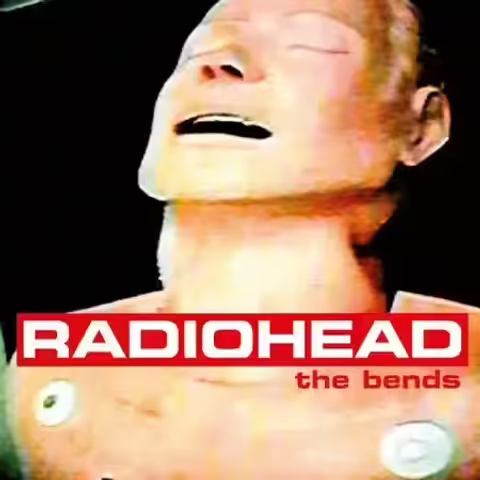
The album's distorted, gasping face on the sleeve is a CPR mannequin. Yorke and Stanley Donwood, who had met at the University of Exeter and previously worked together on the My Iron Lung EP, walked into the basement of Oxford's John Radcliffe Hospital with a Hi8 video camera, intending to film an iron lung. The actual machine was, in Donwood's words, "visually boring". They borrowed a CPR mannequin instead, played the footage back on a television monitor, photographed the screen, then stretched the image in early 1990s photo software to exaggerate the expression. The result became the first Stanley Donwood Radiohead sleeve. Donwood has since drawn or painted every Radiohead album cover.
The mannequin's grimace is more or less perfectly aligned with the album's lyrical themes: pressure, suffocation, illness, the sense of a body being asked to do something it cannot do. Decompression sickness, the medical condition the album is named after, occurs when divers ascend faster than the dissolved nitrogen in their blood can escape, which is the exact metaphor Yorke chose for what "Creep" had done to the band in 1993.
Release and Reception
Parlophone released The Bends in the UK on 13 March 1995, into a chart already dominated by Oasis's Definitely Maybe and the run-up to (What's the Story) Morning Glory? The first-week response was modest. The album entered the UK chart at number six, climbed to four, and spent 16 weeks on the listing without ever quite getting to number one. In the US, where Capitol nearly refused to release it on the grounds that it lacked hit singles, it crawled in at the bottom of the Billboard 200 in the week of 13 May, fell off, came back in February 1996, and finally peaked at number 88 on 20 April 1996, almost exactly a year after release. The slow build was, by every account, deliberately cultivated by MTV's Matt Pinfield and a handful of college radio sympathisers.
"Radiohead clearly resolved to make an album so stunning it would make people forget their own name, never mind 'Creep'. The consummate, all-encompassing, continent-straddling '90s rock record."
Mark Sutherland, NME, 18 March 1995
"A powerful, bruised, majestically desperate record of frighteningly good songs."
Q magazine, April 1995
UK critics were largely converted on first listen. NME gave the album 9 out of 10 and named it among the year's top ten releases, as did Melody Maker. Q ran four stars in its initial review and would later give the reissue five. Caroline Sullivan in The Guardian wrote that Radiohead had "transformed themselves from nondescript guitar-beaters to potential arena-fillers". The Select review by Dave Morrison praised the band as "one of the UK's big league, big-rock assets". US critics were rougher: Spin's Chuck Eddy dismissed much of the album as "nodded-out nonsense mumble", the Chicago Tribune predicted that Radiohead would not amount to anything beyond "Creep", and Robert Christgau's Village Voice grade was a C. The retrospective consensus that emerged later, in everything from Pitchfork's 10/10 reissue review to Rolling Stone's three successive Top 500 placements, did not apply at the time.
| Single | Release | UK Singles peak | Notes |
|---|---|---|---|
| My Iron Lung | 26 September 1994 | 24 | Released as part of an EP for fans rather than a "Creep"-style hit |
| High and Dry / Planet Telex | 27 February 1995 | 17 | Double A side; later reissued in the US, peaking at 78 on Billboard Hot 100 |
| Fake Plastic Trees | 15 May 1995 | 20 | First US single; failed to chart on the Hot 100 but featured in Clueless |
| Just | 21 August 1995 | 19 | Jamie Thraves's video became MTV staple |
| Street Spirit (Fade Out) | 22 January 1996 | 5 | Radiohead's first UK top-five single; surpassed "Creep" |
| The Bends | 26 July 1996 | 26 (Ireland only) | Released in Ireland only; not issued elsewhere |
Videos and Promotion
The Bends was a video record almost as much as it was an album. Jamie Thraves's "Just" video, in which a man lies down on a Camden pavement and refuses to get up, made enough of an impression in its closing close-up of his lip-read explanation that the clip is still parodied on the internet a quarter of a century later. The "Street Spirit (Fade Out)" video, directed by Jonathan Glazer, is a slow-motion black-and-white sequence shot at 1000 frames per second, the first time Glazer worked with a band that would later make him a feature director. Yorke later said he would not watch either of them. The "Fake Plastic Trees" video, directed by Jake Scott, is a supermarket-set piece in which the band sit silently in a row of trolleys for four minutes. None of the videos are easy to read, all of them played in heavy rotation on MTV through 1995 and 1996, and they are the single biggest reason the album sold to American teenagers who were not yet listening to anyone in the band's UK label hierarchy.
"Record companies would ask us why MTV kept playing The Bends when it was selling less than their albums. My reply was always: because it's great."
Matt Pinfield, MTV, recalled in Pitchfork OK Computer oral history, 2017
Yorke later thanked Pinfield with a gold record of The Bends. The use of "Fake Plastic Trees" in the closing scenes of Clueless in July 1995 was equally consequential. According to multiple accounts, the song's appearance over Cher Horowitz's voiceover did more for the album's American sales in a fortnight than any of Capitol's promotional spend in the previous six months.
Touring and the R.E.M. Effect
Radiohead toured The Bends for fifteen months. They opened for Soul Asylum first, then graduated to a US tour with R.E.M. in late 1995, an experience Yorke has talked about more than almost any other moment in his career. Michael Stipe, the R.E.M. singer Yorke had idolised since school, walked up to him backstage in Phoenix and told him The Bends was "the best record of the year" and that Radiohead were "going to be the most important band in the world".
"Everything that we'd come to expect was completely turned on its head. The idea that you get to a certain level and you lose it, that everything was bitter and petty. None of it was true."
Thom Yorke, Record Collector, November 1996
The tour was not without disasters. Before a New York show, Yorke broke down and asked Radiohead's tour manager to book him a flight home; his bandmates persuaded him to stay. In Munich in November 1995 he collapsed on stage; NME ran a story headlined "Thommy's Temper Tantrum" that Yorke described as the most hurtful thing anyone had written about him, and refused to give the magazine interviews for five years. Before a show in Denver, Colorado, the band's tour van and most of their equipment were stolen; Yorke and Jonny Greenwood played a stripped-down acoustic set with rented instruments, several other shows were cancelled, and Greenwood was reunited with his stolen Fender Telecaster Plus only in 2015, when a fan in Denver realised the guitar he had bought twenty years earlier was the missing one.
The 1996 leg saw Radiohead play The Tonight Show, MTV's 120 Minutes, Pinkpop in Holland, Torhout-Werchter in Belgium and T in the Park in Scotland. By August 1996 they were opening for Alanis Morissette and quietly road-testing early versions of "Lucky" and "No Surprises". The Bends tour, in other words, ended with Radiohead already mid-way through writing OK Computer.
The Bends On Screen
"Fake Plastic Trees" appears in Clueless (1995), in The Faculty (1998), and in Cruel Intentions's extended cut, becoming one of the defining American teen-cinema needle-drops of the late nineties. "Street Spirit (Fade Out)" was used in the trailer for Christopher Nolan's Memento in 2000 and in The Vampire Diaries. "High and Dry" appeared in the pilot of Cold Case and in The OC, where Mischa Barton and Adam Brody helped a generation of teenagers discover their parents' record collection. "Black Star" became, almost without anyone organising it, a wedding-and-funeral song among British listeners of a certain age, and is the song most likely to be dedicated on Radio 2 by people who first bought The Bends on cassette in 1995.
Reissues and Anniversaries
Radiohead's contract with EMI ended in 2003. In 2007 EMI released the Radiohead Box Set compiling the band's six EMI albums, including The Bends. On 31 August 2009, EMI issued a "Collector's Edition" of The Bends with B-sides and live performances, but without Radiohead's input and without a remastering of the original mixes. The reissue's Pitchfork review by Scott Plagenhoef gave it 10 out of 10, a score the website rarely awards. In February 2013 Parlophone was bought by Warner Music Group; in April 2016, as part of a deal with the trade group Impala, Warners transferred Radiohead's back catalogue to XL Recordings, which also pulled the unauthorised EMI Collector's Editions from streaming services. In May 2016 XL reissued the album on vinyl. There has, as of 2026, been no thirtieth anniversary box set, although Radiohead marked the date in March 2025 by quietly posting unseen footage of Thom Yorke playing solo at the Horseshoe Tavern in Toronto on 28 March 1995.
Legacy and Influence
The Bends did not so much end the perception of Radiohead as a one-hit wonder as quietly outlast it. Through 1996 the album kept finding new listeners; by the end of that year it had sold around two million copies worldwide. It was nominated for Best British Album at the 1996 Brits, losing to Oasis's (What's the Story) Morning Glory? In a 2000 poll of more than 200,000 British music fans and journalists organised by Channel 4, The Bends was voted second-greatest album of all time, behind Revolver. It has been on every iteration of Rolling Stone's 500 Greatest Albums of All Time. Pitchfork named it the third-greatest Britpop album in 2017, although Radiohead never accepted the Britpop label and Pitchfork were arguing as much against the genre as for the album.
"With The Bends, Radiohead found their voice. No other contemporary band has managed to mix such a cocktail of rage, sarcasm, self-pity, exquisite tunefulness and braininess."
Nick Hornby, The New Yorker, October 2000
What the album actually did, between 1995 and 2005, was teach a generation of British and Irish songwriters how to write the kind of slow-build acoustic rock song that the next decade would over-produce. The list of acts who have publicly named The Bends as the record that opened the door is long and largely interconnected:
- Coldplay, whose Chris Martin has cited the album as the reason he decided to take songwriting seriously at university
- Muse, whose first album was produced by John Leckie almost specifically to chase the sound
- Travis, who toured with Radiohead in 1997 and modelled The Man Who on it
- Keane, James Blunt, Snow Patrol, Athlete, Elbow, Turin Brakes and Kodaline, all of whom emerged into the post-Britpop landscape The Bends helped invent
Yorke has been openly contemptuous about a lot of that lineage, calling the post-Bends "guys singing in falsetto with an acoustic guitar" school of British rock a misreading of his own work. Nigel Godrich has politely pointed out that Yorke did not in fact invent the idea, and that some of the imitation might just be flattery. Garbage, R.E.M. and k.d. lang began publicly citing Radiohead from late 1995 onwards. The Cure's management contacted Radiohead's management to ask, frankly, who had produced The Bends and whether he could be hired to recreate the sound.
For Radiohead themselves, the album's most important consequence was confidence. The success of The Bends gave the band, and EMI, the latitude to self-produce the next record with Nigel Godrich behind the desk. That album, recorded in St Catherine's Court near Bath in 1996 and 1997, was OK Computer. Without the slow, grinding, near-disastrous making of The Bends, OK Computer cannot be made.
Things You Might Not Know
| Fact | Detail |
|---|---|
| The working title | Yorke played early demos to producer Paul Kolderie under the name The Benz, a year before the album was finished. |
| The barn rehearsals | Radiohead spent January 1994 rehearsing the entire album in a disused barn on an Oxfordshire fruit farm. A sketchbook from those rehearsals later sold at auction for 5,000 pounds. |
| The track that nearly bombed | EMI flew Sean Slade and Paul Q. Kolderie from Boston to Abbey Road to remix the album behind John Leckie's back. Only three of Leckie's mixes survived to the final master. |
| The Astoria switch | "My Iron Lung" on the album is a live recording from the London Astoria on 27 May 1994, with Yorke's vocals re-cut later and the audience erased from the multitrack. |
| Greenwood's stolen guitar | The Fender Telecaster Plus stolen with the band's tour van in Denver in 1995 was reunited with Jonny Greenwood in 2015 after a fan recognised it twenty years on. |
| The mannequin in the basement | The album cover is a CPR mannequin filmed in a hospital basement, projected onto a TV screen and then photographed off the screen and stretched in software. |
| Yorke's secret credit | Yorke is co-credited on the artwork as "The White Chocolate Farm", a pseudonym he has used on visual art ever since. |
| The Hungerford line | "Sulk" was originally a response to the 1987 Hungerford massacre. Yorke changed the closing line because he could not sing "just shoot your gun" in April 1994, weeks after Kurt Cobain's death. |
| Godrich's first credit | Nigel Godrich, the band's lifelong producer, has only one production credit on The Bends, for "Black Star". Leckie was out for the evening. |
| EMI's near-cancellation | According to Tim Footman's book, Capitol Records almost refused to release the album in the US on the grounds that it had no obvious singles. |
| Buckley's accidental influence | The recorded vocal on "Fake Plastic Trees" was cut the morning after Yorke watched Jeff Buckley play in London. Yorke is on record as having cried at the end of the take. |
| Q's 1998 readers' poll | Q's readers voted The Bends the second-best album of all time in both 1998 and 2006. The album above it was OK Computer. |
Comments