Beck Hansen began Odelay believing it would be the album that ended his career. Two years after the accidental novelty hit "Loser" had branded him a slacker mascot for a Generation X he had no interest in representing, he holed up in the Silver Lake living room of two hip-hop producers best known for a Beastie Boys record that flopped on release, started chopping organ parts off Them records and sex-education LPs, and emerged with a sampledelic, genre-collapsing oddity that won two Grammys, sold 2.3 million copies in the United States alone, and is now the second Beck album in the Rolling Stone 500. The story of how he got there is mostly a story of failure, a salvaged scrap from earlier sessions, and an early build of Pro Tools so slow that the producers had thirty minutes between takes to dig through their record collection.

"I thought Odelay might be the last time I got a chance to make a record," Beck told Rolling Stone in 2008. "I was acutely aware that I was thought of as a one-hit wonder." That sentence is the secret engine of the album. Every weird production decision, every genre swerve, every absurdist couplet on Odelay was made by a 25-year-old who assumed nobody would be paying attention.

FieldDetail
ArtistBeck
AlbumOdelay
Release date18 June 1996
LabelDGC / Bong Load Custom Records
Producer(s)Beck Hansen, the Dust Brothers (John King, Michael Simpson), Mario Caldato Jr, Brian Paulson, Tom Rothrock, Rob Schnapf
Studio(s)PCP Labs (Silver Lake), G-Son (Atwater Village), Sunset Sound and Conway (Los Angeles), The Shop (Arcata)
Genre / SubgenreAlternative rock, sampledelia, alternative hip hop, folk rock, neo-psychedelia
Track count13 (track 13 contains a hidden noise piece)
Total runtime54:06
Billboard 200 peak16
UK Albums Chart peak17
Other notable peaksSweden 5, Switzerland 14, New Zealand 16, Australia 20, Norway 23, Belgium 27, Germany 30
CertificationsUS 2x Platinum, UK Platinum, Canada 2x Platinum, Japan Platinum, NZ Platinum, Australia Gold
Estimated US sales2.3 million (RIAA, July 2008)
Key singlesWhere It's At, Devils Haircut, The New Pollution, Sissyneck, Jack-Ass

Cultural Context: 1996 and the End of Slackerdom

By the summer of 1996, the cultural mood Beck had been forced to wear on Mellow Gold's tail was already curdling. Kurt Cobain had been dead for over two years. Pearl Jam were in the middle of a self-imposed retreat from MTV. The brand of fuzzed-out, ironic American underground rock that had carried "Loser" up the charts in 1994 was being elbowed aside by post-Britpop UK acts (Oasis's (What's the Story) Morning Glory? was still selling four-figure copies a day in the States), by chart-pop reinventions like the Spice Girls, and by a swelling commercial wave of nu-metal, electronic dance and trip-hop. Metallica released the divisive Load two weeks before Odelay; Aenima by Tool followed in September; DJ Shadow's Endtroducing arrived in November. Sampling, instrumental hip-hop and crate-digging were no longer a New York or London phenomenon, but the dominant pop-cultural language of the year.

For a Los Angeles songwriter who had been written off as a folk-rap novelty, that climate was the door. Odelay walked through it carrying everything: country slide guitar, vintage funk drum breaks, harmonica wheeze, mariachi, beatbox vocal, deliberately corny synth presets, two-step shuffle, Sabbath-style sludge, and lyrics that landed somewhere between William Burroughs cut-up and a yard-sale wisecrack. None of those pieces were new on their own. The novelty was hearing them inside the same three-minute song.

Beck's Story Up to This Point

By the time he walked into the Dust Brothers' house in 1995, Beck Hansen was already four albums deep into a career most of his fans did not know existed. He had grown up in a culturally chaotic Los Angeles household: his mother Bibbe Hansen was a teenage Andy Warhol Factory regular, his grandfather was the Fluxus collage artist Al Hansen, and his father David Campbell, a session string arranger, would later orchestrate parts of his son's records. Beck dropped out of school at sixteen, played anti-folk circuits in New York's Lower East Side, busked in Los Angeles coffee houses, and self-released a clutch of cassettes and limited-run LPs that traded freely in the lo-fi underground.

"Loser", a four-track home recording originally pressed as a 12-inch on Bong Load Custom Records in 1993, was not meant to be heard by millions of people. When KXLU and KROQ began rotating it, a major-label bidding war broke out, and Beck signed an unusually permissive deal with David Geffen's DGC: Bong Load and an independent label, K Records, retained the rights to release "alternative" Beck records in parallel with the major-label catalogue. That deal is the only reason 1994 produced three Beck albums in the same calendar year: Mellow Gold on DGC in March, Stereopathetic Soulmanure on Flipside in February, and the largely acoustic One Foot in the Grave on K Records in June.

None of that complicated framing reached the cover of Spin. To the public Beck was the "I'm a loser, baby" guy, with a single he had grown to dread. The follow-up to Mellow Gold had to be the record that decided whether anyone would still be listening in 1997.

Pre-production and the Lost Acoustic Album

The first version of Odelay was not Odelay at all. In 1994 Beck began tracking a sombre acoustic record with Tom Rothrock and Rob Schnapf, the Bong Load producers who had originally engineered "Loser". The sessions yielded a near-complete album. Beck has described it on multiple occasions in tones that range from affectionate to dismissive.

"It was a whole record's worth of stuff, somewhere between Big Star, Pavement and Nirvana."

Beck Hansen, Rolling Stone, 2008

That description is, in hindsight, the road not taken. The "between Big Star, Pavement and Nirvana" album would have been the natural follow-up to One Foot in the Grave and would almost certainly have arrived as a quieter, more songwriterly second major-label statement, exactly what a label and a press corps in love with sad-eyed singer-songwriters would have expected from him in 1995. Beck shelved nearly all of it. Only one track from those sessions, the closing "Ramshackle", survived intact onto Odelay, with Tom Rothrock and Rob Schnapf retaining their producer credit on that song alone. The rest of the lost album has trickled out across deluxe editions, B-sides and rarities compilations, but never as a coherent statement. The decision to abandon it is the single most consequential creative choice on the record.

What replaced it began as a chance booking. The Dust Brothers, John King and Michael Simpson, were the Los Angeles production team who had assembled the Beastie Boys' Paul's Boutique in 1989 from layered samples and breakbeats, and whose commercial standing in 1994 was largely defined by that record having flopped on first release. They had been working with Tone Loc and Young MC and were not in obvious demand. A Geffen A&R suggestion put Beck and the Dust Brothers in the same room, and the sessions began informally, one slide guitar and a handful of harmonicas at a time.

"Odelay was very informal. I just showed up one day with the slide guitar and a couple of harmonicas, and we started working."

Beck Hansen, Rolling Stone, 2008

Creating the Album: PCP Labs and a Wall of Records

The bulk of Odelay was recorded in 1995 in the smallest room of the Dust Brothers' Silver Lake home. The studio, which they had nicknamed PCP Labs, was barely a studio. It was a converted bedroom whose walls were lined floor to ceiling with vinyl. Beck has been emphatic that despite the album's reputation as a sample collage, much of what sounds sampled is actually played, often by him.

"It was tiny. And one wall, floor to ceiling, was all records. A lot of Odelay was played, not sampled."

Beck Hansen, Rolling Stone, 2008

The records that were sampled tell their own story. Them's 1966 cover of Bob Dylan's "It's All Over Now, Baby Blue" gave up the spectral organ figure that anchors "Jack-Ass". A vintage sex-education LP titled Sex for Teens (Where It's At) contributed the looped, half-mortified spoken phrase that became both a chorus hook and the title of the lead single. Pretty Purdie drum breaks, exotica records, library-music horn stings and obscure soundtrack fragments cycle through the rest of the record, sometimes for less than a bar.

One of the more revealing details about the sessions is how slow the technology was. The trio were using an early build of Pro Tools, on a machine that needed roughly half an hour after each take to commit the audio data. Those forced waits, Beck has said, are part of why the record sounds the way it does: between takes there was nothing to do but pull more vinyl off the wall and hunt for two-bar loops.

The recording was famously cleaved in two by an outside event. In the summer of 1995 Beck joined the second-stage line-up of the touring Lollapalooza festival, alongside Sonic Youth, Hole, Cypress Hill and Pavement. The album was paused mid-flow. When he came back to PCP Labs, the work pattern had changed completely:

"Everything we did before was very complex, we would spend weeks on each track. When I came back, we did a bunch of songs really quick in two weeks. We did 'Devils Haircut' and 'New Pollution' back to back in two days."

Beck Hansen, Rolling Stone, 2008

Two of Odelay's three signature singles, in other words, were tracked over a single weekend at the end of a frustrating year. Beck has also been candid about how scratch-track many of the lyrics on the record are: lines that started as guide vocals to fix in the mix, and then could not be improved on.

"Most of the vocals on the record were scratch vocals. We just grew attached to them."

Beck Hansen on "The New Pollution", Rolling Stone, 2008

Two further tracks were recorded outside Silver Lake. "Minus", the angular punk-grunge interlude that pivots the second half of the album, was tracked at The Shop in the northern Californian town of Arcata, with engineer-producer Brian Paulson, and mixed by Mario Caldato Jr at G-Son in Atwater Village (the Beastie Boys' studio, where Caldato had engineered Check Your Head and Ill Communication). "Ramshackle", as already noted, was a 1994 Rothrock and Schnapf production carried over from the abandoned acoustic record. The album was mastered by Bob Ludwig at Gateway Mastering in Portland, Maine, the man whose name appears on the back of so many era-defining 1990s LPs.

The album's sample-clearance budget, never publicly itemised, was substantial. Both Beck and the Dust Brothers have alluded in interviews to a process of identifying the most valuable samples, paying for them, and quietly replaying or rebuilding others to avoid further legal entanglement. The compromise is part of why a record that sounds like a sample-collage album also has Beck personally credited on roughly fifteen instruments.

Personnel and Credits

The Personnel block on the original CD insert was modest. The 2008 Deluxe Edition liner notes restored the full picture, and it is still arresting: a tiny core, a rotating supporting cast that includes a former Ornette Coleman bassist, and a production credit list of six names spread across three studios.

RolePlayerNotes
Core artist
Vocals, guitars, bass, harmonica, organ, slide guitar, clavinet, Moog, Echoplex, percussion, turntablesBeck HansenPlays on every track. Approximately fifteen instruments credited across the album.
Guest and session musicians
Turntables, TR-808 drum machineThe Dust Brothers (John King, Michael Simpson)Tracks 1, 2, 6, 8, 12 (turntables) and 6, 12 (808).
Drums, percussion, chimesJoey WaronkerTracks 3, 6, 9, 13. Began a long touring relationship with Beck on the Odelay tour and later played with R.E.M. and Atoms for Peace.
Clavinet, trumpet, organMike BoitoTracks 6, 8, 10, 12.
SaxophoneDavid BrownTrack 8 ("Where It's At").
OrganMoney Mark (Mark Ramos-Nishita)Track 8 ("Where It's At"). Beastie Boys keyboardist.
Outro spoken wordEddie LopezTrack 8 ("Where It's At").
Pedal steel guitarGreg LeiszTrack 10 ("Sissyneck"). Country and Americana session legend.
Upright bassCharlie HadenTrack 13 ("Ramshackle"). Free-jazz pioneer, founding member of Ornette Coleman's quartet.
TablasPaolo DiazTrack 5 ("Derelict").
ScreamsMike MilliusTrack 3 ("Lord Only Knows").
"Wizard and child"Ross HarrisTrack 2 ("Hotwax"), credited verbatim that way in the booklet.
Production and engineering
Producer, mixing (tracks 1 to 12)BeckCo-producer alongside the Dust Brothers on the bulk of the record.
Producers, mixing (tracks 1 to 8, 10 to 12)The Dust BrothersJohn King and Michael Simpson, working out of PCP Labs.
Producer, mixing (track 9)Mario Caldato Jr"Minus". Beastie Boys engineer through the early 1990s.
Producer, mixing (track 9)Brian Paulson"Minus". Tracked at The Shop, Arcata.
Producer, mixing (track 13)Tom Rothrock"Ramshackle". Survivor of the abandoned 1994 acoustic record.
Producer, mixing (track 13)Rob Schnapf"Ramshackle".
MasteringBob LudwigGateway Mastering, Portland, Maine.
Artwork and design
Cover photographJoan Ludwig1977 Komondor photograph, originally for the AKC Gazette. Ludwig was the unrelated canine photographer, not the mastering engineer.
Art direction, designBeck Hansen, Robert FisherInside artwork built around collages by the Filipino-American painter Manuel Ocampo and Beck's grandfather Al Hansen.
Inlay paintings, collage imagesManuel Ocampo, Al Hansen, Charlie Gross, Zarim OsbornVisual continuity between the music's collage logic and the booklet artwork.
Beck photographsNitin Vadukul, Charlie Gross, Alison DyerMultiple shoots used across booklet and singles sleeves.

Two names in that table deserve a moment. Charlie Haden, who plays the long, lyrical upright bass figure on "Ramshackle", was 58 years old at the time of the session and had been a defining voice in jazz since the original Ornette Coleman quartet of 1959. He was also a friend and collaborator of Beck's father, the arranger David Campbell. The session was effectively a family-network favour, and the resulting performance is one of the most unexpected pieces of jazz on a 1996 alternative-rock album. Joey Waronker, the drummer credited on four tracks, would within a few years be the de facto fifth member of R.E.M. and the touring drummer for Atoms for Peace; on Odelay he is mostly a quietly inventive timekeeper, anchoring "Lord Only Knows" and "Ramshackle" while the production around him goes everywhere.

The Songs

Odelay is sequenced as thirteen tracks, although the original CD pressing tucks a hidden, minute-long noise piece at the end of "Ramshackle", taking that closing track from a 6:29 song to a 7:29 listing. Across the body of the album, only "Lord Only Knows", "Minus" and "Ramshackle" are credited to Beck Hansen alone; every other song is co-written with the Dust Brothers, John King and Michael Simpson.

#TitleWriter(s)LengthSingle?Notes
1Devils HaircutHansen / King / Simpson3:14Single (Dec 1996)Written and tracked back-to-back with "The New Pollution" in two days post-Lollapalooza.
2HotwaxHansen / King / Simpson3:49Spanish-language refrain ("Yo soy un disco quebrado"). Ross Harris credited as "wizard and child".
3Lord Only KnowsHansen4:14Slide-guitar country with Mike Millius's opening scream. The phrase "odelay" appears in the outro.
4The New PollutionHansen / King / Simpson3:39Single (Feb 1997)Saxophone hook lifted from Joe Thomas's "Venus" (1976). Mostly scratch vocals.
5DerelictHansen / King / Simpson4:12Tablas by Paolo Diaz; closest the record gets to a trip-hop track.
6NovacaneHansen / King / Simpson4:37Big TR-808 kick, distorted megaphone vocal, abrupt key shift halfway through.
7Jack-AssHansen / King / Simpson4:11Single (Aug 1997)Built on the organ figure from Them's 1966 cover of Bob Dylan's "It's All Over Now, Baby Blue".
8Where It's AtHansen / King / Simpson5:30Single (May 1996)Spoken samples taken from a 1969 sex-education LP, Sex for Teens (Where It's At). Money Mark on organ, David Brown on saxophone.
9MinusHansen2:32Recorded at The Shop, Arcata, with Brian Paulson; mixed by Mario Caldato Jr at G-Son.
10SissyneckHansen / King / Simpson3:52Single (June 1997)Country shuffle with Greg Leisz on pedal steel.
11ReadymadeHansen / King / Simpson2:37Title nods to Marcel Duchamp; built around a sample of Dick Hyman's "Topless Dancers of Corfu".
12High 5 (Rock the Catskills)Hansen / King / Simpson4:10Schubert's "Symphony No. 9" sample colliding with a Pretty Purdie drum break and a vocoder hook.
13RamshackleHansen7:29Salvaged from the abandoned 1994 Rothrock / Schnapf sessions. Charlie Haden on upright bass. Hidden one-minute noise piece at the end.

The opening sequence is a manifesto. "Devils Haircut" pivots on a fuzzed Pretty Purdie drum loop, a stuttering distortion-pedal riff and a chorus that scans like nonsense until the phrase "discount orgies on the dropout buses" lodges in the brain. "Hotwax" follows with a Spanish-language hook, a wheezing harmonica, and one of the most quotable B-roll lines in 1990s alternative rock ("yo soy un disco quebrado", "I am a broken record"). "Lord Only Knows" is the album's first feint at sincerity, a slide-guitar country song that buries the title-revealing word "odelay" in its outro.

The middle stretch is where the record's reputation as a magpie's nest is earned. "Where It's At", the lead single, was built around a low-budget novelty: the spoken phrase "I got two turntables and a microphone" sounds like a Beck improvisation, but it is delivered straight on top of a sample lifted from a 1969 sex-education record. The song is the closest Odelay gets to a conventional verse-chorus pop structure, and it became a generational karaoke staple almost by accident.

"Jack-Ass" sits in the album's emotional middle. The melancholy Them organ part anchors a vocal in which Beck sounds, for the first time on the record, genuinely melancholy rather than ironic. "Sissyneck" pulls in the opposite direction with Greg Leisz's pedal steel and a country shuffle loop. "Readymade" and "High 5 (Rock the Catskills)" are the most overtly Dust Brothers-produced moments, each crashing classical or library-music samples (Dick Hyman, Schubert) into Pretty Purdie breakbeats. "Minus" is the album's outlier, a snarling sub-three-minute punk track that sounds like it should belong to a different record.

Then "Ramshackle" closes everything. Recorded a year and a half before the rest of the album, with Charlie Haden's bass walking under Beck's acoustic strum, it is the seam where Odelay's two competing conceptions, the abandoned Big-Star-and-Pavement record and the realised sample-collage record, are visibly stitched together. The minute of feedback that follows on the original CD pressing is the join.

B-sides, Outtakes and the Deluxe Edition

Beck has a deserved reputation for releasing nearly as much material outside his main albums as on them, and Odelay is the apex of that habit. The five Odelay singles between May 1996 and August 1997 each carried unique B-sides, remixes and live cuts on their CD and 12-inch formats, none of which appeared on the album itself. The 2008 two-disc Deluxe Edition, issued on 29 January 2008 by Geffen, gathered nineteen of those tracks for the first time on a single release.

The most interesting of these are not necessarily the most polished:

  • ".000.000", a Sabbath-style sludge instrumental that was the original B-side of "Devils Haircut", recorded at G-Son and described by Beck as having had "a big skate ramp in it"
  • "Burro", a Spanish-language re-recording of "Jack-Ass" with a Los Angeles mariachi band booked from a local restaurant, on which Beck has said he ended up sounding "like Mario Lanza"
  • "Gold Chains", a previously unreleased Dust Brothers session track first surfaced on the Deluxe Edition, dismissed by Beck as "never a serious album contender, we were just fucking around one day"
  • "Erase the Sun", "Lemonade" and "Inferno", three Dust Brothers-produced offcuts that have appeared variously on Odelay-era B-sides and the Deluxe Edition
  • The Mickey Petralia and U.N.K.L.E. remixes of "Where It's At" and "Devils Haircut", which extended several singles to twenty-minute multi-track CD packages

The Deluxe Edition's liner notes are themselves a small archive: a written essay by Sonic Youth's Thurston Moore, and the transcript of a 2007 round-table interview in which Dave Eggers of McSweeney's sat down with fifteen American high-school students to talk about a record made before any of them were born.

Album Artwork and Packaging

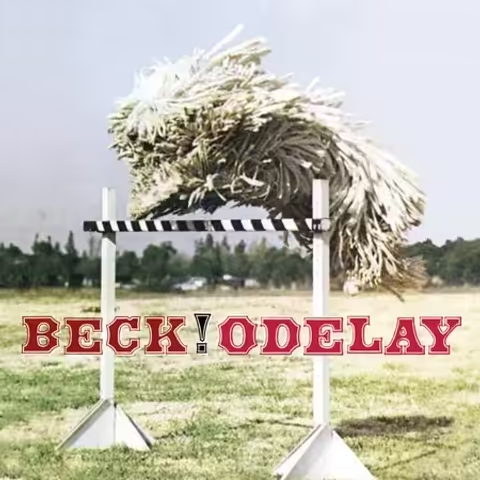
The record's cover image is one of the most parodied of the 1990s. It shows a Komondor, a rare Hungarian sheepdog with a heavy corded coat that genuinely resembles a mop, in mid-leap over a low agility hurdle. The dog's name is not preserved in the credits. The photographer's is.

The image was originally taken by Joan Ludwig, an American canine photographer (no relation to mastering engineer Bob Ludwig), and published in the July 1977 issue of the Gazette, the official publication of the American Kennel Club. Beck and designer Robert Fisher licensed the existing photograph rather than commissioning a new shoot, attracted, Beck has said in interviews, by its accidentally absurdist quality. Ludwig herself died in 2004; the album sleeve, still printed across millions of CDs and LP jackets, is by some distance the most-seen photograph she ever took.

The interior artwork, by contrast, is dense and personal. Robert Fisher's layout incorporates collage elements by the Filipino-American painter Manuel Ocampo, additional photographic and collage work by Charlie Gross and Zarim Osborn, and several pieces by Beck's grandfather, the Fluxus collage and Happenings artist Al Hansen, who had died in 1995 while Odelay was being recorded. The decision to thread Al Hansen's collage work through the booklet is the closest Odelay comes to an explicit dedication.

The album title itself is best understood as a triple pun. It is the phonetic English rendering of the Mexican Spanish slang interjection "órale", roughly "alright" or "cool". The word is buried in the outro of "Lord Only Knows". And, according to Stephen Malkmus of Pavement, who toured with Beck on Lollapalooza 1995 and watched the sessions take an extra year, the title is also a private joke on "Oh Delay":

"It's a pun on 'Oh Delay,' since the album took very long to record."

Stephen Malkmus, Spin, 2011

Release and Reception

Odelay arrived on 18 June 1996 to reviews that, with very little dissent, treated it as a radical leap forward. AllMusic gave the album the maximum five stars in retrospective; Spin scored it a perfect ten out of ten on release; Pitchfork's then-young Ryan Schreiber awarded a 9.8 out of 10. The Chicago Tribune's Greg Kot, the LA Times's Sara Scribner, the Guardian's Jonathan Romney and Robert Christgau in the Village Voice all filed glowing notices within days of release. The most famous contemporary review remains Mark Kemp's in Rolling Stone, headed "Surrealistic Pillar", a piece that argued for Odelay as a defining alternative-rock statement of the decade.

PublicationScoreReviewerYear
AllMusic5 / 5Stephen Thomas Erlewineretrospective
Pitchfork9.8 / 10Ryan Schreiber1996
Spin10 / 10Chris Norris1996
Rolling Stone4 / 5Mark Kemp ("Surrealistic Pillar")1996
NME8 / 10Keith Cameron ("Mr Boho Rising")1996
Entertainment WeeklyA minusEthan Smith1996
The Village VoiceA minusRobert Christgau1996
Chicago Tribune4 / 4Greg Kot1996
The Guardian4 / 5Jonathan Romney1996
Los Angeles Times4 / 4Sara Scribner1996

The end-of-year lists were nearly unanimous. Rolling Stone named Odelay its album of the year for 1996. The Village Voice's Pazz & Jop critics' poll, the most authoritative US critical-consensus list of the era, placed Odelay at number one for 1996. NME named it album of the year. The Associated Press writers' poll later included it in their top-ten albums of the entire 1990s.

Commercially, the album peaked at number sixteen on the Billboard 200 and at number seventeen on the UK Albums Chart, with stronger placings in Sweden (number five), Switzerland (fourteen) and across Scandinavia. It was certified two-times Platinum by the RIAA, with US sales reported by Billboard at 2.3 million by July 2008, two-times Platinum in Canada, Platinum in the UK, Japan and New Zealand, and Gold in Australia. Within four years it had sold an estimated three million copies worldwide.

The award recognition arrived in February 1997 at the 39th Annual Grammy Awards. Odelay was nominated for Album of the Year, losing to Celine Dion's Falling into You. It won Best Alternative Music Album. "Where It's At" won Best Male Rock Vocal Performance, an unintuitive category for a hip-hop adjacent single, but a sign of how thoroughly Odelay had crossed genre filing systems.

Singles and Music Videos

Odelay yielded five singles across fifteen months. Their visual presentation, particularly the Steve Hanft and Spike Jonze videos for "Where It's At" and "Devils Haircut", did at least as much as the music itself to define Beck's public image during the Odelay cycle.

SingleReleasedUK peakUS peakDirectorB-sides / notes
Where It's At28 May 19963561 (Hot 100), 5 (Modern Rock)Steve HanftMultiple B-side cuts; Mickey Petralia and U.N.K.L.E. remixes; line-dance scenes filmed in California desert.
Devils Haircut11 December 1996223 (Modern Rock)Mark RomanekRomanek's New York street video shot in 16mm; original B-side ".000.000".
The New Pollution28 February 19971416 (Modern Rock)Beck (directed and choreographed)Multiple character set-pieces; Beck's first credit as a music-video director.
Sissyneck17 June 199730did not chart Hot 100Spike JonzeEuropean single only in some territories.
Jack-Ass26 August 199734did not chart Hot 100Steve Hanft"Burro", the Spanish-language mariachi re-recording of the same song, included on the maxi-single.

The "Devils Haircut" video, directed by Mark Romanek and shot on 16mm in New York City, follows Beck through Manhattan dragging a giant ghetto blaster, the camera locked uncomfortably close to his face. The "Where It's At" video, directed by Steve Hanft, deposits Beck in a country-line-dancing convention in the desert, and ends with a parade. Beck himself directed and choreographed "The New Pollution", which moves through six or seven distinct visual scenarios in three and a half minutes, and won the MTV Video Music Award for Best Male Video in 1997. Spike Jonze, who would later direct Beck's "Sabotage"-style "Sabotage"-tribute "It's All In Your Mind" video for Sea Change, contributed the "Sissyneck" promo.

Touring and Live: Over 150 Shows in Fifteen Months

The Odelay touring cycle ran from May 1996 through to 5 September 1997, when a band performance was filmed for Sessions at West 54th in New York. Beck and his core touring band, anchored by Joey Waronker on drums, Justin Meldal-Johnsen on bass, Smokey Hormel on guitar and Roger Joseph Manning Jr (formerly of Jellyfish) on keys, played upwards of 150 shows. The tour started in US record stores and on radio-station promotional sets, expanded into the European festival circuit through summer 1996, and by 1997 had moved into mid-sized US arenas.

The touring band's reputation grew almost faster than the album's. Beck's stage shows during this period combined live instrumentation with the Dust Brothers' breakbeat backing tracks, a turntablist on stage, costume changes, James-Brown-style choreography, and a habitual deliberate set-list mismatch in which the album's quieter folk songs were rebuilt as funk numbers and vice versa. Notable confirmed dates from this period include:

  • The 1996 European summer festival run, including Roskilde and Pukkelpop
  • The February 1997 Grammy Awards performance of "Where It's At"
  • Multiple appearances on Later... with Jools Holland through 1996 and 1997, including a "Devils Haircut" performance preserved on the BBC's archive
  • A "Novacane" performance on the Howard Stern Show in 1997, frequently cited by fans as one of the most uncompromising Beck TV appearances of the decade
  • The 5 September 1997 Sessions at West 54th taping in New York, the unofficial closing show of the Odelay cycle

In TV, Film and Media

Odelay's tracks have had a long and slightly underrated post-release life in soundtracks and advertising. "Where It's At" has appeared in episodes of The Simpsons, in HBO comedy specials and in numerous American sports-broadcast cold-opens, where its "two turntables and a microphone" hook is now an instantly readable shorthand for "1990s". "Devils Haircut" has been used in the trailer for Wayne's World 2's home-video re-release campaign and across multiple skateboard videos. "The New Pollution" appears in Be Kind Rewind. "Sissyneck" turns up across documentary soundtracks. The album's cumulative sync presence is large enough that, by Beck's own occasional admission in interviews, the publishing income from Odelay alone has continued to fund the more experimental records (Mutations, Sea Change, Modern Guilt) that followed.

Controversy and Sample Clearance

Odelay never generated the kind of full-blown lawsuit that followed Paul's Boutique, but it has carried a quieter cloud of sample-clearance friction since release. Both the Dust Brothers and Beck have alluded in subsequent interviews to last-minute decisions to replay or rebuild parts that they had originally sampled, in order to keep clearance costs at acceptable levels. The single most-cited example is the bass-and-organ figure that opens "Where It's At", which sounds taken from a Funkadelic record but was, by all available accounts, recreated in PCP Labs from scratch. The album also pre-dates the era when sample-clearance disputes routinely played out in public, and many of its most identifiable lifts (Them, Pretty Purdie, Schubert via library recordings, the Sex for Teens LP) sit in the legal grey zone of fair-use parody and "transformed" sampling that the courts had not yet meaningfully tested in 1996.

The other low-grade controversy of the Odelay era was generational rather than legal. The Pazz & Jop album-of-the-year placement, the Grammy win and the Rolling Stone end-of-year coronation all triggered a small but persistent counter-narrative in the underground press, particularly in the K Records and lo-fi communities Beck had emerged from, that he had abandoned the songwriterly low-fidelity record (the unreleased Rothrock and Schnapf album) for a hipper, more commercial sample-collage that the major-label industry could metabolise. Beck himself has occasionally seemed to share that ambivalence; the wholly acoustic Mutations, released two years later, can be read as a partial restoration of the road not taken.

Covers, Samples and Influence on Other Artists

Odelay has been covered, sampled and referenced unevenly across the years that followed. "Where It's At" has been covered live by, among others, Vampire Weekend, Foster the People, and the Foo Fighters; Beck and Jack White performed "Devils Haircut" together on Conan O'Brien in 2010. "Jack-Ass" has been sampled in turn by hip-hop producers, most prominently by U2 (whose "Take Me to the Clouds Above" remix lifted parts of the Them organ figure that Odelay had already lifted, creating one of the more knotted sample-credits chains of the decade).

The album's broader influence is harder to count and easier to hear: it is at the root of nearly every late-1990s and early-2000s record that built itself out of crate-dug samples plus live instruments. Gorillaz, Beastie Boys' Hello Nasty, Air's Moon Safari, Eels' Beautiful Freak, Cornershop's "Brimful of Asha" remix, the early Flaming Lips orchestral records and a generation of indie acts who would later be filed under "indietronica" all owe a debt to Odelay's permission slip. MGMT, in particular, have repeatedly cited it. Within Beck's own subsequent catalogue, Midnite Vultures (1999) and Guero (2005) are explicit returns to the sample-collage method, with the Dust Brothers returning as co-producers for Guero.

Reissues, Remasters and Anniversaries

Odelay has had two major reissue events. The 2008 Deluxe Edition, released on 29 January 2008 by Geffen, expanded the album to two discs with the original record on disc one and nineteen B-sides, remixes and previously unreleased tracks on disc two. The 2008 reissue is also the source of the most authoritative personnel credits and liner notes for the record, and Rolling Stone's Gavin Edwards-bylined "The Secret History" feature, which generated most of the verifiable interview quotes used in this article, was tied to that release. Rob Sheffield reviewed the Deluxe Edition for Rolling Stone, calling it "a great-as-ever 1996 classic" and arguing that the album's reputation had only grown.

The 2016 twentieth-anniversary cycle was quieter, marked mostly by retrospective magazine features rather than a new physical release, including the TIDAL Magazine "Inventing the Post-Genre World" essay, originally posted to celebrate the album's 25th anniversary in 2021. Half-speed mastered and coloured-vinyl pressings have appeared periodically on the Geffen catalogue release schedule. There has, as of the most recent available record-store reporting, been no full Atmos or spatial-audio reissue of Odelay; the album exists on streaming in the original Bob Ludwig stereo master.

Legacy and Influence

Odelay sits at number 306 in Rolling Stone's 2009 revision of the 500 Greatest Albums of All Time, and was repositioned at number 424 in the 2020 revision. It placed at number sixteen in Spin's 100 Greatest Albums 1985 to 2005, at number nineteen on Pitchfork's first Top 100 Albums of the 1990s in 2003, and at number 93 in their 2022 reworking of the same list. Q magazine readers voted it the 51st-greatest album of all time in 1998. It is included in Robert Dimery's 1001 Albums You Must Hear Before You Die. Beck has won, since 1996, an additional seven Grammys, including Album of the Year for Morning Phase in 2015, but Odelay remains the record that anchors his place in the canon.

Within Beck's own discography, the records that follow Odelay can usefully be grouped as either expansions of its method or reactions against it. Mutations (1998) was a deliberate retreat into acoustic songwriting; Midnite Vultures (1999) doubled down on the Dust Brothers' funk-collage; Sea Change (2002) was an unaccompanied break-up album; Guero (2005) brought the Dust Brothers back; The Information (2006), Modern Guilt (2008), Morning Phase (2014), Colors (2017) and Hyperspace (2019) each pull at one of the sub-genres Odelay had welded together. As of 2026, Beck remains an active, touring, releasing artist, his most recent record having appeared this decade. The album that he assumed would end his career has, instead, defined every record he has made since.

Things You Might Not Know

FactDetail
The lost acoustic albumMost of Odelay was preceded by a near-finished 1994 record produced by Tom Rothrock and Rob Schnapf that Beck described as "between Big Star, Pavement and Nirvana", almost all of which he scrapped. Only "Ramshackle" survived.
The Pro Tools waitThe Dust Brothers were using an early build of Pro Tools that took roughly thirty minutes to compile data after each take, time the trio used to keep digging through the floor-to-ceiling vinyl wall of PCP Labs.
Two singles in two days"Devils Haircut" and "The New Pollution" were tracked back-to-back over a single weekend in late 1995, after Beck returned from Lollapalooza.
Scratch vocals are the final vocalsMost of Odelay's lead vocals were originally guide takes intended to be replaced. Beck has said the trio "just grew attached to them" and never recut.
The Sex for Teens sampleThe "where it's at" hook on the lead single is lifted from a 1969 sex-education LP titled Sex for Teens (Where It's At), which the Dust Brothers had pulled at random off the studio wall.
The Them organ on "Jack-Ass"The melancholy organ figure under "Jack-Ass" is sampled from Them's 1966 cover of Bob Dylan's "It's All Over Now, Baby Blue".
The KomondorThe cover photograph was taken by canine photographer Joan Ludwig (1914 to 2004) for the July 1977 issue of the American Kennel Club's Gazette and licensed wholesale, not commissioned for the album.
Charlie HadenThe upright bass on "Ramshackle" is played by free-jazz pioneer Charlie Haden, originally a member of Ornette Coleman's 1959 quartet, hired through his friendship with Beck's father, the arranger David Campbell.
The triple-pun title"Odelay" is the phonetic English of Mexican Spanish "órale", appears in the outro of "Lord Only Knows", and according to Stephen Malkmus is also a private "Oh Delay" joke about how long the record took to finish.
The hidden trackThe original CD pressing of "Ramshackle" runs 7:29, the final minute of which is an undocumented hidden noise piece that does not appear on every later vinyl reissue.
The grandfather collageSeveral of the inner-sleeve collage pieces are by Beck's grandfather, the Fluxus artist Al Hansen, who died in 1995 while the album was being recorded.
The Grammy upsetOdelay was nominated for Album of the Year at the 39th Annual Grammys in 1997 and lost to Celine Dion's Falling into You. It won Best Alternative Music Album, and "Where It's At" won Best Male Rock Vocal Performance.
The Spanish "Burro"The "Jack-Ass" maxi-single included "Burro", a Spanish-language re-recording of the song with a mariachi band Beck booked from a local Los Angeles restaurant.
Joey Waronker, future R.E.M. drummerThe Odelay tour was the launch pad for Joey Waronker's career as one of the most in-demand alternative-rock session drummers of the next two decades, including a long-running role with R.E.M. and with Atoms for Peace.

Where It's At, the Music Video

Steve Hanft's video for the lead single still functions as Odelay's purest visual summary: a country-line-dance convention crashed by a sex-education-LP-sampling hip-hop track, with Beck stalking through the desert in a corduroy jacket. It is the one Odelay video most fans return to, and it is reproduced here:

Listen to the Riffology Podcast

If you have read this far, the chances are good that you would enjoy the Riffology podcast, a long-form weekly show in which the hosts pick a record like Odelay apart for forty minutes and argue with each other about it. Riffology is available on Apple Podcasts, Spotify, Pocket Casts and every other major podcast platform. New episodes drop weekly, and the back catalogue covers everything from Paul's Boutique to Physical Graffiti to Mellow Gold itself. Subscribe in your podcast app of choice, and if you have thoughts on Odelay, the lost Rothrock and Schnapf record, or whether "Ramshackle" really should have closed it, the comments are open.