King Crimson walked out on the Moody Blues' producer midway through making their first album, let their manager remortgage his house to guarantee the £15,000 studio bill, and then produced In the Court of the Crimson King themselves. The band had played their first gig only that April. The record they made, cut in an old church in London in the summer of 1969, entered the UK chart at number five and has been called the true point at which progressive rock was born.
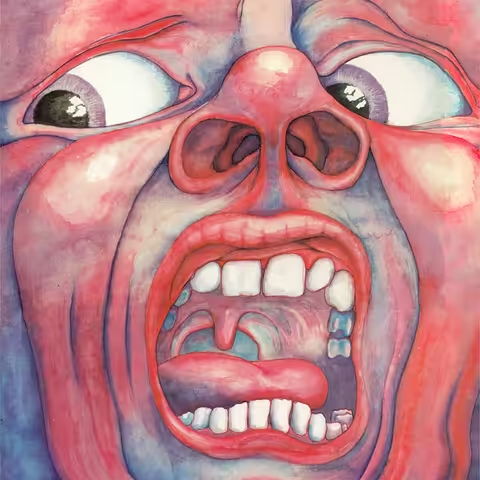
Its full title is In the Court of the Crimson King: An Observation by King Crimson, and it is five songs long. One of them was recorded in a single live take, one was improvised to fill a gap, and one started life as a Dylan-style tune before Ian McDonald rewrote the music. The sleeve, a screaming face painted by a computer programmer who never designed another, has no band name on it at all. This is how it came together.
Album Facts
| Field | Detail |
|---|---|
| Artist | King Crimson |
| Album | In the Court of the Crimson King (An Observation by King Crimson) |
| Release Date | 10 October 1969 |
| Label | Island (UK), Atlantic (US) |
| Producer(s) | King Crimson |
| Studio(s) | Wessex Sound Studios, London (abandoned sessions at Morgan Studios) |
| Genre / Subgenre | Progressive rock, art rock |
| Track Count | 5 |
| Total Runtime | 43:54 |
| Billboard 200 Peak | 28 (March 1970) |
| UK Albums Chart Peak | 5 |
| Other Notable Chart Peaks | Australia 7, Canada 27 |
| Certifications | Gold (US), Platinum (Canada), Gold (UK, 2004 edition) |
| Estimated Sales | Not found |
| Key Singles | The Court of the Crimson King (US No. 80) |
King Crimson's Story Up to This Point
Brothers Michael and Peter Giles had been working musicians in Dorset since their teens when they advertised for a "singing organist". Robert Fripp answered. He neither sang nor played organ, but Giles, Giles and Fripp signed to Deram anyway and made one album, The Cheerful Insanity of Giles, Giles and Fripp, in 1968. It sold poorly.
Trying to widen their sound, the trio recruited Ian McDonald on keyboards and woodwinds. McDonald brought his girlfriend, former Fairport Convention singer Judy Dyble, who did not last, and his writing partner Peter Sinfield, a lyricist whose own band McDonald had judged hopeless while admiring the words. Peter Giles left, and Fripp brought in his old friend Greg Lake, a guitarist and singer. The five-man King Crimson came together on 30 November 1968 and began rehearsing on 13 January 1969.
Sinfield named the band, taking it from a song he had already written, "in a moment of pressured panic". He also designed and ran the stage lights, which is why the sleeve credits him with "words and illumination". McDonald, inspired by the Moody Blues, talked the band into buying a Mellotron.
They rehearsed in the cellar of a café on Fulham Palace Road in west London, and word spread fast. Island's A&R man Muff Winwood was unmoved, telling manager David Enthoven they sounded "a bit like the Tremeloes", but almost nobody else was. The first gig came at the Speakeasy in London on 9 April 1969. In May they recorded a John Peel session, and Jimi Hendrix, catching them at the Revolution club, shook Fripp's hand and told anyone who would listen that Crimson were the best group in the world.
Pre-production and the Material
Even with the buzz, the band were short of songs. They had barely more than half an hour of original music, and they were adamant there would be no covers on the record. McDonald, who had learned horn arranging in the army, was the main composer. Sinfield later said that when he first met him, he thought he had "found Mozart".
Some of the material predated the band. "I Talk to the Wind" had been demoed by Giles, Giles and Fripp in 1968, with Dyble singing on one version, and it is the only song on the album carried over from that group. "Epitaph" began as a poem Sinfield wrote when he had his own band.
Decca's Hugh Mendl brought Moody Blues producer Tony Clarke down to the Fulham cellar with a view to signing Crimson to the Moodies' own Threshold label. Clarke had produced the Moodies' hit "Nights in White Satin".
Creating In the Court of the Crimson King
In June 1969 the band went into Morgan Studios in north-west London with Clarke. Something about the sound was not working, so the sessions moved to Wessex Sound Studios, housed in an old church with a bigger natural sound. Before the second attempt, Crimson played the gig Lake later called a turning point: support to the Rolling Stones in Hyde Park on 5 July, in front of a crowd estimated in the hundreds of thousands. Enthoven reckoned they got on the bill through "sheer brazenness".
"All of a sudden we play ...Schizoid Man at blinding speed and unbearable intensity. Suddenly everyone starts to take notice and stand up."
Greg Lake, Classic Rock
Back at Wessex from 7 July, the doubts returned, and this time they settled on the producer rather than the room. Clarke liked to build big backing tracks slowly, the way he had with the Moody Blues. Michael Giles felt Clarke was trying to tame the band.
"The general sense we had was that his main motivation was to make us another version of the Moody Blues, and we didn't want that."
Greg Lake, Classic Rock
On 16 July Crimson walked away from Clarke and the Threshold deal with him. To fund a self-produced record, Enthoven and co-manager John Gaydon struck a deal with the Thompson family, who owned Wessex, guaranteeing the £15,000 recording costs, and Enthoven remortgaged his house to do it. "It was either a test of commitment or bloody madness on my part!" he said.
The third attempt began on Monday 21 July 1969, the day men first walked on the Moon. Over the next fortnight the band spent three days laying down the backing for the title track, a day each on "I Talk to the Wind" and "Epitaph", a day on "Moonchild", and finally cut "21st Century Schizoid Man" in a single live take. They fitted the sessions between gigs, McDonald recalling two or three days on the road and then back to the studio. Sinfield remembered starting at lunchtime and stopping, exhausted, around nine or ten at night. "It's such a blur, because it was so fast," he said.
Robin Thompson engineered, assisted by Tony Page, and everything went onto a one-inch eight-track machine. In August the band mixed the eight tracks down to two to make room for extensive overdubs, in places going through five tape generations to build the dense, segued layers. Sinfield praised the studio's valve microphones and admitted there was a lot of editing "because it was a very fussy band".
McDonald spent hours overdubbing layers of Mellotron and woodwind and reed instruments, and he wanted the Mellotron to sound nothing like the Moodies' version.
"I didn't want to record the Mellotron in the same way that the Moodies had done. So the way we used it was more aggressive, more majestic."
Ian McDonald, Classic Rock Presents Prog, 2007
One trick was to blast the Mellotron through a double stack of Marshalls and put a microphone about 20 feet away. On "Epitaph" he recorded two separate Mellotron parts and kept shifting their volumes against each other in the mix to give the sustained chords a sense of motion. Sinfield said they recorded the Mellotron note by note, trying to make it sound more like real strings. The instrument went out of tune whenever the temperature changed.
The finishing touch was Fripp's solo on "Schizoid Man", a one-take overdub played with alternating down-up picking. All five members, Sinfield included, are credited with the production, and McDonald later said he "was basically at the forefront" of it. Sinfield went further, calling McDonald "the driving force".
Personnel and Credits
| Role | Player | Notes |
|---|---|---|
| Core band | ||
| Guitars | Robert Fripp | Electric; acoustic on Epitaph and the title track |
| Woodwinds, keyboards, vocals | Ian McDonald | Alto sax, flute, clarinet, bass clarinet, Mellotron, piano, harpsichord, vibraphone, reed organ |
| Bass, lead vocals | Greg Lake | Plays no bass on Moonchild |
| Drums, vocals | Michael Giles | Timpani on Epitaph |
| Words and illumination | Peter Sinfield | All lyrics; stage lighting |
| Production and engineering | ||
| Producers | King Crimson | All five members credited |
| Engineer | Robin Thompson | Wessex Sound Studios |
| Assistant engineer | Tony Page | |
| Artwork | ||
| Cover paintings | Barry Godber | Front and inner gatefold |
There are no guest players. The woodwinds, Mellotron and other keyboards are all McDonald's, which is why so much of the record's character rests on him. The one notable absence is Lake on "Moonchild": Sinfield said free improvisation "was never Greg's bag" and that Lake simply announced he was not playing on it.
The Songs
| # | Title | Writer(s) | Length | Single? | Notes |
|---|---|---|---|---|---|
| 1 | 21st Century Schizoid Man (including Mirrors) | Fripp, McDonald, Lake, Giles, Sinfield | 7:24 | B-side, 1976 | One live take; recorded last |
| 2 | I Talk to the Wind | McDonald, Sinfield | 6:05 | No | Carried over from Giles, Giles and Fripp |
| 3 | Epitaph (including March for No Reason and Tomorrow and Tomorrow) | Fripp, McDonald, Lake, Giles, Sinfield | 8:47 | A-side, 1976 | Basic track took about ten hours |
| 4 | Moonchild (including The Dream and The Illusion) | Fripp, McDonald, Lake, Giles, Sinfield | 12:13 | No | Improvised to fill the running time |
| 5 | The Court of the Crimson King (including The Return of the Fire Witch and The Dance of the Puppets) | McDonald, Sinfield | 9:25 | Yes, 1969 | First track recorded; vocals dropped in line by line |
21st Century Schizoid Man
The opener was the last thing they recorded, and McDonald liked to point out that it went down from beginning to end in one take with no edits, with some parts overdubbed later. His sax solo stops abruptly because the band needed that tape track to punch in one of Fripp's guitar parts. The wheezing noise at the very start is McDonald leaning his forearm on the studio's bellows-driven reed organ. Lake wrote the first six notes of the riff and McDonald added the last three, and McDonald cut his sax solo crouching down, believing it would add angst.
Sinfield wrote the words last, in a park by the cemetery on Fulham Palace Road, knowing the music was angry and aimed at the Vietnam War. Hence lines such as "Politicians' funeral pyre / Innocents raped with napalm fire". Fripp's solo was later ranked 82nd in Guitar World's 2008 list of the 100 greatest guitar solos.
"Except maybe with ...Schizoid Man. I remember listening back to that and thinking: 'What the hell is this?!'"
Ian McDonald, Classic Rock Presents Prog, 2007
I Talk to the Wind
The second track recorded. McDonald's demo was a little more up-tempo, with strummed guitar, and the arrangement changed once the band got into the studio. He played two flute solos for the ending and spliced them together, and was happy to admit you can hear the join. Sinfield said in a 1997 interview that it was still his favourite of all the lyrics he had written.
Epitaph
Sinfield's poem became a group composition, with Lake, by Sinfield's account, contributing one of its lines. The basic track took around ten hours, long enough that McDonald noted it in his diary. He thought it worth it, and in 2019 called "Epitaph" his favourite of the songs in terms of writing, structure and production.
Moonchild
"We'd run out of material," McDonald admitted. Needing another seven to nine minutes, he, Fripp and Giles went back into the studio after the vocal section, set the tape rolling and improvised for about ten minutes. As the writer Mike Barnes has pointed out, that leaves a quarter of the album's running time given over to free improvisation. Crimson did not play "Moonchild" live until 18 October 2017 in Austin, Texas, 48 years after it was recorded.
The Court of the Crimson King
The closing epic was the first track the band recorded. Sinfield called its starting point "a sort of Bob Dylan song, if you can imagine that". McDonald rewrote the music, and Sinfield admitted the vocals were recorded line by line and dropped in. After a pause near the seven-minute mark the track returns with "The Dance of the Puppets", and on streaming services a short hidden track runs from 9:41 to the ten-minute mark.
Album Artwork and Packaging
Barry Godber was a friend of Sinfield's and a regular in the Fulham rehearsal room. He had quit Chelsea School of Art and was working as a computer programmer. Sinfield asked him for a sleeve, telling him the one thing it had to do was stand out in record shops.
Godber listened to demo tapes and produced two paintings in watercolour, studying his own face in a shaving mirror. The front is an extreme close-up of a screaming face that fills the whole sleeve: mouth stretched open to show teeth, tongue and the uvula at the back of the throat, nostrils flared, eyes bulging and glancing sideways, all in washes of red, pink and violet-blue. In August he brought the finished painting to Wessex and laid it on the floor in front of the band.
"This fucking face screamed up from the floor, and what it said to us was 'schizoid man' - the very track we'd been working on."
Greg Lake, Classic Rock
The band duly nicknamed it "Schizoid Man". Fripp has said the face outside is the Schizoid Man and the one inside the gatefold is the Crimson King. Neither the band's name nor a label logo appears on the front, one of the first sleeves to do without either.
"Not having the name on the front cover meant that if you were fingering through the racks in the record shop and you came across it, you had to open it up to see who it was."
Peter Sinfield, Classic Rock
It was Godber's only album sleeve. He died of a heart attack in February 1970, aged 24. Fripp later took the original painting back from the offices of E.G., where it had been left exposed to bright light, and he still owns it.
Release and Reception
Island released the album on 10 October 1969, with Atlantic handling America. It entered the UK chart at number five on 1 November, its peak, and spent 18 weeks on the chart across that winter and spring. Sinfield remembered walking down Oxford Street and seeing a whole shop window full of copies. In the US it debuted on the Billboard 200 in December and climbed to number 28 in March 1970, charting for 25 weeks. It also reached number seven in Australia and was later certified gold in the US.
The British music press were largely won over. NME's Nick Logan found it "totally original and always captivating" and said King Crimson had it in them "to be huge", and Melody Maker said it "still packs tremendous impact". In Rolling Stone, John Morthland wrote that the band had "combined aspects of many musical forms to create a surreal work of force and originality". Pete Townshend called it "an uncanny masterpiece". Robert Christgau dissented, giving it a D+ in the Village Voice and allowing that "the plus is because Peter Townshend likes it" before concluding, "this is ersatz shit."
Singles and B-sides
| Single | Released | B-side | Chart |
|---|---|---|---|
| The Court of the Crimson King, Part 1 | October 1969 (UK), December 1969 (US) | The Court of the Crimson King, Part 2 | US Hot 100: 80 |
| Epitaph | February 1976 | 21st Century Schizoid Man |
The title track was split across both sides of a seven-inch, on Island in Britain and Atlantic in America. It spent three weeks on the Hot 100 in early 1970, peaking at 80, and remains the only King Crimson single to chart there. "Epitaph" followed as a single in 1976 to accompany the compilation A Young Person's Guide to King Crimson, with "Schizoid Man" on the flip. On its own, "21st Century Schizoid Man" reached number 89 in the UK in 1996.
Touring and Live
King Crimson played more than 70 gigs in 1969. After a run of British shows they went to America, opening at Goddard College in Plainfield, Vermont. On that tour Michael Giles and Ian McDonald, homesick and struggling with the pace, decided to leave. Fripp offered to quit instead, but McDonald said the band was more Fripp than them.
The original line-up's last show was at the Fillmore West in San Francisco on 14 December 1969. Recordings of the 1969 band surfaced in 1997 on the live album Epitaph, including a 14 December performance of "Schizoid Man" that Fripp sarcastically dedicates to vice president Spiro Agnew, "an American political personality whom we all know and love dearly", and a surviving fragment of black and white Hyde Park footage was included in the 2019 anniversary box.
Covers, Samples and Afterlife
- Kanye West sampled "21st Century Schizoid Man" on "Power", the 2010 lead single from My Beautiful Dark Twisted Fantasy.
- Ozzy Osbourne covered "Schizoid Man" on Under Cover in 2005, with Robert Randolph on the guitar solo.
- Opus III took "I Talk to the Wind" to number 52 in the UK in 1992.
- Emerson, Lake and Palmer folded an excerpt of "Epitaph" into live performances of "Tarkus".
- "Moonchild" plays while Christina Ricci tap-dances in a bowling alley in the 1998 film Buffalo '66.
The Kanye sample came with a legal tail. A 2010 deal let West keep the sample in return for a 5.33 per cent royalty on each copy of "Power" sold. In March 2022 Declan Colgan Music, which owns the song's mechanical rights, sued Universal Music Group in London's High Court, arguing that streams should earn the same rate. The case settled out of court in May 2024, just before trial. West was not a party to it.
Reissues, Remasters and Anniversaries
For more than 30 years the first-generation master tapes were missing, so 1980s and 1990s pressings were cut from copies several generations removed, with audible hiss. Mobile Fidelity issued a half-speed master cut by Stan Ricker in 1982, Fripp and Tony Arnold remastered the first CD in 1989, and a 24-bit 30th anniversary edition followed in 1999. In 2002 the original masters turned up in the Virgin archives, splicing tape still between the songs, and Simon Heyworth used them for the 2004 Original Master Edition.
| Edition | Year | What it added |
|---|---|---|
| 40th anniversary | 2009 | New stereo and 5.1 mixes by Steven Wilson with Fripp; six-disc box |
| 200g vinyl | 2010 | Original 1969 mix cut by John Dent at Loud Mastering |
| 50th anniversary | 2019 | New Wilson mixes, alternate album, first Blu-ray release |
The 50th anniversary set, released by Panegyric on 25 October 2019, is the one for archaeologists. Its alternate album includes a take of the title track from the abandoned Morgan sessions, and a "Schizoid Man" that marries the Morgan instrumental to Lake's Wessex vocal with new overdubs from Mel Collins and Jakko Jakszyk. There are also extracts from the "wind session" that produced the opening of "Schizoid Man", and new sleeve notes by Sid Smith.
The Legacy of In the Court of the Crimson King
The line-up that made it played its last show before 1969 was out. McDonald and Giles left, Lake sang on In the Wake of Poseidon before leaving to form Emerson, Lake and Palmer, and McDonald later co-founded Foreigner. Fripp carried on with new line-ups. Fripp himself later called the debut "New York's acid album of 1970".
Its reputation has only grown. Edward Macan, in his 1997 book Rocking the Classics, wrote that it "may be the most influential progressive rock album ever released". In 2015 Rolling Stone ranked it second among the greatest prog albums of all time, behind only The Dark Side of the Moon. It appears in 1001 Albums You Must Hear Before You Die and was voted 193rd in Colin Larkin's All Time Top 1000 Albums. McDonald, who died in New York in February 2022, said he had wanted everything on the record to bear repeated listening and stand the test of time. It has.
Things You Might Not Know
| Fact | Detail |
|---|---|
| Bowie was at the first gig | David Bowie and Yes guitarist Peter Banks were in the audience at King Crimson's debut at the Speakeasy on 9 April 1969. |
| The flaming eye | Barry Godber also designed the band's "King Crimson Is..." foil poster of April 1969, and its flaming eye went on Michael Giles's bass drum heads. |
| Composed on guitar | McDonald wrote "The Court of the Crimson King" and "I Talk to the Wind" on guitar, yet played no guitar anywhere on the album. |
| A label named after a song | Epitaph Records, the punk label, took its name from the album's third track. |
| Wrong running times | Original inner sleeves list timings adding up to 42:00, which are incorrect; the album actually runs 43:54. |
| A trimmed Moonchild | The 2009 remix cut around two minutes 50 seconds of the original improvisation, which was included separately as a bonus track. |
| Back in the charts | More than 50 years after release, the album reached number three on the UK Rock and Metal Albums Chart in 2022. |
Listen to Riffology
For more on the records that shaped rock, from prog's first shout to the albums it inspired, the Riffology podcast is available on all major podcast platforms.
Comments