In August 1987, in a tiny Belo Horizonte studio with carpeted walls and a single eight-track machine, four Brazilian teenagers turned in a 38-minute record that was so far ahead of what the local metal scene believed possible that the U.S. label that signed them did so without ever watching them play a note. Schizophrenia is Sepultura's second album, the debut of lead guitarist Andreas Kisser, the first record on which the band sound like a band rather than a death-metal pastiche, and the calling card that turned a Mineiro garage outfit into Roadrunner's first international thrash signing.

Released by Cogumelo Records on 30 October 1987 and licensed worldwide by Roadrunner the following year, Schizophrenia arrived without a single, without a video and without a tour bus. It would chart in Portugal on a 2022 reissue, get name-checked in every conversation about how thrash metal escaped its U.S. ZIP code, and, almost forty years later, be re-recorded note for note by Max and Igor Cavalera at the head of Cavalera Conspiracy. Of all the records in the band's first five-album run, this is the one that points most directly at what Sepultura would become.

Album facts

FieldDetail
ArtistSepultura
AlbumSchizophrenia
Release date30 October 1987
LabelCogumelo Records (Brazil), Roadrunner Records (international, from 1988)
ProducerSepultura with Tarso Senra
StudioJ. G. Estudio, Belo Horizonte, Brazil (August 1987). Troops of Doom (1990 bonus) re-recorded at Morrisound Recording, Tampa, Florida, 26 and 27 August 1990
EngineerTarso Senra; Gauguim on track 10
MixerTarso Senra; Scott Burns on track 10
Mastering (reissue)George Marino
Genre / subgenreThrash metal, death metal, with proto-groove and traditional heavy metal influences
Track count9 (original), 10 (1990 Roadrunner reissue adding re-recorded Troops of Doom), up to 13 on later expanded editions
Total runtime37:49 (original)
Cover artIbsen Otoni, inspired by Scorpions' Blackout and Anthrax's Spreading the Disease
Chart peakNo. 34, Portuguese Albums Chart (2022 reissue)
Notable later recognitionRe-recorded in full by Cavalera Conspiracy and released 21 June 2024; perfect score from Metal Injection
Key songsFrom the Past Comes the Storms, Inquisition Symphony, Escape to the Void, Troops of Doom

Cultural context

October 1987 belonged to U.S. and European metal. Anthrax had released Among the Living in March, Whitesnake's self-titled 1987 record was selling everything else into the ground, Def Leppard's Hysteria was on its way to twelve times platinum, and the underground was about to be cracked open by Metallica's ...And Justice for All the following summer. Thrash had moved from the Bay Area into Florida (Death's Scream Bloody Gore appeared in May 1987) and into Germany (Kreator's Terrible Certainty arrived that October).

Brazil was an unlikely place to add a new sentence to that conversation. The country had emerged from twenty-one years of military dictatorship in 1985, inflation was running at over 350 per cent that year, and the import duties on foreign records and instruments made buying a Marshall stack effectively impossible for a Brazilian teenager. The first wave of Brazilian metal, Stress in Belem, Vulcano in Sao Paulo, the Cogumelo-affiliated bands in Belo Horizonte, was building itself from cassette dubs, hand-painted band shirts and instruments smuggled across borders.

Belo Horizonte specifically had become the country's thrash and death-metal hub thanks to Cogumelo Records, the underground label and record shop run by Joao Carlos Saturnino dos Santos. The 1985 Cogumelo split single that paired Sepultura with Overdose (containing the Bestial Devastation EP) had introduced the Cavalera brothers to a national audience. By 1987 they were the most-bootlegged band in the Brazilian metal underground, and they were about to record the album that took them out of it.

The band up to this point

Max and Igor Cavalera formed Sepultura in Belo Horizonte in 1984, taking the name from the Portuguese word for "grave" that Max had encountered while translating Motorhead's "Dancing on Your Grave". The band's first stable lineup paired the brothers with bassist Paulo Jr. and lead guitarist Jairo Guedz (sometimes credited Jairo T.). They cut the Bestial Devastation EP in 1985 as their half of the Cogumelo split, and the full-length debut Morbid Visions in November 1986; both were sub-Venom, sub-Hellhammer exercises in primitive blackened death, marred by an engineer who turned the rhythm guitars almost inaudible in the final mix.

By early 1987 the band were unhappy with both the Morbid Visions sound and Jairo's musical direction, and a Belo Horizonte friend named Andreas Kisser, then nineteen and playing in local thrash band Pestilence (no relation to the Dutch group), auditioned. He came in as a musical reformer: a trained guitarist who could read music, who had absorbed Iron Maiden, Black Sabbath, Judas Priest, Mercyful Fate and the first three Metallica albums in equal measure, and who had a clear vocabulary of lead-guitar phrasing that Jairo had never aspired to. He was hired on the spot. Kisser later told the British metal historian Marc Shapiro:

"I brought in some new influences, traditional heavy metal and a more melodic style. It was an immediate meeting of minds. We understood where each other was coming from musically and we knew we could find a way to put all our influences together and make the music work."

Andreas Kisser, quoted in Guitar magazine's Speed Demons of Metal, 1993

Paulo Jr. was struggling with both his instrument and his confidence at this stage; the band privately agreed that Kisser would track the bass parts as well, but that Paulo would remain a credited member. The line-up that walked into J. G. Estudio was therefore, on tape if not in person, Max on rhythm guitar and vocals, Andreas on lead guitar and bass, and Igor on drums. They were sixteen, seventeen and nineteen years old.

"We were just kids in Belo Horizonte trying to make a record that sounded like the records we loved. Andreas came in and changed everything overnight. Suddenly we had a guitar player who could actually play and who wanted the band to be better than we were."

Max Cavalera, Phoenix New Times, May 1993

Pre-production and demos

Most of the album was written in three concentrated months between Kisser joining and the session booking. The writing happened in the basement of the Cavalera family home in Belo Horizonte and at Kisser's apartment. The songs that emerged were a deliberate move away from the slow-doom-with-blastbeats template of Morbid Visions toward what the band privately called "real thrash": faster, sharper-riffed, with proper twin-guitar arrangements and instrumental sections that owed as much to Iron Maiden's Adrian Smith and Dave Murray as to anyone in California or New York.

A surviving rough mix and demo of "The Past Reborns the Storms" (later "From the Past Comes the Storms"), "Septic Schizo" and "To the Wall" appears on later reissues, alongside the full studio takes. They establish that the songs arrived at J. G. Estudio largely complete, with arrangements as recorded; what changed in the studio was the production quality rather than the structure.

Lyrics for one track were outsourced. "To the Wall" was written by Vladimir Korg, a friend and contributor in the Belo Horizonte scene, making it one of the only songs in the entire Sepultura catalogue with an outside lyric credit. Every other lyric on the record is credited to Max Cavalera and Andreas Kisser jointly, signalling Kisser's elevation to full creative partner within months of joining.

Creating the album

Recording took place across August 1987 at J. G. Estudio in Belo Horizonte, a small commercial facility that until then had mostly handled jingles, regional pop and the occasional Cogumelo metal session. The studio's engineer-owner Tarso Senra served as producer, alongside the band themselves, and bore the unenviable task of capturing a teenage thrash trio (Paulo Jr. present but not tracking) using equipment that had never been asked to record this much volume.

The budget was tiny. Sepultura have spoken in multiple interviews of the album being recorded for less than the price of a second-hand car; published estimates place the figure under USD 7,000, paid for in large part by Cogumelo's Joao Carlos Saturnino dos Santos in exchange for a long-term Brazilian contract. Studio time was bought in days, not weeks. Andreas Kisser tracked his rhythm and lead guitar parts on a Charvel through a borrowed Marshall, then immediately picked up the bass and re-tracked every song. Igor's drum kit was a borrowed configuration assembled from whatever the studio had on hand.

The shift in sound is audible from the opening of the proper first song. Where Morbid Visions had been muddy and cymbal-heavy, Schizophrenia has actual guitar separation: you can hear the rhythm and the lead as distinct voices. Tarso Senra also pulled Igor's kick drum forward and accepted a brighter cymbal sound than was standard for the genre at the time. The vocals are still throat-shredding death-metal roars, but they are now sitting on top of a recognisable thrash band rather than wading through tape hiss.

Additional musicians widened the palette. Henrique Portugal, a Belo Horizonte session player, contributed synthesizer parts (most audibly on the introductions and on "Inquisition Symphony"). Violinist Paulo Gordo added a brief classical accent. Both credits were unusual for an underground Brazilian metal record in 1987 and signal that the band were already thinking about composition and dynamics in a way most of their genre peers were not.

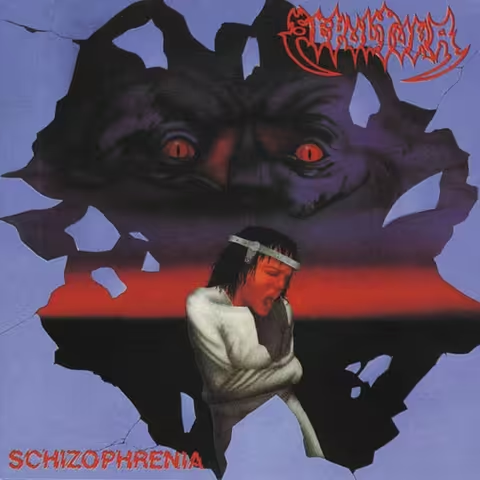
Sleeve art was commissioned from Belo Horizonte airbrush illustrator Ibsen Otoni, who openly cited the Scorpions' Blackout (1982) and Anthrax's Spreading the Disease (1985) as direct visual influences for his composition of a straitjacketed man bursting through a recently-shattered window beneath a red-eyed face formed from clouds in the crepuscular Brazilian sky.

Personnel and credits

RolePlayerNotes
Core band
Lead vocals, rhythm guitarMax Cavalera
Lead guitar, bass (uncredited)Andreas KisserFirst Sepultura album; tracked all bass parts
Bass (credited, did not perform)Paulo Jr.Credited member but did not play on the recording
Drums, percussionIgor CavaleraSeventeen at the time of recording
Guest and session musicians
SynthesizersHenrique PortugalBelo Horizonte session player; intros and Inquisition Symphony textures
ViolinsPaulo Gordo
Lyrics
Lyrics on most tracksMax Cavalera and Andreas Kisser
Lyrics on To the WallVladimir KorgFriend of the band; outside contributor
Production and engineering
ProducerSepultura with Tarso Senra
EngineerTarso SenraJ. G. Estudio
Engineer on Troops of Doom (1990)GauguimMorrisound Recording, Tampa
Mixer on Troops of Doom (1990)Scott BurnsMorrisound Recording
Mastering (reissue)George Marino
Artwork and packaging
Cover artistIbsen OtoniCited Scorpions Blackout and Anthrax Spreading the Disease as influences
PhotographyFabiana
Liner notes (reissue)Don Kaye
Reissue productionJeff Daniels

The songs

#TitleWriter(s)LengthSingle?Notes
1IntroSepultura0:31NoSynth and effects intro by Henrique Portugal
2From the Past Comes the StormsMusic: Sepultura; lyrics: Max Cavalera, Andreas Kisser4:55NoThe de facto opener; the moment the Kisser-era band announces itself
3To the WallMusic: Sepultura; lyrics: Vladimir Korg5:36NoOnly Sepultura track with outside lyrics
4Escape to the VoidMusic: Sepultura; lyrics: Max Cavalera, Andreas Kisser4:38NoLong-time live opener through 1988-1991
5Inquisition SymphonyMusic: Sepultura (instrumental)7:13NoSeven-minute instrumental, the album's structural centrepiece; Apocalyptica covered it on their 1998 album of the same name
6Screams Behind the ShadowsMusic: Sepultura; lyrics: Max Cavalera, Andreas Kisser4:48No
7Septic SchizoMusic: Sepultura; lyrics: Max Cavalera, Andreas Kisser4:31NoThe closest thing to the title track
8The AbyssMusic: Sepultura (instrumental)1:01NoShort instrumental interlude before the closer
9R.I.P. (Rest in Pain)Music: Sepultura; lyrics: Max Cavalera, Andreas Kisser4:36NoOriginal closing track
10Troops of Doom (re-recorded)Music and lyrics: Igor Cavalera, Jairo Guedz, Max Cavalera, Paulo Jr.3:17Yes (re-recording)Re-cut at Morrisound 26-27 August 1990 with Scott Burns; bonus on Roadrunner reissues. Originally on Bestial Devastation (1985)
11The Past Reborns the Storms (demo)Music: Sepultura5:08NoPre-J. G. Estudio demo version, on expanded reissues
12Septic Schizo (rough mix)Music: Sepultura4:34NoPre-mix from August 1987 sessions
13To the Wall (rough mix)Music: Sepultura5:31NoPre-mix from August 1987 sessions

From the Past Comes the Storms is the song most fans cite as the moment the Andreas Kisser era begins. The intro is built around a twin-guitar harmony figure that would have been unthinkable on Morbid Visions; the verses sit on a galloping mid-tempo riff that nods to Iron Maiden as openly as it nods to Slayer; the lead guitar break is melodic, articulated and quoted from a recognisable scale rather than a row of pinch harmonics. Within ninety seconds the listener is in a different band.

To the Wall is the album's lone "outside lyric". Vladimir Korg, a friend of the band in the Belo Horizonte scene, supplied the words; the song itself is among the longest on the record, with Kisser's lead playing audibly stretching out across the back half. It is also the song the band have most consistently revisited in interviews when asked about Schizophrenia, in part because the Korg credit is the only one of its kind they ever issued.

Escape to the Void became the band's live opener for the next three years, including the early Beneath the Remains and Arise tours. The song's locked-in mid-tempo gallop is the first time Igor Cavalera's drumming displays the Brazilian-rhythm undertow that would eventually flower on Chaos A.D. and Roots; you can hear, in retrospect, the entire arc of the band's identity in the way he syncopates the snare against the rhythm guitar.

Inquisition Symphony is the album's most-discussed track and the one with the longest cultural afterlife. A seven-minute instrumental built around a folk-inflected acoustic intro, a thrash midsection and a sweeping melodic outro, it became a cornerstone of the band's live set into the early 1990s, was covered by the Finnish cello quartet Apocalyptica as the title track of their 1998 second album, and has been performed live by Andreas Kisser in solo and acoustic contexts ever since. It is the strongest evidence on the record that the teenage Sepultura wanted to be a composing band, not merely a riffing one.

Septic Schizo is the closest the album gets to a title track, a snarling mid-tempo piece with the album's most direct nod to Slayer; Screams Behind the Shadows is the album's other extended workout; and R.I.P. (Rest in Pain) closes the original LP with the closest thing on the record to a traditional thrash closer.

The 1990 Roadrunner reissue added a re-recorded version of Troops of Doom, originally an EP-era song from 1985's Bestial Devastation. The new version was tracked at Morrisound in Tampa across two nights at the end of August 1990, engineered by Gauguim and mixed by Scott Burns at the height of his Florida death-metal era. It would become the closest thing the album ever had to a single and, alongside the Apocalyptica cover of Inquisition Symphony, the song from these sessions that has had the longest mainstream reach.

B-sides, outtakes and lost songs

Because Schizophrenia was not promoted with singles in any conventional sense, the "outtakes" pool is small but interesting:

  • The 1990 Morrisound re-recording of Troops of Doom, originally from Bestial Devastation (1985), added as bonus track 10 on the Roadrunner reissue.
  • A demo version of From the Past Comes the Storms (titled "The Past Reborns the Storms") that surfaced on the 1997 Cogumelo / Roadrunner 2-CD reissue.
  • Rough mixes of Septic Schizo and To the Wall from the August 1987 sessions, also on the 1997 expanded edition.
  • An untitled minute-long studio fragment that has appeared on Brazilian reissues but never on the international Roadrunner pressings.

Beyond the album-specific bonuses, the songs themselves resurfaced on the 1996 Roadrunner compilation The Roots of Sepultura, the 2002 box set retrospective and the 2024 Cavalera Conspiracy re-recording (see Reissues below).

Album artwork and packaging

Ibsen Otoni's cover is one of the most unusual Brazilian metal images of its decade. The composition shows a long-haired man in a straitjacket bursting through a recently-broken window, glass fragments still suspended midair; behind him is a red crepuscular Brazilian horizon, and above him the top half of a grey face with vertical-slit red eyes appears to be forming out of the clouds, watching. The band logo runs across the top in red-outlined block lettering; the album title is set in a wavy red font in the lower left that mimics a shaken or doubled image.

Otoni was open about his references. He cited the Scorpions' 1982 Blackout (a record whose Gottfried Helnwein cover is itself a portrait of a man in psychological torment) and Anthrax's 1985 Spreading the Disease as direct influences on the composition. Photography on the inner sleeve was credited simply to Fabiana, a one-name credit that became the source of low-grade collector mystery for years.

Release and reception

Cogumelo released Schizophrenia in Brazil on 30 October 1987, in a small initial pressing that sold through almost immediately on the back of word-of-mouth across the Sao Paulo, Rio and Belo Horizonte underground. The band's manager Monika Becker sent the tape to Roadrunner in the Netherlands as part of a wider international demo push. Roadrunner's response, as Suzan Colon documented for Miami New Times in 1991, was to sign the band internationally without ever having seen them perform; the label simply trusted the tape.

The Roadrunner international release followed in 1988. Contemporary U.S. press coverage was modest, in part because (as the Phoenix New Times's Robert Baird reported in 1993) Sepultura initially struggled to book gigs in the United States; club owners were nervous about the band's style and unwilling to take a risk on an unknown Brazilian act.

Retrospective evaluation has been kinder. AllMusic's Eduardo Rivadavia gave the album four stars out of five, writing that it was "the first Sepultura release to make serious waves with international critics and fans, while setting the stage for the group's imminent breakthrough release, Beneath the Remains". The cultural geographer Idelber Avelar, writing in the 2011 Duke University Press collection Metal Rules the Globe, identifies Schizophrenia as the moment Sepultura broke decisively from black-metal pastiche and began constructing a recognisably Brazilian thrash voice. Metal Injection's Jeff Podoshen returned to the album in his 2024 review of the Cavalera Conspiracy re-recording:

"Schizophrenia stands as a pivotal moment in the evolution and history of thrash. What Sepultura brought us were just some incredibly original rhythms and groove that made for a much more novel listening experience back in the day, setting them apart from their American and European counterparts, many of whom were just emphasizing speed and aggression over anything else at the time."

Jeff Podoshen, Metal Injection, June 2024

Chart performance was not part of the album's contemporary story; nothing on the original 1987 Cogumelo pressing reached any national chart. The album's only documented chart placing came thirty-five years later, when a 2022 Portuguese reissue reached No. 34 on the AFP Portuguese Albums Chart.

Singles and music videos

Sepultura did not promote Schizophrenia with conventional singles, radio edits or commercial music videos in 1987 or 1988; the album was sold on the strength of its songs and its sleeve, traded between underground fans on dubbed cassette long after Roadrunner's pressings were available. The only "single" associated with the project in any formal sense is the 1990 re-recorded Troops of Doom on the international reissue, which received Headbangers Ball play in Europe and entered some specialist metal-station rotations in North America without ever charting.

The most-watched piece of video associated with the album is the 1991 Finnish live performance of Troops of Doom captured by Suomen YLE, recorded during the Arise touring cycle. That clip has had a long YouTube afterlife and remains the canonical visual document of how these songs sounded live in their original-band incarnation.

Touring and live

There was no Schizophrenia world tour. Sepultura played a string of small Brazilian dates through late 1987 and into early 1988, then began the long, slow international touring effort that would not properly take off until after Beneath the Remains in 1989. The U.S. press of the early 1990s repeatedly notes that the band struggled to book shows during this period; the live momentum that defined their early-1990s career arrived after Schizophrenia, not because of it.

The album's songs nonetheless became live staples. Escape to the Void was the live opener for the entire 1988-1991 period. Inquisition Symphony became an extended showcase for Andreas Kisser. Troops of Doom (in its 1990 re-recorded form) was a constant of the Arise-era setlist and re-appeared on the Roots and Against tours. Andreas Kisser has continued to perform Inquisition Symphony in acoustic solo settings into the 2020s.

The most significant Schizophrenia live event in recent memory is the Cavalera Conspiracy 2024-2025 "Schizophrenia In Full" tour, on which Max and Igor (with Travis Stone on lead and Igor Amadeus Cavalera on bass) performed the album end to end across Europe, North America and South America to mark the 2024 re-recording.

In TV, film and media

  • Apocalyptica's "Inquisition Symphony" (1998), the title track of the Finnish cello quartet's second album, is by some distance the most widely-heard recording of a Schizophrenia song. It introduced the composition to a classical-crossover audience that had never knowingly encountered Sepultura.
  • Brazilian and European specialist metal radio kept the 1990 Troops of Doom in playlists through the early 1990s.
  • The 1991 Finnish television broadcast of Troops of Doom (the live clip embedded above) is the canonical archival document of the song.
  • The Cavalera Conspiracy 2024 re-recording received extensive press coverage in metal publications worldwide and a perfect score from Metal Injection.

Controversy, censorship and lawsuits

Schizophrenia drew no formal censorship in any market and prompted no lawsuits. The closest the album has come to controversy is internal: the long-running question of whether bassist Paulo Jr. ever physically played on the recording. The Wikipedia personnel block, drawing on more than one source, states explicitly that Andreas Kisser tracked all the bass parts uncredited while Paulo Jr. was credited but did not perform. Both Cavalera brothers have implied as much in passing interviews over the years without ever issuing a formal statement on the record. Paulo Jr. himself has not publicly contradicted the account, but the band have always credited him as a full member of the recording lineup.

The 2024 Cavalera Conspiracy re-recording also reopened a more diplomatic dispute. The current Sepultura lineup (Andreas Kisser, Paulo Jr., Derrick Green, Greyson Nekrutman) does not own the rights to perform the early albums under the Sepultura name with the original arrangements, and the Cavalera brothers' Cavalera Conspiracy re-recordings of Morbid Visions (2023) and Schizophrenia (2024) have been received by some fans as a parallel canonisation; Kisser has remained publicly cordial about the project but has pointedly continued to schedule his own Sepultura performances of these songs on the Celebrating Life Through Death farewell tour.

Covers, samples and tributes

  • Apocalyptica, Inquisition Symphony (1998), the four-cello arrangement that introduced the album to a vastly wider audience and reached classical-crossover charts across Europe.
  • Cavalera Conspiracy, Schizophrenia (re-recorded) (2024), a full album-for-album re-recording released on Nuclear Blast on 21 June 2024 to mark the original's near-40th anniversary.
  • The 2018 Roadrunner Records compilation "Roadrunner: The First 35 Years" included From the Past Comes the Storms as the Schizophrenia-era representative; the song has appeared on subsequent label retrospectives as the canonical track from this period.
  • Sub-genre lineage: Inquisition Symphony is cited by numerous third-wave death and thrash bands (Krisiun, Nervosa, Holocausto, Sarcofago contemporaries) as a model for instrumental composition on metal records.
  • The album itself does not sample any other works.

Reissues, remasters and anniversaries

  • 1990 Roadrunner international reissue: added the re-recorded Troops of Doom (Morrisound, 26-27 August 1990, engineered by Gauguim, mixed by Scott Burns).
  • 1997 Cogumelo / Roadrunner 2-CD expanded edition: bundled Bestial Devastation and Schizophrenia in a single package, with the album-specific demos (From the Past Comes the Storms, Septic Schizo, To the Wall rough mixes) appended.
  • 2004 and 2017 vinyl reissues: standard 180-gram pressings via Cogumelo and Roadrunner.
  • 2022 Portuguese vinyl reissue: the one that gave the album its first-ever national chart entry (No. 34, AFP Portuguese Albums Chart).
  • 2024 Cavalera Conspiracy re-recording: Max and Igor Cavalera re-cut the album in full, released as Schizophrenia on Nuclear Blast on 21 June 2024. Metal Injection gave it a perfect score.
  • 2024-2025 "Schizophrenia In Full" Cavalera Conspiracy tour: end-to-end live performances of the album across Europe, North America, South America and Australia.

Legacy and influence

The most direct measure of Schizophrenia's legacy is what it unlocked. Without it, there is no Roadrunner international deal, no Beneath the Remains, no Scott Burns trip to Tampa, no Arise, no Chaos A.D., no Roots, no Xavante trip. It is the record on which Sepultura stop sounding like a Brazilian band trying to imitate the international metal underground and start sounding like a band the international metal underground would soon imitate.

"Schizophrenia is the first Sepultura release to make serious waves with international critics and fans, while setting the stage for the group's imminent breakthrough release, Beneath the Remains."

Eduardo Rivadavia, AllMusic, 2005

It also re-set the band's working relationships in ways that mattered for the next decade. The Cavalera-Kisser songwriting partnership begins here, and it would write every Sepultura album through Roots. Igor's evolution from a metal drummer into a player with a recognisable Brazilian rhythmic vocabulary starts on this record, particularly on Escape to the Void. And the Tarso Senra production approach (separated guitars, present cymbals, room in the mix for ideas) directly influenced how Scott Burns would later record the band in Tampa.

For Brazilian metal as a whole, Schizophrenia is the record that demonstrated proof of concept. After it, every Cogumelo signing and every Sao Paulo and Rio band had documentary evidence that a metal record made entirely in Brazil with Brazilian engineers, on a tiny budget, could be picked up by a major European label and sold globally. Sarcofago, Sepultura's Belo Horizonte peers, would follow on Cogumelo; Krisiun in Rio Grande do Sul would emerge in the 1990s; Angra would assemble around Andre Matos in Sao Paulo. The map of Brazilian metal as a scene with international export potential begins to be drawn the moment Roadrunner's reply letter arrives in Belo Horizonte.

The album's standing in retrospective lists is solid, if not always front-page. Decibel, Metal Hammer, Loudwire and the Brazilian edition of Rolling Stone have all placed it in essential-listening selections for thrash and Brazilian metal; the 2024 Cavalera re-recording prompted a fresh wave of think-pieces (Metal Injection, Blabbermouth, Brazilian outlets such as Whiplash and Roadie Crew) that re-evaluated the original's importance.

Things you might not know

FactDetail
Andreas played the bassBassist Paulo Jr. was credited as a full member of the recording line-up but did not actually play on the album. Andreas Kisser tracked every bass part himself, uncredited.
The budget was tinyThe album was made for less than the cost of a second-hand car, with published estimates placing the studio bill under USD 7,000.
Recorded in a single monthAll nine original tracks were tracked across a few sessions in August 1987 at J. G. Estudio in Belo Horizonte, a studio better known for jingles and regional pop than thrash metal.
The outside lyric creditTo the Wall is the only Sepultura song with lyrics by an outside contributor, the Belo Horizonte friend Vladimir Korg.
Roadrunner signed them without seeing themRoadrunner Records bought the international rights to Schizophrenia on the strength of the tape alone, having never seen the band play live in person.
The cover sourcesIllustrator Ibsen Otoni cited Scorpions' Blackout (1982) and Anthrax's Spreading the Disease (1985) as direct visual influences on the straitjacket-and-window cover.
The Troops of Doom rewindThe bonus track Troops of Doom on the 1990 Roadrunner reissue is a re-recording of a song from Sepultura's 1985 EP Bestial Devastation. It was tracked at Morrisound in Tampa on 26 and 27 August 1990 by Scott Burns.
Apocalyptica title trackThe Finnish cello quartet Apocalyptica made Inquisition Symphony the title track of their 1998 second album, which sold over a million copies worldwide and introduced the composition to a classical-crossover audience.
The album took thirty-five years to chartSchizophrenia first appeared on any national chart in 2022, when a Portuguese reissue reached No. 34 on the AFP Portuguese Albums Chart, almost thirty-five years after the original Cogumelo pressing.
The 2024 re-recordingMax and Igor Cavalera re-recorded the entire album as Cavalera Conspiracy, released on Nuclear Blast on 21 June 2024. Metal Injection gave it a perfect score and a corresponding live "Schizophrenia In Full" tour followed in 2024 and 2025.
The teenage lineupAt the time of recording, Max Cavalera was eighteen, Andreas Kisser nineteen and Igor Cavalera seventeen. Paulo Jr. was nineteen.
Andreas came from the local sceneKisser joined Sepultura from a Belo Horizonte thrash band also called Pestilence (no relation to the Dutch death-metal group of the same name).
The synth creditSynthesizer parts on the intros and Inquisition Symphony textures were played by Henrique Portugal, a Belo Horizonte session musician later associated with the popular Brazilian rock band Skank.
The album that booked them their first U.S. tourAlthough Schizophrenia struggled to land Sepultura U.S. club dates in 1988 and 1989 (per the Phoenix New Times in 1993), it was the record that put their tape on Scott Burns's desk and led directly to the Morrisound sessions for Beneath the Remains.

The podcast

If this story scratched the itch, the Riffology podcast goes deeper into the records, the rows and the riff-by-riff anatomy of metal's pivot decades. Subscribe wherever you get your podcasts; Schizophrenia sits exactly where we live, on the line between a regional underground and a global genre, and there is plenty more in the back catalogue worth arguing about.