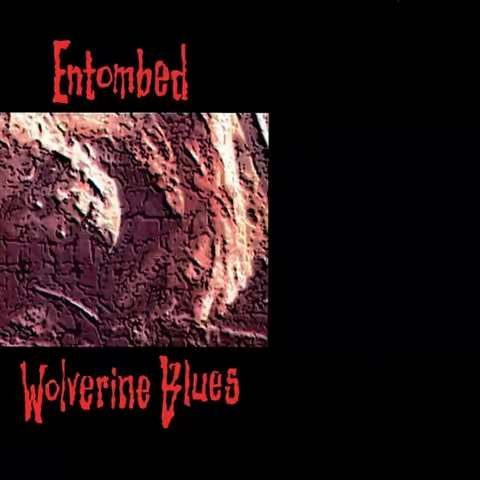
By the summer of 1993 the Swedish death metal sound that Entombed had effectively trademarked, a churning Boss HM-2 buzzsaw tracked at Tomas Skogsberg's Sunlight Studio in Stockholm, was being copied by every band with a guitar and a five-pound distortion pedal. Entombed responded by walking away from it. Wolverine Blues, their third album, came out on 31 August 1993 on Earache Records and sounded almost nothing like the two records that had made them famous. It was mid-paced, hook-driven and bluesy in the way Motorhead is bluesy, full of swung beats where the old albums had double-kick blast, and topped with the recognisable rasp of L-G Petrov, returning to the microphone after sitting out 1991's [Clandestine](/posts/the-making-of-clandestine-by-entombed/).

Fans were furious, then they were converted, and then a subgenre was named after the record. Wolverine Blues is the album that put the phrase death n roll into the rock dictionary, and it is also the album whose American sleeve carried the Marvel Comics character Wolverine on the front without the band having agreed to it. This is the story of how a four-piece Stockholm death metal band recorded a rock and roll album, made enemies of their own audience for a year, accidentally invented a subgenre, ended up in a Marvel mini-comic, and watched Sony quietly strip the film samples from their record before anyone in America heard it.

Album Facts

FieldDetail
ArtistEntombed
AlbumWolverine Blues
Release date31 August 1993 (UK), early 1994 (US Columbia/Earache edition)
LabelEarache Records, with North American distribution through Columbia/Sony
ProducerTomas Skogsberg
EngineerTomas Skogsberg
StudioSunlight Studio, Stockholm, Sweden
GenreDeath n roll, death metal, groove metal
Track count10 (standard edition); 11 with later bonus Stiff Little Fingers cover
Total runtime35:10
Billboard 200 peakDid not chart
UK Albums Chart peakDid not chart on the main Top 100; charted on UK independent/specialist listings
Other notable chart peaksNone confirmed on major mainstream charts
CertificationsNone
Estimated salesNot publicly disclosed; widely cited as Entombed's commercial peak
Key singles"Hollowman" EP (1993, lead promo), "Wolverine Blues" (1994), "Out of Hand" (1994), "Full of Hell" (1994)

Cultural Context: Late Summer 1993

August 1993 was a strange month to release a death metal album that was not really a death metal album. The genre was at its commercial high water mark. Death's Individual Thought Patterns had landed in June. Carcass were finishing Heartwork. Cannibal Corpse, Suffocation, Deicide and Morbid Angel were all touring relentlessly. In Norway, the second wave of black metal was about to become a news story for reasons that had nothing to do with music. Pantera's [Vulgar Display of Power](/posts/pantera-vulgar-display-of-power/) was a year old and still selling, and the word "groove" was being said politely in metal magazines for the first time since the 1970s.

The Swedish scene that Entombed had effectively founded with their 1990 debut [Left Hand Path](/posts/the-making-of-left-hand-path-by-entombed/) was now its own ecosystem. Dismember's Indecent and Obscene had come out in June 1993. Grave, Unleashed, Therion, Edge of Sanity and a dozen others were all queueing up at Sunlight Studio for the same guitar tone. Entombed could have given Earache a fourth Swedish-death-metal-by-numbers record and sold it twice over. Instead, they handed the label a thirty-five-minute album of mid-tempo rock songs played through a death metal rig, and Earache had no idea how to market it. That tension, between what the audience wanted and what the band had decided to do, is the story of Wolverine Blues.

The Band's Story Up to This Point

Entombed were formed in Stockholm in 1989 out of the wreckage of Nihilist, a teenage death metal band started in 1987 by drummer Nicke Andersson, guitarist Alex Hellid and bassist Leif Cuzner. After internal tensions and a clean-out of the rhythm section, the core line-up rebranded as Entombed, kept guitarist Uffe Cederlund and pulled in vocalist Lars-Goran "L-G" Petrov, who had been drumming in Morbid alongside the future Mayhem vocalist Dead.

That line-up made Left Hand Path in 1990, a record whose buzzsaw guitar tone is so distinctive that it is still referred to in shorthand as "the Sunlight sound". The follow-up, Clandestine, arrived in 1991 and matched its predecessor for ferocity, but it was made without Petrov. He had been fired in a personal dispute, and Andersson sang the album from behind the drum kit, with the tour vocals handled by ex-Carnage frontman Johnny Dordevic. Bassist Lars Rosenberg had taken over from David Blomqvist in 1990 and locked in with Andersson as a notably tight rhythm pairing.

By 1992 the band were a mess. Petrov, having released an album with Comecon, reconciled with his old friends and was reinstated. Andersson, whose ear for melody and rock music had always been broader than the death metal scene admitted, was already drifting toward the side project that would eventually become The Hellacopters. Earache's founder Digby Pearson was pushing for an American major-label deal. The four members of Entombed sat down to write their third album knowing two things: the easy money was in repeating Left Hand Path, and they did not want to do it.

Pre-production and Demos

The writing sessions for Wolverine Blues happened in late 1992 and early 1993, in rehearsal rooms in Stockholm. Andersson, the band's musical centre of gravity, had been listening to [Black Sabbath](/posts/black-sabbath-a-complete-history/), Motorhead, Discharge and a lot of late-1970s hard rock. Cederlund and Hellid had been digging into garage rock and proto-punk. The riffs that came out of those rooms were shorter, simpler and groovier than anything on Clandestine. Where the older albums had relied on chromatic tremolo runs at high speed, the new songs sat on two- and three-chord riffs that swung.

The clearest signpost was "Hollowman", recorded ahead of the album and released as a standalone EP on Earache in 1993. The EP version is, in effect, the public preview of Wolverine Blues: same line-up, same studio, same producer, same death-meets-rock approach. It was the band's way of testing whether their audience would follow them sideways. The early reaction was mixed enough to worry the label, but Entombed pushed on regardless.

Working titles for individual songs are poorly documented. What is clear from credits and later interviews is that the songwriting was unusually collaborative for an Entombed record: Andersson, Hellid and Cederlund each carried multiple writing credits, and Rosenberg contributed to "Blood Song" and "Out of Hand". The band has never publicly named a song that was written for the album but cut, although the Stiff Little Fingers cover "State of Emergency" was tracked in the same period and ended up first as a single B-side, then as a bonus on later pressings.

Creating the Album at Sunlight Studio

The sessions took place at Sunlight Studio in Stockholm with Tomas Skogsberg producing and engineering, exactly as he had on Left Hand Path and Clandestine. By 1993, Skogsberg's room and his signal chain had become so synonymous with Swedish death metal that the phrase "the Sunlight sound" appeared in album reviews as if it were a brand name. Wolverine Blues is the record on which Skogsberg, partly at the band's insistence, started bending that sound somewhere else.

The guitar rig had not fundamentally changed. Cederlund and Hellid were still running into Peavey amplifiers with Boss HM-2 distortion pedals stacked in front, the four controls of the HM-2 famously cranked to maximum, producing the chainsaw tone that defines every Sunlight record of the era. What changed on Wolverine Blues was the playing and the tracking philosophy. The riffs were tracked cleaner, with more space between the chugs, so the listener could hear the swing. Andersson's drums were brought further forward in the mix, snare and kick more punchy than the swirling wash of Clandestine, encouraging the listener to nod a head rather than bang it.

The album was recorded quickly by any standard, on a small Earache budget appropriate to a death metal band's third record. There were no orchestras, no string sessions, no guest vocalists. The arrangement details, such as the tambourine Cederlund plays on a couple of tracks, were largely added on the day. Skogsberg's working method had always favoured speed and gut instinct over polish, and Wolverine Blues bears that out. It has the feel of a record made in a fortnight by a band who knew each other's playing well enough not to argue.

The mix was Skogsberg's. Vinyl mastering was credited on the original Earache LP pressing; the CD has the more compressed, hotter top end typical of 1993 metal CD masters. Both formats preserve the unusual dynamic range for an Entombed record. Petrov's voice sits on top of the mix, dryer and more present than on Left Hand Path, where it had been buried inside the guitar wash. That single decision is part of why Wolverine Blues sounds like a rock record.

The Sunlight Sound and the HM-2 Rig

Anyone trying to recreate the Wolverine Blues guitar tone in their bedroom needs to know one piece of folklore and one piece of equipment. The folklore: Skogsberg's room had been a porn studio before he took it over, with a low ceiling and an awkward floor plan that, by accident more than design, flattered down-tuned guitars miked at close range. The equipment: a Boss HM-2 Heavy Metal pedal, manufactured between 1983 and 1991, fed into a Peavey solid-state amp.

  • Boss HM-2 pedal, all four knobs (level, distortion, low, high) at maximum, the so-called "HM-2 chainsaw" setting.
  • Peavey solid-state heads and 4x12 cabs for the rhythm guitar tracks.
  • Down-tuned guitars (Entombed largely played in standard tuning a step down, varying by song).
  • Close-miked cabinets with little to no ambient room mic, contributing to the dry, in-your-face midrange.
  • Skogsberg's habit of double-tracking rhythm guitars hard left and hard right, with no centre rhythm, giving the guitars their wide, enveloping wall.

What Wolverine Blues did differently was use that rig in service of slower, simpler riffs. The HM-2 chainsaw still bites on tracks like "Eyemaster" and "Demon", but it is sitting on top of mid-tempo grooves rather than blast beats. The result is the buzzsaw tone you recognise, applied to riffs that swing. A generation of HM-2 revivalists, from Nails to Black Breath to Trap Them, owes as much to Wolverine Blues as to Left Hand Path.

Personnel and Credits

RolePlayerNotes
Core band
Lead vocalsLars-Goran "L-G" PetrovReturned to the band after sitting out Clandestine; would front Entombed until 2014, then Entombed A.D. until his death in 2021.
Guitar, tambourineUffe CederlundFounding-era member; also played bass on some pre-Entombed Nihilist demos.
GuitarAlex HellidFounding member; later legal owner of the Entombed name.
BassLars RosenbergJoined in 1990; left after 1995 to join Therion.
Drums, design, artworkNicke AnderssonFounding member and chief songwriter; also credited with the album's design and sleeve artwork.
Production and engineering
Producer, engineerTomas SkogsbergRecorded the entire album at his Sunlight Studio in Stockholm.
Artwork and photography
Sleeve design and artworkNicke AnderssonThe standard Wolverine Blues sleeve (the stylised wolverine animal) is Andersson's work.
PhotographyZ. Benny RehnCredited for band and sleeve photography on the original Earache pressing.
Alternative US edition
Cover character licenceMarvel ComicsThe US Columbia/Earache edition used the Marvel character Wolverine on the cover and included a Marvel mini-comic in the CD booklet, via a promotional tie-in arranged by Earache.

The Songs

#TitleWriter(s)LengthSingle?Notes
1EyemasterAndersson, Hellid3:21The opener; the only 1993 Entombed song that still sounds plausibly like Clandestine, with a faster riff that gradually drops into groove.
2Rotten SoilAndersson, Cederlund3:27Carried a Flatliners dialogue sample on the early UK pressing, removed on later editions.
3Wolverine BluesAndersson, Cederlund, Hellid2:161994Title track, the album's shortest song, written about a real wolverine and given a video featuring the Marvel character.
4DemonCederlund, Hellid3:22The album's heaviest pure-groove track and a long-running fan favourite live.
5ContemptHellid4:34Hellid solo writing credit; the longest song on side one and the closest to a traditional Sunlight slow-burner.
6Full of HellHellid3:241994Released as a single in 1994; later lent its name to the American hardcore band Full of Hell.
7Blood SongCederlund, Rosenberg, Andersson, Hellid3:25The only song with a full four-way band writing credit, evidence of the unusually collaborative writing process.
8HollowmanAndersson4:291993 (EP)Pre-released as the lead EP single in 1993; on the Marvel edition the line "Jesus, Satan, Hitler bought my soul" is silently edited out.
9Heavens DieAndersson, Hakansson4:17The slowest, most overtly bluesy track; written with outside collaborator Hakansson.
10Out of HandRosenberg, Hellid, Cederlund, Andersson3:071994Removed entirely from the Marvel-cover US edition; restored on the later Columbia US pressing.
11State of EmergencyStiff Little Fingers cover2:35Bonus track on the 1996 US pressing and various reissues; first appeared as a B-side.

"Eyemaster" is the bait. It opens with a riff that any Left Hand Path fan would recognise, double-tracked HM-2 wall, Petrov spitting venom, before settling into a mid-tempo stomp that signals the rest of the album. The song is sequenced first because it is the most reassuring; everything that follows is more openly a rock record.

"Wolverine Blues" itself is built on one of the simplest riffs Entombed ever recorded, two and a quarter minutes of head-down chug topped with Petrov yelling about the actual North American carnivore. The lyric reads as a portrait of the animal as a Stockholm street fighter. The song's brevity is unusual for the band, and is part of why the title track has remained a live staple ever since.

Entombed, "Wolverine Blues" (Official Video), Earache Records, 1994. The video that introduced the Marvel character to the song.

"Hollowman", which had already been the lead 1993 EP, is the album's most clearly transitional song. Solo Andersson writing credit, four and a half minutes long, structured like a doom riff that occasionally remembers it was supposed to be death metal. The Marvel edition silently edits the "Jesus, Satan, Hitler bought my soul" line because Sony's lawyers wanted nothing in the kids-friendly Wolverine tie-in that could cause an aisle ban.

Entombed, "Hollowman" (Official Video), Earache Records, 1993. The standalone EP single that previewed the death n roll sound a few months ahead of the album.

"Demon" is the album's pure-groove peak and a song that has stayed in Entombed's live set in every line-up since. "Heavens Die", written with the outside collaborator Hakansson, is the slowest and most openly blues-derived song on the record, the moment when the album's title stops being a joke. "Out of Hand", a four-way Rosenberg/Hellid/Cederlund/Andersson collaboration, is the closing groove on the original Earache running order and the song Marvel's lawyers removed entirely from the US Wolverine-cover edition, so that an entire generation of American teenagers heard the album end on "Heavens Die" instead.

B-sides, Outtakes and the Hollowman EP

The Wolverine Blues recording cycle has fewer offcuts than most major albums, partly because the band tracked quickly. The two artefacts that fans hunt for are the Hollowman EP and the Stiff Little Fingers cover "State of Emergency".

The Hollowman EP, released on Earache in 1993, predates the album proper and uses an alternate version of the title song. It is, in commercial terms, the lead single off Wolverine Blues, but it is also a standalone document of where the band's head was at six months before the album dropped. The EP version of "Hollowman" was widely played on metal radio in the second half of 1993 and is the song through which most fans first heard the death n roll shift.

"State of Emergency", a cover of the Stiff Little Fingers song, was tracked at Sunlight in the same window. It first appeared as a B-side and was later added as a bonus track to the 1996 US reissue and various subsequent pressings, becoming the album's official track eleven on most modern editions. The choice of song matters: Stiff Little Fingers were a late-1970s Belfast punk band, and that lineage, via Discharge and the British anarcho-punk scene, is one of the unspoken parents of death n roll.

Album Artwork and Packaging

There are, in effect, two Wolverine Blues sleeves and they tell different stories. The first, designed by Nicke Andersson, shows a stylised wolverine animal, jaws bared, in a high-contrast illustration that nods at the cover art of late-1970s hard rock records far more than it does at death metal sleeve conventions of the time. This is the cover Earache used in Europe and the cover the band considers the real one.

The second is the version Earache cut a deal for in North America. With Sony's distribution arm picking the album up via Columbia, Earache's Digby Pearson negotiated a promotional tie-in with Marvel Comics, and the US edition arrived with the X-Men's Wolverine character on the cover, a Marvel mini-comic stitched into the CD booklet, and the music video for the title track padded out with Wolverine illustrations. Crucially, the band's permission was not sought before the deal was done.

The sleeve photography on both editions was by Z. Benny Rehn. The Marvel mini-comic, included only in the alternate US edition, is now one of the more sought-after pieces of 1990s metal merchandise on the second-hand market, partly because of its scarcity and partly because Marvel-licensed metal product is genuinely rare.

Release and Reception

Wolverine Blues was released by Earache in the UK and Europe on 31 August 1993, with Music Week listing it in the new releases dated 28 August. The Columbia/Earache US edition followed in early 1994. Initial reviews ranged from puzzled to converted, but the verdict from the dedicated metal press hardened over the following twelve months into something close to a classic-status consensus.

AllMusic's Jason Birchmeier later awarded it four and a half stars and treated it as the founding text of death n roll. Rolling Stone's Daina Darzin gave it a three-star write-up in the "Metal Thunder" round-up of 5 May 1994. Entertainment Weekly's Tom Sinclair filed a B grade in February 1994. Germany's Rock Hard scored it 8.5 out of 10 and would later include it in the magazine's 2005 book ranking it number 494 in The 500 Greatest Rock and Metal Albums of All Time. Martin Popoff's Collector's Guide to Heavy Metal volume three rated it a perfect ten out of ten.

"1994's best death metal effort and quite possibly the finest death metal album of this decade."

Al DiPerna, Guitar World, "Top 15 Most Essential Death Metal Records", December 2009

The retrospective rewards have continued to outpace the contemporary ones. Wolverine Blues is now treated as one of the indisputable Swedish death metal classics, regardless of how arguably death metal it actually is, and it sits in most credible Top 20 lists of the genre's defining albums.

Singles and Music Videos

SingleReleasedFormatNotes
Hollowman EP1993CD EP, 12-inchLead promotional release; includes the album version plus an alternate take and the SLF cover "State of Emergency" as B-side.
Wolverine Blues1994CD single, with music videoThe Marvel-illustrated official video for the title track is the song's main visual identity.
Out of Hand1994CD singleReleased ironically, given the song was deleted from the Marvel-cover US edition.
Full of Hell1994CD singleLent its title to the later American hardcore band Full of Hell.

The "Wolverine Blues" music video is the album's defining visual artefact, a low-budget Earache clip cross-cut with Marvel-supplied illustrations of the Wolverine character. The video itself put the song into rotation on MTV's Headbangers Ball during the show's last gasp, and the Hollowman EP got airplay across European metal radio through the autumn of 1993. Beyond that, there is little surviving promotional footage from the era; Entombed were not a band who appeared on Top of the Pops or Saturday Night Live.

Touring and Live

Entombed toured Wolverine Blues across Europe through late 1993 and 1994, with a North American leg riding the Columbia deal. The set-list mix of old Sunlight death metal and new death n roll was the live test of whether the album would work, and it gradually did. By 1995 the new songs were the ones that opened circle pits.

The era was also when Entombed became a credible festival band. The album's accessibility, ironically, was what got them on bigger European bills that pure-death-metal Entombed would never have played. Lars Rosenberg left the band in 1995 to join Therion. The Wolverine Blues line-up therefore had a hard expiry date, and most of the album's classic-line-up performances are concentrated in the 1993 to 1995 window.

In TV, Film and Media

The longest-running joke about Wolverine Blues is that the band put film samples into the songs, and Sony pulled them out before most listeners ever heard them. The early UK pressings contain dialogue from Flatliners and Hellraiser III. Later editions are clean. The "Wolverine Blues" video remains the album's most-watched piece of media on the Earache YouTube channel today.

Beyond that, the album has not had a major sync placement, but it has been name-checked across film and television metal contexts as shorthand for early-1990s Stockholm. The Wolverine Marvel tie-in is occasionally cited as one of the strangest cross-media deals of the entire grunge era.

Controversy: Marvel, the Missing Samples and a Wild Animal

Wolverine Blues has two famous controversies and they overlap. The first is the Marvel sleeve, agreed by Earache without the band's consent and used on the US edition. The second is the deletion of film samples, demanded by Sony as a condition of the major-label distribution deal.

Earache's Digby Pearson addressed both points head-on in an October 2009 post on the label's old "Ask Earache" blog. On the samples:

"To answer your question, I think about 3,000 CDs from memory came out like that, in the UK edition, and none came out in the USA Columbia/Earache edition. It was because the album was due for a major-label release that all samples had to be removed. Sony insisted on it, and myself and the band learned a valuable lesson in the copyrights of movie dialogue."

Digby Pearson, Earache Records, Ask Earache blog, October 2009

And, in the same post, on the Marvel deal and the title track's actual subject:

"In the USA the album had a limited edition Wolverine comic cover which was an official tie-in with Marvel Comics, for extra promotion. That's why the comic character appears in the video clip, even though the song is about an actual wild animal not the comic character."

Digby Pearson, Earache Records, Ask Earache blog, October 2009

The Marvel edition is the more visible scandal in metal history, but it is the sample issue that genuinely upset the band. The Hellraiser III sample at the start of "Eyemaster" and the Flatliners line on "Rotten Soil" are still talked about by collectors who own the with-samples original UK pressing. The Marvel sleeve, by contrast, has aged into a piece of collectible kitsch. Marvel did not sue Entombed; the controversy was an internal one between the band, the label, and the major-label partner that wanted the album marketable to American teenagers who already knew who Wolverine was.

Covers, Samples and Tributes

Wolverine Blues has been covered piecemeal across the metal underground for thirty years. "Wolverine Blues" itself has been a live cover-set staple for groove-oriented death metal bands. The album's songs have been sampled less, partly because the HM-2 wall is harder to chop into samples than a cleaner mix would be. The American hardcore band Full of Hell took their name directly from the album's track six.

What Entombed themselves covered is more interesting. The album cycle's only confirmed cover is Stiff Little Fingers' "State of Emergency", and the choice tells you everything about where the band's heads were. Entombed have also been cited as a foundational reference by Black Breath, Nails, Trap Them, Early Graves and most of the modern HM-2-revival crust scene, with Wolverine Blues frequently named alongside Left Hand Path as the touchstone records.

Reissues, Remasters and Anniversaries

Wolverine Blues has had several reissues, but never the full multi-disc super-deluxe treatment that comparable 1993 metal records have received.

  • 1993, Earache, original UK CD with film samples and original sleeve.
  • 1994, Earache/Columbia US edition with the Marvel sleeve, the Marvel mini-comic and "Out of Hand" removed.
  • 1996, US re-pressing restoring "Out of Hand" and adding "State of Emergency" as a bonus track.
  • 2008, Earache full-catalogue remaster and reissue programme including Wolverine Blues with bonus material.
  • Various Earache vinyl reissues across the 2010s and into the 2020s, with the original Nicke Andersson sleeve and remastered audio.

A 20th anniversary reissue arrived in 2013 as part of Earache's wider Entombed catalogue programme, and the album has continued to be in print on CD, vinyl and digital ever since. As of 2026, there is no official super-deluxe box set of Wolverine Blues, nor any officially released live performance of the album played in full. The Marvel-edition CD remains a sought-after collectors' item on the second-hand market.

Legacy and Influence

Wolverine Blues invented or named, depending on who you ask, the death n roll subgenre. Bands that explicitly cite it as a touchstone include Six Feet Under, the post-Bolt Thrower work of various members, and the entire crop of 2000s HM-2 revivalists. Entombed's own follow-ups, DCLXVI: To Ride, Shoot Straight and Speak the Truth in 1997 and Same Difference in 1998, went further into rock songcraft and lost most of the death metal audience that Wolverine Blues had retained.

The album also paved the way for the rest of Nicke Andersson's career. The Hellacopters, his post-Entombed rock and roll project, were essentially Wolverine Blues without the death metal vocals, and that band's catalogue is the clearest demonstration of where Andersson's ear had been pointing all along. He left Entombed in 1997, replaced by Peter Stjarnvind, but the rock and roll DNA he had stitched into the band on Wolverine Blues stayed.

L-G Petrov continued to front Entombed and then Entombed A.D. until his death from cholangiocarcinoma on 7 March 2021, aged 49. The Wolverine Blues line-up no longer exists in any complete form, but the album has outlived every legal dispute, line-up split and label realignment around the band's name. It is the Entombed record most often pointed at by guitarists, producers and metal historians as the one that mattered most, regardless of its rougher chart and sales performance compared to the genre's later commercial peaks.

Andersson himself, looking back at the broader Swedish death metal moment that Wolverine Blues helped to close out and rewrite, told Loudersound in 2025:

"Once you heard death metal, there was no turning back. Thrash was out of the window. It seemed silly, music for wimps."

Nicke Andersson, in Dom Lawson and Dayal Patterson, Loudersound, "The chaotic story of Nihilist, Unleashed, Entombed and the bloody birth of Swedish death metal", 23 February 2025

That sentence captures the original Entombed mindset. Wolverine Blues, made by the same musicians three or four years later, is what happens when a band who once felt that strongly about a single genre decide that even death metal, on its own, is not enough.

Things You Might Not Know

FactDetail
Earache cut the Marvel deal aloneThe Wolverine Comics tie-in was negotiated by Earache without Entombed's consent. The band publicly stated the title track is about a real animal, not the X-Men character.
Roughly 3,000 with-samples UK CDs existEarache's Digby Pearson estimated in 2009 that around 3,000 UK CDs went out before the film dialogue samples from Flatliners and Hellraiser III were stripped on Sony's orders.
"Out of Hand" was deleted in the USThe first US Wolverine-cover edition removed "Out of Hand" entirely. American fans who bought the US Wolverine version first heard the song years later on the Columbia re-pressing.
The "Hollowman" lyric was silently editedThe line "Jesus, Satan, Hitler bought my soul" is missing from the Marvel-cover Hollowman track and the printed lyrics in that booklet.
Nicke Andersson designed the sleeveThe standard Wolverine Blues sleeve illustration is credited to drummer Nicke Andersson, along with the album's overall design.
Petrov was fired and rehiredL-G Petrov had been fired from the band before Clandestine (1991), recorded an album with Comecon and was rehired in 1992 in time to front Wolverine Blues.
The hardcore band Full of Hell took their name from track sixThe American hardcore-meets-power-electronics band Full of Hell are named after the Wolverine Blues song.
It is the shortest classic Entombed albumAt 35:10 across ten tracks, Wolverine Blues is the most compact of the band's "classic" albums, deliberately tight in the rock and roll tradition rather than the death metal one.
Sunlight Studio's room was a former porn setTomas Skogsberg's studio occupied an awkward Stockholm space that had previously been used for adult-film shoots. The low ceiling is part of the studio's famous tone.
The HM-2 chainsaw settingCederlund and Hellid tracked the album with the Boss HM-2 pedal's four knobs all on maximum, the so-called "all on ten" setting that defines the Sunlight sound.
"Heavens Die" has an outside co-writerThe song is co-credited to "Hakansson", an outside collaborator who has otherwise rarely appeared in the band's credits.
The Stiff Little Fingers cover is the only confirmed cover"State of Emergency" was tracked in the same sessions, first appeared as a B-side and was added as a bonus track from the 1996 US pressing onwards.
Rock Hard ranked it number 494Germany's Rock Hard magazine placed Wolverine Blues at number 494 in its 2005 book The 500 Greatest Rock and Metal Albums of All Time.
The album never charted on the Billboard 200Despite the Columbia deal, Wolverine Blues did not breach the US Billboard 200 or the UK Albums Chart Top 100; its success was specialist-chart only.
Lars Rosenberg left for TherionThe Wolverine Blues bassist left Entombed in 1995 to join Therion, ending the album's classic line-up after roughly two years.

From the Riffology Podcast

Wolverine Blues sits in that small group of records that genuinely changed the shape of a genre while their own audience was busy complaining about them. The Riffology podcast picks albums like this apart in real time, the choices the band made, the rows with the label, the songs that nearly never happened, and the moments where the whole story turned on something nobody noticed at the time. Riffology is available on all the usual podcast platforms; pull up the Entombed episode if this album deserves another spin, and tell a friend who still owns the Marvel-cover CD.